
World
Zelenskyy to make first official visit to Ireland – as ‘productive’ Ukraine-US talks under way in Florida

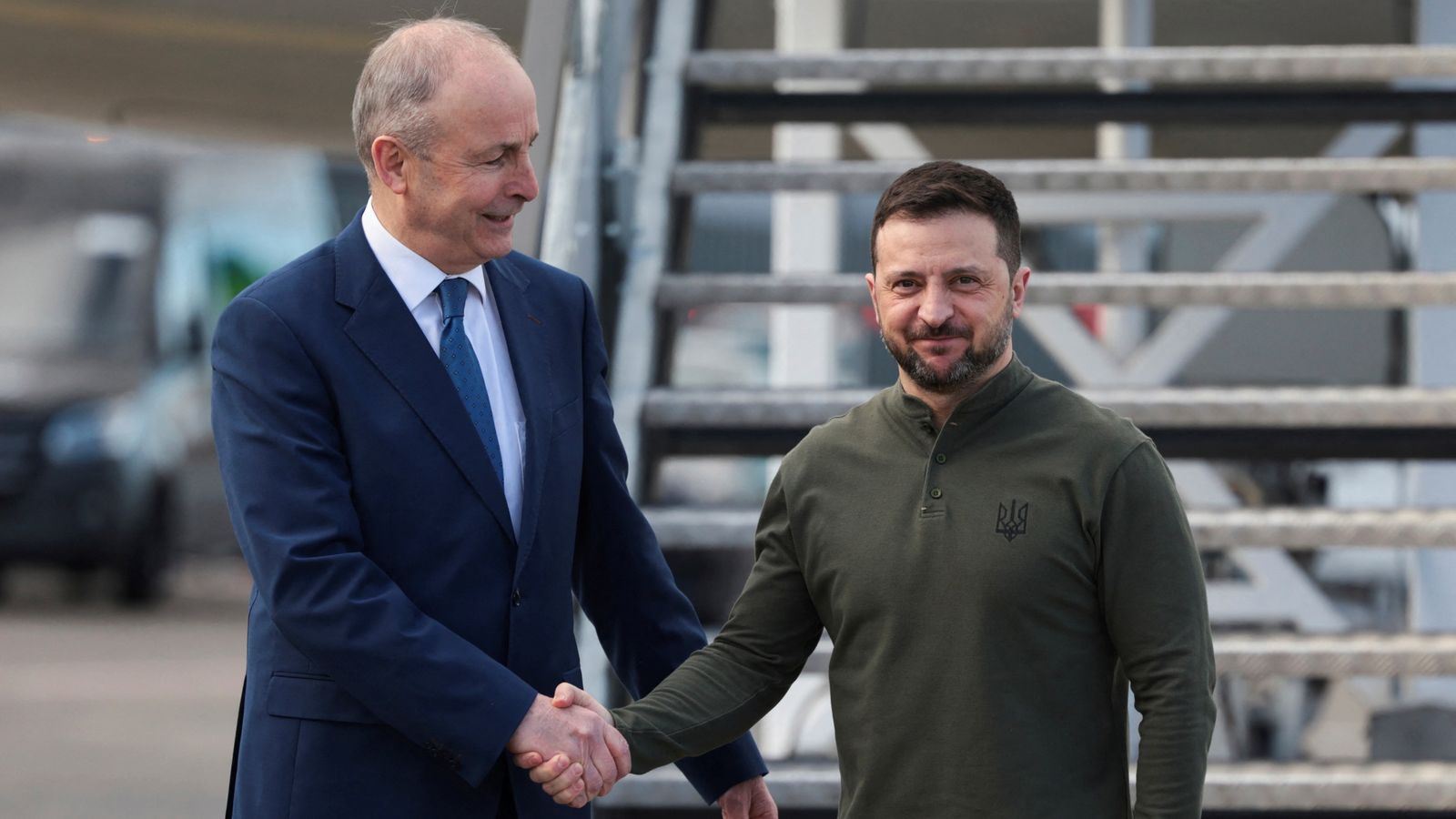

Volodymyr Zelenskyy is set to make his first official visit to Ireland tomorrow, Taoiseach Micheal Martin has revealed.
The Ukrainian president will be accompanied by First Lady Olena Zelenska and meet Mr Martin, president Catherine Connolly and foreign minister Helen McEntee.
Mr Martin said he and Mr Zelenskyy would be holding a bilateral meeting, as well as attending the inauguration of the Ireland-Ukraine Economic Forum, which he said “offers an opportunity to explore the potential for strengthened business-to-business, trade and investment links between Ireland and Ukraine”.
Micheal Martin greets Volodymyr Zelenskyy as he briefly stops in Ireland on way to the US in February. Pic: Reuters
Speaking ahead of the visit, the Taoiseach said: “It is an honour to welcome President Zelenskyy and the First Lady to Ireland.
“Around the world, he is rightly recognised as someone who embodies the courage and resilience of the Ukrainian people, who have inspired the world in their brave defence of their country and its sovereignty since it was brutally and illegally invaded by Russia.
“I have met with President Zelenskyy many times, including in Kyiv, but I particularly look forward to greeting him on this first official visit of a Ukrainian president to Ireland.”
Ireland has been a staunch ally of Ukraine’s since Russia began its invasion in 2022, offering some 120,000 Ukrainians a safe haven.
US-Ukraine talks begin in Florida
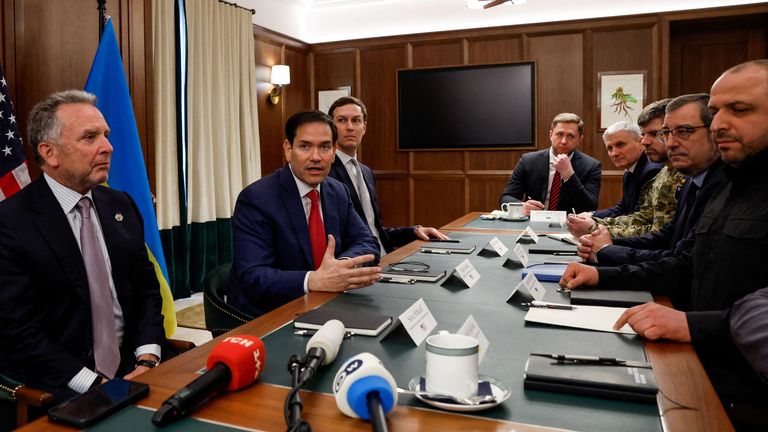
The Ireland announcement comes after Mr Zelenskyy’s top team engaged in peace talks with the US for several hours in Florida on Sunday.
The US-Ukraine talks were quickly organised after Donald Trump released a 28-point proposal that was largely seen to be favouring Russia, having been developed in earlier negotiations between Washington and Moscow.
The plan would have imposed limits on the size of Ukraine’s military, blocked Ukraine from joining NATO and required it to hold elections in 100 days. It also initially envisioned Ukraine ceding the entire eastern region of the Donbas to Russia.
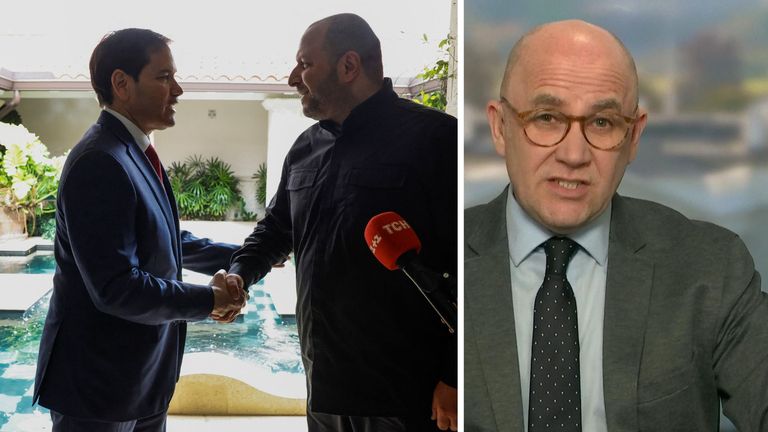
Sky’s US correspondent David Blevins analyses what’s at state this week
Read more:
Who is Steve Witkoff, the property mogul seeking a peace deal?
Go behind the scenes on the frontline with new-look Sky News show
It isn’t clear what changes have been made so far, but US secretary of state Marco Rubio has reassured Ukraine over the plans.
“This is not just about ending a war. This is about ending a war in a way that creates a mechanism and a way forward that will allow them to be independent and sovereign, never have another war again, and create tremendous prosperity for its people,” he said.
“Not just rebuild the country, but to enter an era of extraordinary economic progress.”
He added: “This is not just about peace deals. It’s about creating a pathway forward that leaves Ukraine sovereign, independent and prosperous. We expect to make even more progress today.”
Rustem Umerov, head of Ukraine’s security council, responded by saying the US was “hearing”, “supporting” and “working beside” Ukraine.
Mr Zelenskyy’s team in the US was without his former chief of staff and lead negotiator, Andrii Yermak, as he quit on Friday after officials raided his home amid a corruption scandal.
After the meeting, Mr Rubio said the talks had been “productive”, but more work remained to be done.
On X, Mr Zelenskyy said: “I am grateful to the United States, to President Trump’s team, and to the President personally for the time that is being invested so intensively in defining the steps to end the war. We will continue working. I look forward to receiving a full report from our team during a personal meeting.”
Later this week, Mr Trump’s special envoy Steve Witkoff is set to travel to Moscow to continue talks with the Kremlin.
‘Ukrainians have a delicate job’
Sustained Russian aerial assaults over the weekend
While peace talks ensued, Russian forces launched overnight attacks in and around Kyiv over the weekend, killing at least seven people and injuring dozens more.
Impacts were also reported in the regions of Dnipro, Kharkiv, Odesa, Sumy and Kherson.
Mr Zelenskyy said: “Such attacks occur daily. This week alone, Russians have used nearly 1,400 strike drones, 1,100 guided aerial bombs and 66 missiles against our people. That is why we must strengthen Ukraine’s resilience every day.”
The attacks also hit Ukrainian energy facilities and left hundreds of thousands without power in the capital. Supplies have since been restored.
Targeting such infrastructure has become a familiar tactic from Russia over the winter, in what Ukraine officials say is the “weaponising” of the cold.

Moment Ukraine strikes Russian ‘shadow fleet’ ships
Ukraine launched its own drones at two of Russia’s so-called “shadow fleet” oil tankers in the Black Sea on Friday, and claimed responsibility for damaging a major oil terminal on Saturday near the Russian port of Novorossiysk.
The terminal is owned by the Caspian Pipeline Consortium, which includes Russian, Kazakh and US shareholders.
Subsequently, on Sunday, Kazakhstan’s foreign ministry said it viewed Ukraine’s attack as “an action harming the bilateral relations of the Republic of Kazakhstan and Ukraine”, adding it expected Ukraine to “take effective measures to prevent similar incidents in the future”.
Ukraine’s foreign ministry said the country’s actions were not directed against Kazakhstan or third parties and were only aimed at repelling what it called “full-scale Russian aggression”.
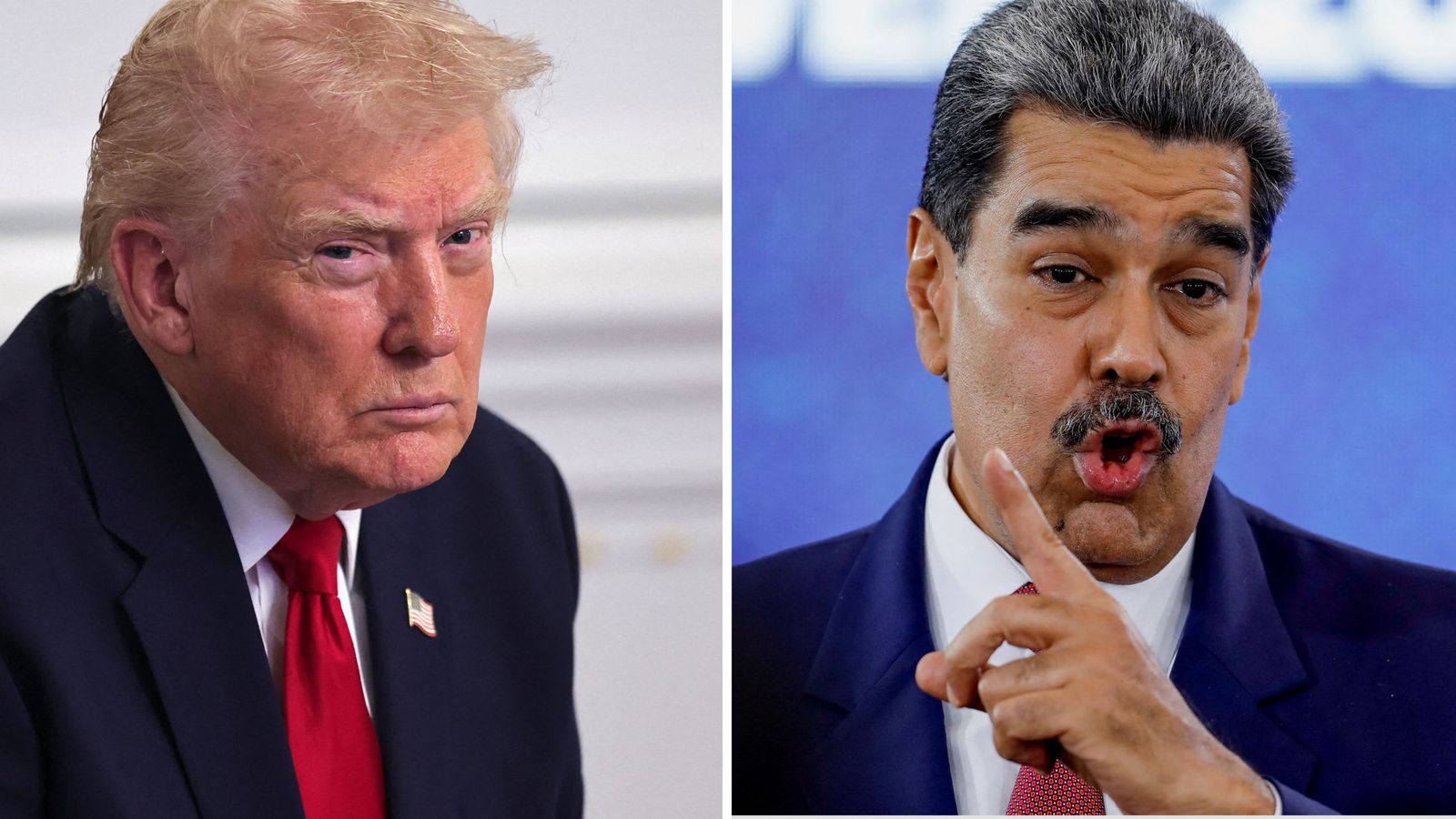
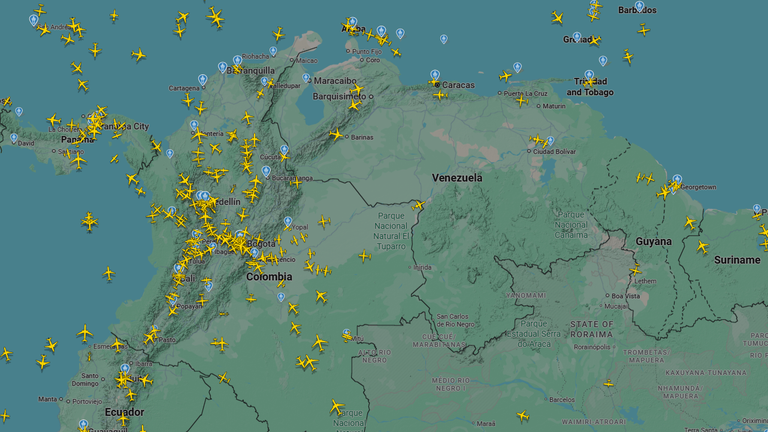
Venezuela has accused Donald Trump of making a “colonial threat,” after the US president said the airspace “above and surrounding” the country should be considered closed “in its entirety”.
Mr Trump made the declaration amid growing tensions with president Nicolas Maduro – and as the US continues attacking boats it claims are carrying drugs from Venezuela.
He wrote on Truth Social: “To all Airlines, Pilots, Drug Dealers, and Human Traffickers, please consider THE AIRSPACE ABOVE AND SURROUNDING VENEZUELA TO BE CLOSED IN ITS ENTIRETY.”
Air traffic above Venezuela on Saturday afternoon. Pic: FlightRadar24
Venezuela’s foreign affairs office called it a “colonial threat” and “illegal, and unjustified aggression,” and accused the president of threatening “the sovereignty of the national airspace… and the full sovereignty of the Venezuelan state”.
It added that Mr Trump’s words were part of a “permanent policy of aggression against our country” that breached international law and the UN Charter.
The Pentagon and the White House have so far not given any additional detail on the president’s statement, but it marks the latest escalation in tensions between the North and South American countries
Last week, the American aviation regulator warned of a “potentially hazardous situation” over Venezuela due to a “worsening security situation”.
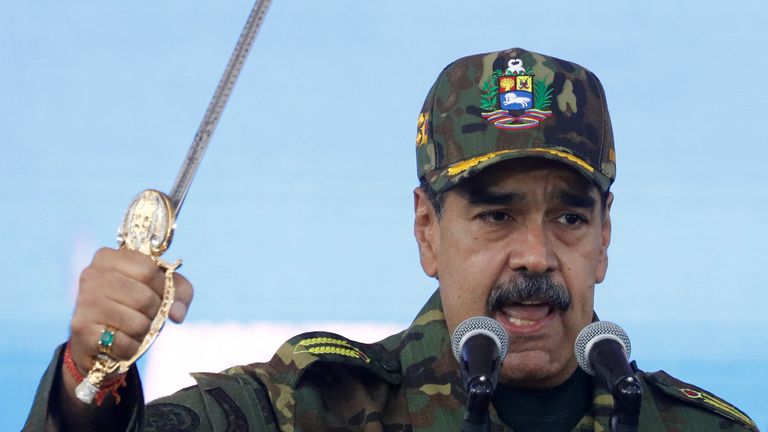
Nicolas Maduro is widely considered a dictator by the West. Pic: Reuters
Venezuela then revoked operating rights for six major airlines, which went on to suspend flights to the country.
Mr Trump warned a few days ago that land operations against alleged Venezuelan drug traffickers would begin “very soon”.
Such a move would be a major escalation in Operation Southern Spear – the US naval deployment in the Caribbean Sea and eastern Pacific that has so far attacked at least 21 vessels.

Three killed as US strikes another alleged drug boat
Venezuela has said the attacks, which have killed more than 80 people, amount to murder.
The US has released videos of boats being targeted, but hasn’t provided evidence – such as photos of their cargo – to support the smuggling claims.
Read more:
Trump may have another motive in war on drugs
The US-Venezuela crisis explained

Venezuela claims Trump creating ‘fables’ to justify ‘war’
The Pentagon has sought to justify the strikes by labelling the drug gangs as “foreign terrorist organisations” – putting them on par with the likes of al Qaeda.
It claims the boats targeted are carrying drugs bound for the US, although Sky’s chief correspondent says the final destination is likely to be Europe and West Africa.
The US is also offering a reward of $50m for the arrest of the Venezuelan president, who has been indicted in American courts on federal charges of narco-terrorism and conspiracy to import cocaine.
Mr Maduro has denied Mr Trump’s claims that he is involved in the drugs trade himself and said his counterpart wants to oust him so he can install a more sympathetic government.
Venezuelan officials have also claimed Mr Trump’s true motivation is access to the country’s plentiful oil reserves.
Mr Maduro, who has been president since 2013, has been accused of being a dictator who has cheated in elections.
UK
UK special forces unit had ‘deliberate policy’ to ‘kill fighting-aged males’ in Afghanistan, inquiry told
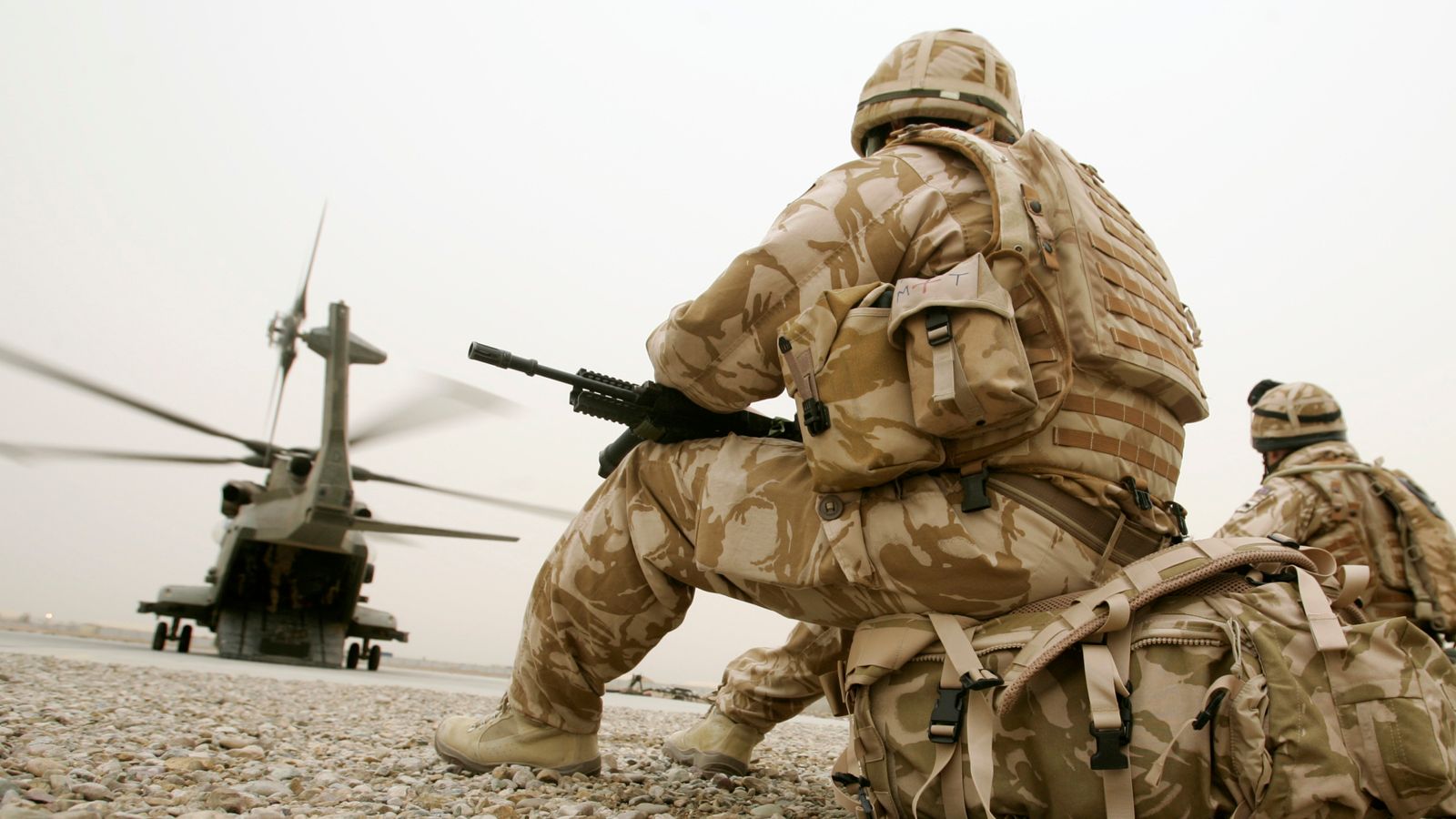
There was a “deliberate policy” to “kill fighting-aged males… even when they did not pose a threat” among some members of a British special forces unit in Afghanistan, an inquiry has heard.
In a note dated 7 April 2011, a senior officer warned the director of UK special forces about the policy, sharing concerns from the unit’s commanding officer.
But the senior officer, codenamed N1466, said a “conscious decision” was made to cover up potential war crimes by the unit, dubbed UKSF1.
British soldiers in Afghanistan in 2010. File pic: Reuters
The document was released by the Afghanistan Inquiry after evidence was given in closed hearings by UK special forces members.
In the note, N1466 – who was assistant chief of staff for operations in UKSF headquarters – described what he’d heard from the unit’s commanding officer.
“He felt that this was… possibly a deliberate policy among the current (sub-unit) to engage and kill fighting-aged males on target even when they did not pose a threat,” the note read.
“He had been approached by some of his men who recounted separate conversations with (trained) members of UKSF1 in which such suggestions had been made.”
The note explained that the unit’s commanding officer “is sure that they are accurately reporting what they are hearing from colleagues”.
And while N1466 conceded that the allegation could be simply a “rumour” or a “wind up”, he said “the context would not support either assertion”.
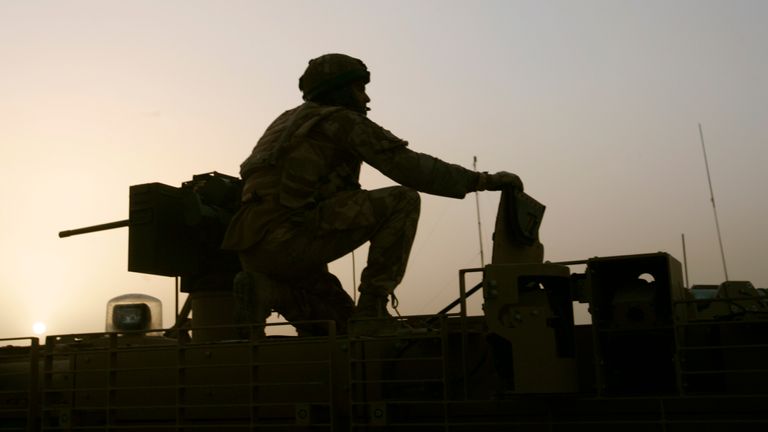
A British soldier in Lashkar Gah, Afghanistan, in 2010. File pic: Reuters
‘Rumour could prove explosive’
He continued: “The very fact that this rumour is circulating is in itself distasteful and in my view unacceptable to UKSF ethos and UKSF dynamics – it could prove explosive.
“Clearly, if there is anything more than rumour behind it then elements of UKSF have strayed into indefensible ethical and legal behaviour.”
He concluded: “My instinct is that this merits deeper investigation.”
However, the director, known to the inquiry as N1802, made a “conscious decision” to cover up potential war crimes, N1466 claimed.
The senior officer further accused the director of controlling information about alleged murders “in a way that I think indicated a desire to keep it low profile”.
N1466 said he became concerned that data from deliberate detention operations (DDOs), including the number of weapons found compared with the number of enemies killed, “didn’t seem credible”.
Soldiers in Afghanistan. Pic: iStock
Read more:
Ex-police chief condemns Afghanistan ‘war crimes’ probe
Ex-veterans minister gives Afghan killings inquiry ‘further information.’
The director shared his view, he believed, but chose to handle the information in a “way which limited the spread of the damage outside the headquarters”.
N1802 failed to “ever talk about possible criminal activity”, the officer alleged, instead initiating a review of the tactics, techniques and procedures (TTPs) used by the sub-unit in question in April 2011.
Review ‘was a charade’
In his witness statement, the officer recalled feeling that the TTP review was intended as a “warning shot across the bows” of the unit.
But, he said, “it was obvious that it was a charade”.
“I was sure at the time and I remain sure that N1802 knew what was happening on the ground,” he said.
“The speed of N1802’s response and the absence of any further mention or investigation of unlawful activity only fortified my belief that he was aware of what was going on.”
Among the documents released by the inquiry was a summary of an interview between N1466 and the Royal Military Police (RMP) in October 2018.
During the exchange, the officer described an incident where members of UKSF1 went to clear a compound and found a room where people were hiding under a mosquito net.
Claims incident was ‘covered up’
The document read: “They did not reveal themselves, so the UKSF1 shot at the net until there was no movement.
“When the net was uncovered it was women and children.
“The incident was covered up and the individual who did the shooting was allegedly given some form of award to make it look legitimate.”
N1466 also told the inquiry why he was speaking out, saying “it’s not loyalty to your organisation to stand by and to watch it go down a sewer”.
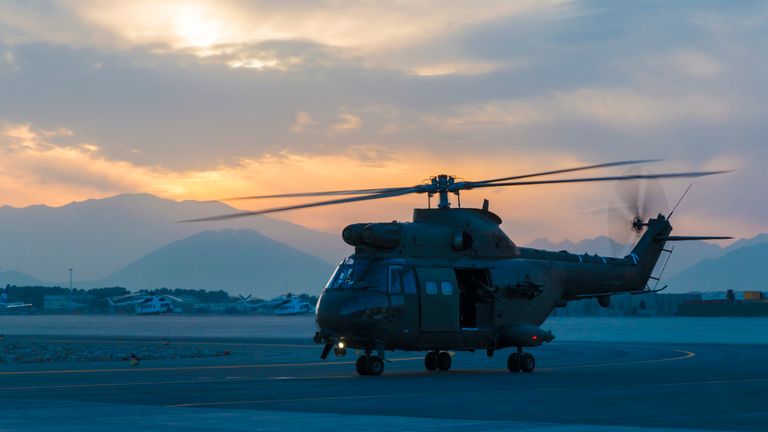
A British Puma military helicopter taxiing at dusk in Afghanistan. File pic: iStock
In his remarks, he referred to the alleged 2012 shooting of two children – Imran and Bilal, sons of Hussain Uzbakzai and his wife Ruqquia Haleem – who were in their beds.
He said: “I know a lot of my colleagues… didn’t join UKSF for this sort of behaviour, you know, toddlers to get shot in their beds or random killing.
“It’s not special, it’s not elite, it’s not what we stand for and most of us I don’t believe would either wish to condone it or to cover it up.”
He added: “Even if you subscribe to some sort of idea that most of the people who were killed were Taliban fighters, which I do not… Imran and Bilal, at one-and-a-half and three, certainly were not.”
Concluding, he said: “UKSF units, not least UKSF1, stand out for their proud history; the courageous and extraordinary feats made by truly remarkable people.
“The activity that we have discussed in the last few days does not fit with that and somehow the amount of kills and the amount of trigger time have become the metric by which people judge themselves.”
Afghan families claim UKSF conducted a “campaign of murder” against civilians, and that senior officers and personnel at the Ministry of Defence (MoD) “sought to prevent adequate investigation”.
Operation Northmoor, a £10m investigation set up in 2014 to examine allegations of executions by special forces, including those of children, resulted in no prosecutions.
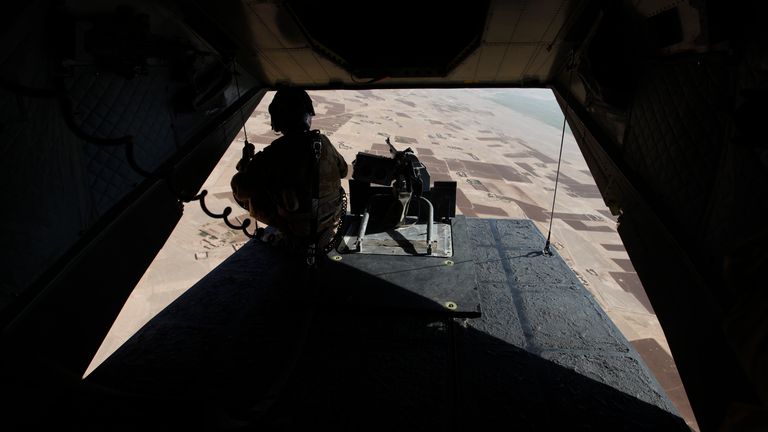
The view from inside a British helicopter flying over Helmand province in Afghanistan in 2010. File pic: Reuters
A RMP investigation, dubbed Operation Cestro, resulted in three soldiers being referred to the Service Prosecuting Authority, but again, none of them were prosecuted.
An MoD spokesperson said: “The government is fully committed to supporting the independent inquiry relating to Afghanistan as it continues its work, and we are hugely grateful to all former and current defence employees who have so far given evidence.
“We also remain committed to providing the support that our special forces deserve, whilst maintaining the transparency and accountability that the British people rightly expect from their armed forces.
“It is appropriate that we await the outcome of the inquiry’s work before commenting further.”
The inquiry continues.
-
 Sports2 years ago
Story injured on diving stop, exits Red Sox game
-
 Sports3 years ago
‘Storybook stuff’: Inside the night Bryce Harper sent the Phillies to the World Series
-
 Sports2 years ago
Game 1 of WS least-watched in recorded history
-
 Sports3 years ago
Button battles heat exhaustion in NASCAR debut
-
 Sports3 years ago
MLB Rank 2023: Ranking baseball’s top 100 players
-
Sports4 years ago
Team Europe easily wins 4th straight Laver Cup
-
 Environment3 years ago
Japan and South Korea have a lot at stake in a free and open South China Sea
-
 Environment1 year ago
Here are the best electric bikes you can buy at every price level in October 2024