
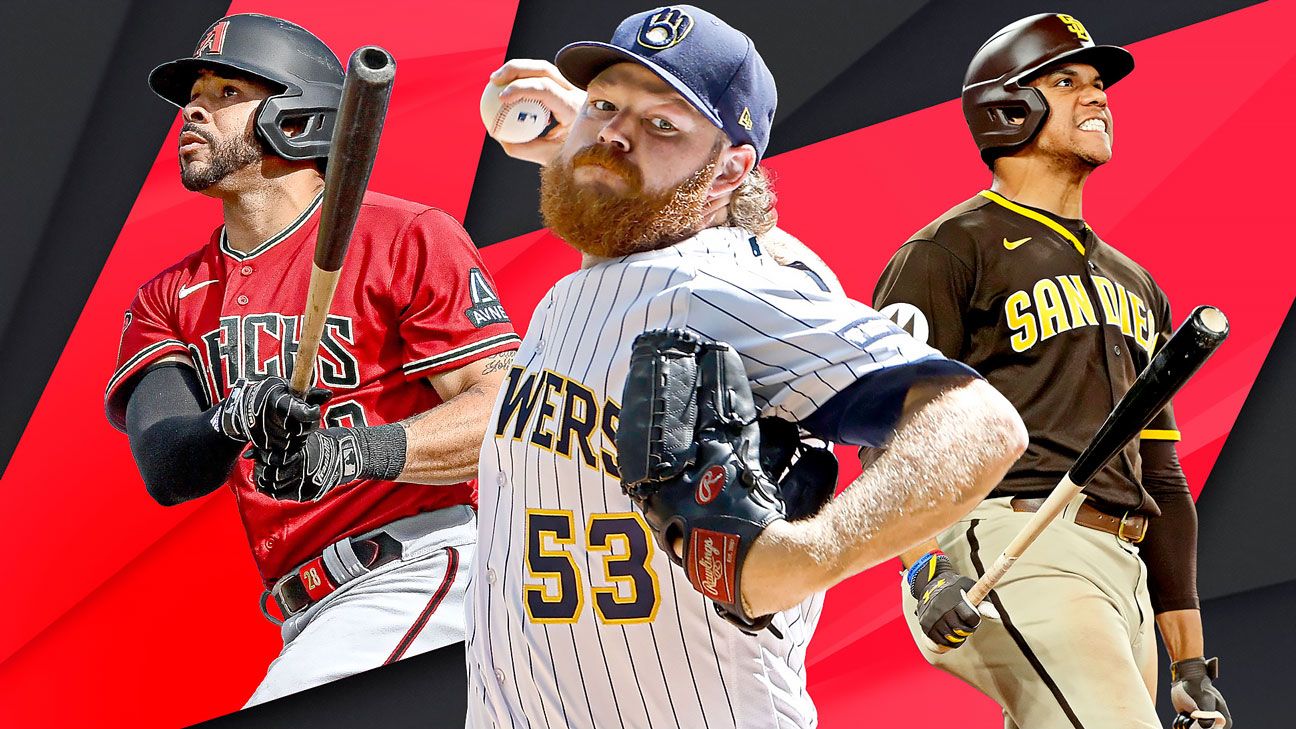
MLB Power Rankings: AL, NL wild-card teams locked in battle


The Braves are in. The Dodgers are in. The Rays and Orioles are in — and the Brewers and Twins aren’t far behind. Welcome to the stretch run!
With a week and a half left in the season, these teams have locked up their spots in the playoffs — but others still have a lot to play for.
Which of the three AL West teams vying for the division title will come out on top? And which of the five teams battling for a National League wild card — the Diamondbacks, Cubs, Marlins, Reds and Giants — will secure the remaining two slots?
Our expert panel has combined to rank every team in baseball based on a combination of what we’ve seen so far and what we already knew going into the 162-game marathon that is a full baseball season. We also asked ESPN MLB experts David Schoenfield, Bradford Doolittle, Jesse Rogers and Alden Gonzalez to weigh in with an observation for all 30 teams.
Week 24 | Second-half preview | Preseason rankings
Record: 97-55
Previous ranking: 1
That ugly sweep to the Marlins after clinching the division title has put the best overall record in jeopardy for the Braves as the Orioles are now breathing down their necks — although, with seven of their final 10 games against the Nationals, the Braves should be able to hold on. With an 11-strikeout performance in a win over the Phillies on Tuesday, Spencer Strider is up to 270 strikeouts, just six short of John Smoltz’s franchise record set in his Cy Young season of 1996. Strider’s 37.9% strikeout percentage is the second highest ever for a starter in a full season, behind only Gerrit Cole’s 39.9% in 2019. — Schoenfield

Record: 95-57
Previous ranking: 2
Manager Brandon Hyde told reporters this week that Jack Flaherty is being shifted to a bullpen role. The switch isn’t necessarily permanent, but even if it’s only a one- or two-game experiment, it’s one worth conducting. With John Means back in the rotation and looking solid, Baltimore has five viable starters, one more than it’ll need in a postseason context. Flaherty has a 6.68 ERA since joining Baltimore at the trade deadline and just wasn’t getting deep enough into games. He has made just five relief appearances in his career, so there isn’t much to go on in terms of his track record in that role. His 1.017 OPS allowed this season in first innings isn’t a great sign, but perhaps his stuff will play up as a reliever. Flaherty’s maximum velocity this season (97.2 mph) ranks in the 78th percentile among qualifying big league hurlers. — Doolittle

Record: 93-58
Previous ranking: 3
The Dodgers won their 90th game and clinched the NL West on Saturday, with 15 games remaining in their regular season. Their focus has since shifted to the playoffs, where their short-handed starting rotation could present problems. But let’s not jump there without appreciating what the Dodgers just did. This, if you remember, was supposed to be a transition year. They took a conservative approach to the offseason in order to create a runway for some of their younger players, and yet they breezed to their 10th division title in 11 years. Their bullpen had the fifth-worst ERA in the majors by the end of June, their rotation has been decimated by injuries all year — in addition to Julio Urias being placed on administrative leave in the wake of domestic violence charges — and yet the Dodgers just keep rolling. It’s truly remarkable. — Gonzalez

Record: 93-60
Previous ranking: 4
The four-game split with Baltimore last week had to register as a letdown in St. Petersburg after Tampa Bay won the first two games of the series. The split leaves the Rays still needing to make up sizable ground in the division race, the winner of which is likely to be the American League’s top seed in the playoffs. Besides the small problem of the Orioles continuing to play championship-caliber baseball is the disparity in remaining schedules. Sandwiched around two games at Fenway Park is a pair of three-game series against a very good Blue Jays team fighting for its postseason life. Meanwhile, the O’s have a four-game set at Cleveland before finishing up with six home contests against last-place teams: Washington and Boston. — Doolittle

Record: 85-68
Previous ranking: 5
Just two weeks ago, Houston manhandled division rival Texas to the tune of 39-10 over three games. The Astros vaulted into the AL West lead during that throttling for the first time this season. With their main weapons back on the field, it very much looked like Houston was situated for a stout defense of its World Series crown. Instead, the Astros have since played sub-.500 baseball and find themselves not just in a no-room-for-error three-team race for the division title, but just one short losing streak away from dropping out of the playoffs altogether. Meanwhile, manager Dusty Baker opted to give Yordan Alvarez a break, saying he didn’t like the way the star slugger looked at the plate or moving on the field. However it shakes out, the Astros’ stretch run looks more interesting than we would have anticipated. — Doolittle

Record: 86-66
Previous ranking: 6
The Brewers are close to securing another division title and playoff spot under manager Craig Counsell as they seem to be peaking at the right time, especially on the mound. Their pitching ranked near the top of the majors in ERA last week — they’ve given up five or more runs just once in their past 12 games. Brandon Woodruff has continued his solid return from injury, compiling a 1.06 ERA over his past five starts that included a complete game shutout followed up by a six-inning stint where he gave up just one run against the Nationals. If Rowdy Tellez and/or Carlos Santana (as a lefty) can get hot next month, Milwaukee could be a dangerous playoff team. — Rogers

Record: 83-69
Previous ranking: 8
The Phillies haven’t won three games in a row since late August as they struggle to officially secure that top wild-card spot. Michael Lorenzen has pitched himself out of the rotation and into the bullpen, so once the Phillies do lock up a playoff spot, it will be fascinating to see who manager Rob Thomson lines up as the next two starters behind Zack Wheeler in a wild-card series. Ranger Suarez has been the best of the rest of late with a 2.86 ERA over his past six starts, although the walk rate has been a little high (16 in 34 2/3 innings). Meanwhile, Kyle Schwarber is up to 45 home runs, following up last year’s 46-homer season. He’s the first player with consecutive 45-homer seasons since Ryan Howard did it with the Phillies in four consecutive seasons from 2006 to 2009. — Schoenfield

Record: 85-67
Previous ranking: 7
With Toronto one of four teams — along with Texas, Houston and Seattle — fighting for three AL playoff berths, it’s easy to fixate on the Jays’ remaining slate, which isn’t an easy one. Toronto’s stretch run consists entirely of AL East rivals: the Yankees and Rays. Both opponents have plenty to play for, with the Rays angling for a division crown and the Yankees trying to extend their epic streak of non-losing seasons. Perhaps more important than the schedule for Toronto is simply trying to figure out what this Jays team is about. Just this month, it has had three winning streaks of at least three games, but the Jays were also swept at home in a crucial four-game series against Texas. So more pertinent than the opponents down the stretch is the question: Which Jays team is going to show up for the most important games of the season? — Doolittle

Record: 84-68
Previous ranking: 10
A streaky second half continued for the Rangers last week as they swept the Blue Jays in a crucial four-game series in Toronto only to lose the next four, including a sweep at the hands of the below-.500 Guardians. Texas’ offense dried up in that series, scoring just six runs over the three games. Mitch Garver had the roughest week — going just 3-for-24 — while Corey Seager wasn’t much better, hitting just .217 over a seven-day span ending on Tuesday. The good news for Texas came in the return of Adolis Garcia from injury. He was out less than two weeks and now is ready for the stretch run — and this up-and-down offense needs him. Now, if their bullpen can lock in, the Rangers might have a chance. Otherwise, it’ll be a long offseason. — Rogers

Record: 84-68
Previous ranking: 9
Let’s give a big shoutout to J.P. Crawford, who has had an outstanding offensive season. Thanks to a .378 OBP and 50 extra-base hits, Crawford ranks seventh in the AL in offensive WAR. (Offensive WAR includes a positional adjustment, so it doesn’t mean Crawford has been the fifth-best hitter; he’s not in the top 10 in runs created, although he does rank right outside the top 10 in OPS+). Crawford has added more power, pulling the ball with authority much more often, but he works the strike zone better than any Mariners hitter in a long time with 88 walks and a low chase rate. — Schoenfield

Record: 81-72
Previous ranking: 12
As the Twins turn their attention to ending their record 18-game postseason losing streak, it’s a mystery what their postseason lineup might look like. Byron Buxton’s injuries are an old story, but it’s still possible he could be patrolling center field in October. Carlos Correa, meanwhile, hit the IL because of a worsening case of plantar fasciitis. He, too, might be back in time for the playoffs. Finally, breakout third baseman Royce Lewis turned up with a hamstring problem and is headed for an MRI to determine the extent of the issue. All of these players are now suspended in postseason limbo. Needless to say, Minnesota’s chances of finally getting a playoff win look a whole lot better with this trio than without it. — Doolittle

Record: 81-72
Previous ranking: 13
The way the D-backs navigated through last week served as a perfect encapsulation of how wacky and unpredictable the wild-card races have been this year. They lost three straight to the lowly Mets, with the Cubs on tap, set to match up the top of their rotation against the back end of Arizona’s. It seemed as if the D-backs were destined to fade down the stretch. Instead, they swept the Cubs over the weekend, vaulting into the second wild-card spot.
“We’re trying to win out,” D-backs first baseman Christian Walker said after Sunday’s game. “We want to give ourselves a no-doubt chance, and we understand how hard it is and how quickly things change.” Do they ever. — Gonzalez

Record: 79-73
Previous ranking: 11
A 1-5 road trip crushed the Cubs’ chances of winning the division or hosting a wild-card series, but they’re still in decent position to make the postseason. Cody Bellinger’s slump has coincided with the team’s issues scoring runs. He has slugged just .308 over a recent 10-game span in which the Cubs went 2-8. A weekend series sweep by fellow NL wild-card contender Arizona really hurt, too, as the Cubs lost all three games while pitching their top two starters and the Diamondbacks were missing both Zac Gallen and Merrill Kelly. Marcus Stroman has returned from a rib cartilage injury and will pitch out of the bullpen. With Michael Fulmer and closer Adbert Alzolay on the IL, Stroman could get some meaningful innings down the stretch. — Rogers

Record: 79-74
Previous ranking: 16
A weekend demolition of the Braves kept the Marlins in the thick of the wild-card race. They scored 36 runs in the three-game sweep as Jazz Chisholm became the first Marlins player with grand slams in consecutive games and Luis Arraez ripped out eight hits, including three home runs. With an off-day on Thursday and another one on Monday, the Marlins will also be able to bypass a couple of starts from the bottom of the rotation, and a concluding six-game road trip against the Mets and Pirates isn’t the toughest of final weeks. Miami has a good shot at its first full-season playoff berth since 2003. — Schoenfield

Record: 79-75
Previous ranking: 14
The Reds are hanging around the playoff race and could make a push in the final week, considering their final eight games come against teams below .500. However, they haven’t had a late-season defining stretch just yet. After getting swept by the Cardinals recently, they won their next two series and took Game 1 against the Twins on Monday before losing on Tuesday and Wednesday. It’s been that kind of back-and-forth for them for quite some time. The team’s waiver claims haven’t exactly panned out, either, as Harrison Bader is on the IL and Hunter Renfroe was DFA’d this week. Bader hit .161 over 14 games for the Reds, who will have to rely on their young players to reach the postseason. The return of Matt McLain from an oblique injury will help. — Rogers

Record: 76-76
Previous ranking: 18
Spoilers is not a role that you’d traditionally associate with the Yankees, but that’s where they’re at. New York’s homestretch includes a number of games against teams engaged in close battles to get into the postseason — Arizona and AL East rival Toronto. When you tack on the Yankees’ quest to avoid their first losing record since 1992, New York’s remaining schedule will have a little drama around it. The quest for .500 is likely to come down to the final weekend when the Bombers finish their season with a three-game series against the triple-digit-losing Royals. It’s not likely to conjure old memories of George Brett against Goose Gossage but, hey, you never know. — Doolittle

Record: 76-76
Previous ranking: 15
The Giants lost for the 11th time this month on Tuesday night, but the biggest blow occurred in the third inning, when Alex Cobb exited with discomfort in his hip. The next day, he was placed on the IL, essentially ending his season. The regular season, at least. Cobb has put up a 3.87 ERA in 151 1/3 innings this year, joining Logan Webb as the only reliable, consistent starters in the Giants’ staff. On the night he went down, the Giants dropped to three games out of the final wild-card spot with three teams in front of them. Their path just got a lot more difficult. — Gonzalez

Record: 75-78
Previous ranking: 17
With Triston Casas joining Jarren Duran on the IL, and Boston searching for its next roster architect, it’s hard to look at the current Red Sox group with an eye toward the future. One player who will be there going forward is Masataka Yoshida, who’s wrapping up his first MLB campaign. He has mostly been as advertised, which is a tepid observation. He has hit for a decent average but displayed limited patience and only occasional power. It’s an overall above-average hitting profile. The problem is that Yoshida can’t run and that limits his value in the field and on the bases. The bottom line: He’s at just 1.0 bWAR as the season winds down. — Doolittle

Record: 75-78
Previous ranking: 19
With a 10-1 rout over the lowly A’s on Sunday, the Padres became the last team in the majors to win a fourth consecutive game. They proceeded to win their next three, running their winning streak to seven games and counting, which begs the question: Where was this earlier? Recent surge aside, the Padres find themselves 4 1/2 games out of a playoff spot with four teams to jump and only nine games remaining in their season. They could make this really, really interesting if they win out, but in all likelihood this will end up as one final tease before the conclusion of a thoroughly disappointing season. Yu Darvish and Joe Musgrove have been shut down, Manny Machado has been relegated to DH duties because of a balky elbow, and the Padres, helped by a soft schedule at the end, are probably too late. — Gonzalez

Record: 72-81
Previous ranking: 20
Cleveland outfielders have combined for 18 home runs — more than 20 fewer than any other team — after hitting 28 last season (which wasn’t the lowest in the majors; Tigers outfielders hit 23). The last outfield with fewer than 20 home runs: the 1992 White Sox, featuring Tim Raines and Lance Johnson, who hit 19. The 1989 Astros hit 18, and the last team with fewer than 18 was the 1976 White Sox with 17. This blurb has been brought to you by Cleveland Public Power. — Schoenfield

Record: 71-81
Previous ranking: 22
One Tiger who wishes the season wasn’t going to end for Detroit in a couple of weeks is second-year slugger Spencer Torkelson — the former top overall pick is building the most sustained momentum of his young career. Since the All-Star break, Torkelson has hit .237/.319/.509 with 17 homers in 62 games. The pace has picked up even more in September, during which he’s at .265/.320/.544. Since the trade deadline, Torkelson’s OPS ranks in the top 30 of the majors. Going forward, one split you’d like to see ironed out in Torkelson’s profile is his awkward home/road disparity. So far as a big leaguer, Torkelson has a .790 road OPS but just .604 at Comerica Park where, you know, he plays half his games. — Doolittle

Record: 71-81
Previous ranking: 23
For all New York’s disappointing results this season, Kodai Senga has been one of the few Mets who has matched expectations — if not exceeded them. With a 2.95 ERA and 191 strikeouts in 155 1/3 innings, he’ll get some down-ballot Cy Young votes. Coming over from Japan, where pitchers normally start once per week, he was handled carefully by the Mets, as he has made just three starts on four days of rest. The ghost forkball has been as advertised and rates as one of the best wipeout pitches in MLB, as batters have hit .112 against it with no home runs and 104 strikeouts in 177 PAs that end with that pitch (through Tuesday). — Schoenfield

Record: 69-83
Previous ranking: 21
On Friday afternoon, Anthony Rendon revealed he has been dealing with a tibia fracture, a diagnosis — from a fifth doctor of his own choosing — that ran in contrast with the Angels’ description of a deep bone bruise over these past two months. Later that night, media returned to the clubhouse to find that Shohei Ohtani’s locker had been cleared out, the product, we learned the following day, of him shutting it down as a hitter and shifting his focus to elbow surgery. Mike Trout, meanwhile, is running out of time in his hopes of returning from the hamate fracture he suffered in early July.
The Angels are a mess of epic proportions, as illustrated by the state of their best players. Ohtani is heading toward free agency, Trout has struggled mightily to stay healthy these past three years, and Rendon’s contract, with $114 million remaining over the next three years, feels untenable. The Angels, meanwhile, have secured their eighth consecutive losing season, the longest streak in franchise history. — Gonzalez

Record: 71-81
Previous ranking: 24
The Pirates have not mailed it in down the stretch. After beating the Nationals three straight times last week, they played the Yankees tough in a series loss, getting outscored only 15-10 over the three games. They’ve pitched well over that timeframe, compiling an ERA just under 4.00 for the week ending on Tuesday. Once again, it was righty Mitch Keller leading the way. He tossed eight shutout innings in a 2-0 win against the Nats. It came after a blowup against the vaunted Braves offense. Take that game away and, much like the whole year, Keller has been fantastic in the final weeks of the season. He’s the unquestioned ace of the team moving forward. — Rogers

Record: 67-85
Previous ranking: 25
Adam Wainwright’s 200th win was a thing of beauty. He made it through seven innings on Monday while giving up four hits and two walks in a tight affair with the Brewers. Nursing a 1-0 lead most of the way, his curveball showed its old life, especially in the later innings when it looked like the veteran would not be denied. In the process, he surpassed 100 innings on the season over 21 starts. The 41-year-old is retiring after compiling a 7.40 ERA in 2023, but he’ll have his last outing in St. Louis as a lasting memory: a 1-0 win to secure No. 200. — Rogers

Record: 68-85
Previous ranking: 26
Jackson Rutledge, the 6-foot-8 right-hander who was the team’s first-round pick in 2019, had an up-and-down career in the minors with injuries and inconsistent results. After posting a 3.71 ERA between Double-A and Triple-A, the Nationals are giving him a look down the stretch. His MLB debut was rough as he allowed 10 hits and seven runs in 3 2/3 innings, but he bounced back against the White Sox, allowing two runs (both home runs) in 6 1/3 innings. His fastball has averaged 95 mph, but he’ll need to improve the changeup to give him another off-speed weapon. Batters are 8-for-16 against it with two home runs. He’s probably more of a deep rotation option for next season. — Schoenfield

Record: 58-95
Previous ranking: 27
Surprisingly, Mike Clevinger has been the team’s second most valuable — and consistent — player after Luis Robert Jr. His latest start was his best as he pitched a complete game against the Nationals on Monday, coming within one out of a shutout. It was the White Sox’s first complete game of the season and Clevinger’s third of his career. His 3.42 ERA over 22 starts would rank seventh in the AL if not for an early-season injury that prevents him from qualifying. He and the team have a mutual option for next season, but Clevinger isn’t likely to exercise his end of it. In a miserable season in Chicago, he has been very good. — Rogers

Record: 56-96
Previous ranking: 28
The Rockies are barreling toward their first 100-loss season in franchise history, but there has been one very clear bright spot lately — Nolan Jones, the rookie outfielder acquired in a swap of young position players with the Guardians last November, has slashed .286/.374/.524 in 96 games since his call-up in late May, hitting 17 home runs and stealing 17 bases. He’s the first rookie in franchise history to accumulate at least 15 homers and 15 steals in the same season, and he has a shot at 20/20 despite spending most of the first two months in the minor leagues. Two Mondays ago, he also recorded the fastest outfield assist of 2023. — Gonzalez

Record: 51-102
Previous ranking: 29
With Salvador Perez suffering a concussion and Freddy Fermin fracturing his finger, the Royals have two of the unlikeliest major leaguers of 2023 in catchers Logan Porter and Tyler Cropley. Porter, a former clubhouse attendant for the Royals’ rookie league team in Arizona, was signed out of Utah Tech in 2018 — with the idea that he would be a bullpen catcher. The Royals told him he might never get in a game — but he did. He hit .301 in the minors in 2022 and .232 this year in Triple-A before getting called up and hitting his first home run on Sept. 16. Cropley, meanwhile, began 2023 in Double-A … as the bullpen catcher. He was called up Sept. 9, but he didn’t get in a game and was designated for assignment two days later. Those injuries to Perez and Fermin gave Cropley another chance, and he started on Tuesday and went 1-for-3 with a sac fly. — Schoenfield

Record: 46-106
Previous ranking: 30
The A’s lost for the sixth straight time and for the 105th time this season on Tuesday night, but a stray dog also wandered into the visiting dugout and made friends with Mariners shortstop Crawford. That was sweet. It was a rose sprouting from concrete, a reminder that beauty can manifest itself anywhere, even within a sewage dump. One just has to actively seek it out. So, remember — there’s beauty somewhere in this miserable A’s season. If you figure out where it is, please let us know. We could all use some positivity. — Gonzalez

-
Adam Rittenberg
The wildest college football coaching cycle — perhaps ever — has reached the hiring phase.
Schools around the Power 4 that fired their coaches in the first two months of the season — or, in Stanford’s case, way back in late March — are targeting candidates and finalizing deals. Interestingly enough, one of the first major coaches to lose his job, Penn State’s James Franklin, was the first noninterim coach to be hired, as he is headed to Virginia Tech.
New hires always come with hope and optimism, grand proclamations and the chance to get programs on the right track. But not all hiring processes are the same. The financial component with jobs is essential — what schools are willing to spend not just on their head coach, but the assistants and support staff and, perhaps most important, the team roster.
We will be reviewing all of the major coaching hires in the 2025-26 cycle, evaluating how each coach fits in the job, their major challenges and what it will take to be successful. We will also assign an initial letter grade for each hire.
Jump to: LSU | Ole Miss | Florida | Arkansas | Auburn
Stanford | Oklahoma State | Virginia Tech


LSU hires Ole Miss’ Lane Kiffin
Why is this a good fit?
LSU got the coach it wanted ahead of other suitors, further confirming that its coaching job, despite the drama and dysfunction, remains one of the best in college football. Kiffin left a great situation at the height of his powers because he knows that LSU can consistently compete for national titles in ways that other programs simply cannot. In Kiffin, LSU gains a coach accustomed to the bright lights and the big stadiums, who can attract and develop talent and potentially restore the program to national powerhouse status. LSU can offer the big stage Kiffin lacked at Ole Miss, and wanted again.
Kiffin hasn’t worked at LSU but knows the SEC well after stops at Ole Miss, Alabama and Tennessee. Like Kiffin did at Ole Miss, he should put together an excellent staff that can scour Louisiana, Texas and the surrounding areas for top talent. He certainly will try to bring some of Ole Miss’ top players with him. Kiffin brings the offensive chops that LSU lacked at the end of Kelly’s tenure. He’s one of the nation’s best at identifying and developing quarterbacks, and the emergence of running back Kewan Lacy and others underscores that the Kiffin plan works on offense. — Adam Rittenberg
Biggest challenges Kiffin will face
LSU has a reputation as a place where it is possible to win championships, and that expectation will be placed on Kiffin immediately – especially with the money he is being paid. The Tigers pride themselves on this fact as Nick Saban, Les Miles, then Ed Orgeron all won national titles. Brian Kelly was an awkward fit from the start and never truly got the vibe down on the Bayou. Kiffin has his own unique way of running a program, but he has to find a way to work with all the different “cooks in the kitchen” so to speak. The entire state is heavily invested in LSU football, and though Kiffin has an extremely high profile, he is moving to an even bigger spotlight in Baton Rouge — the only Power 4 school in the state. Kiffin must embrace that, and everything that comes with it. As coveted as he was in this cycle, Kiffin has never won a conference title and finding a way to get over the hump at a school like LSU has to happen. This will be his best shot to get it done, and the clock will start ticking as soon as his first press conference ends. — Andrea Adelson
Grade: A-
The fixation around Kiffin the past few weeks would normally be attached to a multi-time national championship winner, or at least a coach who has won a Power 4 conference title. Kiffin did tremendous work at Ole Miss but still needs to show he can win the biggest games consistently. LSU is a national championship-or-bust type of program, and Kiffin will be judged at the very highest level, which he craves. He brings the right ingredients to get it done in Baton Rouge, especially his work with quarterbacks. — Rittenberg

Ole Miss makes DC Pete Golding new head coach
Why is this a good fit?
Under normal circumstances, Ole Miss could run a complete coaching search, thoroughly assess candidates currently in head-coaching roles, and others who might help build on the historic success under Lane Kiffin. But these are the strangest of times in Oxford, as Kiffin exits for LSU, a College Football Playoff first-round game looms for the Rebels, and emotions are running extremely high. Kiffin certainly will try to poach the roster for top pieces, and Ole Miss must do what it can to protect as many players as possible. Golding was the lead recruiter for many of them. He’s well-liked by players and won’t need to familiarize himself with Oxford, the administration and how Ole Miss is set up to compete.
Golding, 41, might not have been on the wish list for other SEC jobs just yet, but Ole Miss found itself in a unique situation. He’s a Louisiana native who has spent his entire career in the region, first at his alma mater Delta State and other smaller programs, and then Southern Miss and UTSA before getting his big break with Nick Saban at Alabama in 2018. Golding spent five seasons as a coordinator under Saban, and helped the Crimson Tide to a national title in 2020, before joining Kiffin at Ole Miss. He gives Ole Miss a chance not only for success in this year’s CFP, but can minimize disruptions during a very bumpy coaching transition.
What will be Golding’s biggest challenge?
Golding should be able to handle the next few weeks, but his true readiness for the enormity of the job is unclear. Again, he didn’t emerge as a candidate for the other SEC openings in this cycle, which suggests some external concern about his ability to handle such a role. Any first-time coaching job brings its challenges and even though Golding knows Ole Miss, he hasn’t been the face of the program. He’s also replacing a coach who put together the team’s most successful run since John Vaught in the late 1950s and early 1960s.
Although Golding has shown his talents in recruiting and with schematics, how will he handle the media? How does he do in front of donors and other key stakeholders with the university? Perhaps he just needed the chance, which he now has, but assistant coaches that are shielded from the media often take some time to get fully comfortable.
Grade: B
Coaching hires can’t be evaluated in a vacuum, and Golding’s ultimate success or failure at Ole Miss will be judged by what he accomplishes beyond the 2025 season. But what happens in Ole Miss’ first CFP appearance, after losing Kiffin to a rival SEC school, absolutely does matter, too, and Golding gives Ole Miss a chance to prolong a really special season. There’s little doubt he will continue to compile strong rosters. He will need a strong supporting staff, especially a talented offensive coordinator hire, to ultimately sustain and even elevate the program. The key question here is whether other SEC programs missed out on a great candidate in Golding, or will Ole Miss suffer for making an in-the-moment decision that could backfire long-term? — Rittenberg

Why is this a good fit?
Florida fans: Sumrall isn’t Billy Napier. Yes, he’s another promising Group of 5 coach from a program in Louisiana, just as Napier was when he came to Gainesville. But Sumrall is a different personality who comes from the opposite side of the ball and has more ties to the SEC, where he both played (Kentucky) and coached (Ole Miss, Kentucky). He’s more comfortable than Napier was in being the face of a major program and will delegate to his coordinators while compiling a strong staff. Although Auburn seemed like a more natural spot for Sumrall because of his connections to the state, Florida gives him an even bigger platform at the lone SEC program in one of the nation’s top talent-producing states.
The other thing Sumrall brings is wins. He won Sun Belt titles in both of his seasons at Troy and went to the American Conference title game in his first year at Tulane. Sumrall has succeeded in different ways and with different types of quarterbacks. He hasn’t won in the Power 4 or at a program like Florida, which is an understandable concern. But Sumrall is ready for the opportunity and should be able to foster the consistency Florida has lacked for far too long. Florida didn’t have a talent problem under Napier, and Sumrall should continue to excel in personnel while translating it better on the field. — Rittenberg
Biggest challenges Sumrall will face
Where do we start? First and foremost, Sumrall has to find a way to win over a fan base that thought it had a shot at landing Lane Kiffin. Whether that was a reality or not, Gators fans had their hopes up that Kiffin would choose them. With that, Sumrall has to convince fans he is not another version of Napier. Once Sumrall has done that, he has to find a way to win at what has proved to be one of the hardest jobs to crack in the SEC. Florida has not won an SEC title since 2008, and while there remains a belief it is one of the best jobs in the country, Florida goes through coaches at a fairly frequent clip. If past is precedent, Sumrall will be given a year or two to find success before the fan base starts to turn on him; four years max to compete for a championship. Expectations are sky high, and Sumrall will be given no leeway to learn on the job. — Adelson
Grade: B+
Sumrall has the ingredients to become the next great SEC coach. He’s an excellent communicator who connects with a range of people and should get Florida fans excited about the future, even if they might be skeptical at first because of his background. Florida isn’t where I initially saw him ending up in a wild coaching cycle, but if the school gives him some time, he should stabilize and elevate the Gators’ on-field performance and start getting more out of very talented rosters there. — Rittenberg

Why is this a good fit?
Silverfield has quietly become a really successful coach in the region, and certainly seems ready for a Power 4 opportunity like Arkansas. Although he hasn’t generated as much buzz as Tulane’s Jon Sumrall and other American Conference coaches, he has beaten many of them in head-to-head matchups and boasts a 29-9 record since the start of the 2023 season, including an AP Top 25 finish last fall. Silverfield led Memphis to a win against Arkansas earlier this season and has beaten four consecutive Power 4 opponents, including West Virginia and Iowa State in bowl games the past two seasons.
He has led Memphis since late 2019 but been at the program since 2016, so he understands the recruiting landscape and where Arkansas must look for players. Arkansas’ location can be a challenge for acquiring talent, but Silverfield shouldn’t be intimidated by it. He also brings a strong background on offense to Fayetteville and should compile a staff that has similar knowledge to the area and possibly the SEC.
What are the biggest challenges for Silverfield?
The SEC is only getting tougher with the additions of Texas and Oklahoma, the emergence of Texas A&M, Ole Miss and Vanderbilt, and the pressure on a traditional heavyweight like Florida to start making the CFP. Where does Arkansas really fit in the SEC pecking order? Silverfield likely will have to do more with less initially and win games against programs that have been on steadier footing. His real challenge will be trying to energize and unite the financial hubs around the Arkansas program, which give the program a chance to accelerate but haven’t always been harnessed.
Athletic director Hunter Yurachek was blunt earlier this year about the increased resources needed to better compete in the SEC. Arkansas seemingly could access those individuals and corporations with the right coach and vision. That’s where Silverfield comes in, as Arkansas can use those relationships to overcome some of its baked-in obstacles. Silverfield will need a strong introductory period, as Arkansas fans might not know him that well and need to embrace his personality and leadership style. The first offseason will be critical to make sure the program doesn’t fall further behind.
Grade: B
Silverfield’s consistency and success tended to go under the radar at a program like Memphis, where people have grown accustomed to really strong seasons. But his steady leadership style, shown in 2023, 2024 and most of this year, should help an Arkansas program that needs clear direction. He hasn’t coached in the SEC, and there could be a learning curve, but he shouldn’t be surprised walking in the door at Arkansas after spending so much time with Memphis. — Rittenberg

Why is this a good fit?
Every SEC school asks its head coaches to be engaged in recruiting, and Auburn is no exception. Although Auburn never got the results it wanted with Hugh Freeze, the school’s approach toward NIL and acquiring talent — a major draw when it tried to lure Lane Kiffin from Ole Miss — showed up on the roster. Golesh is the type of head coach who could harness Auburn’s established personnel apparatus and really maximize things going forward. He’s about as hands-on in the recruiting space as head coaches get. When Golesh was offensive coordinator at Tennessee, I remember sitting in his office and seeing him monitor all the recruiting transactions from social media on a giant screen. Golesh will get after it to upgrade Auburn’s roster and use all the resources available to him. He won’t be intimidated by the SEC recruiting scene and has ties to multiple states, including Florida and Ohio.
Golesh also brings an offensive background that should energize Auburn fans, especially after how poorly things went on that side of the ball under Freeze. He spent time with Matt Campbell early in his career, and then with Josh Heuepel at both UCF and Tennessee. South Florida ranks in the top five nationally in both scoring and total offense this season, and its defense shined in wins against Boise State and Florida.
What will be Golesh’s biggest challenge?
The challenge at Auburn is almost always the same. Can the head coach truly capitalize on the best parts of the place — an advantageous recruiting location, strong financial resources and a large and extremely devoted fan base — while navigating the big donors and other significant forces that have clashed too often over time and ultimately held back the program’s progress? Golesh is a strong communicator and brings a good mix of experience to the Plains, most notably his two seasons as an SEC coordinator at Tennessee.
He hasn’t been an SEC head coach, though, and he will need to show he won’t be pushed around or swayed by the forces that have doomed Auburn in the past. Golesh’s staff hires at Auburn will be especially important on defense, as South Florida made strides on that side this season but also struggled in key losses to Memphis and Navy. The other element worth watching is how Golesh balances the personnel element, undoubtedly his passion, with some of the other key responsibilities that come with managing an exciting but complicated program like Auburn.
Grade: B+
Despite no Power 4 head-coaching experience, Golesh checks a lot of boxes with his background, having worked in the Big Ten, Big 12 and SEC, and in the Midwest, South and Southeast. His time at Tennessee should really help him at a program like Auburn, which has a chance to move up in the SEC pecking order but will need a smart, aggressive approach. Golesh’s record of 23-15 doesn’t really jump off the page, and he hasn’t been part of a conference championship just yet. But his assertive vision as a recruiter gives Auburn a chance to quickly improve its roster and win more in an increasingly difficult SEC. — Rittenberg

Why is this a good fit?
Pritchard understands Stanford — its advantages, limitations and possibilities — better than most. He played quarterback for the Cardinal from 2006 to 2009, ahead of Andrew Luck’s run, and then spent the first 13 years of his coaching career with his alma mater, until joining the Washington Commanders‘ staff in 2023. He won’t be blindsided by what he’s walking into at Stanford. He also has a very close relationship with Luck, who is truly directing the program. There will be no feeling-out period between head coach and general manager.
Pritchard, 38, was part of Stanford’s seismic shift under Jim Harbaugh, quarterbacking the team to a signature win against USC in 2007. He then witnessed Stanford’s rise to a consistent contender and, more importantly, saw how things went downhill so quickly after COVID and in the portal/NIL era. His ability to learn from those difficult times and ensure Stanford avoids them will be important. But again, he’s not doing this alone, as he comes in immediately aligned with Luck. — Rittenberg
What will be Pritchard’s biggest challenge?
Generating momentum. Few people share as close an association with some of the biggest moments in Stanford history as Pritchard, but during those heights, the Cardinal never truly resonated broadly within a competitive San Francisco Bay Area sports market. With the collapse of the Pac-12 and six losing seasons in the past seven years, Stanford football has essentially become irrelevant locally. Building a program under those circumstances is difficult.
The academic side of things will always be a draw and should, in theory, help the program limit excessive outgoing transfers, but there also needs to be a robust NIL program. At Stanford that doesn’t have to be a problem. The university’s alumni base is notably wealthy, but it also has not proved to be a group eager to part with large sums of money to help field a better football team. That’s perhaps more of an issue that Luck will be responsible for dealing with, but it is very much part of the hand Pritchard has been dealt.
Beyond the structural challenges, this is just a team that needs a talent upgrade. They don’t have the players right now to compete at a high level. — Kyle Bonagura
Grade: C+
Luck didn’t make the most imaginative hire here. He went with a close friend who needs no introduction to Stanford and the vision for success there. But Pritchard hasn’t been a head coach before and wasn’t mentioned as being on the radar for many other college or NFL jobs. Stanford is really betting on potential here. He only really knows Stanford, which might work out in this case, but he also must learn from what happened toward the end of David Shaw’s tenure and chart out a new path. — Rittenberg

Why is this a good fit?
Oklahoma State needed a coach who knew the Big 12 and the region, and someone who could bring a clear vision, especially on offense. Quarterback play was central to Oklahoma State’s identity under Mike Gundy, and Morris has become one of the best talent identifiers in recent years. Oklahoma State needs to accelerate its recruiting, but likely won’t have the first choice for players, and Morris has repeatedly shown the ability to find and develop under-the-radar players. Ideally, he can bring quarterback Drew Mestemaker and others to Stillwater, and perhaps more importantly, make Oklahoma State an attractive destination for top offensive performers again.
Morris played and coached in the Big 12 at Texas Tech and spent time at Houston early in his career, so he won’t be unfamiliar with the key characteristics of a program like Oklahoma State. He’s not a Gundy disciple, but he can respect what Gundy did to elevate the program, while implementing his own vision, which worked both at Incarnate Word and at North Texas. — Rittenberg
What will be Morris’ biggest challenge?
The answer here is twofold: 1) Morris must live up to the unprecedented levels of consistent success his predecessor brought Oklahoma State; 2) Morris will also have to figure out exactly how to take the Cowboys’ football program to the future.
On the first point, whomever Oklahoma State chose to hire this cycle was going to be replacing a coach who won more — and more consistently — than any other figure in program history. Before 2023, the Cowboys made 18 consecutive bowl appearances under Gundy, winning eight or more games in 13 of those seasons. Past leading Oklahoma State to the very top of the sport and turning the program into a national brand, Gundy’s greatest achievement was transforming a school that had registered back-to-back 10-win seasons only once before he took over in 2005 into a perennial winner. Morris, who made two playoff appearances at Incarnate Word and has North Texas contending for the American this fall, has a history of producing quick turnarounds. Getting Oklahoma State upright — which will likely require a massive roster and staff overhaul — should be his first objective. From there, Morris will be judged on the expectations set by Gundy before him.
How does Morris take Oklahoma State into the future? Gundy’s initial, outspoken reluctance, then too-little, too-late embrace of college football’s NIL/transfer portal era hurt the Cowboys on the field and laid the groundwork for his unceremonious departure earlier this fall. Oklahoma State has fallen behind in terms of roster budgeting compared to its Big 12 counterparts, and industry sources suggested that the Cowboys’ ability to present improved resources would be a key piece of the hiring process. Morris has built a career on making more out of less, and that will serve him well in Stillwater. He has also proven capable of navigating the transfer portal and the current complexities of the sport. With help from Oklahoma State (and its boosters), Morris must take steps to modernize the program. If he can, a Big 12 conference landscape that remains wide open outside of Texas Tech could once again be Oklahoma State’s for the taking. — Eli Lederman
Grade: A-
Morris is only 40 (cue the Gundy memes), hasn’t been a Power 4 head coach, and before this season had only middling results with North Texas. His quarterback track record is his superpower, though, and Oklahoma State needs a renaissance at the position after things fell off too sharply. Morris can recruit Texas and build up the roster. Time will tell if he has the expertise to win one-score games in a league where programs are extremely similar. — Rittenberg
0:32
Paul Finebaum: Is Virginia Tech an upgrade for James Franklin?
Paul Finebaum weighs in on James Franklin reportedly being hired as Virginia Tech’s next coach.

Why is this a good fit?
When Franklin was fired and almost immediately announced his intentions to coach in 2026, Virginia Tech emerged as a natural landing spot for the 53-year-old. He has spent most of his career near the mid-Atlantic region, twice serving as a Maryland assistant, leading programs in Vanderbilt and Penn State and even working within the state at James Madison in 1997.
He understands the key recruiting areas extremely well. Franklin ultimately was fired for not winning the biggest games at Penn State, but he still won a lot of them (104) and understands how to build a consistently successful program. Virginia Tech ultimately had to do more of the selling here and convince a veteran coach that it was financially serious enough to contend in the ACC. Franklin isn’t shy about asking for what he needs, and he wouldn’t take the job if he didn’t feel that Virginia Tech’s investments are sufficient to compete for ACC championships. — Rittenberg
What will be Franklin’s biggest challenge?
This hire would not have happened without the financial investment Virginia Tech is about to make in football. The Hokies have languished behind their ACC counterparts in nearly every area — from staffing to salaries to NIL — and some of that has to do with an outdated way of thinking. The one through line has been the thought that the Hokies could win the way Frank Beamer won. That is a big reason why they hired Brent Pry, who served as Franklin’s defensive coordinator, as head coach in November 2021. That clearly did not work, as Pry never won more than seven games in a season. Virginia Tech pledged to add $229 million to its overall athletics budget over the next four years — a huge concession that the old model no longer works in this new era of college football.
But Franklin has to get the entire athletic department to believe the old Beamer days truly are over and things must be done his way. That is challenge No. 1. The second challenge is to restore Virginia Tech’s prowess in recruiting its home state. Franklin had success taking players out of Virginia Tech’s backyard and turning them into stars at Penn State. Will he be able to do the same now at Virginia Tech, which has lost an enormous amount of ground to powers outside the state? The high school players being recruited now were toddlers the last time Virginia Tech was a nationally respected program playing in BCS games. They don’t remember the Hokies being elite. Convincing players to stay in state will be a challenge, but one that Franklin can achieve given his track record. — Adelson
Grade: A
Virginia Tech’s two post-Frank Beamer hires were a coach who had not led a Power 4 program (Justin Fuente) and a first-time head coach (Brent Pry). In Franklin, Virginia Tech gets a proven winner from the Big Ten and SEC, who knows the region extremely well and will be extremely motivated to compete for league titles and CFP appearances.
Franklin’s big-stage shortcomings are a concern but perhaps not as much for a program like Virginia Tech, which is seeking to become a consistent conference title contender again. — Rittenberg
-
Adam Rittenberg
The wildest college football coaching cycle — perhaps ever — has reached the hiring phase.
Schools around the Power 4 that fired their coaches in the first two months of the season — or, in Stanford’s case, way back in late March — are targeting candidates and finalizing deals. Interestingly enough, one of the first major coaches to lose his job, Penn State’s James Franklin, was the first noninterim coach to be hired, as he is headed to Virginia Tech.
New hires always come with hope and optimism, grand proclamations and the chance to get programs on the right track. But not all hiring processes are the same. The financial component with jobs is essential — what schools are willing to spend not just on their head coach, but the assistants and support staff and, perhaps most important, the team roster.
We will be reviewing all of the major coaching hires in the 2025-26 cycle, evaluating how each coach fits in the job, their major challenges and what it will take to be successful. We will also assign an initial letter grade for each hire.
Jump to: LSU | Ole Miss | Florida | Arkansas | Auburn
Stanford | Oklahoma State | Virginia Tech
LSU hires Ole Miss’ Lane Kiffin
Why is this a good fit?
LSU got the coach it wanted ahead of other suitors, further confirming that its coaching job, despite the drama and dysfunction, remains one of the best in college football. Kiffin left a great situation at the height of his powers because he knows that LSU can consistently compete for national titles in ways that other programs simply cannot. In Kiffin, LSU gains a coach accustomed to the bright lights and the big stadiums, who can attract and develop talent and potentially restore the program to national powerhouse status. LSU can offer the big stage Kiffin lacked at Ole Miss, and wanted again.
Kiffin hasn’t worked at LSU but knows the SEC well after stops at Ole Miss, Alabama and Tennessee. Like Kiffin did at Ole Miss, he should put together an excellent staff that can scour Louisiana, Texas and the surrounding areas for top talent. He certainly will try to bring some of Ole Miss’ top players with him. Kiffin brings the offensive chops that LSU lacked at the end of Kelly’s tenure. He’s one of the nation’s best at identifying and developing quarterbacks, and the emergence of running back Kewan Lacy and others underscores that the Kiffin plan works on offense. — Adam Rittenberg
Biggest challenges Kiffin will face
LSU has a reputation as a place where it is possible to win championships, and that expectation will be placed on Kiffin immediately – especially with the money he is being paid. The Tigers pride themselves on this fact as Nick Saban, Les Miles, then Ed Orgeron all won national titles. Brian Kelly was an awkward fit from the start and never truly got the vibe down on the Bayou. Kiffin has his own unique way of running a program, but he has to find a way to work with all the different “cooks in the kitchen” so to speak. The entire state is heavily invested in LSU football, and though Kiffin has an extremely high profile, he is moving to an even bigger spotlight in Baton Rouge — the only Power 4 school in the state. Kiffin must embrace that, and everything that comes with it. As coveted as he was in this cycle, Kiffin has never won a conference title and finding a way to get over the hump at a school like LSU has to happen. This will be his best shot to get it done, and the clock will start ticking as soon as his first press conference ends. — Andrea Adelson
Grade: A-
The fixation around Kiffin the past few weeks would normally be attached to a multi-time national championship winner, or at least a coach who has won a Power 4 conference title. Kiffin did tremendous work at Ole Miss but still needs to show he can win the biggest games consistently. LSU is a national championship-or-bust type of program, and Kiffin will be judged at the very highest level, which he craves. He brings the right ingredients to get it done in Baton Rouge, especially his work with quarterbacks. — Rittenberg
Ole Miss makes DC Pete Golding new head coach
Why is this a good fit?
Under normal circumstances, Ole Miss could run a complete coaching search, thoroughly assess candidates currently in head-coaching roles, and others who might help build on the historic success under Lane Kiffin. But these are the strangest of times in Oxford, as Kiffin exits for LSU, a College Football Playoff first-round game looms for the Rebels, and emotions are running extremely high. Kiffin certainly will try to poach the roster for top pieces, and Ole Miss must do what it can to protect as many players as possible. Golding was the lead recruiter for many of them. He’s well-liked by players and won’t need to familiarize himself with Oxford, the administration and how Ole Miss is set up to compete.
Golding, 41, might not have been on the wish list for other SEC jobs just yet, but Ole Miss found itself in a unique situation. He’s a Louisiana native who has spent his entire career in the region, first at his alma mater Delta State and other smaller programs, and then Southern Miss and UTSA before getting his big break with Nick Saban at Alabama in 2018. Golding spent five seasons as a coordinator under Saban, and helped the Crimson Tide to a national title in 2022, before joining Kiffin at Ole Miss. He gives Ole Miss a chance not only for success in this year’s CFP, but can minimize disruptions during a very bumpy coaching transition.
What will be Golding’s biggest challenge?
Golding should be able to handle the next few weeks, but his true readiness for the enormity of the job is unclear. Again, he didn’t emerge as a candidate for the other SEC openings in this cycle, which suggests some external concern about his ability to handle such a role. Any first-time coaching job brings its challenges and even though Golding knows Ole Miss, he hasn’t been the face of the program. He’s also replacing a coach who put together the team’s most successful run since John Vaught in the late 1950s and early 1960s.
Although Golding has shown his talents in recruiting and with schematics, how will he handle the media? How does he do in front of donors and other key stakeholders with the university? Perhaps he just needed the chance, which he now has, but assistant coaches that are shielded from the media often take some time to get fully comfortable.
Grade: B
Coaching hires can’t be evaluated in a vacuum, and Golding’s ultimate success or failure at Ole Miss will be judged by what he accomplishes beyond the 2025 season. But what happens in Ole Miss’ first CFP appearance, after losing Kiffin to a rival SEC school, absolutely does matter, too, and Golding gives Ole Miss a chance to prolong a really special season. There’s little doubt he will continue to compile strong rosters. He will need a strong supporting staff, especially a talented offensive coordinator hire, to ultimately sustain and even elevate the program. The key question here is whether other SEC programs missed out on a great candidate in Golding, or will Ole Miss suffer for making an in-the-moment decision that could backfire long-term? — Rittenberg
Why is this a good fit?
Florida fans: Sumrall isn’t Billy Napier. Yes, he’s another promising Group of 5 coach from a program in Louisiana, just as Napier was when he came to Gainesville. But Sumrall is a different personality who comes from the opposite side of the ball and has more ties to the SEC, where he both played (Kentucky) and coached (Ole Miss, Kentucky). He’s more comfortable than Napier was in being the face of a major program and will delegate to his coordinators while compiling a strong staff. Although Auburn seemed like a more natural spot for Sumrall because of his connections to the state, Florida gives him an even bigger platform at the lone SEC program in one of the nation’s top talent-producing states.
The other thing Sumrall brings is wins. He won Sun Belt titles in both of his seasons at Troy and went to the American Conference title game in his first year at Tulane. Sumrall has succeeded in different ways and with different types of quarterbacks. He hasn’t won in the Power 4 or at a program like Florida, which is an understandable concern. But Sumrall is ready for the opportunity and should be able to foster the consistency Florida has lacked for far too long. Florida didn’t have a talent problem under Napier, and Sumrall should continue to excel in personnel while translating it better on the field. — Rittenberg
Biggest challenges Sumrall will face
Where do we start? First and foremost, Sumrall has to find a way to win over a fan base that thought it had a shot at landing Lane Kiffin. Whether that was a reality or not, Gators fans had their hopes up that Kiffin would choose them. With that, Sumrall has to convince fans he is not another version of Napier. Once Sumrall has done that, he has to find a way to win at what has proved to be one of the hardest jobs to crack in the SEC. Florida has not won an SEC title since 2008, and while there remains a belief it is one of the best jobs in the country, Florida goes through coaches at a fairly frequent clip. If past is precedent, Sumrall will be given a year or two to find success before the fan base starts to turn on him; four years max to compete for a championship. Expectations are sky high, and Sumrall will be given no leeway to learn on the job. — Adelson
Grade: B+
Sumrall has the ingredients to become the next great SEC coach. He’s an excellent communicator who connects with a range of people and should get Florida fans excited about the future, even if they might be skeptical at first because of his background. Florida isn’t where I initially saw him ending up in a wild coaching cycle, but if the school gives him some time, he should stabilize and elevate the Gators’ on-field performance and start getting more out of very talented rosters there. — Rittenberg
Why is this a good fit?
Silverfield has quietly become a really successful coach in the region, and certainly seems ready for a Power 4 opportunity like Arkansas. Although he hasn’t generated as much buzz as Tulane’s Jon Sumrall and other American Conference coaches, he has beaten many of them in head-to-head matchups and boasts a 29-9 record since the start of the 2023 season, including an AP Top 25 finish last fall. Silverfield led Memphis to a win against Arkansas earlier this season and has beaten four consecutive Power 4 opponents, including West Virginia and Iowa State in bowl games the past two seasons.
He has led Memphis since late 2019 but been at the program since 2016, so he understands the recruiting landscape and where Arkansas must look for players. Arkansas’ location can be a challenge for acquiring talent, but Silverfield shouldn’t be intimidated by it. He also brings a strong background on offense to Fayetteville and should compile a staff that has similar knowledge to the area and possibly the SEC.
What are the biggest challenges for Silverfield?
The SEC is only getting tougher with the additions of Texas and Oklahoma, the emergence of Texas A&M, Ole Miss and Vanderbilt, and the pressure on a traditional heavyweight like Florida to start making the CFP. Where does Arkansas really fit in the SEC pecking order? Silverfield likely will have to do more with less initially and win games against programs that have been on steadier footing. His real challenge will be trying to energize and unite the financial hubs around the Arkansas program, which give the program a chance to accelerate but haven’t always been harnessed.
Athletic director Hunter Yurachek was blunt earlier this year about the increased resources needed to better compete in the SEC. Arkansas seemingly could access those individuals and corporations with the right coach and vision. That’s where Silverfield comes in, as Arkansas can use those relationships to overcome some of its baked-in obstacles. Silverfield will need a strong introductory period, as Arkansas fans might not know him that well and need to embrace his personality and leadership style. The first offseason will be critical to make sure the program doesn’t fall further behind.
Grade: B
Silverfield’s consistency and success tended to go under the radar at a program like Memphis, where people have grown accustomed to really strong seasons. But his steady leadership style, shown in 2023, 2024 and most of this year, should help an Arkansas program that needs clear direction. He hasn’t coached in the SEC, and there could be a learning curve, but he shouldn’t be surprised walking in the door at Arkansas after spending so much time with Memphis. — Rittenberg
Why is this a good fit?
Every SEC school asks its head coaches to be engaged in recruiting, and Auburn is no exception. Although Auburn never got the results it wanted with Hugh Freeze, the school’s approach toward NIL and acquiring talent — a major draw when it tried to lure Lane Kiffin from Ole Miss — showed up on the roster. Golesh is the type of head coach who could harness Auburn’s established personnel apparatus and really maximize things going forward. He’s about as hands-on in the recruiting space as head coaches get. When Golesh was offensive coordinator at Tennessee, I remember sitting in his office and seeing him monitor all the recruiting transactions from social media on a giant screen. Golesh will get after it to upgrade Auburn’s roster and use all the resources available to him. He won’t be intimidated by the SEC recruiting scene and has ties to multiple states, including Florida and Ohio.
Golesh also brings an offensive background that should energize Auburn fans, especially after how poorly things went on that side of the ball under Freeze. He spent time with Matt Campbell early in his career, and then with Josh Heuepel at both UCF and Tennessee. South Florida ranks in the top five nationally in both scoring and total offense this season, and its defense shined in wins against Boise State and Florida.
What will be Golesh’s biggest challenge?
The challenge at Auburn is almost always the same. Can the head coach truly capitalize on the best parts of the place — an advantageous recruiting location, strong financial resources and a large and extremely devoted fan base — while navigating the big donors and other significant forces that have clashed too often over time and ultimately held back the program’s progress? Golesh is a strong communicator and brings a good mix of experience to the Plains, most notably his two seasons as an SEC coordinator at Tennessee.
He hasn’t been an SEC head coach, though, and he will need to show he won’t be pushed around or swayed by the forces that have doomed Auburn in the past. Golesh’s staff hires at Auburn will be especially important on defense, as South Florida made strides on that side this season but also struggled in key losses to Memphis and Navy. The other element worth watching is how Golesh balances the personnel element, undoubtedly his passion, with some of the other key responsibilities that come with managing an exciting but complicated program like Auburn.
Grade: B+
Despite no Power 4 head-coaching experience, Golesh checks a lot of boxes with his background, having worked in the Big Ten, Big 12 and SEC, and in the Midwest, South and Southeast. His time at Tennessee should really help him at a program like Auburn, which has a chance to move up in the SEC pecking order but will need a smart, aggressive approach. Golesh’s record of 23-15 doesn’t really jump off the page, and he hasn’t been part of a conference championship just yet. But his assertive vision as a recruiter gives Auburn a chance to quickly improve its roster and win more in an increasingly difficult SEC. — Rittenberg
Why is this a good fit?
Pritchard understands Stanford — its advantages, limitations and possibilities — better than most. He played quarterback for the Cardinal from 2006 to 2009, ahead of Andrew Luck’s run, and then spent the first 13 years of his coaching career with his alma mater, until joining the Washington Commanders‘ staff in 2023. He won’t be blindsided by what he’s walking into at Stanford. He also has a very close relationship with Luck, who is truly directing the program. There will be no feeling-out period between head coach and general manager.
Pritchard, 38, was part of Stanford’s seismic shift under Jim Harbaugh, quarterbacking the team to a signature win against USC in 2007. He then witnessed Stanford’s rise to a consistent contender and, more importantly, saw how things went downhill so quickly after COVID and in the portal/NIL era. His ability to learn from those difficult times and ensure Stanford avoids them will be important. But again, he’s not doing this alone, as he comes in immediately aligned with Luck. — Rittenberg
What will be Pritchard’s biggest challenge?
Generating momentum. Few people share as close an association with some of the biggest moments in Stanford history as Pritchard, but during those heights, the Cardinal never truly resonated broadly within a competitive San Francisco Bay Area sports market. With the collapse of the Pac-12 and six losing seasons in the past seven years, Stanford football has essentially become irrelevant locally. Building a program under those circumstances is difficult.
The academic side of things will always be a draw and should, in theory, help the program limit excessive outgoing transfers, but there also needs to be a robust NIL program. At Stanford that doesn’t have to be a problem. The university’s alumni base is notably wealthy, but it also has not proved to be a group eager to part with large sums of money to help field a better football team. That’s perhaps more of an issue that Luck will be responsible for dealing with, but it is very much part of the hand Pritchard has been dealt.
Beyond the structural challenges, this is just a team that needs a talent upgrade. They don’t have the players right now to compete at a high level. — Kyle Bonagura
Grade: C+
Luck didn’t make the most imaginative hire here. He went with a close friend who needs no introduction to Stanford and the vision for success there. But Pritchard hasn’t been a head coach before and wasn’t mentioned as being on the radar for many other college or NFL jobs. Stanford is really betting on potential here. He only really knows Stanford, which might work out in this case, but he also must learn from what happened toward the end of David Shaw’s tenure and chart out a new path. — Rittenberg
Why is this a good fit?
Oklahoma State needed a coach who knew the Big 12 and the region, and someone who could bring a clear vision, especially on offense. Quarterback play was central to Oklahoma State’s identity under Mike Gundy, and Morris has become one of the best talent identifiers in recent years. Oklahoma State needs to accelerate its recruiting, but likely won’t have the first choice for players, and Morris has repeatedly shown the ability to find and develop under-the-radar players. Ideally, he can bring quarterback Drew Mestemaker and others to Stillwater, and perhaps more importantly, make Oklahoma State an attractive destination for top offensive performers again.
Morris played and coached in the Big 12 at Texas Tech and spent time at Houston early in his career, so he won’t be unfamiliar with the key characteristics of a program like Oklahoma State. He’s not a Gundy disciple, but he can respect what Gundy did to elevate the program, while implementing his own vision, which worked both at Incarnate Word and at North Texas. — Rittenberg
What will be Morris’ biggest challenge?
The answer here is twofold: 1) Morris must live up to the unprecedented levels of consistent success his predecessor brought Oklahoma State; 2) Morris will also have to figure out exactly how to take the Cowboys’ football program to the future.
On the first point, whomever Oklahoma State chose to hire this cycle was going to be replacing a coach who won more — and more consistently — than any other figure in program history. Before 2023, the Cowboys made 18 consecutive bowl appearances under Gundy, winning eight or more games in 13 of those seasons. Past leading Oklahoma State to the very top of the sport and turning the program into a national brand, Gundy’s greatest achievement was transforming a school that had registered back-to-back 10-win seasons only once before he took over in 2005 into a perennial winner. Morris, who made two playoff appearances at Incarnate Word and has North Texas contending for the American this fall, has a history of producing quick turnarounds. Getting Oklahoma State upright — which will likely require a massive roster and staff overhaul — should be his first objective. From there, Morris will be judged on the expectations set by Gundy before him.
How does Morris take Oklahoma State into the future? Gundy’s initial, outspoken reluctance, then too-little, too-late embrace of college football’s NIL/transfer portal era hurt the Cowboys on the field and laid the groundwork for his unceremonious departure earlier this fall. Oklahoma State has fallen behind in terms of roster budgeting compared to its Big 12 counterparts, and industry sources suggested that the Cowboys’ ability to present improved resources would be a key piece of the hiring process. Morris has built a career on making more out of less, and that will serve him well in Stillwater. He has also proven capable of navigating the transfer portal and the current complexities of the sport. With help from Oklahoma State (and its boosters), Morris must take steps to modernize the program. If he can, a Big 12 conference landscape that remains wide open outside of Texas Tech could once again be Oklahoma State’s for the taking. — Eli Lederman
Grade: A-
Morris is only 40 (cue the Gundy memes), hasn’t been a Power 4 head coach, and before this season had only middling results with North Texas. His quarterback track record is his superpower, though, and Oklahoma State needs a renaissance at the position after things fell off too sharply. Morris can recruit Texas and build up the roster. Time will tell if he has the expertise to win one-score games in a league where programs are extremely similar. — Rittenberg
0:32
Paul Finebaum: Is Virginia Tech an upgrade for James Franklin?
Paul Finebaum weighs in on James Franklin reportedly being hired as Virginia Tech’s next coach.
Why is this a good fit?
When Franklin was fired and almost immediately announced his intentions to coach in 2026, Virginia Tech emerged as a natural landing spot for the 53-year-old. He has spent most of his career near the mid-Atlantic region, twice serving as a Maryland assistant, leading programs in Vanderbilt and Penn State and even working within the state at James Madison in 1997.
He understands the key recruiting areas extremely well. Franklin ultimately was fired for not winning the biggest games at Penn State, but he still won a lot of them (104) and understands how to build a consistently successful program. Virginia Tech ultimately had to do more of the selling here and convince a veteran coach that it was financially serious enough to contend in the ACC. Franklin isn’t shy about asking for what he needs, and he wouldn’t take the job if he didn’t feel that Virginia Tech’s investments are sufficient to compete for ACC championships. — Rittenberg
What will be Franklin’s biggest challenge?
This hire would not have happened without the financial investment Virginia Tech is about to make in football. The Hokies have languished behind their ACC counterparts in nearly every area — from staffing to salaries to NIL — and some of that has to do with an outdated way of thinking. The one through line has been the thought that the Hokies could win the way Frank Beamer won. That is a big reason why they hired Brent Pry, who served as Franklin’s defensive coordinator, as head coach in November 2021. That clearly did not work, as Pry never won more than seven games in a season. Virginia Tech pledged to add $229 million to its overall athletics budget over the next four years — a huge concession that the old model no longer works in this new era of college football.
But Franklin has to get the entire athletic department to believe the old Beamer days truly are over and things must be done his way. That is challenge No. 1. The second challenge is to restore Virginia Tech’s prowess in recruiting its home state. Franklin had success taking players out of Virginia Tech’s backyard and turning them into stars at Penn State. Will he be able to do the same now at Virginia Tech, which has lost an enormous amount of ground to powers outside the state? The high school players being recruited now were toddlers the last time Virginia Tech was a nationally respected program playing in BCS games. They don’t remember the Hokies being elite. Convincing players to stay in state will be a challenge, but one that Franklin can achieve given his track record. — Adelson
Grade: A
Virginia Tech’s two post-Frank Beamer hires were a coach who had not led a Power 4 program (Justin Fuente) and a first-time head coach (Brent Pry). In Franklin, Virginia Tech gets a proven winner from the Big Ten and SEC, who knows the region extremely well and will be extremely motivated to compete for league titles and CFP appearances.
Franklin’s big-stage shortcomings are a concern but perhaps not as much for a program like Virginia Tech, which is seeking to become a consistent conference title contender again. — Rittenberg

-
Mark Schlabach
Close
Mark Schlabach
ESPN Senior Writer
- Senior college football writer
- Author of seven books on college football
- Graduate of the University of Georgia
LSU‘s courtship of Lane Kiffin has come to an end, as he’s leaving the school to take the job in Baton Rouge and will not coach Ole Miss in the College Football Playoff.
He announced both things Sunday afternoon, the culmination of a weeks-long saga that hung over the sport, prompted viscous debate and puts Kiffin in the unprecedented position of a head coach leaving his team and not coaching them in the College Football Playoff.
“After a lot of prayer and time spent with family, I made the difficult decision to accept the head coaching position at LSU,” Kiffin said in a statement Sunday.
His deal with LSU is for seven years and is worth approximately $12 million annually, with the potential for bonuses, a source told ESPN’s Pete Thamel. That would make him one of the highest-paid coaches in the sport.
Kiffin, 50, and the Rebels just wrapped up an 11-1 regular season with a 38-19 win over rival Mississippi State, all but assuring them a berth in the 12-team College Football Playoff.
After saying he would decide Saturday whether he’ll coach at Ole Miss or LSU in 2026, Kiffin met with Rebels athletics director Keith Carter and chancellor Glenn Boyce for a couple of hours at the chancellor’s home in Oxford.
He also sought the advice of former Alabama coach Nick Saban and Las Vegas Raiders coach Pete Carroll, his former boss at USC, over the past few weeks.
Kiffin expressed his appreciation for his time at Ole Miss in a statement released on social media. He also took issue with Ole Miss athletic director Keith Carter, who Kiffin said “denied” his request to coach in the College Football Playoff.
“I was hoping to complete a historic six season run with this year’s team by leading Ole Miss through the playoffs, capitalizing on the team’s incredible success and their commitment to finish strong, and investing everything into a playoff run with guardrails in place to protect the program in any areas of concern,” Kiffin said in his statement.
“My request to do so was denied by Keith Carter despite the team also asking him to allow me to keep coaching them so they could better maintain their high level of performance. Unfortunately, that means Friday’s Egg Bowl was my last game coaching the Rebels.”
Ole Miss responded quickly, as sources told ESPN that they’d promoted defensive coordinator Pete Golding to the school’s full-time coach soon after Kiffin left the football building for LSU.
Kiffin’s decision was supposed to come Saturday, and there was a delay in part because the result of the Iron Bowl late Saturday impacted whether or not Ole Miss would have played this week. He met with Rebels athletics director Keith Carter and chancellor Glenn Boyce for a couple of hours at the chancellor’s home in Oxford on Saturday.
Kiffin also met with some players in the football building on Sunday, and he pointed out in his statement that the players wanted him to coach in the CFP.
Part of the drama unfolding Saturday revolved around Ole Miss staff members and who would end up going with Kiffin. The Rebels’ brass wanted to protect their staff to keep things as normal as possible for the postseason. Kiffin would obviously take some of his staff with him, and the timing of those departures came into focus as discussions went on during the day.
Ole Miss officials are being aggressive with staff salaries, as there’s a high focus on retention, sources told ESPN.
On the offensive side for Ole Miss, quarterback coach Joe Judge, a longtime NFL coordinator and head coach, has agreed to stay on staff, sources told ESPN. Judge’s role hasn’t been formalized yet, but Ole Miss officials and Golding made clear early on he was a priority staff member to stay in Oxford. He coached Trinidad Chambliss and Jaxson Dart while in Oxford.
The naming of Golding as the head coach will lead to continuity at Ole Miss in 2026 and beyond, especially on the defensive side of the ball.
A former Ole Miss player himself, Golding is in his third season on the Rebels’ staff after serving five years as a top defensive assistant at Alabama under Saban.
Kiffin’s decision included an only-in-the-SEC drama that ensnared three prominent schools, as Florida had expressed interest in Kiffin earlier in their search. When that wasn’t reciprocated, they hired Tulane coach Jon Sumrall.
Kiffin has guided the Rebels to a 55-19 record in his six seasons — only Alabama (67-12) and Georgia (71-8) have more wins in the SEC since the start of the 2020 season. The Rebels have the eighth-most wins among power-conference teams during that stretch.
LSU has a championship brand in multiple sports; state-of-the-art facilities; a rabid, regional fan following; and a legendary, historic home football venue in Tiger Stadium (nicknamed Death Valley), which towers over the banks of the Mississippi River and holds 102,000 spectators — 38,000 more than Vaught-Hemingway Stadium.
The lone football coach of LSU’s past four who did not win a national championship was Kelly. He was fired in late October during his fourth season — a seismic development that also led then-athletic director Scott Woodward to resign under pressure from Louisiana Gov. Jeff Landry.
The Associated Press contributed to this report.
-
 Sports2 years ago
Story injured on diving stop, exits Red Sox game
-
 Sports3 years ago
‘Storybook stuff’: Inside the night Bryce Harper sent the Phillies to the World Series
-
 Sports2 years ago
Game 1 of WS least-watched in recorded history
-
 Sports3 years ago
Button battles heat exhaustion in NASCAR debut
-
 Sports3 years ago
MLB Rank 2023: Ranking baseball’s top 100 players
-
Sports4 years ago
Team Europe easily wins 4th straight Laver Cup
-
 Environment3 years ago
Japan and South Korea have a lot at stake in a free and open South China Sea
-
 Environment1 year ago
Here are the best electric bikes you can buy at every price level in October 2024