
Connect with us

Published

on

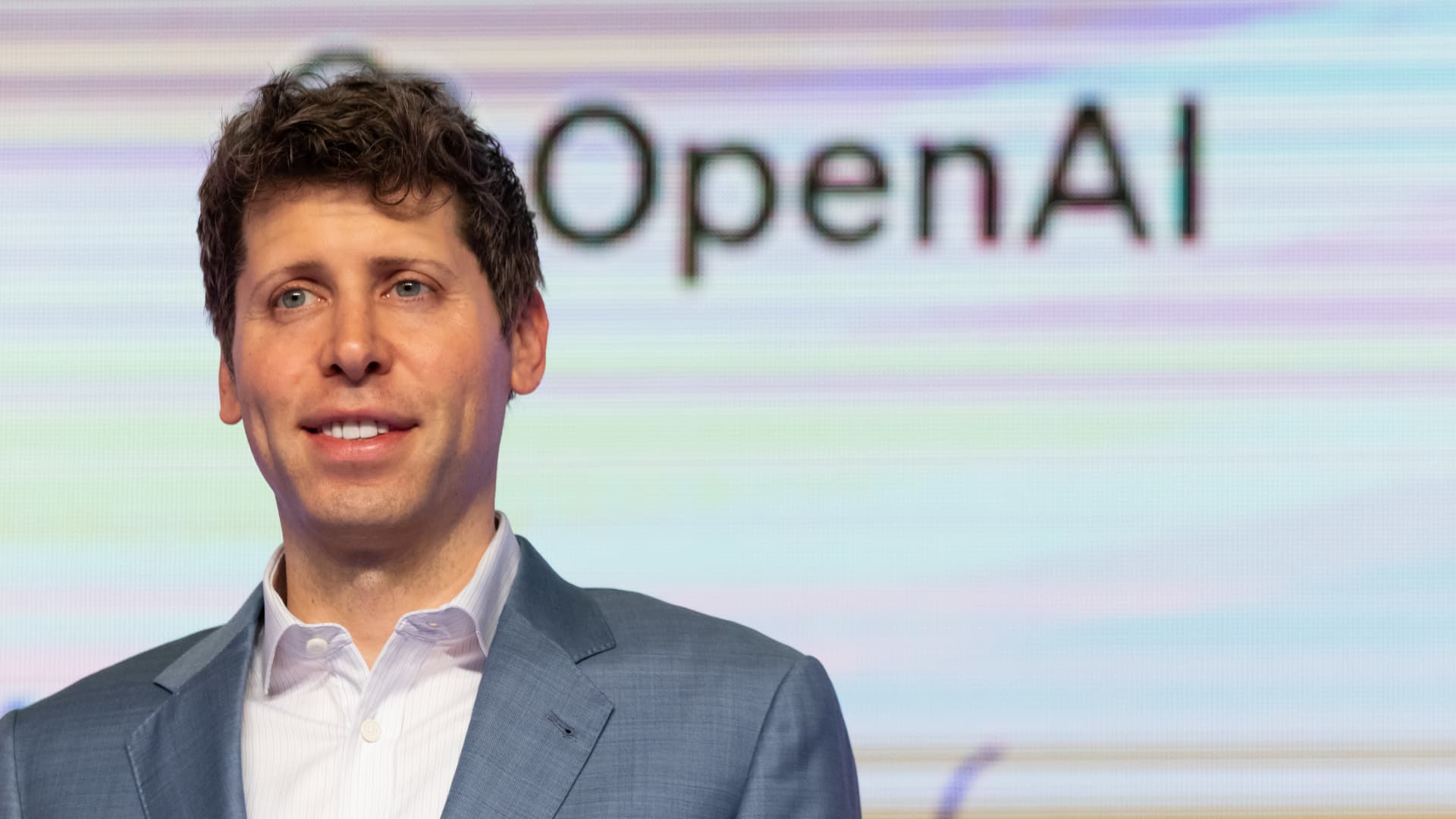
Sam Altman, CEO of OpenAI, at an event in Seoul, South Korea, on June 9, 2023.

Bloomberg | Bloomberg | Getty Images

OpenAI’s ChatGPT can now “see, hear and speak,” or, at least, understand spoken words, respond with a synthetic voice and process images, the company announced Monday.

The update to the chatbot — OpenAI’s biggest since the introduction of GPT-4 — allows users to opt into voice conversations on ChatGPT’s mobile app and choose from five different synthetic voices for the bot to respond with. Users will also be able to share images with ChatGPT and highlight areas of focus or analysis (think: “What kinds of clouds are these?”).

The changes will be rolling out to paying users in the next two weeks, OpenAI said. While voice functionality will be limited to the iOS and Android apps, the image processing capabilities will be available on all platforms.

The big feature push comes alongside ever-rising stakes of the artificial intelligence arms race among chatbot leaders such as OpenAI, Microsoft, Google and Anthropic. In an effort to encourage consumers to adopt generative AI into their daily lives, tech giants are racing to launch not only new chatbot apps, but also new features, especially this summer. Google has announced a slew of updates to its Bard chatbot, and Microsoft added visual search to Bing.

Earlier this year, Microsoft’s expanded investment in OpenAI — an additional $10 billion — made it the biggest AI investment of the year, according to PitchBook. In April, the startup reportedly closed a $300 million share sale at a valuation between $27 billion and $29 billion, with investments from firms such as Sequoia Capital and Andreessen Horowitz. 

Experts have raised concerns about AI-generated synthetic voices, which in this case could allow users a more natural experience but also enable more convincing deepfakes. Cyber threat actors and researchers have already begun to explore how deepfakes can be used to penetrate cybersecurity systems.

OpenAI acknowledged those concerns in its Monday announcement, saying that synthetic voices were “created with voice actors we have directly worked with,” rather than collected from strangers.

The release also provided little information about how OpenAI would use consumer voice inputs, or how the company would secure that data if it were used. OpenAI did not immediately respond to CNBC’s request for comment, and the company’s terms of service say that consumers own their inputs “to the extent permitted by applicable law.”

Continue Reading

Technology

How black boxes became key to solving airplane crashes

Published

on

By

How black boxes became key to solving airplane crashes

After the search for survivors and recovery of victims in tragic aviation accidents — like that of a UPS cargo plane shortly after takeoff from Louisville Muhammad Ali International Airport in Kentucky last month — comes the search for flight data and a cockpit voice recorder often called the “black box.”

Every commercial plane has them. Aerospace giants GE Aerospace and Honeywell are among a few companies that design them to be nearly indestructible so they can help investigators understand the cause of a crash.

“They’re very crucial because it’s one of the few sources of information that tells us what happened leading up to the accident,” said Chris Babcock, branch chief of the vehicle recorder division at the National Transportation Safety Board. “We can get a lot of information from parts and from the airplane.”

Commercial aircraft have become very complex. A Boeing 787 Dreamliner records thousands of different pieces of information. In the case of the Air India crash in June, data revealed both engine fuel switches were put into a cutoff position within one second of each other. A voice recording from inside the cockpit captured the pilots discussing the cutoffs.

“All of those parameters today can have a very huge impact on the investigation,” said former NTSB member John Goglia. “It’s our goal to to provide information back to our investigators who are on scene as quick as we can to help move the investigation forward.”

This crucial data can also help prevent future accidents. A crash can cost airlines or plane manufacturers hundreds of millions of dollars and leave victims’ families with a lifetime of grief.

But in some circumstances black boxes were destroyed or never found. Experts say further developments such as cockpit video recorders and real-time data streaming are needed.

“The technology is there. Crash worthy cockpit video recorders are already being installed in a lot of helicopters and other types of airplanes, but they’re not required,” said Jeff Guzzetti, aviation analyst and former accident investigator for the Federal Aviation Administration and NTSB. “There’s privacy and cost issues involving cockpit video recorders but the NTSB has been recommending that the FAA require them for years now.”

Watch the video to learn more.

CNBC’s Leslie Josephs contributed to this report.

Continue Reading

Technology

Stocks end November with mixed results despite a strong Thanksgiving week rally

Published

on

By

Stocks end November with mixed results despite a strong Thanksgiving week rally

Continue Reading

Technology

Palantir has worst month in two years as AI stocks sell off

Published

on

By

Palantir has worst month in two years as AI stocks sell off

CEO of Palantir Technologies Alex Karp attends the Pennsylvania Energy and Innovation Summit, at Carnegie Mellon University in Pittsburgh, Pennsylvania, U.S., July 15, 2025.

Nathan Howard | Reuters

It’s been a tough November for Palantir.

Shares of the software analytics provider dropped 16% for their worst month since August 2023 as investors dumped AI stocks due to valuation fears. Meanwhile, famed investor Michael Burry doubled down on the artificial intelligence trade and bet against the company.

Palantir started November off on a high note.

The Denver-based company topped Wall Street’s third-quarter earnings and revenue expectations. Palantir also posted its second-straight $1 billion revenue quarter, but high valuation concerns contributed to a post-print selloff.

In a note to clients, Jefferies analysts called Palantir’s valuation “extreme” and argued investors would find better risk-reward in AI names such as Microsoft and Snowflake. Analysts at RBC Capital Markets raised concerns about the company’s “increasingly concentrated growth profile,” while Deutsche Bank called the valuation “very difficult to wrap our heads around.”

Adding fuel to the post-earnings selloff was the revelation that Burry is betting against Palantir and AI chipmaker Nvidia. Burry, who is widely known for predicting the housing crisis that occurred in 2008 and the portrayal of him in the film “The Big Short,” later accused hyperscalers of artificially boosting earnings.

Palantir CEO Alex Karp vocally hit the front lines, appearing twice in one week on CNBC, where he accused Burry of “market manipulation” and called the investor’s actions “egregious.”

“The idea that chips and ontology is what you want to short is bats— crazy,” Karp told CNBC’s “Squawk Box.”

Despite the vicious selloff, Palantir has notched some deal wins this month. That included a multiyear contract with consulting firm PwC to speed up AI adoption in the U.K. and a deal with aircraft engine maintenance company FTAI.

But those announcements did little to shake off valuation worries that have haunted all AI-tied companies in November.

Across the board, investors have viciously ditched the high-priced group, citing fears of stretched valuations and a bubble.

In November, Nvidia pulled back more than 12%, while Microsoft and Amazon dropped about 5% each. Quantum computing names such as Rigetti Computing and D-Wave Quantum have shed more than a third of their value.

Apple and Alphabet were the only Magnificent 7 stocks to end the month with gains.

Sill, questions linger over Palantir’s valuation, and those worries aren’t a new concern.

Even after its steep price drop, the company’s stock trades at 233 times forward earnings. By comparison, Nvidia and Alphabet traded at about 38 times and 30 times, respectively, at Friday’s close.

Karp, who has long defended the company, didn’t miss an opportunity to clap back at his critics, arguing in a letter to shareholders that the company is making it feasible for everyday investors to attain rates of return once “limited to the most successful venture capitalists in Palo Alto.”

“Please turn on the conventional television and see how unhappy those that didn’t invest in us are,” Karp said during an earnings call. “Enjoy, get some popcorn. They’re crying. We are every day making this company better, and we’re doing it for this nation, for allied countries.”

Palantir declined to comment for this story.

WATCH: Palantir CEO Alex Karp: We’ve printed venture results for the average American

Palantir CEO Alex Karp: We've printed venture results for the average American

Continue Reading

Trending





