
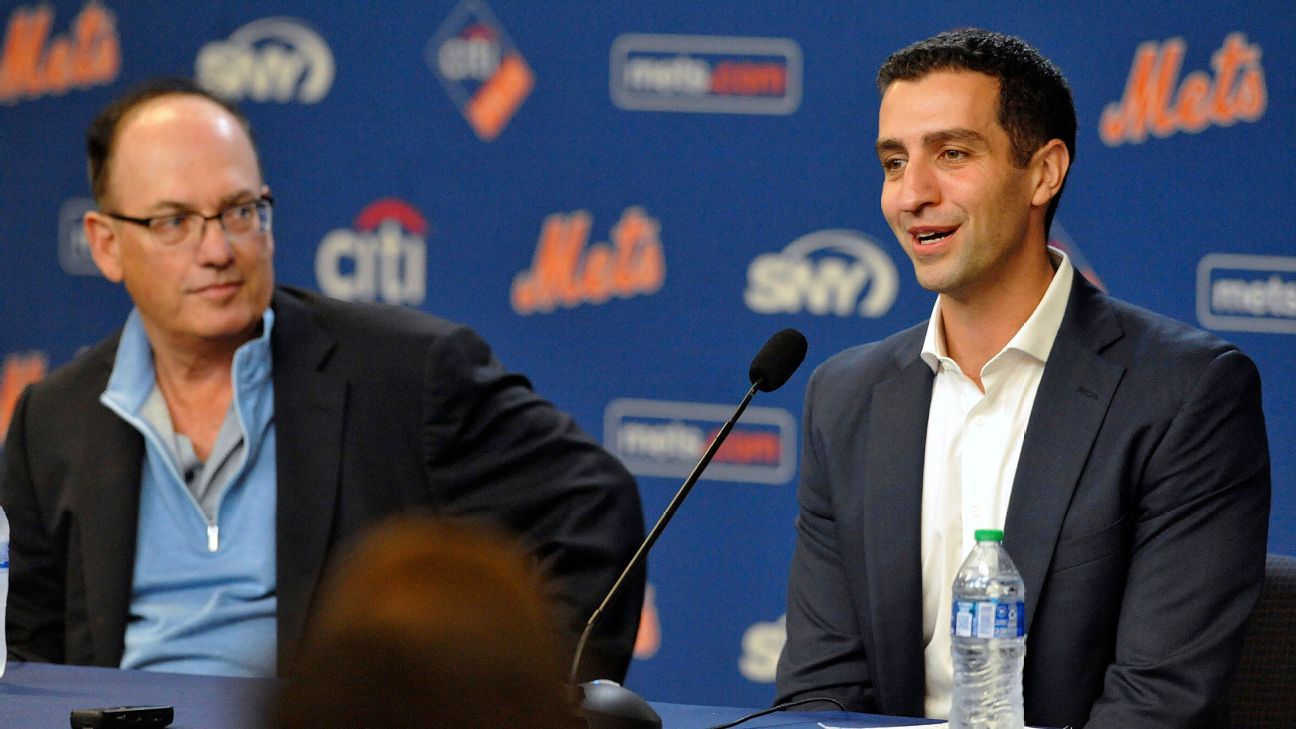
Mets welcome Stearns as president of operations


NEW YORK — Decades ago, David Stearns used to sneak into Shea Stadium to root for the New York Mets.
Now, he holds their entire roster in his hands.
Stearns was formally appointed the first president of baseball operations in Mets history Monday, taking over the hometown team he cheered as a child.
“I appreciate that they’re letting me in here without a ticket,” he said.
“The good news about Shea in the late ’90s is you had some ticket takers and ushers who were pretty sympathetic to a 13-year-old kid who just wanted to watch baseball,” Stearns said with a smile. “Only happened a couple times. May have only happened with one specific usher. But most of the time I was a legal paying fan.”
The former Milwaukee Brewers boss was introduced by owner Steve Cohen at a Citi Field news conference on the heels of a hugely disappointing season. Despite championship aspirations and a record $355 million payroll on opening day, New York dropped out of playoff contention by midsummer and finished fourth in the NL East.
“I’m thrilled to be here. This is my home. It’s nice to be back,” Stearns said. “I’ve got plenty of work to do.”
The 38-year-old executive was placed above general manager Billy Eppler and under Cohen in a working structure fairly common around baseball but new to the Mets.
A large scoreboard display in center field welcomed Stearns, who will lead a search for the team’s next manager after Buck Showalter was fired Sunday.
“I view the managerial position as one of true partnership,” Stearns said, later adding he’d be open to a first-time manager. “There’s no one I have in mind. We are going to cast a wide net. We’re going to have a real process.”
He also said he expects Pete Alonso to be New York’s first baseman on Opening Day next year — the All-Star slugger has been the subject of trade speculation because he’s eligible for free agency after the 2024 season.
“Pete is a great player. He is also good in the clubhouse. He is also homegrown. All of that matters,” Stearns said. “Pete’s an important member of this team, he’s an important member of this organization and I think we’re really fortunate to have him.”
Cohen had been seeking a president of baseball operations to oversee the entire department since buying the club in November 2020. Several attractive candidates, including Stearns, were unavailable during a three-year process that Cohen called “sort of dog years.”
“I’m really excited by this,” Cohen said. “You know, I’ve been really patient looking for the right person. As David and I got to know each other, I mean, it’s clear that we’re aligned in our thinking. We get along very well.”
Stearns grew up a Mets fan in New York City and even interned for the team early in his career. He said he and Cohen spoke about a dozen times on the phone and met face-to-face four times for three-to-six hours each, including a pivotal dinner with their wives that convinced Stearns working for the Mets could be the right fit.
As speculation increased over time that he would ultimately land this job, Stearns said he and his wife had to calm his excited mother, Susan, before finally getting to call her a couple of weeks ago and tell her “this was really happening.”
“It’s meaningful for me, it’s cool for me that our kids get to grow up Mets fans now. That we get to share that. That we get to live this journey together and they get to experience a little bit of what I experienced,” said Stearns, a Harvard graduate. “I grew up listening to Gary Cohen and Bob Murphy and Ed Coleman every summer. I’ve ridden the rollercoaster of disappointment and hope, along with every other Mets fan.
“I feel very fortunate and privileged to be here right now. I understand this doesn’t happen, right? You don’t grow up a rabid fan of a team and then one day get to stand here at a press conference talking about leading that team,” he added. “And so the fact that it has happened to me, I recognize how incredible that is.”
Stearns worked in the commissioner’s office at Major League Baseball from 2008-11. He was Cleveland’s director of baseball operations in 2012 and an assistant GM with Houston from 2013-15 during a successful rebuild.
After taking over the Brewers, he enjoyed a winning run while leading Milwaukee’s baseball operations department from September 2015 through the 2022 season before stepping down and moving into an advisory role.
Milwaukee came within one victory of the World Series in 2018 and returned to the playoffs each of the next three seasons. The Brewers won NL Central titles in 2018 and 2021, and another one this year. Stearns agreed to join the Mets last month, and his contract with the Brewers expired Sunday.
“I need to get under the hood a little bit, talk with our group, understand internally here what we think we do well and where we think there are areas for improvement,” Stearns said.
“Can you do what the Brewers have done here in New York? I think we can develop good starting pitching here. Absolutely. But it’s going to look different than the way Milwaukee has done it. It has to. No two organizations are the same,” he added. “We have to create our own blueprint here and I think we will.”

-
Bradford Doolittle
Close
Bradford Doolittle
ESPN Staff Writer
- MLB writer and analyst for ESPN.com
- Former NBA writer and analyst for ESPN.com
- Been with ESPN since 2013
-
David Schoenfield
Close
David Schoenfield
ESPN Senior Writer
- Covers MLB for ESPN.com
- Former deputy editor of Page 2
- Been with ESPN.com since 1995
It’s hot stove season! The 2025-26 MLB offseason is officially here, and we have you covered with grades and analysis for every major signing and trade this winter.
Whether it’s a big-money free agent signing that changes the course of your team’s future or a blockbuster trade, we’ll weigh in with what it all means for next season and beyond.
ESPN MLB experts Bradford Doolittle and David Schoenfield will evaluate each move as it happens, so follow along here — this story will continue to be updated. Check back in for the freshest analysis through the start of spring training.
Related links: Tracker | Top 50 free agents | Fantasy spin

Mariners get:
LHP Jose Ferrer

Nationals get:
C Harry Ford
RHP Isaac Lyon
Mariners grade: C+
Well, the verdict is in from Mariners fans: They universally hate this trade (it’s not often you get an entire fan base to agree on something). Their feelings are understandable. Ford was the Mariners’ first-round pick in 2021 and progressed nicely, advancing one level per season and hitting .283/.408/.460 in 2025 at Triple-A. He’s remained a top-100 prospect all along, including No. 65 on ESPN’s updated list from August. Sure, he’s blocked by Cal Raleigh, but he projected as the backup catcher and part-time DH in 2026.
The return? A lefty reliever with a 4.48 ERA. It certainly feels a little light for a top-100 prospect — and a hard-to-find catching prospect — but that ERA undersells Ferrer’s potential. He throws a 98-mph sinker 70% of the time that helped him register one of the highest groundball rates in the majors (99th percentile). He throws strikes (16 walks in 76.1 innings) and dominated left-handed batters (holding them to a .186 average and .521 OPS).
With Gabe Speier the only reliable lefty in the bullpen, the Mariners needed a second lefty and, after ending the season as the Nationals closer, Ferrer certainly can slot into a high-leverage role. He’s exactly what teams want in the postseason: A hard-throwing reliever. Scouts like his secondary stuff and the Mariners no doubt will have Ferrer use his slider and changeup more often, which could take him to an elite level.
Nationals grade: A-
The first major transaction from Paul Toboni, the Nationals’ new president of baseball operations, looks like a good one. Anytime you can turn a reliever into a possible long-term starting position player, that’s a win. We’ll hedge the grade here a bit since Ford hasn’t proven himself on the major league level, plus he projects more as a solid regular than a future star, but he should be a significant upgrade at a position that saw the Nationals rank 29th in the majors in OPS.
Indeed, Keibert Ruiz was supposed to be the answer behind the plate for the Nationals when they acquired him in the Max Scherzer/Trea Turner with the Dodgers, but he’s gone backwards since a solid season in 2023, producing an unacceptable .595 OPS in 2025. Ford’s biggest strength is an excellent approach at the plate that produced 16.2% walk rate in Triple-A while striking out less than 20% of the time. With a career .405 OBP in the minors, he could eventually become a top-of-the-order hitter as he also runs well (he stole 34 bases in 2024). The power is only moderate and the defense still needs some work around the edges, but Ford should take over as the regular catcher in 2026. — David Schoenfield

Red Sox get:
RHP Johan Oviedo
LHP Tyler Samaniego
C Adonys Guzman

Pirates get:
OF Jhostynxon Garcia
RHP Jesus Travieso
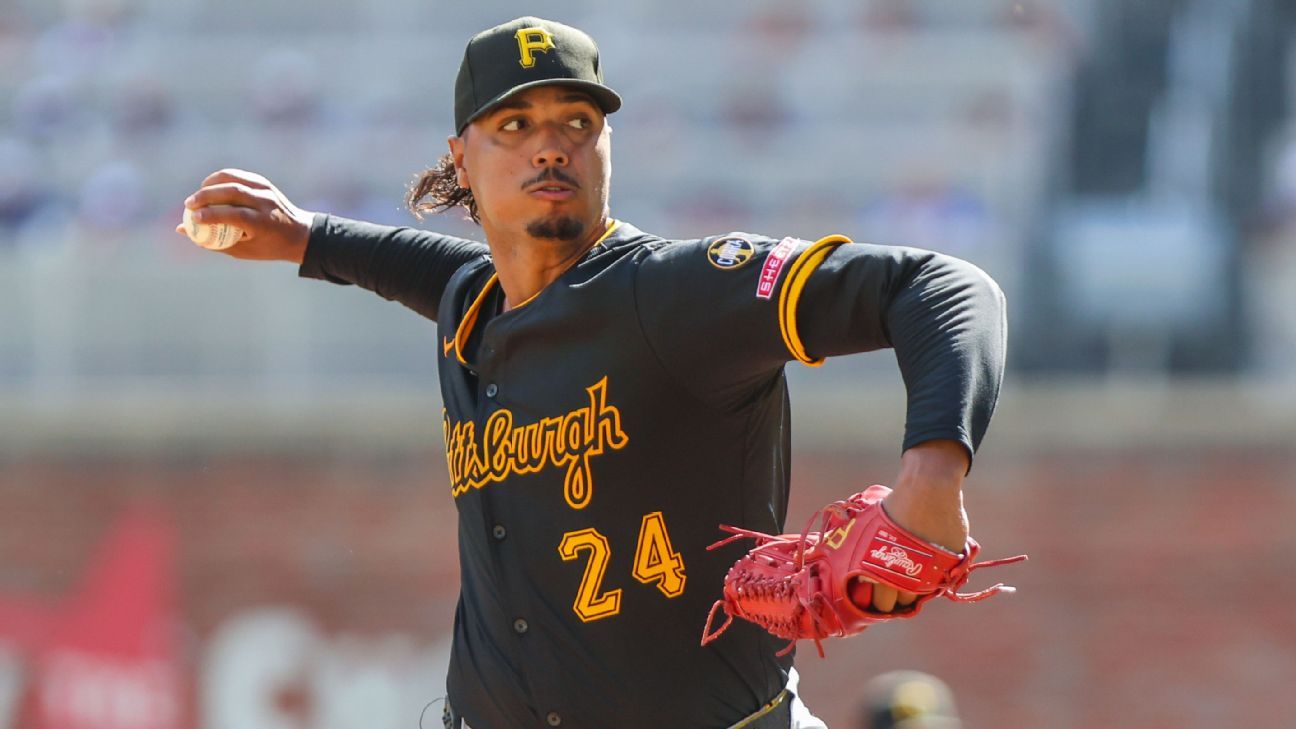
Red Sox grade: B-
The American League East is clearly all-in. The Toronto Blue Jays have signed Dylan Cease and Korean League MVP Cody Ponce for their rotation. The Baltimore Orioles signed Ryan Helsley and traded for Taylor Ward and Andrew Kittredge. The Tampa Bay Rays have added outfielders Cedric Mullins and Jake Fraley and reliever Steven Wilson. And now the Boston Red Sox have acquired Oviedo after trading for Sonny Gray last week. (The New York Yankees? Trent Grisham accepted their qualifying offer, so he’s back.)
While there were other players involved in this trade between Boston and the Pittsburgh Pirates, it’s mostly Oviedo-for-Garcia, so let’s focus on those two. Oviedo is sort of the polar opposite of Gray, other than the fact that both are right-handers: Oviedo is 6-foot-6 and 275 pounds with a fastball that touches 98 mph while Gray is 5-10 and doesn’t throw hard; Gray has been reasonably healthy while Oviedo missed all of 2024 with Tommy John surgery; Gray pounds the strike zone while Oviedo’s control problems have always limited his value (in nine starts in 2025, he averaged 5.1 walks per nine).
Oviedo leans mostly on a fastball/slider, mixing in a curveball and changeup that he uses primarily against left-handers. In his one full season as a starter with the Pirates in 2023, he made 32 starts with a 4.31 ERA and 2.2 WAR, making him essentially a league-average starter. In his abbreviated return of 40 innings in 2025, improved movement on his four-seamer helped limit damage against that pitch as he posted career highs in strikeout rate (24.7%) and batting average allowed (.182) to go along with the high walk rate.
There is obvious upside here, especially if the better results against left-handed hitters in 2025 are for real. In his two years as Red Sox pitching coach, Andrew Bailey has extracted improvement from the likes of Tanner Houck in 2024 (although he got hurt in 2025) and Brayan Bello and Lucas Giolito in 2025, so it will be interesting to see what Bailey can do with Oviedo. For now, Oviedo projects as a fourth/fifth starter with two seasons of team control and gives the Red Sox plenty of rotation depth: They have Garrett Crochet, Gray, Bello, Kyle Harrison, Payton Tolle, Connelly Early and Hunter Dobbins, with Patrick Sandoval returning from injury (Houck is likely out for the season after TJ surgery).
With Oviedo set to make an estimated $2 million, it also leaves the Red Sox plenty of payroll room to make a big splash in free agency — like re-signing Alex Bregman.
Pirates grade: B+
Garcia owns one of the best nicknames in the sport — “The Password” — and is a toolsy soon-to-be 23-year-old who will have a chance to start in a Pirates outfield that ranked 27th in the majors in OPS in 2025. There was no room for him in an already crowded Red Sox outfield, so don’t view them trading him as a sign they weren’t high on his ability.
He is a high-risk player — but the kind of gamble the Pirates need to take. He hit .267/.340/.470 with 21 home runs between Double-A and Triple-A this year, but that came with a 131/45 strikeout-to-walk ratio that included a high chase rate, especially after his promotion to Triple-A. He could stick in center field — depending on what the Pirates do with Oneil Cruz — but probably projects best as an above-average defender in right field. ESPN’s Kiley McDaniel had ranked him as the No. 3 prospect in the Red Sox system in his update this past August.
Garcia could turn into an above-average starter if he improves his chase or could be more of a fourth outfielder with a sub-.300 OBP if he doesn’t. The Pirates, of course, haven’t exactly excelled at turning prospects into good hitters (see Cruz’s regression in 2025), so odds are Garcia probably swings more to the latter scenario. But he’s a nice return for two years of Oviedo. — Schoenfield

The deal: Three years, $30 million
Grade: A-
The last time we saw Cody Ponce in the majors he was one of the worst pitchers in the league. Pitching primarily in relief for the Pirates in 2021, he ranked 426th in ERA out of 436 pitchers with at least 35 innings. He ranked 436th out of 436 in batting average allowed and also ranked 436th in OPS allowed.
Ponce went to Japan in 2022, pitched there for three seasons with mixed results and then joined Hanwha in the Korea Baseball Organization in 2025, where he went 17-1 with a 1.89 ERA and 252 strikeouts in 180⅔ innings to win league MVP honors. Whereas his fastball averaged 93.2 mph with Pittsburgh in 2021, the 6-foot-6 right-hander now sits around 95 mph and gets it up to 99, while mixing in a cutter, curveball and changeup — the changeup being a new pitch that led to an impressive 36% strikeout rate in the KBO.
Now, the KBO is not MLB. This grade isn’t predicting that Ponce is going to be a Cy Young contender but reflective of the contract. At three years and $30 million, it’s a worthy gamble for the Blue Jays. If he’s a 1-WAR pitcher for three years, he’ll at least earn the money back. If he’s a 2-WAR pitcher, it’s a great deal. If he’s a 3-WAR pitcher over the next three seasons, it will be one of the best deals of the offseason.
There have been success stories from U.S. pitchers who went to the KBO and then returned as better pitchers. Merrill Kelly came back in 2019 at age 30 and has averaged 3.3 WAR per 162 games. Erick Fedde went to Korea in 2023 and won MVP honors then returned with a 5.6-WAR season in 2024 (although he faded in 2025). Ponce throws harder than those two. I like his chances to be a midrotation starter, with the bullpen as a nice fallback.
After officially signing Dylan Cease, the Blue Jays are now rolling out a rotation that includes Cease, Kevin Gausman, Shane Bieber, Trey Yesavage, Jose Berrios, Eric Lauer and Ponce. Berrios ended the season with right elbow inflammation, so he has a red flag next to his health status, but that’s a seven-man group that should help make the Blue Jays the preseason favorite in the AL East — especially if they also re-sign infielder Bo Bichette.
Their payroll is now clocking in at an estimated $272 million without Bichette, up from $258 million last season (via FanGraphs), but the Blue Jays have made it clear: They want one more win in 2026 and will pay to try to get it. — Schoenfield

The deal: Three years, $51 million
Grade: B-
Consider these two seasons from two-time All-Star reliever Devin Williams, who has agreed to a three-year contract with the New York Mets:
Season A: 37.7% SO rate, 12.1% BB rate, 1.7% HR rate, .129 BA
Season B: 34.8% SO rate, 9.7% BB rate, 1.9% HR rate, .197 BA
The first one is a little better, but they’re pretty close other than a spike in batting average allowed, which is somewhat canceled out by a lower walk rate. Those seasons should have produced similar results.
They did not.
Season A was 2023, when Williams went 8-3 with a 1.53 ERA and 36 saves for the Brewers and was regarded as perhaps the best closer in the majors. Season B was 2025, when Williams went 4-6 with a 4.79 ERA for the Yankees, lost his job as closer and faced headlines like “Devin Deadly Sins” after a particularly rough outing in August.
But the numbers indicate at least why the Mets were willing to give Williams a $50 million-plus deal (with a reported $5 million in annual deferrals) coming off his shaky season with the Yankees. The peripheral numbers remained excellent, the home run rate wasn’t as high as Yankees fans would lead you to believe, and David Stearns — who ran baseball operations in Milwaukee when Williams was there and is now in that position with the Mets — is still buying that Williams’ changeup/fastball combo can return him to an elite level.
That’s certainly possible. Williams’ ERA was bloated largely because of a handful of terrible outings: He gave up three or more runs in six games with the Yankees — more times than in his career up to 2025. It’s also true that his changeup, which he has thrown more often than his fastball in his career, wasn’t as dominant. All five home runs he gave up came on his changeup, compared to six on his changeup in 235 innings entering 2025. The whiff rate on the pitch also fell under 40% for the first time, which in turn made his 94 mph four-seamer a little less effective.
It’s nothing that can’t be fixed with a little more consistency, but there’s also no guarantee Williams returns to his performance with the Brewers. Maybe hitters are finally figuring him out a bit. Maybe he lost some confidence after he served up a series-losing home run to Pete Alonso in the 2024 playoffs. All that adds some risk to the contract, especially factoring in that Williams’ struggles coincided with his shift from small-market Milwaukee to pressure-packed New York — and that won’t change in moving from the Bronx to Queens.
It’s also possible Williams ends up being a very expensive setup man. Longtime Mets closer Edwin Diaz remains a free agent after opting out of his deal, but reports indicate the Mets are still interested in re-signing Diaz (who could be looking for something like the five-year, $95 million deal Josh Hader signed with the Astros).
If Diaz does return, the Mets would be on their way to building the most expensive bullpen in history, with A.J. Minter already on the books for $11 million, Brooks Raley for $4.75 million and a few other holes yet to be filled. Hey, considering what happened in 2025 — from June 1 on, the Mets were 25th in bullpen ERA, even with Diaz — it’s probably a good idea to spend on what faltered at the end of last season. Williams and Diaz at their best would give the Mets the best 1-2 late-game duo in the majors. — Schoenfield

The deal: 2 years, $28 million, player option after 2026 season
Grade: C+
With Felix Bautista down for most, if not all, of the 2026 season because of shoulder surgery, Baltimore had a need for an end-of-the-game reliever. Helsley had been filling that precise role well for the Cardinals for several seasons, before he embarked on a short-lived Mets career that both he and the team would like to forget.
Barring an obvious and measurable drop in stuff, you always want to lean more on baseline performance when it comes to a reliever than the fluctuations that come with year-over-year results. Over the last three seasons, Helsley is one of 12 relievers with at least 4.0 fWAR in the aggregate and only seven have posted more saves than Helsley’s 84.
Primarily a fastball-slider pitcher, Helsley reportedly began tipping his pitches at some point in 2025 and opposing batters began ambushing his heater early in counts with much success. He ended up giving up a .422 average and .667 slugging on his four-seamer last season even though his average velocity (in excess of 99 mph) and spin rate was in line with past seasons.
The hope would be that Helsley fixes (or has fixed) the issue and once again is able to pair his high-speed fastball with his high-performing slider, a combo which helped him save 49 games for St. Louis in 2024. The structure of this deal gives him a shot at reentering the market next season after hopefully proving that his performance with the Mets was a fluke.
For the Orioles, Helsley slides into the primary saves role after some early chatter in free agency suggested some teams were looking at him as a possible rotation conversion. The contract is a bit of a risk if Helsley doesn’t perform and declines to opt out, as a $14 million average annual value is what you would want to be paying a first-division closer, not a just-a-guy reliever.
At his best, Helsley has been an All-Star-level, high-leverage reliever for multiple seasons, and the Orioles clearly think that his Mets misadventure was a blip, not his new reality. — Doolittle
The deal: 7 years, $210 million
Grade: B
One of the interesting aspects of MLB free agency is that the number of suitors for a player isn’t always directly correlated to on-field value. There are, after all, only so many teams willing and able to spend nine figures. In recent years, we’ve seen excellent players like Pete Alonso, Matt Chapman and Blake Snell settle for shorter-term deals late in the offseason as they waited for that big long-term offer that never came — or was pulled off the table.
In the case of Dylan Cease, it makes a lot of sense for him to sign early while the money is there. He’s a pitcher with clear skills and ability but also frustratingly inconsistent results, which was going to lead to a wide variance in how teams evaluated him — and thus what offers he received. The $210 million deal the Toronto Blue Jays gave Cease is closer to the high end for him, given Kiley McDaniel’s projection of five years, $145 million.
The positive:
-
Pure stuff: The “Stuff+” metric — which various sites now calculate based on a whole host of things like spin, movement and velocity — rates Cease’s pitches as some of the best in the majors, including a fastball that averages 97 mph. Among pitchers with at least 100 innings in 2025, he tied for 12th in Stuff+ per FanGraphs.
-
Durability: Cease is riding a streak of five consecutive seasons with at least 32 starts. Since 2021, he’s first in the majors in games started and seventh in innings. Considering the best predictor for future injuries is past injuries, that health history and projected durability give him a high floor for any future deal.
-
Age: He’s entering his age-30 season, clearly still in his prime years.
The negative:
-
His ERA has jumped from 2.20 to 4.58 to 3.47 to 4.55 over the past four seasons with corresponding changes in his value, from 6.4 WAR in 2022 with the Chicago White Sox to just 1.1 with the San Diego Padres in 2025, when he had a high ERA despite pitching in a good pitcher’s park. His road ERA in 2025 was 5.58, which is certainly a concern as he now goes to a better-hitting division and better hitter’s park.
-
His lack of efficiency not only leads to too many walks — he leads the majors over the past four seasons — but short outings due to high pitch counts. Cease failed to last five innings in 10 of his 32 starts, which is too often for a pitcher who just got $210 million.
In Cease’s best season in 2022, his slider was unhittable while his four-seamer and knuckle-curve were also effective, making him a three-pitch pitcher. The curveball hasn’t been nearly as effective since then, with batters slugging .576 against it in 2025, .444 in 2024 and .538 in 2023, making him more of a two-pitch guy now. He started throwing a sweeper and sinker a little more often last season, and maybe the continued development of those pitches will help him get back to being one of the better starters in the majors.
That’s what the Blue Jays are banking on. They’ll likely note that his Fielding Independent Pitching, which factors in only strikeouts, walks and home runs allowed — has been fairly consistent the past four years: 3.10, 3.72, 3.10 and 3.56, respectively. That averages out to 3.36, with his actual ERA rising and falling depending on the variations of his batting average on balls in play (.261 and .266 in ’22 and ’24, .331 and .323 in ’23 and ’25).
At a minimum, the Blue Jays get a solid middle-of-the rotation starter to go with Kevin Gausman, Trey Yesavage, Shane Bieber and Jose Berrios. The good version of Cease is a No. 2 starter who sometimes looks like an ace. If Bieber is healthy for the entire season and Berrios’ late-season elbow inflammation was just temporary, that’s a rotation that could be as good as any in the game. We knew the Jays were going to strike big this offseason. This might not be their only move of consequence. — Schoenfield
Red Sox get:
RHP Sonny Gray
$20 million in cash

Cardinals get:
LHP Brandon Clarke
RHP Richard Fitts
Red Sox grade: B+
The Red Sox had three-fifths of an outstanding rotation in 2025, with Garrett Crochet leading the way and Brayan Bello and Lucas Giolito producing solid campaigns as the second and third starters. That was enough to get the Red Sox back into the postseason for the first time since 2021, but after Giolito declined his part of a $19 million mutual option, the Red Sox were looking for a veteran starter to replace him.
They landed on Gray, who is 36 years old but coming off a second straight 200-strikeout season while also leading National League starters in strikeout-to-walk ratio. The Red Sox have reportedly restructured Gray’s deal to pay him $31 million in 2026 with a $10 million buyout on a mutual option for 2027, essentially turning this into a one-year rental at $41 million (with the Cardinals picking up half that tab). It’s certainly a great deal for Gray, who no doubt happily waived his no-trade clause to get out of St. Louis.
As for Gray the pitcher, he’s an interesting mix. When he can get to two strikes, he’s one of the best in the game, ranking fourth in the majors among starters with a nearly 52% strikeout rate (Crochet was first at 54.3%) while holding batters to a .135 average. His sweeper is his go-to strikeout pitch, registering 111 of his 201 strikeouts. His curveball generated a 34% whiff rate.
His problems came against his fastballs, as batters hit .370 and slugged .585 against his four-seamer (which he uses more against left-handed batters) and hit .281 and slugged .484 against his sinker (which he uses more against righties). He also throws a cutter, which he takes a little off on the velocity, but that was also similarly ineffective, with batters hitting .387 off it. The damage against his fastballs led to 25 home runs allowed and a 4.28 ERA, despite the excellent walk and strikeout numbers.
Can that be fixed? With a fastball that averages 92 mph, maybe not. Gray did throw his three fastball variants 53% of the time, so maybe the Red Sox suggest a different pitch mix — the four-seamer, while it gives him the one pitch Gray throws up in the zone, has been hammered two years in a row now, but was still the pitch he threw most often in 2025.
Overall, Gray plugs a big hole without the Red Sox paying out a long-term contract — and the Red Sox didn’t give up anybody who projected to be an impact player for them in 2026 (such as starters Payton Tolle and Connelly Early, who debuted this past season and could be in the 2026 rotation).
Cardinals grade: C
It’s not exactly a salary dump, but it has the feel of one, although the Cardinals at least chipped in $20 million to get a little better return on the player side. Fitts could be a bottom-of-the-rotation guy, and given the holes in the St. Louis rotation, is almost certain to get that opportunity. His four-seam fastball, sitting 95-96, was an effective pitch in the 10 starts he made for the Red Sox in 2025, but he hasn’t really developed a trustworthy secondary offering. His slider got hit hard and didn’t generate enough swing-and-miss. Maybe his sweeper/curveball combo will eventually elevate his game, but he threw both less than 11% of the time.
Clarke, a hard-throwing lefty who has hit 100 mph, was drafted out of a Florida junior college in 2024. He had Tommy John surgery in high school and redshirted one year at Alabama with another injury. The Red Sox limited him to 14 starts and 38 innings in 2025 in Class A, where he registered both high strikeout numbers (60) and high walk totals (27). ESPN’s Kiley McDaniel rated him the No. 9 prospect in the Boston system in August and while there’s obvious upside if everything comes together, he’s not close to the majors and the profile screams reliever risk.
For the Cardinals, they’ve at least made their intentions clear: If 2025 was “re-set,” 2026 is going to be a rebuild. Nolan Arenado, Brendan Donovan and Willson Contreras could also all be traded before the winter is over. — Schoenfield
Mets get:
2B Marcus Semien

Rangers get:
OF Brandon Nimmo
Mets grade: C+
One-for-one swaps of quality veterans are rare enough these days that when one lands, and people are familiar with both players, the label “blockbuster” starts to get thrown around in a way that would make Frantic Frank Lane roll his eyes. This deal, which brings Semien to New York for career Met Nimmo, is interesting. It is also a trade involving two post-30 players carrying multiple seasons of pricey contracts. Lackluster would be a better description than blockbuster. The valuations on this deal at Baseball Trade Values illustrate nicely the underwater contracts involved.
For the Mets, it’s important to underscore the fact that Semien is 35 years old. Though he challenged for AL MVP during Texas’ championship season in 2023, his offensive numbers have since headed south, as tends to happen to middle infielders with his expanding chronology. Over the past two seasons, his bat has been just below league average — and while there is plenty of value in being roughly average, it’s still a precarious baseline for a player on the downside of his career. His offensive forecast isn’t as good as that of New York’s heretofore presumed regular at second base, Jeff McNeil, who might still get plenty of run at other positions.
That said, Semien is a much better defender than McNeil. Semien is coming off his second career Gold Glove, an honor backed up by consistently strong fielding metrics that have marked his play at the keystone ever since he moved over from shortstop. Though Semien’s contract features a higher average annual value than Nimmo ($25 million in terms of the luxury tax calculation versus $20.5 million), it’s of shorter duration and the move will cut into New York’s considerable longer-term obligations.
One thing that is head-scratching here: The Mets are pretty deep in high-quality infield prospects, from Luisangel Acuna to Ronny Mauricio to Jett Williams, all of whom carry considerably more upside than Semien at this point.
Rangers grade: C+
If you ignore positional adjustments, Nimmo is a better hitter than Semien and should be a considerable upgrade for Texas in the outfield compared with what the Rangers had been getting from the recently non-tendered Adolis Garcia. He’s not as good a defender as Garcia, especially in arm strength and, in fact, is likelier to play in left in Texas rather than Garcia’s old spot in right. As mentioned, Semien was a Gold Glover at his position and so now, in their effort to remake an offense that needed an overhaul, you worry that the Rangers are putting a dent in their defense.
We’ll see how that shakes out as the offseason unfolds, but for now, we can focus on Nimmo’s bat and the possibility that his numbers could get a bump from the switch in venues. He’s typically hit better on the road than at pitcher-friendly Citi Field, and Globe Life Field, while strangely stingy overall last season, has typically been a solid place to hit for left-handed batters.
The project in Texas is clear. It’s about not just improving the offensive production but also pursuing that goal by shifting the focus of the attack. Nimmo’s power bat is a slim upgrade on Semien and a downgrade from Garcia. But Nimmo is a much better hitter for average than both, and he has the best plate discipline of the trio. These are both traits the Rangers’ offense very much needed.
Nimmo’s contract is a problem, but it’s more of a longer-term issue than it will be in 2026, when he’ll make $5.5 million less than Semien. Texas is looking to reshuffle while reigning in the spending, and this is the kind of deal that aids that agenda. The Rangers can worry about the real downside of Nimmo’s deal later. For now, they can hope that moving to a new vista for the first time will boost Nimmo’s numbers, which have settled a tier below where they were during his Mets prime. — Doolittle
Orioles get:
LF Taylor Ward

Angels get:
RHP Grayson Rodriguez
Orioles grade: D
The first major trade of last offseason came on Nov. 22, when Cincinnati dealt Jonathan India to Kansas City for Brady Singer. This one leaked on Nov. 18, so we’re getting an earlier start. Given the relatively tepid nature of this year’s free agent class, the hope is that this deal is the vanguard of a coming baseball swap meet. Trades are fun.
Alas, although it was easy to understand the reasoning for both sides in the aforementioned Reds-Royals deal, I’m not sure I get this one so much from the Orioles side. The caveat is that maybe Baltimore’s brass, which obviously knows a lot more about Rodriguez than I do, has good reason to think that Gray-Rod (just made that one up) is not likely to live up to his considerable pre-MLB hype.
I don’t like to get too actuarial about these things, but you kind of have to be in this case because Ward will be a free agent after the 2026 season whereas Rodriguez has four seasons of team control left on his service time clock. Thus, even if Rodriguez is likely to need an adjustment period this season as he attempts to come back from the injuries that cost him all of 2025, Baltimore would have had plenty of time to let that play out.
Ward turns 32 next month, likely putting him at the outer rim of his career prime. He has been a decent player — an average of 3.0 bWAR over the past four years — but his skill set is narrow. Ward has been a fixture in left field the past couple of seasons and has shown diminishment both on defense and on the bases. He’s someone you acquire for his bat.
On that front, Ward hit a career-high 36 homers in 2025, but his underlying Statcast-generated expected numbers suggest he overachieved in that area a bit. The righty-swinging Ward does generate power to the opposite field, but his power game is still likely to see a negative impact from the move to Camden Yards. He’s patient at the plate to the point of occasional passivity, as he’s almost always hunting a pitch to drive, even if that means taking a couple of strikes.
That’s not a bad thing, but that approach, combined with a fly ball-heavy distribution, has led to a consistently plummeting average: .281 to .253 to .246 to .228. He’s a take-and-rake guy who doesn’t generate enough fear from pitchers to keep them out of the zone, which might supercharge his walk rate enough to bring his OBP up to an acceptable level, which it won’t be given the batting average trend.
And all of this would be fine for one year of a productive hitter likely to earn $12-14 million through the arbitration process. But at the cost of four years of a pitcher with Rodriguez’s ceiling? I’m not seeing it.
Angels grade: A-
This is about upside for an Angels staff desperate for a true No. 1 starter. To expect Rodriguez to fill that need in 2026 is a lot, and perhaps, given his durability issues, he will never get there. His big league results (97 ERA+, 3.80 FIP over 43 starts in 2023 and 2024) are solid but nothing special. The allure of Rodriguez remains the combination of high ceiling and controllable seasons.
And the ceiling is very high. ESPN’s Kiley McDaniel ranked Rodriguez as the game’s top pitching prospect in 2022 and rated him nearly as high in 2023. The mere possibility of Gray-Rod (did it again) fulfilling that potential in an Angels uniform is an exciting notion for fans in Anaheim.
Whether or not there is much of a possibility of Rodriguez getting there is almost beside the point. I’d feel better about this if he were headed to an organization with a better track record of turning around underachieving/injury-prone hurlers, but maybe the Angels can make some strides in this area.
The deal opens up a hole in the outfield for the Angels with no obvious plug-in solution from the organization. But finding a free agent replacement who approximates or exceeds Ward’s production shouldn’t break the bank. Here’s a vote for going after Cody Bellinger.
The possibility of that kind of upgrade and maybe someday a fully realized Gray-Rod, all for the low-low price of one season of Taylor Ward? Sign me up. — Doolittle
The deal: 5 years, $92.5 million
Grade: A-
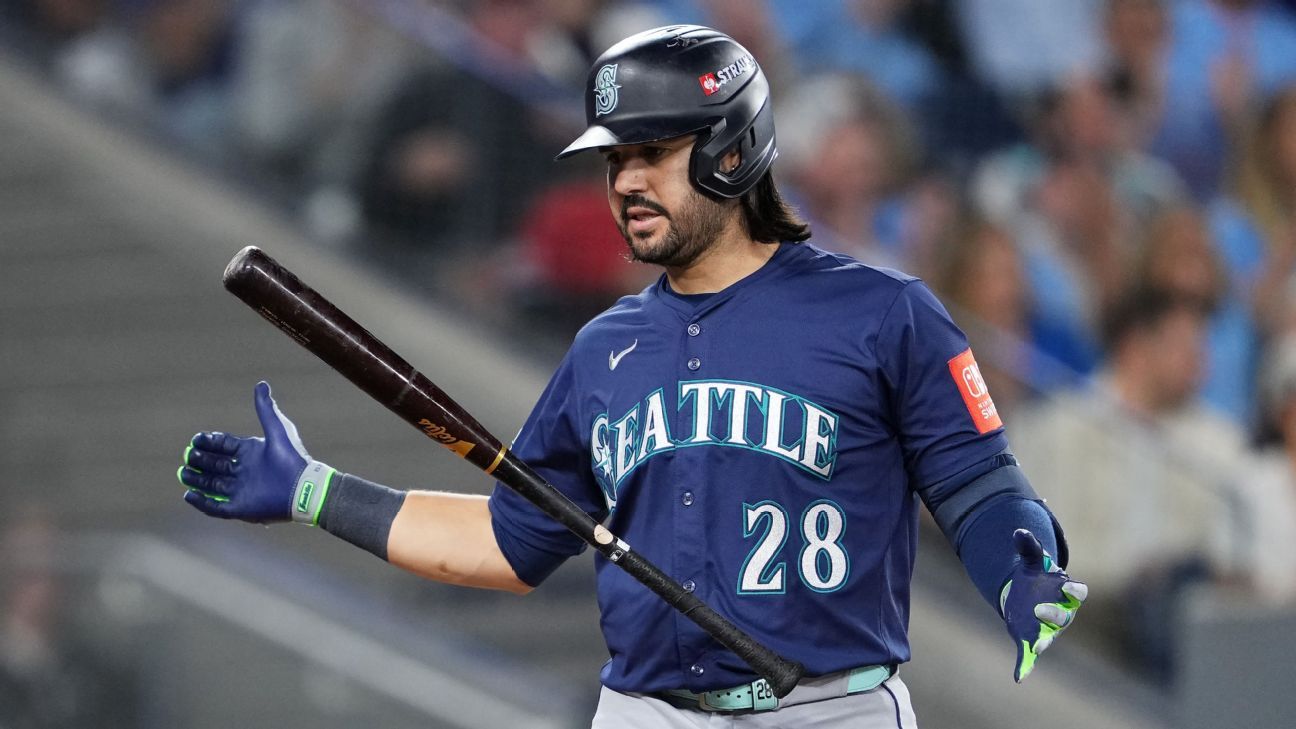
If there was an award for free agent prediction most to likely come true, Josh Naylor returning to the Seattle Mariners would have been the front-runner, so it’s hardly a surprise that this is the first significant signing of the offseason (pending a physical). As soon as the Mariners’ season ended with that heartbreaking loss in Game 7 of the ALCS, the front office made it clear that re-signing Naylor was its top priority. Such public vocalizations at that level are rare — and the Mariners backed them up with a five-year contract.
It’s easy to understand why they wanted Naylor back. The Mariners have been searching for a long-term solution at first base for, oh, going on 20 years — really, since they traded John Olerud in 2004. Ty France gave them a couple solid seasons in 2021 and 2022, but since 2005 only the Pirates’ first basemen have produced a lower OPS than Seattle’s.
Naylor, meanwhile, came over at the trade deadline from Arizona and provided a huge spark down the stretch, hitting .299/.341/.490 with nine home runs and 33 RBIs in 54 games, good for 2.2 WAR. Including his time with the Diamondbacks, he finished at .295/.353/.462 with 20 home runs in 2025. Given the pitcher-friendly nature of T-Mobile Park, it’s not easy to attract free agent hitters to Seattle, but Naylor spoke about how he loves hitting there. The numbers back that up: In 43 career games at T-Mobile, he has hit .304 and slugged .534.
Importantly for a Seattle lineup that is heavy on strikeouts, Naylor is a high-contact hitter in the middle of the order; he finished with the 17th-best strikeout rate among qualified hitters in 2025. Naylor’s entire game is a bit of an oxymoron. He ranks in just the seventh percentile in chase rate but still had a nearly league-average walk rate (46th percentile) with an excellent contact rate. He can’t run (third percentile!) but stole 30 bases in 32 attempts, including 19-for-19 after joining the Mariners. He doesn’t look like he’d be quick in the field, but his Statcast defensive metrics have been above average in each of the past four seasons.
He’s not a star — 3.1 WAR in 2025 was a career high — but he’s a safe, predictable player to bank on for the next few years. This deal runs through his age-33 season, so maybe there’s some risk at the end of the contract, but for a team with World Series aspirations in 2026, the Mariners needed to bring Naylor back. The front office will be happy with this signing and so will Mariners fans. — Schoenfield

-
Kiley McDaniel
Now that we’ve projected contracts for the top 50 free agents in this winter’s class, let’s take a look at which players could provide the most — and least — bang for their expected buck.
Over the past two years, I’ve done pretty well — investing in Sonny Gray, Shane Bieber and Shota Imanaga as free agents while avoiding the end of Justin Turner’s career and megadeals for players the market also avoided going long-term with that offseason, like Blake Snell, Pete Alonso, and Cody Bellinger. And now I’m back again to try to hit the bull’s-eye a few more times.
The projected contracts in my rankings provide important context for this exercise, as my choices are based on return on investment — how I expect the players to perform over the length of their deals at their projected prices.
The rules for this edition are the same I set out for myself last winter: Each group of three players must have one player projected to land more than $50 million, one projected for a one-year deal and at least one pitcher and one position player.
Here are my three free agents to invest in and three to avoid for the 2025-26 MLB offseason.

Free agents to invest in
Michael King, RHP
Projected contract: 3 years, $57 million
King looked to be in line for one of the biggest deals in this free agent pitching class entering 2025, coming off of a breakout 2024 where he threw 173.2 innings with a 2.95 ERA and peripherals not that much behind, with predictive ERA figures in the low-to-mid 3s, good for 3.9 WAR.
His 2025 season was somewhat lost though, as shoulder and knee issues cost him half the season, his strikeout rate dipped from 28% to 25% and he gave up more damage on contact. You could read that platform season as a setup for a make-good one-year deal with incentives, but there are enough unique qualities to King that I think he’ll land a multi-year deal.
Michael King, 93mph Sinker and 83mph Sweeper, Overlay. pic.twitter.com/8peVFu9zVU
— Rob Friedman (@PitchingNinja) April 30, 2025
That’s a good visual representation of what King does well: Wiffleball-level raw stuff. When he got hit around more in 2025, it was concentrated mostly in his four-seam fastball and sweeper. What changed? His zone rate on his heater dropped from 54% to 48%, and on his sweeper it dropped from 44% to 38%. The runs saved on those two pitches combined was +2 on over 1200 pitches in 2024 and -13 on 528 pitches in 2025. The rest of his arsenal played basically the same and all had steady to rising zone rates last season.
An eight-figure decision isn’t as simple as “he should just throw more strikes,” but King looked like a nine-figure free agent before some injuries that now seem behind him, stuff that was the same throughout it, and some location tweaks. That seems like a nice gamble in a world where a No. 3/No. 4 starter goes for $15-20 million per year.
Ha-Seong Kim, SS
Projected contract: 1 year, $16 million
The sales pitch for this former Padre isn’t that different from King. Kim was really good — from 2022 to 2024, he posted a combined 10.5 WAR, which is more than what Pete Alonso and Vladimir Guerrero Jr. posted in that period, despite` more plate appearances than Kim.
Then Kim tore the labrum in his shoulder in August 2024, which led to offseason surgery that caused him to miss roughly half of the 2025 season. Kim also had lower back and hamstring issues last season, while his sprint speed and arm strength were objectively not the same. The Braves claimed him off of waivers in September from the Rays, who paid him roughly $11 million for 24 games and 0.1 WAR. Kim turned down a $16 million player option earlier this offseason to hit the open market, and I’m guessing that’s roughly what he’ll end up with, though maybe with more incentives and maybe an option.
There isn’t a ton to look at in 2025 to give hope, but you can also look at Kim’s 2025 season as he wasn’t fully back and may have rushed a bit, then caused other injuries by overcompensating. I don’t have access to his medicals, but if my medical team clears him, it would appear 2026 is the season to bet on him looking something like his old self, the first full season after a major surgery. His track record of being a 3-win player that is solid average in all aspects is enough for me to gamble here, even though the downside is the 30-year-old is actually closer to his 2025 self going forward.
Brad Keller, RHP
Projected Contract: 2 years, $22 million
Every November, media reports start to trickle out about which free agent relievers teams are considering converting into starters. Reynaldo Lopez, Jordan Hicks, and Clay Holmes are some recent examples, and Keller actually has some similarities to Holmes. That’s one reason Keller’s contract could end up with similar terms to Holmes’ three-year, $38 million deal from last winter.
Keller found some success as a big league starter for Kansas City from 2018 to 2022, then had a bout with thoracic outlet syndrome, leading to up-and-down performances for the Royals, White Sox and Red Sox in various roles in 2023 and 2024, before his breakout role as a setup man for the Cubs in 2025.
One big reason for that change is Keller’s velocity jumped by about 3.5 mph in 2025, helped a bit by the shorter stints, as well. With that added bump, Keller threw his heater in the zone a lot more, jumping his zone rate from 53% to 60%. His lively sinker, slider, sweeper, and changeup are all located to tunnel off of that center-cut 95-99 mph heater. The cutter shape of his fastball is a favorite for pitch design-focused teams due to this movement inclination giving a chance for a seam-shifted sinker, kick changeup and multiple standout breaking pitches. I wrote more about this supinator type of arm in reference to Max Fried and Corbin Burnes here.
You can see why teams look at this situation and think that stretching Keller out to longer outings like he has in the past, giving back some velocity and whiffs, and getting a 150-inning starter with No. 3/No. 4 starter upside is worth a gamble, with a late-inning reliever as the fallback option. If a couple teams really believe he could find success in either role, the bidding could jump to three years at an eight-figure AAV.
I also seriously considered Kazuma Okamoto (more here) and Kyle Finnegan (more here), but the parameters of the exercise pushed me to Kim (due to his projected one-year deal) and Keller (the upside of a potential starter).
Free agents to avoid
Eugenio Suarez, 3B
Projected Contract: 2 years, $45 million
I’m going to cheat a bit here and use Suarez as my $50 million-plus contract since I don’t see a clear big-money guy to bet against, particularly because I picked Pete Alonso last year and he had a nice bounceback year on a prove-it deal, and Kyle Schwarber, an even older DH-only hitter, was even better. I think they’ll both be good for a few more years, then fall off, but that’s true of every giant hitter deal for a player in their 30s. I could even stretch and make a case for Kyle Tucker on those same grounds if he gets a 10-year-plus deal.
On to Suarez: There are a lot of blinking red lights here. He’s 34 years old, and his defensive metrics at third base have gone from +8 to +3 to -3 in the past three seasons. He has played six regular-season innings at first base in his big league career, so you’re either dealing with an aging, below-average defensive third baseman who you’re hoping to move somewhere else, paying big money for him to learn a new position on the fly, or you’re signing a designated hitter.
At the plate, his pitch selection and high-end exit velos are just OK, so you’re basically buying Suarez’s elite ability to slug with little else to back it up. His isolated slugging in 2025 was his best since 2019 and just a hair off of a career best, so I’d bet on that backing up to some degree, but possibly a lot if Suarez’s bat speed also dips.
Zach Eflin, SP
Projected contract: 1 year, $8.5 million
Normally, I’d look at Eflin’s dominating 2023 season (177.2 innings, 3.50 ERA, 4.9 WAR), slightly lesser 2024 (2.8 WAR) then disastrous 2025 season (-0.3 WAR) and see him as a nice bounceback option for some bulk innings. It’s hard picking someone to avoid in the low-risk one-year deal bucket, but I don’t like the indicators I’m seeing in Eflin’s data.
His four-seam fastball velocity has slipped two years in a row and his secondary pitches are getting less crisp. Eflin’s best offspeed pitch in 2023 was his curveball, saving +9 runs. Since then, the pitch has lost 1 mph and went to -7 runs in 2024, then -12 runs in 2025. His primary fastball is a sinker, and it has gone from +13 to +4 to -3 runs from 2023 to 2025. Eflin’s changeup has emerged to save the day as his only run-saving pitch (+4) in 2025.
It seems like Eflin is becoming a pitch-to-contact guy and holding his breath on roughly two-thirds of his pitches. If he can get his velo to hold and then also locate well, he could still end up being a useful backend starter in 2026, but this set of facts also can result in an unconditional release before the All-Star break.
Projected Contract: 2 years, $32 million
Marcell Ozuna, DH
Projected Contract: 2 years, $30 million
Harrison Bader, OF
Projected Contract: 2 years, $25 million
I’m going to cheat a little bit again here, because the cases to avoid all three of these players are similar but focus on slightly different parts of their games. And I also had trouble picking just one, so this is easier.
Realmuto, 34, is still a standout athlete for a catcher and an excellent controller of the running game. The rest of his game has been regressing, and at his age as a catcher, things can sometimes fall off a cliff if you have to count on multiple years of performance.
We can sum up his offensive contributions pretty well with expected wOBA, which strips out ball in play luck and predicts his offensive production based on the exit velo, launch angle, etc.: .351 in 2022, .334 in 2023, .339 in 2024, .315 in 2025. His isolated power (slugging minus batting average, so stripping out the singles to focus on extra bases) in that same span: .202, then .200, then .163, then .127. Realmuto’s bat speed dropped 23 percentile points, to below average, in 2025: You get the idea. His framing numbers went from positive in 2022 to a combined -30 over the past three years, negative each year. I think he’s still a solid starter next year, but it’s hard to be confident after that given these trends.
Ozuna is a right-handed-hitting designated hitter who just turned 35, so he’s already generically in the danger zone when it comes to multiyear deals. He also battled a hip issue starting in roughly May of last season, and if you split his season in half on June 1, you get a stark contrast: .284/.427/.474, 155 wRC+ (55% better than league average as a hitter) in 241 PA before, .199/.306/.354, 86 wRC+ (14% worse than average) in 351 PA after. He might be fully recovered from this in 2026, but I’m not willing to bet much on something like that not happening again, or his decline (.402 xwOBA in 2024, .351 in 2025) accelerating in a fully healthy season when there’s no defensive or baserunning value to protect against it.
Bader had a huge 2025, with his WAR jumping from 1.2 in 2024 to 3.2. This was driven almost entirely by what he did at the plate, with his wOBA jumping from .285 to .346. Here’s where expected wOBA can tell a predictive story: His xwOBA was an identical .295 in both seasons. Bader’s 2.0 WAR jump was entirely created by his hitting, but his underlying performance was exactly the same in both seasons.
He’s 31 years old now and has long been considered a standout defender in center field, but those numbers also dipped last season. Bader is still a championship-level fourth outfielder who can start for certain teams, but that’s what he was last year when Minnesota signed him for one year, $6.25 million plus incentives. He shouldn’t get much more than that, but I think he will.

-
Jorge Castillo
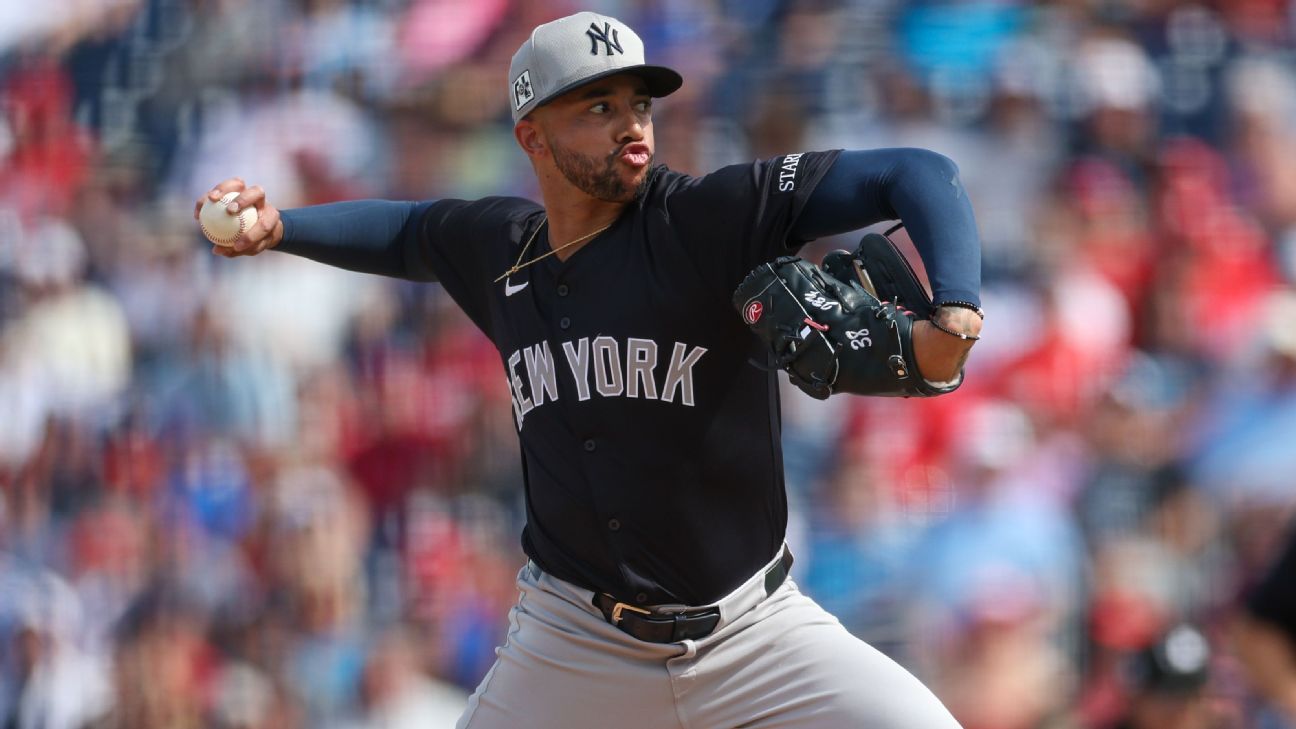
Devin Williams entered free agency with opportunities to sign with clubs as a clear-cut closer. But the right-hander agreed to a three-year, $51 million deal with the New York Mets this week knowing the ninth inning could go to Edwin Díaz if the All-Star closer returns to Queens in free agency.
“I think it’s just a good situation,” Williams said on a video call with reporters Friday. “If he comes back, I think we’re going to have a really good back of the pen. More good arms is always a good thing. That’s really it.”
Díaz opted out of his contract last month with two years and $38 million remaining, determined to secure another multiyear deal approaching the five-year, $102 million pact he signed with the Mets after the 2022 season. The Mets remain interested in a reunion, sources tell ESPN, but Williams gives them a proven backup plan, which could dampen the team’s willingness to meet Díaz’s demands.
If Díaz returns to the Mets, Williams would assume a setup role. It’s a familiar job. The 31-year-old burst onto the scene with the Milwaukee Brewers in 2020, winning NL Rookie of the Year as a setup man for closer Josh Hader. He thrived in the role until Hader was traded in July 2022, an unexpected move that elevated Williams to closer and helped plummet the Brewers from first place in the NL Central to out of the postseason.
Mets president of baseball operations David Stearns ran the Brewers’ front office at the time. He left the organization after the 2023 season, and Williams continued shining in the ninth inning in Milwaukee, posting a 1.46 ERA with 50 saves in 68 games between 2023 and 2024 — his first two full seasons as a closer.
“I’m familiar with the way that he wants the organization to run,” Williams said of Stearns. “The way they want to do things and their process. I think it’s another familiarity for me, so it’s all comfortable.’
Last winter, the Brewers, unwilling to re-sign Williams at his projected premium price in free agency, traded him to the New York Yankees. Williams arrived in the Bronx as the closer, but he struggled out of the gate and lost the job by the end of April. He became the closer again in early June, then lost the job again after the trade deadline, when the Yankees acquired David Bednar from the Pittsburgh Pirates and moved him into the role.
Overall, it was not the platform year Williams and the Yankees expected. He oscillated between ugly and dominant stretches, concluding the year on a high note with 13 scoreless innings over his final 13 outings from Sept. 7 through the postseason. He finished the regular season with a bloated 4.79 ERA, but his peripheral numbers were not far off his usual elite form. Williams lamented mechanical issues and pitch selection for his dismal outings — he was charged with multiple earned runs in 10 of his 67 appearances.
Famously a two-pitch pitcher with a fastball and his unique Airbender changeup, Williams said he is tinkering with a cutter and a gyro slider with the goal of expanding his arsenal with a pitch that moves glove side. He said that adding to his repertoire is “something that I felt I needed to do for a while” and that he has worked on the pitches for years. Now it’s about using one of the offerings — or both — in games.
“Seeing if I can add those to what I do and give myself a little more breathing room with the fastball and changeup,” Williams said.
-
 Sports2 years ago
Story injured on diving stop, exits Red Sox game
-
 Sports3 years ago
‘Storybook stuff’: Inside the night Bryce Harper sent the Phillies to the World Series
-
 Sports2 years ago
Game 1 of WS least-watched in recorded history
-
 Sports3 years ago
Button battles heat exhaustion in NASCAR debut
-
 Sports3 years ago
MLB Rank 2023: Ranking baseball’s top 100 players
-
Sports4 years ago
Team Europe easily wins 4th straight Laver Cup
-
 Environment3 years ago
Japan and South Korea have a lot at stake in a free and open South China Sea
-
 Environment1 year ago
Here are the best electric bikes you can buy at every price level in October 2024