
Regent aims to fly its electric seagliders over the waterways of Japan

Billy Thalheimer (CEO) and Michael Klinker (CTO) of REGENT with a full-scale mockup of their first electric seaglider.
Courtesy REGENT
Regent, a startup developing electric seagliders to transport people and cargo, has raised a $60 million round of venture funding and struck a partnership with Japan Airlines to figure out how to bring the company’s flying electric ferries to the waterways of Japan.
Venture fund 8090 Industries co-led Regent’s series A round alongside Peter Thiel’s Founders Fund, with Japan Airlines Innovation Fund and Point72 Ventures also participating among others. The new funding brings Regent’s total capital raised to $90 million to-date, according to co-founder and CEO Billy Thalheimer.
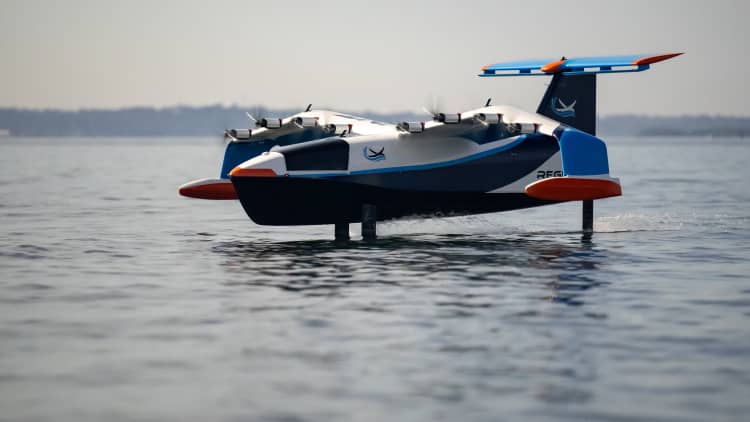
The funding follows two major milestones for the clean transportation startup. As CNBC previously reported, Regent built a quarter-scale prototype and completed a series of test runs on Rhode Island’s Narragansett Bay late last year to prove that its seagliders, which are technically known as wing-in-ground-effect craft (WIGs) can “float, foil and fly” as expected.
The prototype was able to repeatedly motor out of a harbor slowly, then launch from a speed of about 40 mph into the air, where it flew around 10 feet above the open ocean at a speed of approximately 50 mph in different, travel-safe weather conditions.
The commercial version of this battery powered 12-seater, named the Viceroy, will fly higher above the water at speeds of up to 180 mph, Thalheimer says. The battery that powers the Viceroy seaglider will have a range of about 180 miles.
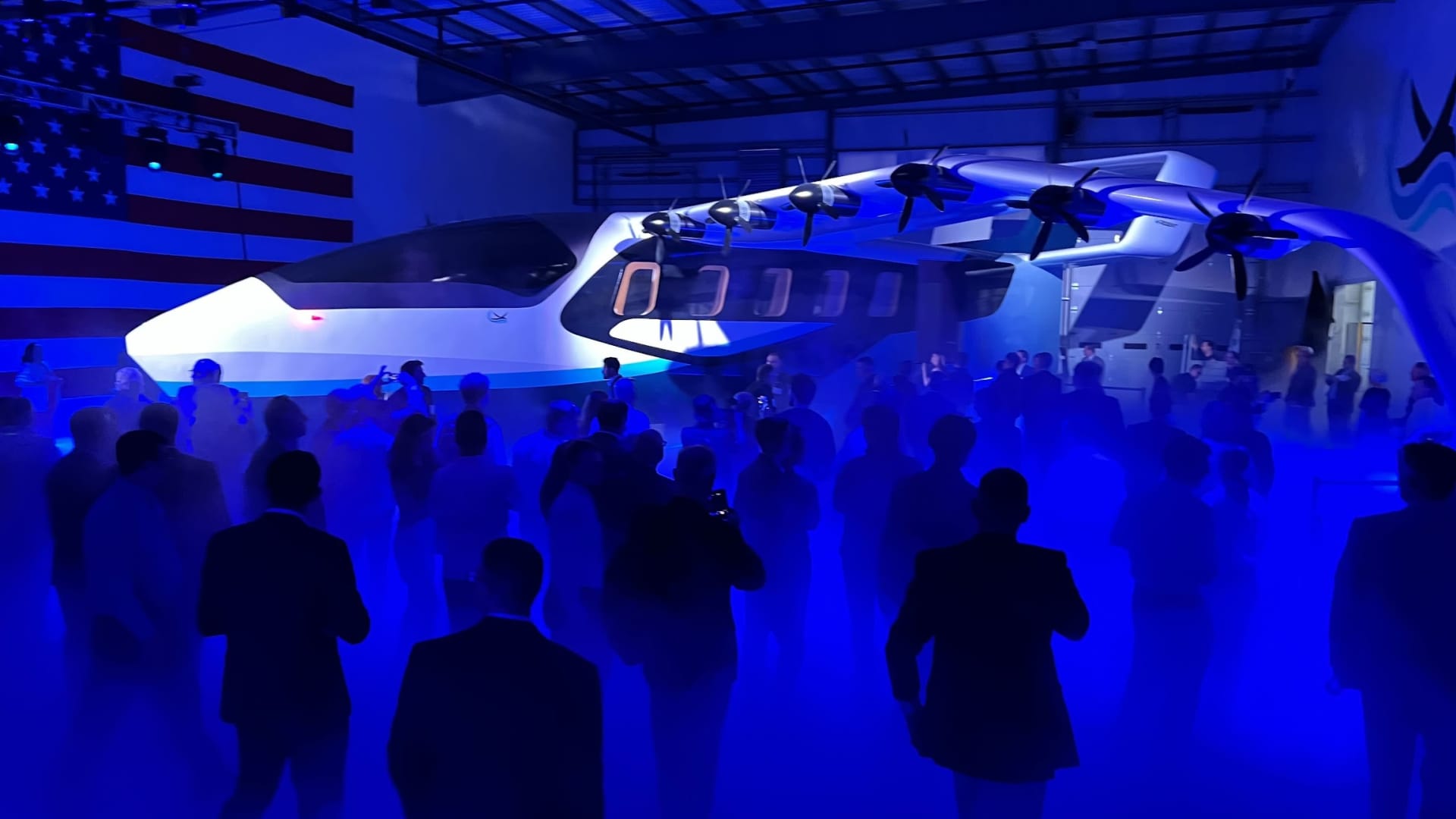
More recently, Regent built a full-scale mockup of the Viceroy, and a “sim room” at its headquarters where visitors can sit in a mock cockpit, and virtually fly the seaglider over any chosen waterway. Thalheimer said, “You can build as many decks or pitches as you want but this is the experience that unlocks excitement.”
Regent has built a full-scale mockup of its first electric seaglider, the 12-seat Viceroy.
Courtesy REGENT
Eventually, travelers should be able to go down to a dock and board Regent seagliders like they would a regular ferry or water taxi. Besides using these WIGs for travel in coastal communities, Regent plans to sell seagliders to organizations providing cargo transport, search and rescue, offshore logistics as well as security and defense services.
Airlines and ferry operators including Mesa Airlines, Brittany Ferries and FRS are among customers who have already signed deals to purchase Regent’s seagliders. The company says it has orders for more than 500 seagliders representing some $8 billion in future revenue. Southern Airways is poised to take the first production Viceroy, which it plans to operate under their Mokulele Airlines brand. Mokulele currently operates inter-island routes throughout Hawaii.
Regent will use its new round of funding for hiring as well as building and testing full-scale prototypes of the Viceroy, along with all the safety systems required to run the seagliders with people on board, Thalheimer says.
The company already has 55 full-time employees, the CEO said, and has managed to attract talent from the likes of SpaceX and Bureau Veritas, an international regulator of ships and vessels.
Longer term, Regent is developing a 100-seat seaglider dubbed the Monarch which is in early design stages. Including regulatory approvals, the company expects its Viceroy 12-seat seagliders to be in production and in service within two to three years. It expects the larger Monarch seagliders to be in service by 2030.
8090 Industries general partner Rayyan Islam, who co-led the series A investment in Regent, told CNBC that his firm backed the startup because of the demand for its seagliders, and the early team’s success in prototyping and proving the viability of the Viceroy.
Islam’s firm sees a new industrial revolution underway, one in which every sector will need to pursue “decarbonization” in a way that makes good business sense. Regent’s seagliders, the investor said, can eliminate much of the greenhouse gas emissions from short-haul flights in aviation, and other emissions from ferries and water taxis, which typically run on diesel while working alongside existing infrastructure.
Islam also envisions Regent seagliders carrying people and equipment to help build, monitor or maintain offshore energy developments, from aging oil rigs to massive wind turbines.


Meta CEO Mark Zuckerberg wears the Meta Ray-Ban Display glasses, as he delivers a speech presenting the new line of smart glasses, during the Meta Connect event at the company’s headquarters in Menlo Park, California, U.S., Sept. 17, 2025.
Carlos Barria | Reuters
Meta is acquiring artificial intelligence wearable startup Limitless, the companies said Friday.
“We’re excited that Limitless will be joining Meta to help accelerate our work to build AI-enabled wearables,” a Meta spokesperson said in a statement.
Limitless makes a small, AI-powered pendant that can record conversations and generate summaries.
Limitless CEO Dan Siroker revealed the deal on Friday via a corporate blog post but did not disclose the financial terms.
“Meta recently announced a new vision to bring personal superintelligence to everyone and a key part of that vision is building incredible AI-enabled wearables,” Siroker said in the post and an accompanying video. “We share this vision and we’ll be joining Meta to help bring our shared vision to life.”
The world of AI wearables has been slowly growing this year, but no company has landed a standout product.
Meta’s Ray-Ban smartglasses, which have been a surprise hit, have a sprinkling of AI flavor with the inclusion of the company’s AI digital assistant.
There are several wearable devices available that are similar to Limitless.
Friend offers a pendant-style device, Plaud comes in a small card shape or pill that can be clipped on or worn around your neck or on your wrist, and Bee, which is worn on a wristband and was scooped up by Amazon in July.
Amazon also runs AI through its Alexa+ line of Echo Speakers, while Google‘s Pixel 10 phones have the Gemini assistant built in.
WATCH: Meta is visibly seeing a return on investment from AI.
CNBC’s Chris Eudaily contributed to this report.
Technology
Salesforce shares pop 5%, continuing post-earnings rally and leaving stock poised for best week since 2023

-
 Sports2 years ago
Story injured on diving stop, exits Red Sox game
-
 Sports3 years ago
‘Storybook stuff’: Inside the night Bryce Harper sent the Phillies to the World Series
-
 Sports2 years ago
Game 1 of WS least-watched in recorded history
-
 Sports3 years ago
Button battles heat exhaustion in NASCAR debut
-
 Sports3 years ago
MLB Rank 2023: Ranking baseball’s top 100 players
-
Sports4 years ago
Team Europe easily wins 4th straight Laver Cup
-
 Environment3 years ago
Japan and South Korea have a lot at stake in a free and open South China Sea
-
 Environment1 year ago
Here are the best electric bikes you can buy at every price level in October 2024