
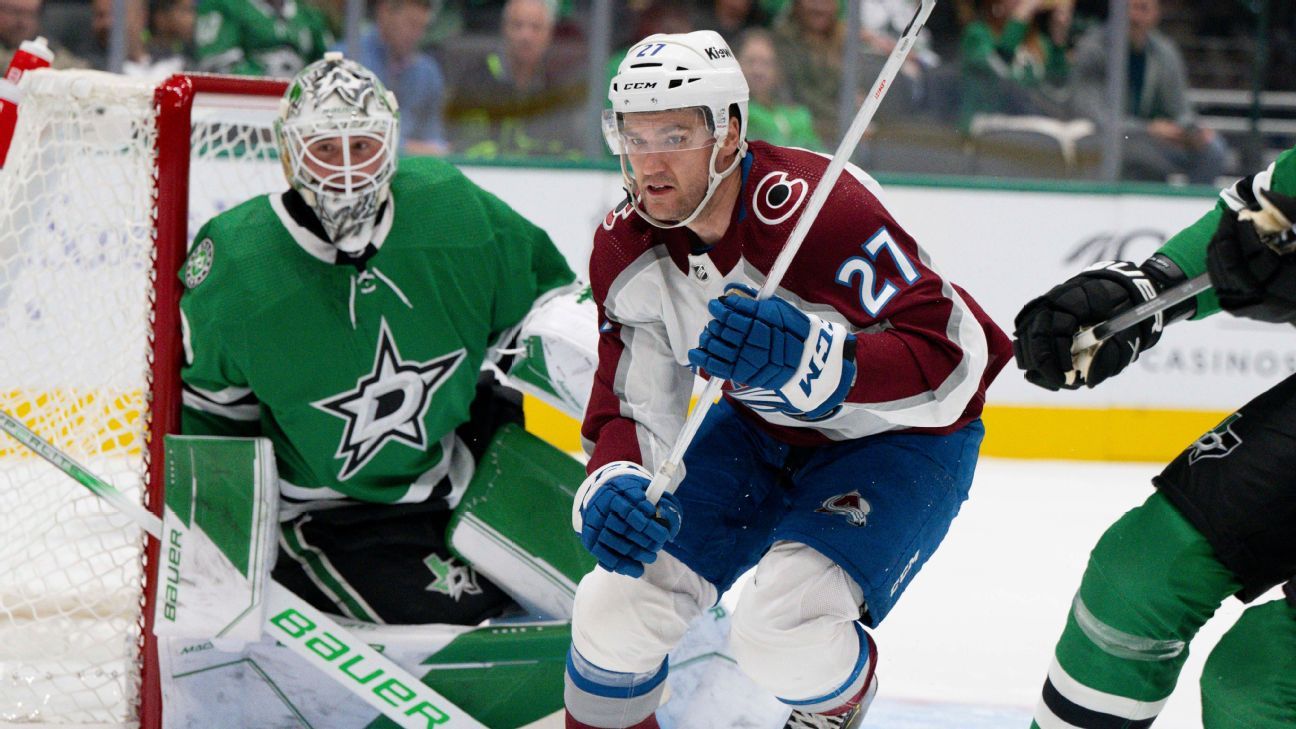
Why Colorado could be the perfect landing spot for Jonathan Drouin


-
Ryan S. Clark, NHL reporter
CENTENNIAL, Colo. — Coming here was not the only option. It was just the best one for Jonathan Drouin.
Every choice has its consequences. Other NHL teams reached out to Drouin and his representatives about joining their club. Those clubs had more salary cap space and offered more money than what the Colorado Avalanche presented to Drouin, which was a one-year contract worth $825,000 — a substantial dip from the $5.5 million annual salary he earned over the past six seasons.
Every choice also has its advantages. Drouin makes this clear while sitting in his stall at the Avs’ rustic practice facility just south of downtown Denver. One of them has to do with the stall just to the right of Drouin. Or rather, who occupies that space. It’s Avs superstar center and perennial Hart Trophy candidate Nathan MacKinnon. They’re best friends and have known each other for more than a decade, dating to when they were teammates with the Halifax Mooseheads in the Quebec Major Junior Hockey League.
Another advantage is what playing for the Avs represents. It was just this time last year that the Avs were seeking to win a consecutive Stanley Cup. They navigated a series of challenges to win the Central Division and finish with the best regular-season record in the Western Conference, only to then have their title aspirations cut short with a first-round exit by the upstart Seattle Kraken.
Championships are how this current iteration of the Avs is being defined. One key to that has been bringing in players and helping them find higher levels of success than they’d seen before. Forwards such as Andre Burakovsky, Nazem Kadri, Artturi Lehkonen and Valeri Nichushkin all set career highs while playing with Colorado. Defenseman Devon Toews went from a top-four option to a low-key Norris Trophy candidate since playing here. Goaltenders such as Alexandar Georgiev, Philipp Grubauer and Darcy Kuemper also enjoyed the strongest seasons of their careers with the Avs.
Is Drouin next? Can he parlay this opportunity into helping the Avs win their fourth Cup while also showing at 28 years old that the best is yet to come?
“With the team here, everyone could probably achieve their career numbers with the way they play and the way they move the puck,” Drouin said. “But that wasn’t really the main reason [why he signed with the Avalanche]. I don’t really have any goals for me other than finding my game back and helping this team in any way I can.”
SCARS CAN OFTEN go beyond being marks on flesh. They provide illustrations into the pain of a life. In Drouin’s case, he has two scars — one on each wrist — from the surgeries he has endured over the past few years.
Remnants of those incisions are noticeable, not just on Drouin’s body but his mind as well. Those scars were born out of pain and have created doubt, but now they have made Drouin optimistic. This is the first time in a while Drouin said he didn’t spend the offseason rehabbing from wrist surgery before starting his workouts.
Having confidence in a pair of fully healthy wrists is what has made the beginning of Avs’ training camp fruitful for him. Drouin has provided more than enough evidence to show that his wrists are fine. It’s the passes he plays during drills or the shots he takes.
Everything about the way his wrists move is fluid, smooth and uninterrupted — three traits that have not always been the easiest to attain in a career that has faced setbacks.
Expectations have long followed Drouin. Recording a pair of 100-point seasons in the QMJHL does that. So does going No. 3 overall in the 2013 draft to the Tampa Bay Lightning. He played three seasons in Tampa, with his final year there amplifying those expectations as Drouin scored a career-high 21 goals and 53 points.
Friction was also a part of Drouin’s time with the Lightning, which is what eventually led to him being traded to the Montreal Canadiens. Drouin scored 99 points in 158 games in his first two seasons with the Canadiens. Injuries hindered that production, however. In Drouin’s final four seasons, he recorded 87 points in 163 games with 29 points in 58 games in the 2022-23 campaign being his most productive.
Fighting through injuries also came at a time when Drouin was attempting to manage his mental health. He’s open about detailing the life-changing anxiety he experienced more than three years ago.
Drouin said he started experiencing anxiety in the early stages of the COVID-19 pandemic, adding that “being in the bubble didn’t help” — a reference to when the NHL held the 2019-20 Stanley Cup playoffs in bubbles in Edmonton and Toronto.
“The two months in the bubble really lingered,” Drouin said. “I don’t think I could tell you if we didn’t have that bubble I would have been fine or I wouldn’t have had to stop playing. But the bubble and the COVID year in Montreal, we had rules in Canada where you could not leave your house unless you were walking your dog. I’d walk my dog six times a day to get out of my house.”
Drouin also said being a top-three pick and a French Canadian who grew up an hour away from Montreal also contributed to his anxiety. He believed he was ready to carrying those expectations because he grew up watching other players handle them.
“Until you live it,” Drouin said. “No one’s ready for it.”
Longtime NHL agent Allan Walsh, who has known Drouin and represented him since he was a teenager, also grew up in Montreal. Walsh said playing in Montreal comes with “a wholly unique set of challenges and pressures” that no one can fully understand until they encounter it.
Walsh said playing in Montreal means coming off the ice to be greeted by 15 cameras and more than 30 media members on a near-daily basis. There’s also the constant attention that comes when a player is walking down the street, if they visit a local market for groceries or if they eat at a restaurant.
“You want to be welcoming and understand that this is a privileged set of circumstances that you are living under, yet at the same time when things are not going well, it’s just grinding you down every day,” Walsh said. “There’s no getting away from hockey off the ice. What players tend to do in this situation … is you tend to cocoon. You order in your food, you don’t go to the market, you don’t walk down the street, you don’t walk to the park to get some fresh air. You tend to avoid people and crowds. It turns into an isolating and insulated life and that is not always the healthiest lifestyle.”
Although Drouin wasn’t performing to the level he or the fans wanted, it wasn’t the primary reason why he struggled with anxiety.
Sleeping was challenging. Drouin would lie awake at night for hours, only thinking about hockey. He would think about the next game or what happened in the game the day before. Those thoughts forced him to replay an entire game in his head. Every single sequence that he was involved in played in his mind as if it were on a continuous loop that could only be interrupted when he realized he only had two hours to sleep before practice.
“I didn’t really go to sleep until I got help and really someone to talk to about the perspective of getting sleep and getting rest,” Drouin said. “At one point, it was just normal for me. I thought it was normal. I didn’t want help. I didn’t feel like I needed help. When you’re sleeping two or three hours a night, you can’t function as an athlete. You can’t perform the way you want to and your body is not responding either.”
Drouin said he realized he needed help when the Canadiens were in Calgary to play the Flames during the 2020-21 season. During that season, the NHL created what was basically an all-Canadian North Division so those teams could travel across Canada to comply with the nation’s COVID-19 restrictions.
“My body literally shut off on me. I remember that first practice and came to the hotel room and started feeling sick, started feeling tired and started having attacks,” Drouin said. “It was new for me and I thought I was sick. I thought I had a fever or something. Obviously, the doctor came and saw me and there was no fever and now I was even more worried about why I was feeling this way.”
Drouin said that “losing control of my body and having my body control me,” was the breaking point. He called his parents and close friends to open up about what he was experiencing. Drouin described it as one of the hardest and most emotional experiences of his life.
A week after his experience in Calgary, Drouin decided to step away from hockey.
“My parents knew and that was the part that hurt me when I was on the phone with them,” Drouin said. “My parents saw it before I saw it. When that phone call happened, I knew it was time to focus on me for once and get better. I’m still young but I was younger then and knew I still had a lot of years left in the NHL. I couldn’t follow that up for 10 years to live that way and handle that stuff by myself. I knew I needed help. Ever since then, my life has been great and I know how to handle those things.”
Opening up about anxiety and undergoing therapy were the first steps toward personal happiness, Drouin said. He found pleasure professionally the past two years in Montreal as well. The organization went through sweeping changes that led to the Canadiens hiring Kent Hughes as their general manager with Hockey Hall of Fame inductee Martin St. Louis becoming head coach.
Drouin said the arrival of Hughes and St. Louis created a sense of newness with the franchise which he believed gave him a clean slate. It also might have contributed to the past two seasons being among the most productive of his career.
While it’s natural to look at his statistics, Drouin explained how he found more positives in his game, allowing him a sense of comfort.
“The last two years have been good and I haven’t had anxiety, nor have the sleeping issues really come back,” Drouin said. “It’s been very positive.”
MONTREAL ALLOWED DROUIN to fulfill a childhood dream of donning those iconic red, blue and white sweaters that made him fall in love with hockey. But the reality of playing in Montreal at this stage of his career and the Canadiens building for the future did not quite align with Drouin’s aspirations to win a Stanley Cup.
There were opportunities elsewhere. Walsh said that there were “multiple teams with offers on the table and all for more money” while Drouin pondered his future.
He decided it was Colorado or bust.
“He was very motivated to reunite with Nate,” Walsh said. “Nate was texting him and calling him several times a day, pushing him to come to Denver and to come together again.”
The decision to join the Avalanche was layered. It started with Drouin’s relationship with MacKinnon, the fact that MacKinnon is one of the best players on the planet and is one of the faces on a team expected to complete for another championship. And Colorado made it clear it wanted Drouin.
Drouin also examined his surroundings. Avalanche coach Jared Bednar has not only won a Stanley Cup, but is the third-longest tenured coach in the NHL behind the Lightning’s Jon Cooper and the Pittsburgh Penguins‘ Mike Sullivan. Having a coach with the longevity and success Bednar and his assistants have and them wanting Drouin also was welcoming.
“Management is also sensitive to the challenges you have had before and is excited to bring you in too,” Walsh said. “Players love to go places where they feel wanted. From July 1, Jonathan felt like Colorado really wanted him. Players in the locker room really wanted him and it gave him a chance to turn things over and get a fresh start somewhere.”
Part of the reason the Avalanche has found success in recent years is how they make new players and their families feel welcomed. MacKinnon, who is an alternate captain, is quite involved in the process.
Several stories have been shared about MacKinnon’s intense nature. One came when Burakovsky joined the Avalanche after he was traded from the Washington Capitals. MacKinnon spent part of the offseason examining Burakovsky’s statistics and advised him to shoot more. Burakovsky recorded his first 20-goal season while scoring what was then a career-best 45 points over 58 games of the pandemic-shortened 2019-20 season.
“I think since we have a relationship already it was easier, a little easier for me to kind of do some things that I think he should do on and off the ice,” MacKinnon said. “That’s been a lot easier for a new player. I’m not used to having new players come in that I’m really good friends with. But other than that, I try to make everyone feel welcomed as I can. We have a lot of new faces, so it’s definitely going to be important for us to come together quickly.”
Reuniting with MacKinnon comes with a sense of nostalgia and warm feelings. Drouin smiles when looking back at how MacKinnon would pick him up for school or practices, all while blaring early-2010s hip-hop. Drouin chuckles upon sharing that the biggest difference with the 18-year-old version of MacKinnon who drove him around Halifax versus the 28-year-old who is trying to steer him toward a Stanley Cup is that older MacKinnon is calmer.
Drouin is also realistic. He knows coming to Denver and playing with one of his best friends will be a challenge. Drouin said even as a teenager MacKinnon pushed their teammates considerably. He knows that type of mentality is what has allowed MacKinnon to be one of the best players in the world and also helped the Avs attain a level of success other teams covet.
What Drouin said about MacKinnon on a recent Friday afternoon backs that up. MacKinnon missed practice that day because he wasn’t in Denver or Colorado. He was home in Halifax, where the Mooseheads retired his number.
The following morning, MacKinnon returned, having taken an early morning flight so he could participate on the third day of training camp in late September.
“He hasn’t changed with that part, he was the same in junior where he’d push you to the end of the wall, sees there’s a hole in the wall and wants you to go further,” Drouin said. “I think this is why this team is so good. It looks like there’s a lot of guys who buy into that and become kind of like Nate a little bit. I think that’s why Nate’s had success [because] he’s never really satisfied with anything.”
MacKinnon’s mentality is one thing that defines this iteration of the Avs. Another is how they continue to have success with new players since Bednar and his staff have taken charge.
While Bednar admits that not every new player the Avs have acquired has found their place, there’s evidence that shows a good number of them have. Burakovsky had his three most productive seasons and could have been a three-time 20-goal scorer if not for the pandemic. Kadri went from averaging 0.64 points per game with the Toronto Maple Leafs over 10 seasons to averaging 0.87 points in three seasons with the Avalanche. Lehkonen finished with a career-high 21 goals and 51 points in his first full season with the Avs, while Nichushkin went from a first-rounder who struggled with the Dallas Stars to a hulking two-way presence averaging 0.63 points per game.
What is it about Denver that allows players — especially forwards — to reach the sort of highs they didn’t achieve elsewhere? Bednar said it is a multifaceted process that starts with the front office identifying players whom it believes will excel.
Bednar said if the Avs get those players, the next step is to have them spend time with the team to get acclimated. That gives new players a chance to experience the Avs’ work ethic, how their leaders work, how competitive they are and how much everyone pays attention to details.
Ryan Johansen, who was traded to the Avs in the offseason, echoed those sentiments.
“I remember our last playoff series where they swept up and it felt like there were 20 MacKinnons on the ice and six [Cale] Makars on defense. I’m not kidding. That’s what it felt like,” Johansen said, referencing when he and the Nashville Predators lost to the Avs in a first-round series during the 2022 playoffs. “The speed this team plays with, it’s exciting for me to be a part of it.”
Another newcomer who had a firsthand encounter with it was Ross Colton, who was also traded in the offseason. Colton won a Cup with the Lightning in 2021 and went against the Avs in a six-game Final during the 2022 playoffs.
“The organization I came from had great leadership and guys who knew how to win in the league and you see the same thing here,” Colton said. “Guys who know what it takes to win, how to carry themselves on and off the ice.”
Something else Bednar does with new players is watch 10 of their games from the previous season. He watches how they played early in the season, in the middle and late. He looks for how they performed in good games and bad ones. Bednar said he takes notes to get ideas about how to optimize a player’s usage based on how they operated with their former team.
“When you come in here, you really don’t have a choice but to follow that same thing,” Bednar said. “That’s going to bring out the best in people. I think [Drouin] is a perfect candidate to be able to step in and help us. The first three days of camp, he’s been one of the hardest working guys on the ice. He’s shown real quickness with an ability to make plays and score goals and play with those top guys.”

-
Dan Wetzel
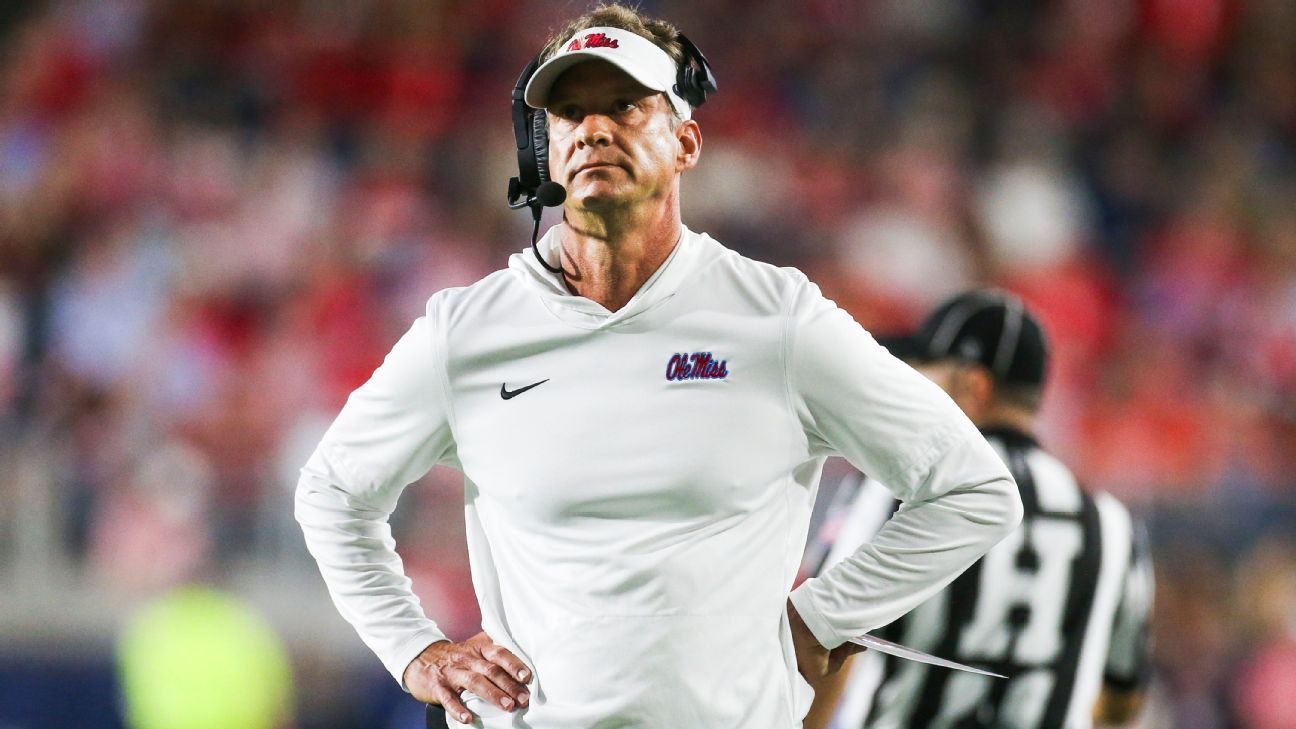
As victims go, Lane Kiffin doesn’t seem like one.
He could have stayed at Ole Miss, made over $10 million a year, led his 11-1 team into a home playoff game and become an icon at a place he supposedly found personal tranquility. Or he could’ve left for LSU to make over $10 million a year leading a program that has won three national titles this century.
Fortunate would be one description of such a fork in life’s road. The result of endless work and talent would be another.
But apparently no one knows a man’s burdens until they’ve walked a mile in his hot yoga pants.
Per his resignation statement on social media, it was spiritual, familial and mentor guidance that led Kiffin to go to LSU, not all those five-star recruits in New Orleans.
“After a lot of prayer and time spent with family, I made the difficult decision to accept the head coaching position at LSU,” he wrote.
In an interview with ESPN’s Marty Smith, Kiffin noted “my heart was [at Ole Miss] but I talked to some mentors, Coach [Pete] Carroll, Coach [Nick] Saban. Especially when Coach Carroll said, ‘Your dad would tell you to go. Take the shot.'” Kiffin later added: “I talked to God, and he told me it’s time to take a new step.”
After following everyone else’s advice, Kiffin discovered those mean folks at Ole Miss wouldn’t let him keep coaching the Rebels through the College Football Playoff on account of the fact Kiffin was now, you know, the coach of rival LSU.
Apparently quitting means different things to different people. Shame on Ole Miss for having some self-esteem.
“I was hoping to complete a historic six-season run … ,” Kiffin said. “My request to do so was denied by [Rebels athletic director] Keith Carter despite the team also asking him to allow me to keep coaching them so they could better maintain their high level of performance.”
Well, if he hoped enough, Kiffin could have just stayed and done it. He didn’t. Trying to paint this as an Ole Miss decision, not a Lane Kiffin decision, is absurd. You are either in or you are out.
Leaving was Kiffin’s right, of course. He chose what he believes are greener pastures. It might work out; LSU, despite its political dysfunction, is a great place to coach ball.
Kiffin should have just put out a statement saying his dream is to win a national title, and as good as Ole Miss has become, he thinks his chance to do it is so much better at LSU that it was worth giving up on his current players, who formed his best and, really, first nationally relevant team.
At least it would be his honest opinion.
Lately, the 50-year-old Kiffin has done all he can to paint himself as a more mature version of a once immature person. In the end, though, he is who he is. That includes traits that make him a very talented football coach. He is unique.
He might never live down being known as the coach who bailed on a title contender. It’s his life, though. It’s his reputation.
One of college sports’ original sins was turning playcallers into life-changers. Yeah, that can happen, boys can become men. A coach’s job is to win, though.
A great coach doesn’t have to be loyal or thoughtful or an example of how life should be lived.
This is the dichotomy of what you get when you hire Kiffin. He was on a heater in Oxford, winning in a way he never did with USC or Tennessee or the Oakland Raiders.
That seemingly should continue at resource-rich LSU. Along the way, you get a colorful circus, a wrestling character with a whistle, a high-wire act that could always break bad. It rarely ends well — from airport firings to near-riot-inducing resignations to an exasperated Nick Saban.
LSU should just embrace it — the good and the not so good. What’s more fun than being the villain? Kiffin might be a problem child, but he’s your problem child. It will probably get you a few more victories on Saturdays. He will certainly get you a few more laughs on social media.
It worked for Ole Miss, at least until it didn’t. Then the Rebels had to finally push him aside. This is Lane Kiffin. You can hardly trust him in the good times.
If anything, Carter had been too nice. He probably should have demanded Kiffin pledge his allegiance weeks back, after Kiffin’s family visited Gainesville, Florida, and Baton Rouge.
Instead, Kiffin hemmed and hawed and extended the soap opera, gaining leverage along the way.
Blame was thrown on the “calendar,” even though it was coaches such as Kiffin who created it. And leaving a championship contender is an individual choice that no one else is making.
Blame was put on Ole Miss, like it should just accept desperate second-class hostage status. Better to promote defensive coordinator Pete Golding and try to win with the people who want to be there.
To Kiffin, the idea of winning is seemingly all that matters. Not necessarily winning, but the idea of winning. Potential playoff teams count for more than current ones. Tomorrow means more than today. Next is better than now.
Maybe that mindset is what got him here, got him all these incredible opportunities, including his new one at LSU, where he must believe he is going to win national title after national title.
So go do that, unapologetically. Own it. Own the decision. Own the quitting. Own the fallout. Everything is possible in Baton Rouge, just not the Victim Lane act.


Closer Ryan Helsley and the Baltimore Orioles are in agreement on a two-year, $28 million contract that includes an opt-out after the first season, sources told ESPN, continuing the remaking of Baltimore’s beleaguered pitching staff with one of the most sought-after relievers on the free agent market.
While multiple teams sought to sign Helsley as a starter, the 31-year-old right-hander chose to remain in the role that made him a two-time All-Star and will hand him the ninth inning for the Orioles while retaining the ability to reach the open market after 2026.
Helsley, whose deal is pending a physical, is the second bullpen addition of the winter for Baltimore, which reacquired right-hander Andrew Kittredge from the Cubs after dealing him to Chicago at the trade deadline. With a moribund pitching staff, the Orioles went 75-87 and finished in last place in the American League East after consecutive postseason berths.
Orioles president of baseball operations Mike Elias trawled the free agent market for a late-inning option and landed on Helsley, who over his seven-year career has a 2.96 ERA in 319⅔ innings with 377 strikeouts, 133 walks and 105 saves.
Among the lowest points were the final two months of Helsley’s 2025 season, when, following a deadline deal from St. Louis to the New York Mets, he posted a 7.20 ERA and allowed 36 baserunners in 20 innings. Coming off an All-Star showing for St. Louis in 2024, which included a National League-leading 49 saves and a 2.04 ERA, Helsley saved 21 games with a solid 3.00 ERA for the Cardinals before the deadline, when he was sent to the Mets for three prospects.
Acquired to deepen a New York bullpen anchored by closer and fellow free agent Edwin Diaz, Helsley struggled badly during his time with the Mets. He blew saves in three straight appearances in mid-August and spent most of the past month working in low-leverage situations as New York collapsed down the stretch and missed the postseason.
Baltimore saw more noise than signal in Helsley’s downturn and is banking on Helsley’s stuff — which pitch-quality metrics rate as some of the best in the game — returning him to dominance. Helsley deploys one of baseball’s hardest fastballs, which averaged 99.3 mph in 2025, according to Statcast, ranking in the 99th percentile of all pitchers.
With incumbent closer Felix Bautista expected to miss the 2026 seasons following rotator cuff and labrum surgeries in August, the Orioles entered the winter with only right-hander Yennier Cano and left-hander Keegan Akin as veteran bullpen options. Beyond Helsley and Kittredge, Baltimore could add another reliever, sources said. The Orioles’ need for pitching help isn’t limited to their bullpen, either. Following the trade of Grayson Rodriguez to the Los Angeles Angels for left fielder Taylor Ward, Baltimore continues to pursue starting-pitching options to join left-hander Trevor Rogers and right-hander Kyle Bradish at the top of their rotation, sources said.
A fifth-round pick out of Northeastern State in Oklahoma, Helsley was a full-time starter throughout the minor leagues until he joined the Cardinals’ big league roster. From 2022 to ’24, he was arguably the most valuable reliever in the NL, alongside right-hander Devin Williams, a free agent with whom the Orioles spoke as well.
ESPN’s Bradford Doolittle contributed to this report.
Sports
Will there be baseball in 2027? Is a salary cap coming? What you need to know about MLB’s looming labor battle

Is Major League Baseball headed for disaster?
One year from today — on Dec. 1, 2026, at 11:59 p.m. ET, to be exact — the league’s current labor agreement expires.
As the owners and players look to agree on a new collective bargaining agreement, there are major hurdles to clear and some key areas of disagreement.
Will we see a work stoppage in 2027? Is a salary cap coming? ESPN MLB experts Jeff Passan, Jesse Rogers and Alden Gonzalez field some of the biggest questions looming over the sport.
Is there any chance that the two sides could come to an agreement before next December’s deadline — and what happens if they don’t?
Sure. There’s always a chance. It’s akin to the chance that Lloyd Christmas had with Mary Swanson, but it’s a chance nonetheless.
The greater likelihood, if past is indeed prologue, points toward the league locking out the players Dec. 1, 2026. A lockout would shut down free agency and trades, as it did in 2021, and set an even more important, though informal, deadline: early to mid-March 2027, the drop-dead date for potentially losing regular-season games.
What happens between today and a year from today could have significant bearing on avoiding the doomsday scenario: that not only are the players locked out, but the sides cannot find common ground thereafter. The greatest threat of an extended work stoppage — baseball’s last was in 1994-95 — would come if owners insist on an overhaul of the game’s economic system to include a salary cap. Player leadership has indicated it won’t even entertain the notion of a capped system.
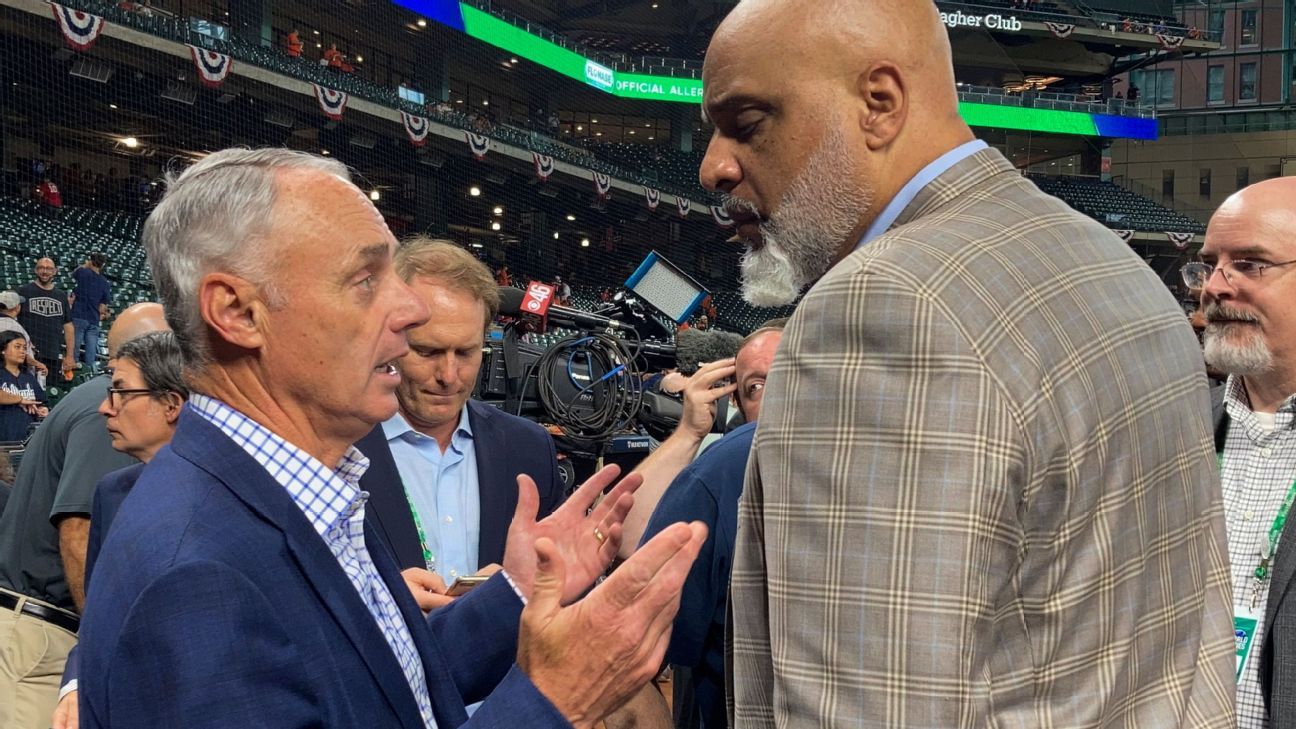
At the same time, the union and executive director Tony Clark are in the middle of a federal investigation into MLBPA finances that launched around May 2025. Any pursuit of a prosecution by the government could have a demonstrable effect on union leadership and, potentially, its positions in bargaining. — Jeff Passan
What is the timeline for negotiations between now and Dec. 1, 2026?
While the sides held a preliminary meeting this fall and could have more informal sessions over the coming months, bargaining typically cranks up during spring training.
At that point, the sides will begin to make their priorities clear to each other, and it will offer a better sense of the issues that are expected to be central to the negotiations. The most pertinent will be just how firm the league is on its desire for a cap.
The initial offers are important to outline the broad strokes of the negotiations to come. The most important meetings, however, will take place closer to the Dec. 1, 2026, deadline, with November the most vital month to establish where the sides stand before the expected lockout. — Passan
Who are the primary names fans should know on both sides of the negotiations?
For the players: Deputy executive director Bruce Meyer is the lead negotiator, Clark the ultimate authority. There is a 38-member executive board of players, made up of eight elected, high-ranking subcommittee members (Cy Young winners Paul Skenes and Tarik Skubal, plus veterans Chris Bassitt, Jake Cronenworth, Pete Fairbanks, Cedric Mullins, Marcus Semien and Brent Suter) and one representative from each team — the delegates for the rank-and-file.
For the league: Deputy commissioner Dan Halem is the lead negotiator, commissioner Rob Manfred the ultimate authority. The league’s labor policy committee — headed by Colorado Rockies owner Dick Monfort, who is joined by Hal Steinbrenner (New York Yankees), John Sherman (Kansas City Royals), Jerry Reinsdorf (Chicago White Sox), Ray Davis (Texas Rangers) and Jim Pohlad (Minnesota Twins) — is the proxy for the 30 owners. — Passan
How will the looming potential of a prolonged labor stoppage impact free agency this offseason?
Executives, league officials and agents are in agreement on one thing at this moment in the offseason: They’re simply not sure how things will shake out just yet in terms of spending. There are no grand predictions about the theme of the offseason, and the few early signings haven’t foreshadowed much, either.
Having said that, two emerging narratives seem to be prevalent. It’s business as usual for the annual World Series contenders like the Yankees, the Philadelphia Phillies and the Los Angeles Dodgers — and now we can include the Toronto Blue Jays in that category.
Phillies president Dave Dombrowski didn’t even hesitate when asked how the final year of labor might impact their winter.
“That is not something we talk about,” he said. “We’re going to proceed normally.”
You can expect the same from the Dodgers, who are attempting a rare three-peat in 2026.
Other organizations are waiting for more certainty, potentially in the form of a new economic system, before they jump back into serious spending. That might not come until after the next CBA is signed, which means that the looming end of the CBA will have some say in the offseason, even if it’s a small impact.
Chicago Cubs president Jed Hoyer admitted at the end of last season that many of his player contracts were designed to be up after 2026 — in other words when the CBA expires — in order to have relatively clean books heading into 2027 and beyond. Several agents and teams believe that cost certainty in the form of a new CBA — and, if MLB gets its way, a first-ever salary cap — will return spending back to higher levels simply because teams will understand their yearly costs more intimately after a new deal.
In the meantime, there’s a postseason and World Series to be played in 2026. And it’s just not the major markets that want to get a playoff run under their belts before things change, according to insiders. So look for free agents to do well in the market even with labor concerns percolating this winter. Yes, a few might take one-year deals, hoping the next economic system benefits them when they go back into the market — but there is certain to be plenty of momentum.
Agent Scott Boras summed it up when asked if spending would be depressed this winter, knowing what’s to come after next season.
“Historically we haven’t seen that, because teams always want to be their best,” he said. “The bottom line is teams understand they don’t have to pay players when there are strikes [or lockouts].” — Jesse Rogers
Will the battle over a potential salary cap be the primary topic discussed between owners and players in the year ahead?
There doesn’t appear to be much doubt about that. Economic disparity has been a hot-button issue for decades. The crumbling of the regional sports network (RSN) television model, which led to several teams losing out on local media revenue, has brought that topic to the forefront in recent years. And the unmitigated spending of teams like the Dodgers and New York Mets has only exacerbated the anger from owners throughout the industry, who continue to claim they don’t have the revenues to keep up.
Even Yankees owner Hal Steinbrenner recently downplayed his franchise’s profit margins and spoke out in favor of a salary cap. If Steinbrenner, who presides over one of the most powerful sports franchises in the world, sounds open to one, imagine how strongly his counterparts in markets such as Pittsburgh, Milwaukee and Tampa feel.
But the prevalence of free markets has been a tentpole issue throughout the MLB Players Association’s existence. Remember that, and you’ll start to understand how ugly this could get. — Alden Gonzalez
Which other issues will fans hear most from each side in the year ahead before the CBA expires?
A central issue for the union during the last round of talks was on how to get players paid sooner, a counter to the middle class of free agency continuing to dry up. As a result of the current CBA, minimum salaries went up, the prospect promotion incentive was introduced, and pre-arbitration bonus pools were established. Expect more talk around that subject in general. In all likelihood, MLB will once again argue that higher compensation for younger players needs to be coupled with a lower luxury tax threshold and will try once again to pair that with a salary floor. The MLBPA probably will say that steers too close to a traditional salary cap system, and on and on we’ll go again.
So, yes, economics will dominate — particularly with changes to the revenue-sharing model desired by both parties and potentially providing a path to an agreement. But two other topics figure to be front and center. One is how MLB implements rule changes. In the last basic agreement, the league secured full autonomy over the implementation of new rules. The union desires more control. And then there’s the subject of an international draft. The league wants one.
During the last round of talks, the union entertained the possibility. After a new CBA was ratified, the two sides gave themselves an additional four months to agree on a trade: The league gets an international draft, the union does away with the qualifying offer. They couldn’t agree by the deadline, but this will come up again. — Gonzalez
-
 Sports2 years ago
Story injured on diving stop, exits Red Sox game
-
 Sports3 years ago
‘Storybook stuff’: Inside the night Bryce Harper sent the Phillies to the World Series
-
 Sports2 years ago
Game 1 of WS least-watched in recorded history
-
 Sports3 years ago
Button battles heat exhaustion in NASCAR debut
-
 Sports3 years ago
MLB Rank 2023: Ranking baseball’s top 100 players
-
Sports4 years ago
Team Europe easily wins 4th straight Laver Cup
-
 Environment3 years ago
Japan and South Korea have a lot at stake in a free and open South China Sea
-
 Environment1 year ago
Here are the best electric bikes you can buy at every price level in October 2024