
Entertainment
Rappers Bob Vylan sue Irish broadcaster RTE over claim lead singer led ‘antisemitic chants’ at Glastonbury gig


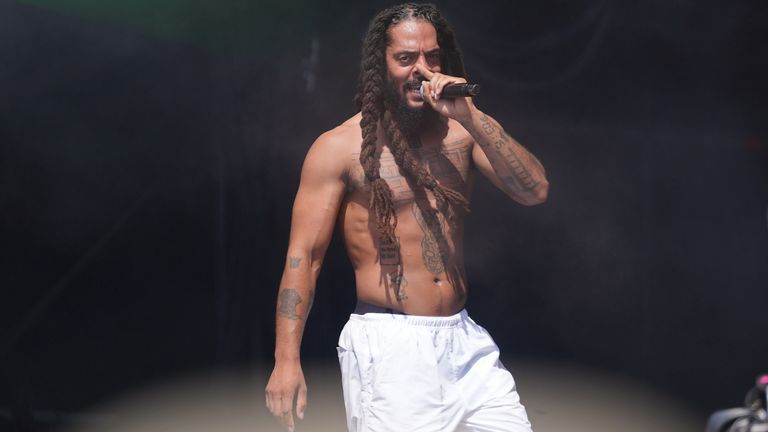
Punk-rap duo Bob Vylan are suing Irish national broadcaster RTE for defamation, claiming it misrepresented chants led by the band when they played this year’s Glastonbury festival.
The group, which performed at Dublin’s Vicar Street last month, claim they were defamed in a report by RTE News that said the lead singer led antisemitic chants when they played the Somerset festival in June.
During their performance, singer Pascal Robinson-Foster, whose stage name is Bobby Vylan, led a chant of “death, death, to the IDF [Israel Defence Forces]”.
File pic: PA
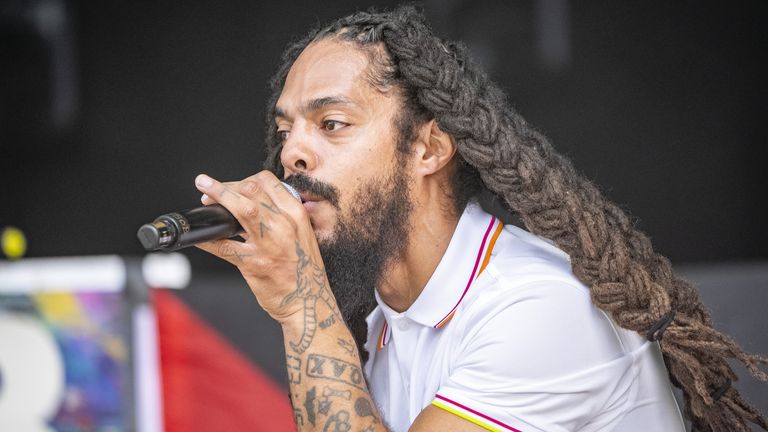
Pic: PA
It provoked widespread criticism of the artist, including from Glastonbury organiser Emily Eavis, and the BBC, which live streamed their show.
Phoenix Law launched legal action on behalf of Robinson-Foster and drummer Wade Laurence George at Ireland’s High Court on Monday, according to court records.
The firm said: “The proceedings arise from a broadcast aired by RTE News following Bob Vylan’s performance at Glastonbury Festival on 28 June 2025.
“During this broadcast, comments were made alleging that the lead singer of Bob Vylan led antisemitic chants. These allegations are categorically denied by our clients and are entirely untrue.”
Phoenix Law said Bob Vylan had made statements expressing support for Palestinian self-determination and criticising military actions by the IDF (Israel Defence Forces).
His comments did not target Jewish people or express hatred towards any group, the firm said, suggesting they were “politically charged but not antisemitic in nature”.
Solicitor Darragh Mackin said the pair “are no stranger to utilising their freedom of expression to speak out against the genocide in Gaza“.
Mr Mackin said there was “a fundamental distinction between speaking critically about the role of the Israeli state forces, and being antisemitic”.
“The former is speech within the confines of political expression, whereas the latter is a form of hatred directed towards Jewish people,” he added.
Read more on Sky News:
Who are Bob Vylan?
The BBC apologised, including to the Jewish community, and said it regretted not pulling the live stream of the set and promised not to live stream “high-risk” acts in future.
It partially upheld complaints made over the broadcast, accepting the live stream broke the corporation’s editorial guidelines.
Ofcom’s chief executive, Dame Melanie Dawes, said the BBC needed to “get a grip quicker” on handling such controversies and complete its internal reports and investigations sooner.
Last month, the Metropolitan Police said detectives would take no further action over similar alleged chants made at a Bob Vylan gig in London in May.
The individual was not arrested but an investigation was ongoing, the Met said.
Avon and Somerset Police said a man, in his 30s, understood to be Mr Robinson-Foster, had voluntarily attended an interview in relation to the band’s Glastonbury performance. Enquiries are ongoing, the force said on Tuesday.
The US condemned the act’s “hateful tirade”, revoking their visas, while several festivals cancelled their upcoming appearances.
Speaking to Louis Theroux in October, Bobby Vylan said he had no regrets about the chants and would do it again “tomorrow”.
Sky News has contacted RTE for comment.

-
Dan Murphy
After another week of frustrating setbacks, at the end of a frustrating year trying to bring stability to their industry, a growing number of college athletic directors say they are interested in exploring a once-unthinkable option: collective bargaining with their players.
Dozens of athletic directors will gather in Las Vegas over the next few days for an annual conference. They had hoped to be raising toasts to the U.S. House of Representatives. But for the second time in three months, House members balked last week at voting on a bill that would give the NCAA protection from antitrust lawsuits and employment threats. So instead, they will be greeted by one of the Strip’s specialties: the cold-slap realization of needing a better plan.
“I’m not sure I can sit back today and say I’m really proud of what we’ve become,” Boise State athletic director Jeramiah Dickey told ESPN late last week. “There is a solution. We just have to work together to find it, and maybe collective bargaining is it.”
Athletic directors see only two paths to a future in which the college sports industry can enforce rules and defend them in court: Either Congress grants them an exemption from antitrust laws, or they collectively bargain with athletes. As Dickey said, and others have echoed quietly in the past several days, it has become irresponsible to continue to hope for an antitrust bailout without at least fully kicking the tires on the other option.
“If Congress ends up solving it for us, and it ends up being a healthy solution I’ll be the first one to do cartwheels down the street,” said Tennessee athletic director Danny White when speaking to ESPN about his interest in collective bargaining months ago. “But what are the chances they get it right when the NCAA couldn’t even get it right? We should be solving it ourselves.”
Some athletic directors thought they had solved their era of relative lawlessness back in July. The NCAA and its schools agreed to pay $2.8 billion in the House settlement to purchase a very expensive set of guardrails meant to put a cap on how much teams could spend to acquire players. The schools also agreed to fund the College Sports Commission, a new agency created by the settlement to police those restrictions.
But without an antitrust exemption, any school or player who doesn’t like a punishment they receive for bursting through those guardrails can file a lawsuit and give themselves a pretty good chance of wiggling out of a penalty. The CSC’s plan — crafted largely by leaders of the Power 4 conferences — to enforce those rules without an antitrust exemption was to get all their schools to sign a promise that they wouldn’t file any such lawsuits. On the same day that Congress’ attempt crumbled last week, seven state attorneys general angrily encouraged their schools not to sign the CSC’s proposed agreement.
In the wake of the attorneys general’s opposition, a loose deadline to sign the agreement came and went, with many schools declining to participate. So, college football is steamrolling toward another transfer portal season without any sheriff that has the legal backing to police how teams spend money on building their rosters.
That’s why college sports fans have heard head football coaches like Lane Kiffin openly describe how they negotiated for the biggest player payroll possible in a system where all teams are supposed to be capped at the same $20.5 million limit. Right now, the rules aren’t real. The stability promised as part of the House settlement doesn’t appear to be imminent. Meanwhile, the tab for potential damages in future antitrust lawsuits continues to grow larger with each passing day.
Collective bargaining isn’t easy, either. Under the current law, players would need to be employees to negotiate a legally binding deal. The NCAA and most campus leaders are adamantly opposed to turning athletes into employees for several reasons, including the added costs and infrastructure it would require.
The industry would need to make tough decisions about which college athletes should be able to bargain and how to divide them into logical groups. Should the players be divided by conference? Should all football players negotiate together? What entity would sit across from them at the bargaining table?
On Monday, Athletes.Org, a group that has been working for two years to become college sports’ version of a players’ union, published a 35-page proposal for what an agreement might look like. Their goal was to show it is possible to answer the thorny, in-the-weeds questions that have led many leaders in college sports to quickly dismiss collective bargaining as a viable option.
Multiple athletic directors and a sitting university president are taking the proposal seriously — a milestone for one of the several upstart entities working to gain credibility as a representative for college athletes. Syracuse chancellor and president Kent Syverud said Monday that he has long felt the best way forward for college sports is a negotiation where athletes have “a real collective voice in setting the rules.”
“[This template] is an important step toward that kind of partnership-based framework,” he said in a statement released with AO’s plan. “… I’m encouraged to see this conversation happening more openly, so everyone can fully understand what’s at stake.”
White, the Tennessee athletic director, has also spent years working with lawyers to craft a collective bargaining option. In his plan, the top brands in college football would form a single private company, which could then employ players. He says that would provide a solution in states where employees of public institutions are not legally allowed to unionize.
“I don’t understand why everyone’s so afraid of employment status,” White said. “We have kids all over our campus that have jobs. … We have kids in our athletic department that are also students here that work in our equipment room, and they have employee status. How that became a dirty word, I don’t get it.”
White said athletes could be split into groups by sport to negotiate for a percentage of the revenue they help to generate.
The result could be expensive for schools. Then again, paying lawyers and lobbyists isn’t cheap either. The NCAA and the four power conferences combined to spend more than $9 million on lobbyists between 2021 and 2024, the latest year where public data is available. That’s a relatively small figure compared to the fees and penalties they could face if they continue to lose antitrust cases in federal court.
“I’m not smart enough to say [collective bargaining] is the only answer or the best answer,” Dickey said. “But I think the onus is on us to at least curiously question: How do you set something up that can be sustainable? What currently is happening is not.”
Players and coaches are frustrated with the current system, wanting to negotiate salaries and build rosters with a clear idea of what rules will actually be enforced. Dickey says fans are frustrated as they invest energy and money into their favorite teams without understanding what the future holds. And athletic directors, who want to plan a yearly budget and help direct their employees, are frustrated too.
“It has been very difficult on campus. I can’t emphasize that enough,” White said. “It’s been brutal in a lot of ways. It continues to be as we try to navigate these waters without a clear-cut solution.”
This week White and Dickey won’t be alone in their frustration. They’ll be among a growing group of peers who are pushing to explore a new solution.
-
 Sports2 years ago
Story injured on diving stop, exits Red Sox game
-
 Sports3 years ago
‘Storybook stuff’: Inside the night Bryce Harper sent the Phillies to the World Series
-
 Sports2 years ago
Game 1 of WS least-watched in recorded history
-
 Sports3 years ago
Button battles heat exhaustion in NASCAR debut
-
 Sports3 years ago
MLB Rank 2023: Ranking baseball’s top 100 players
-
Sports4 years ago
Team Europe easily wins 4th straight Laver Cup
-
 Environment3 years ago
Japan and South Korea have a lot at stake in a free and open South China Sea
-
 Environment1 year ago
Here are the best electric bikes you can buy at every price level in October 2024