

Police sources have told NBC News the identity of a man detained as a “person of interest” after a fatal shooting on the campus of Brown University in Providence, Rhode Island.
Three senior law enforcement officials, briefed on the investigation, told Sky News’s US partner that the suspect is 24-year-old Benjamin Erickson, who had served several years in the US army.
Two people were killed and nine others, all or nearly all of whom are also believed to be students, were injured in the attack at around 4pm (9pm UK time) on Saturday.
Sources told NBC that authorities are looking into what might be an extensive mental health history for Mr Erickson. Any connection with Brown University is also being investigated.
FBI Director Kash Patel posted details of an arrest at a Hampton Inn hotel in Coventry, about 20 miles (32km) from Providence, early on Sunday, “based off a lead” from Providence police.
An operation to arrest a ‘person of interest’ at a hotel in Coventry, Rhode Island. Pic: @FBIDirectorKash/X
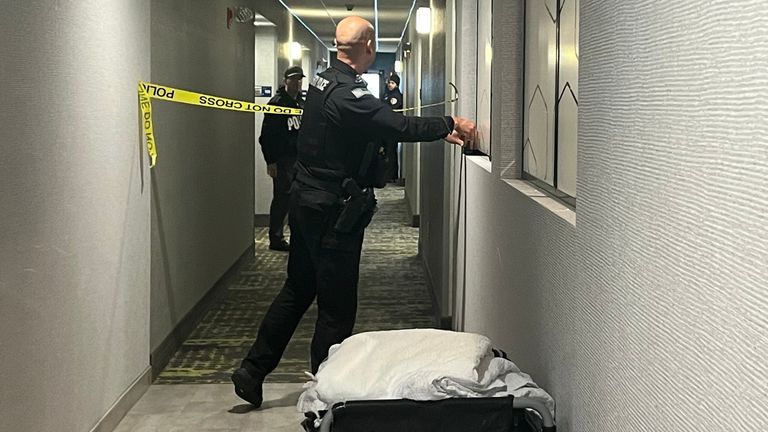
Police taping off hotel rooms following the arrest. Pic: AP
According to a statement provided to NBC News from army spokesperson, Lieutenant Colonel Ruth Castro: “Benjamin W Erickson was an Infantryman (11B) in the Regular Army from May 2021 to November 2024. He has no deployments and left the Army in the rank of specialist.”
Public records show he was living in Washington DC in 2024 and had also been resident in Wisconsin in 2020.
Providence police chief Colonel Oscar Perez told reporters on Sunday that the investigation is “complex” and progressing “extremely fast”, but refused to elaborate.
The shooting happened inside a classroom on the first floor of the Barus & Holley engineering building, a seven-storey structure home to much of the university’s engineering and physics study and research.
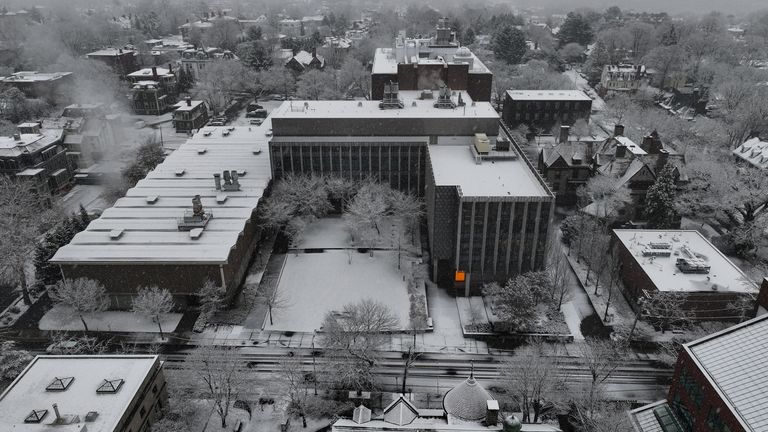
Part of the Brown University campus, the right side of the C-shaped block is the engineering building. Pic: Reuters
Brown University provost Frank Doyle confirmed that final exams were taking place in the engineering building when the gunman opened fire.
A police official told the AP news agency that the gunman fired more than 40 9mm rounds. A gun has not been recovered, but officers did seize two loaded 30-round magazines.
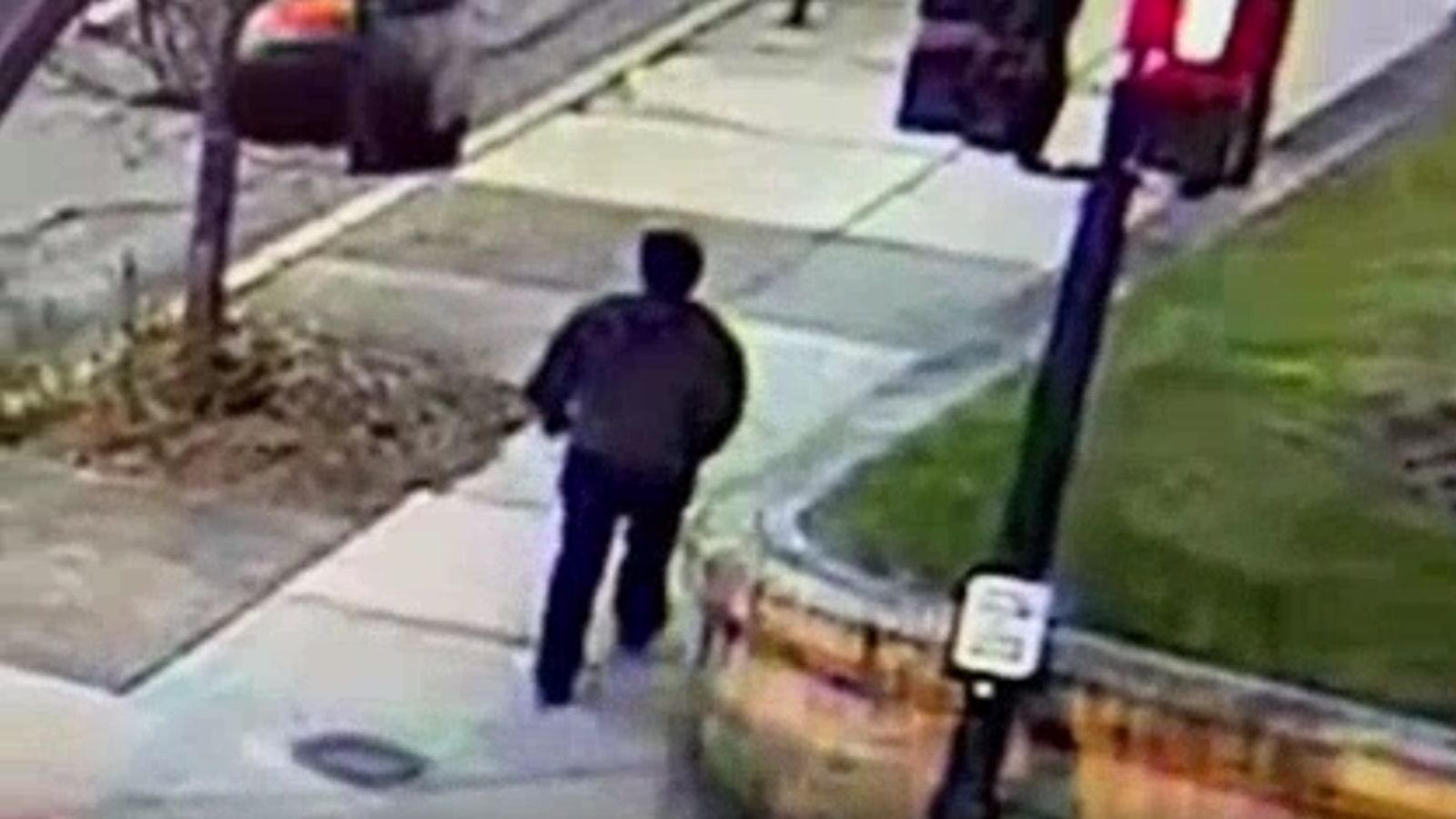
A video released by officials shows a suspect walking down a street away from the campus and turning a corner, dressed in dark, loose-fitting clothing.
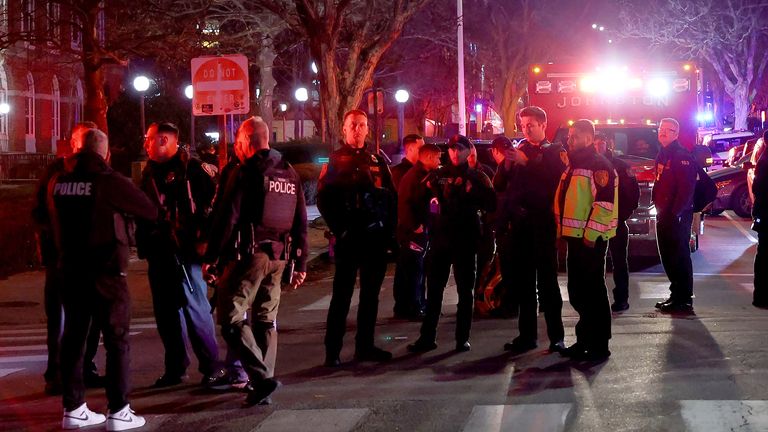
Pic: AP
Pic: AP
Of those injured, eight people have been described as stable, although one remains critically ill. Another person has left hospital.
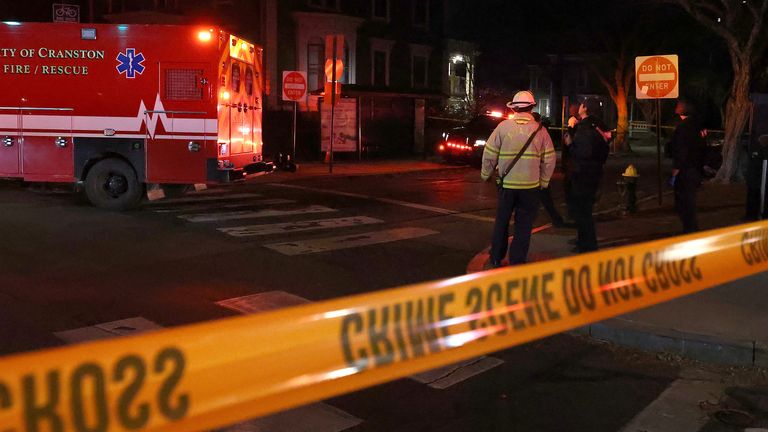
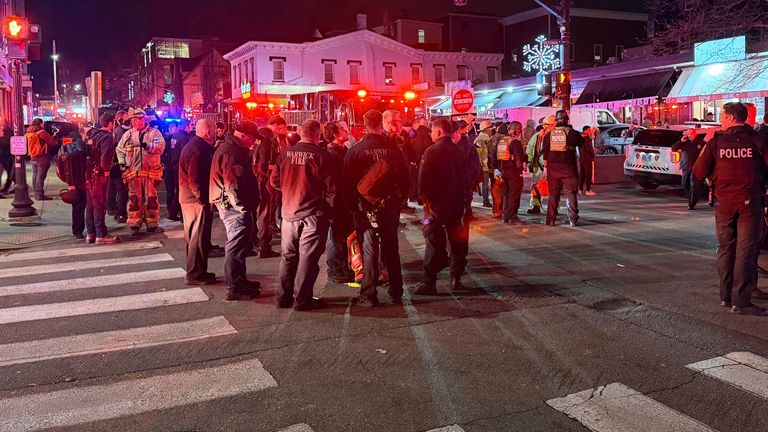
Providence mayor Brett Smiley said the order to shelter-in-place for nearby neighbourhoods had been lifted, but some streets remained shut as investigators work at the scene.
“The people of Providence should breathe a little easier this morning,” Mr Smiley added.
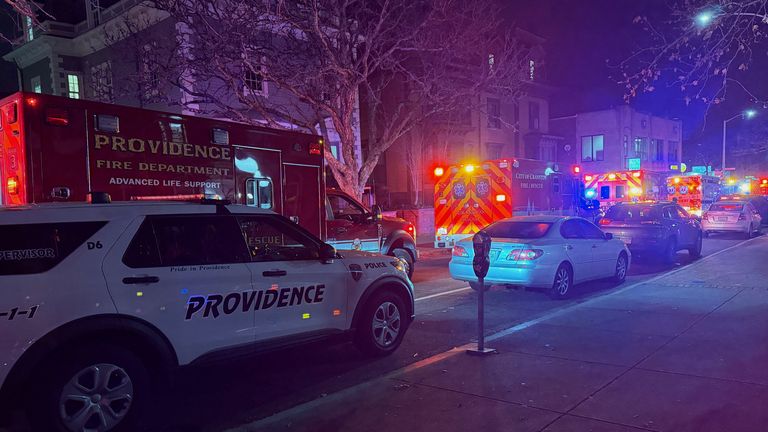
‘Stay inside’ mayor warns after shooting
Access to parts of the campus remained restricted on Sunday as police maintained a security perimeter around Minden Hall and nearby apartment buildings.
The site has hundreds of buildings, including lecture halls, laboratories and dorms.
Brown is a private university with roughly 7,300 undergraduate students and more than 3,000 graduate students.
Students hid under desks
Student Chiang-Heng Chien said he was working in one of the labs with three other students when they received a notification about a shooting nearby.
“We decided to turn the light off and close all the doors and hide under our desks, and wait for the next notification after the shooting,” he told reporters.
The students hid under the desks for about two hours.

‘We hid under our desks for two hours’
“I was hoping that no one’s getting hurt and no one’s dead,” he said.
The students left the building when they received another notification, and security personnel moved in to search the facility.
Read more from Sky News:
Terror attack at Bondi Beach shooting
Belarus pardons 123 prisoners
Thailand destroys bridge in Cambodia
Emma Ferraro, a chemical engineering student, was in the Barus & Holley lobby working on a final project when she heard loud popping sounds coming from the eastern side of the building.
For a moment, everyone paused and looked around, she recalled.
Once Ferraro realised the sounds were gunshots, she rushed to the door and ran to a nearby building, where she had been sheltering for the past few hours.
Pic: AP
Pic: AP
One person who was initially thought to be involved in the shooting was detained but was later determined to have no involvement.
President Donald Trump told reporters at the White House that he had been briefed on the situation, which he called “terrible”.
“All we can do right now is pray for the victims and for those that were very badly hurt,” he added.
US
The shock of a shooting will cut deeply – but if anywhere can find hope in the face of despair, Providence can

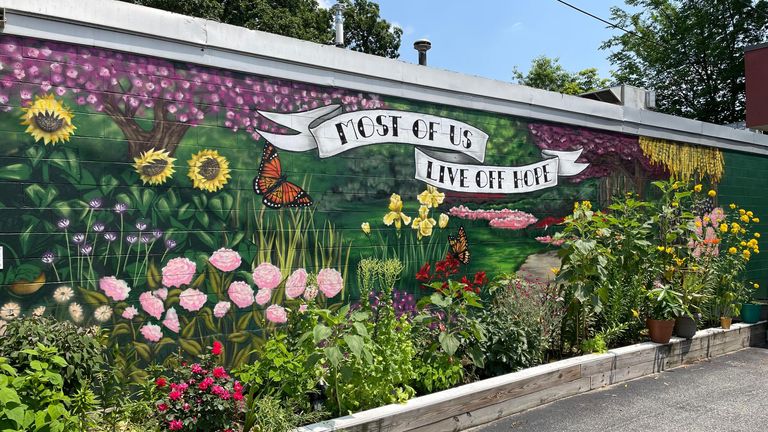
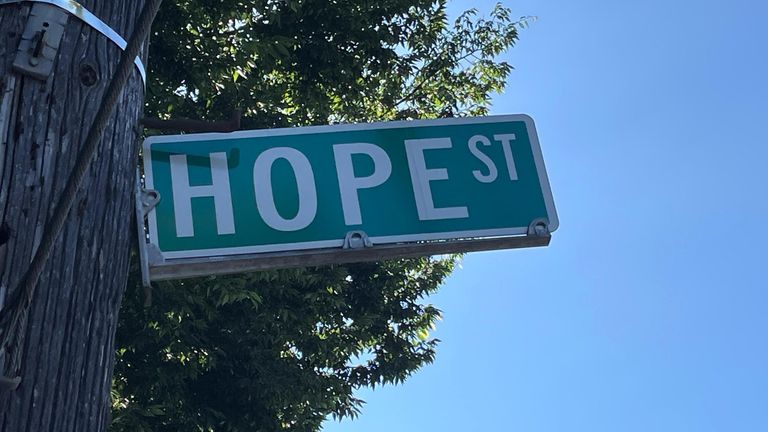
“Most of us live off hope” – the text of a colourful mural, painted on a wall on Hope Street, Providence.
On most days, the neighbourhood around Brown University feels like a place of quiet optimism, swimming against the negative tide.
Hope Street’s mural
The shock of a shooting, that has claimed two lives and left eight others critically wounded, will cut deeply here.
Violence feels not just intrusive but incompatible with the spirit of a place that is governed by thought, not threat.
When the university president said “this is a day we hoped would never come”, she spoke for the whole town.
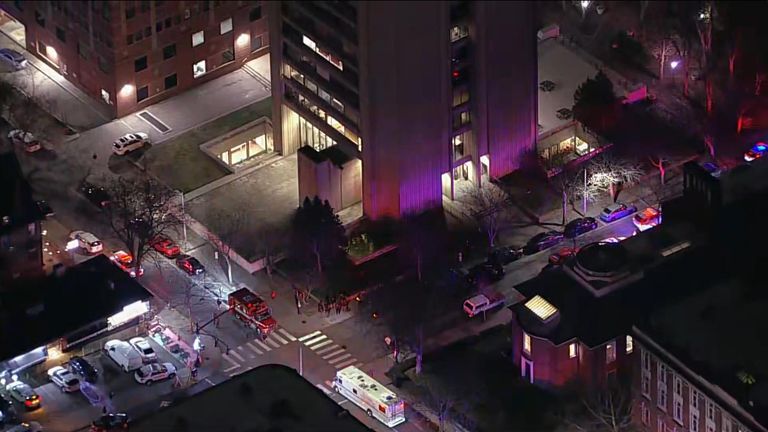
Two students were killed in the attack
Providence, Rhode Island, is a place I know well. My daughter, her husband and their two little girls live there.
It is a college town with a college vibe, the compact campus priding itself on openness – architecturally, intellectually and emotionally.
They rehearse “shelter-in-place” scenarios, as every university does, but they are not experienced at living behind locked doors.
‘Stay inside,’ mayor warns as suspect still at large
Rhode Island, the smallest state, has one of the lowest gun-death rates in America, zero mass shooting events in 2024.
Earlier this year, the state banned the sale and manufacture of assault weapons, but it didn’t include those already owned.
Even in a Democratic, liberal state like Rhode Island, they are struggling to find a solution to America’s gun problem.
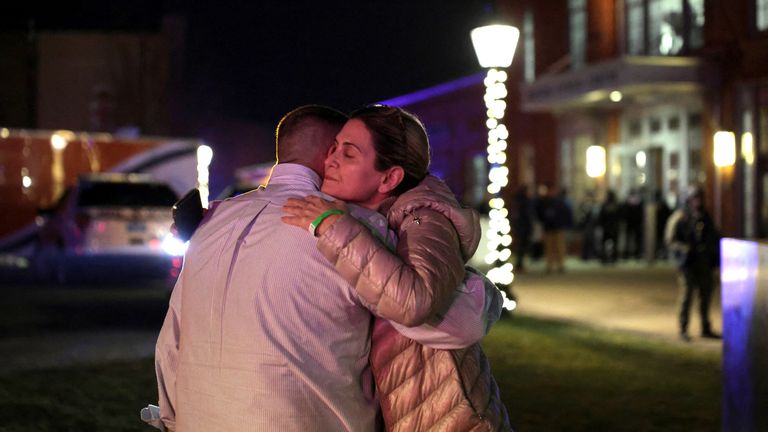
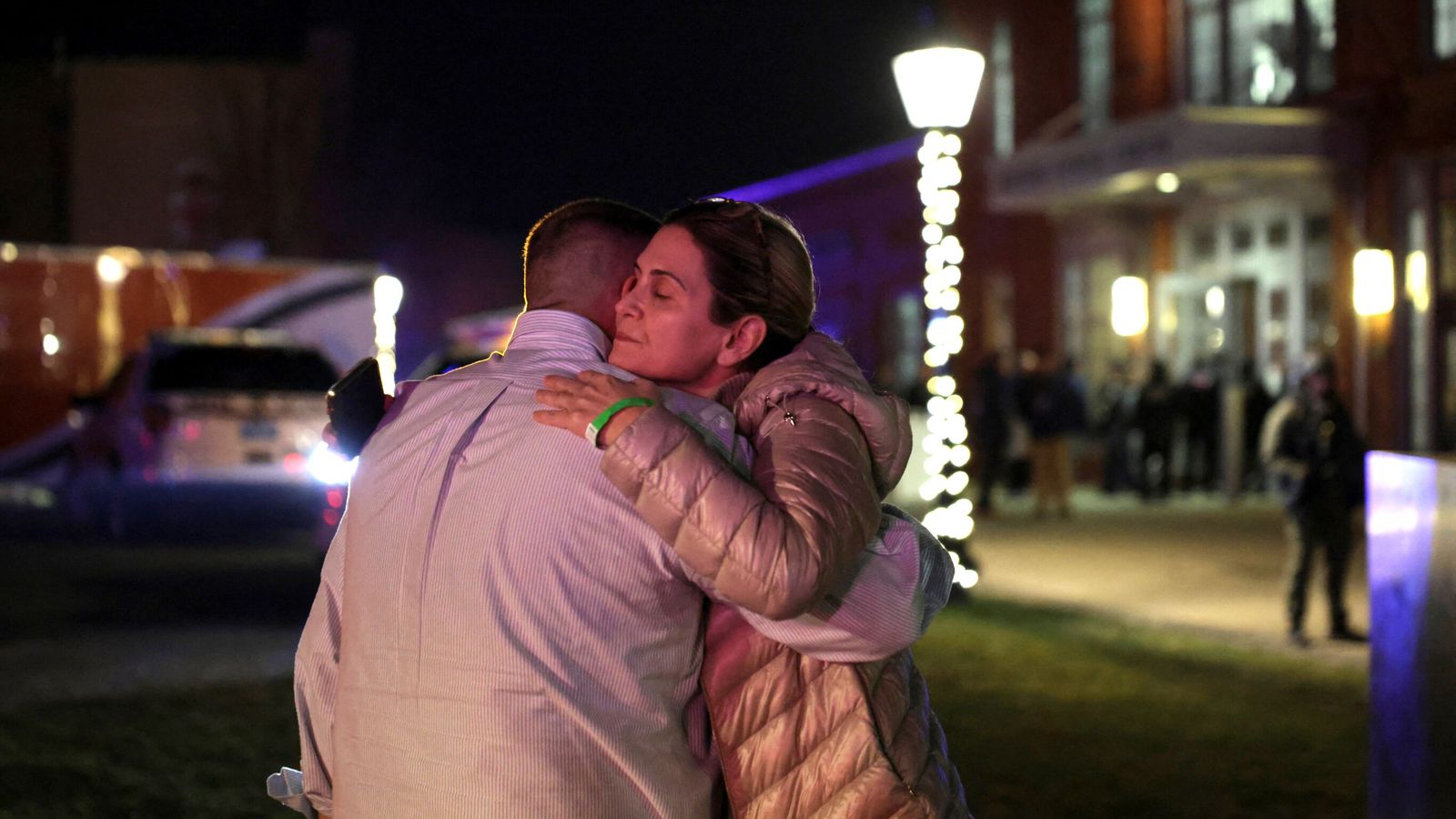
People hug each other outside Brown University in Providence after the shooting. Pic: Reuters
The age-old constitutional right to bear arms continues to trump the most human of all rights – the right to life.
This is a community that assumes safety, not because it is naïve, but because it has grown accustomed to trust.
College Hill rises in gentle brick and ivy, its narrow streets winding past houses with verandas designed for long conversations.
They take place in hushed tones right now, but if anywhere can find its way out of despair, Providence can.
On the historic street along its east side and in the college on the corner, most people live off hope.

A few weeks ago, we talked about some real-world numbers shared by Redditors who added a rooftop solar system to their homes. Not to be outdone, Electrek readers took to the comments to share their own real-world solar numbers. Here are some of the best!
That original post, which you can read here, was inspired by a Reddit user going by DontBuyBitcoin who shared a screenshot on r/Solar indicating that their newly-installed ~11.5 kW system produced over 1,700 kWh of electricity in October. “Pretty surprised by the production of the system I got,” writes DontBuyBitcoin. “11.48KW. I cant wait to see what JUNE-AUGUST [2026] going to look like 😍 I wish SolarEdge will make their app better looking with more functionality.”
Other Redditors were quick to share in the enthusiasm, but our Electrek readers weren’t going to be outdone, and shared their own results in the comments section.
I’ve got a 49 panel, 16.5 kW system just outside Austin, TX, and while it’s expensive ($320/mo), I produce much more power than I use each month. But with 2 EVs, a hot tub, and air conditioning in a Texas summer, I’m not mad I have all this. On a current sunny day, I’m producing about 65 kWh. I top out around 107 kWh on a long but somehow not hot day.l in late spring or early fall (whatever that means in Texas).
Another reader, Craig Morrow, had a much smaller system at “just” 6.5 kW compared to David’s 16.5 kW deal, but still put up some highly respectable numbers.
My 6.5 kw PV generates from 16 kwh/day (winter) to 38 kwh/day (late spring). Between the efficiency of my house and my consumption habits, my usage averages 5-6 kwh per day. Went all-in on passive and active solar when I built the house ten years ago, an investment which has long since paid for itself with no heating or utility bills, plus having battery storage means no worries about power outages when the grid goes down. A great feeling to be energy independent!
Craig had the top comment with twenty upvotes, but he wasn’t the only reader to see some big efficiency gains with home solar. Several of you posted about the cost of your system, and when you’d begin to see an ROI with the savings you were seeing.
My ROI on a $42k system ($30k with the IRA tax credit) was calculated to be 15 years assuming a 4% yearly rate increase. Without the tax credit it would likely be 20+ years. It makes no sense financially. Interestingly, Europeans pay a lot less for similar size systems. Why is that?
Another commenter, Leonard Bates, was also seeing great returns – but took things a step further by doing some extra math to compare the cost of fueling up his car with gas vs. topping it off with electrons generated by his home solar system.
It is hard for the average Joe to understand electricity production numbers, so I have reduced our experience into dollars. We have a 8.8 kWh rooftop system and two EVs that (other than a few vacation trips a year) are charged at home. We are retired, so we can charge during the day. Bottom line, we saved over $4,000 by not buying gasoline last year (drove ~41,000 miles). Electric bills, with the load of the EVs, is basically a breakeven. The system cost us about $22,000, so a breakeven on the system of about six years and then free electricity for another 20, until the panels need to be replace. Plus we are “energy independent” for our cars. If there is turmoil in the Middle East, it doesn’t affect our pocket books.
Leonard’s math reminds me of landscaper Colin Ash, who has been operating Ash Landscaping for over 30 years and recently traded his diesel excavator in for an electric JCB mini excavator he powers exclusively with solar panels mounted on his carport. “I’m a long-time electric vehicle driver and run my cars on solar energy generated from solar panels on the roof of the car port at my home,” explains Ash. “Adding the new JCB 8008E CTS was a perfect next step and I can plug it in next to the car and charge both overnight.”
So, Ash is happy. It seems like you guys are pretty happy, too – even without the home solar tax credit that a lot of you didn’t even know existed in the first place. Here’s hoping a lot more people decide to share their results with home solar, too.
Or, as one of our commenters put it:
If more homeowners share data like this, it’ll help others make informed decisions rather than relying just on sales projections.
Original content from Electrek.

If you’re considering going solar, it’s always a good idea to get quotes from a few installers. To make sure you find a trusted, reliable solar installer near you that offers competitive pricing, check out EnergySage, a free service that makes it easy for you to go solar. It has hundreds of pre-vetted solar installers competing for your business, ensuring you get high-quality solutions and save 20-30% compared to going it alone. Plus, it’s free to use, and you won’t get sales calls until you select an installer and share your phone number with them.
Your personalized solar quotes are easy to compare online and you’ll get access to unbiased Energy Advisors to help you every step of the way. Get started here.


FTC: We use income earning auto affiliate links. More.
-
 Sports2 years ago
Story injured on diving stop, exits Red Sox game
-
 Sports3 years ago
‘Storybook stuff’: Inside the night Bryce Harper sent the Phillies to the World Series
-
 Sports2 years ago
Game 1 of WS least-watched in recorded history
-
 Sports3 years ago
Button battles heat exhaustion in NASCAR debut
-
 Sports3 years ago
MLB Rank 2023: Ranking baseball’s top 100 players
-
Sports4 years ago
Team Europe easily wins 4th straight Laver Cup
-
 Environment3 years ago
Japan and South Korea have a lot at stake in a free and open South China Sea
-
 Environment1 year ago
Here are the best electric bikes you can buy at every price level in October 2024