
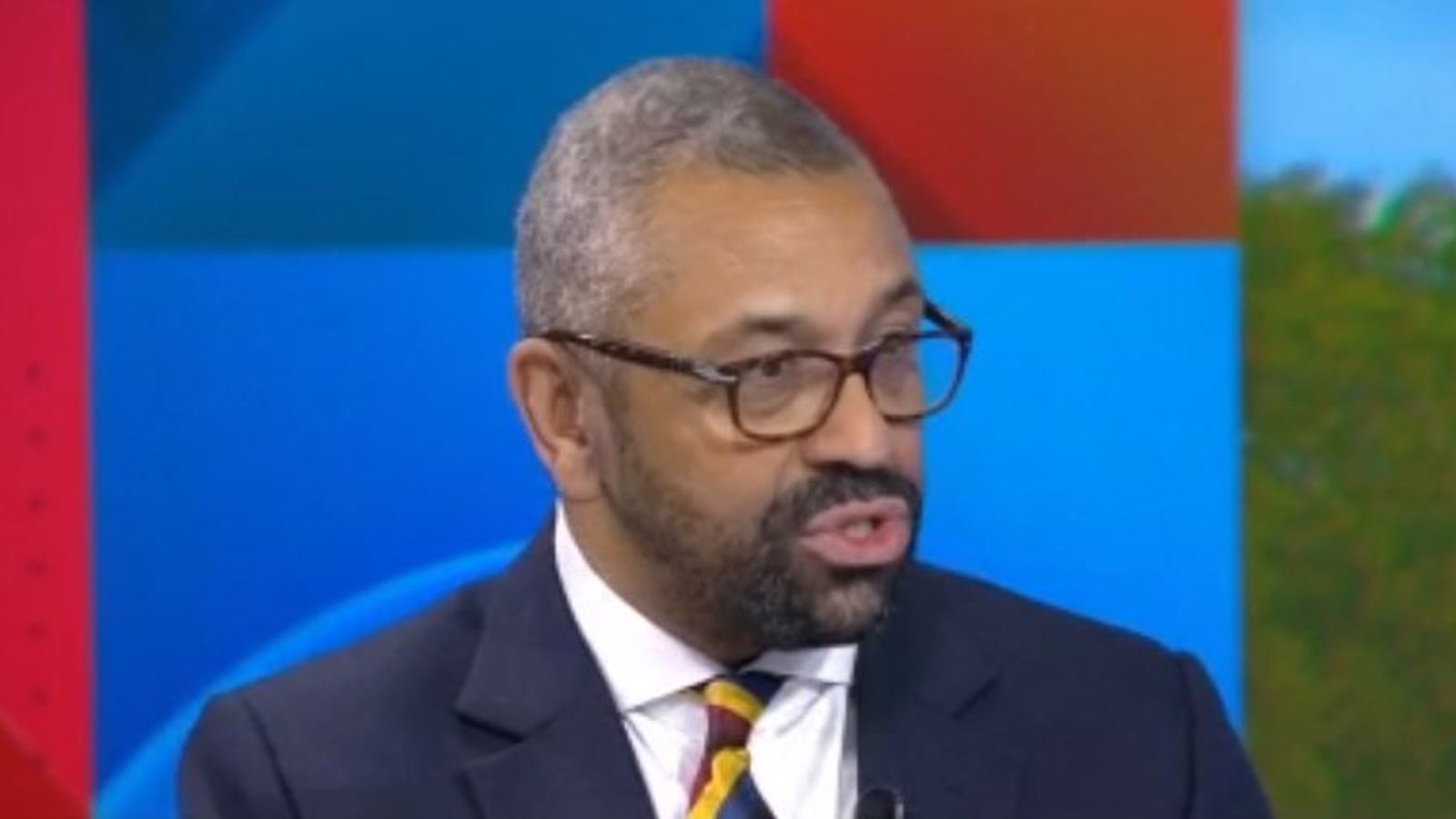
Britons trapped in Gaza will be supported, vows foreign secretary, in face of escape route difficulties

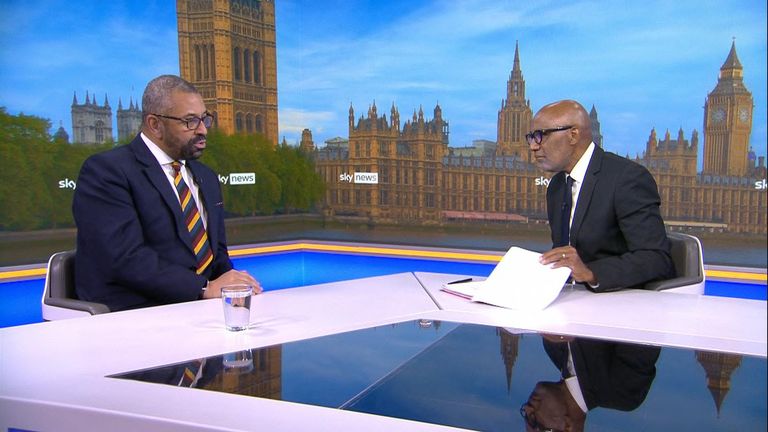
Foreign Secretary James Cleverly has insisted the UK will maintain support for Britons trapped in Gaza, as he said it was proving “incredibly difficult” to open the Rafah border crossing into Egypt.
Speaking to Sky News’ Trevor Phillips On Sunday Morning programme, the cabinet minister also said that 10 was “not an unreasonable estimate” for the number of British hostages held by Hamas.
And Mr Cleverly warned protesters who displayed support for the militant group, designated a terror organisation in the UK, did not help the Palestinian people.
He made his comments against the backdrop of the current Israel-Hamas war.
The conflict, which was sparked by the militant group launching a deadly assault from Gaza on Israel, has claimed thousands of lives on both sides.
Israeli forces have retaliated with airstrikes and ordered residents to evacuate to the south of the besieged enclave ahead of an imminent offensive to dismantle the insurgent network.
The US has been trying to broker a deal to reopen Egypt’s Rafah crossing with Gaza to allow foreigners to leave and humanitarian aid to be taken in.
The border was closed because of airstrikes early in the war.
Both Egypt and Jordan, which is next to the Israeli-occupied West Bank, have also expressed concern about Palestinians being forced off their land where they want to build a future state.
‘Were you afraid when you had to run for cover?’
On establishing a safe route out of Gaza for British citizens stuck in the territory, Mr Cleverly said: “I’ve spoken on a number of occasions with my Egyptian counterpart.
“We stay in very close coordination with the United States of America, with other friends in the region and of course with the Israeli government trying to coordinate a time window when the Rafah crossing can be opened so that people can leave.
“That is proving incredibly difficult. So I’m not able to say with any certainty when that crossing may be open.”
He added: “This is very important for the British nationals in Gaza.
“We continue to support them, we continue to update them as much as we can through, text messaging and whatever other means is available.
“So we will keep supporting the British nationals in Gaza and we will keep working with the US, with the Israelis and others to try and bring this crossing into use.”
When pressed over whether the number of UK nationals being held captive by Hamas was 10, Mr Cleverly was reluctant to be drawn as the situation remained uncertain, but said: “That is not an unreasonable estimate of the kind of number of people that we’re talking about.”
He also warned people against glorifying terrorism, after major marches across the UK in support of the Palestinian cause where some people in attendance appeared to openly support Hamas.
Mr Cleverly said: “The point is about whether arrests may happen at all or whether they happen at the event or after the event. So I’m not going to drift into operational policing.
“I would remind people that being passionate about a better life for the Palestinian people is a passion that I share and indeed shared by Government.
“However, glorifying murder and terrorism is no benefit to the Palestinian people, just as Hamas are not friend to the Palestinian people.”
Politics
Young people may lose benefits if they don’t engage with help from new £820m scheme, government warns

Young people could lose their right to universal credit if they refuse to engage with help from a new scheme without good reason, the government has warned.
Almost one million will gain from plans to get them off benefits and into the workforce, according to officials.
Latest updates from the Politics Hub
Pic: iStock
It comes as the number of young people not in employment, education or training (NEET) has risen by more than a quarter since the COVID pandemic, with around 940,000 16 to 24-year-olds considered as NEET as of September this year, said the Office for National Statistics.
That is an increase of 195,000 in the last two years, mainly driven by increasing sickness and disability rates.
The £820m package includes funding to create 350,000 new workplace opportunities, including training and work experience, which will be offered in industries including construction, hospitality and healthcare.
Around 900,000 people on universal credit will be given a “dedicated work support session”.
That will be followed by four weeks of “intensive support” to help them find work in one of up to six “pathways”, which are: work, work experience, apprenticeships, wider training, learning, or a workplace training programme with a guaranteed interview at the end.
However, Work and Pensions Secretary Pat McFadden has warned that young people could lose some of their benefits if they refuse to engage with the scheme without good reason.
“Doing nothing should not be an option,” he told Sky News’ Sunday Morning with Trevor Phillips.
“If someone just took that attitude, yes, they would then be subject to, you know, the obligations that are already part of the system.”
“What I want to see is young people in the habit of getting up in the morning, doing the right thing, going to work,” he added.
“That experience of that obligation, but also the sense of pride and purpose that comes with having a job.”

Some young people on benefits will be offered job opportunities in construction. Pic: iStock
Read more from Sky News:
Child poverty strategy unveiled – but not everyone’s happy
Universal credit claimants soar by over million in a year
The government says these pathways will be delivered in coordination with employers, while government-backed guaranteed jobs will be provided for up to 55,000 young people from spring 2026, but only in those areas with the highest need.
However, shadow work and pensions secretary Helen Whately, from the Conservatives, said the scheme is “an admission the government has no plan for growth, no plan to create real jobs, and no way of measuring whether any of this money delivers results”.
She told Sky News the proposals are a “classic Labour approach” for tackling youth unemployment.

Youth jobs plan ‘the wrong answer’
“What we’ve seen today announced by the government is funding the best part of £1bn on work placements, and government-created jobs for young people. That sounds all very well,” she told Sunday Morning with Trevor Phillips.
“But the fact is, and that’s the absurdity of it is, just two weeks ago, we had a budget from the chancellor, which is expected to destroy 200,000 jobs.
“So the problem we have here is a government whose policies are destroying jobs, destroying opportunities for young people, now saying they’re going to spend taxpayers’ money on creating work placements. It’s just simply the wrong answer.”
Ms Whately also said the government needs to tackle people who are unmotivated to work at all, and agreed with Mr McFadden on taking away the right to universal credit if they refuse opportunities to work.
But she said the “main reason” young people are out of work is because “they’re moving on to sickness benefits”.
Ms Whately also pointed to the government’s diminished attempt to slash benefits earlier in the year, where planned welfare cuts were significantly scaled down after opposition from their own MPs.
The funding will also expand youth hubs to help provide advice on writing CVs or seeking training, and also provide housing and mental health support.
Some £34m from the funding will be used to launch a new “Risk of NEET indicator tool”, aimed at identifying those young people who need support before they leave education and become unemployed.
Monitoring of attendance in further education will be bolstered, and automatic enrolment in further education will also be piloted for young people without a place.
-
 Sports2 years ago
Story injured on diving stop, exits Red Sox game
-
 Sports3 years ago
‘Storybook stuff’: Inside the night Bryce Harper sent the Phillies to the World Series
-
 Sports2 years ago
Game 1 of WS least-watched in recorded history
-
 Sports3 years ago
Button battles heat exhaustion in NASCAR debut
-
 Sports3 years ago
MLB Rank 2023: Ranking baseball’s top 100 players
-
Sports4 years ago
Team Europe easily wins 4th straight Laver Cup
-
 Environment3 years ago
Japan and South Korea have a lot at stake in a free and open South China Sea
-
 Environment1 year ago
Here are the best electric bikes you can buy at every price level in October 2024