Representative Jim Jordan may or may not break down the last few Republican holdouts who blocked his election as House speaker yesterday. But the fact that about 90 percent of the House GOP conference voted to place him in the chambers top job marks an ominous milestone in the Republican Partys reconfiguration since Donald Trumps emergence as its central figure.
The preponderant majority of House Republicans backing Jordan is attempting to elevate someone who not only defended former President Trumps efforts to subvert the 2020 presidential election but participated in them more extensively than any other member of Congress, according to the bipartisan committee that investigated the January 6 insurrection. As former Republican Representative Liz Cheney, who was the vice chair of that committee, said earlier this month: Jim Jordan knew more about what Donald Trump had planned for January 6 than any other member of the House of Representatives.
Read: Jim Jordan could have a long fight ahead
Jordans rise, like Trumps own commanding lead in the 2024 GOP presidential race, provides more evidence that for the first time since the Civil War, the dominant faction in one of Americas two major parties is no longer committed to the principles of democracy as the U.S. has known them. That means the nation now faces the possibility of sustained threats to the tradition of free and fair elections, with Trumps own antidemocratic tendencies not only tolerated but amplified by his allies across the party.
Ian Bassin, the executive director of the bipartisan group Protect Democracy, told me that the American constitutional system is not built to withstand a demagogue capturing an entire political party and installing his loyalists in key positions in the other branches of government. That dynamic, he told me, would likely mean our 247-year-old republic wont live to celebrate 250. And yet, he continued, those developments are precisely what were witnessing play out before our eyes.
Sarah Longwell, the founder of the anti-Trump Republican Accountability Project, told me that whether or not Jordan steamrolls the last holdouts, his strength in the race reflects the position inside the party of the forces allied with Trump. Even if he doesnt make it, because the majorities are so slim, you cant argue that Jim Jordan doesnt represent the median Republican today, she told me.
Longwell said House Republicans have sent an especially clear signal by predominantly rallying around Jordan, who actively enlisted in Trumps efforts to overturn the 2020 election, so soon after they exiled Cheney, who denounced them and then was soundly defeated in a GOP primary last year. Nominating Jim Jordan to be speaker is not them acquiescing to antidemocratic forces; it is them fully embracing antidemocratic forces, she said. The contrast between Jim Jordan potentially ascending to speaker and Liz Cheney, who is out of the Republican Party and excommunicated, could not be a starker statement of what the party stands for.
In one sense, Jordans advance to the brink of the speakership only extends the pattern that has played out within the GOP since Trump became a national candidate in 2015. Each time the party has had an opportunity to distance itself from Trump, it has roared past the exit ramp and reaffirmed its commitment. At each moment of crisis for him, the handful of Republicans who condemned his behavior were swamped by his fervid supporters until resistance in the party crumbled.
Even against that backdrop, the breadth of Republican support for Jordan as speaker is still a striking statement. As the January 6 committees final report showed, Jordan participated in virtually every element of Trumps campaign to subvert the 2020 result. Jordan spoke at Stop the Steal rallies, spread baseless conspiracy theories through television appearances and social media, urged Trump not to concede, demanded congressional investigations into nonexistent election fraud, and participated in multiple White House strategy sessions on how to pressure Vice President Mike Pence to reject the results.
Given that record, undermining the election is too soft a language to describe Jordans activities in 2020, Jena Griswold, Colorados Democratic secretary of state, told me. He was involved in every step to try to destroy American democracy and the peaceful transfer of the presidency. If Jordan wins the position, she said, you could no longer count on the speaker of the House to defend the United States Constitution.
Jordan didnt stop his service to Trump once he left office. Since the GOP won control of the House last year, Jordan has used his role as chair of the House Judiciary Committee to launch investigations into each of the prosecutors who have indicted Trump on criminal charges (local district attorneys in Manhattan and Fulton County, Georgia, as well as federal Special Counsel Jack Smith). Fani Willis, the Fulton County district attorney, has described Jordans demand for information as an effort to obstruct a Georgia criminal proceeding that is flagrantly at odds with the Constitution.
The willingness of most GOP House members to embrace Jordan as speaker, even as he offers such unconditional support to Trump, sends the same message about the partys balance of power as the former presidents own dominant position in the 2024 Republican race. Though some Republican voters clearly remain resistant to nominating Trump again, his support in national surveys usually exceeds the total vote for all of his rivals combined.
Equally telling is that rather than criticizing Trumps attempts to overturn the 2020 election, almost all of his rivals have echoed his claim that the indictments hes facing over his actions are unfair and politically motivated. In the same vein, hardly any of the Republican members resisting Jordan have even remotely suggested that his role in Trumps attempts to subvert the election is a legitimate reason to oppose him. That silence from Jordans critics speaks loudly to the reluctance in all corners of the GOP to cross Trump.
If Jordan becomes speaker, it would really mean the complete and total takeover of the party by Trump, former Republican Representative Charlie Dent, now the executive director of the Aspen Institutes congressional program, told me. Because he is the closest thing Trump has to a wingman in Congress.
All of this crystallizes the growing tendency at every level of the GOP, encompassing voters and activists as well as donors and elected officials, to normalize and whitewash Trumps effort to overturn the 2020 election. In an Economist/YouGov national poll earlier this year, fully three-fifths of Trump 2020 voters said those who stormed the Capitol on January 6 were participating in legitimate political discourse, and only about one-fifth said they were part of a violent insurrection. Only about one-fifth of Trump 2020 voters thought he bore a significant share of responsibility for the January 6 attack; more than seven in 10 thought he carried little or no responsibility.
That sentiment has solidified in the GOP partly because of a self-reinforcing cycle, Longwell believes. Because most Republican voters do not believe that Trump acted inappropriately after 2020, she said, candidates cant win a primary by denouncing him, but because so few elected officials criticize his actions, the more normal elements of the party become convinced its not an issue or its not worth objecting to.
The flip side is that for the minority of House Republicans in highly competitive districts18 in seats that voted for President Joe Biden in 2020 and another 15 or so in districts that only narrowly preferred TrumpJordan could be a heavy burden to carry as speaker. Everyone is worried about their primary opponents, but in this case ameliorating the primary pressures by endorsing Jordan could spell political death in the general election in a competitive district, Dent told me. Even so, 12 of the 18 House Republicans in districts that Biden carried voted for Jordan onhis first ballot as a measure of their reluctance to challenge the partys MAGA forces.
The instinct for self-preservation among a handful of Republican members combined with ongoing resentment at the role of the far right in ousting Kevin McCarthy might be enough to keep Jordan just below the majority he needs for election as speaker; many Republicans expect him to fail again in a second vote scheduled for this morning. Yet even if Jordan falls short, its his ascent that captures the shift in the partys balance of power toward Trumps MAGA movement.
Bassin, of Protect Democracy, points to a disturbing analogy for what is happening in the GOP as Trump surges and Jordan climbs. When you look at the historical case studies to determine which countries survive autocratic challenges and which succumb to them, Bassin told me, a key determinant is whether the countrys mainstream parties unite with their traditional opponents to block the extremists from power.
Philip Wallach: Newt Gingrichs degraded legacy
Over the years, he said, that kind of alliance has mobilized against autocratic movements in countries including the Czech Republic, France, Finland, and, most recently, Poland, where the center-right joined with its opponents on the left to topple the antidemocratic Law and Justice party. The chilling counterexample, Bassin noted, is that during the period between World War I and World War II, center-right parties in Germany and Italy chose a different course. Rather than directly opposing the emerging fascist movements in each country, they opted instead to try to ride the energy of [the] far-right extremists to power, thinking that once there, they could easily sideline [their] leaders.
That was, of course, a historic miscalculation that led to the destruction of democracy in each country. But, Bassin said, right now, terrifyingly, the American Republican Party is following the German and Italian path. The belligerent Jordan may face just enough personal and ideological opposition to stop him, but whether or not he becomes speaker, his rise captures the currents carrying the Trump-era GOP ever further from Americas democratic traditions.
Sad female worker carrying her belongings while leaving the office after being fired
Isbjorn | Istock | Getty Images
Layoffs have been a defining feature of the job market in 2025, with several major companies announcing thousands of job cuts driven by artificial intelligence.
In fact, AI was responsible for almost 55,000 layoffs in the U.S. this year, according to consulting firm Challenger, Gray & Christmas.
There were in total 1.17 million job cuts through 2025, the highest level since the Covid-19 pandemic in 2020 when there were 2.2 million layoffs announced by the end of the year.
In October, U.S. employers announced 153,000 job cuts, and there were over 71,000 job cuts in November, with AI being cited for over 6,000 for the month, per Challenger.
At a time when inflation bites, tariffs are adding to expenses, and firms are looking to carry out cost-cutting measures, AI has presented an attractive, short-term solution to the problem.
The Massachusetts Institute of Technology released a study in November showing that AI can already do the job of 11.7% of the U.S. labor market and save as much as $1.2 trillion in wages across finance, healthcare, and other professional services.
Not everyone is convinced that AI is the real reason behind the dramatic job cuts, as Fabian Stephany, assistant professor of AI and work at the Oxford Internet Institute, previously told CNBC, that it might be an excuse.
Stephany said many companies that performed well during the pandemic “significantly overhired” and the recent layoffs might just be a “market clearance.”
“It’s to some extent firing people that for whom there had not been a sustainable long term perspective and instead of saying ‘we miscalculated this two, three years ago, they can now come to the scapegoating, and that is saying ‘it’s because of AI though,'” he added.
Here are the top firms that cited AI as part of their layoff and restructuring strategy in 2025.
Amazon
Amazon CEO Andy Jassy speaks during a keynote address at AWS re:Invent 2024, a conference hosted by Amazon Web Services, at The Venetian Las Vegas on December 3, 2024 in Las Vegas, Nevada.
Noah Berger | Getty Images
In October, Amazon announced the largest ever round of layoffs in its history, slashing 14,000 corporate roles, as it looks to invest in its “biggest bets” which includes AI.
“This generation of AI is the most transformative technology we’ve seen since the Internet, and it’s enabling companies to innovate much faster than ever before… we’re convinced that we need to be organized more leanly, with fewer layers and more ownership, to move as quickly as possible for our customers and business,” Beth Galetti, senior vice president of people experience and technology at Amazon, wrote in a blog post.
Amazon CEO Andy Jassy warned of the cuts earlier this year, telling employees that AI will shrink the company’s workforce and that the tech giant will need “fewer people doing some of the jobs that are being done today, and more people doing other types of jobs.”
Microsoft
Microsoft CEO Satya Nadella appears at the CES event in Las Vegas on Jan. 9, 2024. The event typically doubles as a preview of how tech giants and startups will market their wares in the coming year and if early announcements are any indication, AI-branded products will become the new “smart” gadgets of 2024.
David Paul Morris | Bloomberg | Getty Images
Microsoft has cut a total of around 15,000 jobs through 2025, and its most recent announcement in July saw 9,000 roles on the chopping block.
CEO Satya Nadella wrote in a memo to employees that the company needed to “reimagine” its “mission for a new era,” and went on to tout the significance of AI to the company.
“What does empowerment look like in the era of AI? It’s not just about building tools for specific roles or tasks. It’s about building tools that empower everyone to create their own tools. That’s the shift we are driving — from a software factory to an intelligence engine empowering every person and organization to build whatever they need to achieve,” Nadella said.
Salesforce
Marc Benioff, chief executive officer of Salesforce Inc., during the US-Saudi Investment Forum at the Kennedy Center in Washington, DC, US, on Wednesday, Nov. 19, 2025.
Stefani Reynolds | Bloomberg | Getty Images
IBM
CEO of IBM Arvind Krishna looks on during a roundtable discussion hosted by U.S. President Donald Trump in the Roosevelt Room at the White House on Dec. 10, 2025 in Washington, DC.
However, unlike other companies that had cited AI in job cuts, Krishna admitted that the firm had increased hiring in other areas that required more critical thinking, such as software engineering, sales, and marketing.
In November, the company announced a 1% global cut, which could impact nearly 3,000 employees.
Crowdstrike
Founder and CEO of CrowdStrike George Kurtz speaks during the Live Keynote Pregame during the Nvidia GTC (GPU Technology Conference) in Washington, DC, on Oct. 28, 2025.
Jim Watson | AFP | Getty Images
Cybersecurity software maker CrowdStrike said in May that it’s laying off 5% of its workforce or 500 employees, and directly attributed the cuts to AI.
“AI has always been foundational to how we operate,” co-founder and CEO George Kurtz wrote in a memo included in a securities filing. “AI flattens our hiring curve, and helps us innovate from idea to product faster. It streamlines go-to-market, improves customer outcomes, and drives efficiencies across both the front and back office. AI is a force multiplier throughout the business.”
Workday
Carl Eschenbach, CEO of Workday speaks on CNBC’s Squawk Box outside the World Economic Forum in Davos, Switzerland on Jan. 23, 2025.
Gerry Miller | CNBC
In February, HR platform Workday was one of the first companies this year to say its cutting 8.5% of its workforce, amounting to around 1,750 jobs, as the company invests more in AI.
Workday CEO Carl Eschenbach said the layoffs were needed to prioritize AI investment and to free up resources.
US lawmakers have introduced a discussion draft that would ease the tax burden on everyday crypto users by exempting small stablecoin transactions from capital gains taxes and offering a new deferral option for staking and mining rewards.
The proposal, introduced by Representatives Max Miller of Ohio and Steven Horsford of Nevada, seeks to amend the Internal Revenue Code to reflect the growing use of digital assets in payments. The draft is set “to eliminate low-value gain recognition arising from routine consumer payment use of regulated payment stablecoins,” per the draft.
Under the draft, users would not be required to recognize gains or losses on stablecoin transactions of up to $200, provided the asset is issued by a permitted issuer under the GENIUS Act, pegged to the US dollar and maintains a tight trading range around $1.
The bill includes safeguards to prevent abuse. The exemption would not apply if a stablecoin trades outside a narrow price band, and brokers or dealers would be excluded from the benefit. Treasury would also retain authority to issue anti-abuse rules and reporting requirements.
Draft bill explains the reasoning behind tax breaks. Source: House
Beyond payments, the proposal addresses long-standing concerns around “phantom income” from staking and mining. Taxpayers would be allowed to elect to defer income recognition on staking or mining rewards for up to five years, rather than being taxed immediately upon receipt.
“This provision is intended to reflect a necessary compromise between immediate taxation upon dominion & control and full deferral until disposition,” the draft said.
The draft also extends existing securities lending tax treatment to certain digital asset lending arrangements, applies wash sale rules to actively traded crypto assets, and allows traders and dealers to elect mark-to-market accounting for digital assets.
Crypto groups urge Senate to rethink stablecoin rewards ban
Last week, the Blockchain Association sent a letter to the US Senate Banking Committee, signed by more than 125 crypto companies and industry groups, opposing efforts to extend restrictions on stablecoin rewards to third-party platforms.
The group argued that expanding the GENIUS Act’s limits beyond stablecoin issuers would curb innovation and increase market concentration in favor of large incumbents. The letter compared crypto rewards to incentives commonly offered by banks and credit card companies, warning that banning similar features for stablecoins would undermine fair competition.
Several victims of Jeffrey Epstein have told Sky News that the incomplete release of the files relating to the dead paedophile financier have left them feeling shocked, outraged and disappointed.
Thousands of files relating to Epstein, who died in prison in 2019 while awaiting trial on sex trafficking charges, were made public late on Friday – but only a fraction of them have been released so far, with many heavily redacted.
‘Nothing transparent about release’
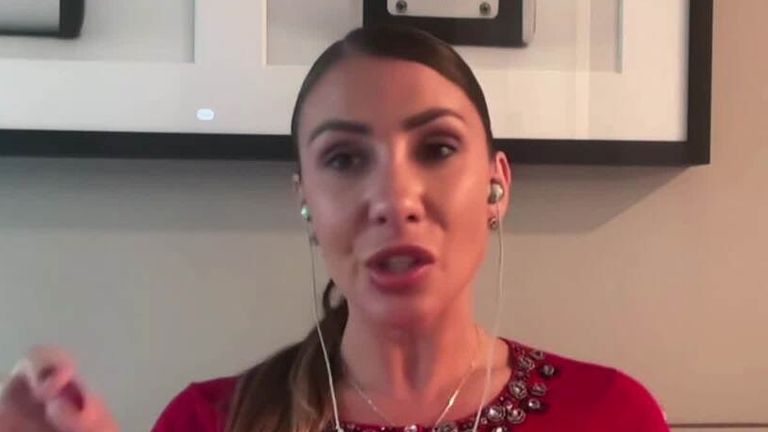
Marina Lacerda, a Brazilian-born survivor who suffered sexual abuse by Epstein as a teenager, expressed her disappointment over the incomplete release, calling it “a slap in our faces”.
“We were all excited yesterday before the files came out,” she told Sky News presenter Anna Botting.
“And when they did come out, we were just in shock, and we see that there is nothing there that is transparent. So it’s very sad, it’s very disappointing.”
Ms Lacera said she had just turned 14 when she met Epstein before “our relationship, our friendship I should say” ended when she was 17.
More on Jeffrey Epstein
Related Topics:
There is nothing transparent about Epstein files release, Marina Lacerda says
“At that point, he had made it very clear to me that I was old, that I was no longer fun for him. So, he booted me out, and I was no longer needed for him,” she said.
The Department of Justice (DoJ) suggests that 1,200 victims and their families have effectively been shielded from view in the released documents.
Ms Lacera said: “From what I know, [the number of Epstein victims] is over a thousand, but that’s just what the DoJ can collect or the FBI can collect, but I presume there may be more than that.”
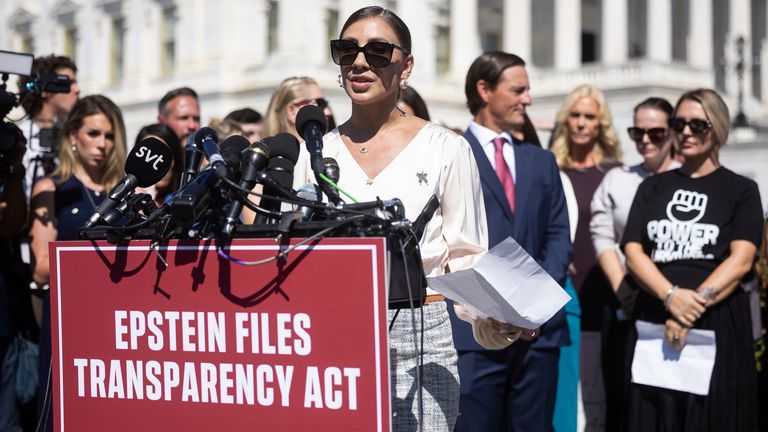
Image: Marina Lacerda spoke outside the US Capitol in favour of the Epstein Files Transparency Act. Pic: AP
‘No way it’s not a cover-up’
Ashley Rubright met the late sex offender when she was just 15 in Palm Beach and was subject to abuse over several years.
Asked about her dissatisfaction with yesterday’s government release and if there was a sense of a cover-up operation, she noted that there had been knowledge of Epstein’s crimes “for so, so long”.
“There’s no way that there’s not a cover-up – what it is, I don’t know,” she told Sky News’ US correspondent James Matthews.
“I just hope that nobody’s allowed to fly under the radar with their involvement.”
Ashley Rubright says ‘there’s no way there’s not a cover-up’
Regarding the extent of the redactions, she said: “I’m so not shocked, but let down. Disappointed.
“Seeing […] completely redacted pages, there’s no way that that’s just to protect the victims’ identities, and there better be a good reason. I just don’t know if we’ll ever know what that is.
“We’ve been left behind since day one. That’s why I think we’re all fighting so loud now, because we’re tired of it.”
Image: Ashley Rubright speaks at a rally in support of Epstein victims. Pic: Reuters
‘He wanted to man-handle me’
Another survivor, Alicia Arden, told Sky News that she met Epstein in a California hotel room in 1997 for an audition, when she was a 25-year-old model and actress.
“He let me in and he started looking over my portfolio, which is customary to do in a talent audition, and then he insinuated, ‘oh, you should come closer to me and let me see your body’,” she said.
Epstein then started “taking off my top and my pants and touching my rear end and my breasts”.
“He goes, ‘let me come over here and spin for me and let me man-handle you. Let me man-handle you.’ And I got very nervous and started to cry. I said, ‘I have to go, Jeffrey. I don’t really think this is gonna work out’,” Ms Arden said.
“He got a phone call and I was crying in front of him. And he said, ‘I have this beautiful girl in front of me and she’s very upset’. I said ‘I’m gonna leave’ and he offered me $100 and I said ‘I’m not a prostitute’.”
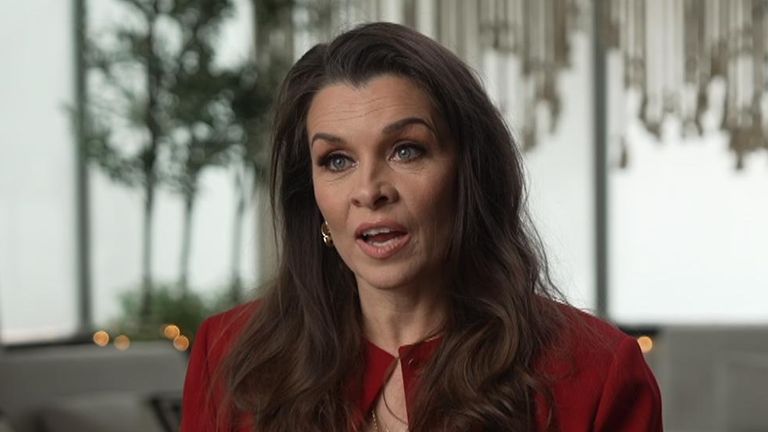
Image: Alicia Arden
She said she went to the Santa Monica Police Department to file a report.
“That was as difficult, and I’m like shaking telling you, but as difficult as being in the hotel room with him because they weren’t supportive at all about it,” she said. Her redacted report was included in previous files.
‘Epstein was a monster’
Asked what she thought about Epstein now, she said: “He’s a monster […] and just horrible. I mean, I’m trembling thinking about him and talking about him.
“If I could do anything, I’m happy I got the police report filed. If they would have pursued him and maybe gone over the hotel [where he was] essentially living, then I could have maybe saved the girls. I’ve always thought that.”

Image: Ms Arden’s redacted police report. Pic: AP
Ms Arden does not believe she has seen justice as one of Epstein’s victims.
“I want to see all of the files come out. I want all of the men in there or women that were trafficking these girls, and they shouldn’t be able to walk around free and not pay for if they did something,” she said.
“They should be actually arrested if they’re in the files and it’s proven that they did horrible things to these girls, and they should lose their jobs, their lives, their homes, their money, and pay for what they did, and it was all supposed to come out, and it hasn’t.”

Image: Jeffrey Epstein died in prison in 2019 while awaiting trial on federal sex trafficking charges
‘I feel redeemed’ by file release
Maria Farmer, who made a complaint to the Miami FBI in 1996 in which she alleged that Epstein stole and sold photos she had taken of her 12- and 16-year-old sisters, expressed gratitude for the release of the files.
“This is amazing. Thank you for believing me. I feel redeemed. This is one of the best days of my life,” she said in a statement through her lawyers.
“I’m crying for two reasons. I want everyone to know that I am shedding tears of joy for myself, but also tears of sorrow for all the other victims that the FBI failed.”
Image: Annie Farmer holds a photo of herself and her sister, Maria Farmer, when they were victims of Epstein. Pic: AP
A positive-leaning reaction also came from Dani Bensky, who said she was sexually abused by Epstein when she was 17 years old.
She told Sky News’ US partner network NBC News: “There is part of me that feels a bit validated at this moment, because I think so many of us have been saying, ‘No, this is real, like, we’re not a hoax’.
“There’s so much information, and yet not as much as we may have wanted to see.”
‘It is not over’
Lawyer Gloria Allred, who has represented several Epstein victims, told Sky News about the partial release on Friday: “It’s very disappointing that all of the files were not released yesterday as required and, in fact, mandated by law.
“The law didn’t say they could do this over a period of time, it didn’t say that weeks could go by.”

Image: Lawyer Gloria Allred
Deputy attorney general Mr Blanche said additional file disclosures can be expected by the end of the year.
“But that’s not what the law says. So clearly, the law has been violated. And it’s the Department of Justice letting down the survivors once again,” Ms Allred said.
The lawyer labelled the incomplete release of the files a “distraction”, adding: “This is not over, and it won’t be over until we get the truth and transparency for the survivors.”
The tranche of material was released just hours before a legal deadline in the US following the passing of the Epstein Files Transparency Act – and at the same time as a US strike targeting Islamic State fighters in Syria.
The US deputy attorney general, Todd Blanche, said the justice department was continuing to review the remaining files and was withholding some documents under exemptions meant to protect the victims.
Epstein files release has become ‘a political football’
Meanwhile, the justice department has defended the redactions made in the released files.
“The only redactions being applied to the documents are those required by law – full stop. Consistent with the statute and applicable laws, we are not redacting the names of individuals or politicians unless they are a victim,” it quoted deputy attorney general Mr Blanche in a post on X.
The Trump administration has claimed to be the most transparent in history.
Captivate
This content is provided by Captivate, which may be using cookies and other technologies.
To show you this content, we need your permission to use cookies.
You can use the buttons below to amend your preferences to enable Captivate cookies or to allow those cookies just once.
You can change your settings at any time via the Privacy Options.
Unfortunately we have been unable to verify if you have consented to Captivate cookies.
To view this content you can use the button below to allow Captivate cookies for this session only.
In a statement, the White House claimed the release also demonstrated its commitment to justice for Epstein’s victims, criticising previous Democratic administrations for not doing the same.
But that statement ignored that the disclosures only happened because Congress forced the administration’s hand with a bill demanding the release, after Trump officials declared earlier this year that no more Epstein files would be made public.