
AD: Fisher fired because Aggies ‘stuck in neutral’


-
Dave Wilson, ESPN Staff Writer
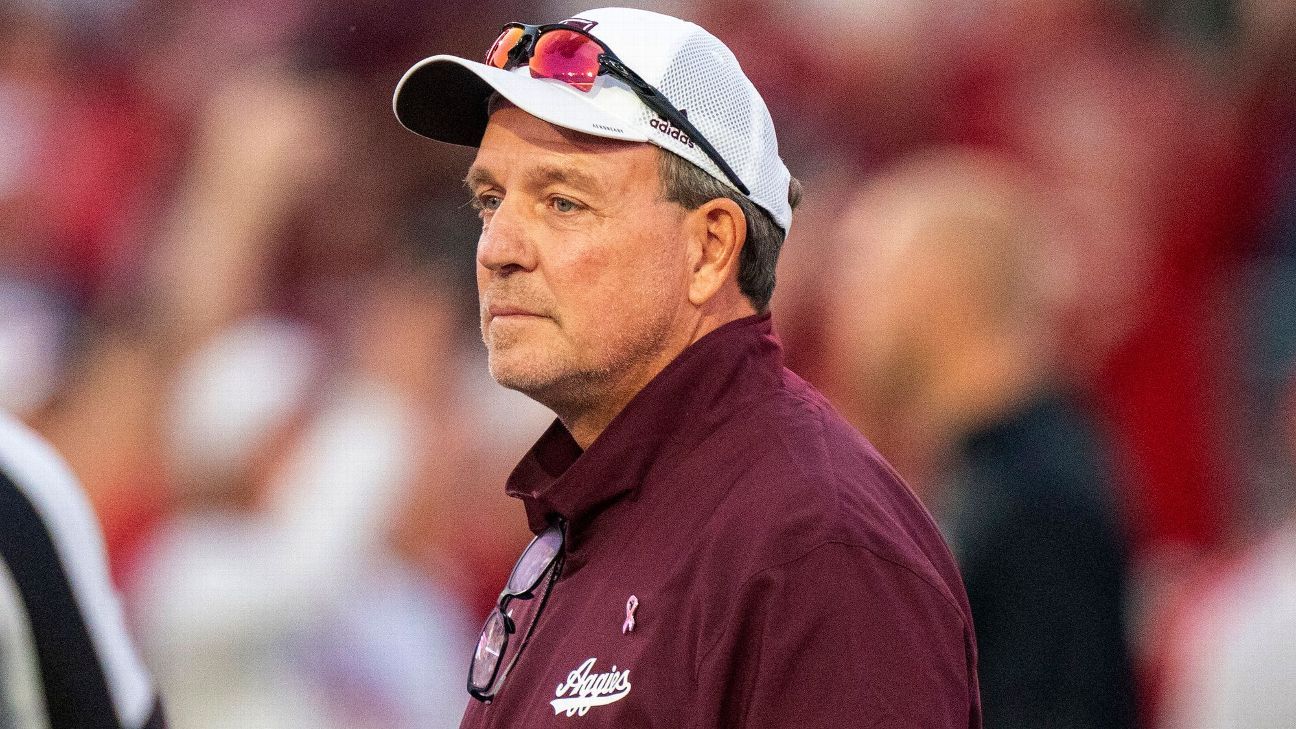
COLLEGE STATION, Texas — Texas A&M athletic director Ross Bjork on Sunday night said it was his decision to fire football coach Jimbo Fisher earlier in the day, saying that the program was “stuck in neutral.”
Bjork said he called interim Texas A&M president Gen. Mark Welsh after the Aggies’ loss to Ole Miss on Nov. 4 and asked to meet.
“The assessment that I delivered was that we are not reaching our full potential,” Bjork said at a news conference. “We are not in the championship conversation and something was not quite right about our direction and the plan.
“We should be relevant on the national scene.”
In Fisher’s first three seasons in College Station, the Aggies were 26-10 and finished No. 4 in 2020 — the second-highest ranking ever for the program, after the 1939 national championship. Over the past three seasons, Texas A&M is 19-15, including an active nine-game road losing streak that is tied for the program’s longest since the AP poll began in 1936.
Since Fisher’s first full recruiting class in 2019, Texas A&M has signed 70 ESPN 300 players, the fourth most in the FBS, behind Alabama, Georgia and Ohio State, who have each played in at least one national championship game over that span. The Aggies were credited with the No. 1 recruiting class in 2022.
“There was something just not clicking to provide confidence for everyone in the program,” Bjork said. “You have to adapt, you have to evolve. I’m not going to say whether he did or didn’t, but it didn’t work.”
Fisher’s A&M tenure ends with a 45-25 record over six seasons and no appearances in the SEC championship game.
Bjork said he and Welsh met with Fisher inside Kyle Field just before 9 a.m. Sunday and informed the coach that they were making an immediate change, as well as dismissing Mark Robinson, Fisher’s associate athletic director for football.
Bjork said the conversation was “quick and cordial.”
Steps toward removing Fisher began in a board of regents meeting Thursday, sources told ESPN’s Pete Thamel. An executive session included a four-hour discussion, much of which was dedicated to Fisher’s future.
“I’ll just say [there was a] robust conversation and I’ll just leave it at that,” Bjork said. “But there was no vote. This was my decision to the president and Chancellor [John] Sharp. And that was the end of our decision-making process.”
Defensive line coach Elijah Robinson, who Bjork said has the respect of the players, will serve as the interim coach, with coordinators Bobby Petrino and D.J. Durkin continuing their roles.
“I expect them to really rally around Coach Robinson and finish the season strong,” Bjork said.
Fisher’s dismissal is expected to cost the school more than $76 million to buy out his contract, nearly triple the highest known previous coaching contract buyout at a public school. According to his contract, Fisher is owed $19.2 million within 60 days and then $7.2 annually through 2031. There is no offset or mitigation on those payments, and the annual payments start 120 days after termination.
Bjork said the athletic department and the 12th Man Foundation, a Section 501(c)(3) charitable organization that is the university’s fundraising arm for athletics, will cover the costs.
“The finances are monumental,” Bjork said. “Let me be very clear in this next part: Texas A&M athletics and the 12th Man Foundation will be the sole sources of the necessary funds covering these transition costs.”
When asked if he expected to be on the hook for the entire buyout, Bjork said there were “different parameters” in the contract language.
“Those mechanics will be worked out as soon as we touch base with his representation,” Bjork said, referring to Fisher’s agent, Jimmy Sexton.
Fisher was initially given a 10-year, $75 million fully guaranteed contract in December 2017, when the Aggies hired him from Florida State, where he had won a national championship following the 2013 season. His buyout is so large because he was given a four-year extension in August 2021 that raised his annual salary from $7.5 million to $9 million and pushed his contract through 2031.
“That’s an institutional decision, but I take responsibility,” Bjork said. “I knew what was coming in the marketplace later that fall [when LSU gave Brian Kelly a 10-year, $95 million deal, among other large contracts]. So I knew that it was the right decision at that time because that’s the information we had. Clearly it didn’t work out. We’re going to learn from that and make sure that we don’t make those same mistakes again.”
Bjork said his athletic department will be responsible for making the yearly payouts to Fisher.
“We have a lot of new revenue coming our way too, but we also have to manage expenses,” Bjork said. “There’s a lot of things within even the football budget that we’ve got flexibility on where we can still be at a high level, but we can also spend a lot less, but we can be a championship-funded program. We’re going to adjust all that.”
There is a set list of traits that Bjork said he’s looking for during the Aggies’ search for their next coach. He said it includes someone who has a program identity, great interpersonal skills, a track record of player development, commitment to academics and a strong recruiting background with solid organizational skills.
With the transfer portal opening Dec. 4, Bjork said that will be a key date as the program transitions to a new coach.
“It’s not ideal,” Bjork said. “But also not unique in the modern day of college football, especially given [the] transfer portal world, signing day and all those dynamics that played into it.”
Bjork, who has been in College Station five years, said he’s not deterred in his goals of making the Aggies into a national title contender.
“The ingredients for a championship are here,” Bjork said. “Aggies want to do it the right way and deserve excellence in everything that we do. … Onward we go.”



-
Max Olson
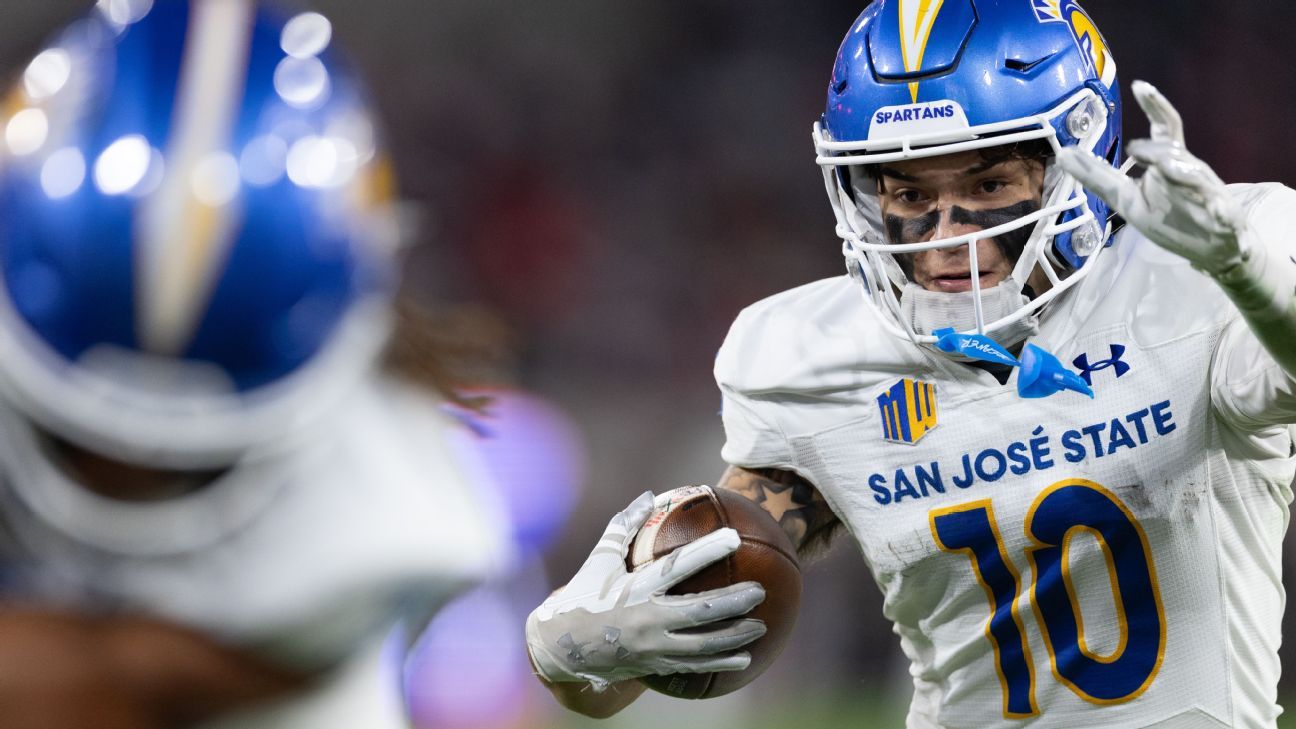
San Jose State wide receiver Danny Scudero, the leading receiver in FBS this season, will enter the NCAA transfer portal when it opens in January, he announced Friday.
The 5-foot-9, 174-pound redshirt sophomore caught 88 passes for 1,291 yards and 10 touchdowns in his first season with the Spartans, becoming a semifinal for the Biletnikoff Award and earning first-team All-Mountain West honors.
Scudero is expected to be one of the more coveted wide receivers available when the transfer portal officially opens on Jan. 2 and has two more seasons of eligibility remaining.
Scudero spent two years at Sacramento State before transferring to San Jose State after the 2024 season. He broke out with 189 receiving yards to open the season against Central Michigan and surpassed 100 yards in five more games, including a career-high 215 and two touchdowns against Hawaii.
Scudero’s 88 receptions ranked fourth-most in FBS, and he leads all receivers this season with 16 catches of 30 or more yards.
The Spartans produced the No. 14 passing offense in FBS this season but went 3-9 in their second year under coach Ken Niumatalolo.
-
 Sports2 years ago
Story injured on diving stop, exits Red Sox game
-
 Sports3 years ago
‘Storybook stuff’: Inside the night Bryce Harper sent the Phillies to the World Series
-
 Sports2 years ago
Game 1 of WS least-watched in recorded history
-
 Sports3 years ago
Button battles heat exhaustion in NASCAR debut
-
 Sports3 years ago
MLB Rank 2023: Ranking baseball’s top 100 players
-
Sports4 years ago
Team Europe easily wins 4th straight Laver Cup
-
 Environment3 years ago
Japan and South Korea have a lot at stake in a free and open South China Sea
-
 Environment1 year ago
Here are the best electric bikes you can buy at every price level in October 2024