
Australia renames shark attacks ‘negative encounters’ to dispel ‘man-eating monster’ perception

Officials in Australia are describing shark attacks as “interactions” or “negative encounters” as part of a new strategy for helping the animals to be more understood.
The change in language is part of an effort to overhaul public perception of the threatened species, with authorities and scientists keen to change their long-standing image as deadly, man-eating animals.
Multiple scientists have argued that terms like “attack” and “bite” have created a culture of fear surrounding the animals, which is harming efforts to help protect them.
Leonardo Guida, a shark researcher at the Australian Marine Conservation Society, told The Sydney Morning Herald that ending the use of such terms “help dispel inherent assumptions that sharks are ravenous, mindless man-eating monsters”.
In New South Wales, officials have changed the way they describe human encounters with sharks that result in injuries.
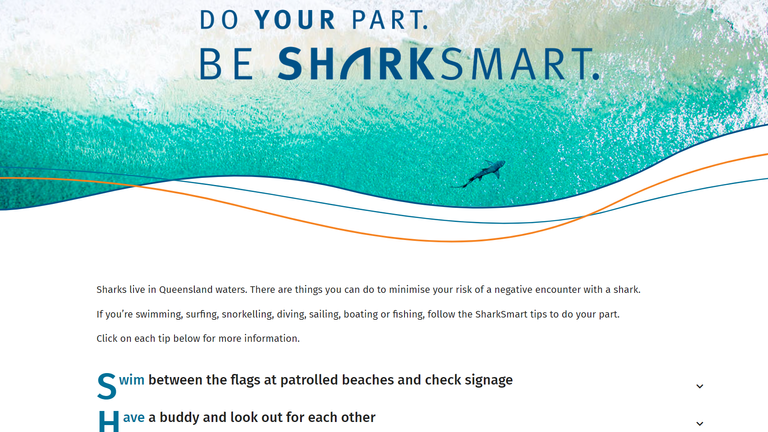
Authorities in Queensland have used the phrase ‘negative encounter’ in their official advice. Pic: Queensland government
A government spokeswoman said its formal shark reports now generally refer to “incidents” or “interactions” with the animals, meanwhile in Queensland the state government’s SharkSmart website now describes how to minimise risks “of a negative encounter with a shark”.
However, the change in terminology is yet to be adopted everywhere in Australia.
The Queensland’s Department of Agriculture and Fisheries said there had “been no formal direction in this space” and in Victoria, fisheries describe the encounters on its Shark Smart advice only as “attacks”.
The more negative terms are a largely modern invention, according to researchers.
Christopher Pepin-Neff, from the University of Sydney, told the paper that encounters with sharks were called “shark accidents” before the 1930s when a prominent surgeon, Victor Coppleson, began to describe them as attacks. Shark nets were also introduced.
He added that the change in wording “has been coming for a while” as the notion of a shark attack is unrealistic because more than a third of encounters leave no injury at all.
Experts have noted that while sharks are predatory, very rarely are humans killed and consumed by them.
Eight people were killed in shark-related incidents in Australia last year.
Dr Guida said moving away from the term “attack”, “helps improve the public’s understanding of sharks and how they behave”.
This is important in getting people to support the conservation of these animals – many species of which are killed by humans across the world.
According to the WWF, shark species are in rapid decline. The latest research suggests that around 100 million sharks may be killed annually, often targeted for their fins.
However, over-fishing, pollution and the increasing impacts of climate change are also to blame.
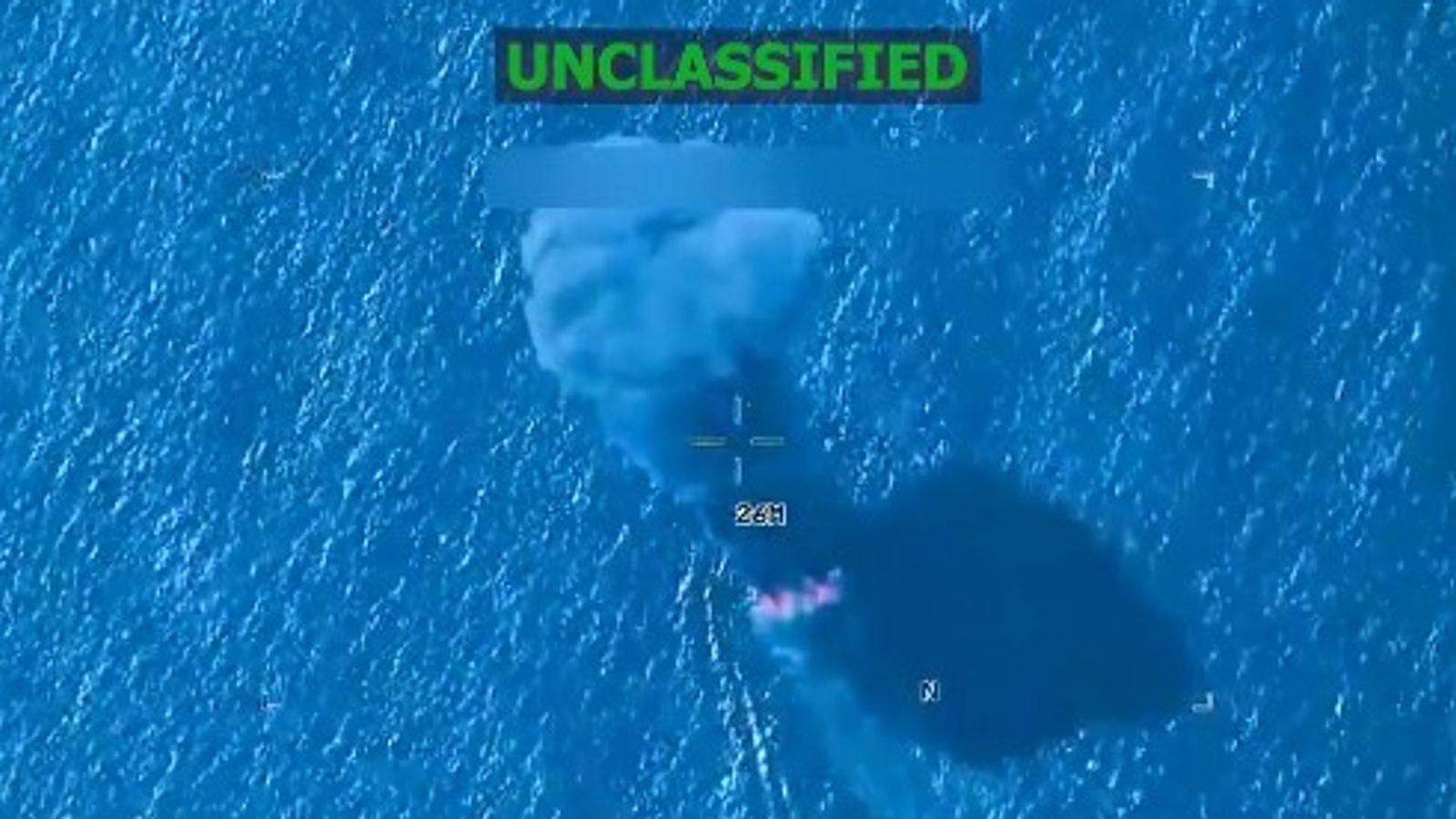
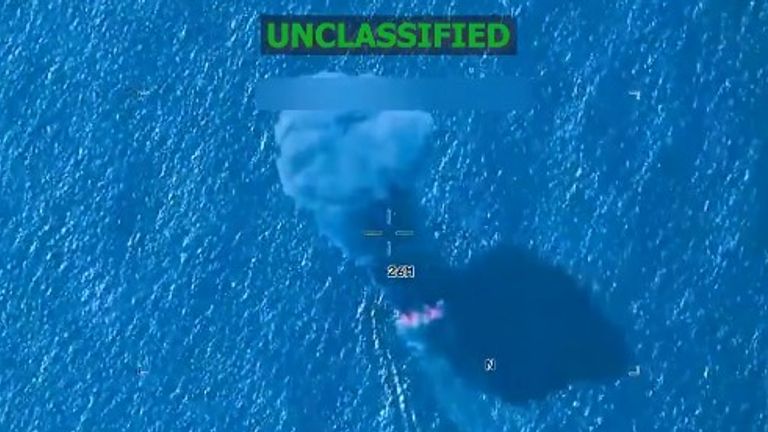
Eight people have been killed in US military strikes on three boats it has accused of smuggling drugs in the Pacific Ocean.
The US military’s Southern Command said the strikes targeted “designated terrorist organisations” killing three “narco-terrorists” in the first vessel, two in the second boat and three in the third.
No evidence the vessels were involved in drug trafficking has been given, but a video showing the strikes on the boats was posted on social media.
Southern Command added that defence secretary Pete Hegseth ordered the strikes, and claimed intelligence confirmed the vessels were using known drug trafficking routes and engaged in drug trafficking.
The US military said it carried out strikes in the Pacific Ocean on three boats it accused of trafficking drugs. Pic: X/@Southcom
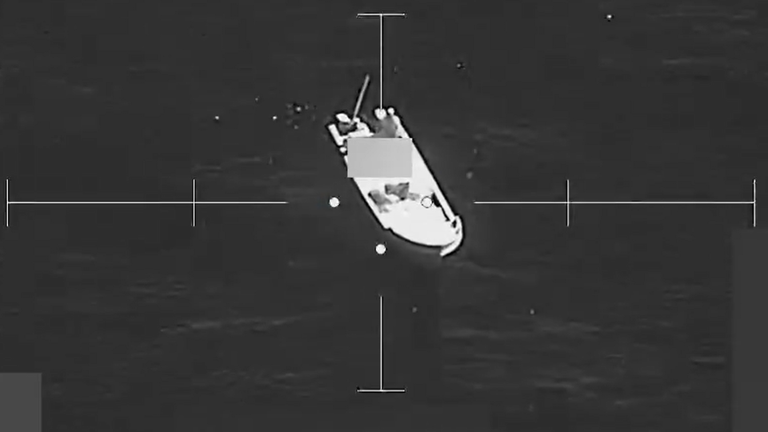
One of the boats targeted during the strikes. Pic: X/@Southcom
It is unclear where the vessels were from, but the strikes mark the latest in Donald Trump‘s “war” with drug cartels, which has also seen vessels targeted in the Caribbean Sea, including near Venezuela.
Over the past several months, the US has been carrying out a large-scale military build-up in the southern Caribbean, with the stated goal of combating drug trafficking.
In its first lethal strike on 2 September, the White House posted on X that it had conducted a strike against “narcoterrorists” shipping fentanyl to the US, without providing evidence of the alleged crime.
Sky’s Data & Forensics unit last week verified that in the four months up to 10 December, 23 boats were targeted in 22 strikes, killing 87 people.
US forces also seized a crude oil tanker, named Skipper, off the coast of Venezuela last week.
The government in Caracas, led by President Nicolas Maduro, who insists the real purpose of the US military operations is to force him out of office, branded the ship’s seizure a “blatant theft” and an “act of international piracy”.
Read more from Sky News:
Musk is winning the space race – and looks unstoppable
Trump wants $10bn in damages over BBC Panorama edit
On Monday, Mr Trump signed an executive order declaring fentanyl a “weapon of mass destruction”.
The order instructs the State and Treasury departments to pursue the financial assets of and sanctions on financial institutions and groups involved in fentanyl trafficking.
It also calls for greater co-operation between the Pentagon and the Justice Department on fentanyl and drug trafficking issues.
The latest strikes on vessels allegedly trafficking drugs come on the eve of briefings on Capitol Hill for all members of Congress as questions mount over the Trump administration’s military actions.
Mr Hegseth, secretary of state Marco Rubio, and other top national security officials are expected to provide closed-door briefings for politicians in the House and Senate.
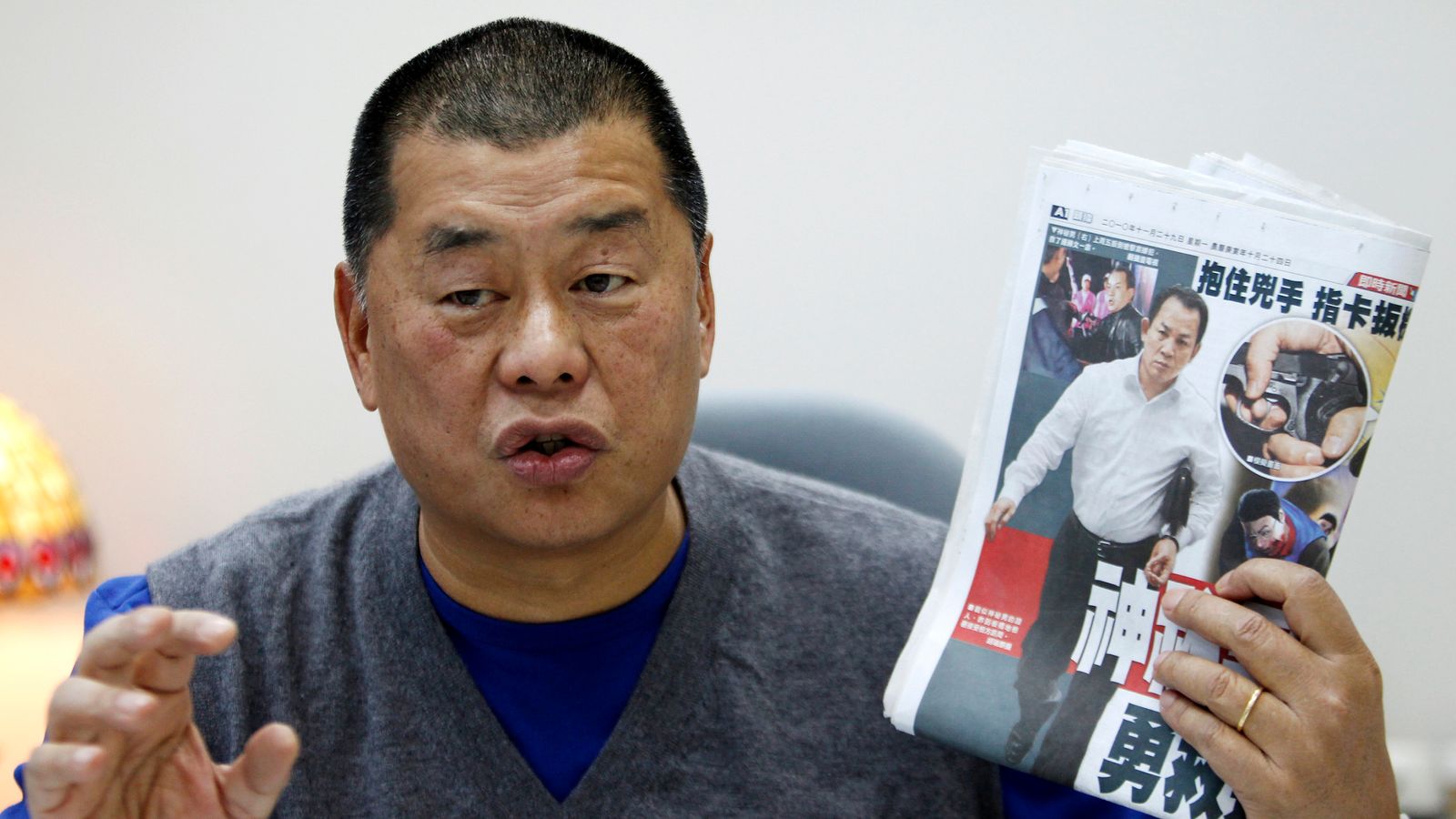
Donald Trump has asked his Chinese counterpart to release pro-democracy campaigner Jimmy Lai, who has been found guilty of national security offences in Hong Kong.
The US president said he felt “so badly” about the media tycoon and British citizen, 78, who was arrested in August 2020 after China imposed a national security law following massive anti-government protests in Hong Kong.
Lai, who had previously been sentenced for several lesser offences during his five years in prison, could now spend the rest of his life behind bars.
Jimmy Lai. Pic: Reuters
Mr Trump said he had spoken to Xi Jinping about Lai’s case and asked for his release.
“I spoke to President Xi about it, and I asked to consider his release,” he said. “He’s not well, he’s an older man, and he’s not well, so I did put that request out. We’ll see what happens.”
It comes as UK Foreign Secretary Yvette Cooper said China’s ambassador to the UK had been summoned over Lai’s conviction to underline the government’s position in the “strongest terms”.
Speaking in parliament, she repeated calls for Lai to be released and called the conviction “a politically motivated prosecution”.
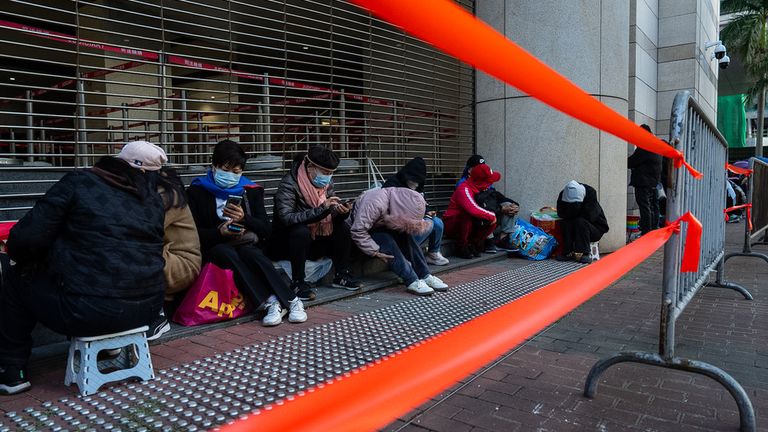
People wait to enter the court building ahead of the verdict. Pic: AP
Ms Cooper made the remarks after Sir Keir Starmer’s spokesperson said Lai’s case has been a priority for the government and “we will continue to call for his immediate release”.
Earlier in the day, China’s ambassador to the UK, Zheng Zeguang, met with a senior official at the UK Foreign Office “to lodge solemn representations over the UK side’s statement that made irresponsible remarks on the Hong Kong High Court’s guilty verdict in the Jimmy Lai case”, China’s embassy said.
Lai, who founded the now-defunct pro-democracy newspaper Apple Daily, was charged with two counts of conspiracy to commit collusion with foreign forces to endanger national security, as well as one count of conspiracy to distribute seditious publications. He was found guilty of all three charges.
Speaking after the verdict, Lai’s daughter Claire said if he were released he would devote himself to God and his family rather than political activism.
“He just wants to reunite with his family. He wants to dedicate his life to serving our Lord, and he wants to dedicate the rest of his days to his family,” Claire Lai told the Associated Press. “My father is fundamentally not a man who operates on illegal ground.”
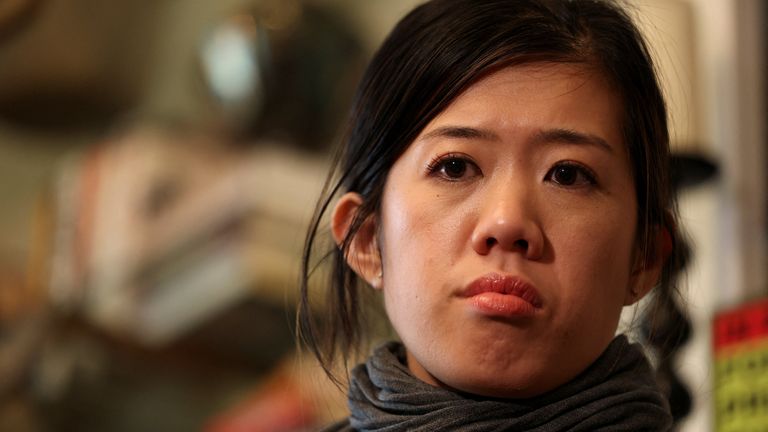
Claire Lai. Pic: Reuters
She said five years of solitary confinement has taken a toll on his health, and he has lost a significant amount of weight.
“He is a lot weaker and has only gotten weaker in the last year,” she said. “He has back pains and waist pains, his nails… when we visit, we can tell that they’re turning colours and falling off. Some of his teeth are rotting.”
He also has heart palpitations, is diabetic and his vision and hearing are failing, she added.
Hong Kong’s security chief, Chris Tang, said Lai has received “full medical services” and has never complained of the medical care he has been given.
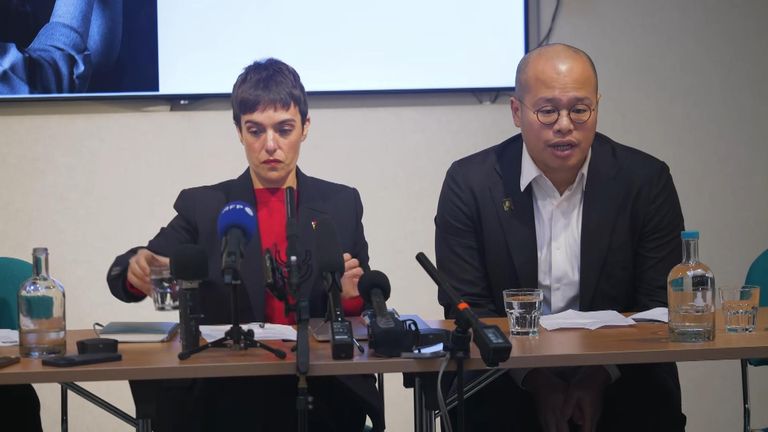
Jimmy Lai’s son: UK government must ‘do more’
‘You’ve got to keep fighting’
Meanwhile, her brother Sebastian Lai is lobbying the UK government for their father’s release.
“Regarding the United Kingdom, we talk about normalising relationships. Well, my father’s freedom should be a precondition to that,” he said.
Asked if he is optimistic international pressure can help, he said: “I think you’ve got to keep fighting no matter what. I think, taking my father’s example, standing up for what is right is why we’re doing it. This is my way of fighting for it.”
Hong Kong’s leader John Lee welcomed the verdict, saying: “He has harmed the fundamental interests of the country and the well-being of the people of Hong Kong; his actions are shameful and his intentions malicious.”
World
European leaders back ‘multinational force’ to secure peace in Ukraine, as US commits to security guarantees
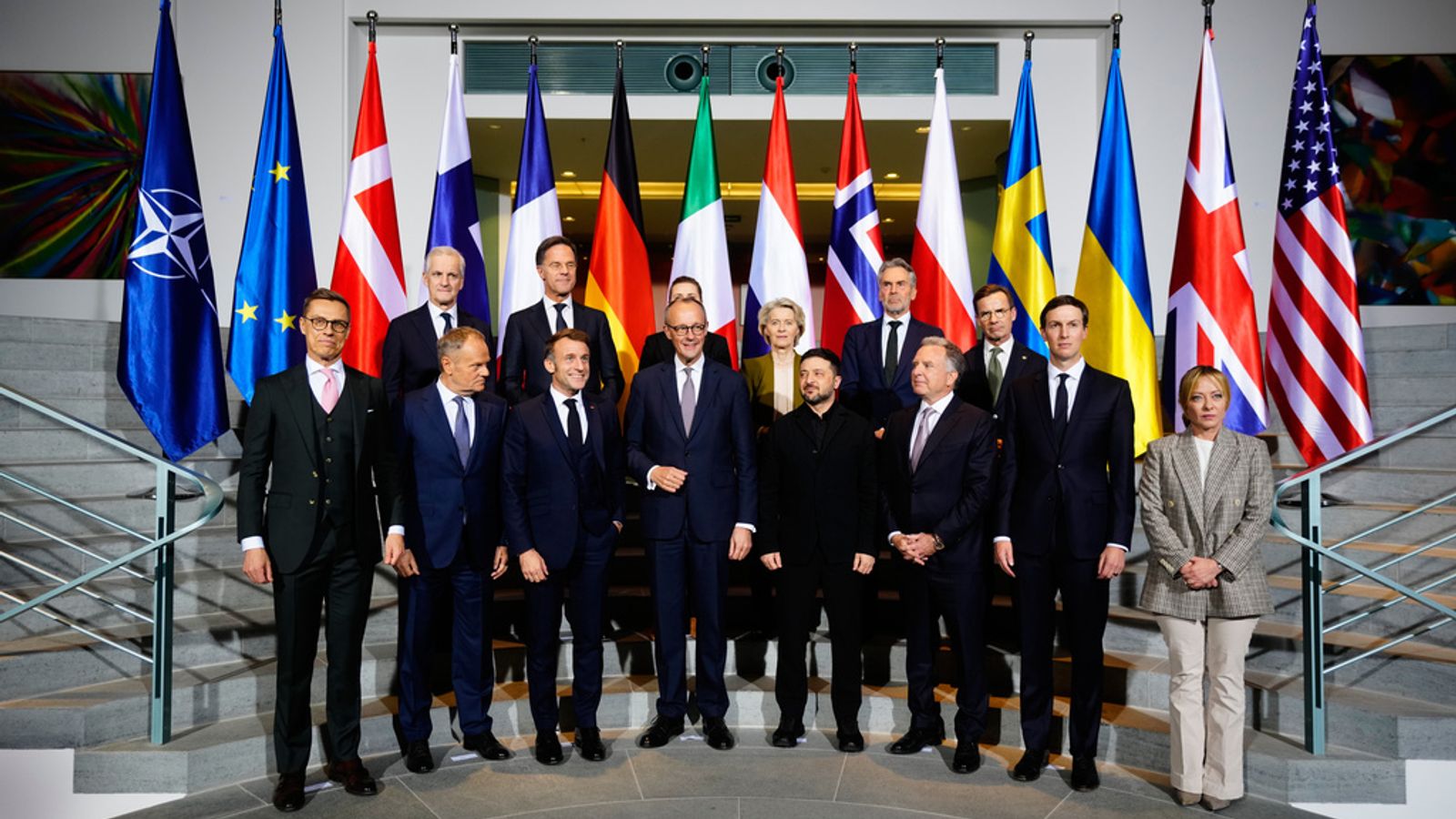
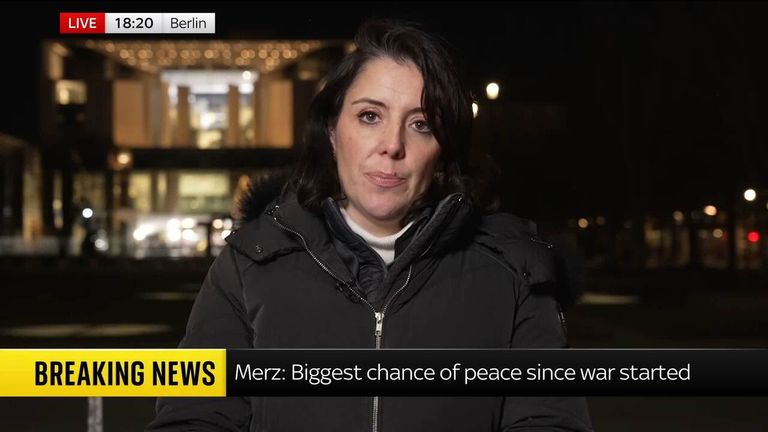
European leaders have called for a “multinational force” to secure Ukraine after any peace deal with Russia, as they struck an optimistic tone after talks in Berlin.
In a joint statement, they heralded “significant progress” – boosted by a new US commitment to provide unspecified security guarantees to Ukraine.
German Chancellor Friedrich Merz described the guarantees by the US as “truly remarkable” and a “very important advancement”.
Adding to the positive mood music, Donald Trump said he believed “we are closer now than we have been ever” to agreeing a ceasefire for the deadliest conflict in Europe since the Second World War.
The comments round off two days of talks in Berlin between Ukrainian and US envoys Steve Witkoff and Jared Kushner, and a separate meeting of European leaders in the German capital.
Another high-level meeting, this time of the Ukraine Defence Contact Group, will be held on Tuesday. The British defence secretary, John Healey, will attend.
Read more: UK’s ‘sons and daughters’ need to be ready to fight
Siobhan Robbins: Change in mood music after US-Ukraine talks
Ukrainian President Volodymyr Zelenskyy was not quite as cheery after Monday’s developments, called the talks on conceding territories to Russia “painful” and “very difficult”.
He told reporters in Berlin: “Frankly speaking, we still have different positions.”
Earlier, his security officials claimed to have dealt a lethal strike to a $400m (£299m) Russian submarine in the Black Sea – a claim that Russia rejected.
“The information from the Ukrainian special services about the alleged destruction of one of Russia’s submarines is not true”, said the Black Sea Fleet command.
Not a single ship or submarine of the Black Sea Fleet in the Novorossiysk base bay, nor their crews, were injured in the sabotage, the fleet command said.
Back in Berlin, European leaders issued a joint statement on behalf of the leaders of Germany, Denmark, Finland, France, Italy, the Netherlands, Norway, Poland, Sweden, and the UK, as well as the presidents of the European Council and the European Commission.
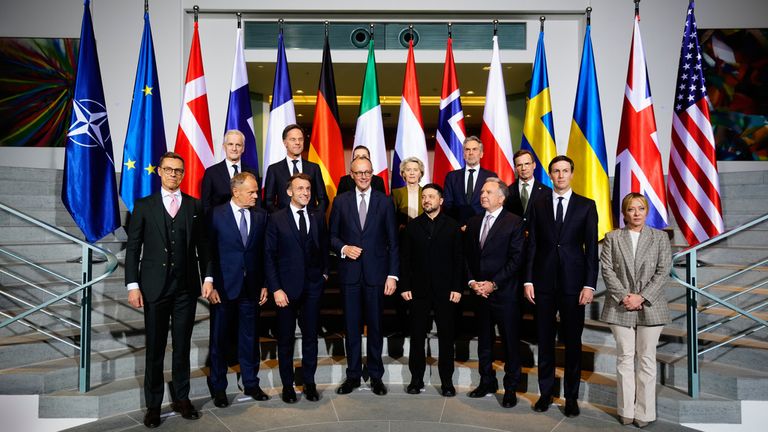
European, US and Ukrainian officials convened in the chancellery in Berlin. Pic: AP
The document said the leaders “welcomed the close work between President Zelenskyy’s and President Trump’s teams, as well as European teams over the recent days and weeks”.
“They agreed to work together with President Trump and President Zelenskyy to get to a lasting peace, which preserves Ukrainian sovereignty and European security.
“Leaders appreciated the strong convergence between the United States, Ukraine and Europe.”
Outlining what they considered necessary security guarantees, the leaders said the “multinational force” should be made up of countries from the so-called Coalition of the Willing and “supported by the US”.
They also said they “strongly support” Ukraine joining the European Union, and that it should be able to maintain its armed forces at a level of 800,000.
“It will assist in the regeneration of Ukraine’s forces, in securing Ukraine’s skies, and in supporting safer seas, including through operating inside Ukraine.”
A US official said about 90% of issues between the warring parties had been resolved and that they believed Russia would be open to Ukraine joining the European Union, and to the security guarantees in the deal.
-
 Sports2 years ago
Story injured on diving stop, exits Red Sox game
-
 Sports3 years ago
‘Storybook stuff’: Inside the night Bryce Harper sent the Phillies to the World Series
-
 Sports2 years ago
Game 1 of WS least-watched in recorded history
-
 Sports3 years ago
Button battles heat exhaustion in NASCAR debut
-
 Sports3 years ago
MLB Rank 2023: Ranking baseball’s top 100 players
-
Sports4 years ago
Team Europe easily wins 4th straight Laver Cup
-
 Environment3 years ago
Japan and South Korea have a lot at stake in a free and open South China Sea
-
 Environment1 year ago
Here are the best electric bikes you can buy at every price level in October 2024