
Divers search for bodies as German town counts cost of tragic flood

From a bridge in one the most severely flood-hit towns in Germany, we watched as the army moved heavy lifting equipment onto the bypass below.
Cars and lorries were visible in the water that covered the road but after a dry, hot day the level had fallen enough for a search and clearance operation to begin.
Divers moved around the vehicles, looking inside for some of the hundreds still missing in Germany.
The fear was some people may have died in their vehicles when floodwaters hit Erftstadt.

It is feared divers and rescue crews may find more bodies as waters recede in Erftstadt
While we were there no victims were found but there are vast areas still to search here.
Much of the town – where some houses collapsed during the floods – is still a no-go area for residents.
A vast sinkhole has appeared in one neighbourhood, making it too dangerous for people to return to properties they were forced to leave.
We meet some of them queuing to receive €200 (£171) payments to buy basic necessities. They left their homes at speed and took little or nothing with them.
One man, Peter Baer, tells me that the three houses next to him were totally demolished. When he left his house was still standing but he has no idea what state it is in.

Much of the town of Erftstadt is a no-go zone
Momika Preiter, who is in line with her daughter, says the floodwater came in violently. She wanted to stay upstairs but fire crews knocked on her door to say ‘get out, your life is at risk’.
As they wait for their emergency money, staff from a local restaurant hand out free pizzas.

Flood relief arrives for German victims
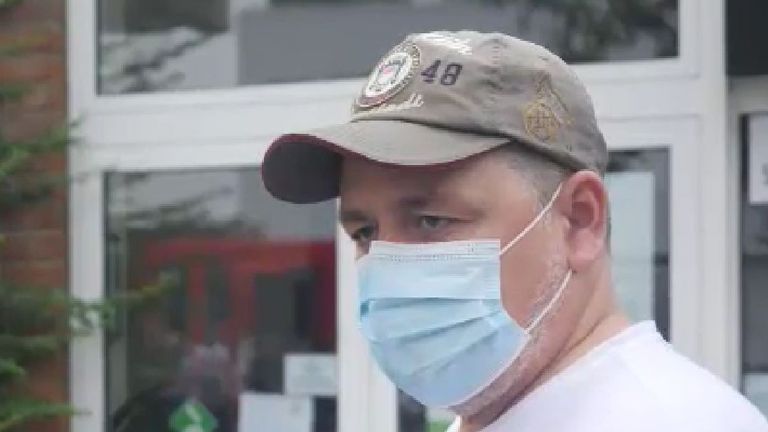
Peter Baer told us he does not know if his house is still standing
They tell us they just want to help and there is a real sense of being in it together here.
But there is also a common sense of fear. That it may rain heavily again and the floodwaters return.

People in the town of Ahrweiler start to clear up
Fear, too, about what has happened to their homes, streets, neighbours.
So many are still unaccounted for in western Germany and only now as the waters recede can intensive searches begin of areas that were submerged.

Pizza was offered to those queuing for cash handouts
Officials have warned the number of dead is certain to increase.
And many here worry if they’ll recognise a name or notice a face is missing from the evacuation centres.
That is a tough thing to have to think about for people who’ve already been through so much.


At least 50 people, including 33 children, have been killed in southern Sudan after a drone attack by paramilitary forces hit a nursery in South Kordofan state.
Sudan Doctors’ Network says paramedics on the scene in the town of Kalogi were also targeted by the Rapid Support Forces (RSF) in a “second unexpected attack”.
Rights group Emergency Lawyers reported a “third civilian site” near the previous two attacks was also targeted.
The death toll is expected to be higher, but communication blackouts have made it difficult to confirm the full number of casualties.
Emergency Lawyers says the strikes are a “flagrant violation of international humanitarian law, including the protection of civilians, especially children, and vital civilian infrastructure.”
UNICEF has urged both parties to stop the attacks immediately and allow safe access for humanitarian aid.
“Killing children in their school is a horrific violation of children’s rights,” said UNICEF representative for Sudan Sheldon Yett.
“Children should never pay the price of conflict.”
Read more from Sky News
RSF says it has captured Babanusa in West Kordofan
Sudan ‘epicentre of suffering in the world’
Sudan’s paramilitary forces agree to US-led humanitarian ceasefire proposal
The attack on the nursery is among the latest in the two-year conflict between the RSF and Sudan’s military, where the focus has recently shifted to the oil-rich Kordofan states.
A photo released by UNICEF shows displaced children and families from al-Fashir. (Mohammed Jammal/UNICEF via AP)
Hundreds of civilians have been killed in the last few weeks as fighting shifted from Darfur, following the RSF’s violent takeover of the city of Al Fashir, which was marked with civilians being executed, rapes, sexual assaults and other atrocities.
Thousands managed to escape the violence, but thousands more are trapped or feared killed.
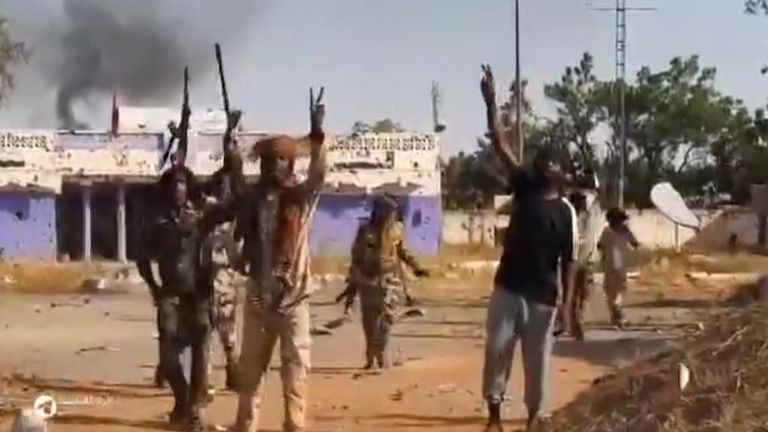
Grab from RSF social media channels in Al Fashir, Sudan
Meanwhile, Sudanese military aerial strikes last weekend killed at least 48 people, mostly civilians, in South Kordofan.
The RSF has also accused the military of carrying out a drone strike on the border with Chad, posting a video showing billowing black smoke.
The Associated Press has been unable to verify the video or whether there were any casualties, while Sudan’s military also hasn’t commented.
The RSF and the Sudanese military have been fighting for power over the country since 2023, which has seen more than 40,000 people killed, according to the World Health Organisation, although the real death toll is expected to be higher. 12 million people have been displaced.
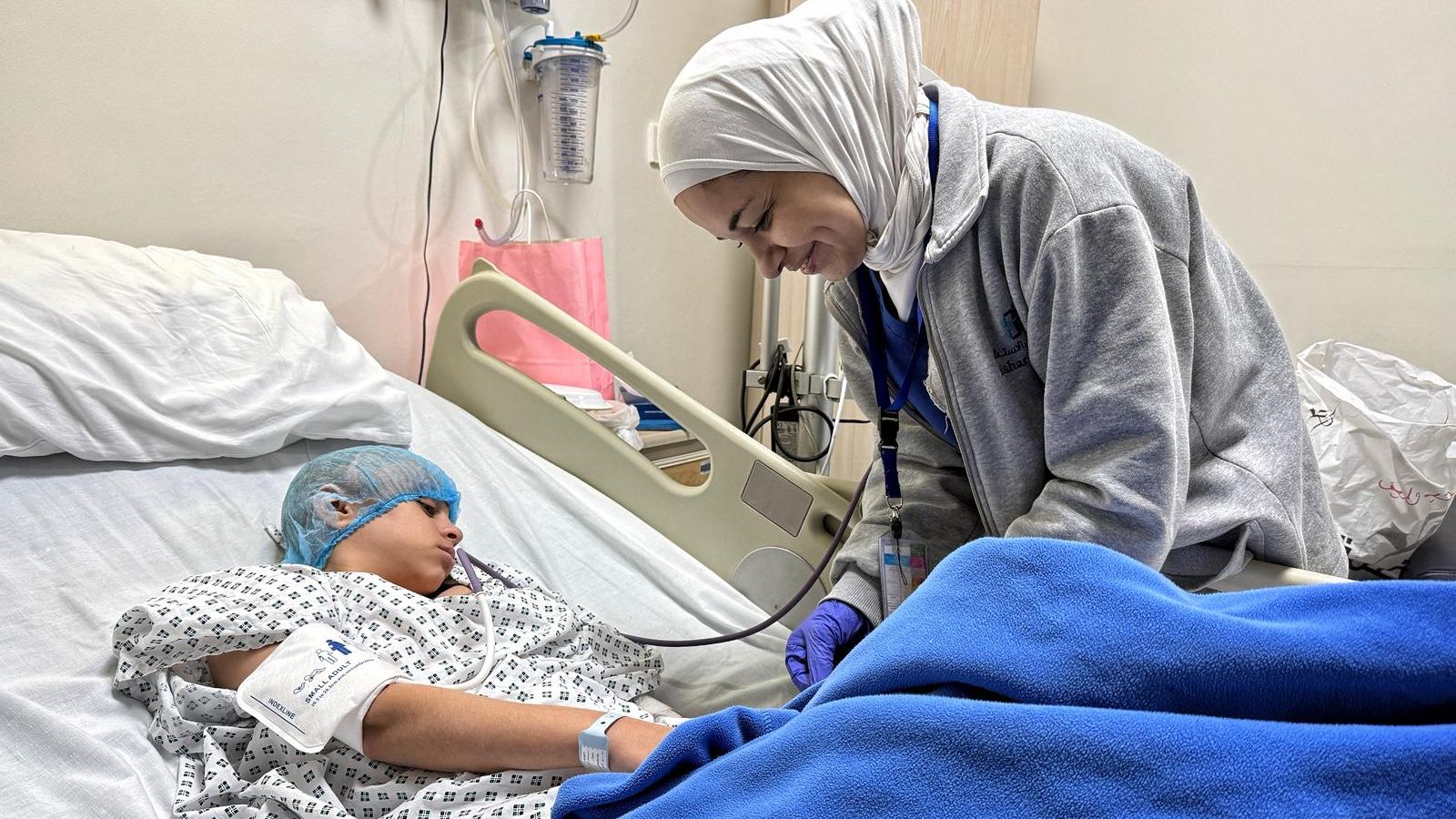
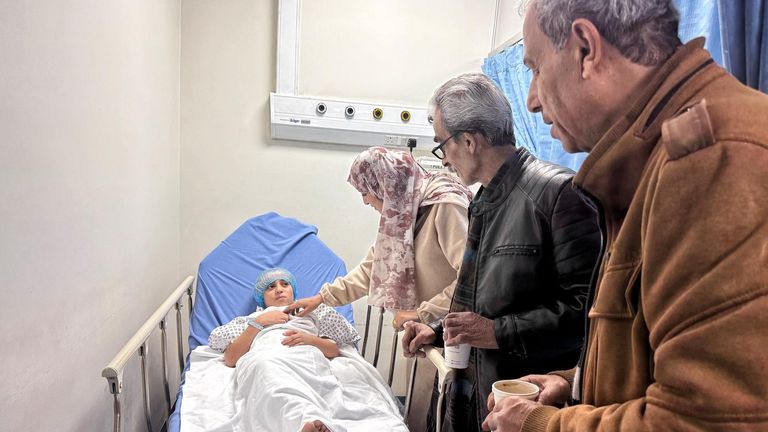
The 3D picture we’re shown of Maryam’s skull shows a gaping hole.
It’s astonishing the young girl from Gaza even survived an Israeli bombing near her home.
But she’s sitting up in her hospital bed in the Jordanian capital Amman, as we look on and she’s smiling and joking during a call with her father who remains in the Palestinian territory.
“I’m okay,” she says cheerily, “how are you?”
She’s heard overnight there’s been severe flooding in Gaza and the tents and makeshift shelters which tens of thousands are living in, are now soaked and under water.
But her father is focussed on how his 12-year-old daughter is feeling ahead of yet another life-saving brain operation.
Maryam is a rarity.
She is one of a few hundred patients who’ve been allowed by the Israeli authorities to leave the Gaza Strip to receive critical medical help since the October 2025 agreement signed between Israel and Hamas, which was aimed at ending hostilities.

The World Health Organisation (WHO) says they’ve identified nearly 16,000 medical cases needing urgent critical care outside Gaza.
WHO data documented a total of 217 patients who left Gaza for medical care in other countries between the dates of 13 October and 26 November 2025.
Since then, Israel’s Coordination of Government Activities in the Territories (COGAT) has said a further 72 patients and caregivers from Gaza have departed the Israeli-occupied area for Jordan.
But behind them, they left a long queue of ill and wounded people in desperate need of the sort of specialised medical help Maryam Ibrahim is receiving in Jordan.
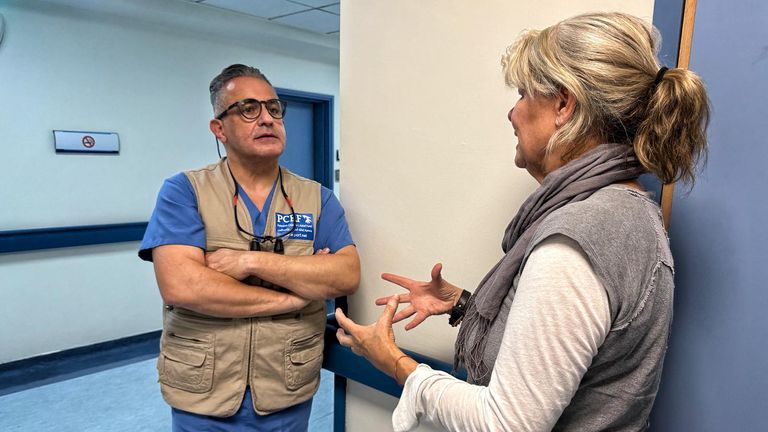
Alex Crawford and Dr Samer Elbabaa
Having survived the bombing and having survived the craniectomy (removing her fractured skull), Maryam’s next challenge was surviving the wait to receive permission to leave Gaza for the surgery which offered her a chance of long-term survival.
She waited almost half a year for this operation: an operation considered vital.
Without it, Maryam’s brain was unprotected. Any stumble or accident risked irreversibly injuring her brain and negatively impacting her neurological functions – a risk which was considerably heightened given where she’s living.
The Palestine Children’s Relief Fund (PCRF) which has funded her medical care in Jordan says they’ve “witnessed at first hand the catastrophic toll of this conflict on children’s health and well-being.
“Thousands have been orphaned, maimed or left with lifelong trauma. Entire hospitals and health centres have been destroyed leaving an entire population of children without access to even the most basic medical care.”
While humanitarian organisations continue to encounter challenges in organising evacuations from Gaza, two British surgeons were amongst a group of medics refused permission by the Israeli authorities to enter the territory.
Dr Victoria Rose, a plastic and reconstructive surgeon with the IDEALS charity, told Sky News: “WHO calculated that in 2025, only 47% of emergency medical teams were granted entry to Gaza.
“This is at a time when hundreds of local doctors have been detained by the IDF with many still unaccounted for. Gaza does not have the manpower to cope with the numbers of injured.”
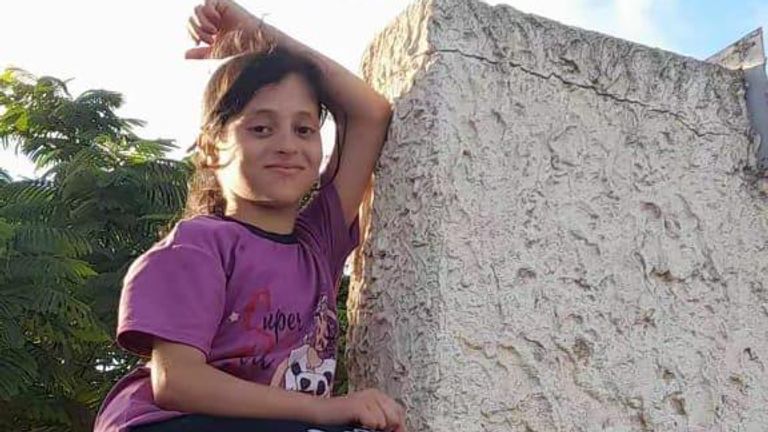
Maryam
Read more:
More children from Gaza to be brought to UK for urgent treatment
Rafah crossing to open ‘in coming days’, says Israel
Maryam’s case received widespread publicity after the intervention of the popular American children’s educator and YouTuber Rachel Griffin Accurso known as “Ms Rachel”.
She highlighted her case by talking to the little girl via Instagram after Maryam posted about how she was being bullied for her unusual appearance because of her cranial injury.
Maryam’s family realise she’s been unusually fortunate to receive this specialised care, but they know too that as soon as Maryam is well enough, the little girl will be returned to Gaza and an unpredictable future.
The Israeli authorities continue to insist via X that they are helping to organise humanitarian aid into Gaza and are committed to “facilitating a humanitarian-medical response” – which includes establishing field hospitals.
They have repeatedly suggested that it is the lack of coordination on the part of various countries and organisations which is the issue – but this runs counter to what multiple humanitarian groups and individuals have experienced.

Germany’s parliament has voted to reintroduce voluntary military service, but getting Gen Z recruits could prove tricky.
Across the country, students gathered to demonstrate against what they fear will be a return to conscription.
In Berlin, they held signs saying, “You can’t have our lives if we don’t eat your lies” and “peace is power”.
While most demonstrators were in their late teens or twenties, some parents also turned out with their younger children.
One mother held a placard declaring: “You can’t have my son”.
The new plan means from January, all 18-year-olds will be sent a questionnaire about their fitness and willingness to serve.
Men must fill it in, while for women it will be voluntary.
In the future, if the numbers of volunteers are too low, then parliament could trigger conscription at times of war or in emergencies.
It’s an idea which horrifies many in the crowd.
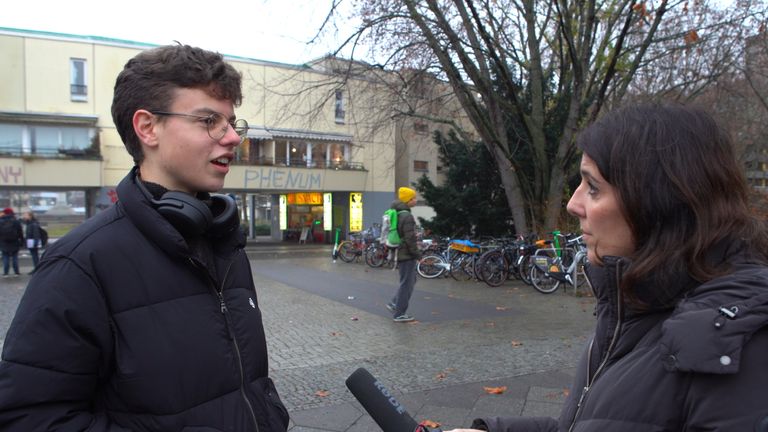
“None of us want to die for a country that doesn’t really care about us,” Levi tells me.
He says the government has ignored their calls for climate protections and better social conditions, so he feels no allegiance to them.
Levi
I ask: “If Germany was attacked, who do you think should defend it if Gen Z don’t want to?”
“Why don’t the people that started the war do it? I don’t see why the older people shouldn’t go to war. I mean, a lot of them already were in the army,” he replies.
17-year-old Sara agrees, declaring: “I would not be willing to die for any country.”
“I don’t think it’s right to send children or anyone against their will into the military, because war is just wrong,” she says.
“I’m never going to join the military and if Germany is attacked, I’ll just go somewhere else where there’s no war.”

Sara
While the government says the system will be voluntary for as long as possible, from 2027 all 18-year-old men will have to have a medical examination so the government can see who is fit to serve.
German defence minister Boris Pistorius says the mandatory medical is needed so that in the event of an attack, Germany would not waste time confirming “who is operationally capable as a homeland protector and who is not”.
The move is a massive cultural shift for Germany, which suspended mandatory military conscription on 1 July 2011.
“From my friends no one wants to volunteer because we don’t want to fight for a problem that’s not really ours. We didn’t start the problems, they [the government] did,” says Silas.
Sky’s Europe Correspondent Siobhan Robbins investigates.
The change is a direct reaction to Russia’s invasion of Ukraine
Despite Moscow’s denials, NATO’s chief has warned Russia could be able to attack a member country in the next four to five years.
I ask 19-year-old Lola if she’s thinks Russia is a threat?
“It could be, maybe. However, I think there are more important issues, especially like social ones, than war,” she says.

Lola
Her friend, 28-year-old Balthasar, goes further, saying: “A country being able to attack isn’t the same as a country planning to attack.
“The track record of Russia has been to attempt at least diplomatic resolution, cooperation, and I think those are the right approaches to take in international politics, opposed to sabre-rattling, which the German government has resorted to.”
The German chancellor, Friedrich Merz, has said he wants to build the strongest army in Europe.
Germany currently has around 184,000 soldiers and wants to boost that by over 80,000 in the next decade.
Read more from Sky News:
Irish police investigating drone sightings during Zelenskyy visit
Giving up Ukrainian territory would be ‘unjust peace’
Volunteers are being offered incentives like a monthly wage of more than €2,000 (£1,750).
Despite this, a survey earlier this year found 81% of Gen Z wouldn’t fight for Germany.
In contrast, many of the older generation supported conscription.
At the Berlin protest, 17-year-old Valentin was the only person we met who reluctantly agreed to fight.
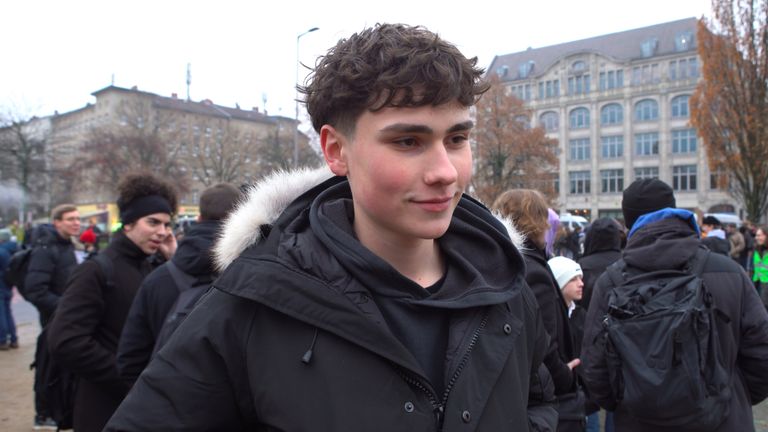
Valentin
“When we are attacked, then yes [I would fight], but when we are attacking other countries, then no,” he says.
Germany isn’t the only country looking for reinforcements, last month France announced a new military service for over-18s.
Currently, 10 EU countries already have compulsory military service.
While others like Belgium, the Netherlands and Germany are opting for voluntary schemes.
The German plan still must be signed off by parliament’s upper house later this month before it’s expected to start in January.
-
 Sports2 years ago
Story injured on diving stop, exits Red Sox game
-
 Sports3 years ago
‘Storybook stuff’: Inside the night Bryce Harper sent the Phillies to the World Series
-
 Sports2 years ago
Game 1 of WS least-watched in recorded history
-
 Sports3 years ago
Button battles heat exhaustion in NASCAR debut
-
 Sports3 years ago
MLB Rank 2023: Ranking baseball’s top 100 players
-
Sports4 years ago
Team Europe easily wins 4th straight Laver Cup
-
 Environment3 years ago
Japan and South Korea have a lot at stake in a free and open South China Sea
-
 Environment1 year ago
Here are the best electric bikes you can buy at every price level in October 2024