Connect with us

Published

on

Tesla has dropped the price of their FSD Computer/Hardware 3.0 upgrade to $1,000, from the previous price point of $1,500. This applies to vehicles that still have Hardware 2.0/2.5 computers and want to try the new Tesla FSD subscription service rolled out this weekend.

The move comes after significant criticism from Tesla forums and from us here at Electrek, who pointed out that Tesla is charging owners to upgrade to hardware they were already told they had.

Our previous story lays out the whole situation, and we won’t completely repeat it here. Click through if you want more details.

Here’s a quick recap: all vehicles Tesla sold from late-2016 to mid-2019 purportedly included the appropriate hardware for Full Self-Driving capabilities. This was not functional yet, but would be utilized as Tesla further developed its Autopilot software. Eventually, Tesla found out they needed a hardware upgraded, and started shipping cars with a more capable Autopilot computer. When owners of cars with the old hardware bought the Full Self-Driving package, they would be upgraded for free to the new computer. Then Tesla introduced a new subscription model, but started charging people with the old hardware $1,500 for the hardware upgrade, even though those owners had bought the car thinking they had the proper hardware for Full Self-Driving.

After seeing the backlash from forums, Electrek, and other publications, Tesla seems to have taken this criticism at least partially to heart, and customers in the same situation who go to upgrade in the Tesla app are now shown a $1,000 upgrade cost, rather than the previous $1,500:
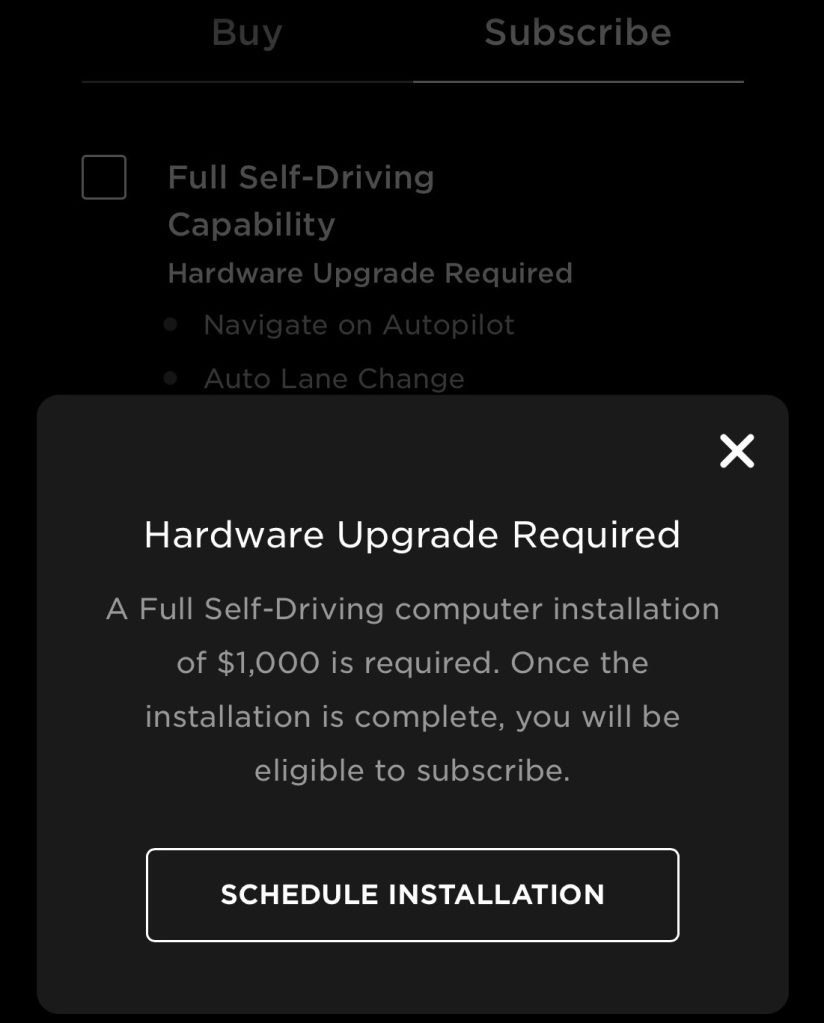
We have also seen reports that anyone who has scheduled an installation in the last few days will receive a refund for the $500 difference.

According to a teardown by EE Times, Tesla’s HW 3.0 system costs about $190 per unit – though, to be honest, this seems a little low to us. Also, this is simply hardware cost, and doesn’t include any service or logistics costs for the retrofit installation.

Electrek’s Take

While this is a step forward, it’s still not zero. Tesla sold these vehicles with the promise that they had the hardware for self-driving capabilities, so it does not seem ethical to charge additional money to owners who bought the vehicle with that promise simply in order to restore a capability that they were told they already have.

Yes, things have changed since then, but a person who bought a Tesla in 2017 did not know that HW3 would be required for Full Self-Driving, as that announcement wasn’t made until 2019.

Tesla did right by those owners previously, by offering free upgrades for those who bought Full Self-Driving, but they’re still not doing right by the owners of late-2016 to mid-2019 cars who subscribe to the new subscription feature.

We don’t know what Tesla’s specific concerns are which led to this decision. It’s possible they thought that if enough people subscribe for one month and then cancel their subscription, the cost of installing hardware in those vehicles would result in a loss for Tesla, and those cars wouldn’t be gaining any functionality from the new hardware anyway. From their current point of view this makes some sense, but remember: they still sold these cars as if they had Full Self-Driving hardware. Upgrades required to get to that point should be Tesla’s responsibility, not the owner’s.

Fred had a suggestion for a compromise that Tesla could implement, which does alleviate this possible concern:

I had been thinking something similar. Tesla could have introduced the subscription service with a minimum contract, or as Fred states, perhaps a credit of several free months in exchange for a lump sum upfront to cover the hardware upgrade. This would have been an easier sell, as customers wouldn’t feel like they’re losing out on any money, even though they should have already had the hardware for FSD.

They likely didn’t do that because they wanted to keep subscriptions easy, but If they had done this from the get-go, they probably could have avoided the anger of customers who feel jilted at having to pay for hardware they thought they already had.

In the end, the most fair solution is just to take it on the chin and install this hardware for free to people who bought a car that was marketed as having Full Self-Driving hardware. Maybe Tesla takes a short financial hit from this, but if they’re proud enough about the system and think its capabilities are worth 199/month, they’ll eventually recoup those upgrade costs and more.

Besides, it was a promise, and for a company that has grown largely due to the loyalty and word of mouth of its early customers, it’s not just the right thing to do, but the smart thing to do. We’re glad they made this change, because it means they recognize they were wrong and are receptive to criticism, but we’d really like to see the price go down to what it should have been all along: zero.


Subscribe to Electrek on YouTube for exclusive videos and subscribe to the podcast.
Continue Reading

Entertainment

Sherlock star Benedict Cumberbatch’s ‘very odd job’ – acting opposite an enormous bird in The Thing With Feathers

Published

on

By

Sherlock star Benedict Cumberbatch's 'very odd job' - acting opposite an enormous bird in The Thing With Feathers

He’s played Sherlock Holmes, Doctor Strange, and even voiced The Grinch but acting opposite a seven-foot (2.1m) crow may be one of the strangest roles Benedict Cumberbatch has taken on. 

Speaking about his new film, The Thing With Feathers, he admits it’s “a very odd job, there’s no getting away from it”.

If the vision of Cumberbatch wrestling with a giant bird sounds like the sort of amusingly surreal movie you fancy taking a look at next week, it’s important to understand that this is no comedy.

Pic: The Thing With Feathers/Vue Lumiere
Image:
Pic: The Thing With Feathers/Vue Lumiere

Pic: The Thing With Feathers/Vue Lumiere
Image:
Pic: The Thing With Feathers/Vue Lumiere

While the film, based on Max Porter’s eclectic novella Grief Is The Thing With Feathers, the film is at times disturbingly funny, but mostly it is an incredibly emotional take on the heartbreaking way we all process grief.

Cumberbatch plays a man whose wife has died suddenly, leaving him with their two young boys. The story itself is split into three parts – dad, boys and crow.

Crow – voiced by David Thewlis – is a figment of dad’s imagination, a sort of “unhinged Freudian therapist” for him, according to Porter.

Cumberbatch, a father of three, said this certainly wasn’t a role he wanted to think about when he returned to his own family each night.

More on Benedict Cumberbatch

“I didn’t take it home, I didn’t talk about it…You have to work fast when you’re a father of three with a busy home life, you know, it’s very immediate the need they have of you, so you don’t go in and talk about your day crying your eyes out on a sofa with a crow punching you in the face.”

Benedict Cumberbatch in The Thing With Feathers. Pic: Vue Lumiere
Image:
Benedict Cumberbatch in The Thing With Feathers. Pic: Vue Lumiere

Since Porter’s award-winning work was first published in 2015 it has built a cult following.

Using text, dialogue and poetry to explore grief from various characters’ perspectives, the author says the subject matter is universal.

“Most of us are deeply eccentric in one way or another, like my father-in-law, apparently a very rational, blokey bloke, who’s like ‘when my mum died, a wren landed on the window and I knew it was my mum’.

“Grief puts us into these states where we are more attuned to the natural world and particularly more attuned to symbols and signs. So, imagining a crow moving in with the family actually makes a lot of sense to people, whereas, weirdly, five steps to getting better or get well soon or a hallmark card or whatever doesn’t make much sense to the people when you’re in that storm of pain.”

Read more from entertainment news:
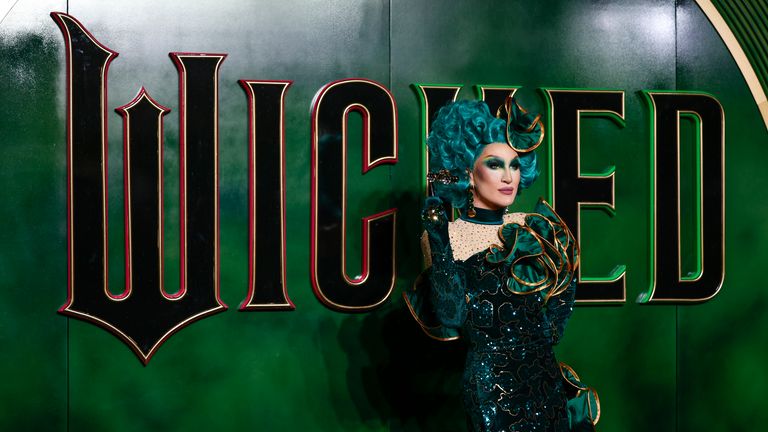
Wicked star ‘felt really scared’ growing up gay in school
Pope Leo meets with film stars and directors at Vatican

While the film sees Cumberbatch portray a firestorm of emotions, he says he feels it’s important to tackle weighty issues on screen.

Benedict Cumberbatch
Image:
Benedict Cumberbatch

Max Porter
Image:
Max Porter

“It is a universal experience, in one way or another you’re ‘gonna lose someone that you love during your life.”

The film, he says, explores grief through a male prism.

“At a time when there’s a lot of very troubling influences on men without female presence in their lives, this thing of scapegoating and seeing the other as a threat, all of that comes into play within the allowance of grief to be a messy, scary, intimidating, chaotic, unruly and out of control place to exist as a man.

“This is a film that just leans into the idea that it’s alright to have feelings, you bury them or hide them at your peril.”

The Thing With Feathers is out in cinemas in the UK and Ireland on 21 November.

Continue Reading

Entertainment

‘I felt really scared and I felt alone’ – Wicked star Jonathan Bailey on growing up gay in school

Published

on

By

'I felt really scared and I felt alone' - Wicked star Jonathan Bailey on growing up gay in school

“I felt scared and I felt alone and I felt entirely limited at various points in my life”, actor Jonathan Bailey says of growing up gay in school.

While promoting Wicked: For Good, the actor donated one of his interview slots to talk about the charity he is a patron of: Just Like Us, which works with LGBT+ youth in schools.

“That’s something that I would have really benefited from when I was young,” he said, talking exclusively to Sky News about his charitable work.

In surveys of thousands of UK pupils, Just Like Us found that LGBT participants aged 11 to 18 were twice as likely to suffer anxiety, depression and to be bullied, and that only half felt safe at school on a daily basis.

“I experienced all of that,” he said. “It became clear quite early on that something that was very specific and clear to me about who I was, it wasn’t safe and it wasn’t celebrated.”

Whether as Lord Anthony in Bridgerton, being crowned sexiest man alive and as the Winkie Prince Fiyero in Wicked: For Good, Bailey has broken through an outdated stereotype.

Historically, it was considered a career risk to be out – a heterosexual romantic lead’s career was at risk if his sexuality was public.

More on Lgbt

For the Winkie prince actor, education can play a role in defying limitations.

While promoting Wicked: For Good, Bailey talked about a charity that works with LGBT+ youth in schools.. File pic: Just Like Us
Image:
While promoting Wicked: For Good, Bailey talked about a charity that works with LGBT+ youth in schools.. File pic: Just Like Us

“This is beyond sexuality,” he said, “it’s race, it’s class, it is where you’re from, we are all given limiting narratives that we have to break free of.

“I thought not only was I not going to be able to play these sorts of parts because of my sexuality, but that I wouldn’t be able to do Shakespeare because I didn’t go to drama school.

“They’re the sort of stories that we need to be reminded of is that actually standing up and being safe enough to be able to say who you really are, and to be vulnerable at that age… these formative years, is inspiring to everyone in the classroom.”

But classrooms in the UK are facing tightening budgets due to “spiralling costs” that threaten to outstrip the growth in school funding.

Citing budget and time pressures on teachers, Just Like Us has made its talks free in schools. Does the actor think the government should be doing more?

He said: “I’m a very proud brother of an incredible teacher who works in the state system, and I know how much she cares about her school, her pupils.

“The resources are being crunched, and the problem is that it will be the arts and it will be really important conversations that Just Like Us bring into the schools and these… things that are going to go, and that’s just really sad.

“But I’m not the person to come up with solutions other than I can do my bit.”

Bailey, Cynthia Erivo and Bowen Yang are among Wicked’s LGBT cast, and in Wicked: For Good, openly gay actor Colman Domingo joins them as the voice of the Cowardly Lion.

But not everyone is encouraging the onscreen representation: A “warning” by conservative group One Million Moms said that the Jon M Chu-directed films are “normalising the LGBTQ lifestyle” to children and takes aim at the cast.

The alert urges people to boycott the sequel “even if you have seen Wicked: Part One”.

Read more from Sky News:
Ariana Grande rushed by red carpet intruder at Wicked premiere
Man given 13-month prison sentence for stealing Banksy print
Budget 2025 income tax U-turn: What the hell just happened?

When asked about the pushback, Bailey is resolute: “I don’t even acknowledge… the thing that’s important to me is how do I chat to little Johnny in all this.

“I’m thrilled to be living in a time where I can play the Winkie Prince and where Just Like Us is doing the extraordinary work that they’re doing.”

Continue Reading

Entertainment

Donald Trump confirms he will sue the BBC over Panorama edit – despite broadcaster’s apology

Published

on

By

Donald Trump confirms he will sue the BBC over Panorama edit - despite broadcaster's apology

Donald Trump has said he will sue the BBC for between $1bn and $5bn over the editing of his speech on Panorama.

The US president confirmed he would be taking legal action against the broadcaster while on Air Force One overnight on Saturday.

“We’ll sue them. We’ll sue them for anywhere between a billion (£792m) and five billion dollars (£3.79bn), probably sometime next week,” he told reporters.

“We have to do it, they’ve even admitted that they cheated. Not that they couldn’t have not done that. They cheated. They changed the words coming out of my mouth.”

Mr Trump then told reporters he would discuss the matter with Prime Minister Sir Keir Starmer over the weekend, and claimed “the people of the UK are very angry about what happened… because it shows the BBC is fake news”.

The Daily Telegraph reported earlier this month that an internal memo raised concerns about the BBC’s editing of a speech made by Mr Trump on 6 January 2021, just before a mob rioted at the US Capitol building, on the news programme.

Please use Chrome browser for a more accessible video player

BBC crisis: How did it happen?

The concerns regard clips spliced together from sections of the president’s speech to make it appear he told supporters he was going to walk to the US Capitol with them to “fight like hell” in the documentary Trump: A Second Chance?, which was broadcast by the BBC the week before last year’s US election.

More on Bbc

Following a backlash, both BBC director-general Tim Davie and BBC News chief executive Deborah Turness resigned from their roles.

‘No basis for defamation claim’

On Thursday, the broadcaster officially apologised to the president and added that it was an “error of judgement” and the programme will “not be broadcast again in this form on any BBC platforms”.

A spokesperson said that “the BBC sincerely regrets the manner in which the video clip was edited,” but they also added that “we strongly disagree there is a basis for a defamation claim”.

Earlier this week, Mr Trump’s lawyers threatened to sue the BBC for $1bn unless it apologised, retracted the clip, and compensated him.

The US president said he would sue the broadcaster for between $1bn and $5bn. File pic: PA
Image:
The US president said he would sue the broadcaster for between $1bn and $5bn. File pic: PA

Legal challenges

But legal experts have said that Mr Trump would face challenges taking the case to court in the UK or the US.

The deadline to bring the case to UK courts, where defamation damages rarely exceed £100,000 ($132,000), has already expired because the documentary aired in October 2024, which is more than one year.

Also because the documentary was not shown in the US, it would be hard to show that Americans thought less of the president because of a programme they could not watch.

Read more from Sky News:
Key findings in 20,000 pages of documents in the Epstein files

Banksy art theft lands burglar with 13-month prison sentence

Please use Chrome browser for a more accessible video player

Sky’s Katie Spencer on what BBC bosses told staff on call over Trump row

Newsnight allegations

The BBC has said it was looking into fresh allegations, published in The Telegraph, that its Newsnight show also selectively edited footage of the same speech in a report broadcast in June 2022.

A BBC spokesperson said: “The BBC holds itself to the highest editorial standards. This matter has been brought to our attention and we are now looking into it.”

Continue Reading

Trending