
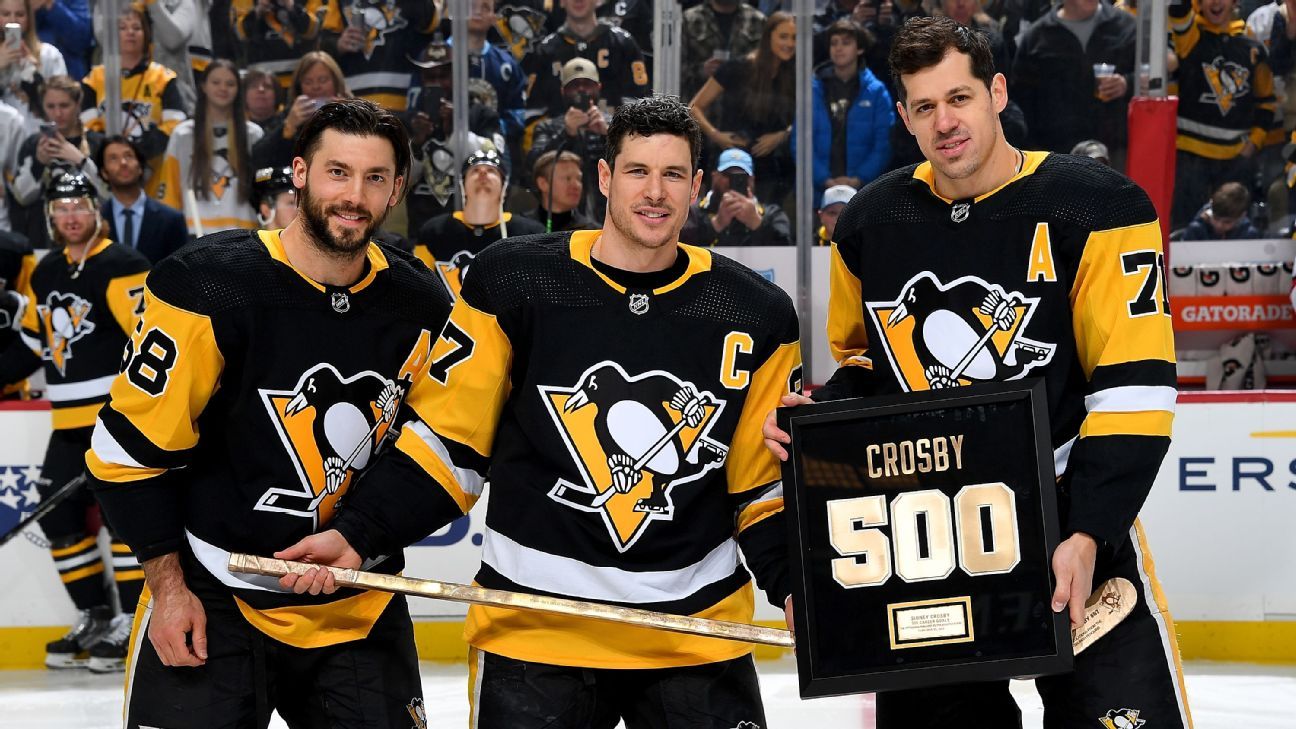
‘We’ve gotta do something with it:’ Pens’ veterans back and hungry for another Cup


-
Bradford Doolittle
ORLANDO, Fla. — There were a number of ironies surrounding the results of the contemporary baseball era committee’s Hall of Fame ballot, announced Sunday night at MLB’s winter meetings.
Perhaps the most poignant is this: If not for Barry Bonds, Jeff Kent — the only one of the eight players under consideration selected Sunday — might not be bound for Cooperstown. While Kent is the all-time home run hitter among second basemen, he was on the same ballot as Bonds — who hit more homers than anyone, at any position.
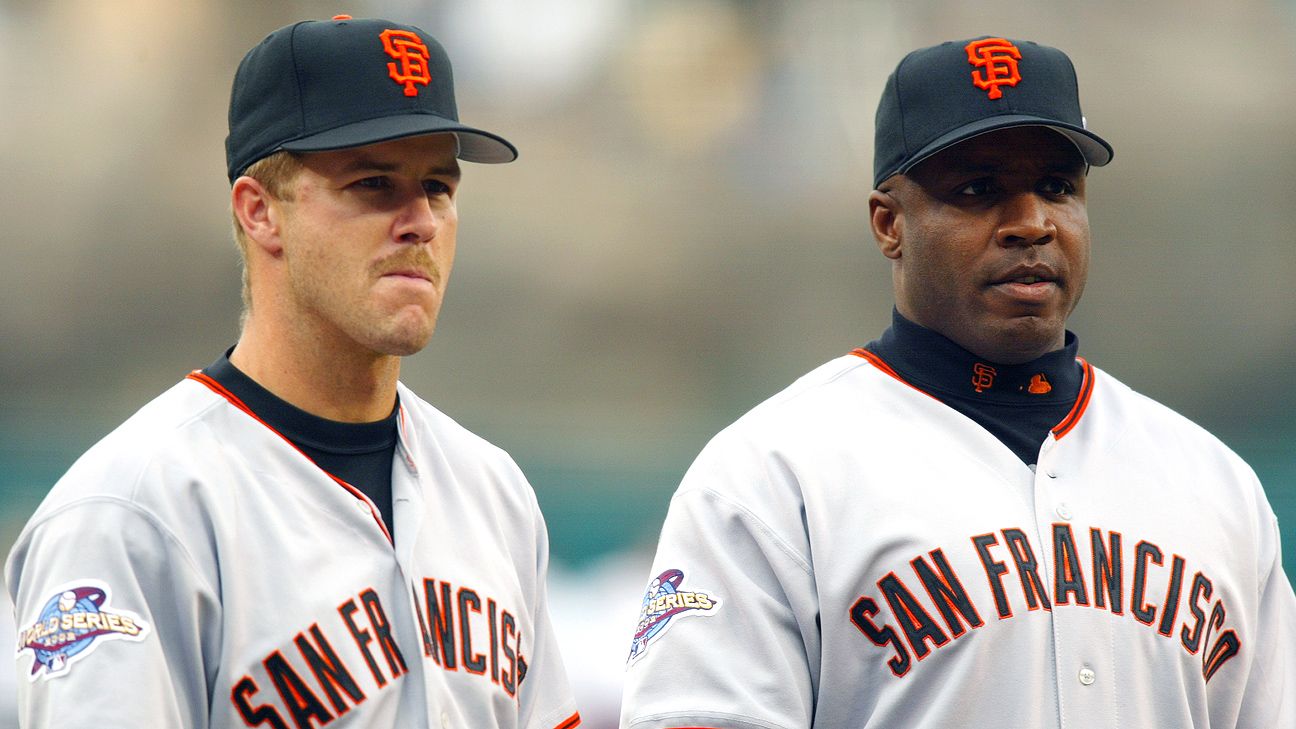
During a post-announcement news conference, Kent recalled the way he and Bonds used to push, prod and sometimes annoy each other during their six seasons as teammates on the San Francisco Giants. Those were Kent’s best seasons, a fairly late-career peak that ran from 1997 to 2002, during which Kent posted 31.6 of his 55.4 career bWAR.
The crescendo was 2000, when Kent enjoyed his career season at age 32, hitting .334 with a 1.021 OPS, hammering 33 homers with 125 RBIs and compiling a career-best 7.2 bWAR. Hitting fourth behind Bonds and his .440 OBP, Kent hit .382 with runners on base and .449 with a runner on first base.
During Kent’s six years in San Francisco, he was one of five players in baseball to go to the plate with at least one runner on base at least 2,000 times, and the other four all played at least 48 more games than he did. Turns out, hitting behind Bonds is a pretty good career move.
To be clear, Kent was an outstanding player and the numbers he compiled were his, and his alone. When you see how the news of election impacts players, it’s a special thing. I am happy Jeff Kent is now a Hall of Famer.
But I am less happy with the Hall of Fame itself. While Kent’s overwhelming support — he was named on 14 of the 16 ballots, two more than the minimum needed for induction — caught me more than a little off guard, what didn’t surprise me was the overall voting results. In what amounted to fine print, there was this mention in the Hall’s official news release: “Barry Bonds, Roger Clemens, Gary Sheffield and Fernando Valenzuela each received less than five votes.”
By the new guidelines the Hall enacted for its ever-evolving era committee process — guidelines that went into effect with this ballot — Bonds, Clemens, Sheffield and Valenzuela aren’t eligible in 2028, the next time the contemporary era is considered. They can be nominated in 2031, and if they are, that’s probably it. If they don’t get onto at least five ballots then, they are done. And there is no reason to believe they will get more support the next time.
I thought that the makeup of this committee was stacked against the PED-associated players, but that’s a subjective assessment. And who knows what goes on in those deliberations. With so many players from the 1970s and 1980s in the group, it seemed to bode well for Don Mattingly and Dale Murphy. But they were both listed on just six ballots. Carlos Delgado had the second most support, at nine.
Why? Beats me. I’ve given up trying to interpret the veterans committee/era committee processes that have existed over the years. But the latest guidelines seem perfectly designed to ensure that for the next six years, there’s no reason to wail about Bonds and Clemens being excluded. Then in 2031, that’s it.
Meanwhile, the classic era will be up for consideration again in 2027, when Pete Rose can and likely will be nominated. Perhaps Shoeless Joe Jackson as well. What happens then is anybody’s guess, but by the second week of December 2031, we could be looking at a Hall of Fame roster that includes the long ineligible (but no more) Rose and maybe Jackson but permanently excludes the never-ineligible Bonds and Clemens — perhaps the best hitter and pitcher, respectively, who ever played.
If and when it happens, another kind of symbolic banishment will take place: The Hall will have consigned itself, with these revised guidelines, to always being less than it should be. And the considerable shadows of Bonds and Clemens will continue to loom, larger and larger over time, just as they happened with Rose and Jackson.
Ironic, isn’t it?
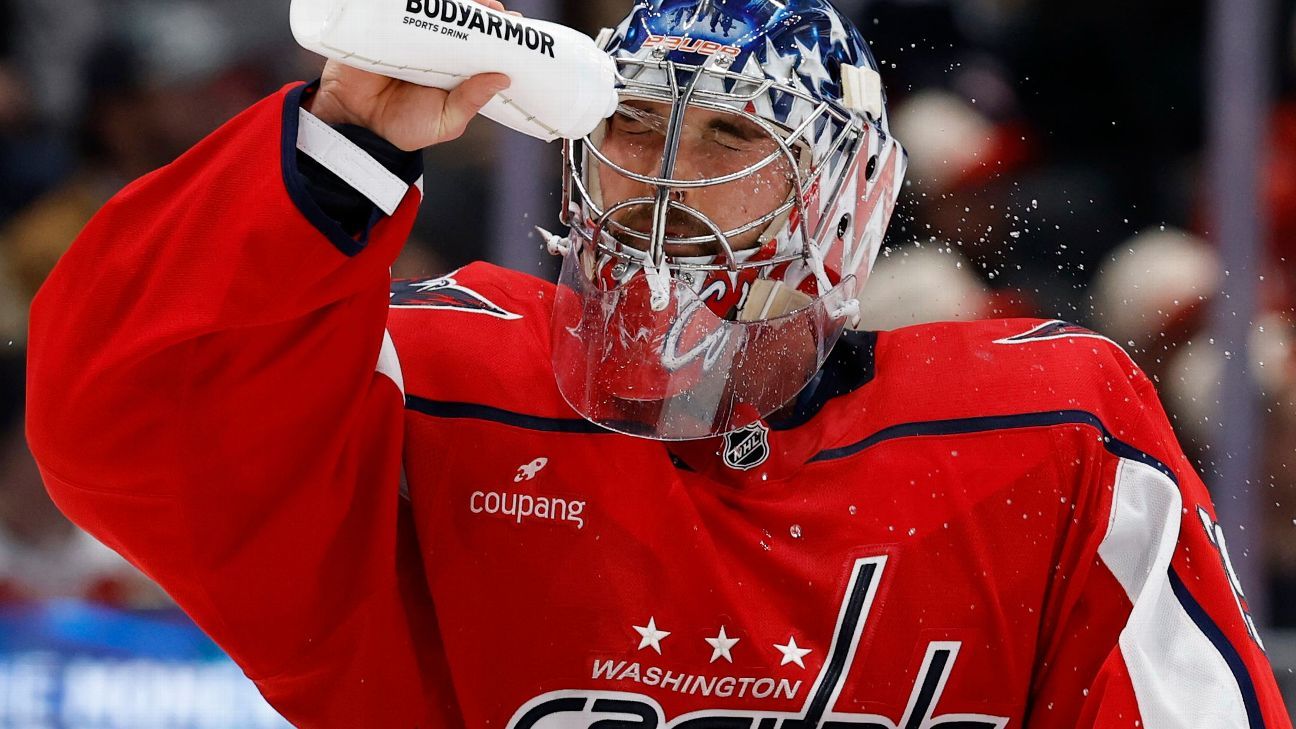

WASHINGTON — The Washington Capitals placed goaltender Charlie Lindgren and forward Ryan Leonard on injured reserve Sunday night before their game against the Columbus Blue Jackets.
Washington recalled forward Bogdan Trineyev and goaltender Clay Stevenson from Hershey of the American Hockey League.
Lindgren (upper body) was a late scratch Friday night before a 4-3 shootout loss at Anaheim. Leonard (upper body) didn’t return after his face was bloodied on an unpenalized first-period check from Jacob Trouba.
“He’s going to miss an extended period of time,” Capitals coach Spencer Carbery said about Leonard, the rookie who has seven goals and 11 assists after having two each Wednesday night in a 7-1 win at San Jose.
Lindgren is 5-3 with a 3.11 goals-against average in his 10th NHL season and fifth with Washington.
“We’ll see once he gets back on the ice,” Carbery said. “But [we] put him on the IR, so he’s going to miss, what is it, seven days at the bare minimum. And then we’ll see just how he progresses.”
-
Bradford Doolittle
ORLANDO, Fla. — Jeff Kent, who holds the record for home runs by a second baseman, was elected to the National Baseball Hall of Fame on Sunday.
Kent, 57, was named on 14 of 16 ballots by the contemporary baseball era committee, two more than he needed for induction.
Just as noteworthy as Kent’s selection were the names of those who didn’t garner enough support, which included all-time home run leader Barry Bonds, 354-game winner Roger Clemens, two MVPs from the 1980s, Don Mattingly and Dale Murphy, and Gary Sheffield, who slugged 509 career homers.
Bonds, Clemens, Sheffield and Dodgers great Fernando Valenzuela were named on fewer than five ballots. According to a new protocol introduced by the Hall of Fame that went into effect with this ballot, players drawing five or fewer votes won’t be eligible the next time their era is considered. They can be nominated again in a subsequent cycle, but if they fall short of five votes again, they will not be eligible for future consideration.
The candidacies of Bonds and Clemens have long been among the most hotly debated among Hall of Fame aficionados because of their association with PEDs. With Sunday’s results, they moved one step closer to what will ostensibly be permanent exclusion from the sport’s highest honor.
If Bonds, Clemens, Sheffield and Valenzuela are nominated when their era comes around in 2031 and fall short of five votes again, it will be their last shot at enshrinement under the current guidelines.
Kent, whose best seasons were with the San Francisco Giants as Bonds’ teammate, continued his longstanding neutral stance on Bonds’ candidacy, declining to offer an opinion on whether or not he believes Bonds should get in.
“Barry was a good teammate of mine,” Kent said. “He was a guy that I motivated and pushed. We knocked heads a little bit. He was a guy that motivated me at times, in frustration, in love, at times both.
“Barry was one of the best players I ever saw play the game, amazing. For me, I’ve always said that. I’ve always avoided the specific answer you’re looking for, because I don’t have one. I don’t. I’m not a voter.”
Kent played 17 seasons in the majors for six different franchises and grew emotional at times as he recollected the different stops in a now-Hall of Fame career that ended in 2008. He remained on the BBWAA ballot for all 10 years of his eligibility after retiring, but topped out at 46.5% in 2023, his last year.
“The time had gone by, and you just leave it alone, and I left it alone,” Kent said. “I loved the game, and everything I gave to the game I left there on the field. This moment today, over the last few days, I was absolutely unprepared. Emotionally unstable.”
A five-time All-Star, Kent was named NL MVP in 2000 as a member of the Giants, who he set a career high with a .334 average while posting 33 homers and 125 RBIs. Kent hit 377 career homers, 351 as a second baseman, a record for the position.
Kent is the 62nd player elected to the Hall who played for the Giants. He also played for Toronto, the New York Mets, Cleveland, Houston and the Dodgers. Now, he’ll play symbolically for baseball’s most exclusive team — those with plaques hanging in Cooperstown, New York.
“I have not walked through the halls of the Hall of Fame,” Kent said. “And that’s going to be overwhelming once I get in there.”
Carlos Delgado was named on nine ballots, the second-highest total among the eight under consideration. Mattingly and Murphy received six votes apiece. All three are eligible to be nominated again when the contemporary era is next considered in 2028.
Next up on the Hall calendar is voting by the BBWAA on this year’s primary Hall of Fame ballot. Those results will be announced on Jan. 20.
Anyone selected through that process will join Kent in being inducted on July 26, 2026, on the grounds of the Clark Sports Center in Cooperstown.
-
 Sports2 years ago
Story injured on diving stop, exits Red Sox game
-
 Sports3 years ago
‘Storybook stuff’: Inside the night Bryce Harper sent the Phillies to the World Series
-
 Sports2 years ago
Game 1 of WS least-watched in recorded history
-
 Sports3 years ago
Button battles heat exhaustion in NASCAR debut
-
 Sports3 years ago
MLB Rank 2023: Ranking baseball’s top 100 players
-
Sports4 years ago
Team Europe easily wins 4th straight Laver Cup
-
 Environment3 years ago
Japan and South Korea have a lot at stake in a free and open South China Sea
-
 Environment1 year ago
Here are the best electric bikes you can buy at every price level in October 2024