
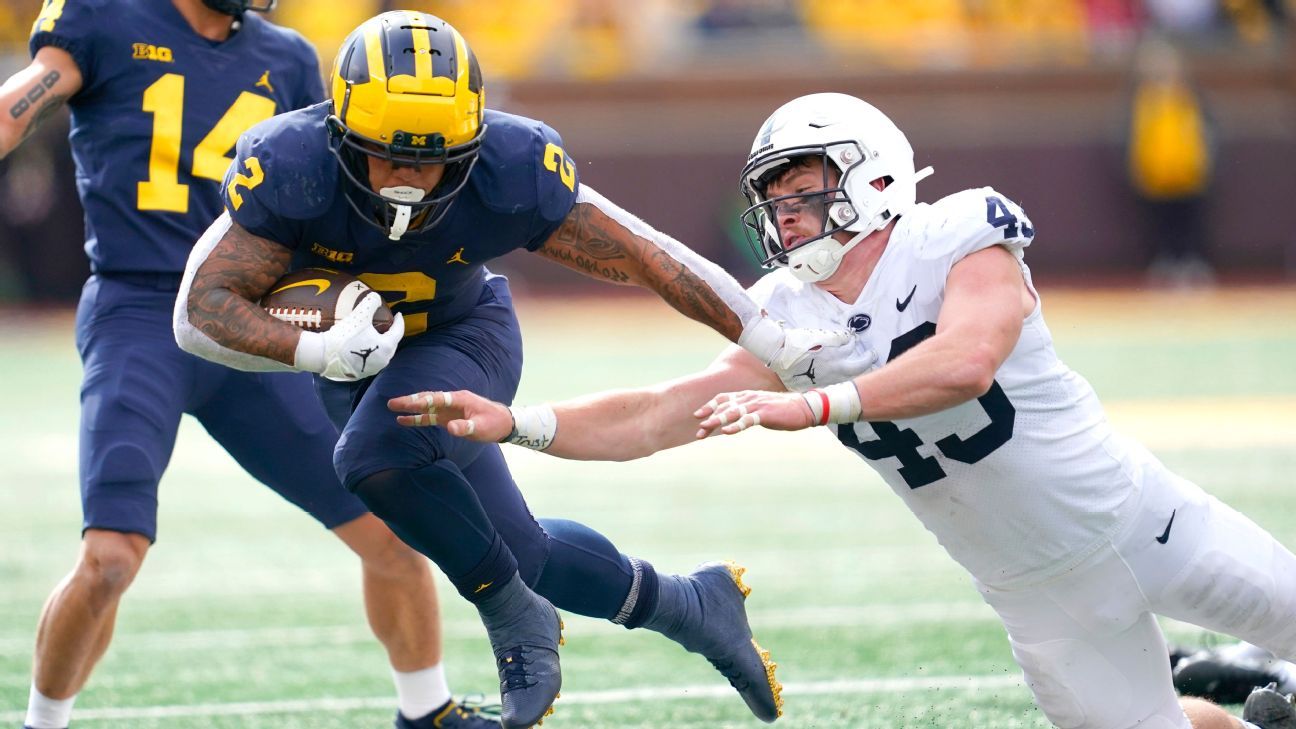
U-M overwhelms PSU; tempers flare at halftime

ANN ARBOR, Mich. — No. 5 Michigan bullied No. 10 Penn State on Saturday, from the line of scrimmage to the scoreboard to the newly named Lloyd Carr Tunnel at Michigan Stadium.
Tempers flared as both teams entered the shared tunnel with the Wolverines holding a 16-14 halftime lead. While video showed the teams exchanging verbal volleys, the situation never became physical.
“How they were emotionally all game, I wouldn’t be surprised if [it was] them starting it,” Wolverines quarterback J.J. McCarthy said of the altercation. “We just finished it.”
Michigan defensive lineman Mike Morris said the standoff stemmed from Penn State players talking trash on social media before the game.
“We all told each other, ‘They want to have those Twitter fingers, they want to talk on social media,’ and then they didn’t talk on the field,” Morris said. “They wanted to talk at halftime because they got lucky.”
After dominating the stat sheet but not the scoreboard in the first half, the Wolverines finished Penn State with a resounding third quarter en route to a 41-17 victory. Michigan took some time to pull away but held massive advantages in rushing yards (418-111), first downs (28-10) and possession time (41:56-18:04).
In a game in which Penn State briefly had more touchdowns (2) than first downs (1), Michigan looked every bit like the defending Big Ten champion and a team poised to push Ohio State for the league crown and a likely College Football Playoff spot.
“Like Coach [Jim] Harbaugh said in the locker room, ‘It was a butt-kicking in every which way a butt could be kicked,'” McCarthy said. “Just being able to do it in the fashion that we did was just awesome to see. Obviously, the first half, we wish it went a little different way scoreboard-wise, but they only had one first down and we had 18. We’ll take that any day of the week.”
Harbaugh was more diplomatic but clearly pleased, acknowledging that Michigan’s line-of-scrimmage dominance is his favorite way to win games. Despite a 6-0 start, Michigan had not been fully branded a CFP contender because of its competition. Penn State also came in undefeated but was no match for the Wolverines.
“The team made a real positive statement today,” Harbaugh said. “They call it a statement game? OK, it’s a statement game.”
Harbaugh’s team wasn’t concerned at halftime, even though it led by only two points after holding Penn State quarterback Sean Clifford to 17 passing yards, the lowest for a Nittany Lions starter since at least 2004, according to ESPN Stats & Information.
Penn State allowed more rushing yards to Michigan than it had in its previous five games (399), as Donovan Edwards and Blake Corum combined for 339 yards and four touchdowns. Michigan’s inability to convert red zone opportunities into touchdowns plagued the offense in the first half, but Edwards and Corum had touchdown runs of 67 and 61 yards, respectively, in the third quarter to break the game open.
“I feel like [I’ve] been [ready] for a game like this for a while now,” said Edwards, who missed two games with a leg injury in September. “I had to just sit back and wait my turn and show the world what I’m capable of being able to do.”
Corum has 666 rushing yards in his past four games, the most by a Michigan player since quarterback Denard Robinson in 2010 and the most by a Wolverines running back since Mike Hart in 2004, according to ESPN Stats & Information. Hart, who had a medical emergency on the sideline last week at Indiana and had to be hospitalized, returned to his duties as running game coordinator Saturday.
Corum and Edwards became the first Michigan tandem to each eclipse 150 rushing yards and record multiple rushing touchdowns since 2017.
“Blake’s really fast, Donovan’s really fast,” Harbaugh said. “When they get in the open, they’re rolling.”
McCarthy, who threw his first interception of the season last week at Indiana, had a pass tipped, intercepted and returned for a touchdown in the second quarter. He had a season-low 145 passing yards as a starter but added 57 rushing yards in the win.
“I keep saying week-to-week that I need to use my legs more,” McCarthy said. “When you go back to the 2019 season and [former LSU quarterback] Joe Burrow and everything he was able to do with that, and I’m faster than Joe Burrow, so I should be able to do it.”
Clifford left the game in the second half with an injury and was replaced by heralded true freshman Drew Allar, who completed 5 of 10 passes for 37 yards. Michigan had two sacks and five quarterback hurries.
Other than Clifford’s 62-yard run to set up a first-half touchdown, Penn State had 49 net rushing yards on 21 carries.
“People look at it as we haven’t played anybody, but in reality, we have, and we showed up and showed out,” said Morris, who had a tackle for loss, a pass breakup and a quarterback hurry. “Now people say we haven’t played anybody, and now Penn State, again, we showed up and we showed up. That narrative can keep going, but we’re in the business of proving people wrong.”
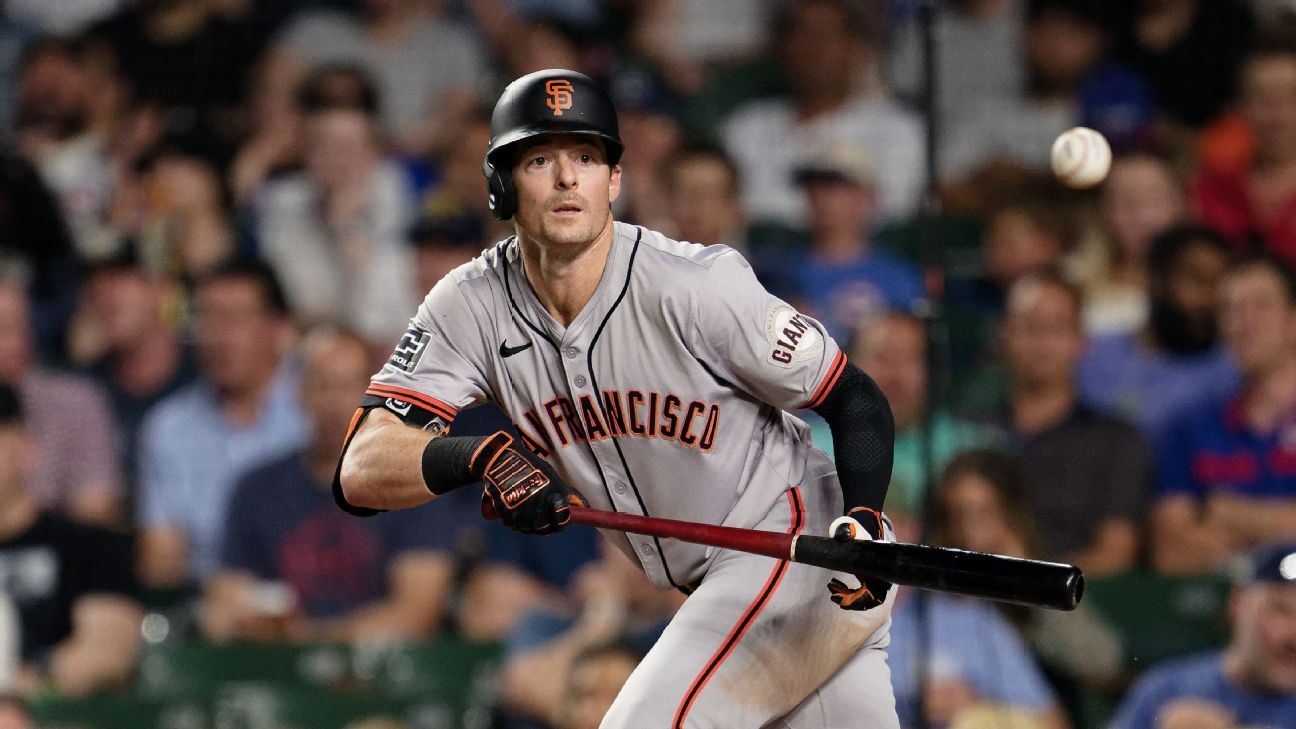

ATLANTA — The Atlanta Braves signed veteran outfielder Mike Yastrzemski to a two-year deal Wednesday that includes a club option for 2028.
The 35-year-old Yastrzemski hit .233 with 17 home runs and 46 RBIs in 146 games last year between San Francisco and Kansas City.
Yastrzemski, who spent the first six-plus seasons of his career with the Giants before being sent to the Royals in July, will make $9 million in 2026 and $10 million in 2027. Atlanta holds a club option for 2028. Yastrzemski will make $7 million if the Braves pick up the option. He will receive a $4 million buyout if they do not.
The versatile Yastrzemski, the grandson of Hall of Famer Carl Yastrzemski, can play all three outfield positions and is a career .238 hitter. His best season came in the COVID-19-shortened 2020 campaign, when he batted .297 with 10 homers in 54 games and finished in the top 10 in NL MVP voting.

-
Jorge Castillo
ORLANDO, Fla. — The New York Yankees made their first selection in a Rule 5 draft since 2011 on Wednesday, taking right-hander Cade Winquest from the St. Louis Cardinals.
Winquest was one of 13 players — and 12 right-handed pitchers — chosen in the major league portion of the draft.
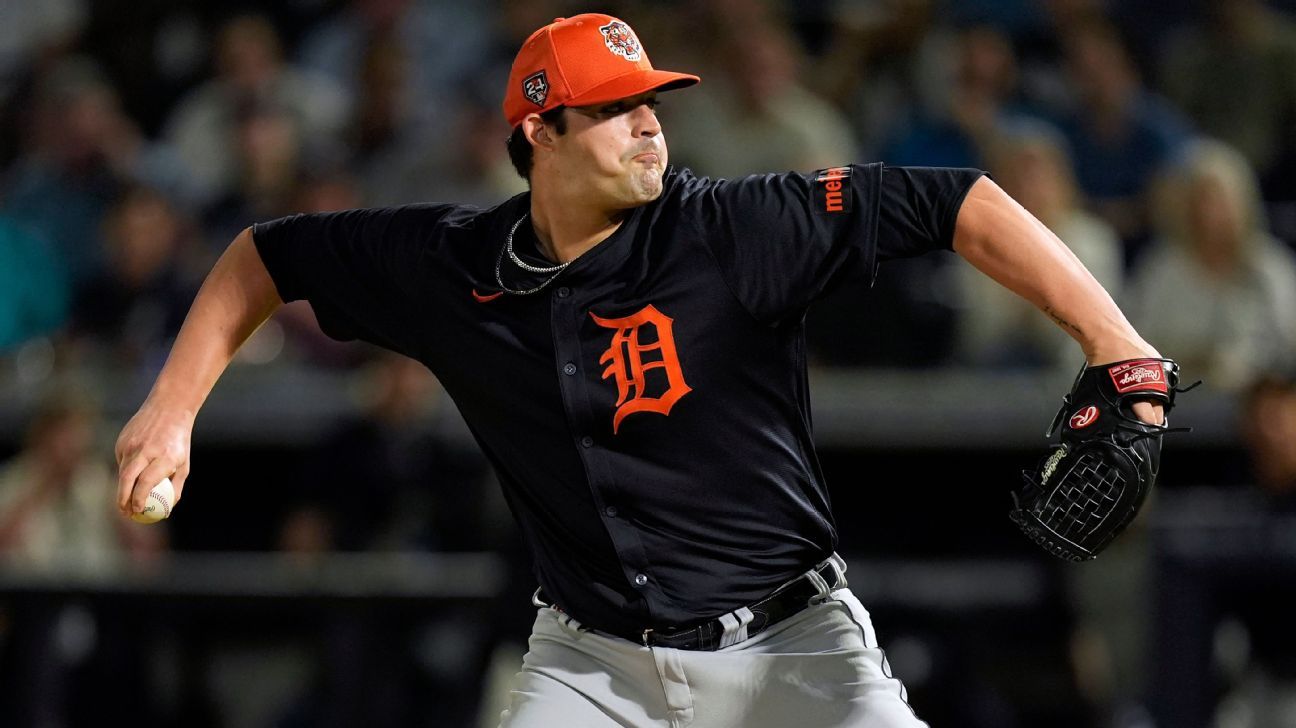
The Rockies took RJ Petit, a 6-foot-8 reliever, with the first pick from the Detroit Tigers. Petit, 26, had a 2.44 ERA in 45 relief appearances and two starts between Double A and Triple A last season. The Minnesota Twins chose the only position player, selecting catcher Daniel Susac from the Athletics.
Clubs pay $100,000 to select a player and must keep him on the active major league roster for the entire following season unless he lands on the injured list. Players taken off the roster must be offered back to the former club for $50,000.
The 25-year-old Winquest recorded a 4.58 ERA with a 48% groundball rate in 106 innings across 25 games, including 23 starts, between Single A and Double A last season. He features a fastball that sits in the mid-90s and touches 98 mph plus a curveball, cutter and sweeper. He is expected to compete for a spot in the Yankees’ bullpen next season.
Right-hander Brad Meyers was the last player the Yankees had chosen in a Rule 5 draft. He suffered a right shoulder injury in spring training and was on the injured list for the entire 2012 season before he was offered back to the Washington Nationals. He never appeared in a major league game.
Also picked were right-hander Jedixson Paez (Colorado from Boston), right-hander Griff McGarry (Washington from Philadelphia), catcher Carter Baumler (Pittsburgh from Baltimore), right-hander Ryan Watson (Athletics from San Francisco), right-hander Matthew Pushard (St. Louis from Miami), right-hander Roddery Munoz (Houston from Cincinnati), right-hander Peyton Pallette (Cleveland from Chicago White Sox), right-hander Spencer Miles (Toronto from San Francisco), right-hander Zach McCambley (Philadelphia from Miami) and right-hander Alexander Alberto (White Sox from Tampa Bay).

-
 Sports2 years ago
Story injured on diving stop, exits Red Sox game
-
 Sports3 years ago
‘Storybook stuff’: Inside the night Bryce Harper sent the Phillies to the World Series
-
 Sports2 years ago
Game 1 of WS least-watched in recorded history
-
 Sports3 years ago
Button battles heat exhaustion in NASCAR debut
-
 Sports3 years ago
MLB Rank 2023: Ranking baseball’s top 100 players
-
Sports4 years ago
Team Europe easily wins 4th straight Laver Cup
-
 Environment3 years ago
Japan and South Korea have a lot at stake in a free and open South China Sea
-
 Environment1 year ago
Here are the best electric bikes you can buy at every price level in October 2024