
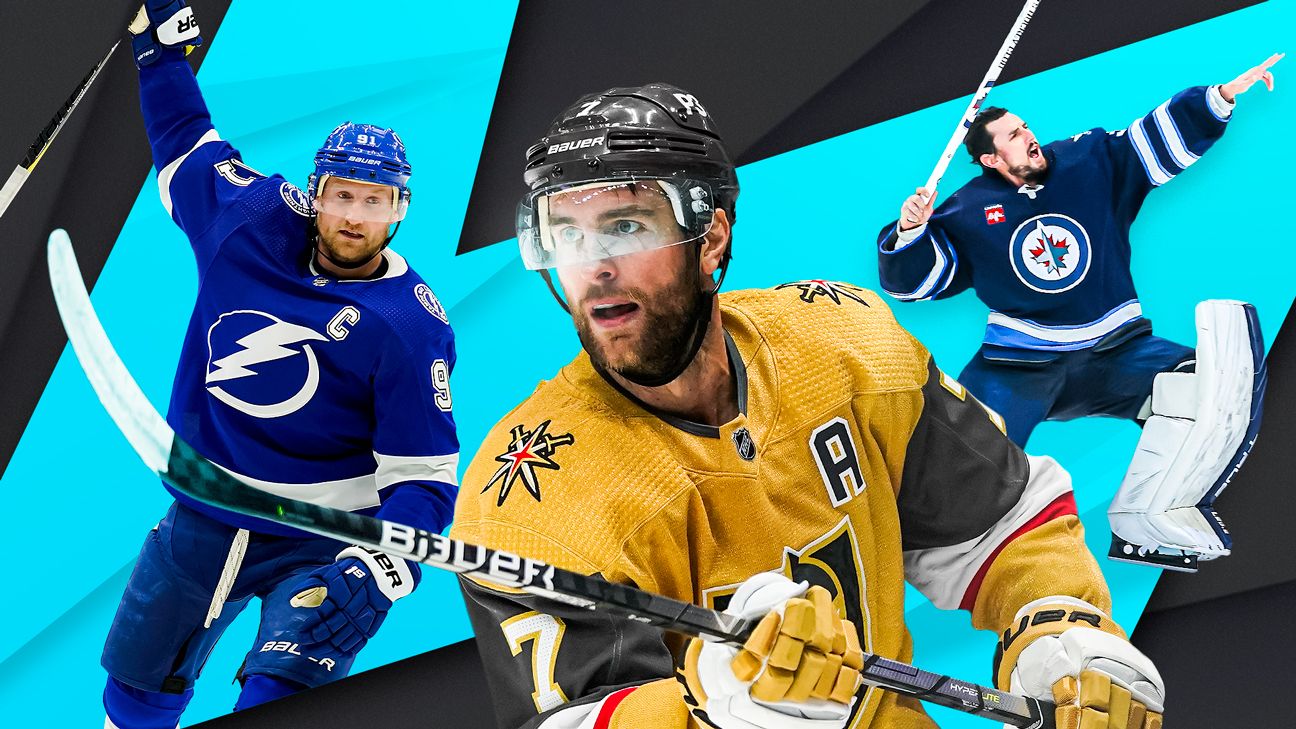
NHL Power Rankings: Canes on top, plus each team’s best newcomer for 2022-23


The 2022-23 NHL regular season is just 10 days old, but it’s time to assess what all 32 teams have done thus far — for better or worse.
For this week’s Power Rankings, we also identified the best newcomer for every team.
How we rank: A panel of ESPN hockey commentators, analysts, reporters and editors rates teams against one another — taking into account game results, injuries and upcoming schedule — and those results are tabulated to produce the list featured here.
Note: Previous ranking for each team refers to the last edition, published Oct. 10. Points paces are through Thursday’s games.

Previous ranking: 3
Points percentage: 0.750
Next seven days: @ CGY (Oct. 22), @ VAN (Oct. 24)
Brent Burns seems tailor-made for the Hurricanes (and not just because he loves a storm surge celebration). The veteran blueliner stepped right into a top-pairing slot with Jaccob Slavin. He can still play over 22 minutes per game, get shots through traffic, play physically and make solid first passes. It’s good energy for the Canes.

Previous ranking: 4
Points percentage: 0.750
Next seven days: vs. CAR (Oct. 22), vs. PIT (Oct. 25)
Nazem Kadri scored his first goal as a Flame by going coast-to-coast through the Oilers and heating up the always fiery Battle of Alberta. That’s one way to say hello. Kadri has been a perfect early fit in Calgary with his balance of talent and tenacity.

Previous ranking: 6
Points percentage: 0.700
Next seven days: vs. CBJ (Oct. 23), vs. COL (Oct. 25), @ NYI (Oct. 26)
Vincent Trocheck can be the Rangers’ jack-of-all-trades: a high-speed, top-line contributor and special-teams stalwart who continuously pushes the pace offensively. It took Trocheck some time to get comfortable in the preseason and build chemistry with new linemates, but the veteran averaged a point per game out of the gate and is noticeably more confident with every game.

Previous ranking: 15
Points percentage: 0.875
Next seven days: @ MTL (Oct. 22), @ OTT (Oct. 24), @ BOS (Oct. 25), vs. WSH (Oct. 27)
Mason Marchment is off to a dynamic start for Dallas that included two goals in his Stars debut — the top-shelf snipe was especially nice — and the big winger has continued to ooze confidence. He’ll earn plenty of ice time at 5-on-5 and can be lethal on the power play, all things Dallas hoped for when Marchment signed his four-year, $18 million deal last summer.

Previous ranking: 9
Points percentage: 0.875
Next seven days: @ CBJ (Oct. 22), @ EDM (Oct. 24), @ CGY (Oct. 25)
Jeff Petry is at his best when, as coach Mike Sullivan says, he’s making the Penguins “harder to play against.” That’s been Petry’s goal early on in navigating his new environment, leaning on his brand of hard-nosed hockey to elevate Pittsburgh’s defense. It hasn’t been perfect, but Petry’s a player his team believes in.

Previous ranking: 2
Points percentage: 0.750
Next seven days: vs. TB (Oct. 21), vs. NYI (Oct. 23), @ CHI (Oct. 25), @ PHI (Oct. 27)
Matthew Tkachuk has ably transitioned his signature blend of scoring skill, puck-hounding and ability to aggravate right into the Sunshine State. He notched two goals in two games to start the season in tandem with a strong defensive effort and, of course, getting under opponents’ skin. That Tkachuk-ian attitude is just what the Panthers needed.

Previous ranking: 10
Points percentage: 0.700
Next seven days: vs. MIN (Oct. 22), vs. DAL (Oct. 25), vs. DET (Oct. 27)
How much does A.J. Greer love being a Boston Bruin? Enough to celebrate his first goal in black and gold by literally kissing the logo on his chest. Greer scored again in that Bruins home opener and has continued raising the bar on Boston’s third line with physicality and strong defensive habits.

Previous ranking: 16
Points percentage: 0.800
Next seven days: vs. COL (Oct. 22), vs. TOR (Oct. 24), @ SJ (Oct. 25)
Bruce Cassidy is the most notable new face for Vegas, and he has the Golden Knights back up and running. The team appeared to need another fresh voice behind the bench, and Cassidy has supplied it in helping guide the Golden Knights to a 4-1 start. Change can be a good thing.

Previous ranking: 1
Points percentage: 0.625
Next seven days: vs. SEA (Oct. 21), @ VGK (Oct. 22), @ NYR (Oct. 25)
Alexandar Georgiev lands here almost by default because the reigning Stanley Cup champions are basically running it back with the same group that took it to the house last season. The major exception, of course, is Georgiev replacing Darcy Kuemper as the team’s starter in net. He’s off to a solid start at 2-0 with a .911 SV% and 2.51 GAA.

Previous ranking: 12
Points percentage: 1.000
Next seven days: @ EDM (Oct. 22), @ WPG (Oct. 24), vs. EDM (Oct. 26), @ NSH (Oct. 27)
Jake Neighbours got a taste of the NHL in nine games last season, and the rookie battled to make St. Louis’ roster out of camp. The 20-year-old is a strong competitor with bite to his game, and he’s showing dynamic offensive potential with a playmaker’s edge. Wherever Neighbours slots in the lineup he’s capable of chipping in.

Previous ranking: 18
Points percentage: 0.500
Next seven days: @ WSH (Oct. 22), vs. TB (Oct. 25), vs. WPG (Oct. 27)
Kevin Fiala is delivering on the scoresheet for Los Angeles. The Kings went all-in on trading for — and then extending — Fiala to boost their forward depth, and so far it’s paying off. The winger popped in a goal and two assists against his former team, the Minnesota Wild, and has showcased good chemistry with Anze Kopitar and Adrian Kempe.

Previous ranking: 5
Points percentage: 0.600
Next seven days: @ WPG (Oct. 22), @ VGK (Oct. 24), @ SJ (Oct. 27)
Calle Jarnkrok has been a solid addition to the Leafs’ third line. He’s durable and versatile, a low-maintenance linemate who makes players around him better. Jarnkrok can contribute just about anywhere, including on the scoresheet, and he has looked like a nice under-the-radar pickup by Toronto.

Previous ranking: 26
Points percentage: 0.750
Next seven days: @ NSH (Oct. 22), vs. SJ (Oct. 23), vs. FLA (Oct. 27)
John Tortorella gets the nod here because in all honesty no one is having the impact on the Flyers that he is. Philadelphia’s new coach is brutally frank, and that attitude is what will continue to define the atmosphere around this team. If anything, Tortorella seems to have the Flyers believing in themselves — even if no one else did.

Previous ranking: 20
Points percentage: 0.500
Next seven days: @ TB (Oct. 22), @ FLA (Oct. 23), vs. NYR (Oct. 26)
Robin Salo rounded up a pair of goals in his second game of the season and has been a steady performer on the Islanders’ blue line. The rookie came into this season with 21 games previously under his belt, and early on Salo looks increasingly ready to become a full-time NHL skater.

Previous ranking: 13
Points percentage: 0.417
Next seven days: vs. PHI (Oct. 22), vs. STL (Oct. 27)
Nino Niederreiter started hot in Music City with four goals in his first four games. Nashville previously lacked depth scoring, and Niederreiter is providing the solution there with timely offensive contributions while creating chances and helping drive play for his linemates.

Previous ranking: 25
Points percentage: 0.833
Next seven days: @ CHI (Oct. 21), vs. ANA (Oct. 23), vs. NJ (Oct. 25), @ BOS (Oct. 27)
Ville Husso opened his tenure as Detroit’s starter with a 29-save shutout. That memorable debut is just the beginning of Husso’s potential with the Red Wings, who have desperately needed stability between the pipes. Looks like Husso — in tandem with Alex Nedeljkovic — is primed to provide it.

Previous ranking: 23
Points percentage: 0.750
Next seven days: @ VAN (Oct. 22), @ SEA (Oct. 25), vs. MTL (Oct. 27)
Eric Comrie already made history in Buffalo as the first goaltender to register an assist — this one on an Alex Tuch goal — in his Sabres debut. The former Winnipeg Jet has been solid for the Sabres so far, with good technique and some big-time saves. Buffalo needs all that and more while finding its bearings this season.

Previous ranking: 14
Points percentage: 0.400
Next seven days: vs. LA (Oct. 22), @ NJ (Oct. 24), @ DAL (Oct. 27)
Dylan Strome just wanted to be wanted. His early play with the Capitals shows that Strome still has much to offer. He’s a skilled skater and passer with good instincts and transitions up the ice quickly. That looks to fit with what Washington needs most as it weathers the start of this season without the likes of Nicklas Backstrom and Tom Wilson.

Previous ranking: 17
Points percentage: 0.500
Next seven days: vs. TOR (Oct. 22), vs. STL (Oct. 24), @ LA (Oct. 27)
Sam Gagner joining the Jets on a one-year deal in September was widely under-discussed. No matter, Gagner has done the necessary talking on the ice early in the season. He’s a hardworking grinder who has been a perfect fit on Winnipeg’s fourth line and second power play unit.

Previous ranking: 11
Points percentage: 0.500
Next seven days: vs. STL (Oct. 22), vs. PIT (Oct. 24), @ STL (Oct. 26), @ CHI (Oct. 27)
Dylan Holloway turned an excellent training camp and preseason into an opening night roster spot to make his NHL debut in Edmonton’s top six. That’s impressive enough. Holloway has worked hard finding his way and will continue learning on the job — and through a few turnovers — to ideally become a consistent piece of the Oilers’ lineup.

Previous ranking: 28
Points percentage: 0.600
Next seven days: vs. DAL (Oct. 22), vs. MIN (Oct. 25), @ BUF (Oct. 27)
Arber Xhekaj was a great story before he stepped onto NHL ice. The undrafted blueliner made a bruising debut with the Canadiens on opening night, and also tallied an assist. Xhekaj has been noticeable ever since and continues to show why Montreal found a place for him in the lineup.

Previous ranking: 7
Points percentage: 0.250
Next seven days: @ FLA (Oct. 21), vs. NYI (Oct. 22), @ LA (Oct. 25), @ ANA (Oct. 26)
Vladislav Namestnikov has technically played for Tampa before, from 2013-14 to 2017-18, but the Lightning might need him now more than ever. Namestnikov has been part of Tampa Bay’s revamped third line and shown some good early returns. What the veteran lacks in flash he can make up for in reliability and consistency, two things Tampa could use.

Previous ranking: 30
Points percentage: 0.500
Next seven days: vs. ARI (Oct. 22), vs. DAL (Oct. 24), vs. MIN (Oct. 27)
Jake Sanderson has fit beautifully onto Ottawa’s back end, and looks poised to retain a top-four role. The rookie plays a confident game, can control pace of play and isn’t afraid to take calculated chances. The Senators have to be feeding off that energy.

Previous ranking: 21
Points percentage: 0.400
Next seven days: vs. PIT (Oct. 22), @ NYR (Oct. 23), vs. ARI (Oct. 25)
Johnny Gaudreau is an elite talent who can drive Columbus’ offense — and the Blue Jackets will need their new acquisition to do that as Patrik Laine is sidelined three to four weeks with an elbow sprain. Gaudreau is still settling onto his top-line perch while giving Columbus over 21 minutes per game with good returns on the scoresheet.

Previous ranking: 8
Points percentage: 0.250
Next seven days: @ BOS (Oct. 22), @ MTL (Oct. 25), @ OTT (Oct. 27)
Sam Steel is one of Minnesota’s only new faces this season, and he has not been lost in the crowd. Checking in on the Wild’s third or fourth line, the 24-year-old has been reliable defensively and added some offense (including a critical game-tying goal) to be a viable option within the team’s bottom-six group.

Previous ranking: 29
Points percentage: 0.500
Next seven days: vs. SJ (Oct. 22), vs. WSH (Oct. 24), @ DET (Oct. 25)
Alexander Holtz isn’t completely new to the Devils — he played nine games for them last season — but the rookie is eyeing a bigger role this season. The 20-year-old already notched his first career goal and could be a versatile piece in New Jersey’s bottom six as coach Lindy Ruff has already shuffled him throughout New Jersey’s lineup.

Previous ranking: 22
Points percentage: 0.300
Next seven days: @ DET (Oct. 23), vs. TB (Oct. 26)
Ryan Strome announced himself with Anaheim in a three-point debut to fuel the Ducks’ comeback win over Seattle. That’s the impact Anaheim hoped its new top-line center would have when Strome inked a five-year, $25 million free agent contract last summer.

Previous ranking: 19
Points percentage: 0.200
Next seven days: vs. BUF (Oct. 22), vs. CAR (Oct. 24), @ SEA (Oct. 27)
Andrei Kuzmenko has a shot just like Alex Ovechkin — or so says his coach, Bruce Boudreau. The 26-year-old rookie did score in his NHL debut and has exhibited some early chemistry with center Elias Pettersson. While Kuzmenko is still adjusting from the KHL game, there’s an assuredness and ease to him that suggests he’ll be fine.

Previous ranking: 27
Points percentage: 0.333
Next seven days: vs. DET (Oct. 21), vs. SEA (Oct. 23), vs. FLA (Oct. 25), vs. EDM (Oct. 27)
Jason Dickinson wanted a fresh start in Chicago and in his debut game (a 5-2 win over the Red Sharks) had a goal and two assists. Dickinson barely had any notice he’d be suiting up, but it didn’t matter as the 27-year-old played on instinct and clicked with his new club.

Previous ranking: 31
Points percentage: 0.400
Next seven days: @ COL (Oct. 21), @ CHI (Oct. 23), vs. BUF (Oct. 25), vs. VAN (Oct. 27)
Matty Beniers is the present and future of this Kraken squad. The 19-year-old is already centering Seattle’s top line, and his rookie season is off to a good start offensively with four points in five games.

Previous ranking: 32
Points percentage: 0.250
Next seven days: @ OTT (Oct. 22), @ CBJ (Oct. 25)
Dylan Guenther might not be a fixture all season with Arizona, but the 19-year-old is making the most of his moment. Playing a second-line role, Guenther tallied an assist in his NHL debut and appears composed and confident beyond his years. That’s an excellent start.

Previous ranking: 24
Points percentage: 0.167
Next seven days: @ NJ (Oct. 22), @ PHI (Oct. 23), vs. VGK (Oct. 25), vs. TOR (Oct. 27)
Luke Kunin went straight to a top-line role for the Sharks as a complement to Tomas Hertl and Timo Meier. San Jose grabbed Kunin from Nashville in a summertime trade to maximize its scoring potential and Kunin has tried to oblige with a pair of points in his first five games. Like the rest of San Jose’s lineup, there’s more Kunin can offer, too.

-
Kiley McDaniel
MLB held its fourth annual draft lottery at the winter meetings in Orlando on Tuesday, and the Chicago White Sox landed the No. 1 overall pick in the 2026 MLB draft.
It’s still very early in the draft process, but it’s a perfect time for a quick five-pick mini-mock draft to see how things could play out in July. Four of the five players in last winter’s edition of this exercise landed in the top 11 picks on draft day, so it’s fair to think we have a reasonable idea of how the top picks will play out even though a lot can change in the seven months ahead.
Here is my early prediction for the first five picks in the 2026 MLB draft, after consulting with industry sources combined with my own scouting.

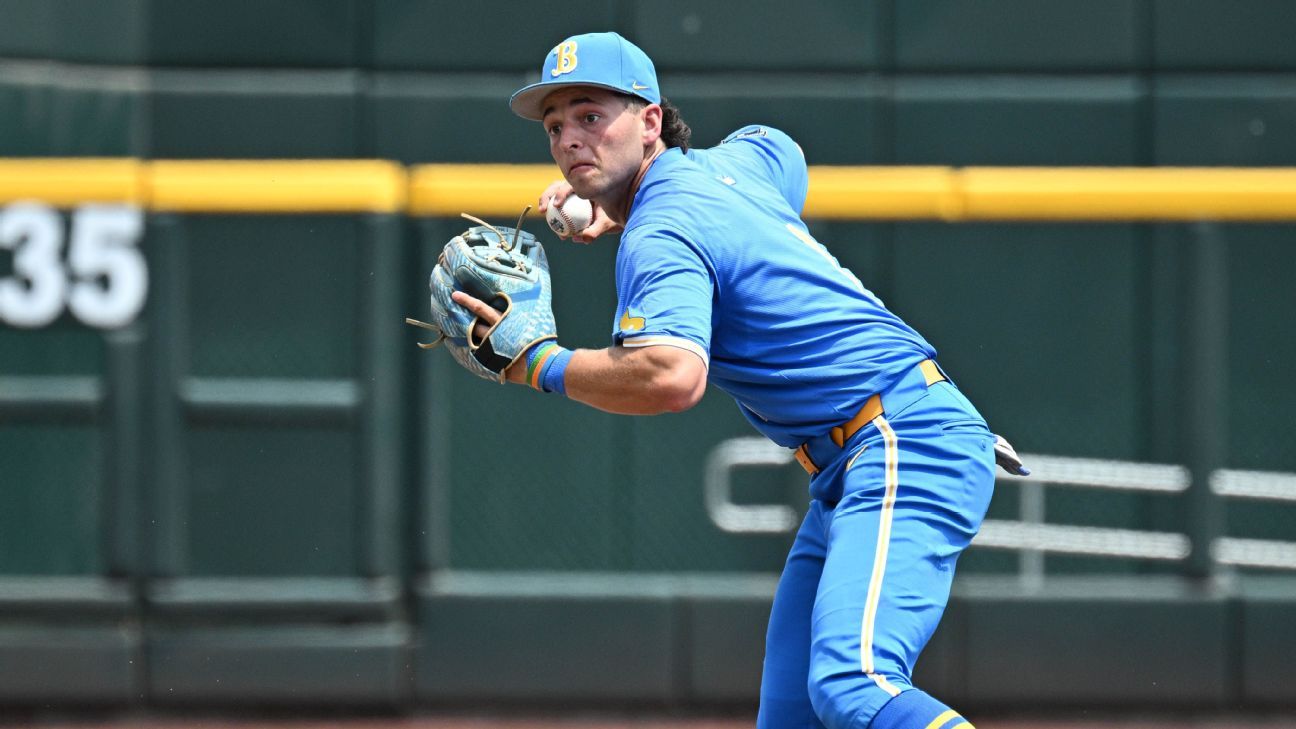
1. Chicago White Sox: Roch Cholowsky, SS, UCLA
Cholowsky was a big name in the 2023 draft, ranking 32nd on my final board as a standout defender with solid tools, but questions on his overall offensive upside along with a big asking price. His bonus price wasn’t met and he was solid as a freshman at UCLA, then took a huge jump forward as a sophomore, hitting 23 home runs last season.
He is still a standout defender but now both his (above-average) hit and (plus) power tools have developed, allowing evaluators to go back over the last decade and find comps at the tops of previous drafts, like Dansby Swanson or Troy Tulowitzki. Cholowsky has a pretty solid lead on the pack for the top pick right now, but it isn’t insurmountable due to the solid group of up-the-middle, high-upside talents in this class.
The lottery couldn’t have gone better for the White Sox after a 102-loss season, landing the top pick in a year where there is a clear preseason favorite to be the top pick. Chase Meidroth and Colson Montgomery are solid shortstop options in the big leagues with Caleb Bonemer and Billy Carlson as Top 100 types in the low minors, but Cholowsky would give the White Sox a great problem: too many good players at the most important position on the field.

2. Tampa Bay Rays: Grady Emerson, SS, Fort Worth Christian (Texas) HS, Texas commit
Emerson has been touted as the top prep prospect in the 2026 class for years and has held that title through the summer showcase season and fall workouts. He’s a 6-foot-2, left-handed hitting shortstop who projects as above average to plus at almost everything on the field. He may not be truly plus-plus at anything right now, but he’s still only 17 years old, so that could develop.
Given his long track record of being an elite prospect and being in the most desirable player demographic in the draft, he’s a consensus talent in this pick area, even for teams that don’t normally take high school players at the top. The Rays are not that team, taking a prep shortstop in the top two rounds in each of the last three drafts; Tampa Bay also loves left-handed hitters. Emerson is the rare prep prospect who is a safer pick than the vast majority of college players but also comes with more upside.

3. Minnesota Twins: Justin Lebron, SS, Alabama
Lebron was scouted as part of the loaded 2023 prep class alongside prep teammate Antonio Jimenez, who was a third-round pick of the Mets out of UCF in 2025. Lebron’s hitability and athleticism each jumped a tick right when he got to Tuscaloosa and the 6-foot-2 shortstop is now a plus runner, thrower and defender with above-average raw power. His pitch selection is fine with the only question being about his bat-to-ball ability due to worse-than-average miss rates last season, fueled somewhat by an uphill, power-driven approach. If Lebron can find a happy medium between his swing plane, contact and power, he could challenge Cholowsky as the top pick.
The Twins haven’t been scared of a little swing-and-miss if it comes with big upside in recent drafts, like with Billy Amick, Brandon Winokur and Quentin Young the last three years, but also love taking collegiate shortstops like Kaelen Culpepper, Marek Houston and Kyle DeBarge. Lebron threads the needle of certainty given his tools and positional profile but also untapped upside due to his contact/power balance being a little off kilter at the moment.

4. San Francisco Giants: Drew Burress, CF, Georgia Tech
Burress was a pick to click of mine in the 2023 draft, ranking 40th overall on my board (among the highest ranks among media and teams), but ultimately proving unsignable to the teams that also had him in that range. He stands only 5-foot-8, so impact power wasn’t expected at that point, but he had more power than you might think given his size, along with a long track record of hitting for average, plus speed and center-field defense.
Burress exploded at Georgia Tech, particularly when it comes to power — hitting 25 homers as a freshman then 19 in his sophomore year — fueled by what is now above-average raw power. He grades as above average or plus in all five tools, but his approach/swing is more power-oriented than in high school, so balancing his abilities at the plate in pro ball could be key to reaching his ceiling. The Giants have picked college position players with their top three picks each of the last two years and will likely be staring at a best available player from that same demographic in 2026.

5. Pittsburgh Pirates: A.J. Gracia, OF, Virginia
Gracia had almost no national scouting profile coming out of a New Jersey high school as a two-way player in 2023 before heading to Duke. He immediately showed scouts he should’ve been considered a real pro prospect out of high school, hitting .305 with 14 homers as a freshman, then following it up with more walks, fewer strikeouts and 15 homers as a sophomore. Gracia transferred to Virginia after the season, following much of the Duke coaching staff.
He is a 6-foot-3 center/right field tweener for now who is above average at almost everything in the batter’s box, especially his ability to lift/pull the ball in games, though his swing can get too uphill at times.
The Pirates seem to be turning the corner with Konnor Griffin and Bubba Chandler joining Paul Skenes and Co. while they’re also looking to spend money in free agency, so I see them leaning into the college position-player group that is a strength in this class.


-
Dan Murphy
After another week of frustrating setbacks, at the end of a frustrating year trying to bring stability to their industry, a growing number of college athletic directors say they are interested in exploring a once-unthinkable option: collective bargaining with their players.
Dozens of athletic directors will gather in Las Vegas over the next few days for an annual conference. They had hoped to be raising toasts to the U.S. House of Representatives. But for the second time in three months, House members balked last week at voting on a bill that would give the NCAA protection from antitrust lawsuits and employment threats. So instead, they will be greeted by one of the Strip’s specialties: the cold-slap realization of needing a better plan.
“I’m not sure I can sit back today and say I’m really proud of what we’ve become,” Boise State athletic director Jeramiah Dickey told ESPN late last week. “There is a solution. We just have to work together to find it, and maybe collective bargaining is it.”
Athletic directors see only two paths to a future in which the college sports industry can enforce rules and defend them in court: Either Congress grants them an exemption from antitrust laws, or they collectively bargain with athletes. As Dickey said, and others have echoed quietly in the past several days, it has become irresponsible to continue to hope for an antitrust bailout without at least fully kicking the tires on the other option.
“If Congress ends up solving it for us, and it ends up being a healthy solution I’ll be the first one to do cartwheels down the street,” said Tennessee athletic director Danny White when speaking to ESPN about his interest in collective bargaining months ago. “But what are the chances they get it right when the NCAA couldn’t even get it right? We should be solving it ourselves.”
Some athletic directors thought they had solved their era of relative lawlessness back in July. The NCAA and its schools agreed to pay $2.8 billion in the House settlement to purchase a very expensive set of guardrails meant to put a cap on how much teams could spend to acquire players. The schools also agreed to fund the College Sports Commission, a new agency created by the settlement to police those restrictions.
But without an antitrust exemption, any school or player who doesn’t like a punishment they receive for bursting through those guardrails can file a lawsuit and give themselves a pretty good chance of wiggling out of a penalty. The CSC’s plan — crafted largely by leaders of the Power 4 conferences — to enforce those rules without an antitrust exemption was to get all their schools to sign a promise that they wouldn’t file any such lawsuits. On the same day that Congress’ attempt crumbled last week, seven state attorneys general angrily encouraged their schools not to sign the CSC’s proposed agreement.
In the wake of the attorneys general’s opposition, a loose deadline to sign the agreement came and went, with many schools declining to participate. So, college football is steamrolling toward another transfer portal season without any sheriff that has the legal backing to police how teams spend money on building their rosters.
That’s why college sports fans have heard head football coaches like Lane Kiffin openly describe how they negotiated for the biggest player payroll possible in a system where all teams are supposed to be capped at the same $20.5 million limit. Right now, the rules aren’t real. The stability promised as part of the House settlement doesn’t appear to be imminent. Meanwhile, the tab for potential damages in future antitrust lawsuits continues to grow larger with each passing day.
Collective bargaining isn’t easy, either. Under the current law, players would need to be employees to negotiate a legally binding deal. The NCAA and most campus leaders are adamantly opposed to turning athletes into employees for several reasons, including the added costs and infrastructure it would require.
The industry would need to make tough decisions about which college athletes should be able to bargain and how to divide them into logical groups. Should the players be divided by conference? Should all football players negotiate together? What entity would sit across from them at the bargaining table?
On Monday, Athletes.Org, a group that has been working for two years to become college sports’ version of a players’ union, published a 35-page proposal for what an agreement might look like. Their goal was to show it is possible to answer the thorny, in-the-weeds questions that have led many leaders in college sports to quickly dismiss collective bargaining as a viable option.
Multiple athletic directors and a sitting university president are taking the proposal seriously — a milestone for one of the several upstart entities working to gain credibility as a representative for college athletes. Syracuse chancellor and president Kent Syverud said Monday that he has long felt the best way forward for college sports is a negotiation where athletes have “a real collective voice in setting the rules.”
“[This template] is an important step toward that kind of partnership-based framework,” he said in a statement released with AO’s plan. “… I’m encouraged to see this conversation happening more openly, so everyone can fully understand what’s at stake.”
White, the Tennessee athletic director, has also spent years working with lawyers to craft a collective bargaining option. In his plan, the top brands in college football would form a single private company, which could then employ players. He says that would provide a solution in states where employees of public institutions are not legally allowed to unionize.
“I don’t understand why everyone’s so afraid of employment status,” White said. “We have kids all over our campus that have jobs. … We have kids in our athletic department that are also students here that work in our equipment room, and they have employee status. How that became a dirty word, I don’t get it.”
White said athletes could be split into groups by sport to negotiate for a percentage of the revenue they help to generate.
The result could be expensive for schools. Then again, paying lawyers and lobbyists isn’t cheap either. The NCAA and the four power conferences combined to spend more than $9 million on lobbyists between 2021 and 2024, the latest year where public data is available. That’s a relatively small figure compared to the fees and penalties they could face if they continue to lose antitrust cases in federal court.
“I’m not smart enough to say [collective bargaining] is the only answer or the best answer,” Dickey said. “But I think the onus is on us to at least curiously question: How do you set something up that can be sustainable? What currently is happening is not.”
Players and coaches are frustrated with the current system, wanting to negotiate salaries and build rosters with a clear idea of what rules will actually be enforced. Dickey says fans are frustrated as they invest energy and money into their favorite teams without understanding what the future holds. And athletic directors, who want to plan a yearly budget and help direct their employees, are frustrated too.
“It has been very difficult on campus. I can’t emphasize that enough,” White said. “It’s been brutal in a lot of ways. It continues to be as we try to navigate these waters without a clear-cut solution.”
This week White and Dickey won’t be alone in their frustration. They’ll be among a growing group of peers who are pushing to explore a new solution.
-
 Sports2 years ago
Story injured on diving stop, exits Red Sox game
-
 Sports3 years ago
‘Storybook stuff’: Inside the night Bryce Harper sent the Phillies to the World Series
-
 Sports2 years ago
Game 1 of WS least-watched in recorded history
-
 Sports3 years ago
Button battles heat exhaustion in NASCAR debut
-
 Sports3 years ago
MLB Rank 2023: Ranking baseball’s top 100 players
-
Sports4 years ago
Team Europe easily wins 4th straight Laver Cup
-
 Environment3 years ago
Japan and South Korea have a lot at stake in a free and open South China Sea
-
 Environment1 year ago
Here are the best electric bikes you can buy at every price level in October 2024