
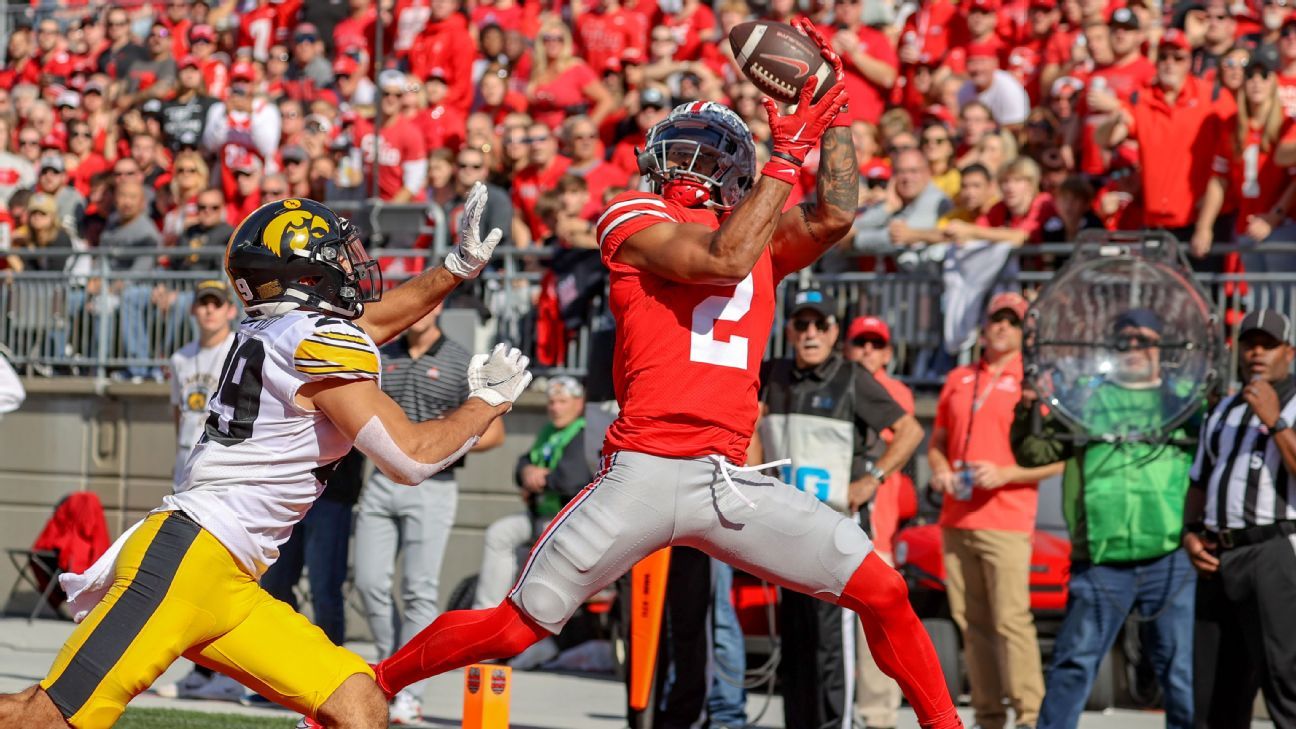
Wide Receiver U? Ohio State’s latest pass-catching stars want the title

COLUMBUS, Ohio — When Pierre Charles L’Enfant laid out the plans for the city that would become Washington, D.C., he purposely sought to both inspire visitors and intimidate foes by way of Rome-inspired towering architecture, monuments and marble. A century and a half later, Howard Dwight Smith did the same when he designed Ohio Stadium, adorning the Horseshoe with a Rotunda inspired by the Pantheon, eliciting gasps from Ohio State fans and shivers from those who dared to oppose the home team.
That same DNA of shock and awe can be found a short walk from the ‘Shoe, in the lobby layout of the Woody Hayes Athletic Center. That’s where a pair of two-story walls are covered in trophies earned via 54 bowl trips, 41 conference championships and eight national titles, those cups and sculptures connected by a collection of floor displays featuring seven Heisman Trophies won.
The room highlights multiple long lists of legendary names. There are so many stockpiles of linemen, tight ends and bulldozer runners. But if you’re looking for wide receivers, you’re going have to put in some time and perhaps even bring a magnifying glass.
Until you get to the here and now.
“You come to Ohio State to be part of the best wide receiver corps that I think there’s ever been, because there’s a torch that has been passed to us and that pushes us to defend that legacy,” said Emeka Egbuka, the current team leader with 41 catches and the ninth-best receiver in the nation in yards per game with an average of 105 over seven games.
Hang on. Did you say best there’s ever been?
“Yes sir,” Egbuka said. “I believe that. Everyone in our position group believes that. We all do. We have to.”
Every classic college football program likes to proudly declare it is the official university of some particular position group. Penn State has always laid claim to Linebacker U. An internet search for “Quarterback U” produces a list that ranges from USC and Miami to BYU and NC State. In 2019, LSU and Texas famously feuded over the rights to Defensive Back U. The Horns even wore DBU T-shirts during pregame warm-ups, before being outplayed by the Tigers.
But with the greatest respect to Cris Carter, David Boston and Terry Glenn, at no point has anyone ever dared to declare the Ohio State University as Wide Receiver U. Well, until now. And those who do have a rather good case.
Yes, those six Heisman legends (Archie Griffin won two) were all running backs, with the exception of QB Troy Smith in 2006. Of the school’s 32 members of the College Football Hall of Fame, none are true wide receivers and two are listed as “end.” Of the Buckeyes’ 213 all-time All-American selections, there are tight ends scattered around, but only five of those honors were awarded to true wideouts and between 1914 and 2020, they had only three in Carter, Boston and Glenn.
But one year ago, the Buckeyes had two in Chris Olave and Garrett Wilson, now rookie starters with the New Orleans Saints and New York Jets, respectively. Entering this season, they had one receiver on the preseason All-American team in Jaxon Smith-Njigba, who is still on the mend from a Week 1 hamstring injury. Last week, when the midseason awards were announced, there were a pair of OSU wideouts on most lists, Egbuka and Marvin Harrison Jr. Those honors were announced leading up to a game at Iowa when those two and teammates Julian Fleming and Mitch Rossi each hauled in a TD catch against the Hawkeyes.
Egbuka, Harrison and tight end Cade Stover each have at least one catch in all seven games this season. Those three and Fleming have combined for 30 plays of 20-plus yards. Harrison, Egbuka and Fleming are among the nation’s TD reception leaders with a combined 23. Harrison’s 10 touchdowns rank second in the nation, and he is the first receiver to have three games of three TD catches in the 132-year history of Ohio State football. All cogs in the extremely fast wheel that is college football’s second-highest-scoring offense, trailing only Tennessee.
“When you just get around them, you realize that, for their age, they don’t look like they’re 18, 19, 20. They don’t talk like it, they don’t act like it, they don’t speak like it, but they are,” explains Ryan Day, now in his fourth full season as Ohio State’s coach. “It’s pretty remarkable sometimes when you think about who they are as people and just the maturity level of all those guys.”
“I think one of the greatest skills about our team is that they love to play,” offensive coordinator Kevin Wilson said. “They love the challenge of solving problems: ‘OK, look, I didn’t expect this guy to be as wide this alignment,’ or ‘I didn’t expect this defender to challenge me as much,’ or ‘I didn’t expect as much pressure or movement up front.’ But now you’re getting it. How do you handle it? Good teams handle that on the sideline, during halftime and during the game. Bad teams come in on Sunday and talk about what they should have done.”
Now, to be fair, the quarterback tossing the football to these vaunted receivers is pretty good, too. C.J. Stroud is on every sportswriter’s Heisman watch list and every pro scout’s NFL draft board. But even he knows his so-called supporting cast is made up of stars.
“They have told me that they always trust me to have the ball where they need it to be, and I really appreciate that,” the QB said after the team’s Week 3 win over Toledo. “And I always trust them to be where they are supposed to be, and sometimes even where they aren’t supposed to be because they are doing work to make my throw look better than it actually was!”
Stroud was talking about a pass he had thrown into the right rear corner of the end zone that was intended for Harrison but wound up being snagged by Fleming for a tiptoe TD when the third-year wideout unknowingly stepped in front of his more famous teammate.
The laugh that accompanied Stroud’s explanation was met with responsive chuckles from Fleming, Harrison, Egbuka and even the injured Smith-Njigba. Those chuckles were telling, not simply about that play, but the room in which the film of that play would be dissected the following week.
“We’re best friends in the room. Like, these are the guys I choose to spend my time with outside of football,” said Egbuka, sporting a sweat-covered grin following a midweek practice ahead of Saturday’s trip to Penn State. Last season he shared an apartment with Harrison and Jayden Ballard. This year they might as well still be living together, because if they aren’t in meetings or practice, they’re playing Madden or going to the movies. “There’s no selfishness within the room. Whenever someone scores a touchdown, it’s just like we all score.”
They do all score, just as they all catch balls. No less than a dozen Ohio State receivers and tight ends have at least one reception this season and eight have a TD catch. In a building full of position rooms packed with five-star signees, none of those rooms is more talent rich than the wide receiver corner of the Buckeyes’ roster. And no receiver room anywhere, at any school, no matter if they have ever dared claim to be Wide Receiver U, is deeper than the current group in Columbus.
At a lot places, particularly in the still-new era of the transfer portal, that kind of overwhelming depth can also become an overwhelming problem. (And it should be noted that former Alabama star Jameson Williams transferred from OSU, as did Ohio Bobcat Sam Wiglusz, who has 49 catches and seven TDs.) Not enough balls to go around. This group, at least for now, understands that patience in the short run will earn long-term rewards. If they need to see proof of that fact, they need look no further than the people around them in that position group as well as those who were in that room not so long ago.
“It started back with Terry McLaurin, Parris Campbell, with Johnny Dixon. And they just brought this certain level of accountability to that world,” Day said of three Buckeyes wideouts who were members of the 2015 CFP national title team and were all drafted by NFL teams in 2019. “Chris Olave and guys picked it up over time, and now you’re seeing Emeka and Marvin and Julian really taking over. And they cut their teeth on special teams. They come in as freshmen and they put their work in and kind of show up and play in the second half of the season. And then by the time they get to that second year, they’re ready to go. And that’s kind of in the blueprint for them. And it’s working.”
Working because they are putting in the work. Every Ohio State receiver loves to talk about the fun they have in the film room, but to a man they are also quick to remind that when it comes to buckle down for football prep, they can shift from goofy to serious as quickly as they can turn and burn on a helpless backpedaling defensive back.
That is a learned approach. Harrison’s pedigree is well known to anyone who has watched any pro football over the past two decades. His father, Marvin Sr., owned an entire chapter of the NFL record book and a Super Bowl ring after more than a decade with the Indianapolis Colts, playing pitch-and-catch with fellow Pro Football Hall of Famer Peyton Manning. So, it should surprise no one to learn that Harrison’s weekday work ethic has already become the stuff of scarlet and gray legend. As representatives from a visiting TV network were recently holding pregame meetings with Day and his staff, they heard the smack-smack-smack of leather against gloves on the nearby practice field. When they looked to see who it was, they watched Harrison running routes by himself, loading the Jugs pitching machine and going through every page of the playcalling scenarios for that weekend’s game.
The rest of the room certainly feeds off of Harrison’s energy and example, but the others also didn’t require much if any motivation when it comes to a desire for preparation. Since March 2017, any and every would-be ball catcher who has donned a silver helmet in the Horseshoe has been immersed in the world and mind of Brian Hartline.
The former Ohio State receiver and seven-year NFL veteran, Columbus-area convenience store mogul and OSU passing game coordinator has also been wide receivers coach since 2018. He was moved into that job after one season as a graduate assistant/offensive quality control assistant. That promotion came after the departure of Zach Smith, the assistant coach who was fired after he was charged with violating a personal protection order and prior allegations of domestic violence came to light. The repercussions of Ohio State’s subsequent investigation of Smith and head coach Urban Meyer reverberated for months, all the way through Meyer’s retirement at the end of the ’18 season. Meyer was succeeded by Day, and Smith was officially replaced by Hartline.
A year later, the Buckeyes made it to the College Football Playoff. The following year, in 2020, Hartline was named National Recruiter of the Year by 247Sports, thanks is no small part to landing Fleming and Smith-Njigba, who joined a room that already had Olave and Wilson. Shortly after, Harrison and Ballard also committed.
“We as a group, we fit together like pieces, we are different in ways that complement each other, the way we play — see how Marv plays, see how I play, see how Jaxon plays, it’s different skill sets — and Coach Hart, he fits in like that, too,” Egbuka said. He points to that well-designed puzzle as the reason that when the room’s OG leader, Smith-Njigba, finally returns to full power, he will be able to step right back into the lineup without disrupting the current, very well-oiled offensive machine.
“Now, I’m not gonna sit here and lie and say that [Hartline] is not a goof,” Egbuka continues. “He’ll cut up in the receiver room just as much as we do. But when it’s time to handle business and lock in, he’s one that’s really good at doing that. He’s a perfectionist like us. He recruits thinking about the room, where would this guy fit in? Would he fit in? And can that guy be a part of our discussions? You caught the ball, but this could have been better. Let’s all make each other better. That starts with Coach Hart.”
“I am a believer in coaching who you have in the room instead of trying to make everyone in the room do the same thing and run the same route and just do what we tell them to do,” Hartline said at the end of September. “That’s how I wanted to be coached. That’s how the guys I played with wanted to be coached. As individuals who believe in what they can do and they want to share that not because they’ll post big numbers, but because they know that it will contribute to the team. When you can make that work, that’s the best kind of football right there.”
It’s also what started the process of transitioning the Ohio State receiving corps from very good to very great in a very short period time. A spark unexpectedly lit by the same internal fire that once seemed like it might have the potential to burn down the building. Instead, that building is now full of pass-catching potential.
No, you won’t find a lot of wide receiving awards or plaques hanging on the walls of the Woody Hayes Center among all the Heisman and Rose Bowl trophies. Not yet anyway. But if you’re in that lobby, turn to the left and take a look at that other wall, the one covered in the framed jerseys of the Ohio State alums currently playing in the NFL. When the 2022 season kicked off, there were 65 Buckeyes on active NFL rosters. Ten of them were wideouts.
Tuesday afternoon, Marvin Harrison Jr. moved through that lobby, headphones on, and without realizing he was being watched, turned to look at those jerseys and gave them a little point as if to say, “See y’all soon, but first I got to go to work.”
Ohio State as Wide Receiver U? If not yet, it sure feels like it’s coming.

-
Bradford Doolittle
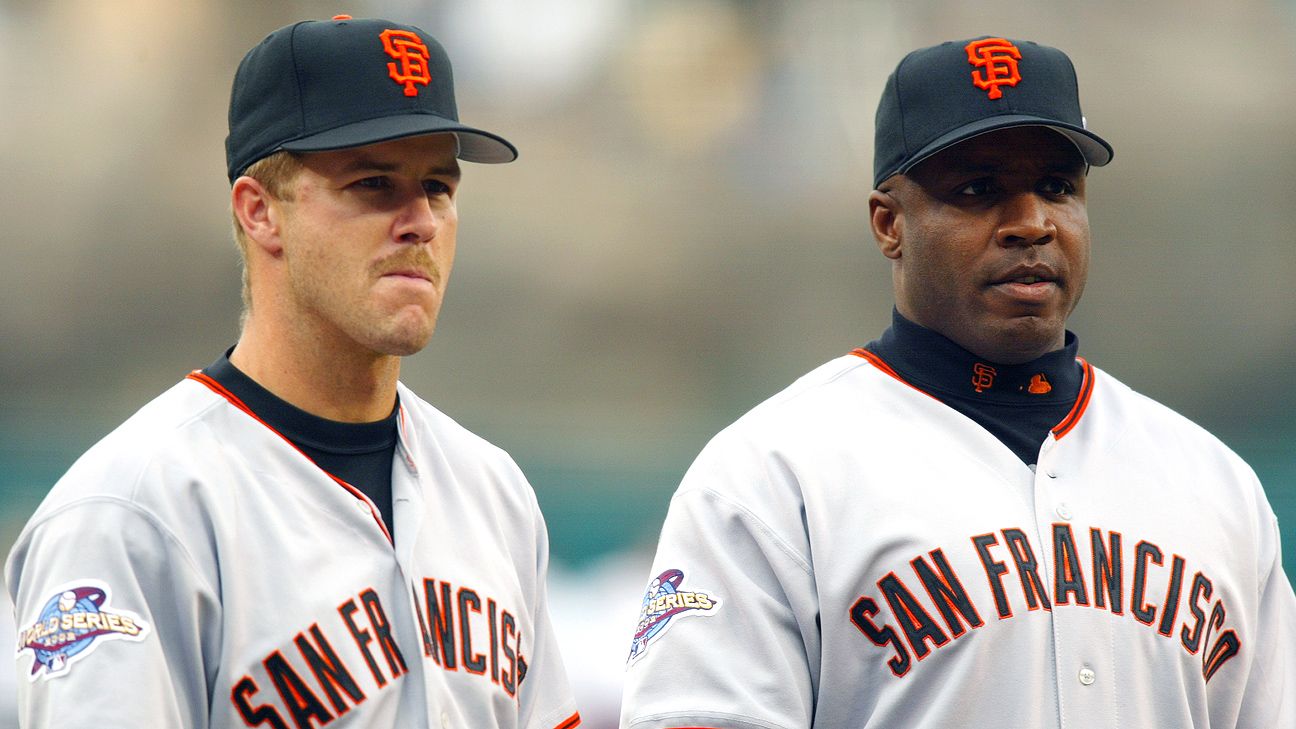
ORLANDO, Fla. — Jeff Kent, who holds the record for home runs by a second baseman, was elected to the National Baseball Hall of Fame on Sunday.
Kent, 57, was named on 14 of 16 ballots by the contemporary baseball era committee, two more than he needed for induction.
Just as noteworthy as Kent’s selection were the names of those who didn’t garner enough support, which included all-time home run leader Barry Bonds, 354-game winner Roger Clemens, two MVPs from the 1980s, Don Mattingly and Dale Murphy, and Gary Sheffield, who slugged 509 career homers.
Bonds, Clemens, Sheffield and Dodgers great Fernando Valenzuela were named on fewer than five ballots. According to a new protocol introduced by the Hall of Fame that went into effect with this ballot, players drawing five or fewer votes won’t be eligible the next time their era is considered. They can be nominated again in a subsequent cycle, but if they fall short of five votes again, they will not be eligible for future consideration.
The candidacies of Bonds and Clemens have long been among the most hotly debated among Hall of Fame aficionados because of their association with PEDs. With Sunday’s results, they moved one step closer to what will ostensibly be permanent exclusion from the sport’s highest honor.
If Bonds, Clemens, Sheffield and Valenzuela are nominated when their era comes around in 2031 and fall short of five votes again, it will be their last shot at enshrinement under the current guidelines.
Kent, whose best seasons were with the San Francisco Giants as Bonds’ teammate, continued his longstanding neutral stance on Bonds’ candidacy, declining to offer an opinion on whether or not he believes Bonds should get in.
“Barry was a good teammate of mine,” Kent said. “He was a guy that I motivated and pushed. We knocked heads a little bit. He was a guy that motivated me at times, in frustration, in love, at times both.
“Barry was one of the best players I ever saw play the game, amazing. For me, I’ve always said that. I’ve always avoided the specific answer you’re looking for, because I don’t have one. I don’t. I’m not a voter.”
Kent played 17 seasons in the majors for six different franchises and grew emotional at times as he recollected the different stops in a now-Hall of Fame career that ended in 2008. He remained on the BBWAA ballot for all 10 years of his eligibility after retiring, but topped out at 46.5% in 2023, his last year.
“The time had gone by, and you just leave it alone, and I left it alone,” Kent said. “I loved the game, and everything I gave to the game I left there on the field. This moment today, over the last few days, I was absolutely unprepared. Emotionally unstable.”
A five-time All-Star, Kent was named NL MVP in 2000 as a member of the Giants, who he set a career high with a .334 average while posting 33 homers and 125 RBIs. Kent hit 377 career homers, 351 as a second baseman, a record for the position.
Kent is the 62nd player elected to the Hall who played for the Giants. He also played for Toronto, the New York Mets, Cleveland, Houston and the Dodgers. Now, he’ll play symbolically for baseball’s most exclusive team — those with plaques hanging in Cooperstown, New York.
“I have not walked through the halls of the Hall of Fame,” Kent said. “And that’s going to be overwhelming once I get in there.”
Carlos Delgado was named on nine ballots, the second-highest total among the eight under consideration. Mattingly and Murphy received six votes apiece. All three are eligible to be nominated again when the contemporary era is next considered in 2028.
Next up on the Hall calendar is voting by the BBWAA on this year’s primary Hall of Fame ballot. Those results will be announced on Jan. 20.
Anyone selected through that process will join Kent in being inducted on July 26, 2026, on the grounds of the Clark Sports Center in Cooperstown.

-
David Hale
Twelve years into the College Football Playoff, the committee may have been tasked with its toughest decision yet.
On one hand, there’s Alabama, the bluest of blue bloods, a team that played the sixth-toughest schedule in the country, with seven wins over FPI top-40 opponents, and whose final loss — the one that put the Tide squarely on the bubble — came in the SEC championship game, while others like Miami and Notre Dame sat at home.
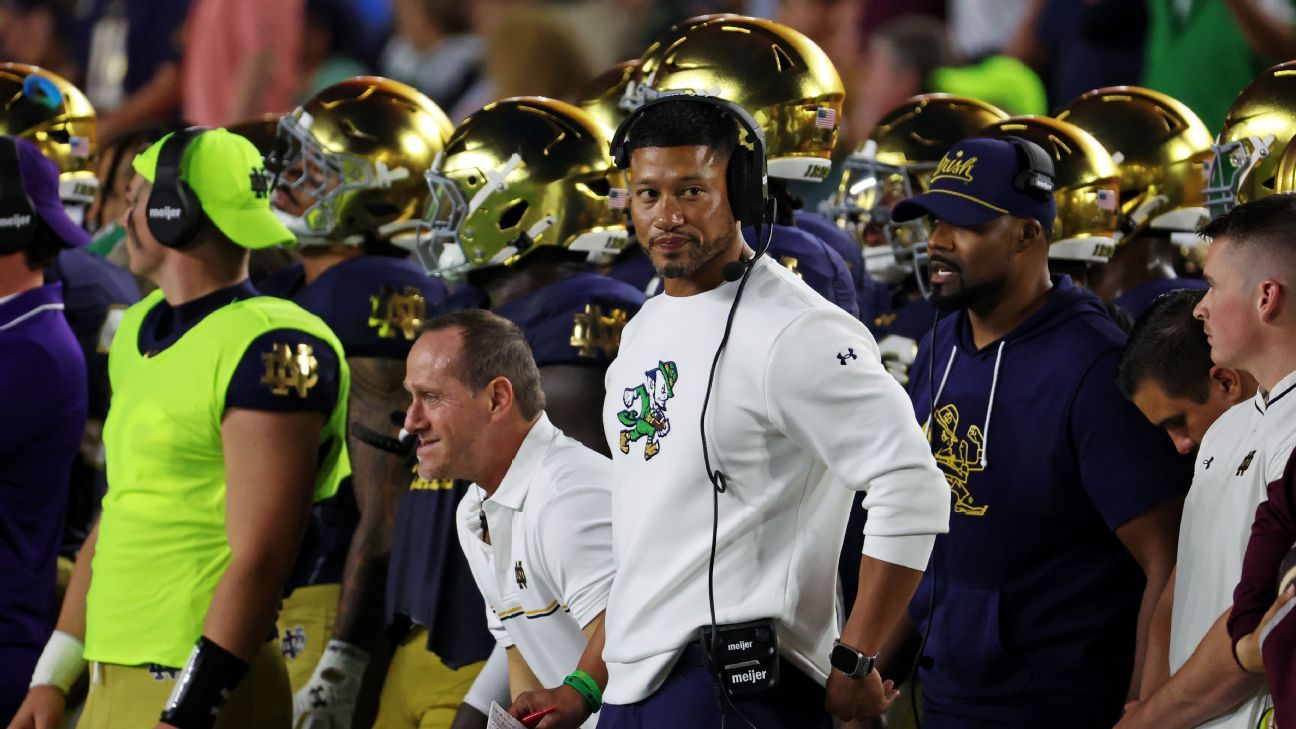
On the other hand, there’s Notre Dame, the most storied program in the sport’s history with a legion of fans from coast to coast. The Irish are playing exceptional football, winning 10 straight all by double digits, and their lone losses, way back in August and early September, came to two other top-tier teams by a combined four points.
Then on the metaphorical third hand is Miami, a team that began the season with fireworks, sagged in the middle, then responded to its No. 18 placement in the first set of rankings by reeling off four straight wins by an average of 27 points per game. Oh, and Miami holds a head-to-head win over Notre Dame, albeit one that came in the first week of the season and that the committee may or may not consider from week to week.
Spread around a few garnishes of Texas, Vanderbilt and BYU on the plate and add a dessert course of a Duke-JMU argument that could result in bumping a Power 4 conference from the playoff entirely and it’s a tough year to be a committee member.
There have been others, of course. In 2014, the committee punted on a tricky Baylor-TCU debate in favor of Ohio State, and the Buckeyes won it all. In 2017, amid a chaotic final week, the committee handed its final bid to Alabama, despite its absence from the SEC championship game, and the Tide went on to win a championship. In 2023, the committee snubbed an undefeated Florida State, because of an injury to QB Jordan Travis, and the Seminoles have gone on to lose 18 of their next 25 games.
The results after a controversial decision always seem to lead to the same conclusion: The committee got things right.
And yet, as the committee so often notes after each rankings release, the results alone don’t tell the whole story. In football, perhaps more than any other sport, the process matters. And the committee’s process, from the outset of that first playoff 12 years ago, has been a mess.
The ultimate verdict of Sunday’s final ranking showcased the disaster vividly.
Step away from the whole process, and the decision to rank Miami ahead of Notre Dame makes perfect sense. They have the same record. Miami won head-to-head. Most rational folks, aligned with neither side, would acknowledge the committee came to a sensible conclusion.
But look at the process and try to follow the committee’s rationale, and it’s like climbing the stairs in an M.C. Escher painting.
In the first ranking, Notre Dame was eight spots ahead of Miami. Both won out, both by big margins, and each week along the way, Notre Dame remained ahead of Miami. Last week, Alabama — fresh off a near disaster in the Iron Bowl — leapfrogged Notre Dame despite the Irish dominating Stanford 49-20. That was a head-scratcher, unless, of course, you believed the minor conspiracy that the committee was setting up a direct comparison between Miami and Notre Dame by having them ranked one right after the other.
And, what do you know, that’s what we got. After BYU lost its conference championship, the Cougars dropped in the rankings — something that didn’t happen to Alabama for a similar blowout defeat, it should be noted — and Notre Dame and Miami were separated by nothing other than the committee’s whims.
1:31
Saban hopes Notre Dame’s snub leads to CFP changes
Nick Saban gives his thoughts on the structure of the College Football Playoff in light of Notre Dame being left out.
So while both sat home on their couches on championship weekend, Miami somehow did enough to push its way into the playoff instead of Notre Dame.
Is it a reasonable conclusion? Yes!
Is it a ridiculous process that got us here? A thousand yeses!
Let’s consider how the committee evaluates teams for a moment. Which variables matter most? We’ve gone from Florida State’s battle against game control in 2014 to Notre Dame’s résumé boasting two quality losses in 2025.
Does head-to-head matter? For five weeks it might not, but in the last week it clearly did.
The committee is supposed to evaluate a school’s entire body of work, but does that mean a September loss can’t be overshadowed by clear and obvious growth throughout a season?
Do conference championships matter? Winning them is supposed to be a factor — though, ask 2023 Florida State about that — so shouldn’t a loss matter, too? A year ago, committee chair Warde Manuel said it might — including docking SMU two spots after a three-point loss to Clemson in the ACC conference championship game, even if it didn’t knock the Mustangs out of the playoff. But Alabama’s 21-point loss Saturday meant nothing.
Ranked wins are great, but of course the committee decides who earns the distinction of being ranked. The eye test is the best argument for one team, the data for another, and no one can be sure which metric matters more, because again, it depends. For a committee composed primarily of former coaches and active ADs, the human element — perceptions, expectations, projections, biases and misunderstandings — loom like a cloud over every mention of strength of record or game control.
Or boil it down to the most basic debate: Are we trying to find the best teams or the most deserving? And how do we even define those two things? From week to week, the answer is a shrug emoji and a Mad Libs of metrics and records pieced together like those magnetic words people put on their refrigerator.
All of this leads to arguments, which is likely a feature of the system, not a bug. Debate is part of the DNA of sports. But ironically, no one seems to contradict the committee more than the committee itself. The case for Team A so often sounds like the mirror image of the case against Team B. Alabama jumped Notre Dame in last week’s rankings after an ugly win over Auburn, but Miami’s dominant victory on the road against a ranked Pitt team made no difference. When Texas A&M needed a Houdini act to beat South Carolina, that wasn’t a knock on the Aggies, the committee chair said, but when Alabama narrowly escaped those same Gamecocks, it was a flaw in the Tide’s résumé. Ranked wins are great — but only if the team was ranked at the time, or maybe if it ends up ranked in the future. Also, the committee does the ranking so, whew.
And when those explanations get parsed by fans in the aftermath of perplexing decisions — Alabama’s “impressive” seven-point win over 5-7 Auburn allowing the Tide to leapfrog Notre Dame after a 29-point Irish win over 4-8 Stanford, for example — the outcome isn’t just disagreements and debate. It’s conspiratorial thinking. It’s a hollowing out of trust in the process. It’s a belief that the deck is stacked ahead of time. And that’s a disservice to the sport, the teams involved, and the committee itself. Good folks work hard and care about their role, but because their process is so immensely flawed, the presumption of nefarious motives isn’t just fodder for the message boards, but increasingly, mainstream thinking.
Imagine for a moment this wasn’t about college football. Imagine instead this was clinical trials for a new drug or a prized astrophysicist trying to explain an anomaly deep in outer space or, heck, assembling a bookshelf you bought from IKEA. Any such endeavor requires not just a result that seems to work, but a process that can be repeated, again and again, by a completely different set of people, before anyone gives it enough credence that a majority of people — even ones who don’t understand the process at all — believe in the work that was done and trust the results provided.
We don’t have to understand Einstein’s theory of relativity to believe in its basic principles. Relativity remains a theory, not a fact, but it is commonly accepted around the world by brilliant scientists and guys watching “Interstellar” at 3 a.m. on cable alike, because we can all appreciate a stringent process, rigorous testing, and an ability to withstand criticism from dissenting voices.
If we can do that for quantum physics, then surely we can do that for a college football playoff, right?
Instead, we’ll continue to argue. That’s OK. The arguments are part of the fun. But at the foundation of those arguments are real people — players, coaches, administrators, support staffs and even the fans. While no result will make everyone happy, the least this sport owes them is a process they can understand.


Way back on Nov. 4, Notre Dame was 6-2 with a three-point loss to Miami on its résumé. The committee believed the Irish were the No. 10 team in the country.
On that same date, Miami was 6-2 with a three-point win over Notre Dame on its résumé. The committee believed the Canes were the No. 18 team in the country.
This isn’t complicated math, but just for clarity’s sake: Five weeks ago, these two teams had the same record, Miami had a head-to-head win, and the committee believed Notre Dame was eight spots better. That would certainly seem to indicate a sincere and strong belief that, the Week 1 result be damned, the Irish were clearly the better team overall.
So, what has happened since then?
Notre Dame is 4-0 with a win over a ranked team and an average margin of 38 points per game. Miami is 4-0 with a win over a ranked team and an average margin of 27.5 points per game.
And yet, when the committee put its rankings together this time around, Miami is one spot ahead of Notre Dame.
There is every reason to be suspicious of the committee’s initial evaluation of these two teams. Perhaps those Nov. 4 rankings were a mistake. But the committee waited five weeks to correct that mistake, and during that span, the Irish absolutely demoralized everyone they played — including two teams that Miami also played, but Notre Dame won by more.
Nothing that has happened between the first rankings and the last suggests Notre Dame got worse relative to Miami, and yet a full nine spots in the rankings have shifted between the two.
If this was all about the committee playing the long game, using the opening scenes to set up a dramatic showdown between Miami and Notre Dame in the final act, then kudos for creating some exceptional TV.
As far as offering an honest weekly evaluation of college football teams, however, this was an absurd farce that served as a slap in the face to coach Marcus Freeman and his team and leaves us without the chance to see arguably the best player in the country, Jeremiyah Love, in the biggest games of the year.

Typically the difference between a No. 6 and a No. 7 ranking is negligible. Both get a home game in the first round, both have a good shot to advance.
This year, however, it’s a little different.
Thanks to the ACC’s pratfall of a season, two Group of 5 teams made the final field. That means both the No. 5 seed and the No. 6 seed get to play teams from outside the big-boy conferences, while the No. 7 seed lands a genuine contender on the docket in Round 1.
The loser of this lottery is Texas A&M, and that’s a pretty tough take to defend.
Let’s look at the résumés.
Team A: No. 10 in FPI, best win vs. FPI No. 3, loss to FPI No. 13, No. 3 strength of record, five wins vs. bowl-eligible teams, six wins vs. FPI top 40
Team B: No. 12 in FPI, best win vs. FPI No. 15, loss to SP+ No. 6, No 6 strength of record, four wins vs. bowl-eligible teams, four wins vs. FPI top 40
They’re close, but the edge in nearly every metric is with Team A. That’s Texas A&M.
Or how about this: Against five common opponents, A&M has a scoring edge of 2 points, including a far better win over LSU, their best common foe.
Is it splitting hairs? Of course, but that’s the committee’s job. And the results of that hair-splitting are the difference between Ole Miss getting a rematch with a Tulane team it beat by 35 in September or facing off against a red-hot Miami eager to prove it belonged in the field.

3. Greg Sankey
On Saturday, the SEC commissioner was asked to state his case for his league’s bubble teams. He offered an inclusive take.
“I view that there are seven of our teams at the conclusion of the 12-game season over 14 weeks that merit inclusion in the playoff,” Sankey said.
And yet, here we are, with just a measly five SEC teams in the field, including one getting a first-round bye and three hosting home games. It’s a slap in the face!
Truth is, Vanderbilt was quite good this year, with a strength of record ahead of both Notre Dame and Miami, and the world would simply be a better place with Diego Pavia in the playoff.
Truth is, if the goal of the playoff is to seed it with the best teams — the teams capable of beating other elite teams and making a run for a championship — then Texas had as good a case as anyone, with head-to-head wins over Oklahoma, Vandy and Texas A&M.
Heck, compare these two résumés:
Team A: Three losses, the worst loss to FPI No. 53 by eight and three wins vs. FPI top-15 teams
Team B: Three losses, the worst loss to FPI No. 74 by 14 and two wins vs. FPI top-15 teams
Team A also has a 17-point win over a team that beat Team B.
So, who would you take?
Don’t ask Sankey. His answer is both. But Team A is Texas and Team B is Alabama, and the Longhorns have looked markedly better over the past month of the season than the flailing Tide.

You have to hand it to Manny Diaz. The man can make a coherent argument for a lost cause.
“We played 10 Power 4 teams. Comparing us to James Madison, for example, who had a fantastic season — their strength of schedule is in the 100s. Ours is in the 50s. Seven wins in our conference. Seven Power 4 wins as opposed to zero Power 4 wins. The ACC champions. … I’m watching them play Troy at home [in the Sun Belt championship] and Troy had a backup quarterback in for most of the game, right? And it’s a three-point game until, really, the last few minutes of the game when they were able to pull away. They won the game and their conference, but you just can’t compare going through the Sun Belt this year — the Sun Belt has been a really good conference in years past, but most of their top teams are just having down years. They’re not challenged the way they would’ve been going through a normal Sun Belt schedule. Then you start comparing strength of schedule — if you simply go into wins and losses, you have to look at who you’re playing against. That’s the whole point of why you play a Power 4 schedule. There’s a reason these coaches are all leaving to take Power 4 jobs. There’s a recognition that’s where the best competition is.”
That was no small jab at JMU, whose coach, Bob Chesney, is leaving for a Power 4 job at UCLA.
It also probably gets Diaz removed from Sun Belt commissioner Keith Gill’s Christmas card list, which given that ACC commissioner Jim Phillips can’t be pleased with Duke torpedoing his conference’s reputation by winning the league with five losses, is going to leave a lot of extra space on Diaz’s mantle this holiday season.

Alabama lost a championship game by 21 points to a top-four team. It didn’t budge in the rankings.
BYU lost a championship game by 27 points to a top-four team. It dropped a spot.
Did it ultimately matter for the Cougars? No. They weren’t sniffing the playoff unless they beat Texas Tech. But on principle, they ought to be angry about the double standard.
Moreover, BYU was the most overlooked team all season — the one that had a good case, a comparable résumé, and virtually no one outside of Provo cheerleading for them.
Which, oddly enough, feels about the same as last year, when BYU had a perfectly good case alongside Alabama, Miami, Ole Miss and South Carolina, and no one seemed to bat an eye when they finished a distant 17th — behind Clemson, even — in the committee’s final ranking.
Also angry this week: Virginia Cavaliers (10-3, No. 19 and dropped two spots — more than any other conference championship game loser, despite playing the closest conference championship game), Tennessee Volunteers, LSU Tigers, Illinois Fighting Illini and Missouri Tigers (all 8-4, all unranked, and all with a better strength of record than the Arizona Wildcats or the Georgia Tech Yellow Jackets), Lane Kiffin (astonished the committee didn’t value his departure more).
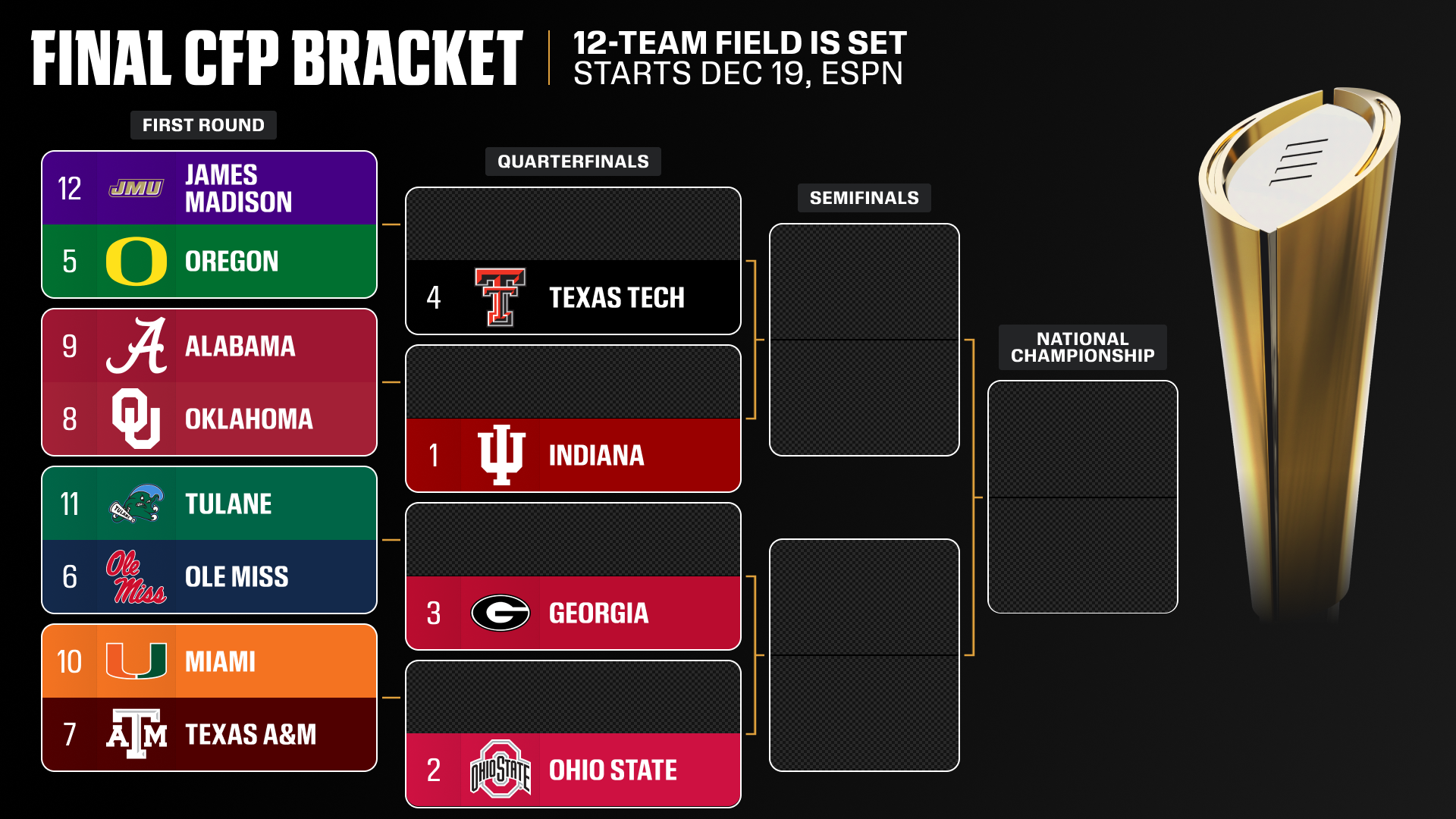
College football’s championship weekend delivered a mix of compelling drama and blowouts.
In Atlanta, Georgia dominated Alabama and won the SEC for a second year in a row. The Bulldogs held the Tide to 209 total yards and locked up a first-round bye. UGA, the No. 3 seed, will play the winner of the matchup of No. 6 Ole Miss vs. No. 11 Tulane in the Allstate Sugar Bowl.
It was a similar story in the Big 12 where Texas Tech broke open the game with BYU in the second half. The Red Raiders forced four turnovers in the 34-7 win. Texas Tech is the No. 4 seed and will face either No. 5 Oregon or No. 12 James Madison in the Capital One Orange Bowl.
The real drama was reserved for the Big Ten and ACC championships. Indiana won its first conference title since 1967 and took down No. 1 Ohio State. The Hoosiers will be the No. 1 seed while the Buckeyes fell just one spot to No. 2 The undefeated Hoosiers will have their first playoff game at the Rose Bowl presented by Prudential against the winner of the No. 8 Oklahoma-No. 9 Alabama matchup. Ohio State faces the winner of No. 10 Miami vs. No. 7 Texas A&M in the Goodyear Cotton Bowl.
Duke‘s upset of Virginia in the ACC title game opened the door for two Group of 5 teams — Tulane (which won the American) and James Madison (Sun Belt winner).
After months of rankings, seedings and countless debates, we have a 12-team bracket that brings about plenty of enticing questions and intriguing possibilities.
Can Oregon, Indiana, Texas A&M or Texas Tech bring home its first national title? Can Ohio State repeat? Will a Group of 5 team get its first-ever CFP win?
Here are our full picks for the 12-team College Football Playoff.
Andrea Adelson
First round
Oregon 55, JMU 13
Bama 20, Oklahoma 17
Ole Miss 35, Tulane 14
Miami 27, Texas A&M 24
Quarterfinals
Oregon 35, Texas Tech 30
Indiana 30, Alabama 20
Georgia 40, Ole Miss 24
Ohio State 24, Miami 21
Semifinals
Ohio State 27, Georgia 24
Indiana 35, Oregon 31
National title game
Ohio State 21, Indiana 20
Kyle Bonagura
First round
Oregon 49, James Madison 24
Texas A&M 31, Miami 24
Ole Miss 38, Tulane 24
Alabama 31, Oklahoma 28
Quarterfinals
Texas Tech 28, Oregon 27
Georgia 35, Ole Miss 21
Ohio State 24, Texas A&M 14
Indiana 35, Alabama 27
Semifinals
Ohio State 24, Georgia 17
Indiana 28, Texas Tech 24
National title game
Indiana 17, Ohio State 10
Bill Connelly
First round
Oregon 41, James Madison 24
Oklahoma 27, Alabama 17
Ole Miss 35, Tulane 20
Texas A&M 31, Miami 28
Quarterfinals
Texas Tech 38, Oregon 34
Indiana 30, Oklahoma 7
Georgia 27, Ole Miss 23
Ohio State 24, Texas A&M 13
Semifinals
Texas Tech 27, Indiana 23
Georgia 17, Ohio State 16
National title game
Texas Tech 28, Georgia 20
David Hale
First round
Oregon 35, JMU 13
Ole Miss 48, Tulane 24
Alabama 17, Oklahoma 10
Miami 27, Texas A&M 21
Quarterfinals
Texas Tech 24, Oregon 21
Indiana 20, Alabama 10
Georgia 30, Ole Miss 21
Ohio State 34, Miami 24
Semifinals
Indiana 30, Texas Tech 28
Georgia 27, Ohio State 24
National title game
Georgia 24, Indiana 20
Eli Lederman
First round
Oregon 38, James Madison 10
Ole Miss 31, Tulane 20
Alabama 21, Oklahoma 10
Texas A&M 38, Miami 31
Quarterfinals
Oregon 24, Texas Tech 17
Indiana 23, Alabama 10
Georgia 41, Ole Miss 30
Ohio State 30, Texas A&M 17
Semifinals
Indiana 20, Oregon 17
Georgia 27, Ohio State 20
National title game
Georgia 31, Indiana 17
Max Olson
First round
Oregon 34, James Madison 17
Alabama 13, Oklahoma 10
Ole Miss 38, Tulane 14
Texas A&M 27, Miami 24
Quarterfinals
Texas Tech 27, Oregon 20
Indiana 24, Alabama 17
Georgia 41, Ole Miss 31
Ohio State 27, Texas A&M 17
Semifinals
Indiana 17, Texas Tech 16
Georgia 35, Ohio State 31
National title game
Georgia 31, Indiana 20
Adam Rittenberg
First round
Oregon 38, James Madison 13
Ole Miss 34, Tulane 16
Alabama 20, Oklahoma 17
Miami 31, Texas A&M 28
Quarterfinals
Texas Tech 23, Oregon 20
Indiana 24, Alabama 16
Georgia 31, Ole Miss 21
Ohio State 27, Miami 20
Semifinals
Indiana 20, Texas Tech 17
Ohio State 19, Georgia 16
National title game
Ohio State 24, Indiana 20
Mark Schlabach
First round
Oregon 51, JMU 17
Alabama 17, Oklahoma 14
Ole Miss 42, Tulane 20
Miami 28, Texas A&M 20
Quarterfinals
Texas Tech 35, Oregon 31
Indiana 31, Alabama 14
Georgia 35, Ole Miss 28
Ohio State 24, Miami 17
Semifinals
Ohio State 27, Georgia 24
Indiana 42, Texas Tech 38
National title game
Indiana 24, Ohio State 20
Jake Trotter
First round
Oregon 38, James Madison 10
Oklahoma 17, Alabama 16
Ole Miss 30, Tulane 14
Miami 27, Texas A&M 23
Quarterfinals
Texas Tech 25, Oregon 17
Indiana 24, Oklahoma 13
Georgia 35, Ole Miss 14
Ohio State 21, Miami 13
Semifinals
Indiana 19, Texas Tech 17
Ohio State 16, Georgia 14
National title game
Ohio State 21, Indiana 20
Paolo Uggetti
First round
Oklahoma 21, Alabama 17
Oregon 38, JMU 14
Miami 27, Texas A&M 24
Ole Miss 31, Tulane 21
Quarterfinals
Indiana 34, Oklahoma 20
Oregon 24, Texas Tech 21
Georgia 21, Ole Miss 17
Ohio State 27, Miami 20
Semifinals
Indiana 23, Oregon 20
Georgia 24, Ohio State 17
National title game
Indiana 21, Georgia 17
Dave Wilson
First round
Oregon 44, James Madison 13
Texas A&M 27, Miami 17
Ole Miss 31, Tulane 24
Oklahoma 23, Alabama 17
Quarterfinals
Texas Tech 24, Oregon 20
Georgia 44, Ole Miss 17
Ohio State 21, Texas A&M 20
Indiana 24, Oklahoma 10
Semifinals
Georgia 27, Ohio State 17
Indiana 24, Texas Tech 17
National title game
Georgia, 17, Indiana 14
-
 Sports2 years ago
Story injured on diving stop, exits Red Sox game
-
 Sports3 years ago
‘Storybook stuff’: Inside the night Bryce Harper sent the Phillies to the World Series
-
 Sports2 years ago
Game 1 of WS least-watched in recorded history
-
 Sports3 years ago
Button battles heat exhaustion in NASCAR debut
-
 Sports3 years ago
MLB Rank 2023: Ranking baseball’s top 100 players
-
Sports4 years ago
Team Europe easily wins 4th straight Laver Cup
-
 Environment3 years ago
Japan and South Korea have a lot at stake in a free and open South China Sea
-
 Environment1 year ago
Here are the best electric bikes you can buy at every price level in October 2024