
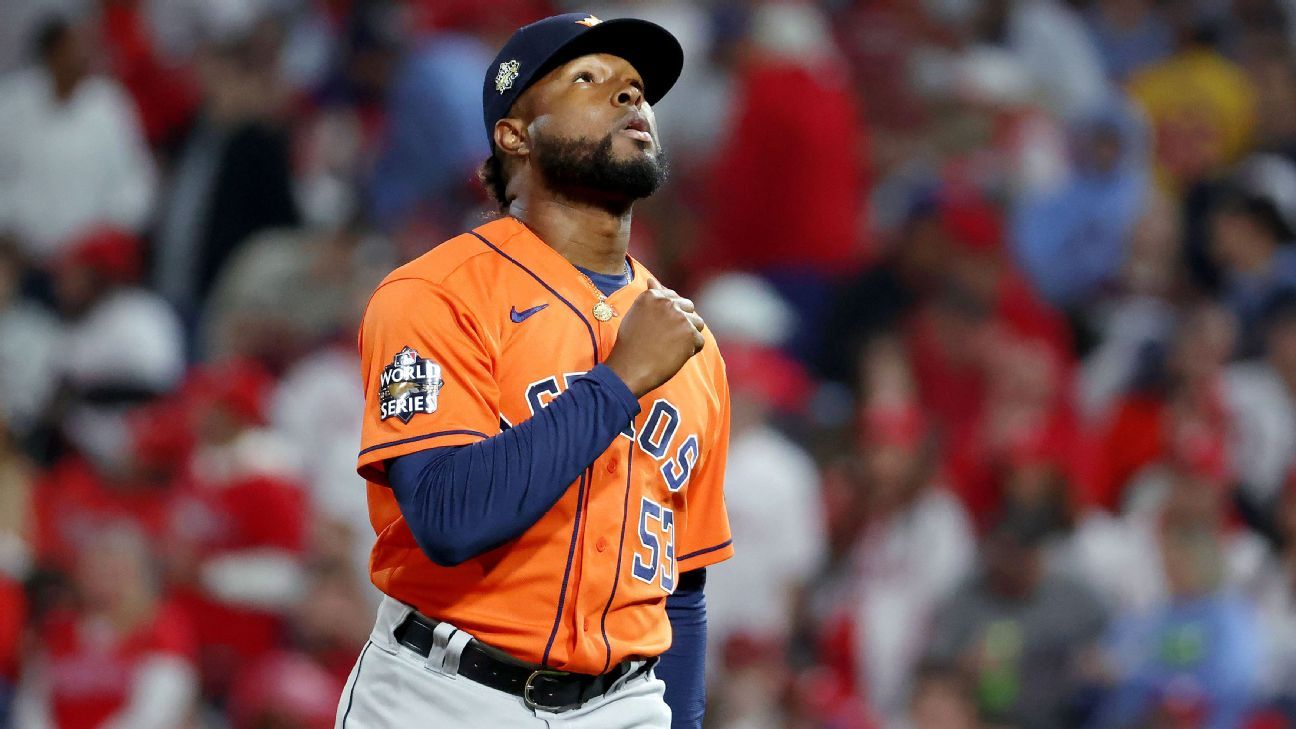
How Cristian Javier’s fastball became the best pitch this postseason


-
Jeff PassanESPN
PHILADELPHIA — Late last week, before Cristian Javier etched his name into baseball history, his Houston Astros teammates attempted to describe his fastball. By velocity alone, it is a milquetoast effort, flung from his right arm at 94 mph. And yet one teammate called the pitch “obscene” and another said “it looks 100” and a third deemed it “invisible.” On Wednesday night, after Javier started Game 4 of the World Series, one more teammate chimed in with the most apt descriptor of all.
“Clearly unhittable,” Astros closer Ryan Pressly said.
Certain pitches in baseball are so good they anger hitters, aggravate and frustrate and confound. Javier’s fastball tops the list. He threw invisiball after invisiball Wednesday, carving through a Philadelphia Phillies lineup with six no-hit innings that set the stage for Pressly to close out the first ever combined no-hitter in the World Series; the Fall Classic’s first hitless effort since Don Larsen’s perfect game in 1956. Houston’s 5-0 victory evened the World Series at two games apiece and continued the 25-year-old Javier’s meteoric rise from sometimes-starter, sometimes-reliever to the most dominant pitcher this postseason.
It’s a reputation that Javier solidified over 11⅓ innings in the playoffs’ last two rounds, with Javier allowing one hit and no runs and racking up 14 strikeouts against the potent offenses of the New York Yankees and Phillies. In a World Series that has featured starts by Justin Verlander, Framber Valdez, Aaron Nola and Zack Wheeler, Javier has twirled the best game of the bunch.
Javier finds himself here because of that fastball, a pitch that combines a number of important attributes to make it a wholly unique pitch — “a unicorn,” said one scout, who called Javier’s fastball the best in all of baseball, an assessment with which others concur.
The secret sauce for Javier’s fastball starts with something called vertical approach angle (VAA). It is essentially the pitcher’s equivalent of launch angle, measuring the angle at which a fastball goes toward the plate. Pitchers with extremely high arm slots have high VAAs, and ones like Javier, with lower arm angles, come with low VAAs.
What’s exceptional about Javier isn’t just a VAA that is third lowest among starters, behind Freddy Peralta and Joe Ryan, two other pitchers whose fastballs play way above their velocities. His high front side adds some funk and deception to the delivery. His spin rate and spin efficiency are well above average. VAA is an important factor — “a big component of it [with Javier] is the approach angle, we think,” Astros pitching coach Josh Miller said — but the other elements help give the pitch what looks like a rising effect.
Physics, of course, prevent a fastball from actually rising. With Javier’s VAA and spin characteristics, his fastball simply drops less than the average one. And because nobody else throws like him, hitters trying to track the pitch struggle because of how it carries through the strike zone and looks as if it’s hopping as it crosses the plate.
“That’s just an absolute kangaroo of a fastball coming from his hip,” Astros reliever Ryne Stanek said. “And he’s got some of the longest arms I’ve ever seen. His fastball is obscene.”
“Doesn’t matter what the radar gun’s saying,” fellow reliever Hector Neris said. “It may say he’s 94, but the heater looks 100. It’s gas.”
That deception explains why, one day after hitting five home runs off Astros starter Lance McCullers Jr. amid concerns that he might have tipped his pitches, the Phillies couldn’t see anything against Javier — or the three relievers that followed him, Bryan Abreu, Rafael Montero and Pressly. Ten days after his last start, against the Yankees, Javier threw 97 pitches, 70 of which were fastballs. He struck out nine, including a five-batter stretch in which he got J.T. Realmuto, Bryce Harper and Nick Castellanos swinging before catching Alec Bohm and Bryson Stott looking, all on fastballs.
“His nickname is El Reptil because he’s just cold-blooded,” Stanek said. “Nothing fazes him. He could give up a pump, same face. Punch the side three innings in a row, same face. He’s just that guy. What he does is special.”
The Astros knew that already. They’d seen Javier sashay into Yankee Stadium on June 25 and throw seven no-hit innings with 13 strikeouts, paving the way for Neris and Pressly to finish what wound up as only their first combined no-hitter of the season. This one was bigger, better, far more important in ensuring the Astros would return home for a Game 6 and have a chance to clinch a championship at Minute Maid Park.
Pitching in Game 4 in front of his father, Cecilio, who had never seen Javier pitch in the big leagues before, only added to the majesty of the night. Javier was already an unlikely success story: A failed outfielder who converted to pitcher, signed at 18 years old out of the Dominican Republic for $10,000, figured out how to harness his unicorn and rode it not just to the big leagues but to the sort of praise that hitters lavish infrequently.
“It’s electric,” said Christian Vazquez, who caught the no-hitter. “It’s like playing PlayStation with him. You don’t care if it’s going down and away. It’s going to finish up.”
Astros players brave enough to step into the batter’s box against Javier understand how he finished this season with a 2.54 ERA and remains unscored upon as a starter since Sept. 7. In his final four starts of the regular season, Javier threw 23 scoreless innings, allowed six hits and struck out 29.
“I did play catch with him a couple spring trainings ago, and it just really gets on you,” said Hunter Brown, another member of the Astros’ dynamic bullpen. “It’s just kind of invisible. I remember the first couple — you always wanna catch it in the seat. First couple hit me kind of in the pink area. I’m like, OK, I better figure that one out.”
In 2020, Javier’s rookie season, third baseman Alex Bregman faced Javier in a live at-bat on a shadowy day at Minute Maid Park during MLB’s accelerated spring camp. Bregman stared at strike one, strike two, strike three, not even lifting the bat off his shoulder. He walked back to the dugout, put his lumber in the bat rack and said: “I’m glad he’s on our team.”
Opponents wish the same. They’ll say so to Bregman at third base — if they can get there — and wonder how a pitch sitting 94 can look triple digits or how from his low slot he can generate such true spin or how they keep swinging over that stupid fastball.
“A lot of people are like, ‘Wow, it’s just insane stuff,'” Bregman said. “And they’ll say it’s insane how the ball looks coming out of his hand.”
So, OK, this magic pitch, this miracle fastball, this World Series no-hitter-causing bit of sorcery: What does it look like coming out of his hand?
“I don’t know,” Bregman said. “I didn’t see it.”

-
Dan Wetzel
Close
Dan Wetzel
ESPN
- Dan Wetzel is a senior writer focused on investigative reporting, news analysis and feature storytelling.
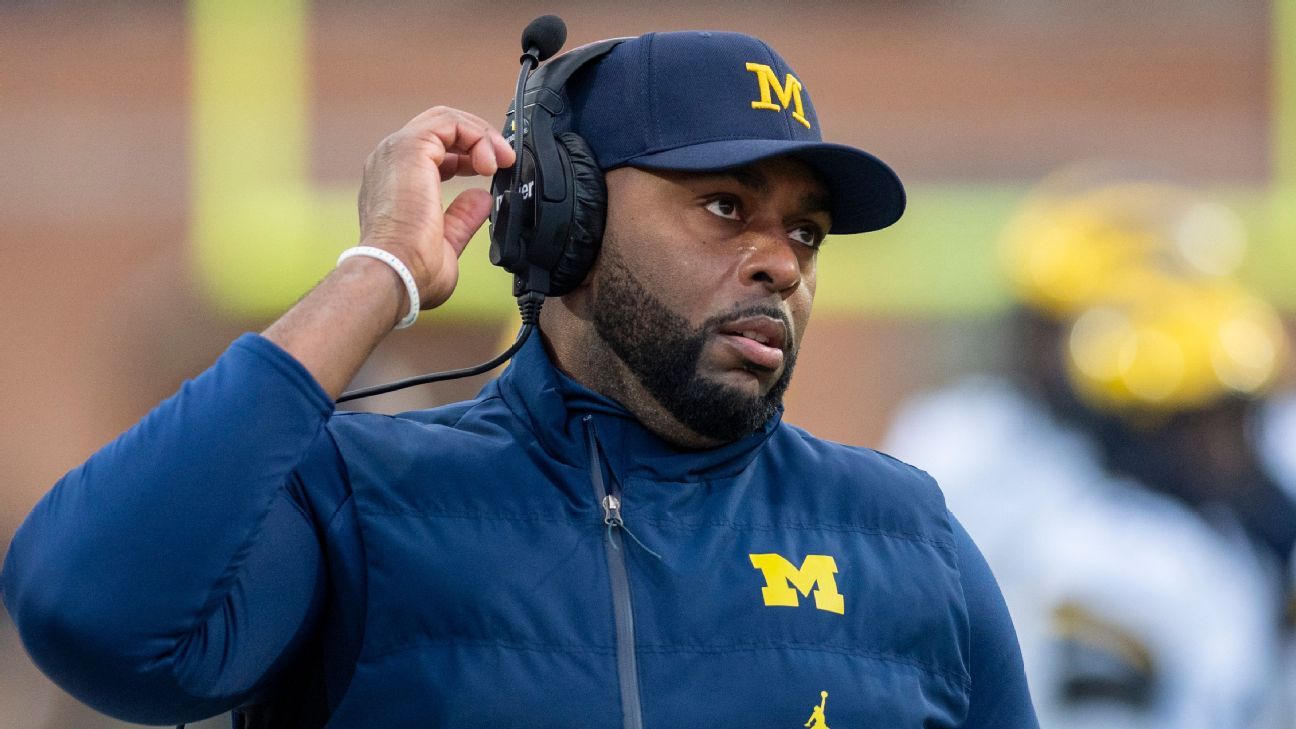
Sherrone Moore was in custody in the Washtenaw (Michigan) County Jail on Wednesday night as a suspect in an alleged assault, just hours after he was fired as Michigan’s football coach for having what the school said was an “inappropriate relationship with a staff member.”
Moore was initially detained by police in Saline, Michigan, on Wednesday and turned over to authorities in Pittsfield Township “for investigation into potential charges.”
Pittsfield police released a statement Wednesday night saying they responded at 4:10 p.m. to the 3000 block of Ann Arbor Saline Road “for the purposes of investigating an alleged assault. … A suspect in this case was taken into custody. This incident does not appear to be random in nature, and there appears to be no ongoing threat to the community.
“The suspect was lodged at the Washtenaw County Jail pending review of charges by the Washtenaw County Prosecutor,” the statement continued. “At this time, the investigation is ongoing. Given the nature of the allegations, the need to maintain the integrity of the investigation, and its current status at this time, we are prohibited from releasing additional details.”
Pittsfield police did not name the suspect in its statement.
Earlier, Saline police stated they “assisted in locating and detaining former University of Michigan football coach Sherrone Moore. Mr. Moore was turned over to the Pittsfield Township Police Department for investigation into potential charges.”
Michigan fired Moore on Wednesday following an investigation into his conduct with a staff member.
“U-M head football coach Sherrone Moore has been terminated, with cause, effective immediately,” the school said in a statement. “Following a University investigation, credible evidence was found that Coach Moore engaged in an inappropriate relationship with a staff member.”
Moore, 39, spent two seasons as Michigan’s coach, after serving as the team’s offensive coordinator.
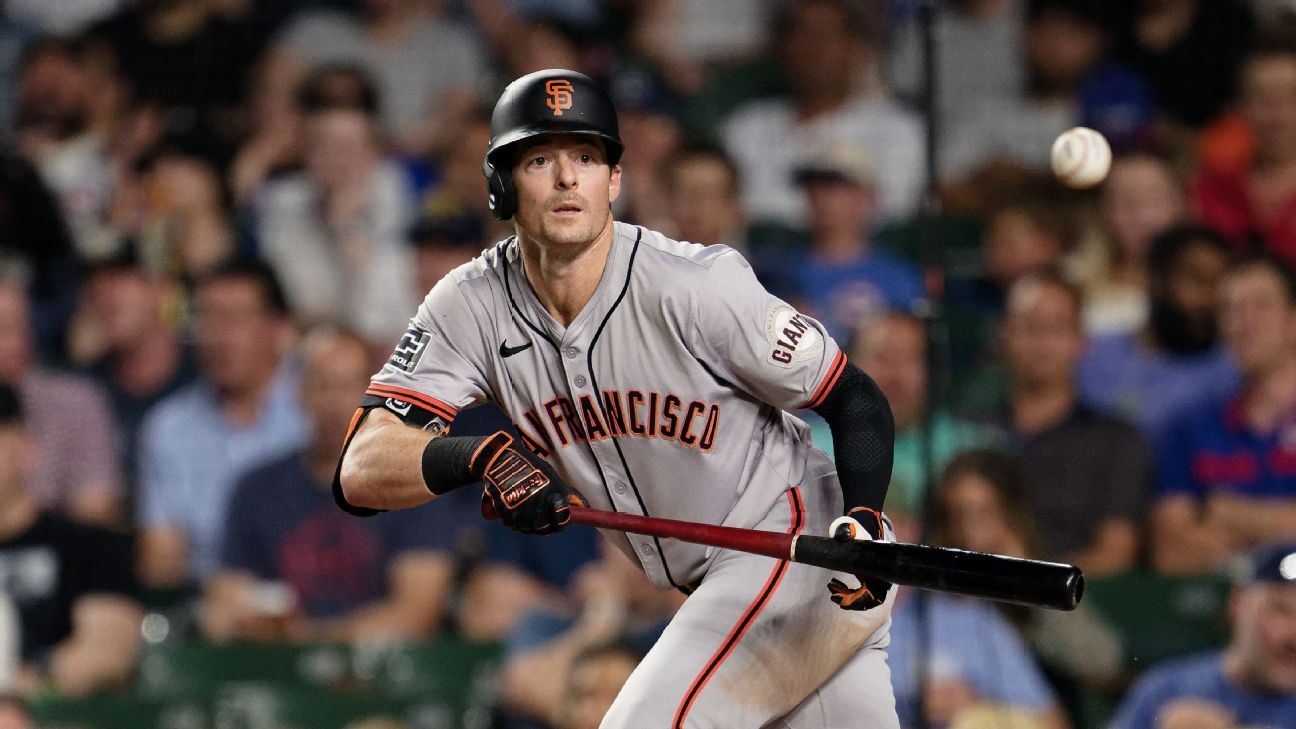

ATLANTA — The Atlanta Braves signed veteran outfielder Mike Yastrzemski to a two-year deal Wednesday that includes a club option for 2028.
The 35-year-old Yastrzemski hit .233 with 17 home runs and 46 RBIs in 146 games last year between San Francisco and Kansas City.
Yastrzemski, who spent the first six-plus seasons of his career with the Giants before being sent to the Royals in July, will make $9 million in 2026 and $10 million in 2027. Atlanta holds a club option for 2028. Yastrzemski will make $7 million if the Braves pick up the option. He will receive a $4 million buyout if they do not.
The versatile Yastrzemski, the grandson of Hall of Famer Carl Yastrzemski, can play all three outfield positions and is a career .238 hitter. His best season came in the COVID-19-shortened 2020 campaign, when he batted .297 with 10 homers in 54 games and finished in the top 10 in NL MVP voting.

-
Jorge Castillo
ORLANDO, Fla. — The New York Yankees made their first selection in a Rule 5 draft since 2011 on Wednesday, taking right-hander Cade Winquest from the St. Louis Cardinals.
Winquest was one of 13 players — and 12 right-handed pitchers — chosen in the major league portion of the draft.
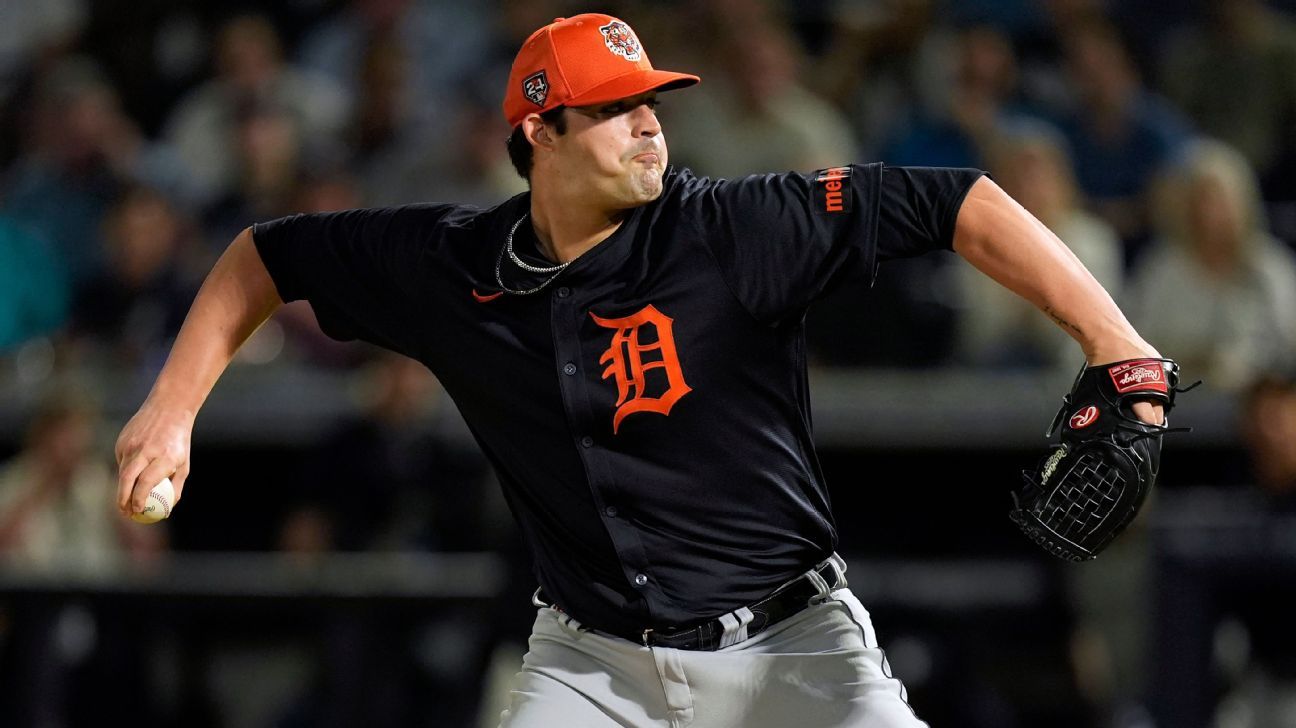
The Rockies took RJ Petit, a 6-foot-8 reliever, with the first pick from the Detroit Tigers. Petit, 26, had a 2.44 ERA in 45 relief appearances and two starts between Double A and Triple A last season. The Minnesota Twins chose the only position player, selecting catcher Daniel Susac from the Athletics.
Clubs pay $100,000 to select a player and must keep him on the active major league roster for the entire following season unless he lands on the injured list. Players taken off the roster must be offered back to the former club for $50,000.
The 25-year-old Winquest recorded a 4.58 ERA with a 48% groundball rate in 106 innings across 25 games, including 23 starts, between Single A and Double A last season. He features a fastball that sits in the mid-90s and touches 98 mph plus a curveball, cutter and sweeper. He is expected to compete for a spot in the Yankees’ bullpen next season.
Right-hander Brad Meyers was the last player the Yankees had chosen in a Rule 5 draft. He suffered a right shoulder injury in spring training and was on the injured list for the entire 2012 season before he was offered back to the Washington Nationals. He never appeared in a major league game.
Also picked were right-hander Jedixson Paez (Colorado from Boston), right-hander Griff McGarry (Washington from Philadelphia), catcher Carter Baumler (Pittsburgh from Baltimore), right-hander Ryan Watson (Athletics from San Francisco), right-hander Matthew Pushard (St. Louis from Miami), right-hander Roddery Munoz (Houston from Cincinnati), right-hander Peyton Pallette (Cleveland from Chicago White Sox), right-hander Spencer Miles (Toronto from San Francisco), right-hander Zach McCambley (Philadelphia from Miami) and right-hander Alexander Alberto (White Sox from Tampa Bay).
-
 Sports2 years ago
Story injured on diving stop, exits Red Sox game
-
 Sports3 years ago
‘Storybook stuff’: Inside the night Bryce Harper sent the Phillies to the World Series
-
 Sports2 years ago
Game 1 of WS least-watched in recorded history
-
 Sports3 years ago
Button battles heat exhaustion in NASCAR debut
-
 Sports3 years ago
MLB Rank 2023: Ranking baseball’s top 100 players
-
Sports4 years ago
Team Europe easily wins 4th straight Laver Cup
-
 Environment3 years ago
Japan and South Korea have a lot at stake in a free and open South China Sea
-
 Environment1 year ago
Here are the best electric bikes you can buy at every price level in October 2024