
Everyone’s watching Meta’s earnings report for a hint at how online ads are doing


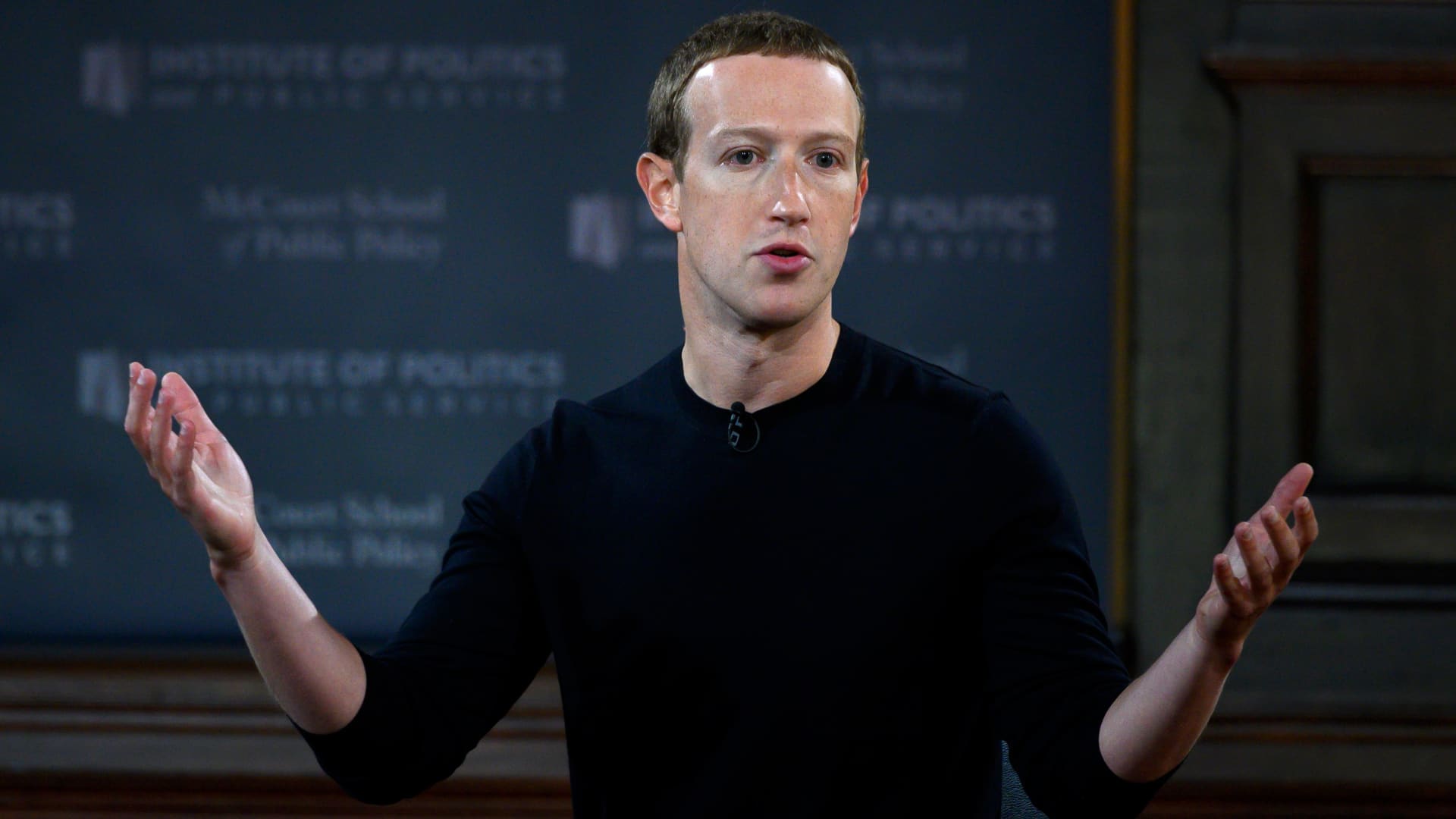
Meta Platforms CEO Mark Zuckerberg speaks at Georgetown University in Washington on Oct. 17, 2019.
Andrew Caballero-Reynolds | AFP | Getty Images
Wall Street’s worst year since 2008 wreaked havoc on tech companies, particularly those reliant on digital advertising.
Facebook parent Meta lost almost two-thirds of its value in 2022 as year-over-year revenue fell in consecutive quarters, leading the company in November to cut 13% of its workforce. Snap’s stock plummeted 81% as growth dipped into the single digits, and the company opted not to provide a forecast for two straight periods. In August, Snap said it was laying off 20% of its employees.
related investing news

Following a brutal 2022, investors are starting to return to the online ad sector before a rebound in financial performance that’s expected at some point in 2023. They’re hoping for some signs of a recovery this week as the biggest companies in the space report fourth-quarter results and provide an update on whether brands are starting to spend more on ads after pausing many of their campaigns.
Snap is scheduled to issue results after the close of trading on Tuesday. Meta reports on Wednesday, followed by Google parent Alphabet on Thursday. Also on Thursday, investors will hear from Amazon and Apple, which both have growing digital ad businesses that have been taking market share of late from Google and Facebook.
With concerns of a potential recession still looming large, market analysts anticipate more turmoil ahead for online advertising. A survey of 50 ad buyers published this month by Cowen showed that companies expect their spending in 2023 to rise just 3.3%, which the investment bank said represents “the softest ad growth outlook we’ve seen in five years.” Last year, those companies increased spending by 7.5%.
“Two-thirds of ad buyers factored in a recession as part of their budgeting process, citing inflation and a softening consumer, among other macro factors,” Cowen said.
In addition to the macro challenges, companies that rely on mobile data for ad targeting are still reckoning with upheaval caused by Apple. In 2021, the iPhone maker instituted a new App Tracking Transparency (ATT) feature, which reduced targeting capabilities by limiting advertisers from accessing a smartphone user identifier. Meta said early last year that ATT would reduce revenue by $10 billion for all of 2022.
Meta and Snap over past 12 months
CNBC
In its most recent earnings call in October, as Meta’s stock sank in extended trading, CEO Mark Zuckerberg acknowledged a multitude of headwinds facing the company, including the economy, ATT and competition — and he was left thanking the remaining investors for their patience.
“I think that those who are patient and invest with us will be rewarded,” Zuckerberg said.
So far in 2023, there have been some rewards. Meta and Snap are both up more than 22% as January comes to a close. But revenue growth isn’t expected to pick back up until the second half of the year.
Analysts expect Snap to show fourth-quarter growth of less than 1%, followed by expansion of 1.6% in the current period, according to Refinitv.
‘Little bit of a rebound’
Meta, whose ad business is more than 20 times the size of Snap’s, is expected to report a third straight quarter of declines — and its steepest drop yet — at more than 6%, according to Refinitiv. Revenue is expected to fall another 2.8% in the first quarter, before sub-1% growth returns in the second period.
Since April 2021, when Apple’s ATT update went into effect, Meta has been working on improving its advertising technology and has been utilizing data from other sources. Some retailers, for instance, told CNBC that they’ve been porting their customer data from their Shopify websites into Meta’s platforms, which has helped improve the ability for Meta to target personalized ads to users.
“There’s some signals that maybe Facebook is seeing a little bit of a turnaround in ad spending,” said Debra Williamson, an analyst at research firm Insider Intelligence.
However, TikTok has driven consumers from stagnant updates to short videos, and Facebook has been slow to catch up. Meanwhile, even with Meta’s incremental improvements to its ad system, the impact of Apple’s privacy change was so severe that Facebook and Instagram are nowhere close to making up for it.
“Facebook has had a lot of challenges with coming up with its own tools and metrics to be able to prove the effectiveness of those ads,” Williamson said. “I think it’s getting better at that, so I’m hopeful that we will see maybe a bit of a rebound for Facebook compared to the past couple of quarters.”
Google’s business has been less harmed by Apple’s moves, but it’s still being hit hard by the economic slowdown and by TikTok. Growth at Alphabet is expected to come in below 1% in the fourth quarter of 2022 and slowly build in 2023, not reaching double digits until the last period of the year.
“Among the existing players, TikTok is expected to be the largest share gainer within Digital Video advertising over the next two years,” Cowen analysts wrote. They estimate TikTok will capture 8% of budgets in 2024, up from 6% last year.
Amazon’s ad business has also made major inroads, as e-retailers show their willingness to pay big bucks to promote their brands on the company’s site and across its various services. According to Insider Intelligence, Amazon captured 13% of the digital ad market last year, and in the third quarter its ad business grew by 25% even as overall revenue missed estimates.
Analysts expect Amazon’s ad unit to show growth of 17% in the fourth quarter, well ahead of its peers, and to stick in the mid-teens throughout 2023, according to FactSet.
And then there’s Netflix, which has added advertising as a revenue stream. The company debuted a new ad-supported streaming tier in November that costs $6.99 a month.
“Netflix is expected to climb from 0% of budgets in 2022 to nearly ~4% of Digital Video ad spend by 2024,” the Cowen analysts said.
Still, the biggest uncertainty looming over this year’s online ad market is the shaky economy, said Barton Crockett, an analyst at Rosenblatt Securities. He has a hold rating on Meta, Snap, Amazon and Netflix, but recommends buying Alphabet and Apple, according to FactSet.
If the economy improves, “things that are very economically sensitive, like advertising, will be an attraction for investors across the spectrum,” Crockett said. “That could be great for everyone in this group.”
It’s a giant and risky bet. The U.S. Department of Commerce said last week that consumer spending dropped 0.2% in December, indicating that people are still holding on to their cash.
“In that circumstance, it will be hard for there to be any kind of meaningful expansion of ad spend,” Crockett said.



Beta Technologies shares surged more than 9% after air taxi maker Eve Air Mobility announced an up to $1 billion deal to buy motors from the Vermont-based company.
Eve, which was started by Brazilian airplane maker Embraer and is now under Eve Holding, said the manufacturing deal could equal as much as $1 billion over 10 years. The Florida-based company said it has a backlog of 2,800 vehicles.
Shares of Eve Holding gained 14%.
Eve CEO Johann Bordais called the deal a “pivotal milestone” in the advancement of the company’s electric vertical takeoff and landing, or eVTOL, technology.
“Their electric motor technology will play a critical role in powering our aircraft during cruise, supporting the maturity of our propulsion architecture as we progress toward entry into service,” he said in a release.


Mateusz Slodkowski | SOPA Images | Lightrocket | Getty Images
Amazon’s cloud unit on Tuesday announced AI-enabled software designed to help clients better understand and recover from outages.
DevOps Agent, as the artificial intelligence tool from Amazon Web Services is called, predicts the cause of technical hiccups using input from third-party tools such as Datadog and Dynatrace. AWS said customers can sign up to use the tool Tuesday in a preview, before Amazon starts charging for the service.
The AI outage tool from AWS is intended to help companies more quickly figure out what caused an outage and implement fixes, Swami Sivasubramanian, vice president of agentic AI at AWS, told CNBC. It’s what site reliability engineers, or SREs, do at many companies that provide online services.
SREs try to prevent downtime and jump into action during live incidents. Startups such as Resolve and Traversal have started marketing AI assistants for these experts. Microsoft’s Azure cloud group introduced an SRE Agent in May.
Rather than waiting for on-call staff members to figure out what happened, the AWS DevOps Agent automatically assigns work to agents that look into different hypotheses, Sivasubramanian said.
“By the time the on-call ops team member dials in, they have an incident report with preliminary investigation of what could be the likely outcome, and then suggest what could be the remediation as well,” Sivasubramanian told CNBC ahead of AWS’ Reinvent conference in Las Vegas this week.
Commonwealth Bank of Australia has tested the AWS DevOps Agent. In under 15 minutes, the software found the root cause of an issue that would have taken a veteran engineer hours, AWS said in a statement.
The tool relies on Amazon’s in-house AI models and those from other providers, a spokesperson said.
AWS has been selling software in addition to raw infrastructure for many years. Amazon was early to start renting out server space and storage to developers since the mid-2000s, and technology companies such as Google, Microsoft and Oracle have followed.
Since the launch of ChatGPT in 2022, these cloud infrastructure providers have been trying to demonstrate how generative AI models, which are often training in large cloud computing data centers, can speed up work for software developers.
Over the summer, Amazon announced Kiro, a so-called vibe coding tool that produces and modifies source code based on user text prompts. In November, Google debuted similar software for individual software developers called Antigravity, and Microsoft sells subscriptions to GitHub Copilot.
WATCH: Amazon rolls out AI-powered tools to help big AWS customers update old software
Technology
Amazon to let cloud clients customize AI models midway through training for $100,000 a year


Attendees pass an Amazon Web Services logo during AWS re:Invent 2024, a conference hosted by Amazon Web Services, at The Venetian hotel in Las Vegas on Dec. 3, 2024.
Noah Berger | Getty Images
Amazon has found a way to let cloud clients extensively customize generative AI models. The catch is that the system costs $100,000 per year.
The Nova Forge offering from Amazon Web Services gives organizations access to Amazon’s AI models in various stages of training so they can incorporate their own data earlier in the process.
Already, companies can fine-tune large language models after they’ve been trained. The results with Nova Forge will lean more heavily on the data that customers supply. Nova Forge customers will also have the option to refine open-weight models, but training data and computing infrastructure are not included.
Organizations that assemble their own models might end up spending hundreds of millions or billions of dollars, which means using Nova Forge is more affordable, Amazon said.
AWS released its own models under the Nova brand in 2024, but they aren’t the first choice for most software developers. A July survey from Menlo Ventures said that by the middle of this year, Amazon-backed Anthropic controlled 32% of the market for enterprise LLMs, followed by OpenAI with 25%, Google with 20% and Meta with 9% — Amazon Nova had a less than 5% share, a Menlo spokesperson said.
The Nova models are available through AWS’ Bedrock service for running models on Amazon cloud infrastructure, as are Anthropic’s Claude 4.5 models.
“We are a frontier lab that has focused on customers,” Rohit Prasad, Amazon head scientist for artificial general intelligence, told CNBC in an interview. “Our customers wanted it. We have invented on their behalf to make this happen.”
Nova Forge is also in use by internal Amazon customers, including teams that work on the company’s stores and the Alexa AI assistant, Prasad said.
Reddit needed an AI model for moderating content that would be sophisticated about the many subjects people discuss on the social network. Engineers found that a Nova model enhanced with Reddit data through Forge performed better than commercially available large-scale models, Prasad said. Booking.com, Nimbus Therapeutics, the Nomura Research Institute and Sony are also building models with Forge, Amazon said.
Organizations can request that Amazon engineers help them build their Forge models, but that assistance is not included in the new service’s $100,000 annual fee.
AWS is also introducing new models for developers at its Reinvent conference in Las Vegas this week.
Nova 2 Pro is a reasoning model whose tests show it performs at least as well as Anthropic’s Claude Sonnet 4.5, OpenAI’s GPT-5 and GPT-5.1, and Google’s Gemini 3.0 Pro Preview, Amazon said. Reasoning involves running a series of computations that might take extra time in response to requests to produce better answers. Nova 2 Pro will be available in early access to AWS customers with Forge subscriptions, Prasad said. That means Forge customers and Amazon engineers will be able to try Nova 2 Pro at the same time.
Nova 2 Omni is another reasoning model that can process incoming images, speech, text and videos, and it generates images and text. It’s the first reasoning model with that range of capability, Amazon said. Amazon hopes that, by delivering a multifaceted model, it can lower the cost and complexity of incorporating AI models into applications.
Tens of thousands of organizations are using Nova models each week, Prasad said. AWS has said it has millions of customers. Nova is the second-most popular family of models in Bedrock, Prasad said. The top group of models are from Anthropic.
WATCH: Amazon set to kick off AI conference next week: Maxim’s Tom Forte on what to expect
-
 Sports2 years ago
Story injured on diving stop, exits Red Sox game
-
 Sports3 years ago
‘Storybook stuff’: Inside the night Bryce Harper sent the Phillies to the World Series
-
 Sports2 years ago
Game 1 of WS least-watched in recorded history
-
 Sports3 years ago
Button battles heat exhaustion in NASCAR debut
-
 Sports3 years ago
MLB Rank 2023: Ranking baseball’s top 100 players
-
Sports4 years ago
Team Europe easily wins 4th straight Laver Cup
-
 Environment3 years ago
Japan and South Korea have a lot at stake in a free and open South China Sea
-
 Environment1 year ago
Here are the best electric bikes you can buy at every price level in October 2024