
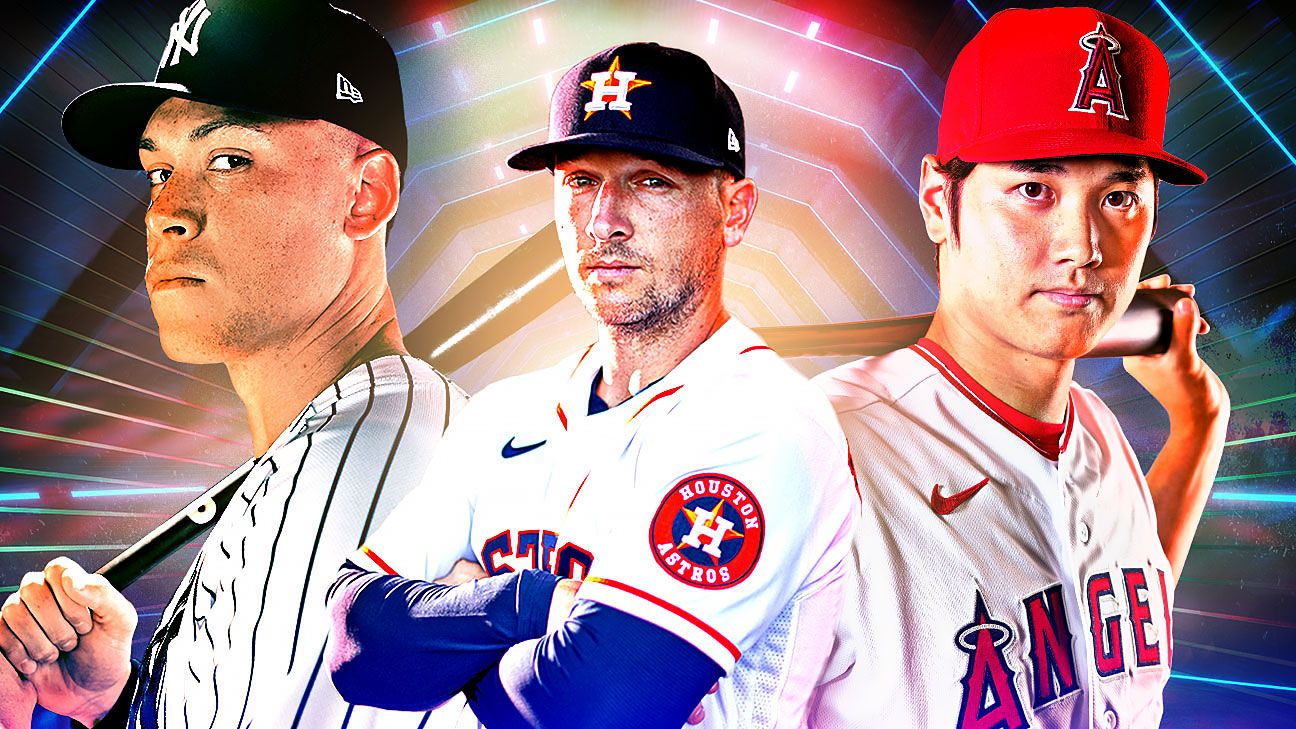
MLB Opening Day is here! What we’re watching, live updates and more as baseball returns


Welcome to MLB Opening Day 2023!
After one of the most exciting preludes to a regular season in recent memory — from offseason chaos to players (and fans) learning baseball’s new rules and enjoying shorter, faster paced games to an epic World Baseball Classic — it’s time to play ball.
All 30 teams are in action today, starting with a pair of 1:05 p.m. ET contests in Washington, D.C. and the Bronx, where 21-year-old top shortstop prospect Anthony Volpe becomes the youngest player to start on Opening Day for the New York Yankees since Derek Jeter. Speaking of debuts, Jacob deGrom makes his for the Texas Rangers, who play at home against prized offseason acquisition Trea Turner and the defending National League champions Philadelphia Phillies (4:05 p.m. on ESPN+).
Later, Jose Abreu faces his former team, the Chicago White Sox, as the newest member of last year’s World Series champion Houston Astros (7 p.m. on ESPN). It all leads up to the game’s best player, Shohei Ohtani, taking the mound for the Los Angeles Angels in one of four West Coast night games to close things out.
In other words, we won’t blame you for playing hooky.
What are we looking for as the season gets started? Our reporters give their pregame takes from the ballpark, plus we’ll post lineups as they are announced and live updates throughout the day, including takeaways from each game as it concludes.
Season preview: How all 30 teams rank as baseball returns | Predictions
New rules: What you need to know | Passan: Welcome to a new era
MLB Rank 2023: Who are baseball’s 100 best players? | Snubs
Passan’s bold predictions | Your guide to MLB’s offseason chaos
Jump to a game:
ATL-WAS | SF-NYY | BAL-BOS
MIL-CHC | DET-TB | PHI-TEX
MIN-KC | NYM-MIA | PIT-CIN
TOR-STL | CHW-HOU | COL-SD
LAA-OAK | ARI-LAD | CLE-SEA
All times ET


The pitching matchup: Max Fried vs. Patrick Corbin
The big storyline: The Braves have World Series aspirations but perhaps no contending team will have a more surprising Opening Day — or Opening Week — look than the Braves. After Dansby Swanson left in free agency, Vaughn Grissom was expected to take over as shortstop; instead, it will be veteran Orlando Arcia with Grissom beginning the season in Triple-A.
The biggest shock comes in the rotation, however. With 21-game winner Kyle Wright still building up after receiving a cortisone shot in his right shoulder in January, rookies Jared Shuster and Dylan Dodd both made the initial rotation, alongside Opening Day starter Fried, Spencer Strider and Charlie Morton. No Ian Anderson, Bryce Elder or Mike Soroka. The kicker: A farm system that ESPN’s Kiley McDaniel ranked last in the majors will be expected to contribute right out of the gate.
One obscure thing to impress your friends: Corbin starts for the Nationals — after leading the NL with 19 losses in 2022. The last Opening Day starter to draw the assignment after leading his league in losses: Corbin, last season. Before that: Matthew Boyd of the Tigers in 2021. And Sandy Alcantara of the Marlins did it in 2020, so it’s not all that unusual, although Corbin’s 6.31 ERA is certainly among the worst ever from the previous season for an Opening Day starter. — David Schoenfield
Braves lineup: TBA
Nationals lineup: TBA


The pitching matchup: Logan Webb vs. Gerrit Cole
The big storyline: All eyes will be on Anthony Volpe. “I don’t know [how] to put into words how I expect to feel,” said the rookie, who grew up a diehard Yankees fan, like his now-teammates Harrison Bader and Cole, about putting on the pinstripes and hearing Yankee Stadium public address announcer Paul Olden say his name during the pregame ceremonies. Volpe’s promotion is perhaps the only storyline that could have trumped Aaron Judge‘s return to the South Bronx as the highest-paid player in Yankees franchise history and its first captain since Jeter. That on the heels of Judge breaking Roger Maris’ 61-year-old American League home run record on his way to becoming last year’s league MVP. And there is also this: As part of the new competitive balanced schedule, the Yankees will open the season against one of Judge’s most aggressive offseason pursuers, his childhood team, the San Francisco Giants. And maybe Judge put it best when talking about the Yankees’ Opening Day opponent. “I think I saw it middle of the year last year and I was kind of like, ‘Someone’s messing with me on the MLB side,'” he said with a huge grin. “I grew up as a kid watching the Giants … Getting a chance [to have my] first Opening Day as captain, and getting a chance to play against a great organization like that, we’re going to have some fun.”
One obscure thing to impress your friends: When Volpe first arrived in spring training back in February, the reporters that cover the team talked to him at his locker. And, as we typically do with kids who grew up as Yankees fans, I asked whom he was most looking forward to meeting during his first spring call-up. With Volpe being only 21 years old, one generally formulates a guess as to whose name it might be. The answer for most position players, nine out of 10 times, is Derek Jeter. But Volpe dropped an unexpected name: Willie Randolph. I was shocked, given Randolph’s years with the Yankees spanned the late 1970s and 1980s — and Volpe was only eight years old when the Yankees won their last World Series ring in 2009. But Volpe explained that Randolph was a hero in his Yankees-crazed household, which is where his fanhood comes from. That day, I went over to talk to Randolph, a guest instructor with the club at the start of most spring trainings, and I told him about Volpe’s answer. Randolph had yet to meet Volpe — the two would work closely this spring — but he was really impressed, and asked me to please let Yankees photographer Ariele Goldman Hecht know so they could take a picture together. After Randolph and Volpe met, they took the picture — which will certainly have a place of honor among the Volpe family keepsakes. — Marly Rivera
Giants lineup: TBA
Yankees lineup: TBA


The pitching matchup: Kyle Gibson vs. Corey Kluber
The big storyline: For Boston, an Opening Day matchup against the Orioles is a reminder that the team finished in last place in an extremely competitive division last season, five games behind a Baltimore team that surprised many after being projected to be the worst team in the AL East. With the departures of Xander Bogaerts and J.D. Martinez and the big contracts given to Rafael Devers and Masataka Yoshida, 2023 represents a crucial year for chief baseball officer Chaim Bloom, who will feel the fire from fans if Boston fails to make the playoffs for a second straight season.
For Baltimore, it’s time to start having some expectations. The O’s aren’t exactly a World Series contender, but in Year 2 of catcher Adley Rutschman, the full-season debut of top prospect Gunnar Henderson and other top prospects on the way — like Grayson Rodriguez and Jackson Holliday — we’ll begin to see if the extensive rebuild over the last few years was worth it.
One obscure thing to impress your friends: Henderson is clearly a star on the diamond, but the infielder showed basketball prowess in high school too, averaging 17 points and 11 rebounds a game in 2019 for Morgan Academy, earning Alabama Independent School Association Player of the Year honors. — Joon Lee
Orioles lineup: TBA
Red Sox lineup: TBA


The pitching matchup: Corbin Burnes vs. Marcus Stroman
The big storyline: The denizens of Wrigley Field will get their first look at a revamped Cubs lineup. With Milwaukee starting righty ace Burnes, Chicago could feature an Opening Day lineup that includes six offseason signings. The list is led by shortstop Dansby Swanson and former NL MVP Cody Bellinger, who is looking to get his career back on track after being non-tendered by the Dodgers. Other likely new faces on the scorecard: Trey Mancini, Eric Hosmer, Edwin Rios and Tucker Barnhart.
One obscure thing to impress your friends: As you might imagine, it’s not common for a player like Bellinger, who won an MVP award so early in his career (age 23), to find himself debuting with a new team so soon. Only nine hitters have won NL MVP honors in their age-24 or younger seasons. The first six — think guys with names like Aaron, Mays, Musial and Bench — played an average of 16 more seasons for the team they won the award with. Things have slowed. Kris Bryant, the 2016 winner, lasted five more seasons with the Cubs, then signed with the Rockies. Meanwhile, there is Bellinger and Bryce Harper, who both lasted three more seasons with their original teams after winning MVP. Obviously, the circumstances for the two sluggers were very different (non-tender vs. massive free agent deal) but the Cubs hope for a similar outcome: Harper repeated as an MVP winner for his new team in 2021. — Bradford Doolittle
Brewers lineup: TBA
Cubs lineup: TBA


The pitching matchup: Eduardo Rodriguez vs. Shane McClanahan
The big storyline: The Rays are seeking their fifth straight playoff appearance as McClanahan makes his second straight Opening Day start. McClanahan blitzed through the league in the first half last season, going 10-3 with a 1.71 ERA in his first 18 starts and starting the All-Star Game. He was just 2-5 with a 4.20 ERA in the second half, however, missing a couple starts with a sore left shoulder. “He can be better,” manager Kevin Cash said early in spring training. “It’s definitely doable.”
One obscure thing to impress your friends: In the offseason, McClanahan dedicated himself to self-improvement, embarking on a regular stretching routine and limiting snacking and alcohol while focusing on home-cooked meals. He’s on the short list of top AL Cy Young contenders. — Schoenfield
Tigers lineup: TBA
Rays lineup: TBA


The pitching matchup: Aaron Nola vs. Jacob deGrom
The big storyline: DeGrom’s debut with the Rangers is the storyline of this game. Yes, he’ll face the defending NL champions Phillies, but there’s comparatively little mystery with that team, outside of how it will survive without injured stars Bryce Harper and Rhys Hoskins. With deGrom, the question isn’t likely to be about performance, it’s about durability.
Watching deGrom on the backfields at Rangers camp during spring training brought oohs and ahhs — but not from adoring fans. Opposing minor league hitters were making those noises, and shaking their heads as they went back to the dugout after seeing 100-mph heat from the two-time Cy Young Award winner. His stuff was electric and the swings by those hitters told the story: Bad, late — or not at all. Many ridiculed the Rangers for spending $185 million on a player who appeared in a total of 26 games over the past two seasons, but there’s a good chance that come Thursday afternoon, the baseball world will be reminded why they did.
One obscure thing to impress your friends: Phillies outfielder Nick Castellanos hates iPhones — he’s not a fan of social media, either — but was forced to get one after having kids. “It’s good for Ubers and things like that,” he said this spring. “I still have my flip phone, though.” — Jesse Rogers
Phillies lineup: TBA
Rangers lineup: TBA


The pitching matchup: Pablo Lopez vs. Zack Greinke
The big storyline: The shortstops will be the focal point of both teams in 2023. Carlos Correa ended up returning to the Twins after his failed attempts to sign with the Giants and Mets. For all the injury issues earlier in his career, Correa has been pretty healthy the past three seasons, missing two games in 2020, 14 in 2021 and 26 last season (most of those due to a finger injury). The Twins would love nothing more than 150-plus games from him. For the Royals, Bobby Witt Jr. showcased his explosive tools as a rookie, hitting 20 home runs with 57 extra-base hits and 30 steals. Now it’s all about refining his game: consistency at the plate, improved plate discipline and better defense after some surprisingly poor defensive metrics, especially at shortstop. The rebuilding Royals need him to turn into a star.
One obscure thing to impress your friends: Greinke will be making his seventh career Opening Day start — three for the Royals (2010, 2022, 2023), three for the Diamondbacks and one for the Astros. His comment: “It’s nice.” The record for most different teams making an Opening Day start for belongs to Gaylord Perry, who started for the Giants, Indians, Rangers, Padres and Mariners. — Schoenfield
Twins lineup: TBA
Royals lineup: TBA


The pitching matchup: Max Scherzer vs. Sandy Alcantara
The big storyline: Can Mets owner Steve Cohen buy a championship? When the departure of Jacob deGrom left a big hole in New York’s rotation, the Mets filled it by signing reigning AL Cy Young Justin Verlander and Japanese star Kodai Senga. Otherwise, New York returns much of the same clubhouse that gelled exceptionally well last season. With closer Edwin Diaz out for the year with a knee injury, what happens at the back end of the bullpen remains a question for the Mets, who have options with Adam Ottavino and David Robertson.
Miami has a legit ace in Alcantara, but a lot of eyes are focused on Jazz Chisholm, who will transition from the middle infield to the outfield after an injury-filled 2022 season. Chisholm — who graces the cover of this year’s “MLB: The Show” video game — has everything you need to be a star, but hasn’t had a season where he’s put it all together yet. If the Marlins have any hope for the future with its current core, the Marlins need to see progress from Chisholm.
One obscure thing to impress your friends: While Senga comes over to New York as one of Japan’s most famous baseball players, that almost wasn’t the case. The Fukuoka SoftBank Hawks selected Senga in the developmental player draft, which does not guarantee players a spot on a minor league roster. He transitioned from infielder to pitcher and became one of the biggest surprise stories in Nippon Professional Baseball history, turning into one of the league’s best players after starting out on the bottom rung, a similar development success story to 62nd-round MLB draft pick Mike Piazza or 13th-round pick Albert Pujols. — Lee
Mets lineup: TBA
Marlins lineup: TBA


The pitching matchup: Mitch Keller vs. Hunter Greene
The big storyline: Umm … the battle for fourth place in the NL Central? Neither team figures to be in the playoff race, but each feature one of the most potentially exciting players in the game: Pirates shortstop Oneil Cruz and Reds Opening Day starter Greene, both entering their sophomore seasons. Cruz needs rein in the strikeouts to get to his impressive raw power more often. Greene, who averaged 98.9 mph with his fastball, simply needs to build upon what we saw down the stretch last year when he had a 0.62 ERA over his final five starts with a 45/7 strikeout-to-walk ratio.
One obscure thing to impress your friends: Joey Votto had started the last 14 Opening Days for the Reds but will begin the season on the IL as he continues to recover from last August’s rotator cuff surgery. Votto did play in spring training games but will start the season on a rehab stint in the minors. He’s in the final year of a 10-year, $225 million extension he signed back in 2012. “I think I’m going to play well,” Votto told reporters the other day. “I think I’m going to perform well offensively. If not, I’m going to retire. End of story.” — Schoenfield
Pirates lineup: TBA
Reds lineup: TBA


The pitching matchup: Alek Manoah vs. Miles Mikolas
The big storyline: Much-hyped prospect Jordan Walker will still be a few weeks shy of his 21st birthday when he takes the field for his first Opening Day at Busch Stadium. Assuming Walker plays in the opener, he will become the youngest Cardinals position player ever to make his MLB debut in an Opening Day game. He will be the first hitter 21 or younger to debut in an opener for the Redbirds since Albert Pujols in 2001. Pujols, as we all remember, retired last fall after a memorable final season for St. Louis. Kismet? To be fair, we can’t put Pujols’ considerable legacy on Walker’s shoulders any time soon, but he certainly looks like a special talent and is a preseason frontrunner in the NL Rookie of the Year race.
One obscure thing to impress your friends: For the first time since April 8, 1969, the Cardinals will feature a member of the Caray family in their broadcast booth. Chip will take over as the new TV voice of the Redbirds this season, following in the footsteps of his legendary grandfather, Harry, who called games for the Cardinals from 1945 to 1969. Harry’s last Opening Day broadcast was a doozy: After being hit by a car during the offseason and breaking both of his legs, he appeared on the field at Busch Stadium II during Opening Day ceremonies, hobbling around on two canes. Then he dramatically chucked the canes into the air to the delight of the fans. Chip, who was born and raised in St. Louis, was four years old at the time. He’s got a tough act to follow. — Doolittle
Blue Jays lineup: TBA
Cardinals lineup: TBA


The pitching matchup: Dylan Cease vs. Framber Valdez
The big storyline: Jose Abreu was the clubhouse leader in his nine seasons with the White Sox, with young players naturally gravitating toward the equilibrium in his personality and the team relying on his production. With the White Sox front office turning to a younger, cheaper option in Andrew Vaughn, 24, to play first base, Abreu signed a three-year, $58.5 million deal with the Astros — and, not surprisingly, he has fit in seamlessly, reporting to the Astros’ spring camp two weeks before it opened. “It feels like family,” he said early in the camp. Knowing how competitive Abreu is, one staffer said, “He’ll probably hit four homers.” It wasn’t clear whether the staffer meant Abreu would bash four homers on Opening Day or over the first series, but you get the point. Abreu will want to put on a show for his ex-teammates.
One obscure thing to impress your friends: The Astros will try to become the first team since the Yankees of 1998 to 2000 to repeat as World Series champions, almost a quarter century ago. But the difficulty of the challenge of going back-to-back is underscored by this fact: The last team that won a World Series to even return to the Fall Classic the following season was the 2001 Yankees, who held a lead in the bottom of the ninth inning of Game 7. Yainer Diaz, the Astros’ backup catcher, was three years old when that occurred. — Buster Olney
White Sox lineup: TBA
Astros lineup: TBA


The pitching matchup: German Marquez vs. Blake Snell
The big storyline: It’s not necessarily the start of the “Big Four” era because Fernando Tatis Jr. won’t come off his PED-related suspension until April 20. But it’s a teaser, at least. The Padres, looking to capitalize on reaching the NL Championship Series last October, signed shortstop Xander Bogaerts to a $280 million contract this offseason, teaming him with Tatis, Manny Machado and Juan Soto to form a devastating lineup. Three of those four will be in there Opening Day, making up what is probably the most star-studded roster in the major leagues. The Padres have set themselves up for grand expectations, more so than at any point in their franchise’s history. The goal is to deliver San Diego its first championship. Anything less is a failure.
One obscure thing to impress your friends: Nine players attained nine-figure contracts this offseason, and three of them did so with the Padres — Bogaerts, Machado and starting pitcher Yu Darvish, with the latter two doing so on extensions. All three of those players are now signed into their 40s. The Padres’ competitive balance tax payroll — the figure used to determine where teams reside relative to the luxury tax threshold — sits at a projected $276 million heading into 2023. Only the Yankees ($295 million) and the Mets (a whopping $375 million) are higher. — Alden Gonzalez
Rockies lineup: TBA
Padres lineup: TBA


The pitching matchup: Shohei Ohtani vs. Kyle Muller
The big storyline: As it was, as it is, as it shall be: Shohei Ohtani. He’s not only the One Big Opening Day storyline, he’s bound to be one big season-long storyline. This could be the beginning of the end to Ohtani’s career as an Angel, and it starts on the mound — and in the batter’s box — in the barren expanse of the Oakland Coliseum, nearly five years to the day after he made his first big-league start on the same exact spot.
One obscure thing to impress your friends: Center fielder Cristian Pache, considered the best prospect in the trade that sent Matt Olson to the Braves, couldn’t crack Oakland’s Opening Day roster despite being out of options. He was traded Wednesday for Billy Sullivan, a Phillies reliever who had a 4.59 ERA in Double-A. “It was really hard to run out of time with a player that you feel is young and still has a huge future in this game,” A’s manager Mark Kotsay said. The A’s, a franchise eternally waiting for something — a new home, a contending team, the next trade of a known quantity for a group of unknowns — finally found something that wasn’t worth the wait. — Tim Keown
Angels lineup: TBA
A’s lineup: TBA


The pitching matchup: Zac Gallen vs. Julio Urias
The big storyline: Teams doled out free agent dollars in record fashion this offseason, but the Dodgers, among the most aggressive spenders these last few years, opted to mostly stand pat in order to create a path for their homegrown players. We’ve already seen that backfire in one respect, with Gavin Lux, primed to be the everyday shortstop, suffering a season-ending knee injury in spring training. Do they have enough to contend the way they have over the last decade? And can the D-backs — an underrated team that plays really good defense, runs the bases well, received solid contributions from key members of their rotation last season and has several young players ready to make an impact — give them a run?
One obscure thing to impress your friends: Keep your eyes on Miguel Vargas, the 23-year-old who will get his first opportunity to play every day in the major leagues. His hit tool has never really been in question — the concern has been his defense. But the Dodgers believe he’ll be a lot better defensively at second base than many outsiders expect, pointing to the work he put in during the offseason. They see him as a potential breakout star, somebody who will compete for the Rookie of the Year Award. Just as important: He plays with high energy, runs the bases aggressively and should be lots of fun to watch. — Gonzalez
Diamondbacks lineup: TBA
Dodgers lineup: TBA


The pitching matchup: Shane Bieber vs. Luis Castillo
The big storyline: One of just two Opening Day games where both teams made the playoffs last year (Blue Jays-Cardinals is the other), this one showcases a terrific pitching matchup between Bieber and Castillo. That’s fun, but all eyes will be on Julio Rodriguez, who enters the season as one of the must-watch players in the game after his stellar rookie of the year campaign. He ranked seventh on ESPN.com’s list of the top 100 players in the game, an aggressive ranking, but symbolic of what the 22-year-old might achieve after hitting .284 with 28 home runs and 25 steals — with the charisma to match.
One obscure thing to impress your friends: The Mariners made the playoffs last year for the first time since 2001, but going back to 2007, they have the best Opening Day record in the majors at 13-3 (the Mets and Dodgers are 12-4). Much of that is thanks to Felix Hernandez, who started 11 Opening Day games and posted a 1.53 ERA. — Schoenfield
Guardians lineup: TBA
Mariners lineup: TBA

-
Bill Connelly
After compiling a perfect coaching pedigree — he played for Bill Walsh, Tom Osborne and Bill Belichick and coached for Frank Solich and Chip Kelly — and going unbeaten at UCF in 2017, former Nebraska quarterback Scott Frost returned to Lincoln to save a flailing Cornhuskers program. It was perfect timing, and there seemed to be approximately a 100% chance of things working out beautifully.
Frost went 16-31 and was fired early in his fifth season.
After leading Cincinnati to extended success (53-10 from 2018 to 2022, including making the 2021 College Football Playoff), former Ohio State player and longtime Buckeyes assistant Luke Fickell took the Wisconsin head coaching job. He had a great résumé, had proved his player development chops and had modern ideas but was grounded in Big Ten physicality. It was a perfect hire.
Three years in, Fickell is 17-21. During the season, speculation swirled about his job status, and when the school announced he was returning for 2026, the Badgers actually perked up and played well down the stretch. But they still went 4-8, their worst record in 35 years.
The two most perfectly logical college football hires of the past decade either didn’t work out or haven’t to date, proving that the process of grading coaching hires immediately after they’re made is almost completely pointless. We never know how coaches will handle their new surroundings, and so much is determined by the school doing the hiring (or, in some cases, plain old luck).
Grading hires is also fun, however. And in this moment in college football’s transition to becoming a player-compensation sport, it’s a particularly interesting thought exercise. So we’re going to do it anyway.
Though a few vacancies are still on the board, we’ve seen 30 FBS head coaches hired thus far in the 2025-26 coaching carousel. Some schools sought a proven winner and committed the type of big-money (and guaranteed) contracts for which the sport has become increasingly known. Others opted for up-and-coming assistants, potentially choosing to invest some of those savings into player talent.
We don’t yet know who will be rewarded for their moves, and we know we’re going to be wrong with about half of our opinions. But let’s grade this year’s hires based purely on the logic at hand. I’m honestly a pretty easy grader — I just need to understand (and, preferably, agree with) the thought process. Therefore, a hire ranking into the 20s might still land a pretty good grade. But in theory, the higher the grade, the more likely the hire will succeed.

Grade: A+ (probably the best job available, filled by the best available coach)
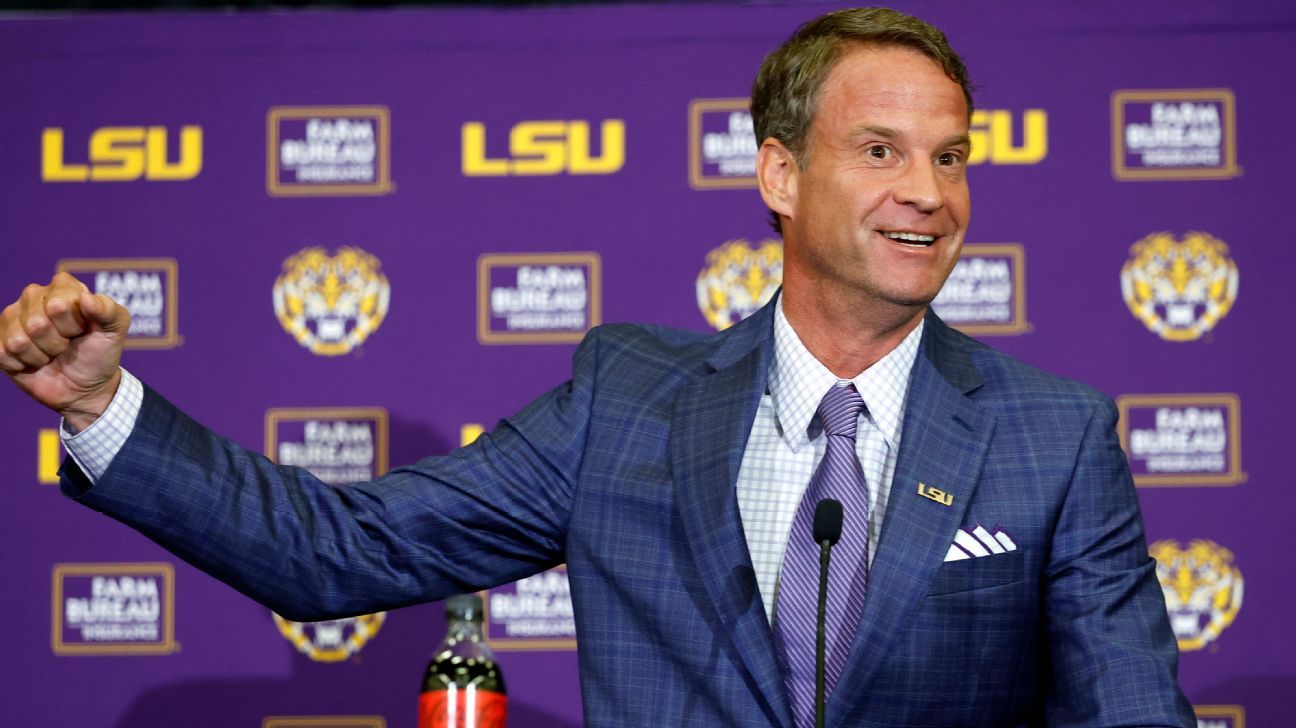
 1. Lane Kiffin, LSU. We won’t overthink this one. Everything about the run-up to Kiffin’s departure from Ole Miss was dramatic and strung out, and it will forever be part of his coaching biography that he left an active playoff team for a school he had beaten weeks earlier. But in his past nine years as a head coach, he has won double-digit games six times (at schools without much, or any, recent history of doing that), and he engineered the Rebels’ best three-year run in 60-plus years. He checks almost every box for a school that can afford to hire a guy who checks lots of boxes.
Grade: A (this just makes all the sense in the world)
 2. James Franklin, Virginia Tech. Last summer, I used stats to look at which coaches have done the best job of overachieving against their school’s recent history. Granted, Franklin’s average will go down once I’ve added this year’s Penn State team to the mix, but heading into 2025 he was No. 8 among all long-term coaches of the past 20 years.
Vanderbilt had averaged 3.1 wins per season over a 35-year period, and he won 24 games in three seasons there. Penn State had enjoyed four top-10 finishes in 19 years and was still dealing with sanctions when he arrived in 2014, and he oversaw five top-10 finishes in a nine-year run. No matter how the run at PSU ended, for Tech to land someone with that type of résumé was an absolute coup.
 3. Eric Morris, Oklahoma State. OSU was at its best under Mike Gundy when it was lighting up the scoreboard with an innovative offense. Morris teams do that. He was Texas Tech’s offensive coordinator as Patrick Mahomes transitioned from high-three-star recruit into Patrick Mahomes. Morris took on an unrecruited option quarterback named Cam Ward at Incarnate Word in 2020, and five years later Ward became the No. 1 pick in the draft. At North Texas, Morris took a walk-on (and high school backup) named Drew Mestemaker and turned him into a 4,000-yard passer. Morris might have the best quarterback-development track record in the sport at the moment, and in both of his head coaching stops he led historically unsuccessful programs to new heights. It’s hard to ask for much more.
 4. Jon Sumrall, Florida. The dirty little secret about Tulane this season is, the Green Wave weren’t actually great at anything. Sumrall had to rebuild a healthy portion of his depth chart after last season’s nine-win campaign, and he ended up starting a quarterback (Jake Retzlaff) who arrived in July. But through sheer will and adaptability, his team won 11 games and an American Conference title. That’s three conference titles for Sumrall in four years as a head coach. He can put together teams and units with outstanding talent, but even when he doesn’t, he finds a way to win.
 5. Jim Mora, Colorado State. CSU sure seemed to make a logical hire in Jay Norvell four years ago, but the former Nevada coach could never generate traction, and now the Rams are on an extended run of dreadful play: one winning season and an average SP+ ranking of 105.5 in the past eight years. But they aren’t in as much of a funk as UConn was in when it hired Jim Mora, and after a couple of iffy seasons, he produced something brilliant: The Huskies won 18 games in 2024 and 2025 after winning just 19 in the previous seven seasons.
 6. Mark Carney, Kent State. The best Kent State could have hoped for when firing Kenni Burns in mid-April — maybe the single most awkward time on the calendar, at least when there was a spring portal window — was that Carney, the offensive coordinator and new interim head coach, would do enough to earn the job permanently. Man, did he do so. The Golden Flashes were 1-23 under Burns but perked up to 5-7 this fall. Were they actually good? Not really. Do we have any idea how Carney will navigate an ever-tricky offseason? Nope. The challenges are just beginning, but Carney earned the right to take them on.
 7. Matt Campbell, Penn State. When Campbell took over at Iowa State in 2016, the Cyclones had enjoyed two ranked finishes ever, none higher than 19th. He engineered a No. 9 finish in 2020 and a No. 15 showing in 2024, succeeding enough that going 8-4 in 2025 almost seemed disappointing. He had eight winning seasons in nine years after ISU had just seven between 1981 and 2016. The problem for almost anyone Penn State hired was going to be that he wouldn’t have a résumé that stacked up with that of the guy it just fired (Franklin). Campbell comes about as close as one can get.
 8. Charles Huff, Memphis. Huff was an assistant for Nick Saban and James Franklin, he went to four bowls and won a Sun Belt title in four years at Marshall, and he inspired enough loyalty with his players that, when the Thundering Herd let him leave for Southern Miss a year ago, more than 20 followed him to Hattiesburg and helped the Golden Eagles surge from 1-11 to 7-5. He has built teams around potent offenses and strong defenses. Another hire who checks lots of boxes.
Grade: A- or B+ (perfectly sensible)
 9. Bob Chesney, UCLA. Chesney took Assumption University to the Division II quarterfinals. He took Holy Cross to the FCS quarterfinals. He took James Madison to the College Football Playoff. Chesney is 132-51 as a head coach, and while he took over a great situation at JMU, he handled the jump in competition with as much ease as one could have hoped for. The reason this isn’t an outright A grade is that he has coached only in the East and Northeast, and UCLA is about as far away from there as possible. But in a world with such transient rosters, I’m not sure that actually matters.
 10. Will Stein, Kentucky. Of the teams in the current AP top 10, six are led by first-time head coaches. Hiring a known entity is great, but I was curious which schools would attempt to land the next Dan Lanning instead of a known (and expensive) winner. What better candidate for that title might there be than Stein, the guy who has operated a ruthlessly efficient offense for Lanning for three years and has ties to the state of Kentucky as well (albeit mostly at Louisville)?
 11. Collin Klein, Kansas State. When Chris Klieman suddenly announced his retirement in early December, K-State clearly had a succession plan ready to go. Not that it was hard to piece together. Klein quarterbacked the Wildcats to a Big 12 title under Bill Snyder in 2012 and produced the No. 7 offense in the country (per SP+) as Klieman’s coordinator in 2023 before moving on to Texas A&M. It’s as if he were produced in a lab to be K-State’s head coach one day. (Granted, you could have said the same about Frost and Nebraska.)
 12. Alex Golesh, Auburn. Golesh inherited a program that had gone just 8-37 over the previous four seasons, and he immediately went 7-6 twice, then finished his run with a 9-3 team that was just six points away from 11-1. We’ll see whether he can craft advantages from heavy tempo in a conference that has already seen plenty of it from Josh Heupel’s Tennessee and Lane Kiffin’s Ole Miss, but if you can win nine games at USF, you can win nine games at Auburn.
 13. Jimmy Rogers, Iowa State. Rogers went 27-3 with an FCS national title in two seasons at South Dakota State, and although he had inherited a brilliantly crafted culture in Brookings, he went to Washington State last season and immediately put together an exciting team there too. Built around defense, the Cougars nearly beat Ole Miss, Virginia and James Madison on the road down the stretch. Now he inherits a pretty good culture from Matt Campbell. This seems like a “Chris Klieman to Kansas State” type of hire — only Rogers is just 38 — and, well, that was a great hire.
Grade: B (don’t absolutely love it but won’t be surprised if it works out)
 14. Mike Jacobs, Toledo. Jacobs is basically Bob Chesney from two years ago. He brought the now-closed Notre Dame College to the Division II semifinals, then did the same for Lenoir-Rhyne. He went to Mercer and immediately built on what Drew Cronic had started, going 20-6 and reaching the playoffs twice. Jacobs is 94-23 as a head coach at two levels and three diverse schools. It’s a big jump to the FBS, but we’ve seen plenty of guys do it well.
He’s also an Ohio guy. Bonus points for that.
 15. Pete Golding, Ole Miss. After he was put in the ridiculously tough spot of trying to ensure continuity when Lane Kiffin left before the school’s first playoff run, Golding’s promotion makes plenty of sense. And I enjoyed his selection of East Carolina coordinator John David Baker to run the offense next year, so that’s one hurdle cleared. It seems that continuity hires have lower ceilings in general, so I’m at least a smidgen skeptical, but he obviously cleared his first hurdle with aplomb thanks to Ole Miss’ CFP blowout of Tulane.
 16. Morgan Scalley, Utah. Scalley worked for the departing Kyle Whittingham for 19 seasons, and he was named Utah’s head coach in waiting 18 months ago, so he has had plenty of time to prepare for the job. His history isn’t pristine, and succession plans often fail, but the logic here is pretty easy to understand.
 17. Tosh Lupoi, California. With obvious exceptions, most of the best active and recent coaches have come from the offensive side of the ball, so right or wrong, I tend to look at defensive coordinator-to-head coach hires with a bit more scrutiny. Or at least, I wait to see whether said former DC makes an offensive coordinator hire that doesn’t seem either hostile to recent offensive trends (the Will Muschamp special) or focused too heavily on a “pro-style” approach that often lacks identity.
Long known as an elite recruiter, Lupoi has spent the past four seasons slowly building Oregon’s defense into a wrecking ball. It was beyond time for him to get a head coaching opportunity, and he aced his first test in making sure quarterback Jaron-Keawe Sagapolutele stays in Berkeley. But his first offensive coordinator is a young former Oregon staffer who spent the past three seasons as assistant QBs coach in the very pro-style pros.
Join us in welcoming Offensive Coordinator @JordanSom_TBB to Bear Territory 👏🐻#GoBears pic.twitter.com/MP1tvbLT7z
— Cal Football (@CalFootball) December 19, 2025
Maybe Jordan Somerville will turn out to be a genius hire, but I don’t love the logic there. It produces a slight point deduction, at least.
 18. Kirby Moore, Washington State. The former Mizzou offensive coordinator was worshipped by Tigers fans in his first year on the job and jeered in his third year when the points tapered off after a quarterback change and quarterback injury. That tends to be the way it goes. But he has the pedigree — he played for Boise State’s Chris Petersen, and he’s Kellen Moore’s brother — and honestly, when your track record of hires is as strong as Washington State’s of late, you get the benefit of the doubt.
 19. Billy Napier, James Madison. Napier was able to build major talent advantages at Louisiana and went 33-5 in his last three seasons there. That seems like extremely relevant experience now that he’s returning to the Sun Belt at a school that is building a strong infrastructure.
I don’t absolutely love this hire, but the reasons are mostly aesthetic. First, we saw him run a sloppy and mistake-prone program at Florida for 3½ seasons, and even if Florida isn’t anything like JMU, that’s still a data point. Plus, I don’t like when schools stray from a model that works. JMU had done the “Hire an FCS overachiever” thing for three straight hires and was rewarded beautifully for it. I just assumed the school would go after someone like Lehigh’s Kevin Cahill.
 20. Neal Brown, North Texas. Last we saw Brown at the mid-major level, he was leading Troy to 32 wins and a Sun Belt title (plus a win over LSU) in his final three seasons there. As with Napier, that might be all the experience that matters. He went just 37-35 in six seasons at West Virginia after that, though, which muddies the waters at least a bit. His offensive identity has muddied, too, through the years, which is at least a slight concern considering UNT just enjoyed its best season ever with a specific identity.
 21. JaMarcus Shephard, Oregon State. I’d love to have seen some solo coordinator experience on the résumé, as jumping straight from position coach (or even co-coordinator) can be tricky. But if you’re looking for a potential overachiever for a school that desperately needs a shot in the arm, hiring someone who has coached for Bobby Petrino, Jeff Brohm, Mike Leach and Kalen DeBoer — and has a bit of experience in the Pacific Northwest (plus a reputation as a strong recruiter) — seems like a great place to start. And getting a guy who can answer a question like this at his introductory news conference is even better.
 22. Brian Hartline, South Florida. Like Lupoi, Hartline is regarded as a masterful recruiter, and at USF he might be able to build at least some of the talent advantages he was used to at Ohio State. His defensive coordinator hire (ECU’s aggressive Josh Aldridge) is intriguing from a disruption standpoint, but he went with a trusted old friend, former Ohio State co-coordinator Tim Beck, as his OC. That doesn’t scream “tactical advantage” there, but if Hartline recruits well enough, maybe it won’t matter.
 23. Jason Candle, UConn. A Mount Union product like Campbell, Candle won 81 games, two MAC titles and three division crowns (plus two MAC Coach of the Year awards) in 10 seasons at Toledo. He’s the school’s winningest coach — he’s clearly good. But with the talent advantages he was able to compile at UT, it always seemed that his Rockets should have won more than they did. That waft of disappointment makes it hard to evaluate him.
 24. Ryan Silverfield, Arkansas. Like Candle, Silverfield was able to build an excellent base of talent and score some big wins over teams such as Arkansas, Florida State, West Virginia, Iowa State and Mississippi State. But that made the letdown losses that followed — like a ghastly defeat against UAB this season — even more disappointing. Silverfield is clearly solid, but he won’t have many athleticism advantages in the SEC.
 25. Ryan Beard, Coastal Carolina. Bobby Petrino’s defensive coordinator at Missouri State for three seasons (and also his son-in-law), Beard has been regarded as a solid up-and-comer for a while. He took over the Bears in 2023 and went 19-16, and while that’s more impressive than it sounds — it includes a solid 7-5 debut and No. 99 SP+ ranking in MSU’s 2025 FBS debut — it’s still a pretty light résumé.
Grade: B- or C+ (I understand, but I’m not totally sure I agree)
 26. Tavita Pritchard, Stanford. There’s a certain poetry to general manager Andrew Luck hiring Pritchard, the quarterback before him at Stanford and the player who led the upset of USC that put Stanford’s late-2000s rise into motion. Pritchard has plenty of coaching experience too, including 13 seasons at Stanford. But the Cardinal averaged an offensive SP+ ranking of 84.0 in his five years as OC. He did oversee Jayden Daniels‘ excellent rookie season in the pros, and he has witnessed what it takes to build Stanford up. But that run as OC is hard for me to look past.
 27. Alex Mortensen, UAB. Mortensen was the fired Trent Dilfer’s offensive coordinator, and offense was definitely the Blazers’ stronger unit. UAB pulled a huge upset of Memphis after Mortensen took over as the interim coach, so you can probably see the hiring logic here. But the Blazers otherwise played to projections under Mortensen, and this seems a bit like settling to me.
 28. Will Hall, Tulane. Hall led West Georgia to the Division II semifinals in 2014 and 2015; he knows Tulane well (three years as an assistant); and he enjoyed brief success as Southern Miss’ head coach, going 7-6 in 2022. But while Southern Miss has become an awfully hard job, his Golden Eagles collapsed to 4-20 in 2023 and 2024. I’d love to have seen him take on a longer coaching rehab stint before getting the keys to such a high-profile Group of 5 job.
Grade: C (are you sure about this?)
 29. Blake Anderson, Southern Miss. Southern Miss caught a bad break of sorts, making such a good hire (Charles Huff) that he left for a higher-rung job after just one season. But hiring Anderson, who had one winning season in his past four head coaching seasons (one at Arkansas State, three at Utah State) and was fired by USU for failing to adhere to reporting requirements regarding “investigating issues of sexual misconduct, including domestic violence” and failing to “manage the team in a manner that reflects USU’s academic values” is questionable for any number of reasons.
 30. Pat Fitzgerald, Michigan State. At first glance, this seems right. Fitzgerald, still only 51, won 110 games at Northwestern with a pair of division titles and three seasons of double-digit wins. Who better than a known Big Ten overachiever to take over a program that has fallen into quite an underachieving rut?
That logic falls apart pretty quickly, however. Even including his success during the 2020 COVID-19 season, a year in which lots of teams and coaches saw success they couldn’t maintain under normal circumstances, Fitzgerald went 14-31 in his last four seasons at Northwestern. Its average offensive SP+ ranking over those four years was a ghastly 108.5, and perhaps more worrisome is that, following the retirement of longtime defensive coordinator Mike Hankwitz after 2020, his last two teams sank to 49th and then 62nd in defensive SP+. The Wildcats fell to 3-9 in 2021 and 1-11 in 2022.
Simply put: If Michigan State had employed Fitzgerald from 2019 to 2022, the school would have fired him. Jonathan Smith was just fired for going 4-15 in part of two seasons, and instead of embarking on a thorough replacement search, the school replaced him the very next day with a guy who went 4-20 in his past two years. Fitzgerald has no track record of success in the NIL-and-transfers era either, and while it might turn out that he has all the right answers, why would you pay $6 million a year to find out?
(Plus, while Fitzgerald was found to have not known about or encouraged the hazing and sexual abuse that was allegedly occurring during his time at NU, that’s only so much of an exoneration for a the-buck-stops-here type of coach.)
This is the one power-conference hire I just don’t like. Again: Maybe things will work out great. Our guts are wrong about hires all the time. Fitzgerald is still pretty young, and no one simply forgets how to coach. But with so little recent success and with so much recent change in the sport, I assumed he would need to prove himself at the G5 level before being handed the keys to a big-time program again. State is taking a massive risk.

-
David Hale
COLLEGE STATION, Texas — Offensive coordinator Shannon Dawson’s game plan for Miami‘s first College Football Playoff appearance was to throw the kitchen sink at Texas A&M, to run every twist on every play he could imagine until something broke. He would leave no stone unturned.
By the fourth quarter, however, the score was tied at 3, and both offenses had traded blows in a battle of attrition. All the gadget plays and misdirection had amounted to nothing. A swirling wind at Kyle Field had stunted the passing attack and played havoc with the kicking game, as Miami missed three field goal attempts. The last hope, Dawson figured, was to do the thing he had been criticized for most this season.
He would run the ball — power run, A-gap, right down the Aggies’ throats until Miami was in the end zone.
Dawson found his tailback on the sideline before Miami’s final drive, and he issued an edict to Mark Fletcher Jr.
“We’re riding you down the field,” Dawson said.
Fletcher grinned — that smile that has become so familiar to everyone around Miami for the past three years. Fletcher is always happy, always an optimist, but this was different. It wasn’t optimism. It was certainty.
Fletcher found his O-line and explained the game plan for that final drive.
“I know what I’m going to do,” he told them. “Now you just get ’em out of the way, and I’ll handle the rest.”
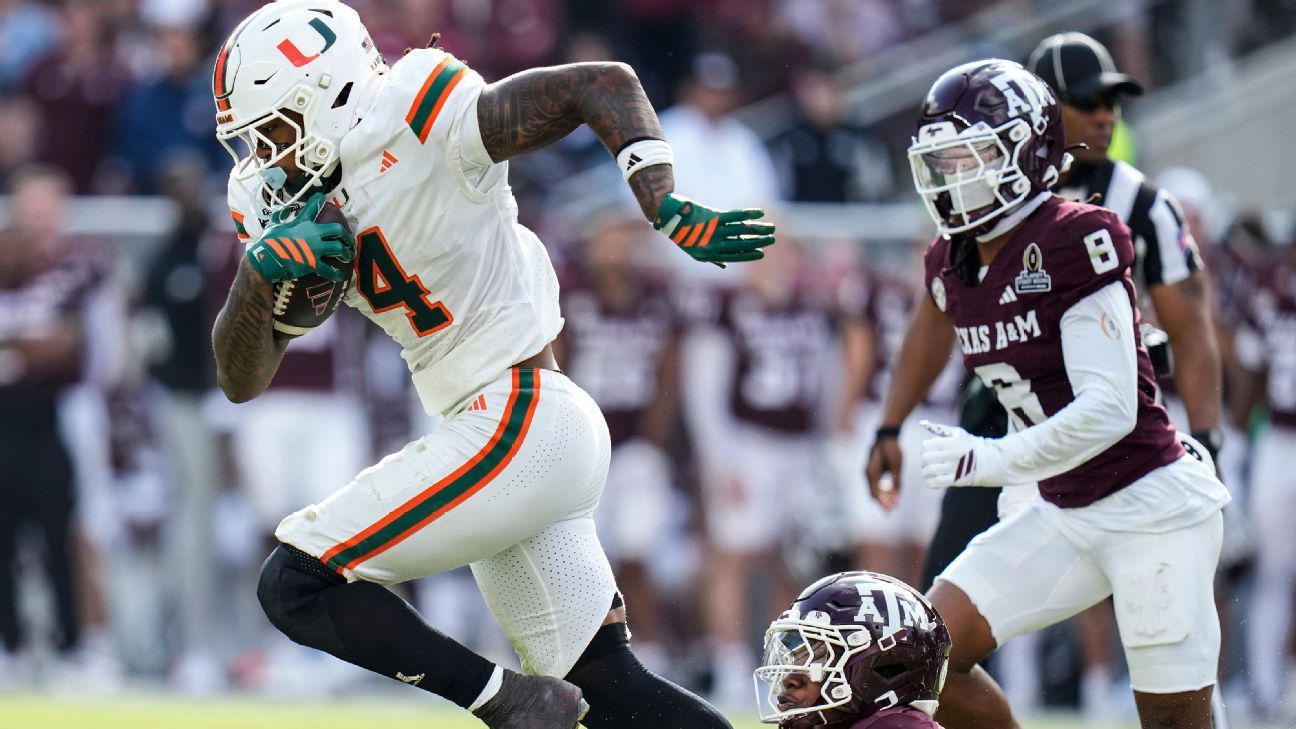
Fletcher took a handoff on the first play of the drive, surged up the middle, dashed toward the sideline, fought off a pair of defenders and marched 56 yards downfield before he was dragged to the ground.
0:31
Miami’s Mark Fletcher Jr. takes off for a 56-yard run late in 4th
Mark Fletcher Jr. is able to break free to set Miami up in field goal range.
He followed with runs of 2, 12, 3 and 2 yards to set Miami up for what became the decisive touchdown in the program’s biggest win in more than 20 years.
No one on the team was surprised.
“To see him have that success,” quarterback Carson Beck said, “I’m super happy for him. But it was very expected.”
Fletcher finished the game, a 10-3 win, with 172 yards rushing for an offense that managed just 278 yards total. On Dec. 31, Miami will face Ohio State in the Goodyear Cotton Bowl Classic (7:30 p.m. ET, ESPN).
In the chaos of the postgame locker room celebration, Fletcher went live on Instagram, holding up a T-shirt with his father’s face emblazoned on it, and the words that have come to define both his journey and Miami’s inspiration this season: “Long live Big Mark.”
It has been less than 14 months since Fletcher’s father, Big Mark, died in his sleep at 53. In the time since, Fletcher has reevaluated his outlook, refocused on his goals and relived so many memories of the man who helped make him into the glue that binds the Hurricanes together. He’s not playing for his dad exactly, Fletcher said, but it’s in these moments when he still feels closest to Big Mark.
So, yes, Fletcher knew what he was going to do on that final drive. He would do what his father always told him to do. He would put one foot in front of the other and fight for every inch.
“What he means to this team, it was a rough year for him, and he never flinched,” Miami coach Mario Cristobal said. “He’s the heart and soul of our football team. Everything he does is dedicated to his teammates getting better and his team winning. And he was the difference in this game. He just took over.”
LINDA FLETCHER WELCOMED as many fans to the Miami-Texas A&M game as she could, whether they were decked out in orange or maroon. She perched outside the stadium armed with signs — “Freight Train Fletcher” and “Long Live Big Mark” — and said hello to anyone she saw pass.
“I gave out 10,000 hugs,” she said. “And I love it.”
To understand Mark Fletcher’s outlook on the world, it helps to know who raised him.
“My other children always say, ‘Oh, she finally had her mini me,'” Linda said. “Mark’s ways are a lot like mine.”
There’s a group text for all the “Mamma Canes” to trade travel tips and hotel advice and just to talk football, but even amid the fanatical group of mothers, Linda stands out. A few are baffled by Linda’s willingness to engage the enemy at games but, as she sees it, everyone could use a little more love in their lives.
“I don’t know what my purpose is,” Linda said, “but they feel good, I feel good, and people are always talking about how much they love Mark.”
Linda hates flying, so she drives to each game, including the 1,300-mile journey from Fort Lauderdale to College Station for Miami’s playoff game against the Aggies. She has two older kids who live in Jacksonville, so she tries to stop there for the night, then ventures on in daylong chunks — to Syracuse and Dallas and Berkeley, California — stopping wherever she sees fit to experience a little of what the road has to offer.
Linda has tried to convince a few of the other Miami moms to join her on a road trip, but so far, she has had no takers. Occasionally someone will offer to buy her a plane ticket, and she laughs.
“I say they can buy me a tank of gas,” Linda said.
The dream, Linda said, is to buy an RV, so she can cruise America’s highways in style.
“Once Linda Fletcher pulls out in her big RV, that’s how you know we’ve made it,” she said. “I’m going to get me a big RV. I look forward to that. It’s on my bucket list.”
And yet, Linda is in no hurry to make the dream a reality. Mark Fletcher could move on to the NFL when Miami’s season draws to a close, but he has talked with his mom about the decision, and he wants to stick around. He loves Miami, and the program has been the salve that has made the past year bearable.
Mark Fletcher Sr. was “an inside dad,” Linda said. He never missed a practice. When the locker room opened to family, he was there. He was his son’s closest ally, but he was also a rock for Fletcher’s teammates.
“Him being around the building with the team, he was always cheering somebody up, always willing to talk to somebody,” Miami defensive end Rueben Bain said. “Of course, Mark lost him, but I feel like so many of us on the team lost him. Even myself. It’s crazy what the Fletcher family has done for this university.”
Fletcher said his dad served as a father figure for a number of his teammates who had grown up without one.
Linda said Big Mark was just a fun, outgoing person. He was someone people could trust.
And then, on Oct. 24, 2024, he was gone.
“We were broken inside,” Linda said. “My baby was broken. That’s the worst thing that ever could’ve happened, and I was nervous for him because I know how close him and his dad are.”
A few hours after Fletcher was marched into Cristobal’s office, where he was told his father had died, he was at practice. A week later, Miami was set to play rival Florida State. Fletcher insisted on suiting up for the game. The family rescheduled the funeral to accommodate it.
“We were crying our eyes out,” Linda said. “But funeral time, you know, it’s business. We had to go lay dad to rest. We’re not crying now.”
Then a procession of five buses arrived at the church. Every member of the Miami football program had come to say goodbye to Big Mark.
“We couldn’t keep ourselves together,” Linda said. “We thought it would be Mario and his family. The whole team? Think about that. For us. A little Black family from Fort Lauderdale. That was over the top.”
In the year since, Linda has been constantly amazed at how much football has been her center amid the grief.
She shows up for every practice now, except the ones at the tail end of the week before a road game. Then, she’s in her car, following some new stretch of highway. She gets to the games, and she holds up her signs, and she hugs a thousand strangers because, for her and for her son, the world is still full of love, even if one of their most important lights has gone out.
“It’s not always sad because we’re doing work that Big Mark Fletcher would so approve of,” Linda said. “It’s a bittersweet thing.”
During warmups on the field this past Saturday, before Miami played its biggest game in decades, Bain found Fletcher, and he hung an arm around his friend.
Bain wanted to soak in the moment with one of the teammates who had helped deliver Miami to this place — two of Cristobal’s early recruits who have helped engineer this new era.
Bain looked at his friend, patted his back and smiled.
“Long live Big Mark,” he said.
BEFORE FLETCHER’S DOMINANT final drive delivered Miami to the doorstep of the lone touchdown of the game, the Canes had another drive brewing. Fletcher had opened it with a 16-yard run, and, on the next play, Beck connected with star freshman Malachi Toney on a 12-yard completion past midfield. But as Toney fought for extra yardage, an A&M defender jarred the ball loose, and the Aggies recovered at their own 47.
Toney was heartbroken. He jogged to the sideline, took a seat on the bench and slumped over, believing he had cost his team the game.
“The second I saw him drop down,” Fletcher said, “I rushed over to him.”
In the weeks after Big Mark died, Fletcher spent his share of time slumped in his seat, too.
He had never wavered from football, but the problem was that Fletcher kept thinking about what his dad would’ve wanted. He thought about all the ways Big Mark had pushed him, motivated him, supported him. He was at Miami because of his dad, and now he felt he had to honor his father’s legacy. It was a weight, a feeling like his every step came in the shadow cast by the man who had set him on this path.
“I’d get so sad,” Fletcher said. “I’d cry before games.”
That sadness felt wrong though, Linda said. She admits, she still has her moments of overwhelming grief, but that’s not how the Fletcher family had ever lived. It’s in their DNA to find the light, even amid the darkest clouds. They are happy people, Linda said. Big Mark was happy.
“Big Mark helped build my son up to what he is today,” Linda said. “It gets sad that he’s not here in the flesh to follow this dream with us, but in the spiritual realm, we say he’s here with us. We just have to enjoy him in a different form. And that’s where our faith kicks in.”
So Linda and Mark and the rest of their family devised a slogan to help them honor Big Mark without remaining tethered to their grief: Keep going.
When his father was alive, Fletcher texted him daily. Usually his phone would chime a few minutes later with a note from Big Mark, offering inspiration. Nothing was owed to Fletcher, Big Mark would say. You have to earn it, then take it. Big Mark always understood how to push his son forward.
Looking back now, Linda sees it as part of Big Mark’s legacy. In his absence, he taught his family — and, really, an entire team — to keep putting one foot in front of the other, to keep living life to the fullest. Their story is not over yet.
Fletcher’s mission, Linda said, has shifted from being stressful to being purposeful.
“I think about him every single day, every second, honestly,” Fletcher said. “That’s what drives me. But I had to switch my mindset in how I’d think about him. That’s not how he’d want me to play this beautiful game of football. I just said, I miss my dad but he’d want me to go out there and have fun.”
So when Fletcher found his teammate slumped on the sideline after the worst moment of his young career, he knew exactly the right words.
Keep going.
“God just gave you some adversity right now,” Fletcher told Toney. “That’s all it is. Now let’s go win this game.”
Miami’s defense stuffed Texas A&M on three straight plays after Toney’s fumble. The Aggies punted it back to the Canes, Fletcher ran 75 yards on five plays, setting up Miami with a third-and-5 at the A&M 11.
On the next play, Beck tossed to Toney streaking across the backfield. Toney bolted around the edge, out to the sideline, past frustrated A&M defenders and into the end zone.
Keep going, and good things will happen.
“Week in and week out, Mark’s been the best guy in the building,” Bain said. “He’s always positive, always gives his best effort. He’s the leader we need him to be, but he’s just a good, righteous person, and he’s reaping what he sows. He gives his all, and he’s getting it all.”
But Fletcher remembers what his father always told him. He’s not owed anything. He is blessed. And, like his mother’s RV, he’s in no rush to seize the dream. He’s here, right now, with a chance to make his family proud and to play the game he loves.
He wouldn’t want to be anywhere else.
“I just know that every day I wake up breathing it’s another opportunity to make somebody else’s life better,” Fletcher said. “God blessed me to be in this position, and I just want to make an impact.”

-
Eli Lederman
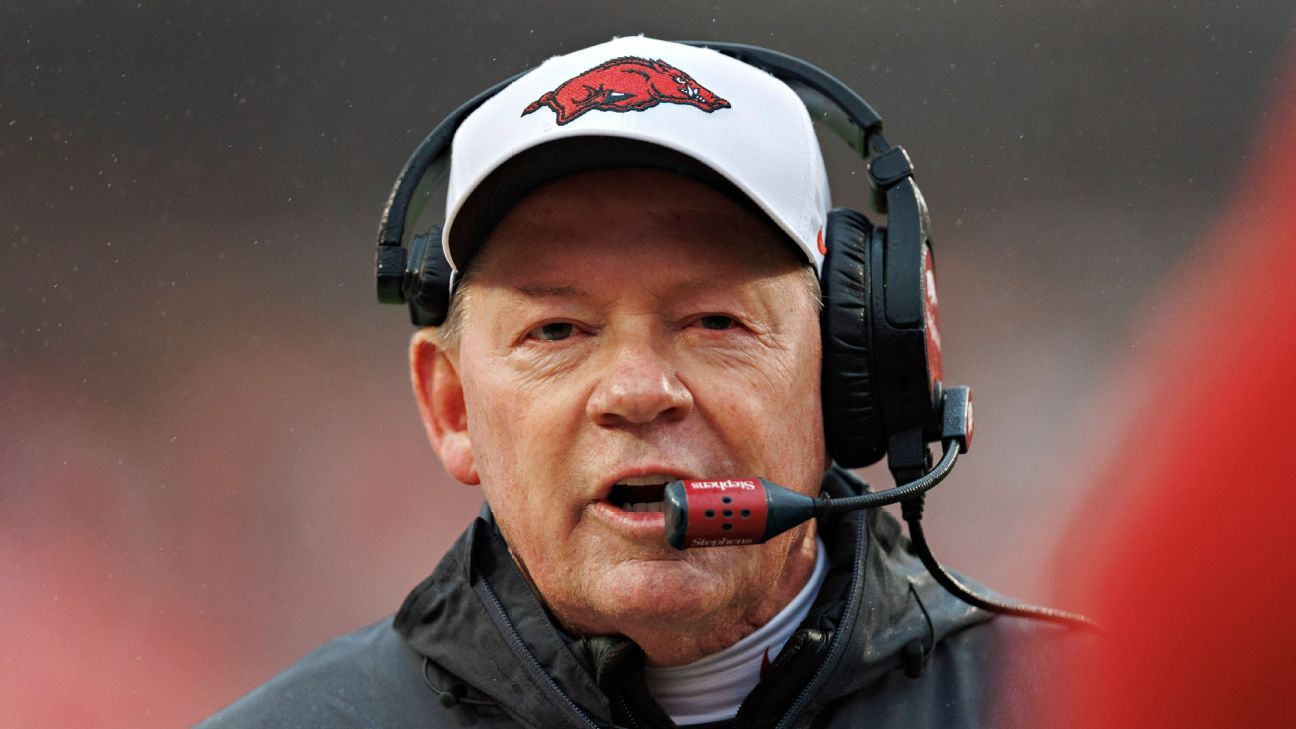
North Carolina and coach Bill Belichick are working toward hiring Bobby Petrino as the program’s next offensive coordinator, sources confirmed to ESPN on Monday.
Offensive coordinator Freddie Kitchens was fired earlier this month after the Tar Heels ranked 131st nationally in total offense (288.8 yards per game) in 2025.
Petrino, the former head coach at Arkansas, returned to the Razorbacks in 2024, where he served as offensive coordinator for the past two seasons. He took over as interim coach after the program fired Sam Pittman on Sept. 28. He’s also served as head coach at Louisville, Western Kentucky and Missouri State and the NFL’s Atlanta Falcons.
UNC sources told ESPN’s Pete Thamel that there are still multiple steps remaining before any potential hire is announced. No announcement is imminent and other candidates remain engaged in the process.
The move back into the top job at Arkansas marked a full-circle turnaround for Petrino, who was fired by the Razorbacks in 2012 for misleading officials about an extramarital affair with an athletic department employee. The Razorbacks went 0-7 under Petrino’s leadership this fall en route to a 2-10 finish, and Arkansas hired Memphis‘ Ryan Silverfield as its head coach on Nov. 30.
The Tar Heels are seeking to revamp their offense following a 4-8 season in 2025. Only five FBS teams finished this past season with fewer yards per game than North Carolina, which also ranked 121st in scoring offense (19.3 PPG) and 124th in rushing (105.3) in Belichick’s debut season at UNC.
Under Kitchens, the former Cleveland Browns head coach, the Tar Heels scored 15 points or fewer in six of their 12 games.
Petrino has built a reputation for turning around struggling offenses throughout his career.
As a head coach, he led Louisville from 2003 to 2006 before one season with the Falcons. At Arkansas, he went 21-5 in the final two seasons before he was fired in December 2012.
Petrino spent the 2023 season as the offensive coordinator at Texas A&M prior to joining Pittman’s staff at Arkansas in 2024. With Petrino calling plays, the Razorbacks improved from 107th to 10th nationally in yards per game (326.5 to 459.5) last year. Despite going winless in its final 10 games in 2025, Arkansas closed the regular season ranked inside the top 25 nationally in both scoring (32.0 PPG), total offense (454.8 YPG) and rushing (191.9 YPG) among FBS programs.
Each of the previous two head coaches Petrino has worked for — Texas A&M’s Jimbo Fisher and Pittman — have been fired within two seasons. If a deal is finalized, Petrino will arrive at North Carolina ahead of a pivotal season under Belichick, who went 2-6 in ACC play in 2025.
The Tar Heels’ intention to hire Petrino was first reported by On3.
-
 Sports2 years ago
Story injured on diving stop, exits Red Sox game
-
 Sports3 years ago
‘Storybook stuff’: Inside the night Bryce Harper sent the Phillies to the World Series
-
 Sports2 years ago
Game 1 of WS least-watched in recorded history
-
 Sports3 years ago
Button battles heat exhaustion in NASCAR debut
-
 Sports3 years ago
MLB Rank 2023: Ranking baseball’s top 100 players
-
Sports4 years ago
Team Europe easily wins 4th straight Laver Cup
-
 Environment3 years ago
Japan and South Korea have a lot at stake in a free and open South China Sea
-
 Environment1 year ago
Here are the best electric bikes you can buy at every price level in October 2024