
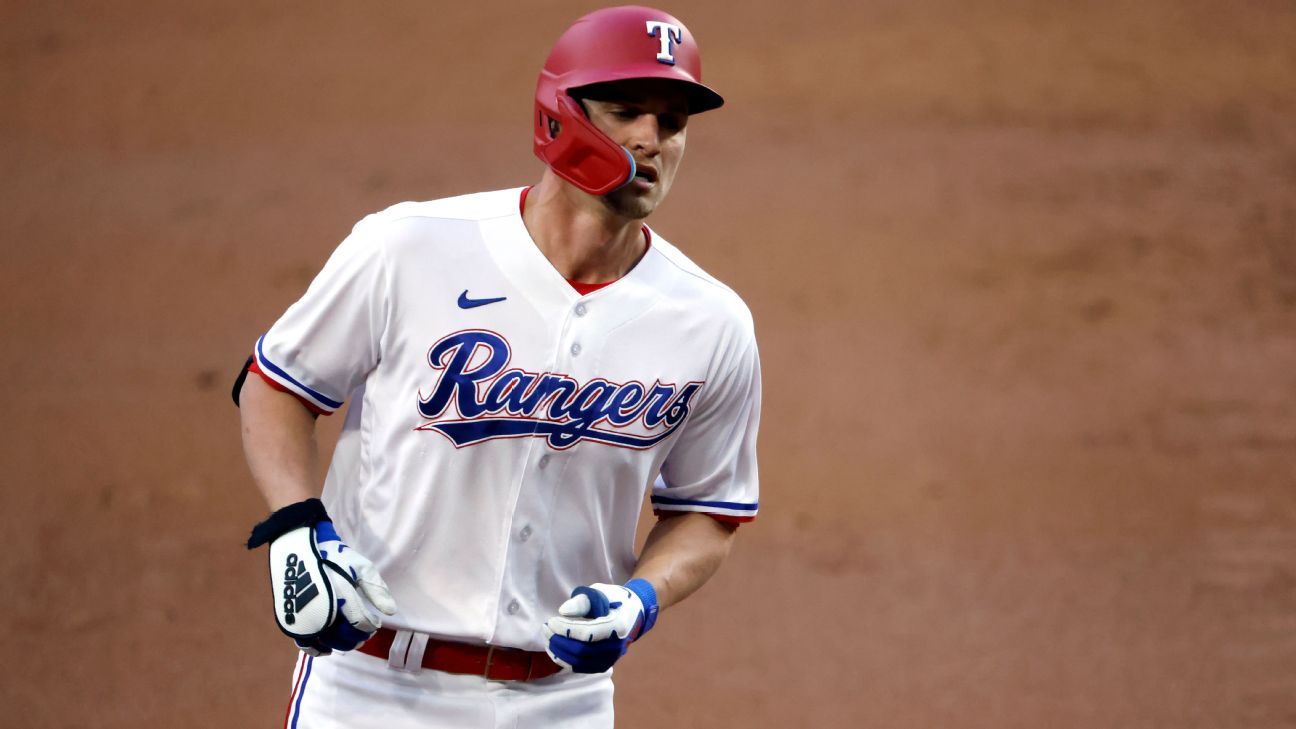
Rangers’ Seager exits with hamstring tightness


Just win, baby.
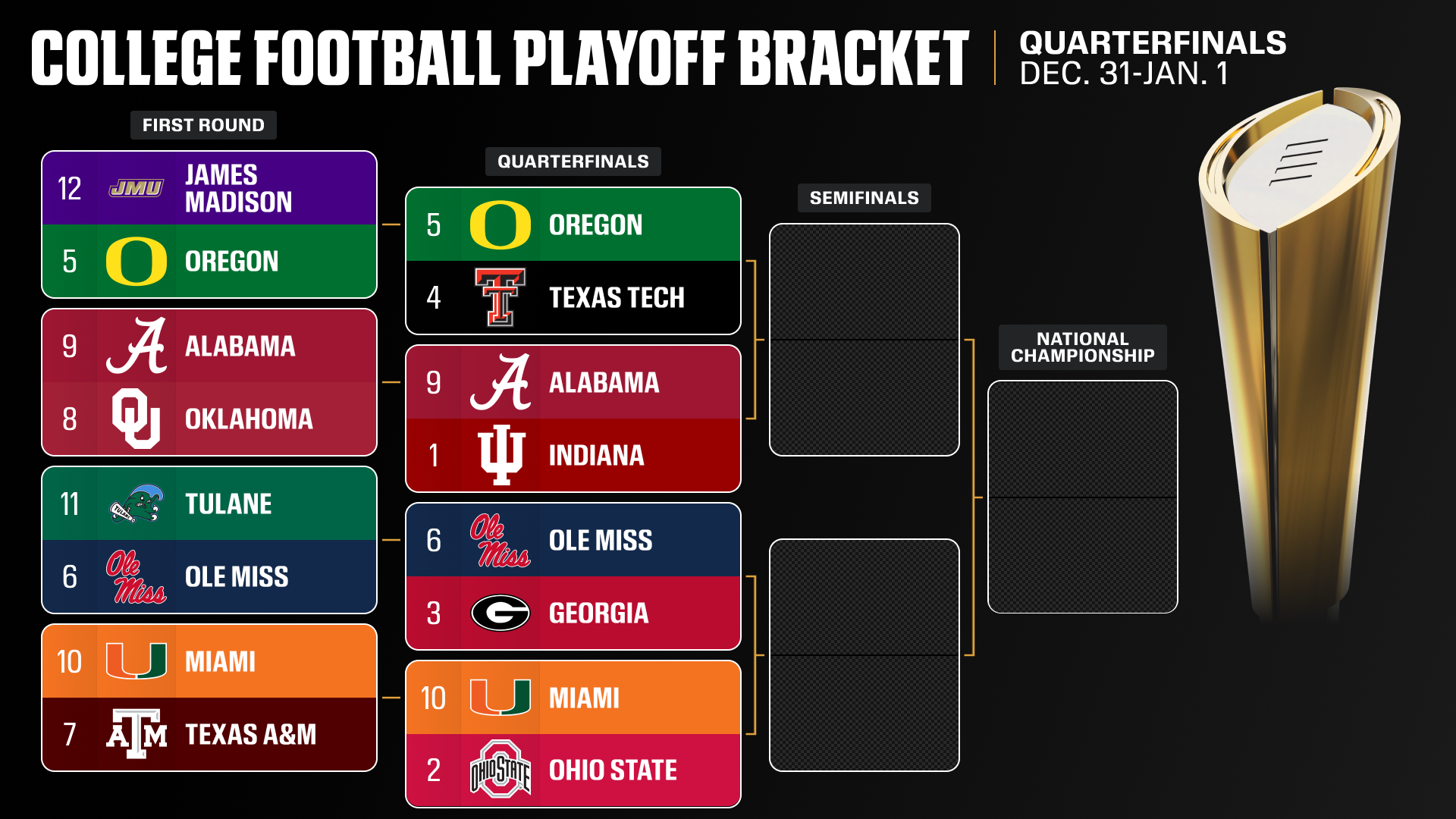
None of the hand-wringing around who should be included in the 12-team playoff matters anymore. All that matters is advancing to the quarterfinals, and three teams have done so already.
Alabama rallied from down 17-0 to beat Oklahoma on Friday, moving on to play top-seeded Indiana in the Rose Bowl.
Then on Saturday, Miami, Ole Miss and Oregon advanced. The Canes beat Texas A&M thanks to an interception in the end zone in the final seconds of the game, and they will play Ohio State in the Cotton Bowl. The Rebels took care of business against Tulane 41-10 and will face Georgia in the Sugar Bowl. The Ducks beat James Madison 51-34 in the final first-round game and will face Texas Tech in the Orange Bowl. The Rose, Sugar and Orange bowls will be played on Jan. 1, with the Cotton Bowl set for Dec. 31.
ESPN’s college football writers are already looking ahead, so here’s a closer look at those quarterfinal matchups.
Jump to:
No. 5 Oregon vs. No. 4 Texas Tech
No. 6 Ole Miss vs. No. 3 Georgia
No.10 Miami vs. No. 2 Ohio State
No. 9 Alabama vs. No. 1 Indiana
When: Jan. 1, noon ET. TV: ESPN
Road to the playoff: Texas Tech had never come close to competing for the College Football Playoff before, but it made all the right moves this offseason and won the program’s first-ever Big 12 title.
Joey McGuire hired two excellent new coordinators in Mack Leftwich and Shiel Wood. General manager James Blanchard and the program’s billionaire benefactors put together an all-time great transfer portal class with 11 new starters who have perfectly complemented the returning talent and culture. They put it all together and then went out and practically steamrolled their schedule.
The Red Raiders won by more than 21 points in every victory this season, finishing with the best scoring margin (552-142) in the FBS. Their exceptional defensive line, led by Lombardi Award winner Jacob Rodriguez, has helped shape one of the best defenses in the country, a unit that is No. 1 against the run and top five in many other metrics. The team’s lone loss came by four points on the road against defending Big 12 champ Arizona State when quarterback Behren Morton was out due to injury.
Player to watch: Morton has been playing through pain for most of this season after suffering a hairline fracture in his right fibula in the opener. The senior aggravated the injury a month later and sat out two games to try to get better before the Big 12 title race. After the Big 12 title game, Morton told ESPN that he was feeling “about 70 percent” healthy and was looking to a first-round bye and three weeks to recover. Losing No. 2 quarterback Will Hammond to a season-ending torn ACL in late October was a setback that has made the week-to-week management of Morton’s injury more challenging.
McGuire calls him the toughest player he has ever coached, and Texas Tech’s title hopes depend on keeping Morton protected and in a good rhythm.
Biggest question: Can Texas Tech’s offense execute at a consistently high level in the red zone? The Red Raiders have played five games against teams that achieved winning records in 2025. They’ve scored touchdowns on just 32% of drives that reached the red zone, totaling 13 field goals and eight touchdowns over 25 opportunities in those games. That percentage vs. winning teams ranks fourth worst in the FBS.
Place-kicker Stone Harrington has had a solid year on field goal attempts (22-of-27), and McGuire clearly trusts him. But this team settled for a total of 11 field goal tries over its two matchups against BYU with two misses in the Big 12 title game.
A lot of factors play into this, including Texas Tech’s trust in its defense. It’ll be interesting to see what solutions Leftwich and his offensive coaches come up with from a playcalling standpoint for finishing drives in the CFP quarterfinals.
They can win if…: Texas Tech’s front seven keeps playing at an elite level. The Red Raiders led the FBS in pressures for most of the season and are also No. 1 in takeaways with 31 after grabbing four more in the Big 12 title game. The defensive line is as good as it gets with three first-team All-Big 12 performers. Rodriguez is enjoying a historic season at linebacker and also won the Butkus Award. His fellow linebackers Ben Roberts and John Curry are having terrific years as well. This team wins with defense and absolutely believes it can compete with the best of the best. In the playoff, that starts with Oregon. — Max Olson
What we learned in Round 1: There wasn’t much new revealed in the Ducks’ 51-34 win against James Madison. The game went about as expected considering the considerable gulf in talent. It reaffirmed, however, that preparations were not meaningfully impacted by offensive coordinator Will Stein (Kentucky) and defensive coordinator Tosh Lupoi (Cal) being named head coaches elsewhere in recent weeks. The Ducks started fast and put the Dukes away early in the first-ever College Football Playoff game at Autzen Stadium.
Player to watch: The marquee player is quarterback Dante Moore, who could be in his final days with the Ducks. Moore has played his way to the top of ESPN NFL draft analyst Mel Kiper Jr.’s 2026 Big Board but has yet to indicate publicly what his future plans are. Against James Madison, Moore led the Ducks to touchdowns on each of their first five drives and finished 19-of-27 for 313 yards with four TDs. He also ran for a score.
They can win if…: They limit the impact of Texas Tech’s front seven. No one in the Big 12 was equipped to deal with how dominant the Red Raiders are up front, and that set the tone almost every week. Oregon has an offensive line that should give Texas Tech its toughest challenge of the season, but — perhaps more importantly — the Ducks have a bunch of speedsters who can make life difficult on the perimeter. Neither of these teams has lost since mid-October, and on paper it might be the most evenly matched game of the quarterfinals. — Kyle Bonagura
When: Jan. 1, 8 p.m. ET. TV: ESPN

Road to the playoff: There were concerns about whether this Georgia team would be as talented as coach Kirby Smart’s championship-winning ones of the past. The Bulldogs didn’t seem to have a high number of potential NFL first-round draft picks, outside of linebacker CJ Allen, and quarterback Gunner Stockton was debuting as the full-time starter.
Yet when the dust settled, the Bulldogs were back in the SEC championship game, where they defeated Alabama 28-7 to win back-to-back conference titles for the first time since Heisman Trophy-winning tailback Herschel Walker led them to three straight in the 1980s. The Bulldogs (12-1) avenged their only loss of the regular season, a 24-21 defeat to the Crimson Tide in Athens on Sept. 27, which ended their 33-game home winning streak. Georgia won its next nine games, including victories over then-No. 5 Ole Miss, then-No. 10 Texas and then-No. 23 Georgia Tech. The Bulldogs won at least 11 games for the eighth time in the past nine seasons under Smart.
Player to watch: Georgia’s offense has mostly been steady with Stockton running the show, averaging 31.9 points and 406.9 yards per game. Receiver Zachariah Branch, a transfer from USC, has been Stockton’s No. 1 option in the passing game. Branch, from Las Vegas, is one of the most explosive players in the FBS. In 12 games, Branch has 73 receptions for 744 yards with five touchdowns. He needs only four catches to break the UGA single-season record of 76, set by Brice Hunter in 1993. A former track star, Branch has the speed and elusiveness to score every time he touches the ball. He makes plays that others don’t, as evidenced by his 13-yard touchdown catch in the SEC championship game when he sidestepped a couple of Tide defenders and then burst into the end zone.
Biggest question: Georgia’s offensive line struggled early but improved throughout the season once key players returned from injury. Then the Bulldogs lost starting center Drew Bobo to a foot injury in their 16-9 victory against Georgia Tech in the regular-season finale. Bobo, whose father is Georgia offensive coordinator Mike Bobo, will miss the CFP because of the injury. Redshirt freshman Malachi Toliver started at center against Alabama in the SEC championship and played well. Toliver, 6-foot-5 and 320 pounds, appeared in five games and made an earlier start against Charlotte. He had a couple of extra weeks to work with Stockton because of the Bulldogs’ first-round bye in the CFP.
Georgia’s offensive line ended up being among the better ones in the SEC. The team ranked third in the league in sacks allowed (18) and fifth in rushing (186.6 yards) after struggling mightily to run the ball in 2024. How well will the line hold up if the Bulldogs end up playing a menacing defensive front such as Miami’s or Texas Tech’s?
They can win if…: Georgia sticks to basics by running the ball and continuing to play tough, physical defense. Defensive coordinator Glenn Schumann caught plenty of flak early in the season when his unit struggled to stop opponents on third down. But the Bulldogs are starting to resemble the defenses that helped them win back-to-back CFP national championships in 2021 and 2022.
In its past four games, Georgia hasn’t allowed more than 81 rushing yards or 274 yards of total offense. Its opponents — Texas, Charlotte, Georgia Tech and Alabama — went a combined 10-for-48 (20.8%) on third down. The Bulldogs forced five turnovers and had nine sacks combined in those contests.
Sophomores Chris Cole (4.5 sacks) and Quintavius Johnson (2 sacks) are getting pressure on the quarterback, and Ellis Robinson IV is living up to his billing as the No. 1 cornerback in the class of 2024 by ESPN Recruiting.
If Georgia can continue to run the ball with Nate Frazier and Stockton, and its defense gets opponents off the field, the Bulldogs will be tough to beat. — Mark Schlabach

What we learned in Round 1: Sure, it was against AAC champion Tulane, which has the worst defense of the 12 teams in the CFP, but the Ole Miss offense came out firing on all cylinders in its first game without coach Lane Kiffin, who left for LSU. Each of Ole Miss’ first five plays went for 20 yards or more, and it scored touchdowns on its first two drives. Things slowed down from there in the second quarter, however, especially after star quarterback Trinidad Chambliss and tailback Kewan Lacy went down with injuries. (They returned in the second half, although Lacy went back to the locker room late in the third quarter.) As long as Lacy isn’t sidelined for long, the offense figures to be fine even without Kiffin on the sideline. — Schlabach
Player to watch: Chambliss. He has been the player to watch over the course of the season, not only for the improbability of his rise but also for the way he has played. Following his ascension to starter, Chambliss became the first SEC player with 300 passing yards and 50 rushing yards in three straight games over the past 30 years. Against Tulane on Saturday, he completed 23 of 29 passes for 282 yards with one touchdown and ran six times for 36 yards with two scores. — Andrea Adelson
They can win if …: The Rebels will need Lacy to be healthy and ready to go against Georgia in 12 days. Ole Miss’ defense figures to get a much more difficult test in New Orleans. The Rebels had a nine-point lead heading into the fourth quarter at Georgia on Oct. 18, but the Bulldogs scored 17 straight points for a 43-35 victory. Georgia bullied the Rebels at the line of scrimmage, controlling the ball for all but 1 minute, 54 seconds. The Bulldogs went 6-for-11 on third down and had 510 yards of offense, including 221 rushing. — Schlabach
When: Dec. 31, 7:30 p.m. ET. TV: ESPN
Road to the playoff: The Buckeyes knocked off then-top-ranked Texas in the opener, then cruised through the schedule, snapping a four-game losing streak to Michigan with an emphatic 27-9 victory in Ann Arbor to cap an undefeated regular season. But in the Big Ten title game, Ohio State came up empty on two second-half drives that ended inside the Indiana 10-yard line as the Hoosiers captured the Big Ten championship with a 13-10 victory. The defending national champion Buckeyes still ended up with the No. 2 seed and a first-round bye. Now, they’ll look to rebound and win back-to-back national titles for the first time in program history.
Player to watch: Quarterback Julian Sayin had the worst game of his career in the Big Ten championship game. He completed 21 of 29 passes for 258 yards and a touchdown but threw an interception on the opening drive and took five sacks as the Buckeyes struggled in the red zone and scored a season-low 10 points. Before that, Sayin had been spectacular in his first season as the starter. He still ranks second nationally with a QBR of 89.6 and owns the best single-season completion rate (78.4%) in FBS history. Will Howard bounced back from a poor performance against Michigan last year to quarterback the Buckeyes to a dominant run through the playoff and a national championship. Sayin has the talent — and supporting cast — to do the same.
Biggest question: Ohio State’s offensive line dominated the opposition for much of the regular season. But when pitted against an elite defensive line in the Big Ten championship game, the Buckeyes faltered up front. The Hoosiers constantly made their way into the Ohio State backfield, racking up nine tackles for loss while limiting the Buckeyes to 87 rushing yards. After ranking in the top 10 in lowest pressure rate allowed (25.8%) during the regular reason — 10th best among Power 4 offensive lines — Ohio State gave up a pressure rate (percentage of dropbacks where the QB was sacked, under duress or hit) of 48.6% in the Big Ten title game (Central Michigan ranked last in the FBS with a pressure rate allowed of 46.2% this season). Can the Buckeyes offensive line respond against the best in the playoff?
They can win if…: Sayin has time to find star wideouts Jeremiah Smith and Carnell Tate downfield. When the Buckeyes do that, they’re virtually unstoppable offensively. Smith and Tate battled lower-body injuries late in the season, which slowed them down a bit, but the time off should help them heal and get closer to 100 percent for the Cotton Bowl. Ohio State’s sensational defense will give the Buckeyes a chance in any matchup. If the passing attack gets back to clicking after the off night in the Big Ten title game, Ohio State can defeat anyone in the playoff, and that includes Miami. — Jake Trotter
What we learned in Round 1: That the Hurricanes belonged in the field. Miami was the last team in, making the College Football Playoff in somewhat controversial fashion, jumping Notre Dame in the final rankings despite both teams not playing in the final week. There were doubters, but Miami made its statement Saturday. In front of the second-largest crowd in playoff history in College Station, Texas, the Canes were poised, efficient and, if not always particularly explosive, they avoided any catastrophic mistakes. Mark Fletcher Jr. answered the critics of Miami’s lackluster run game with 172 yards on the ground, Malachi Toney atoned for a late turnover, and the defense — which likely cost the Canes a playoff spot a year ago — dominated, nabbing three takeaways, including the game-clinching interception in the end zone with 24 seconds left on the clock.
Player to watch: Carson Beck was supposed to be here two years ago, but his playoff dreams burst when Georgia lost to Alabama in the 2023 SEC championship, the Dawgs’ first defeat in three years. He was supposed to be here last year, but an injury in a win over Texas in the SEC title game kept him out of the playoff. He was supposed to be a star Saturday for Miami, but the passing game was mostly absent in the team’s 10-3 win. As the Canes look ahead to Ohio State, there’s only one way they advance, and that will be if Beck plays his best game. He has proved he’s capable. Against A&M, he did just enough to win. In the Cotton Bowl, he’ll need to be special. He’s overdue for that moment.
They can win if…: Miami’s defense was otherworldly against A&M, racking up seven sacks, nine tackles for loss and three takeaways, including a goal-line stand to seal the win. It was an all-time performance at Kyle Field, and the Canes will likely need another one against Ohio State’s high-powered offense. A&M managed just 89 rushing yards, and making the Buckeyes equally one-dimensional will be critical. Then it’s up to a secondary that has been a work in progress at times but that played a nearly flawless game against the Aggies. — David Hale
When: Jan. 1, 4 p.m. ET. TV: ESPN
Road to the playoff: Coach Curt Cignetti and the Hoosiers heard the hate directed at them at the end of their historic 2024 season and decided to run it back and perform even better this fall. Indiana built on its first 10-win season and first CFP appearance by becoming the only FBS team to run the table, posting a 13-0 mark, winning its first outright Big Ten title since 1945 and securing the top seed in the CFP field.
The Hoosiers navigated a much tougher Big Ten schedule than they did in 2024, taking down Oregon, Iowa and Penn State on the road, thumping then-No. 9 Illinois by 53 points in Bloomington and capping things off with a 13-10 win against Ohio State in the Big Ten title game, a matchup that paired the nation’s Nos. 1 and 2 teams.
For all the talk about a soft nonleague schedule, Indiana wasn’t hindered at all, winning all but two of its regular-season Big Ten games by double digits. The Hoosiers finished second nationally in points margin, outscoring their opponents by 404 points. They had to rally against Penn State and Iowa but were unstoppable at home, winning seven games by an average of 40.7 points.
Player to watch: After a team-record 11 wins in 2024, Indiana looked for areas to upgrade, including quarterback, despite Kurtis Rourke’s strong performance (3,042 passing yards, 29 touchdowns). The Hoosiers landed an even more coveted transfer quarterback in Cal’s Fernando Mendoza, who elevated the passing attack even further and became the school’s first Heisman Trophy winner.
Mendoza has delivered four near-flawless performances with more than 85% completions and four or more touchdowns and no interceptions. He occupies the top three spots on Indiana’s single-game completion percentage chart. Mendoza helped rally Indiana for key road wins against Penn State and Iowa and overcame one of his few major mistakes — a pick-six at Oregon — to lead two fourth-quarter scoring drives. Mendoza leads the FBS with 33 touchdown passes, an Indiana single-season record.
Biggest question: There aren’t many weaknesses in Indiana’s profile, as the Hoosiers’ offense and defense ranks in the top 10 nationally in many key statistical categories. But if Indiana wants to advance in the CFP, it likely will face some key fourth-down situations and might need to find greater efficiency. The Hoosiers ended the season 8 of 16 on fourth down, which is tied for 90th nationally and ranks well below other CFP teams such as Texas A&M, Georgia, Ohio State and Alabama. Indiana failed on all three of its fourth-down chances in a 20-15 win at Iowa and went 0-for-1 the following week at Oregon. The good news is IU then became much better on the money down, converting its final five fourth-down attempts, including a fourth-and-2 late in the first half against Ohio State to set up a field goal.
They can win if …: The Hoosiers can successfully execute a balanced offense, as they have for most of the season. Mendoza’s arrival and success have at times overshadowed Indiana’s run game, which is significantly better than it was in 2024. The Hoosiers rank 11th nationally in rushing (221.1 yards per game), up from 63rd last season (165.1). Indiana committed to the run even in lower-scoring games, as it showed against Iowa (39 attempts), Penn State (31) attempts and Ohio State (34 attempts). The offense can’t deviate from that approach against an Alabama defense that defends the run well but doesn’t rank among the nation’s very best. Indiana also is brilliant in the turnover game, tying Texas Tech for the national lead in margin at plus-17. — Adam Rittenberg
What we learned in Round 1: Alabama might not have looked as good Friday night as it did in September and October, but the Crimson Tide still showed it had another gear to kick into en route to matching the largest comeback in CFP history against Oklahoma. Unforced errors crushed the Crimson Tide in their 23-21 loss to the Sooners in November. In the opening round rematch, Alabama flipped the script, storming back from a 17-0 deficit behind Zabien Brown‘s 50-yard pick-six and a disciplined performance from quarterback Ty Simpson, who looked much more like himself two weeks from a disastrous showing in the SEC title game. The Crimson Tide played the kind of (largely) mistake-free football that eluded them over the back half of the regular season. They’ll need to do it again when they meet No. 1 Indiana in the Rose Bowl on New Year’s Day.
Player to watch: With touchdowns on either side of halftime in the first round matchup with Oklahoma, freshman wide receiver Lotzeir Brooks joined some elite company as only the fifth Alabama pass catcher to record two receiving scores in a CFP game. Alongside him on that list: DeVonta Smith (twice), O.J. Howard, Calvin Ridley and Amari Cooper. Brooks caught five passes for 79 yards in his CFP debut, finishing as the Crimson Tide’s leading receiver in the 34-24 win. Within a pass-catching corps that features Germie Bernard, Ryan Williams and Isaiah Horton, Brooks is as dynamic as anyone, and he could be a difference-maker once again against the Hoosiers 19th-ranked pass defense.
They can win if …: Alabama limits its mistakes, and Simpson plays like the Heisman-caliber quarterback we saw over the first half of the season. The Crimson Tide beat Oklahoma at its own game in the first round, forcing quarterback John Mateer into timely errors and pouncing on miscues such as Grayson Miller‘s bobbled punt attempt before halftime. Couple that with composed, accurate quarterback play from Simpson, and the Crimson Tide have the tools to give Indiana trouble. — Eli Lederman

-
David Schoenfield
We’ve started to see some top free agents come off the board as the MLB offseason has gotten rolling: Kyle Schwarber back to the Philadelphia Phillies, Pete Alonso to the Baltimore Orioles and Dylan Cease to the Toronto Blue Jays. The closer market also moved quickly: Devin Williams to the New York Mets, Edwin Diaz then ditching the Mets for the Los Angeles Dodgers, Robert Suarez to the Atlanta Braves and Ryan Helsley to Baltimore.
That still leaves seven of the top 10 free agents from Kiley McDaniel’s top-50 ranking unsigned. Let’s look at that group and see where things stand. The team at the center of everything right now is the Mets: They have needs to fill and money to spend and will be a key player in how the rest of this offseason plays out.
We’ll list Kiley’s contract projections for each player — including updated projections for the four remaining big free agent hitters, based on how the deals for Schwarber and Alonso have reset that market. Then, of course, we’ll make some predictions that will certainly be correct.
2025 free agent ranking: 1
Initial projection: 11 years, $418 million
New projection: 11 years, $418 million (with potential deferrals)

Team that might be out: Phillies. The Phillies crossed off their top agenda item, re-signing Schwarber, and then filled a hole in the outfield with a one-year deal for Adolis Garcia. At the Garcia news conference, president of baseball operations Dave Dombrowski said the Phillies’ outfield is “pretty well set,” with Brandon Marsh in left field (at least against right-handed pitching) and rookie Justin Crawford getting the chance to win the job in center field.

What about the Mets? The Mets quickly replaced Alonso with Jorge Polanco, but they have holes in the outfield, where Jeff McNeil, Tyrone Taylor and prospect Carson Benge are the current candidates to suit up alongside Juan Soto. The payroll is some $42 million below where it was in 2025, via Roster Resource at FanGraphs, but the Mets still need a front-line starting pitcher and bullpen depth.
Does the reluctance to give Diaz and Alonso long-term contracts preclude signing the younger Tucker? Not necessarily, but it’s clear president of baseball operations David Stearns is operating with a disciplined mission this offseason, focusing on upgrading the team’s defense and not getting trapped into longer deals that can quickly go awry. Plus, with Soto entering the second year of a 15-year contract, does it make sense to give another long-term deal to an outfielder? Probably not.

What about the Dodgers? The Dodgers could shift Teoscar Hernandez to left field and sign Tucker to play right field, especially with the payroll about $43 million below where it was in 2025. But do the Dodgers believe that much in Tucker to give him a megadeal? At some point, they do need to weave some younger position players into the lineup — and their top prospects are all outfielders: Josue De Paula, Eduardo Quintero, Mike Sirota and Zyhir Hope. Tucker on a shorter deal with a higher AAV might work if a longer one isn’t out there for him.

Prediction: Blue Jays. The Jays are doubling down on their World Series appearance so far, signing starters Cease and Cody Ponce, who’s coming off Korean League MVP honors, as well as reliever Tyler Rogers. With George Springer in the final year of his deal, Tucker can be viewed as Springer’s replacement in the outfield (with Anthony Santander as the DH). The Jays also have a lot of other money coming off the books after 2026 (Kevin Gausman, Shane Bieber, Myles Straw and Yimi Garcia). Including Springer, that’s $78 million, so they can absorb the long-term implications of a Tucker deal.
2025 free agent ranking: 2
Initial projection: 6 years, $168 million
Team that might be out: Blue Jays. With Bieber exercising his player option and then the Jays signing Cease and Ponce, the rotation looks settled for 2026.
What about the Mets? Last offseason, Stearns tried the second-tier route to fix the rotation, signing Sean Manaea to a three-year, $75 million deal, Clay Holmes for three years and $38 million, and Frankie Montas for two years and $34 million. It didn’t exactly work. Holmes was fine, but Manaea had a 5.64 ERA in 12 starts while Montas made just seven starts and the Mets released him after the season. Given that Mets starters ranked 27th in the majors, let’s see if Stearns swims in deeper waters this time and signs the top starter out there, one who has averaged 192 innings the past four seasons. But does Stearns have the appetite to sign a pitcher for longer than three years? Reports seem to suggest the answer to that question is no — and that a trade is more likely.

What about the Orioles? Signing Alonso shouldn’t prevent the Orioles from going after one of the top remaining starting pitchers. Indeed, after signing Alonso and trading for Taylor Ward (a free agent after 2026) the urgency to win now has only increased. The payroll is $22 million below 2025’s $160 million. Is that enough room to sign Valdez? A more likely option might be a starter just outside the top 10 free agents, such as Ranger Suarez or Michael King.

Prediction: Chicago Cubs. The Cubs need a top-of-the-rotation starter, a guy they feel more confident handing the ball to in a playoff game than they did with Matthew Boyd or Shota Imanaga. They also have the payroll flexibility to do it, sitting about $22 million below last season’s total.
2025 free agent ranking: 3
Initial projection: 6 years, $165 million
New projection: 6 years, $180 million

Team that might be out: Cincinnati Reds. Not that the Reds were ever in on Bellinger, but they were in on Schwarber. Even though Bellinger fits a need in the outfield, the Reds’ interest in Schwarber was apparently only due to ownership’s belief the Ohio native would help sell tickets.

What about the New York Yankees? It has been a quiet offseason so far for the Yankees, but general manager Brian Cashman reiterated at the winter meetings that the Yankees still want Bellinger back after his stellar 5.1-WAR season in the Bronx. While they don’t necessarily want to give up on Jasson Dominguez, there is still plenty of room for Bellinger, especially since he can play center — which allows New York to hedge against Trent Grisham regressing from his surprising 2025 numbers. Bellinger could also fill in at first base or play right field when Aaron Judge needs a DH day.
Prediction: Mets. Stearns is clearly emphasizing defense — bringing in Marcus Semien to play second base and ditching Alonso. Bellinger fits in that regard, especially in left field, where he would be a plus defender, and he can handle center as well. The Dodgers could be in the mix here as well, but that outfield hole for the Mets is glaring. If they aren’t going to sign Tucker and if they’re not willing to give a long-term deal to a pitcher, Bellinger is the best fit for them at the top of the market.
Would the Mets give Bellinger a bigger contract than the one Alonso received from the Orioles? Bellinger is only a year younger, but over the past three seasons he has averaged 4.0 WAR while Alonso averaged 3.1
2025 free agent ranking: 4
Initial projection: 5 years, $160 million
New projection: 5 or 6 years, $170 million

Team that might be out: Detroit Tigers. Bregman and the Tigers felt like the perfect match last offseason when Bregman was a free agent, but Buster Olney recently reported on an episode of the Baseball Tonight podcast that negotiations turned a “little bit nasty” last year, making it less likely for a match this time around.
What about the Mets? This was a popular prediction at the outset of free agency, but the Mets now seem committed to Brett Baty at third base. Bregman’s age — he’s entering his age-32 season — also makes him a risky bet, and Stearns is clearly anti-risk.
What about the Cubs? The Cubs went hard after Bregman last season and there have been reports of interest once again, even though Matt Shaw played much better in the second half of his rookie season (.258/.317/.522).

Prediction: Boston Red Sox. In the end, a return to Boston still makes the most sense. The Red Sox went after Schwarber and Alonso, and they need Bregman’s right-handed bat to help balance out the lefty-heavy lineup.
2025 free agent ranking: 5
Initial projection: 6 years, $135 million
Team that might be out: Dodgers. After initially declaring he wants to take the Dodgers down, Imai has doubled down on his desire to beat the Dodgers — not join them. “With the number of pitchers they already have, they don’t need me,” he told a Japanese news outlet. Meanwhile, Tyler Glasnow told MLB Network Radio on Sunday that he spoke with Andrew Friedman, and the Dodgers’ exec told him, “You’re not going anywhere.” Seems like the Dodgers will stick with their rotation.
What about the Mets? If the Dodgers are out, Imai landing with a big-market East Coast team certainly feels like a strong possibility. But there’s still the issue of whether Stearns will give a pitcher a long-term deal — and Imai is expected to get five or six years.
What about the Yankees? Imai has until Jan. 2 to sign, so this could happen any day. The rotation isn’t really a need for the Yankees — they finished fourth in rotation ERA in 2025 without Gerrit Cole, who should be back at some point in the first half of the 2026 season after undergoing Tommy John surgery in March 2025. But they are undoubtedly looking at all of the Dodgers’ Japanese starters with envy, plus there are rumors of the Yankees going after a starting pitcher (such as a return engagement with King).

Prediction: San Francisco Giants. The Giants are going to be in the mix for several of these top guys — Tucker, Bellinger and the pitchers. Heck, if Imai wants to beat the Dodgers, how about joining a team where he can face them four or five times a season? The Giants’ payroll is only $8 million under 2025’s total, but that 2025 figure was about $30 million below 2024. They have room to pay, they need a starting pitcher and Robbie Ray is a free agent after 2026.
2025 free agent ranking: 7
Initial projection: 5 years, $130 million
New projection: 5 years, $150 million

Team that might be out: Braves. With the one-year deal given to Ha-Seong Kim for $20 million to return to Atlanta, where he played 24 games at the end of the season, the Braves would seemingly be out on Bichette. They have Kim at shortstop, Ozzie Albies at second and Mauricio Dubon in a utility role.
What about the Mets? Bichette’s age — he’s entering his age-28 season — makes him the kind of free agent who might be more attractive to Stearns, although the Mets have their double-play combo set with Francisco Lindor and Semien. But what about Bichette moving to third? His range at shortstop is subpar anyway, and that was before the knee injury in September. Executives love his high-contact rate that should translate well to October baseball — and he would make for a terrific No. 3 hitter behind Lindor and Soto. Baty would then become trade bait for pitching or outfield help. Don’t sleep on this one.
What about the Blue Jays? A return certainly fits, with Andres Gimenez taking over at shortstop and Bichette sliding to second base on a permanent basis. But do the Jays have an appetite to sign both Tucker and Bichette? They do also have other infield options, with Addison Barger playing third base after splitting time between third and right field in 2025 and Ernie Clement playing second on a full-time basis.
Prediction: Yankees. We’re trying to read the tea leaves here, and those Jazz Chisholm Jr. trade rumors keep popping up. Perhaps the Yankees are trying to clear space for a new infielder? Bichette could either provide another option at shortstop to Anthony Volpe, who struggled at the plate in 2025 and saw his defense regress as well, or play second, with Jose Caballero still around to back up both positions.
2025 free agent ranking: 10
Initial projection: 5 years, $80 million
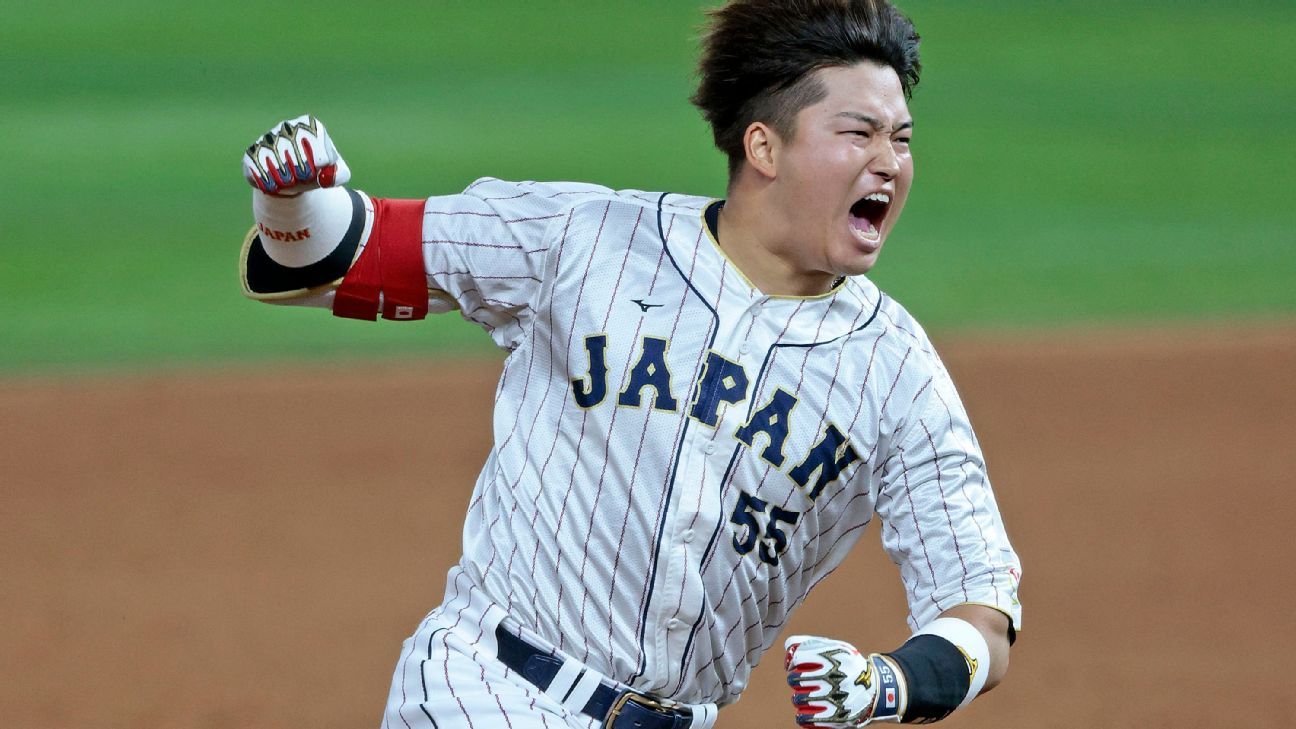
Team that might be out: Mets. Murakami and the Mets were linked early on, but given Stearns’ defensive emphasis and the signing of Polanco to play first base — where many scouts believe Murakami is best suited to play — there doesn’t seem to be a clear fit, unless the Mets turn him into a full-time DH (and Mark Vientos is still around for that role or could share it with Polanco).
What about the Red Sox? The Red Sox have obviously been on the prowl for a slugger and Murakami’s power potential is huge — although it will come with a lot of swing-and-miss. If the Red Sox are tired of Triston Casas‘ continued injury issues, Murakami is a fit at first base. His age — he turns 26 in February — also makes him attractive, despite the strikeout risk.

What about the Seattle Mariners? At the winter meetings, president of baseball operations Jerry Dipoto said the Mariners were still interested in adding one more hitter. That obviously won’t be re-signing Polanco. They’ve been mentioned in trade rumors for Brendan Donovan and Ketel Marte. But what about keeping their prospects and just signing Murakami to play third base and DH? The Mariners might not want to add another strikeout-prone hitter, but if the bidding for Murakami does fall below nine figures, maybe they get in the mix.

Prediction: Chicago White Sox. Murakami’s deadline to sign is Dec. 22, so we’re running out of time. His market still seems wide open. The Phillies could also be an interesting fit, or maybe the Los Angeles Angels want to do something. Indeed, if any of these top 10 free agents land in a surprising spot, Murakami might be the one. The White Sox have money to spend — their current estimated payroll is just $68 million and that includes $20 million for Luis Robert Jr., who might be traded. They have a desperate need for power and Murakami fits at either third or first, depending on where Miguel Vargas ends up. This would be a nice roll of the dice for a White Sox team that looks to be on the rise.

-
Bradford Doolittle
Close
Bradford Doolittle
ESPN Staff Writer
- MLB writer and analyst for ESPN.com
- Former NBA writer and analyst for ESPN.com
- Been with ESPN since 2013
-
David Schoenfield
Close
David Schoenfield
ESPN Senior Writer
- Covers MLB for ESPN.com
- Former deputy editor of Page 2
- Been with ESPN.com since 1995
It’s hot stove season! The 2025-26 MLB offseason is officially here, and we have you covered with grades and analysis for every major signing and trade this winter.
Whether it’s a big-money free agent signing that changes the course of your team’s future or a blockbuster trade, we’ll weigh in with what it all means for next season and beyond.
ESPN MLB experts Bradford Doolittle and David Schoenfield will evaluate each move as it happens, so check back in for the freshest analysis through the start of spring training.
Related links: Tracker | Top 50 free agents | 2025-26 free agent class | Fantasy spin
Jump to biggest deals:
Murakami to CHW | Alonso to BAL
Schwarber to PHI | Diaz to LAD | Cease to TOR
Dec. 21

The deal: Two years, $34 million
Grade: A+
Munetaka Murakami arrived on my radar roughly at the same time as his feats in Nippon Professional Baseball began to attract international attention, which was during his 56-homer, 134-RBI monster season for the Yakult Swallows in 2022. His .710 slugging percentage occurred in a Japanese Central League context that featured a .370 collective slugging percentage. That kind of separation between a then-22-year-old slugger and the rest of a really good professional league tends to merit scrutiny.
Since then, Murakami’s numbers have slipped as the league around him continued to tilt toward the pitchers. Last year, the Central League had a .350 collective slugging percentage and a 3.26 aggregate ERA. Murakami, who turns 26 in early February, mashed 22 homers in only 187 at-bats during an injury-laden year. He also struck out 28.6% of the time in a league where hits still far outstrip whiffs. It’s a mixed bag, to be sure, especially for someone hoping to make the leap to the game’s highest level.
Even as Murakami’s window for signing with an MLB team neared its closing — a 45-day period that expires Monday — specific rumors about his destination were scarce. In a free agent market light on premium power threats, it seemed teams were shying away from a player who generated quotes like, “He’s still got 90 raw power.” The early prediction for Murakami’s deal from ESPN’s Kiley McDaniel (five years, $80 million) was not an outlier. Most projections were in that vein or even loftier. Instead, he lands what ostensibly is a make-good contract with a rebuilding White Sox team whose offseason just got a lot more interesting.
Clearly, the red flags in Murakami’s profile scared away teams. The profile is that of a one- or two-tool player, though the one standout tool — that off-the-charts power bat — is exceptional. Baseball America gives Murakami an average grade for his arm, and a 70 grade for power, but everything else is below average, including a 30 grade for speed. And if the reports on Murakami’s defense are accurate, his arm grade won’t have much utility if he ends up at first base or DH.
In a White Sox organization rich in young infield talent, that destiny seems like a good bet. Besides the likes of Colson Montgomery, Chase Meidroth and Billy Carlson, Chicago is likely to add UCLA star Roch Cholowsky to the mix with the No. 1 pick in the 2026 draft. There doesn’t seem to be any great need to give Murakami much of a runway at third base, though for 2026, it might be worth a shot, if only to build value.
While Murakami’s hype initially seemed to suggest a destination to a win-now team, he instead joins a team for a two-year trial that isn’t likely to contend during the length of the pact. But for the White Sox, this deal gives them a long audition with a player who, with adjustments, can be a premier middle-of-the-order hitter if he can get to enough pitches to let that power play. At this price, it’s a more than worthy project. If it succeeds, there will be a lot of teams looking back at this opportunity, wishing they had focused more on what Murakami can do, and not what they think he cannot.
And who knows? If Murakami, who is sure to be highly motivated after the way his posting window unfolded, becomes some semblance of that 56-homer monster we first heard about, maybe he will decide his new South Side digs suit him just fine. And when he’s ready to win, the White Sox club around him might be ready to do the same. — Doolittle
Dec. 19

Pirates get:
2B Brandon Lowe
OF Jake Mangum
LHP Mason Montgomery

Rays get:
OF Jacob Melton
RHP Anderson Brito

Astros get:
RHP Mike Burrows
Pirates grade: A-
The Pirates have pitching depth from which to deal and a lineup full of upgrade opportunities, and to turn Burrows — a back-end starter for them likely to be usurped sooner than later — into three right-now big league contributors is a nice bit of work for Ben Cherington and his staff. It signifies a real attempt to capitalize on Pittsburgh’s contention-worthy starting rotation.
Lowe isn’t a star, but he’s a proven power threat and the Pirates need those in the worst way. Over the past five years, Lowe has averaged 34.5 homers per 162 games; last season Oneil Cruz led the Bucs with 20. Stack Lowe, Bryan Reynolds and Spencer Horwitz in the lineup, then you’re moving toward league average on offense, which for this team is a formula for wild-card contention. They do need to keep moving — there is more work to do.
Mangum, a late developer who turns 30 during spring training, is a speed-and-defense guy who gets the bat on the ball and should figure into the Pirates’ regular outfield rotation. Montgomery is a lefty with 97th percentile fastball velocity who misses bats at the level that kind of stuff allows. Command is his issue, which last season led to a 12.9% walk rate and a frequency of barreled up pitches, which led to a blistering .391 BABIP. But the Pirates have done a lot of good work with such pitchers.
If there’s one thing that gives you pause, it’s simply the recent history of Pittsburgh’s trades with these two teams. Which has been — not great. Pirates fans will hope past is not prologue in this instance.
Rays grade: B+
The Rays spent Friday morning doing what the Rays do, which is converting their recognizable names with dwindling controllable years into multiple contributors, prospects and, in the case of their earlier trade with Baltimore, another draft pick.
The aggregate potential of Brito and Melton makes this a win for the Rays. The two deals on Friday probably ought to be considered together. But in moving Lowe they’ve opened up an infield slot to create a clear opportunity for prospect Carson Williams, who has tremendous potential but heightening concerns about his ceiling due to exorbitant strikeout rates. Still, at the very least a middle infield of Williams and Taylor Walls will be virtuoso from a defensive standpoint.
Melton has a chance to carve out a role sooner than later as a younger version of Mangum with more upside, especially in the power department. He struggled during his MLB debut at the plate last season, but now the Rays will get a chance to polish off his development with no real pressure given the addition earlier this offseason of veteran Cedric Mullins.
Brito is a diminutive righty with a chance to stick in a rotation role eventually who throws five pitches and features a fastball that touches triple digits. He’s a ways off but finished last season in the Arizona Fall League, where he just missed striking out two batters per inning — 22 whiffs over 11⅓ frames.
Astros grade: D+
In their most recent set of organizational top-10 prospects, Baseball America rated Melton as the Astros’ top prospect and Brito at No. 3. While the system as a whole isn’t a strong one, that’s still an awful lot of future value to give up for Burrows, who profiles as a back-of-the-rotation type.
The Astros have a strong pitching program, to be sure, and perhaps they see more upside in Burrows than the prospect analysts and his track record suggest. He has a lot of controllable seasons left on his service time clock and even if he’s a league-average starter during that span, he’ll carry considerable value. Just not enough to justify two prospects of Melton and Brito’s combined quality. — Bradford Doolittle
Orioles get:
RHP Shane Baz
Rays get:
OF Slater du Brun
C Caden Bodine
RHP Michael Forret
OF Austin Overn
Competitive Balance Round A pick
Orioles grade: C
After the Baltimore Orioles traded for Taylor Ward and signed Pete Alonso, everyone knew there had to be a pitching move arriving next for the team, and general manager Mike Elias swung the kind of deal he prefers, trading for a cost-controlled starter rather than spending big money in free agency. This deal is certainly more reflective of the 2024 trades for Corbin Burnes and Zach Eflin than the signings last offseason of second-tier starters in Charlie Morton, Tomoyuki Sugano and Kyle Gibson (who combined for just 17 wins and a 5.49 ERA).
Baz was originally drafted by the Pittsburgh Pirates in 2017 and then traded to the Tampa Bay Rays, where he became the No. 15 prospect on ESPN’s list entering the 2022 season after a strong debut in 2021 — only to get injured after six starts and eventually undergo Tommy John in September of 2022, leading him to miss all of 2023. In his first full season back in 2025, he went 10-12 with a 4.87 ERA, striking out 176 in 166⅓ innings but allowing 26 home runs.
It was a strange season for the Rays, having to play their home games at the New York Yankees‘ spring training field in Tampa, and Baz struggled there with a 5.90 ERA. The Orioles are no doubt looking at his 3.86 ERA on the road with a much lower home run rate and believing that’s the pitcher they’re getting. It’s certainly easy to envision a higher ceiling here as Baz averaged 97 mph with his fastball while registering above-average ground ball (73rd percentile), strikeout (67th percentile) and hard-hit rates (59th percentile).
He has a five-pitch repertoire, although he ended up essentially ditching his slider for a cutter after the slider got hammered (batters were 9-for-21 with six home runs off it). His slider was his second-most used pitch in 2024, so he was making adjustments on the fly throughout the 2025 season and did at least finish with a strong September. He does come with three years of team control and will make an estimated $3.1 million in 2026, so he’s a nice fit for the payroll, but he doesn’t project right now as top-of-the-rotation starter like he did pre-injury.
Rays grade: A
In the words of ESPN prospect analyst Kiley McDaniel, “This is a lot of good prospects for three years of Baz.” Indeed, getting a 5-for-1 exchange for a pitcher coming off a so-so regular season has the potential to be a huge home run for the Rays — and swing big is exactly what they have to do, even if there are no guarantees. Still, de Brun ranked seventh and Bodine tenth in Kiley’s August update of the Orioles’ top 10 prospects. In a Tampa system that’s probably the weakest it has been in years — it ranked 16th in Kiley’s most recent farm system ranking — this group will add some needed overall depth.
Bodine and de Brun were both first-round picks in the 2025 draft: Bodine went 30th out of Coastal Carolina, where he h.it .318 with twice as many walks as strikeouts, and de Brun — a shorter, fast, lefty-hitting outfielder from the Pacific Northwest (see Corbin Carroll) — was the No. 37 pick. Both players have questions surrounding their power but have showcased bat-to-ball skills and de Brun should easily stick in center field. Forret might be the first to reach the majors, posting a 1.58 ERA across 18 starts between High-A and Double-A.
It looks like a great return for the Rays from an Orioles team that was desperate to add pitching. Elias is certainly operating more aggressively than he has in the past — perhaps a GM trying to save his job. — Schoenfield

Royals get:
LHP Matt Strahm
Phillies get:
RHP Jonathan Bowlan
Royals grade: B
Strahm returns to the Royals organization after a long journey in which he became one of the game’s top relievers, made an All-Star team and rose to prominence in both the mullet and baseball card-collecting departments. In Kansas City, he ostensibly replaces recently traded Angel Zerpa as the highest-leverage lefty in the bullpen and as long as he maintains his performance, he’s a significant upgrade in that role.
The Royals’ Opening Day pitching staff looks contention-worthy. You start with a core-five rotation of Cole Ragans, Seth Lugo, Kris Bubic, Noah Cameron and Michael Wacha. The back of the bullpen consists of closer Carlos Estevez and top-tier setup guys in Strahm and Lucas Erceg. The middle-leverage bridge innings are solid as well: Nick Mears, John Schreiber, Daniel Lynch IV and Alex Lange. Bailey Falter is a quality option as a combo starter/long reliever.
This trade completes that puzzle, and while the rotation is deep beyond the top five, the Royals need to add a little more in the bullpen department, though we shouldn’t overlook the possible healthy return of James McArthur. Given the Royals’ always-strong defensive profile, Kansas City once again has the look of a top-10 run prevention team.
The dings on this move involve risks around the performance/price consideration when it comes to Strahm. Basically, the Royals need Strahm to be for them what he was for the Phillies, because $7.5 million is a lot of money for a non-closer on a small-market team. Erceg, Strahm’s righty setup counterpart, is still in the pre-arbitration phase of his service time, for example. That’s more typical of a small-market bullpen setup.
Strahm is entering a walk year so it’s less about the financial risk than the potential lack of flexibility to add during the season if he doesn’t work out. Strahm just turned 34. Last season, his strikeout rate was down a tick, as was his velocity. Still, we can’t be alarmist. Strahm is on a multiyear run of elite effectiveness and posted a 1.88 ERA last season after the All-Star break. He’s worth the mild gamble that his run will go on for at least another year. And if the Royals’ season were to go off the rails, he would be attractive at the trade deadline.
Phillies grade: C+
My knee-jerk reaction to seeing this deal was to wonder what in the heck Dave Dombrowski was doing. Strahm has been a key member of the win-now Phillies bullpen, and for the last few years has operated at a level one or two tiers higher than Bowlan. Even with a $7.5 million salary on the books for 2026, Strahm projects to provide more marginal value than Bowlan, mostly because Bowlan doesn’t figure to be much better than replacement level.
Moving Strahm’s contract does lighten the Phillies’ payroll and perhaps that makes it more likely that they reach an accord to bring free agent catcher J.T. Realmuto back into the fold. If so, then this mild bit of cash-dumping is probably worth it. Certainly Bowlan, who has little big league service time on his counter and is optionable, is no kind of financial risk.
But there’s also a nonzero chance the Phillies get more out of Bowlan moving forward than they would have gotten from Strahm, as good as the latter has been. He’s five years younger and, after early-career arm problems, has gradually been trending upward, leading to his career-best 2025 season in Kansas City. He throws six pitches and was developed as a starter, and while the Phillies probably see him as a middle-leverage bullpen option who can get more than three outs if needed, he could also be stretched out if Philadelphia suffers an injury spate to its rotation.
But even if Bowlan continues to be what he was last year, he’s a viable member of a good bullpen. One thing that does worry you though: Bowlan’s rate of homers allowed hasn’t been great, and that tendency might get out of control when moving from Kauffman Stadium to Citizens Bank Park. — Doolittle
Dec. 18

The deal: Three years, $75 million with opt-out clauses after first two seasons
Grade: C+
The Padres’ rotation was looking light before re-upping with King. Even after doing so, the health profile of this group is concerning, mostly because of King and Joe Musgrove, and San Diego needs to keep building out depth with this group. Still, on the field, the return of King to head up the 2026 rotation does much to clarify what was a murky picture.
The structure of the deal makes this very much a player-friendly pact, and since we grade these things from the perspective of the team, it drags down the grade a bit. King, who turns 31 next May, has qualified for the ERA title once in his career as a swing-type pitcher who finally became a full-time rotation hurler after moving to San Diego as part of the Juan Soto trade with the Yankees. That season was gangbusters, a 2024 campaign in which King put up a 2.95 ERA over 173⅔ innings, finishing with a 4.1 bWAR and seventh in NL Cy Young balloting.
Last year, however, was marred by shoulder trouble early and knee trouble late, limiting King to 73⅓ innings during the season and one inning during San Diego’s wild-card loss to the Cubs. He also missed half the 2022 season with a fractured elbow, and while his injury history is far from unusual for a 21st-century pitcher, it’s worth keeping in mind. The flip side of the IL stints is this: For a pitcher King’s age, with a baseline performance of something like a 135 to 140 ERA+, he doesn’t have that much mileage on him.
King was a solid candidate for a multiyear deal in the average annual value range in the neighborhood of what the Padres offered. But the structure puts most of the benefits in King’s court. The first year of the deal reportedly pays out at $22 million, the amount of the qualifying offer the Padres gave him which attached a draft pick penalty to any team signing him other than San Diego. The last two years, then, are worth $53 million unless King opts out. If he gives San Diego a full, productive season, that seems like a good bet. If he doesn’t, then he’s fine — he won’t opt out and the Padres have to hope that whatever went wrong doesn’t linger.
Still, if this is what it took to secure King’s services, the Padres had to do it. The remaining starting pitcher market above King probably consists of Ranger Suarez and Framber Valdez, who both will likely command a heftier commitment than this. As it is, the Padres have a strange payroll outlook, with a raw payroll projection of about $212 million, per Cot’s Contracts, but a CBT payroll projection ($257.4 million after signing King, but before adding in newly acquired KBO player Sung-mun Song) that is above the initial tax threshold because of all the backloaded contracts A.J. Preller has handed out. (The CBT calculation averages out the total value of those deals.)
So while the Padres might have the cash for additional acquisitions, the tax implications of further payroll increases start to become more onerous. That is, unless Preller gets busy in the trade market, which would be less than surprising, But for King, it’s all good. With this deal, he can’t lose. — Doolittle
Dec. 17
The deal: Two years, $22 million
Grade: C+
In first signing Devin Williams and now Luke Weaver, at least the New York Mets know they’re getting two relievers who understand what it’s like to pitch in New York. But with Williams and Weaver as two of the New York Yankees‘ high-leverage arms in 2025, their bullpen ranked just 20th in the majors in win probability added and general manager Brian Cashman had to acquire David Bednar at the trade deadline to take over as the closer down the stretch.
Weaver had come out of nowhere in 2024 to turn in one of the best seasons of any reliever in the majors. The Yankees had claimed him off waivers from Seattle in September 2023 and then re-signed him to a one-year deal ahead of the 2024 season with a club option for 2025. A starter up until then, the Yankees moved Weaver to the bullpen and he went 7-3 with a 2.89 ERA with 103 strikeouts in 84 innings, carrying a big workload for a reliever. He was especially valuable with his ability to pitch more than one inning, which he did multiple times that postseason as the Yankees reached the World Series.
He wasn’t able to replicate that success in 2025, however, even as his workload decreased to 64 innings. His ERA rose to 3.62 and his strikeout rate dropped from 31.1% to 27.5%. Weaver had three pitches working in 2024: his four-seamer, changeup and cutter. But in 2025, while the changeup remained lethal, his cutter was ineffective (and he used it much less often) and his fastball got hit harder. Eight of the 10 home runs he allowed came off the four-seamer.
That’s the potential problem with Weaver as a high-leverage reliever: He’s an extreme flyball pitcher (he ranked in the first percentile in groundball rate), so he’s prone to the home run. That showed up in more than a few clutch situations for the Yankees in 2025. The previous season, Weaver ranked seventh among all relievers in win probability added. In 2025, he fell to 35th. The changeup remains one of the best pitches in baseball, but Weaver will likely have to get the feel back for his cutter to give batters a third pitch and keep them off the fastball.
The Mets still need more bullpen depth, but the Weaver-Williams pair looks like the back-end duo. It will certainly be fascinating to see how it plays out. The 2024 version of Weaver and the pre-2025 version of Williams would give the Mets one of the best late-game pens in the majors. But from their 2025 experience, Yankees fans know what can happen when that isn’t the case. — Schoenfield
The deal: Two years, $22 million
Grade: A-
With a few mechanical tweaks in 2025, Brad Keller went from journeyman starter to one of the top relievers in the majors for the Chicago Cubs. He posted a 2.07 ERA, held batters to a .171 average and a .528 OPS that was ninth lowest among pitchers with at least 60 innings and then finished the season as the Cubs’ closer in the playoffs.
Was the improvement for real? Indicators suggest so. Keller lowered his arm slot and focused on drills that used his lower half more efficiently. Now fully recovered from thoracic outlet surgery he had in 2023, his average fastball velocity increased from 93.8 mph in 2024 to 97.2 mph this past season and his strikeout rate jumped to a career-high 27.2%, nearly 10 percentage points higher than his career mark. Everything especially clicked in the second half, when he held batters to a .089 average and fanned 35 batters in 27⅔ innings.
Those numbers would make Keller the prime setup man to closer Jhoan Duran in a Philadelphia Phillies bullpen that also features Jose Alvarado, Orion Kerkering, Matt Strahm and Tanner Banks. That’s a solid group, so don’t be surprised if the Phillies try Keller as a starter, looking to repeat the success the New York Mets had with moving Clay Holmes from reliever to starter last season.
Unlike Holmes, Keller has plenty of experience as a starter in the majors, with 117 career starts, although the last time he started regularly with the Kansas City Royals in 2021 and 2022, his ERA was over 5.00 both seasons. He has a starter’s repertoire, using five different pitches at least 10% of the time in 2025. He has always generated a high groundball rate — 95th percentile in 2025 — and while he might not throw 97 mph as a starter, the newfound velocity and the addition of a sweeper that he didn’t have with the Royals should make him an effective midrotation starter.
For the Phillies, who have Ranger Suarez in free agency and Zack Wheeler coming off his own thoracic outlet surgery, the bigger need appears to be in the rotation. At two years and $22 million, this would be a bargain if Keller replicates what Holmes did for the Mets — 3.53 ERA, 1.9 WAR. And as a fallback, the Phillies have a high-leverage reliever. This could end up being one of the sneaky best signings of the offseason. — Schoenfield
Dec. 16
The deal: One year, $20 million
Grade: B+
If this seems like an inflated grade for a player who feels a bit overpaid coming off an injury-riddled season of 0.3 bWAR, I direct you to last week’s assessment of Atlanta’s deal with Mike Yastrzemski, where I wrote, “you like the options that new Atlanta manager Walt Weiss will have at his disposal, especially if the Braves find a solution at short that would shift Mauricio Dubon into the super-utility role he’s best suited for.”
That solution turns out to be Ha-Seong Kim, who held the position over the final month of last season before declining his one-year, $16 million option for 2026. Per ESPN’s Jeff Passan, Kim had multiyear offers on the table so, given that leverage, Atlanta ends up paying a $4 million premium to retain Kim’s services above the option-year payout.
This needed to happen. The Braves’ position-player depth chart was almost a complete set, but the missing piece — starting shortstop — was a doozy. The options in the free agent market at this position are best described as slim pickings. Unless you wanted to pay an exorbitant amount to sign Bo Bichette, who needs to move off of the shortstop position defensively but has a premium bat, Kim was the only non-trade solution.
Over the final few weeks last season, Braves president of baseball operations Alex Anthopoulos kept the transaction wire spinning like a top even though Atlanta had fallen out of the race. For a couple of weeks there, it felt like all but a certainty that if a recognizable player ended up in the DFA category, the Braves would soon claim him. Kim, whose short and doomed career with the Rays was a veritable nonentity, was one of those players.
Now you get it: The Braves were able to give Kim some runway at short while he and the club got to know each other. Despite his ongoing injury problems that persisted even after he recovered from offseason shoulder surgery, Kim played well. That audition now pays off with this signing.
The Braves limped through the 2025 season with Nick Allen getting the most time at short, and while he’s a solid defender, his OPS+ at the dish was an unplayable 53. Kim is in Allen’s class as a defender and has many more viable offensive attributes. After the season, Anthopoulos moved quickly to deal him for Dubon, who now indeed will have the leeway to move around the field as Weiss requires. This of course assumes that Kim is healthy. When he is, he’s an above-average big league infielder and legit defensive shortstop.
Anthopoulos has now inked Kim, Yastrzemski, Robert Suarez, Raisel Iglesias and Joel Payamps to big league free agent deals this offseason, pushing Atlanta’s payroll over the luxury tax threshold. Clearly, I’ve been more concerned about that than the Braves, who have the financial heft that goes with their cash cow home ballpark and its surrounding village.
The Braves could still use another core rotation option, but the offseason is still young and there are still a number of really good starting pitchers on the market. All it will take is more money. Given the Braves’ aggression so far, why stop now? — Doolittle
Dec. 15
The deal: One year, $10 million
Grade: D
The Philadelphia Phillies have been seeking an upgrade on Nick Castellanos in right field for a couple of years but have never found a team willing to take on his contract, which is now entering its last year at $20 million. Seemingly stuck with Castellanos, they decided to add a new right fielder anyway in Adolis Garcia. They may be replacing Castellanos with … somebody worse than Castellanos. Your raw batting stats from 2025:
Castellanos: .250/.294/.400, 17 HRs, 5.4% BB rate, 22.6% SO rate
Garcia: .227/.271/.394, 19 HRs, 5.1% BB rate, 24.7% SO rate
You would be hard pressed to find two more similar batters, two right-handed batters who swing at everything and hit for some power. OK, there is one big difference:
Castellanos: -0.8 bWAR
Garcia: 2.7 bWAR
Whoa. Baseball-Reference absolutely loved Garcia’s defense and thus rated him as a more valuable player than Jorge Polanco, Seiya Suzuki, Jackson Chourio, Masyn Winn, Carlos Correa or any number of other players who had higher than a .271 OBP. Globe Life Field also played as an extreme pitcher’s park for some reason in 2025, so the metrics boosted Garcia’s offensive value because of that (although he hit worse on the road than at home).
It’s also worth pointing out that as much as Baseball-Reference loved Garcia’s defense in 2025 (plus-16 runs) it rated him below average in 2024 (minus-5 runs). He’s an upgrade over Castellanos on defense but take one-year spikes in defensive ratings with a large degree of skepticism.
The bigger issue is whether Garcia’s bat is in a free fall. His best season came in the Texas Rangers‘ World Series year in 2023, when he hit .245/.328/.508 with 39 home runs in the regular season and followed that up with a monster October run. That was the one year he reigned in his super-high chase rate, going below 30% for the only time in his career (he was back up to a 35.7% chase rate in 2025) and posting a 10% walk rate (back down to 5% in 2025). Since that season stands out as an outlier, it seems unlikely Garcia will suddenly transform back into a more patient hitter with an above-average OBP.
We’ll see if this leads to a Castellanos trade, or maybe he ends up platooning in left field with a left-handed batter (Justin Crawford, Brandon Marsh or somebody else). The Phillies would love to trade him — or maybe they even just cut him and eat the salary.
This signing also begs the question: Does this take the Phillies out of the mix for Kyle Tucker or Cody Bellinger?
You can’t completely dismiss the idea of a rebound from Garcia, and a one-year deal is always acceptable — but this looks like a low-impact move, at best a minor upgrade on Castellanos. — Schoenfield
Dec. 14

The deal: Two years, $40 million
Grade: B+
You can’t say the Diamondbacks don’t know what they’re getting in Kelly, who spent more than a half-decade as an upper-echelon starter for Arizona before getting shipped to Texas at last season’s trade deadline. Now he’s headed home, where he made his late MLB debut at age 30 back in 2019 after four seasons in the KBO. The odds of such a pitcher ever reaching MLB free agency are fairly long, and the odds of that pitcher landing a multiyear deal at the going rate for a legit rotation pitcher are even longer. So this is a great deal for Kelly and an especially nice deal for the Diamondbacks.
Arizona needed starting pitchers after trading Kelly and losing Corbin Burnes to injury and Zac Gallen to free agency. The Diamondbacks still need more even after re-adding Kelly and (earlier this week) Michael Soroka, but the depth chart is starting to look more workable and there is plenty of offseason to go.
Kelly is 37 but there has been little decline in his underlying numbers. His 2025 raw ERA (3.52) was excellent, and Statcast pegged his expected ERA at 4.15, consistent with that of previous years. A six-pitch starter, Kelly has never relied on elite velocity, but it’s worth noting that his velocity and spin readings bounced back after he dealt with shoulder issues in 2024. He seems primed to give Arizona 180 to 190 quality innings over the next couple of years.
The lofty grade handed out here is not just for this signing, but also for the exemplary work by Mike Hazen and his staff at the deadline. With the Diamondbacks’ status as a contender teetering, and Kelly headed for the market, they brought back three pitching prospects from the Rangers in exchange for loaning them Kelly for a couple of months.
Now Kelly is a Snake once more after signing a deal Arizona would surely have given him had he never been dealt. And for their trouble, the Diamondbacks deepened their organizational depth chart. In righty David Hagaman, they added a future rotation contributor who Baseball America recently ranked as Arizona’s No. 5 prospect. Not for nothing: According to B.A., at the time of the deal, Hagaman was viewed as the organization’s third-best prospect, behind Kohl Drake and Mitch Bratt.
In other words, that haul might turn out to be a huge return for Arizona — and they still have Kelly. Not bad. — Doolittle
Dec. 13
Royals trade Zerpa to Brewers for Collins, Mears

Brewers get:
LHP Angel Zerpa
Royals get:
OF/IF Isaac Collins
RHP Nick Mears
Brewers grade: B-
This is a prototypical off-the-radar move for the Brewers, one that has little downside, a good bit of upside and costs relatively little in the payroll department. Zerpa is a hard-throwing lefty who was developed as a starter during his slow rise through the Royals’ system before transitioning to a mid-leverage bullpen role once he finally stuck in The Show.
Zerpa can dial it up to 99 mph or so when he’s revved up, but doesn’t miss as many bats as elite relievers with that kind of top-end velocity do. He does feature elite vertical movement on his slider and that, combined with the hard sinker he throws to hitters on both sides of the plate, allowed him to produce groundballs at a 99th percentile rate last season, per Statcast.
Zerpa can be maddening. His command wavers, a tendency that manifests less in his walk rate than in the homer column — he can take a batter or two to find his release point and until that happens leaves pitches in the meatball zone. (Four of the seven homers Zerpa gave up in 2025 were to the first batter he faced.) But he’s got that old starter’s arsenal — four-seamer, sinker, hard-dropping slider and a changeup — which makes him a versatile member of any staff.
The Brewers have a tremendous track record of extracting more out of pitchers like Zerpa than they’ve shown before, and they have plenty to work with here. The Milwaukee bullpen is currently heavy on southpaws, and while that doesn’t mean they can’t use another, it also wouldn’t be a shock if Milwaukee ends up experimenting with a back-to-the-rotation project with Zerpa.
Royals grade: C+
When we refer to the Brewers’ success in getting more from other teams’ players, Mears is a classic example. An undrafted journeyman who bounced from the Pirates to the Rockies to the Brewers, Mears had 107 1/3 innings yielding a 5.20 ERA in his career entering last season. Then he emerged as a key member of a Milwaukee bullpen made populous because of so many injuries, posting a 3.49 ERA over 56 2/3 innings an earning his first career save at age 28.
There’s little in his metrics to suggest that level of success will continue, but the Royals’ recent track record with acquired pitchers has been good, so you want to give them the benefit of the doubt. Mears has to work the edges but he has good command and induces a good number of chases. He’s a fairly extreme flyball pitcher and moving to Kauffman Stadium will help him in that regard. Mears doesn’t have Zerpa’s upside but he can help the Royals.
Most of the focus will be on the versatile Collins, a key contributor to the Brewers’ record season in 2025 who finished fourth in National League Rookie of the Year balloting. His strength is in the precise area the Royals needed to upgrade: plate discipline. Collins walked 57 times with a .368 OBP last season. The OBP would have led the Royals, aside from Carter Jensen’s exciting late season cup of coffee, and the walk total would have ranked second to Maikel Garcia (62), who had 245 more plate appearances.
Collins turns 29 next season, as his rise through the minors was slow. But he’s a good athlete who can play both outfield corners while chipping in as a fill-in at the non-shortstop infield positions. There’s probably not much future improvement to be had, given his age, but what he is right now is good enough to upgrade Kansas City’s roster.
What Collins is not, however, is that middle-of-the-order jolt the Royals needed when the offseason began. They still need it, even after acquiring Collins and doling out a combined $13 million or so to bring back Jonathan India and add Lane Thomas. It’s a piecemeal approach that might very well look like running in place by the time next season begins, which will put the onus on young hitters like Jensen and Jac Caglianone to become the right-now difference makers Kansas City’s lineup needs. — Doolittle
The deal: One year, $11 million
Grade: B-
With A.J. Hinch — one of the better bullpen managers in the game — calling the shots, the Tigers have embraced a philosophy of “bullpen chaos” the last couple of years, which have featured two straight postseason appearances and wild-card round wins. With the addition of Jansen to Detroit’s 2026 bullpen, things promise to be less chaotic.
Whether or not this is a feature or a bug remains to be seen. Last year’s bullpen was more fine than outstanding last season, and that continued into the playoffs when Detroit’s relievers struck out just 5.8 batters per nine innings. Jansen is coming off a season when his own strikeout rate was his lowest ever — 8.7 K/9 — and has been declining with each passing season. That happens to even a future Hall of Famer as he pushes into his late 30s.
Jansen still leans heavily on a cutter that has long been one of the most effective pitches in the game, including last season when opposing hitters managed just a .536 OPS against the offering (righties were at just .481). His cutter didn’t induce as many chases or swinging strikes, but the slider he mixes in seemed to fill those voids, at least in 2025. Jansen saved 29 games with a 2.59 ERA that wasn’t really supported by his peripherals (3.98 FIP), but he was clearly still effective.
The Tigers’ bullpen has been fortified this fall with the re-signing of Kyle Finnegan and now the addition of Jansen to join a returning crew that includes Will Vest and Tyler Holton. Last year’s Tigers led the majors in appearances in which a reliever recorded four or more outs, something Jansen isn’t going to be asked to do very often, if at all. Now Hinch will be able to match up all of those multi-inning relievers to set up one of the best-ever closers.
And Jansen’s status as closer is surely unquestioned as we view it from this December vantage point. Without such an assurance, it seems unlikely that a pitcher 24 saves shy of the 500 milestone would sign with a team that has already two relievers (Vest and Finnegan) who topped 20 saves a season ago. In a vacuum, this is probably a C to C-plus addition, but the terms seem downright team-friendly in an offseason that has seen teams throwing an awful lot of guaranteed money at those back-of-the-bullpen roles, so let’s bump the grade up a bit. — Doolittle
The deal: Two years, $40 million
Grade: C
Just days after the Mets lost Pete Alonso to the Baltimore Orioles — without even making the franchise’s career home run leader a formal offer — the club has found his replacement by signing Polanco in a deal that is unlikely to immediately win back disgruntled Mets fans.
Polanco is coming off an excellent season with the Seattle Mariners, hitting .265/.326/.495 with 26 home runs and a 134 OPS+. With Marcus Semien now the Mets’ second baseman, Polanco will work into the first-base/DH mix alongside Mark Vientos.
On the surface, it’s possible to argue that Polanco can fill Alonso’s shoes — or, given that he’ll be making about two-thirds of the $31 million AAV that Alonso will make with the Orioles, at least replace two-thirds of those shoes given that Alonso’s numbers weren’t that much better: .272/.347/.524 with a 144 OPS+.
Indeed, with either Vientos or Polanco projected at least as a small defensive upgrade over Alonso at first base, the Mets can pretend they’ve just replaced Alonso’s overall value while saving $11 million they could use toward signing top free agent Kyle Tucker or a front-line starting pitcher.
Of course, it’s not quite so simple. Polanco’s 134 OPS+ was a career high, and he has surpassed 20 home runs just three times in his career, the other two coming with the Twins in the lively ball years of 2019 and 2021. To be fair, he was healthier in 2025 after battling various leg and knee injuries the previous two seasons that limited him to a .213/.296/.355 line in his first season with Seattle in 2024.
In comparison to Alonso’s record of durability, that makes this a risky signing, as Polanco averaged just 101 games from 2022 to 2024. It’s fair to argue that three years of injuries is a better predictor of what might happen in the future than one healthy, career-best season. Polanco’s season also ran hot and cold: He had a 1.226 OPS in April and finished strong with a 1.015 OPS in September, along with some big postseason moments, but hit just .139 in May and .222 in June.
At his best, the 32-year-old switch-hitter is a tough out from both sides of the plate, with an 83rd percentile strikeout rate. He produced career highs in 2025 in average exit velocity and hard-hit rate while cutting his strikeout rate nearly in half from 2025. If the Mets get that version of Polanco, he’ll be a nice addition, if a bit of an overpay for a player with his health history. You certainly can’t pencil him for 162 games like you could for Alonso — and that’s what the Mets will miss most in 2026. — Schoenfield
Dec. 12
The deal: Three years, $37 million
Grade: B+
Rogers is one of the most unique — and underrated and wonderful — relievers in the majors. A pitcher with an 83 mph sinker shouldn’t succeed, but Rogers has, with a 2.71 ERA since 2021. Among pitchers with at least 350 innings since then, only Jacob deGrom has a lower ERA. Rogers does it with his ground-scraping delivery, the lowest release point of any pitcher in the majors, which gives him a different look than any other pitcher, with the ball leaving his hand 6 feet lower than most pitchers.
He threw that sinker nearly 75% of the time in 2025, relentlessly pounding the strike zone (he has walked just 11 batters unintentionally in 148 innings over the past two seasons). Rogers then mixes in what is essentially a rising slider due to his low release point. In other words: He pitches down with his fastball and up with his breaking ball, the exact opposite of how most pitchers are doing it. Hitters’ brains just have trouble adjusting to something they’re not used to seeing.
It works, even though his whiff rate is in the first percentile — basically the lowest in baseball. But his ground ball rate was in the 98th percentile, his hard-hit rate was in the 95th percentile, and he never walks anybody. Unlike many sidearmers of the past, he has no platoon split, with a .627 OPS allowed against left-handed batters since 2021 and .633 against right-handers. Like those sidearmers, he has been extremely durable, averaging 75 appearances over the past five seasons.
It looks like a great signing for the Blue Jays, especially because it fills a hole. Indeed, when we last saw the Jays in Game 7 of the World Series, manager John Schneider used six relievers, four of whom allowed a run. Three of those pitchers were starters, which indicated the lack of trust Schneider had in his regular relievers. Jeff Hoffman is presumably back as the closer after an up-and-down season, but Rogers immediately becomes the top high-leverage setup guy and Plan B if Hoffman struggles again with the long ball.
The biggest risk here is Rogers turns 35 in a few days, but, while the contract was higher than projected, Rogers doesn’t rely on velocity anyway, so he’s a good bet to remain healthy and age well into his late 30s. With the additions now of Dylan Cease, Korean League MVP Cody Ponce and Rogers, the Jays have reinforced the pitching staff while seeing the payroll soar past where it was in 2025. It will soar even higher if they can re-sign Bo Bichette, which now feels more likely given this spending spurge so far. — Schoenfield
Dec. 11
The deal: Three years, $45 million
Grade: B
If you close your eyes, ignore the rest of the offseason and the 2026 regular season, and then imagine the Braves in next year’s playoff bracket, you see something enticing. A team with a one-two back-of-the-bullpen punch that has shrunk games down to seven innings. Navigate the bridge innings between the rotation and this dual-closer dynamo waiting in the wings, add a resurgent offense, and you’re in business.
To be clear, this very well might happen. The Braves, despite last season’s disappointments, rate as a prime contender, solidly in the tier down from the one-team group composed of the Dodgers. This was even before the additions over the past 18 hours or so of Yastrzemski and Suarez. Thus the Braves’ probabilities keep trending in the right direction.
Suarez is a powerhouse righty with an average fastball velocity approaching 99 mph. He throws harder than incumbent Braves closer Raisel Iglesias but has fewer weapons and induces fewer swing-and-misses. The question of who closes on a game-by-game basis might come down to who’s batting, as Suarez is strictly fastball/changeup against lefties and has been less successful in that regard than Iglesias. But the heavy sinker he mixes in against righties has made for a nasty combination: Batters from the right side produced just a .435 OPS against Suarez a season ago.
Still, the arsenals and movement profiles between Suarez and Iglesias seem pretty similar with the exception of Iglesias’ slider, a pitch which Suarez doesn’t throw. This isn’t necessarily a problem. For one thing, if you follow one with the other in a game, there’s little chance that the same hitters will see both pitchers. The more important consideration is simply the two innings of elite stuff opposing teams will see when trying to wage a comeback against the Braves. Still, in the context of the postseason series we conjured at the outset, this could be a consideration. Ideally, teams want their bullpen to be minimally redundant.
The contract is about right in AAV but probably a year longer than you’d like. That’s surely the function of a free agent market growing thin on elite closer types. The Braves re-upped with the 36-year-old Iglesias on a one-year, $16 million deal last month, so as long as Suarez holds up, he’s in position to take over as Atlanta’s exclusive closer after next season. The “if he holds up” qualifier is the potential sticking point because Suarez himself will be 35 by the time next season starts and has a strikeout rate (28%, 78th percentile among relievers with at least 30 appearances) that isn’t elite despite his raw stuff.
Also, we noted in our grade on the Yastrzemski signing below that the Braves’ room under the first tax threshold is shrinking. That continues with this move, though the deal is slightly backloaded ($13 million in 2025, $16 million in 2026 and 2027). According to Cot’s Contracts, this drops Atlanta down to within $9 million to $10 million below that line — and the Braves have more moves to make, with a shortstop topping their list.
Passing the threshold wouldn’t be a huge deal for Atlanta, which operated below the threshold last season. Still, it’s something you don’t want to do willy-nilly and since the Braves already had Iglesias on hand, maybe a lower-cost alternative like Brad Keller or Seranthony Dominguez would have made sense.
But if the Braves can steer this new bullpen structure into next October, no one will be worrying about the threshold. — Doolittle
Dec. 10
The deal: Two years, $23 million
Grade: B-
The Braves didn’t need a major overhaul in the outfield, but Yastrzemski represents an upgrade to the overall position group. He’s a versatile left-handed hitter who will ostensibly bump veteran Michael Siani out of a depth role on the 40-man roster.
The deal feels like a mild overpay given Yastrzemski’s age (he turns 36 next August), the two-year commitment and the Braves’ payroll outlook. Atlanta still has room to play with under the first luxury tax threshold (around $22 million, according to Cot’s Contracts) but they still need a starting shortstop and more pitching, so things could get cozy pretty quick.
That said, you like the options that new Atlanta manager Walt Weiss will have at his disposal, especially if the Braves find a solution at short that would shift Mauricio Dubon into the super-utility role for which he’s best suited. The Braves would have Yastrzemski, Michael Harris II, Ronald Acuna Jr., Jurickson Profar and Eli White as a core outfield rotation.
If you extend it further, Yastrzemski and Profar could log DH time, as would catcher Drake Baldwin, who shares his position with Sean Murphy, and maybe even first baseman Matt Olson, with Profar filling at first to give Olson a break. And of course, Dubon can fill in pretty much anywhere. It’s a deep and versatile position group with a healthy blend of lefty, righty and switch-hitters.
The concern would be a sharp decline for Yastrzemski, as can certainly happen with a mid-30s veteran. He has seen a mild drop in sprint speed already, though he remains a canny baserunner and, at least through last season, can still play center field when needed. At the plate, Yastrzemski posted the best strike zone indicators of his career last season and showed no drop-off in exit velocity or bat speed.
Those swing metrics could pay off big time at Truist Park, as Yastrzemski is way above average in terms of pulling balls in the air, and his new park, with the Chop House section as a target, is typically welcoming to fly ball-generating lefty pull hitters. Good player, good fit, perhaps one year too long on the guarantee. — Doolittle
The deal: Five years, $155 million
Grade: B
It’s fair to call this a stunning deal, although maybe less so once it was clear the Orioles had been in pursuit of Kyle Schwarber. This signing is as much about what it means to the Orioles as to what it means for the New York Mets to lose one of the most popular players in franchise history, a player who has averaged 42 home runs and 114 RBIs per 162 games in his career (and he played 162 each of the past two seasons). He’s a five-time All-Star, coming off a season in which he hit .272/.347/.524 — a career high in batting average — while hitting 38 home runs and an NL-leading 41 doubles.
Alonso’s value might have the widest difference in perception between what an average fan might think and the more analytical assessment from MLB front offices. That’s even aside from how much stake to put into his 2025 season, which was a much better all-around season at the plate than the previous two, with swing changes that resulted in a shorter swing and utilizing his hips more playing a big part in the improved batting average and contact rate. If those changes hold, Alonso should remain a productive hitter for at least the initial years of his contract, even as he enters his age-31 season.
As far as his overall value, Alonso has averaged 3.7 WAR per 162 games — a very good player for sure, but not necessarily the superstar level his home run and RBI totals suggest. Alonso tries hard on defense but lacks range. He hustles on the bases but lacks speed. He led the NL with 23 double plays hit into. His career OBP is .341 — good but not great. All this works to lower his overall value and helps explain why his market was soft when he was in free agency a year ago and why the Mets were willing to let him go despite his popularity in New York.
For the Orioles, they’ve now added Alonso and Taylor Ward, two right-handed sluggers who combined for 74 home runs in 2025. The Orioles tied for 11th in the majors in home runs in 2025, but they hit 44 fewer home runs than in 2024, so adding power was their clear offseason priority. Their first basemen — a combo of Ryan Mountcastle, Coby Mayo and Ryan O’Hearn — were especially weak, ranking last in the majors with just 14 home runs and tied for last with 62 RBIs (they were 23rd in OPS). Alonso might end up at DH, or at least get some time there, but his power will fix a problem at first base.
His durability is a plus. His energy and enthusiasm — which Mets fans loved — are a plus, especially for an Orioles team that seemed to lack those characteristics last season. He’ll provide a jolt to a lineup that needed it. It’s interesting the O’s found themselves in this position, considering everyone thought a couple of years ago that they were printing position players. You could also argue that if the Orioles were going to make one big splash this offseason, it should have been for a front-line starting pitcher. Maybe they’ll surprise and do that as well.
The $31 million AAV, combined with Alonso’s age and lack of all-around game, limit the grade here, but he’ll help the Orioles, at least until the .220, 25-homer seasons pop up at the end of this deal.
As for the Mets, they’ve gone from Alonso to Mark Vientos, Edwin Diaz to Devin Williams, and Brandon Nimmo to Marcus Semien. Those are arguably all downgrades, so it’s hard to see the plan here. If Vientos can bounce back to his 2024 numbers, that will help replace Alonso’s offense (manager Carlos Mendoza already said Brett Baty will get the majority of time at third base), but the Mets still have holes at DH, left field and center field.
In the end, David Stearns did the analysis and decided Alonso isn’t a $150 million player and the Mets can find the offense elsewhere — or use some of that money to add to a rotation and bullpen that need help. It’s not often that a big-market team walks away from a face-of-the-franchise type of player like Alonso. We’ll see if that ultimately ends up as the right decision, but Stearns has a lot of work to do the rest of this offseason to get the Mets back to playoff contention. — Schoenfield
Dec. 9
The deal: Five years, $150 million
Grade: A
Let’s cut right to it: The Phillies had to re-sign Schwarber. It would be hard to envision the Phillies, a team with four consecutive playoff appearances and back-to-back NL East titles, winning a World Series without the slugger who in some fashion has replaced Bryce Harper as the central figure for the franchise. It’s no coincidence that the Phillies’ run of success overlapped with signing Schwarber to a four-year, $79 million contract after the 2021 season.
During those four seasons, Schwarber averaged 47 home runs, 107 runs and 108 RBIs while hitting .226/.349/.507. He’s been a rock of stability, averaging 157 games, and over those four years, he tied for second in the majors in home runs (with Shohei Ohtani) while ranking fourth in RBIs, fifth in runs scored and third in walks. His game is simple: He’s trying to hit the ball 500 feet with every massive swing. He hits bombs, he takes his walks, and he strikes out with the gusto of Mighty Casey. That approach worked better than ever in 2025, when he led the National League with 56 home runs and 132 RBIs while hitting .240/.365/.563 and finishing behind only Ohtani in the MVP voting.
Collectively, the Phillies’ offense has remained remarkably consistent, scoring between 778 and 794 runs the past three seasons, but that offense has become increasingly reliant on three players: Schwarber, Harper and Trea Turner. While the Phillies had 10 players hit at least 10 home runs, only Schwarber and Harper topped 20. Those three combined for about 77 runs created above average while the rest of the offense was a combined minus-38 runs below average.
Losing Schwarber would have opened up an enormous hole in the lineup — and while the Phillies were the clear favorite to re-sign Schwarber all along, there was a lot of interest in him from other teams, enough to create believable speculation that he could move on, possibly to the Cincinnati Reds (the team he grew up rooting for) or even to the rival New York Mets, at least if the Mets and Pete Alonso ended up parting ways. In the end, the Phillies did what they had to, even if it perhaps meant giving Schwarber an additional season based on projected contracts (Kiley McDaniel predicted a four-year, $128 million deal in his free agent rankings).
Schwarber will be entering his age-33 season, so this deal isn’t without risk. He’s coming off his best season, largely due to a dramatic improvement against left-handers, hitting .252/.366/.598 with 23 home runs, after hitting .228/.347/.436 against them from 2022 to 2024. But maybe that improvement is for real: He hit .300 with 12 home runs against lefties in 2024, so this is now consecutive seasons he’s hit well against same-side pitching.
As for how he might age, his raw power skills remain elite so those should remain stable for the immediate future: 100th percentile hard-hit rate in 2025, 98th percentile bat speed, 90th percentile chase rate. He swings at strikes, he swings hard, and he hits it hard. As a power-hitting DH, Schwarber draws comparisons to David Ortiz, who aged remarkably well (having one of his greatest seasons in his final year at age 40). That’s not necessarily the best comparison, however, because in his mid-30s, Ortiz transformed into a much better contact hitter, cutting his strikeout rate from 22.6% in his age 33/34 seasons to 14.5% the rest of his career. That’s not likely to happen with Schwarber, who fanned 27.2% of the time in 2025.
Still, Schwarber projects as one of the best run producers in the game, and it’s reasonable to expect at least solid production all the way through his age-37 season. The Phillies still have some holes to address: re-signing or replacing catcher J.T. Realmuto, perhaps re-signing or replacing Ranger Suarez in the rotation, finding a left fielder, maybe moving on from Alec Bohm at third base. But Schwarbs is back. And that makes the Phillies World Series contenders once again. — Schoenfield
The deal: Three years, $69 million
Grade: A
It’s a bad idea to sign a relief pitcher to a long-term contract. But it’s not a bad idea to sign Edwin Diaz to a long-term contract, and it’s especially not a bad idea for the Los Angeles Dodgers to do so.
You could get really cynical or optimistic about this — whether you’re a Dodgers fan or not. The Dodgers’ bullpen plan a year ago was to stock the roster with a ridiculous list of big-name relievers who had all worked in the closing role for various teams. The depth chart was eye-popping: Blake Treinen, Tanner Scott, Evan Phillips, Kirby Yates and Michael Kopech. The plan did not work. Each of those pitchers struggled with injuries, performance or both.
That being the base, you could point at the Diaz signing as an expression of Dodger hubris: They did not learn the most basic of bullpen-building lessons, that there is no such thing as certainty with that position group, no matter how much money you spend on it. Of that quintet, only Scott and Treinen remain on the roster.
So, sure, any and every reliever is a risk, but for the Dodgers, Diaz is more than worth it. Few relievers truly separate themselves from the pack and maintain their status for an extended period of time. Diaz is one of them, and this deal — strange as it is to say about a reliever — is a bargain, even if the $23 million average annual value is a record for a bullpenner.
Over the past five years, only Emmanuel Clase has earned more fWAR (8.1) than Diaz among relievers, and Diaz missed the entire 2023 season with a knee injury. During that span, only Mason Miller has a higher strikeout rate among relievers (14.3 K/9 for Diaz) and only Cade Smith has a better fielding-independent ERA than Diaz’s 2.14.
Diaz is 31, but last season was one of his best (1.63 ERA, 28 saves in 31 chances), and his underlying traits remain elite. According to Statcast, Diaz rated in the 99th percentile in expected ERA, expected batting average allowed, whiff rate and strikeout rate. His command wavers periodically but his nasty four-seamer/slider combo allows him to work out of jams when it does.
For the Dodgers’ depth chart, adding Diaz provides clarity where last year’s did not. Having all of those different closer types was nice, but who gets the ninth and in what situation? Now the ninth belongs to Diaz, and the rest of the bullpen plan becomes that much easier to set up on a game-by-game basis, with Treinen and Scott becoming a lethal setup combo if they regress to the better versions of themselves.
And of course, with the Dodgers landing Diaz, that means none of their chief competitors will have him, including the Mets. New York goes from possibly having a much upgraded back of the bullpen with a Diaz/Devin Williams combination to a dynamic in which Williams is now serving as Diaz’s replacement. It could be a lot worse because Williams is very good, but it’s not the kind of outlook Mets fans might have envisioned as recently as Tuesday morning.
The bargain aspect of the deal is the length — three years, which is a hedge against Diaz’s age. He’s been a good health bet except for a fluky knee injury and his stuff has shown no decline. But he’s still a power pitcher who throws a lot of high-spin sliders who is on the wrong side of 30.
You have to wonder how many teams could have landed Diaz on a three-year deal. Surely some were willing to go to four years at least, perhaps at a lower AAV but with more overall value. But this is what the Dodgers have become — a destination. And their uniforms — not to mention the super-swag championship rings that go with them — are becoming status symbols among baseball’s elite in the way that super-yachts have become the darlings of the mega-wealthy.
The Dodgers, already a definitive favorite to win a third straight World Series, have solidified that status by a few more percentage points. And all it cost them was money, a resource that for them has become all but irrelevant. That is increasingly what puts the Dodgers on the hilltop, and makes the climb for everyone else that much more difficult to complete. — Doolittle
Dec. 6
Mariners get:
LHP Jose Ferrer

Nationals get:
C Harry Ford
RHP Isaac Lyon
Mariners grade: C+
Well, the verdict is in from Mariners fans: They universally hate this trade. (It’s not often you get an entire fan base to agree on something.) Their feelings are understandable. Ford was the Mariners’ first-round pick in 2021 and progressed nicely, advancing one level per season and hitting .283/.408/.460 in 2025 at Triple-A. He has remained a top-100 prospect all along, including No. 65 on ESPN’s updated list from August. Sure, he’s blocked by Cal Raleigh, but he projected as the backup catcher and part-time DH in 2026.
The return? A lefty reliever with a 4.48 ERA. It certainly feels a little light for a top-100 prospect — and a hard-to-find catching prospect — but that ERA undersells Ferrer’s potential. He throws a 98 mph sinker 70% of the time that helped him register one of the highest ground ball rates in the majors (99th percentile). He throws strikes (16 walks in 76.1 innings) and dominated left-handed batters (holding them to a .186 average and .521 OPS).
With Gabe Speier the only reliable lefty in the bullpen, the Mariners needed a second lefty and, after ending the season as the Nationals’ closer, Ferrer certainly can slot into a high-leverage role. He’s exactly what teams want in the postseason: a hard-throwing reliever. Scouts like his secondary stuff and the Mariners no doubt will have Ferrer use his slider and changeup more often, which could take him to an elite level.
Nationals grade: A-
The first major transaction from Paul Toboni, the Nationals’ new president of baseball operations, looks like a good one. Anytime you can turn a reliever into a possible long-term starting position player, that’s a win. We’ll hedge the grade here a bit since Ford hasn’t proved himself on the major league level, plus he projects more as a solid regular than a future star, but he should be a significant upgrade at a position that saw the Nationals rank 29th in the majors in OPS.
Indeed, Keibert Ruiz was supposed to be the answer behind the plate for the Nationals when they acquired him in the Max Scherzer/Trea Turner with the Dodgers, but he has gone backward since a solid season in 2023, producing an unacceptable .595 OPS in 2025. Ford’s biggest strength is an excellent approach at the plate that produced a 16.2% walk rate in Triple-A while striking out less than 20% of the time. With a career .405 OBP in the minors, he could eventually become a top-of-the-order hitter as he also runs well. (He stole 34 bases in 2024.) The power is only moderate and the defense still needs some work around the edges, but Ford should take over as the regular catcher in 2026. — Schoenfield
Dec. 4
Red Sox get:
RHP Johan Oviedo
LHP Tyler Samaniego
C Adonys Guzman
Pirates get:
OF Jhostynxon Garcia
RHP Jesus Travieso
Red Sox grade: B-
The American League East is clearly all-in. The Toronto Blue Jays have signed Dylan Cease and Korean League MVP Cody Ponce for their rotation. The Baltimore Orioles signed Ryan Helsley and traded for Taylor Ward and Andrew Kittredge. The Tampa Bay Rays have added outfielders Cedric Mullins and Jake Fraley and reliever Steven Wilson. And now the Boston Red Sox have acquired Oviedo after trading for Sonny Gray last week. (The New York Yankees? Trent Grisham accepted their qualifying offer, so he’s back.)
While there were other players involved in this trade between Boston and the Pittsburgh Pirates, it’s mostly Oviedo-for-Garcia, so let’s focus on those two. Oviedo is sort of the polar opposite of Gray, other than the fact that both are right-handers: Oviedo is 6-foot-6 and 275 pounds with a fastball that touches 98 mph while Gray is 5-10 and doesn’t throw hard; Gray has been reasonably healthy while Oviedo missed all of 2024 with Tommy John surgery; Gray pounds the strike zone while Oviedo’s control problems have always limited his value (in nine starts in 2025, he averaged 5.1 walks per nine).
Oviedo leans mostly on a fastball/slider, mixing in a curveball and changeup that he uses primarily against left-handers. In his one full season as a starter with the Pirates in 2023, he made 32 starts with a 4.31 ERA and 2.2 WAR, making him essentially a league-average starter. In his abbreviated return of 40 innings in 2025, improved movement on his four-seamer helped limit damage against that pitch as he posted career highs in strikeout rate (24.7%) and batting average allowed (.182) to go along with the high walk rate.
There is obvious upside here, especially if the better results against left-handed hitters in 2025 are for real. In his two years as Red Sox pitching coach, Andrew Bailey has extracted improvement from the likes of Tanner Houck in 2024 (although he got hurt in 2025) and Brayan Bello and Lucas Giolito in 2025, so it will be interesting to see what Bailey can do with Oviedo. For now, Oviedo projects as a fourth/fifth starter with two seasons of team control and gives the Red Sox plenty of rotation depth: They have Garrett Crochet, Gray, Bello, Kyle Harrison, Payton Tolle, Connelly Early and Hunter Dobbins, with Patrick Sandoval returning from injury (Houck is likely out for the season after TJ surgery).
With Oviedo set to make an estimated $2 million, it also leaves the Red Sox plenty of payroll room to make a big splash in free agency — like re-signing Alex Bregman.
Pirates grade: B+
Garcia owns one of the best nicknames in the sport — “The Password” — and is a toolsy soon-to-be 23-year-old who will have a chance to start in a Pirates outfield that ranked 27th in the majors in OPS in 2025. There was no room for him in an already crowded Red Sox outfield, so don’t view them trading him as a sign they weren’t high on his ability.
He is a high-risk player — but the kind of gamble the Pirates need to take. He hit .267/.340/.470 with 21 home runs between Double-A and Triple-A this year, but that came with a 131/45 strikeout-to-walk ratio that included a high chase rate, especially after his promotion to Triple-A. He could stick in center field — depending on what the Pirates do with Oneil Cruz — but probably projects best as an above-average defender in right field. ESPN’s Kiley McDaniel had ranked him as the No. 3 prospect in the Red Sox system in his update this past August.
Garcia could turn into an above-average starter if he improves his chase or could be more of a fourth outfielder with a sub-.300 OBP if he doesn’t. The Pirates, of course, haven’t exactly excelled at turning prospects into good hitters (see Cruz’s regression in 2025), so odds are Garcia probably swings more to the latter scenario. But he’s a nice return for two years of Oviedo. — Schoenfield
Dec. 2
The deal: Three years, $30 million
Grade: A-
The last time we saw Cody Ponce in the majors he was one of the worst pitchers in the league. Pitching primarily in relief for the Pirates in 2021, he ranked 426th in ERA out of 436 pitchers with at least 35 innings. He ranked 436th out of 436 in batting average allowed and also ranked 436th in OPS allowed.
Ponce went to Japan in 2022, pitched there for three seasons with mixed results and then joined Hanwha in the Korea Baseball Organization in 2025, where he went 17-1 with a 1.89 ERA and 252 strikeouts in 180⅔ innings to win league MVP honors. Whereas his fastball averaged 93.2 mph with Pittsburgh in 2021, the 6-foot-6 right-hander now sits around 95 mph and gets it up to 99, while mixing in a cutter, curveball and changeup — the changeup being a new pitch that led to an impressive 36% strikeout rate in the KBO.
Now, the KBO is not MLB. This grade isn’t predicting that Ponce is going to be a Cy Young contender but reflective of the contract. At three years and $30 million, it’s a worthy gamble for the Blue Jays. If he’s a 1-WAR pitcher for three years, he’ll at least earn the money back. If he’s a 2-WAR pitcher, it’s a great deal. If he’s a 3-WAR pitcher over the next three seasons, it will be one of the best deals of the offseason.
There have been success stories from U.S. pitchers who went to the KBO and then returned as better pitchers. Merrill Kelly came back in 2019 at age 30 and has averaged 3.3 WAR per 162 games. Erick Fedde went to Korea in 2023 and won MVP honors then returned with a 5.6-WAR season in 2024 (although he faded in 2025). Ponce throws harder than those two. I like his chances to be a midrotation starter, with the bullpen as a nice fallback.
After officially signing Dylan Cease, the Blue Jays are now rolling out a rotation that includes Cease, Kevin Gausman, Shane Bieber, Trey Yesavage, Jose Berrios, Eric Lauer and Ponce. Berrios ended the season with right elbow inflammation, so he has a red flag next to his health status, but that’s a seven-man group that should help make the Blue Jays the preseason favorite in the AL East — especially if they also re-sign infielder Bo Bichette.
Their payroll is now clocking in at an estimated $272 million without Bichette, up from $258 million last season (via FanGraphs), but the Blue Jays have made it clear: They want one more win in 2026 and will pay to try to get it. — Schoenfield
Dec. 1
The deal: Three years, $51 million
Grade: B-
Consider these two seasons from two-time All-Star reliever Devin Williams, who has agreed to a three-year contract with the New York Mets:
Season A: 37.7% SO rate, 12.1% BB rate, 1.7% HR rate, .129 BA
Season B: 34.8% SO rate, 9.7% BB rate, 1.9% HR rate, .197 BA
The first one is a little better, but they’re pretty close other than a spike in batting average allowed, which is somewhat canceled out by a lower walk rate. Those seasons should have produced similar results.
They did not.
Season A was 2023, when Williams went 8-3 with a 1.53 ERA and 36 saves for the Brewers and was regarded as perhaps the best closer in the majors. Season B was 2025, when Williams went 4-6 with a 4.79 ERA for the Yankees, lost his job as closer and faced headlines like “Devin Deadly Sins” after a particularly rough outing in August.
But the numbers indicate at least why the Mets were willing to give Williams a $50 million-plus deal (with a reported $5 million in annual deferrals) coming off his shaky season with the Yankees. The peripheral numbers remained excellent, the home run rate wasn’t as high as Yankees fans would lead you to believe, and David Stearns — who ran baseball operations in Milwaukee when Williams was there and is now in that position with the Mets — is still buying that Williams’ changeup/fastball combo can return him to an elite level.
That’s certainly possible. Williams’ ERA was bloated largely because of a handful of terrible outings: He gave up three or more runs in six games with the Yankees — more times than in his career up to 2025. It’s also true that his changeup, which he has thrown more often than his fastball in his career, wasn’t as dominant. All five home runs he gave up came on his changeup, compared to six on his changeup in 235 innings entering 2025. The whiff rate on the pitch also fell under 40% for the first time, which in turn made his 94 mph four-seamer a little less effective.
It’s nothing that can’t be fixed with a little more consistency, but there’s also no guarantee Williams returns to his performance with the Brewers. Maybe hitters are finally figuring him out a bit. Maybe he lost some confidence after he served up a series-losing home run to Pete Alonso in the 2024 playoffs. All that adds some risk to the contract, especially factoring in that Williams’ struggles coincided with his shift from small-market Milwaukee to pressure-packed New York — and that won’t change in moving from the Bronx to Queens.
It’s also possible Williams ends up being a very expensive setup man. Longtime Mets closer Edwin Diaz remains a free agent after opting out of his deal, but reports indicate the Mets are still interested in re-signing Diaz (who could be looking for something like the five-year, $95 million deal Josh Hader signed with the Astros).
If Diaz does return, the Mets would be on their way to building the most expensive bullpen in history, with A.J. Minter already on the books for $11 million, Brooks Raley for $4.75 million and a few other holes yet to be filled. Hey, considering what happened in 2025 — from June 1 on, the Mets were 25th in bullpen ERA, even with Diaz — it’s probably a good idea to spend on what faltered at the end of last season. Williams and Diaz at their best would give the Mets the best 1-2 late-game duo in the majors. — Schoenfield
November moves
The deal: Two years, $28 million
Grade: C+
With Felix Bautista down for most, if not all, of the 2026 season because of shoulder surgery, Baltimore had a need for an end-of-the-game reliever. Helsley had been filling that precise role well for the Cardinals for several seasons, before he embarked on a short-lived Mets career that both he and the team would like to forget.
Barring an obvious and measurable drop in stuff, you always want to lean more on baseline performance when it comes to a reliever than the fluctuations that come with year-over-year results. Over the last three seasons, Helsley is one of 12 relievers with at least 4.0 fWAR in the aggregate and only seven have posted more saves than Helsley’s 84.
Primarily a fastball-slider pitcher, Helsley reportedly began tipping his pitches at some point in 2025 and opposing batters began ambushing his heater early in counts with much success. He ended up giving up a .422 average and .667 slugging on his four-seamer last season even though his average velocity (in excess of 99 mph) and spin rate was in line with past seasons.
The hope would be that Helsley fixes (or has fixed) the issue and once again is able to pair his high-speed fastball with his high-performing slider, a combo which helped him save 49 games for St. Louis in 2024. The structure of this deal gives him a shot at reentering the market next season after hopefully proving that his performance with the Mets was a fluke.
For the Orioles, Helsley slides into the primary saves role after some early chatter in free agency suggested some teams were looking at him as a possible rotation conversion. The contract is a bit of a risk if Helsley doesn’t perform and declines to opt out, as a $14 million average annual value is what you would want to be paying a first-division closer, not a just-a-guy reliever.
At his best, Helsley has been an All-Star-level, high-leverage reliever for multiple seasons, and the Orioles clearly think that his Mets misadventure was a blip, not his new reality. — Doolittle
The deal: Seven years, $210 million
Grade: B
One of the interesting aspects of MLB free agency is that the number of suitors for a player isn’t always directly correlated to on-field value. There are, after all, only so many teams willing and able to spend nine figures. In recent years, we’ve seen excellent players like Pete Alonso, Matt Chapman and Blake Snell settle for shorter-term deals late in the offseason as they waited for that big long-term offer that never came — or was pulled off the table.
In the case of Dylan Cease, it makes a lot of sense for him to sign early while the money is there. He’s a pitcher with clear skills and ability but also frustratingly inconsistent results, which was going to lead to a wide variance in how teams evaluated him — and thus what offers he received. The $210 million deal the Toronto Blue Jays gave Cease is closer to the high end for him, given Kiley McDaniel’s projection of five years, $145 million.
The positive:
-
Pure stuff: The “Stuff+” metric — which various sites now calculate based on a whole host of things like spin, movement and velocity — rates Cease’s pitches as some of the best in the majors, including a fastball that averages 97 mph. Among pitchers with at least 100 innings in 2025, he tied for 12th in Stuff+ per FanGraphs.
-
Durability: Cease is riding a streak of five consecutive seasons with at least 32 starts. Since 2021, he’s first in the majors in games started and seventh in innings. Considering the best predictor for future injuries is past injuries, that health history and projected durability give him a high floor for any future deal.
-
Age: He’s entering his age-30 season, clearly still in his prime years.
The negative:
-
His ERA has jumped from 2.20 to 4.58 to 3.47 to 4.55 over the past four seasons with corresponding changes in his value, from 6.4 WAR in 2022 with the Chicago White Sox to just 1.1 with the San Diego Padres in 2025, when he had a high ERA despite pitching in a good pitcher’s park. His road ERA in 2025 was 5.58, which is certainly a concern as he now goes to a better-hitting division and better hitter’s park.
-
His lack of efficiency not only leads to too many walks — he leads the majors over the past four seasons — but short outings due to high pitch counts. Cease failed to last five innings in 10 of his 32 starts, which is too often for a pitcher who just got $210 million.
In Cease’s best season in 2022, his slider was unhittable while his four-seamer and knuckle-curve were also effective, making him a three-pitch pitcher. The curveball hasn’t been nearly as effective since then, with batters slugging .576 against it in 2025, .444 in 2024 and .538 in 2023, making him more of a two-pitch guy now. He started throwing a sweeper and sinker a little more often last season, and maybe the continued development of those pitches will help him get back to being one of the better starters in the majors.
That’s what the Blue Jays are banking on. They’ll likely note that his Fielding Independent Pitching, which factors in only strikeouts, walks and home runs allowed — has been fairly consistent the past four years: 3.10, 3.72, 3.10 and 3.56, respectively. That averages out to 3.36, with his actual ERA rising and falling depending on the variations of his batting average on balls in play (.261 and .266 in ’22 and ’24, .331 and .323 in ’23 and ’25).
At a minimum, the Blue Jays get a solid middle-of-the rotation starter to go with Kevin Gausman, Trey Yesavage, Shane Bieber and Jose Berrios. The good version of Cease is a No. 2 starter who sometimes looks like an ace. If Bieber is healthy for the entire season and Berrios’ late-season elbow inflammation was just temporary, that’s a rotation that could be as good as any in the game. We knew the Jays were going to strike big this offseason. This might not be their only move of consequence. — Schoenfield
Red Sox get:
RHP Sonny Gray
$20 million in cash

Cardinals get:
LHP Brandon Clarke
RHP Richard Fitts
Red Sox grade: B+
The Red Sox had three-fifths of an outstanding rotation in 2025, with Garrett Crochet leading the way and Brayan Bello and Lucas Giolito producing solid campaigns as the second and third starters. That was enough to get the Red Sox back into the postseason for the first time since 2021, but after Giolito declined his part of a $19 million mutual option, the Red Sox were looking for a veteran starter to replace him.
They landed on Gray, who is 36 years old but coming off a second straight 200-strikeout season while also leading National League starters in strikeout-to-walk ratio. The Red Sox have reportedly restructured Gray’s deal to pay him $31 million in 2026 with a $10 million buyout on a mutual option for 2027, essentially turning this into a one-year rental at $41 million (with the Cardinals picking up half that tab). It’s certainly a great deal for Gray, who no doubt happily waived his no-trade clause to get out of St. Louis.
As for Gray the pitcher, he’s an interesting mix. When he can get to two strikes, he’s one of the best in the game, ranking fourth in the majors among starters with a nearly 52% strikeout rate (Crochet was first at 54.3%) while holding batters to a .135 average. His sweeper is his go-to strikeout pitch, registering 111 of his 201 strikeouts. His curveball generated a 34% whiff rate.
His problems came against his fastballs, as batters hit .370 and slugged .585 against his four-seamer (which he uses more against left-handed batters) and hit .281 and slugged .484 against his sinker (which he uses more against righties). He also throws a cutter, which he takes a little off on the velocity, but that was also similarly ineffective, with batters hitting .387 off it. The damage against his fastballs led to 25 home runs allowed and a 4.28 ERA, despite the excellent walk and strikeout numbers.
Can that be fixed? With a fastball that averages 92 mph, maybe not. Gray did throw his three fastball variants 53% of the time, so maybe the Red Sox suggest a different pitch mix — the four-seamer, while it gives him the one pitch Gray throws up in the zone, has been hammered two years in a row now, but was still the pitch he threw most often in 2025.
Overall, Gray plugs a big hole without the Red Sox paying out a long-term contract — and the Red Sox didn’t give up anybody who projected to be an impact player for them in 2026 (such as starters Payton Tolle and Connelly Early, who debuted this past season and could be in the 2026 rotation).
Cardinals grade: C
It’s not exactly a salary dump, but it has the feel of one, although the Cardinals at least chipped in $20 million to get a little better return on the player side. Fitts could be a bottom-of-the-rotation guy, and given the holes in the St. Louis rotation, is almost certain to get that opportunity. His four-seam fastball, sitting 95-96, was an effective pitch in the 10 starts he made for the Red Sox in 2025, but he hasn’t really developed a trustworthy secondary offering. His slider got hit hard and didn’t generate enough swing-and-miss. Maybe his sweeper/curveball combo will eventually elevate his game, but he threw both less than 11% of the time.
Clarke, a hard-throwing lefty who has hit 100 mph, was drafted out of a Florida junior college in 2024. He had Tommy John surgery in high school and redshirted one year at Alabama with another injury. The Red Sox limited him to 14 starts and 38 innings in 2025 in Class A, where he registered both high strikeout numbers (60) and high walk totals (27). ESPN’s Kiley McDaniel rated him the No. 9 prospect in the Boston system in August and while there’s obvious upside if everything comes together, he’s not close to the majors and the profile screams reliever risk.
For the Cardinals, they’ve at least made their intentions clear: If 2025 was “re-set,” 2026 is going to be a rebuild. Nolan Arenado, Brendan Donovan and Willson Contreras could also all be traded before the winter is over. — Schoenfield
Mets get:
2B Marcus Semien

Rangers get:
OF Brandon Nimmo
Mets grade: C+
One-for-one swaps of quality veterans are rare enough these days that when one lands, and people are familiar with both players, the label “blockbuster” starts to get thrown around in a way that would make Frantic Frank Lane roll his eyes. This deal, which brings Semien to New York for career Met Nimmo, is interesting. It is also a trade involving two post-30 players carrying multiple seasons of pricey contracts. Lackluster would be a better description than blockbuster. The valuations on this deal at Baseball Trade Values illustrate nicely the underwater contracts involved.
For the Mets, it’s important to underscore the fact that Semien is 35 years old. Though he challenged for AL MVP during Texas’ championship season in 2023, his offensive numbers have since headed south, as tends to happen to middle infielders with his expanding chronology. Over the past two seasons, his bat has been just below league average — and while there is plenty of value in being roughly average, it’s still a precarious baseline for a player on the downside of his career. His offensive forecast isn’t as good as that of New York’s heretofore presumed regular at second base, Jeff McNeil, who might still get plenty of run at other positions.
That said, Semien is a much better defender than McNeil. Semien is coming off his second career Gold Glove, an honor backed up by consistently strong fielding metrics that have marked his play at the keystone ever since he moved over from shortstop. Though Semien’s contract features a higher average annual value than Nimmo ($25 million in terms of the luxury tax calculation versus $20.5 million), it’s of shorter duration and the move will cut into New York’s considerable longer-term obligations.
One thing that is head-scratching here: The Mets are pretty deep in high-quality infield prospects, from Luisangel Acuna to Ronny Mauricio to Jett Williams, all of whom carry considerably more upside than Semien at this point.
Rangers grade: C+
If you ignore positional adjustments, Nimmo is a better hitter than Semien and should be a considerable upgrade for Texas in the outfield compared with what the Rangers had been getting from the recently non-tendered Adolis Garcia. He’s not as good a defender as Garcia, especially in arm strength and, in fact, is likelier to play in left in Texas rather than Garcia’s old spot in right. As mentioned, Semien was a Gold Glover at his position and so now, in their effort to remake an offense that needed an overhaul, you worry that the Rangers are putting a dent in their defense.
We’ll see how that shakes out as the offseason unfolds, but for now, we can focus on Nimmo’s bat and the possibility that his numbers could get a bump from the switch in venues. He’s typically hit better on the road than at pitcher-friendly Citi Field, and Globe Life Field, while strangely stingy overall last season, has typically been a solid place to hit for left-handed batters.
The project in Texas is clear. It’s about not just improving the offensive production but also pursuing that goal by shifting the focus of the attack. Nimmo’s power bat is a slim upgrade on Semien and a downgrade from Garcia. But Nimmo is a much better hitter for average than both, and he has the best plate discipline of the trio. These are both traits the Rangers’ offense very much needed.
Nimmo’s contract is a problem, but it’s more of a longer-term issue than it will be in 2026, when he’ll make $5.5 million less than Semien. Texas is looking to reshuffle while reigning in the spending, and this is the kind of deal that aids that agenda. The Rangers can worry about the real downside of Nimmo’s deal later. For now, they can hope that moving to a new vista for the first time will boost Nimmo’s numbers, which have settled a tier below where they were during his Mets prime. — Doolittle
Orioles get:
LF Taylor Ward

Angels get:
RHP Grayson Rodriguez
Orioles grade: D
The first major trade of last offseason came on Nov. 22, when Cincinnati dealt Jonathan India to Kansas City for Brady Singer. This one leaked on Nov. 18, so we’re getting an earlier start. Given the relatively tepid nature of this year’s free agent class, the hope is that this deal is the vanguard of a coming baseball swap meet. Trades are fun.
Alas, although it was easy to understand the reasoning for both sides in the aforementioned Reds-Royals deal, I’m not sure I get this one so much from the Orioles side. The caveat is that maybe Baltimore’s brass, which obviously knows a lot more about Rodriguez than I do, has good reason to think that Gray-Rod (just made that one up) is not likely to live up to his considerable pre-MLB hype.
I don’t like to get too actuarial about these things, but you kind of have to be in this case because Ward will be a free agent after the 2026 season whereas Rodriguez has four seasons of team control left on his service time clock. Thus, even if Rodriguez is likely to need an adjustment period this season as he attempts to come back from the injuries that cost him all of 2025, Baltimore would have had plenty of time to let that play out.
Ward turns 32 next month, likely putting him at the outer rim of his career prime. He has been a decent player — an average of 3.0 bWAR over the past four years — but his skill set is narrow. Ward has been a fixture in left field the past couple of seasons and has shown diminishment both on defense and on the bases. He’s someone you acquire for his bat.
On that front, Ward hit a career-high 36 homers in 2025, but his underlying Statcast-generated expected numbers suggest he overachieved in that area a bit. The righty-swinging Ward does generate power to the opposite field, but his power game is still likely to see a negative impact from the move to Camden Yards. He’s patient at the plate to the point of occasional passivity, as he’s almost always hunting a pitch to drive, even if that means taking a couple of strikes.
That’s not a bad thing, but that approach, combined with a fly ball-heavy distribution, has led to a consistently plummeting average: .281 to .253 to .246 to .228. He’s a take-and-rake guy who doesn’t generate enough fear from pitchers to keep them out of the zone, which might supercharge his walk rate enough to bring his OBP up to an acceptable level, which it won’t be given the batting average trend.
And all of this would be fine for one year of a productive hitter likely to earn $12-14 million through the arbitration process. But at the cost of four years of a pitcher with Rodriguez’s ceiling? I’m not seeing it.
Angels grade: A-
This is about upside for an Angels staff desperate for a true No. 1 starter. To expect Rodriguez to fill that need in 2026 is a lot, and perhaps, given his durability issues, he will never get there. His big league results (97 ERA+, 3.80 FIP over 43 starts in 2023 and 2024) are solid but nothing special. The allure of Rodriguez remains the combination of high ceiling and controllable seasons.
And the ceiling is very high. ESPN’s Kiley McDaniel ranked Rodriguez as the game’s top pitching prospect in 2022 and rated him nearly as high in 2023. The mere possibility of Gray-Rod (did it again) fulfilling that potential in an Angels uniform is an exciting notion for fans in Anaheim.
Whether or not there is much of a possibility of Rodriguez getting there is almost beside the point. I’d feel better about this if he were headed to an organization with a better track record of turning around underachieving/injury-prone hurlers, but maybe the Angels can make some strides in this area.
The deal opens up a hole in the outfield for the Angels with no obvious plug-in solution from the organization. But finding a free agent replacement who approximates or exceeds Ward’s production shouldn’t break the bank. Here’s a vote for going after Cody Bellinger.
The possibility of that kind of upgrade and maybe someday a fully realized Gray-Rod, all for the low-low price of one season of Taylor Ward? Sign me up. — Doolittle
The deal: Five years, $92.5 million
Grade: A-
If there was an award for free agent prediction most to likely come true, Josh Naylor returning to the Seattle Mariners would have been the front-runner, so it’s hardly a surprise that this is the first significant signing of the offseason (pending a physical). As soon as the Mariners’ season ended with that heartbreaking loss in Game 7 of the ALCS, the front office made it clear that re-signing Naylor was its top priority. Such public vocalizations at that level are rare — and the Mariners backed them up with a five-year contract.
It’s easy to understand why they wanted Naylor back. The Mariners have been searching for a long-term solution at first base for, oh, going on 20 years — really, since they traded John Olerud in 2004. Ty France gave them a couple solid seasons in 2021 and 2022, but since 2005 only the Pirates’ first basemen have produced a lower OPS than Seattle’s.
Naylor, meanwhile, came over at the trade deadline from Arizona and provided a huge spark down the stretch, hitting .299/.341/.490 with nine home runs and 33 RBIs in 54 games, good for 2.2 WAR. Including his time with the Diamondbacks, he finished at .295/.353/.462 with 20 home runs in 2025. Given the pitcher-friendly nature of T-Mobile Park, it’s not easy to attract free agent hitters to Seattle, but Naylor spoke about how he loves hitting there. The numbers back that up: In 43 career games at T-Mobile, he has hit .304 and slugged .534.
Importantly for a Seattle lineup that is heavy on strikeouts, Naylor is a high-contact hitter in the middle of the order; he finished with the 17th-best strikeout rate among qualified hitters in 2025. Naylor’s entire game is a bit of an oxymoron. He ranks in just the seventh percentile in chase rate but still had a nearly league-average walk rate (46th percentile) with an excellent contact rate. He can’t run (third percentile!) but stole 30 bases in 32 attempts, including 19-for-19 after joining the Mariners. He doesn’t look like he’d be quick in the field, but his Statcast defensive metrics have been above average in each of the past four seasons.
He’s not a star — 3.1 WAR in 2025 was a career high — but he’s a safe, predictable player to bank on for the next few years. This deal runs through his age-33 season, so maybe there’s some risk at the end of the contract, but for a team with World Series aspirations in 2026, the Mariners needed to bring Naylor back. The front office will be happy with this signing and so will Mariners fans. — Schoenfield
-
 Sports2 years ago
Story injured on diving stop, exits Red Sox game
-
 Sports3 years ago
‘Storybook stuff’: Inside the night Bryce Harper sent the Phillies to the World Series
-
 Sports2 years ago
Game 1 of WS least-watched in recorded history
-
 Sports3 years ago
Button battles heat exhaustion in NASCAR debut
-
 Sports3 years ago
MLB Rank 2023: Ranking baseball’s top 100 players
-
Sports4 years ago
Team Europe easily wins 4th straight Laver Cup
-
 Environment3 years ago
Japan and South Korea have a lot at stake in a free and open South China Sea
-
 Environment1 year ago
Here are the best electric bikes you can buy at every price level in October 2024