
No Adolis, no Max? No problem: How the Rangers responded to adversity with a dominant victory


-
Jeff Passan, ESPN
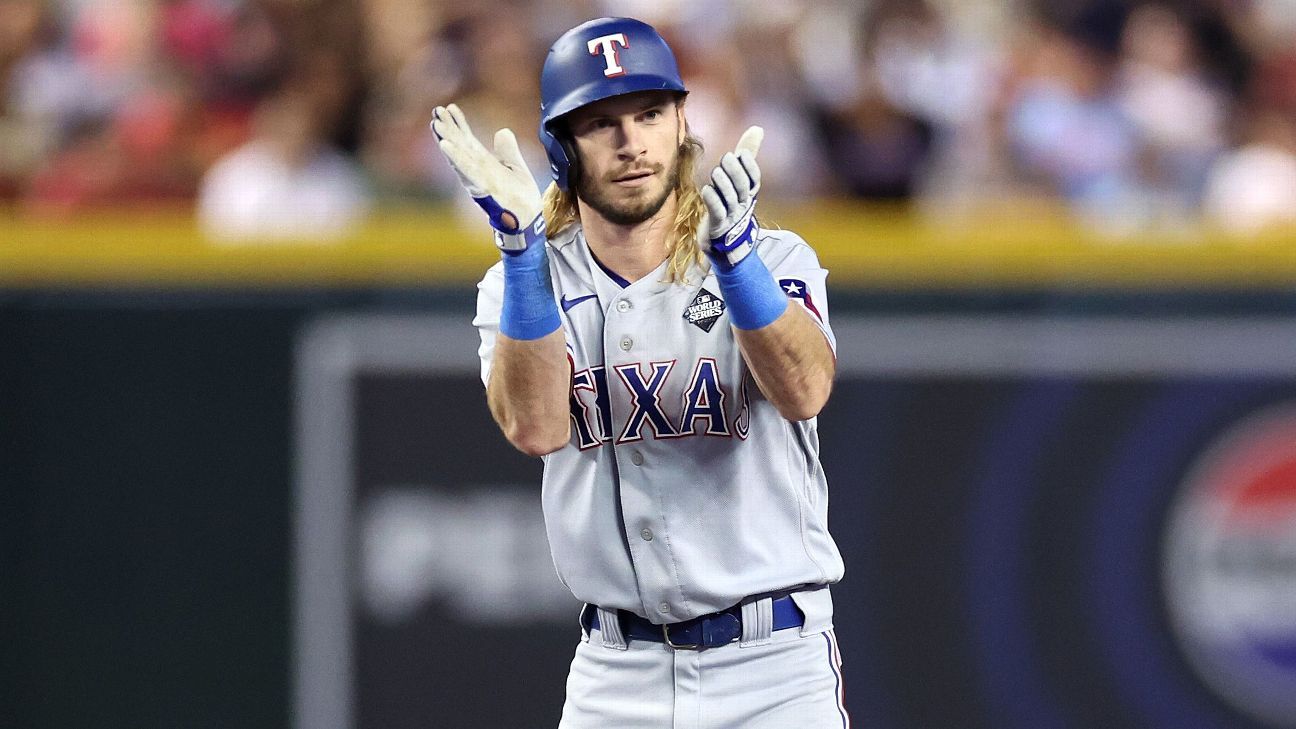
PHOENIX — Travis Jankowski is a long-haired, kinda-Spicolli-looking font of wisdom, the sort of guy who understands the soul of a baseball team because he spends more time observing than participating. When he signed a one-year, $1.25 million contract this spring with the Rangers, he expected to do what he’d spent most of his nine-year career doing: bringing some speed, some plate discipline and some good vibes. He did not expect to help save their season.
The first time it happened was April 12, when the Rangers’ all-everything shortstop, Corey Seager, hit the injured list with a strained hamstring. Some shuffling opened up an outfield spot for Jankowski, who spent most of his time in Seager’s No. 2 hole in the lineup. In the five weeks before Seager returned, all the Rangers did was lead Major League Baseball in runs scored.
On Tuesday, about an hour before Game 4 of the World Series, the Rangers announced that Adolis Garcia and Max Scherzer — their hottest hitter and erstwhile ace — would miss the remainder of the series with injuries. Jankowski would replace Garcia — ALCS MVP, Game 1 walk-off-homer author — in right field and slot in at the bottom of their lineup.
“When you’ve been through this, it’s a little easier,” Jankowski said. “We could’ve folded. That’s not us. I think everyone knows that by now.”
That much is clear after Game 4. The Rangers did the folding, shellacking the Arizona Diamondbacks in the early innings and weathering a tepid late rally to secure an 11-7 victory and move themselves to within one game of a World Series title. As much as was made of the losses of Garcia and Scherzer before Game 4, it was easy to forget the Rangers learned about the frailty of the human body and the strength of the human mind long before they were on the verge of winning their first World Series in 63 years of existence.
The domino effect from Seager’s injury — and the season-ending elbow surgery for ace Jacob deGrom and the dings that kept catcher Jonah Heim and third baseman Josh Jung and even Garcia out for extended periods during the regular season — fully prepared Texas for this. What their bodies lacked in any particular moment they made up for with an attitude that never leaned into any woe-is-me rhetoric.
The Rangers prefer whoa-is-me. And on the night that Seager hit another momentous and monumental home run to continue his postseason mastery, a night in which his keystone partner, Marcus Semien, busted out of a slump with a two-run triple and three-run homer in back-to-back innings, Jankowski did what he showed himself capable of in April. In the second inning, he feathered a single up the middle to keep the inning going. He followed the next inning with a bases-loaded double that scored a pair of runs and extended Texas’ lead to 7-0 — one that would grow to 10-0 one Semien swing later.
The Rangers are on the verge of winning the World Series because of this unrelenting offense that, after staying relatively quiet in the first three games of the series, feasted on Arizona’s bullpen. In the second and third innings, the Rangers put up five runs with two outs. A five-run inning in the World Series is uncommon. Back-to-back five-run innings never had happened. Consecutive five-run innings, all with two outs, probably never will happen again.
Texas understood that in order to feast, it needed to stop offering at the Diamondbacks’ bad pitches and maraud the good ones. After chasing on nearly 27% of Arizona’s pitches in the first three games, the Rangers cut that to 19.1% in Game 4. And with the Diamondbacks throwing significantly more pitches in the strike zone, Texas’ offense — which led MLB with 26 innings of five or more runs during the regular season — found itself.
“They don’t get swing happy,” Rangers hitting coach Tim Hyers said. “They stick to a plan. That’s what gives you competitive at-bats one after the other. But I think it starts with a good plan, but it also starts with they just don’t expand that much whenever they get the ball rolling.”
This wasn’t a ball. It was a boulder. Because this is how this Rangers offense has operated not just since the beginning of the postseason but the beginning of the season. The Rangers swing with the impertinence of Bamm-Bamm Rubble and the patience of a preschool teacher, marrying these divergent concepts and riding them to the verge of history. Texas’ 881 runs led the American League, and navigating this lineup, even without Garcia, is rife with peril.
“Think about it,” said Nate Lowe, the Rangers’ first baseman, who broke down the Rangers’ lineup in very simple terms:
“We have two MVP types hitting 1-2.” (Seager and Semien.)
“We had a playoff MVP cleaning up.” (Garcia.)
“We have an MVP-ceiling kid who’s stepping in to hit third.” (Evan Carter, who was in Double-A for almost the entirety of the season.)
“We have a Silver Slugger hitting fifth.” (DH Mitch Garver)
“The starting All-Star third baseman hitting sixth.” (Jung, whose three hits in Game 4 led Texas.)
“Another Silver Slugger hitting seventh.” (Lowe pointed to himself.)
“And then the All-Star starter at catcher hitting eight.” (Jonah Heim, whose eighth-inning home run Tuesday added Texas’ 11th run.)
“And a very quality leadoff hitter for arguably 29 other teams hitting ninth for us.” (Leody Taveras, whose walk against Diamondbacks closer Paul Sewald in Game 1 set up Seager’s epic game-tying ninth-inning home run.)
“So, yeah,” Lowe said, “when you spell it all out like that, it’s pretty easy to relieve pressure on one bat to know that there are eight others, and two or three other bench bats” — Jankowski, Robbie Grossman, Ezequiel Duran, Austin Hedges — “that are ready to come in.”
Which is why the Rangers offense, better than most, can weather the loss of a hitter even of Garcia’s quality. When they are not doing well, they’re still better than most, and when they are locked in, it is baseball in god mode. The Rangers got healthy before the postseason, and until Scherzer hobbled off the mound in Game 3 with a locked-up back and Garcia grabbed at his oblique in the eighth inning, they’d shown that the team that sprinted to the American League West lead — before those injuries hit, causing that lead to evaporate and almost costing them a postseason spot — still lived somewhere in that clubhouse.
Game 4 unleashed god mode again, and they clowned the Diamondbacks in the same way Arizona has those who dared to doubt them. Though the Diamondbacks walked here in glass slippers, only a fool would suggest they’re done. The Philadelphia Phillies made that mistake and are now watching the World Series on TV.
Besides, these are the Texas Rangers, among the most woebegone franchises in professional sports. They’ve either been bad or sad. The awfulness is pervasive. The melancholy is particularly acute, aged a dozen years, when they were one strike from winning the World Series.
This is a new team, though, a new era, with a new manager in Bruce Bochy, who has three rings, and a new franchise player in Seager, who’s got one, and a new appreciation for what all of the injuries taught them. And it doesn’t hurt to know that only six of 47 teams facing 3-1 World Series deficits have recovered to win.
The Rangers are not what they are — they are not here — without April and May giving them the opportunity to find out they can be just as good without even someone who feels integral to their success.
“That, to me, is kind of the motto of our team,” Jankowski said. “We got some boppers in the lineup, but we can’t rely on them all the time. It’s baseball. Crazy stuff happens. We need a team unit to win this whole thing. And that’s what I was in awe of.”

-
Kiley McDaniel
MLB held its fourth annual draft lottery at the winter meetings in Orlando on Tuesday, and the Chicago White Sox landed the No. 1 overall pick in the 2026 MLB draft.
It’s still very early in the draft process, but it’s a perfect time for a quick five-pick mini-mock draft to see how things could play out in July. Four of the five players in last winter’s edition of this exercise landed in the top 11 picks on draft day, so it’s fair to think we have a reasonable idea of how the top picks will play out even though a lot can change in the seven months ahead.
Here is my early prediction for the first five picks in the 2026 MLB draft, after consulting with industry sources combined with my own scouting.

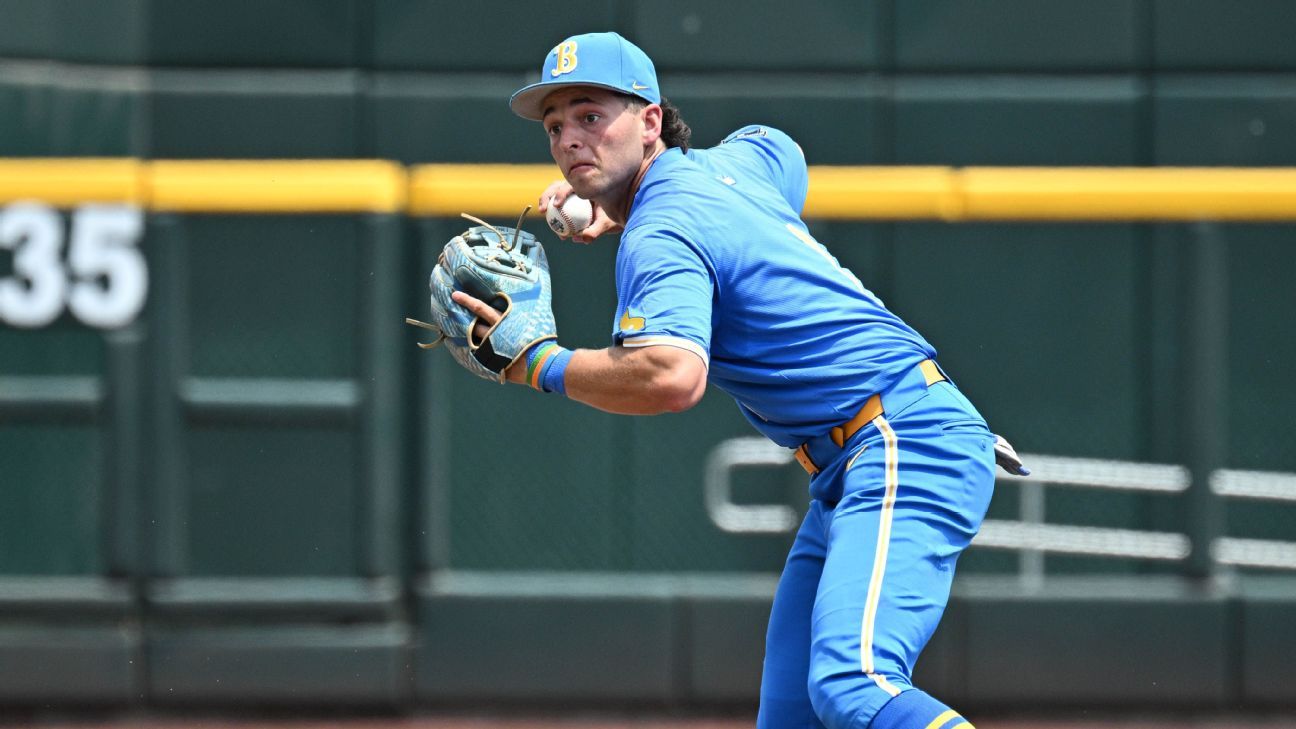
1. Chicago White Sox: Roch Cholowsky, SS, UCLA
Cholowsky was a big name in the 2023 draft, ranking 32nd on my final board as a standout defender with solid tools, but questions on his overall offensive upside along with a big asking price. His bonus price wasn’t met and he was solid as a freshman at UCLA, then took a huge jump forward as a sophomore, hitting 23 home runs last season.
He is still a standout defender but now both his (above-average) hit and (plus) power tools have developed, allowing evaluators to go back over the last decade and find comps at the tops of previous drafts, like Dansby Swanson or Troy Tulowitzki. Cholowsky has a pretty solid lead on the pack for the top pick right now, but it isn’t insurmountable due to the solid group of up-the-middle, high-upside talents in this class.
The lottery couldn’t have gone better for the White Sox after a 102-loss season, landing the top pick in a year where there is a clear preseason favorite to be the top pick. Chase Meidroth and Colson Montgomery are solid shortstop options in the big leagues with Caleb Bonemer and Billy Carlson as Top 100 types in the low minors, but Cholowsky would give the White Sox a great problem: too many good players at the most important position on the field.

2. Tampa Bay Rays: Grady Emerson, SS, Fort Worth Christian (Texas) HS, Texas commit
Emerson has been touted as the top prep prospect in the 2026 class for years and has held that title through the summer showcase season and fall workouts. He’s a 6-foot-2, left-handed hitting shortstop who projects as above average to plus at almost everything on the field. He may not be truly plus-plus at anything right now, but he’s still only 17 years old, so that could develop.
Given his long track record of being an elite prospect and being in the most desirable player demographic in the draft, he’s a consensus talent in this pick area, even for teams that don’t normally take high school players at the top. The Rays are not that team, taking a prep shortstop in the top two rounds in each of the last three drafts; Tampa Bay also loves left-handed hitters. Emerson is the rare prep prospect who is a safer pick than the vast majority of college players but also comes with more upside.

3. Minnesota Twins: Justin Lebron, SS, Alabama
Lebron was scouted as part of the loaded 2023 prep class alongside prep teammate Antonio Jimenez, who was a third-round pick of the Mets out of UCF in 2025. Lebron’s hitability and athleticism each jumped a tick right when he got to Tuscaloosa and the 6-foot-2 shortstop is now a plus runner, thrower and defender with above-average raw power. His pitch selection is fine with the only question being about his bat-to-ball ability due to worse-than-average miss rates last season, fueled somewhat by an uphill, power-driven approach. If Lebron can find a happy medium between his swing plane, contact and power, he could challenge Cholowsky as the top pick.
The Twins haven’t been scared of a little swing-and-miss if it comes with big upside in recent drafts, like with Billy Amick, Brandon Winokur and Quentin Young the last three years, but also love taking collegiate shortstops like Kaelen Culpepper, Marek Houston and Kyle DeBarge. Lebron threads the needle of certainty given his tools and positional profile but also untapped upside due to his contact/power balance being a little off kilter at the moment.

4. San Francisco Giants: Drew Burress, CF, Georgia Tech
Burress was a pick to click of mine in the 2023 draft, ranking 40th overall on my board (among the highest ranks among media and teams), but ultimately proving unsignable to the teams that also had him in that range. He stands only 5-foot-8, so impact power wasn’t expected at that point, but he had more power than you might think given his size, along with a long track record of hitting for average, plus speed and center-field defense.
Burress exploded at Georgia Tech, particularly when it comes to power — hitting 25 homers as a freshman then 19 in his sophomore year — fueled by what is now above-average raw power. He grades as above average or plus in all five tools, but his approach/swing is more power-oriented than in high school, so balancing his abilities at the plate in pro ball could be key to reaching his ceiling. The Giants have picked college position players with their top three picks each of the last two years and will likely be staring at a best available player from that same demographic in 2026.

5. Pittsburgh Pirates: A.J. Gracia, OF, Virginia
Gracia had almost no national scouting profile coming out of a New Jersey high school as a two-way player in 2023 before heading to Duke. He immediately showed scouts he should’ve been considered a real pro prospect out of high school, hitting .305 with 14 homers as a freshman, then following it up with more walks, fewer strikeouts and 15 homers as a sophomore. Gracia transferred to Virginia after the season, following much of the Duke coaching staff.
He is a 6-foot-3 center/right field tweener for now who is above average at almost everything in the batter’s box, especially his ability to lift/pull the ball in games, though his swing can get too uphill at times.
The Pirates seem to be turning the corner with Konnor Griffin and Bubba Chandler joining Paul Skenes and Co. while they’re also looking to spend money in free agency, so I see them leaning into the college position-player group that is a strength in this class.

-
Dan Murphy
After another week of frustrating setbacks, at the end of a frustrating year trying to bring stability to their industry, a growing number of college athletic directors say they are interested in exploring a once-unthinkable option: collective bargaining with their players.
Dozens of athletic directors will gather in Las Vegas over the next few days for an annual conference. They had hoped to be raising toasts to the U.S. House of Representatives. But for the second time in three months, House members balked last week at voting on a bill that would give the NCAA protection from antitrust lawsuits and employment threats. So instead, they will be greeted by one of the Strip’s specialties: the cold-slap realization of needing a better plan.
“I’m not sure I can sit back today and say I’m really proud of what we’ve become,” Boise State athletic director Jeramiah Dickey told ESPN late last week. “There is a solution. We just have to work together to find it, and maybe collective bargaining is it.”
Athletic directors see only two paths to a future in which the college sports industry can enforce rules and defend them in court: Either Congress grants them an exemption from antitrust laws, or they collectively bargain with athletes. As Dickey said, and others have echoed quietly in the past several days, it has become irresponsible to continue to hope for an antitrust bailout without at least fully kicking the tires on the other option.
“If Congress ends up solving it for us, and it ends up being a healthy solution I’ll be the first one to do cartwheels down the street,” said Tennessee athletic director Danny White when speaking to ESPN about his interest in collective bargaining months ago. “But what are the chances they get it right when the NCAA couldn’t even get it right? We should be solving it ourselves.”
Some athletic directors thought they had solved their era of relative lawlessness back in July. The NCAA and its schools agreed to pay $2.8 billion in the House settlement to purchase a very expensive set of guardrails meant to put a cap on how much teams could spend to acquire players. The schools also agreed to fund the College Sports Commission, a new agency created by the settlement to police those restrictions.
But without an antitrust exemption, any school or player who doesn’t like a punishment they receive for bursting through those guardrails can file a lawsuit and give themselves a pretty good chance of wiggling out of a penalty. The CSC’s plan — crafted largely by leaders of the Power 4 conferences — to enforce those rules without an antitrust exemption was to get all their schools to sign a promise that they wouldn’t file any such lawsuits. On the same day that Congress’ attempt crumbled last week, seven state attorneys general angrily encouraged their schools not to sign the CSC’s proposed agreement.
In the wake of the attorneys general’s opposition, a loose deadline to sign the agreement came and went, with many schools declining to participate. So, college football is steamrolling toward another transfer portal season without any sheriff that has the legal backing to police how teams spend money on building their rosters.
That’s why college sports fans have heard head football coaches like Lane Kiffin openly describe how they negotiated for the biggest player payroll possible in a system where all teams are supposed to be capped at the same $20.5 million limit. Right now, the rules aren’t real. The stability promised as part of the House settlement doesn’t appear to be imminent. Meanwhile, the tab for potential damages in future antitrust lawsuits continues to grow larger with each passing day.
Collective bargaining isn’t easy, either. Under the current law, players would need to be employees to negotiate a legally binding deal. The NCAA and most campus leaders are adamantly opposed to turning athletes into employees for several reasons, including the added costs and infrastructure it would require.
The industry would need to make tough decisions about which college athletes should be able to bargain and how to divide them into logical groups. Should the players be divided by conference? Should all football players negotiate together? What entity would sit across from them at the bargaining table?
On Monday, Athletes.Org, a group that has been working for two years to become college sports’ version of a players’ union, published a 35-page proposal for what an agreement might look like. Their goal was to show it is possible to answer the thorny, in-the-weeds questions that have led many leaders in college sports to quickly dismiss collective bargaining as a viable option.
Multiple athletic directors and a sitting university president are taking the proposal seriously — a milestone for one of the several upstart entities working to gain credibility as a representative for college athletes. Syracuse chancellor and president Kent Syverud said Monday that he has long felt the best way forward for college sports is a negotiation where athletes have “a real collective voice in setting the rules.”
“[This template] is an important step toward that kind of partnership-based framework,” he said in a statement released with AO’s plan. “… I’m encouraged to see this conversation happening more openly, so everyone can fully understand what’s at stake.”
White, the Tennessee athletic director, has also spent years working with lawyers to craft a collective bargaining option. In his plan, the top brands in college football would form a single private company, which could then employ players. He says that would provide a solution in states where employees of public institutions are not legally allowed to unionize.
“I don’t understand why everyone’s so afraid of employment status,” White said. “We have kids all over our campus that have jobs. … We have kids in our athletic department that are also students here that work in our equipment room, and they have employee status. How that became a dirty word, I don’t get it.”
White said athletes could be split into groups by sport to negotiate for a percentage of the revenue they help to generate.
The result could be expensive for schools. Then again, paying lawyers and lobbyists isn’t cheap either. The NCAA and the four power conferences combined to spend more than $9 million on lobbyists between 2021 and 2024, the latest year where public data is available. That’s a relatively small figure compared to the fees and penalties they could face if they continue to lose antitrust cases in federal court.
“I’m not smart enough to say [collective bargaining] is the only answer or the best answer,” Dickey said. “But I think the onus is on us to at least curiously question: How do you set something up that can be sustainable? What currently is happening is not.”
Players and coaches are frustrated with the current system, wanting to negotiate salaries and build rosters with a clear idea of what rules will actually be enforced. Dickey says fans are frustrated as they invest energy and money into their favorite teams without understanding what the future holds. And athletic directors, who want to plan a yearly budget and help direct their employees, are frustrated too.
“It has been very difficult on campus. I can’t emphasize that enough,” White said. “It’s been brutal in a lot of ways. It continues to be as we try to navigate these waters without a clear-cut solution.”
This week White and Dickey won’t be alone in their frustration. They’ll be among a growing group of peers who are pushing to explore a new solution.
-
 Sports2 years ago
Story injured on diving stop, exits Red Sox game
-
 Sports3 years ago
‘Storybook stuff’: Inside the night Bryce Harper sent the Phillies to the World Series
-
 Sports2 years ago
Game 1 of WS least-watched in recorded history
-
 Sports3 years ago
Button battles heat exhaustion in NASCAR debut
-
 Sports3 years ago
MLB Rank 2023: Ranking baseball’s top 100 players
-
Sports4 years ago
Team Europe easily wins 4th straight Laver Cup
-
 Environment3 years ago
Japan and South Korea have a lot at stake in a free and open South China Sea
-
 Environment1 year ago
Here are the best electric bikes you can buy at every price level in October 2024