
Premature babies evacuated from Gaza arrive in Egypt – as World Health Organisation warns they have ‘serious infections’


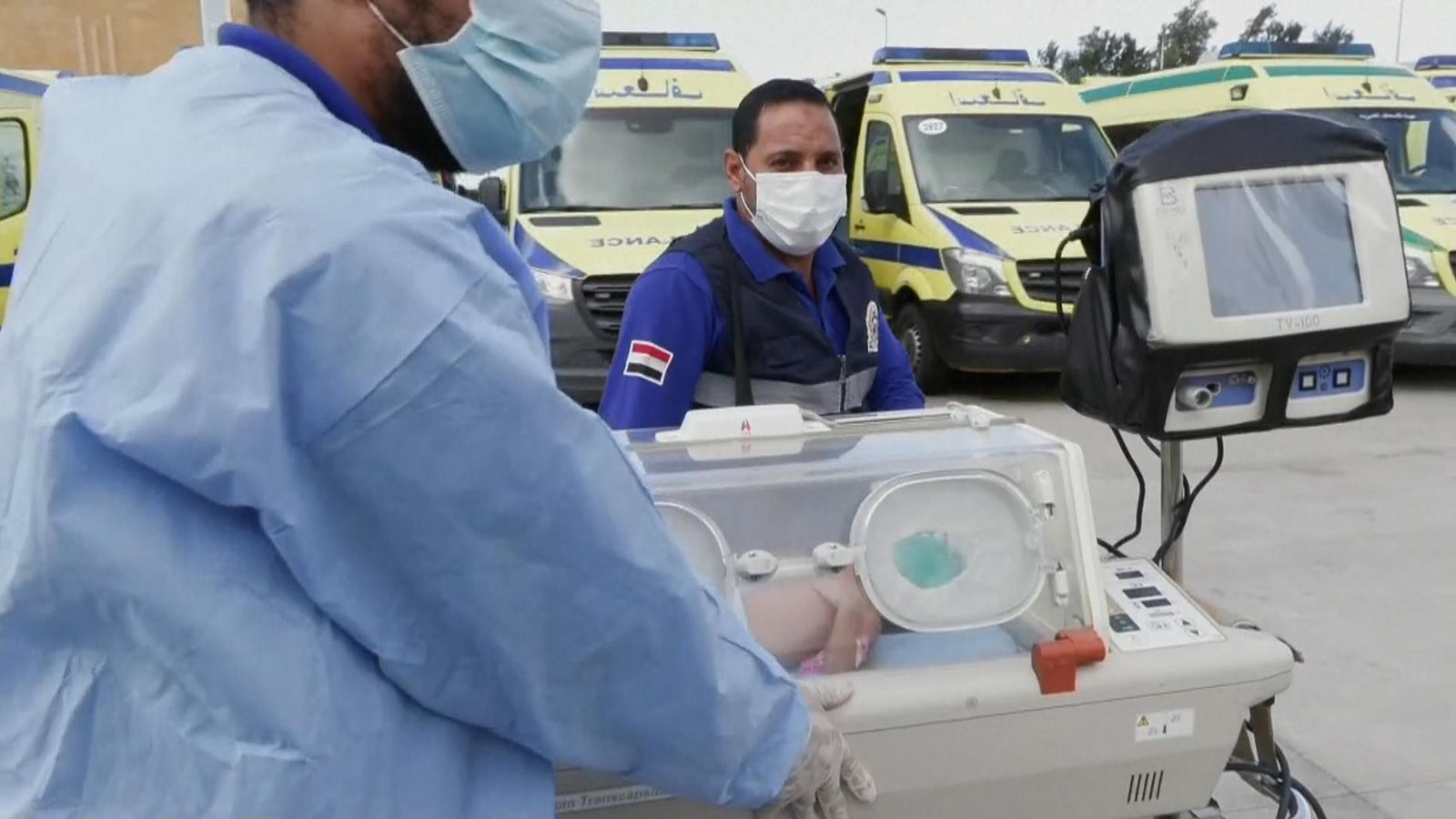
A first group of prematurely-born babies have arrived in Egypt for treatment after they were evacuated from Gaza’s biggest hospital.
The 28 infants were transported from the Emirati hospital in southern Gaza, having been removed from the besieged al Shifa hospital, according to the Palestinian Red Crescent and Egyptian media.
Footage on Egyptian TV showed medics lifting tiny infants from inside an ambulance and placing them in mobile incubators, which were then wheeled towards other ambulances.
Israel-Gaza latest: Tanks ‘200 metres from hospital’
Health officials initially said a total of 31 premature babies had been safely moved to the facility, but the World Health Organisation said three babies still remain at the Emirati hospital.
The premature babies were evacuated from al Shifa
The babies, who the World Health Organisation said have “serious infections”, will now be treated in Egyptian hospitals.
Four other babies died in the two days before the evacuation on Sunday, according to Mohamed Zaqout, the director of Gaza hospitals, amid a collapse in medical services partly caused by power cuts when fuel ran out.
Israel has been criticised for the number of civilian deaths reported in Gaza, with the Hamas-run health ministry claiming more than 12,000 Palestinians have been killed.
The Israeli military has come under particular scrutiny because of the impact on the territory’s hospitals.
Reports of fighting around another facility in northern Gaza on Monday have raised fears another evacuation will have to take place.
A shell struck the second floor of the Indonesian Hospital, where thousands of patients and displaced people have been sheltering, according to the Hamas-led health ministry.
The ministry claims at least 12 Palestinians were killed and dozens were wounded by firing into the complex, which was encircled by Israeli tanks.
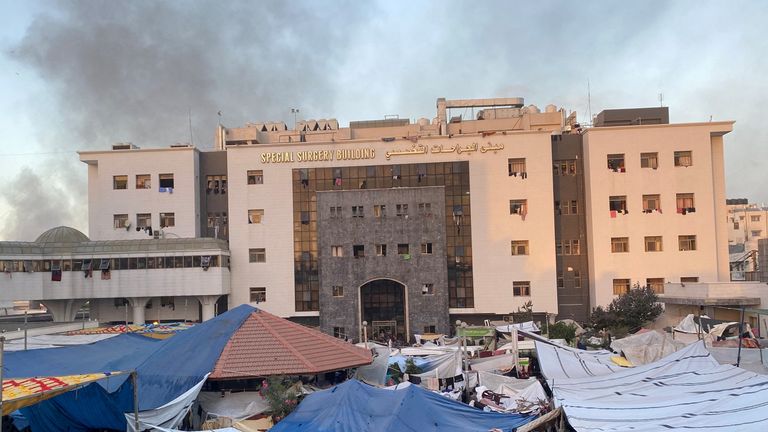
Smoke seen rising over the al Shifa hospital earlier in the conflict
Marwan Abdallah, a medical worker at the facility, told the AP news agency Israeli tanks were operating less than 200m from the hospital, and Israeli snipers could be seen on roofs nearby.
As he spoke over the phone, the sound of gunfire could be heard in the background.
Mr Abdallah said the hospital, which is among those forced to cease operations due to the fuel shortage, had received dozens of dead and wounded after airstrikes and shelling overnight.
Read more:
Israel presents most convincing evidence yet of Hamas activity at al Shifa
Israel has questions to answer after worrying Gaza hospital report
He said medical staff and displaced people fear Israel will besiege the hospital and force its evacuation.
Human Rights Watch warned hospitals have special protections under the laws of war and only lose that status “if it can be shown that harmful acts have been carried out from the premises”.
Israel claims Hamas uses civilians as human shields and operated a major command hub beneath al Shifa. Around 1,200 people were killed in the group’s 7 October attack, Israel says 0 with 242 taken back to Gaza as hostages.
Critics say Israel’s offensive amounts to collective punishment of the territory’s 2.3 million Palestinians.
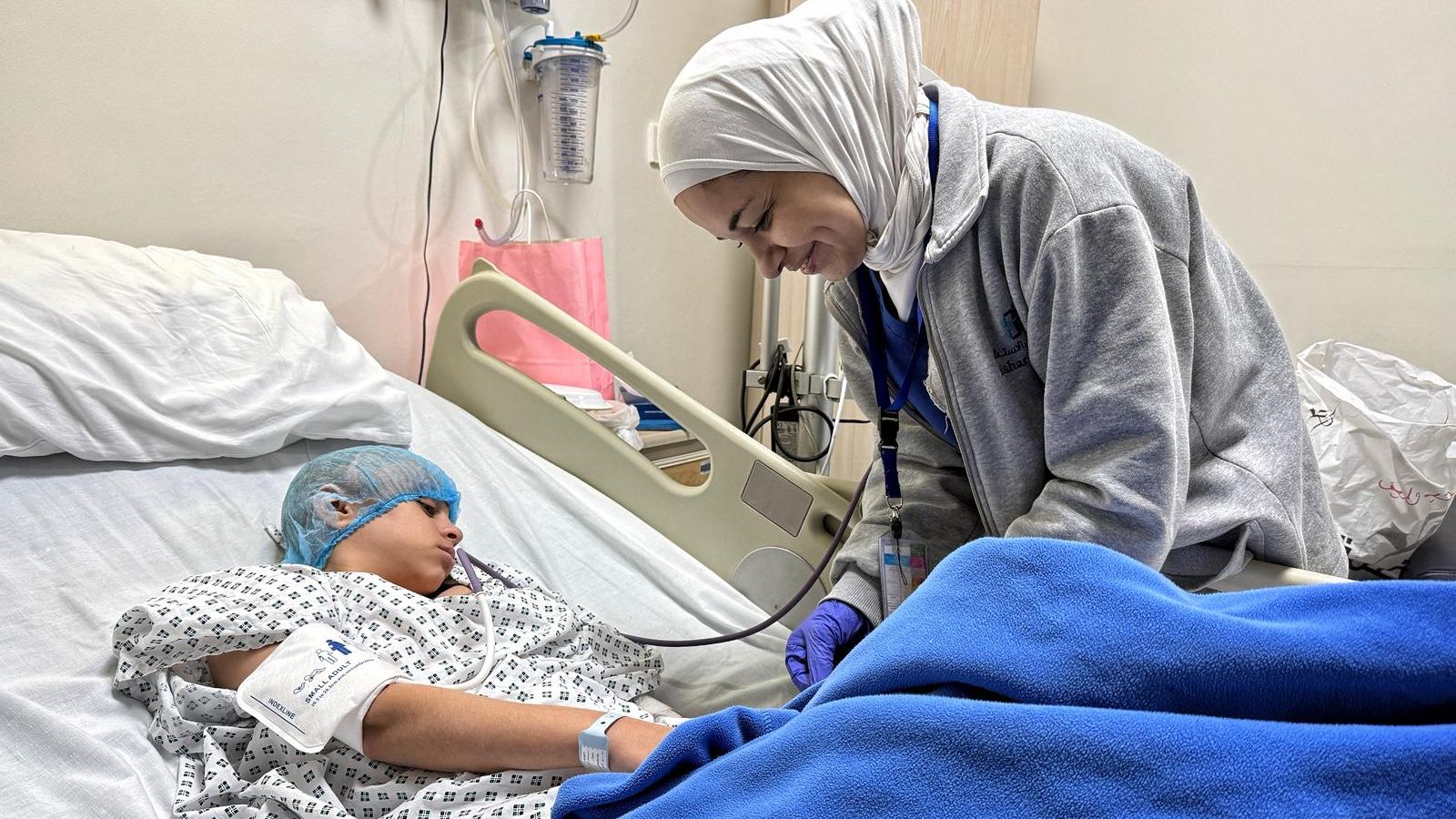
The 3D picture we’re shown of Maryam’s skull shows a gaping hole.
It’s astonishing the young girl from Gaza even survived an Israeli bombing near her home.
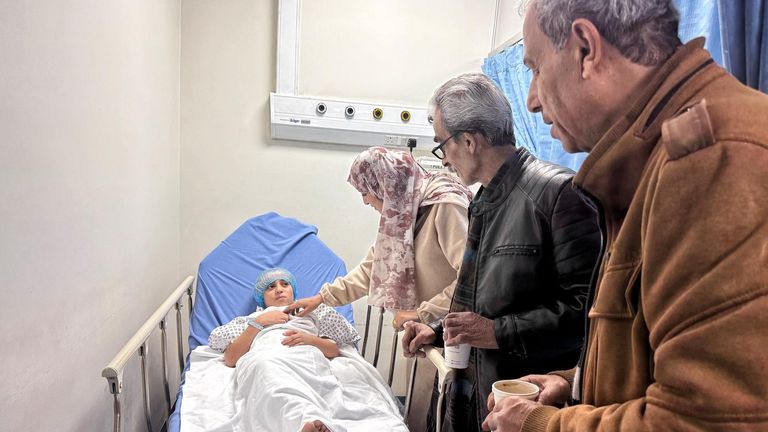
But she’s sitting up in her hospital bed in the Jordanian capital Amman, as we look on and she’s smiling and joking during a call with her father who remains in the Palestinian territory.
“I’m okay,” she says cheerily, “how are you?”
She’s heard overnight there’s been severe flooding in Gaza and the tents and makeshift shelters which tens of thousands are living in, are now soaked and under water.
But her father is focussed on how his 12-year-old daughter is feeling ahead of yet another life-saving brain operation.
Maryam is a rarity.
She is one of a few hundred patients who’ve been allowed by the Israeli authorities to leave the Gaza Strip to receive critical medical help since the October 2025 agreement signed between Israel and Hamas, which was aimed at ending hostilities.

The World Health Organisation (WHO) says they’ve identified nearly 16,000 medical cases needing urgent critical care outside Gaza.
WHO data documented a total of 217 patients who left Gaza for medical care in other countries between the dates of 13 October and 26 November 2025.
Since then, Israel’s Coordination of Government Activities in the Territories (COGAT) has said a further 72 patients and caregivers from Gaza have departed the Israeli-occupied area for Jordan.
But behind them, they left a long queue of ill and wounded people in desperate need of the sort of specialised medical help Maryam Ibrahim is receiving in Jordan.

Alex Crawford and Dr Samer Elbabaa
Having survived the bombing and having survived the craniectomy (removing her fractured skull), Maryam’s next challenge was surviving the wait to receive permission to leave Gaza for the surgery which offered her a chance of long-term survival.
She waited almost half a year for this operation: an operation considered vital.
Without it, Maryam’s brain was unprotected. Any stumble or accident risked irreversibly injuring her brain and negatively impacting her neurological functions – a risk which was considerably heightened given where she’s living.
The Palestine Children’s Relief Fund (PCRF) which has funded her medical care in Jordan says they’ve “witnessed at first hand the catastrophic toll of this conflict on children’s health and well-being.
“Thousands have been orphaned, maimed or left with lifelong trauma. Entire hospitals and health centres have been destroyed leaving an entire population of children without access to even the most basic medical care.”
While humanitarian organisations continue to encounter challenges in organising evacuations from Gaza, two British surgeons were amongst a group of medics refused permission by the Israeli authorities to enter the territory.
Dr Victoria Rose, a plastic and reconstructive surgeon with the IDEALS charity, told Sky News: “WHO calculated that in 2025, only 47% of emergency medical teams were granted entry to Gaza.
“This is at a time when hundreds of local doctors have been detained by the IDF with many still unaccounted for. Gaza does not have the manpower to cope with the numbers of injured.”

Maryam
Read more:
More children from Gaza to be brought to UK for urgent treatment
Rafah crossing to open ‘in coming days’, says Israel
Maryam’s case received widespread publicity after the intervention of the popular American children’s educator and YouTuber Rachel Griffin Accurso known as “Ms Rachel”.
She highlighted her case by talking to the little girl via Instagram after Maryam posted about how she was being bullied for her unusual appearance because of her cranial injury.
Maryam’s family realise she’s been unusually fortunate to receive this specialised care, but they know too that as soon as Maryam is well enough, the little girl will be returned to Gaza and an unpredictable future.
The Israeli authorities continue to insist via X that they are helping to organise humanitarian aid into Gaza and are committed to “facilitating a humanitarian-medical response” – which includes establishing field hospitals.
They have repeatedly suggested that it is the lack of coordination on the part of various countries and organisations which is the issue – but this runs counter to what multiple humanitarian groups and individuals have experienced.
Germany’s parliament has voted to reintroduce voluntary military service, but getting Gen Z recruits could prove tricky.
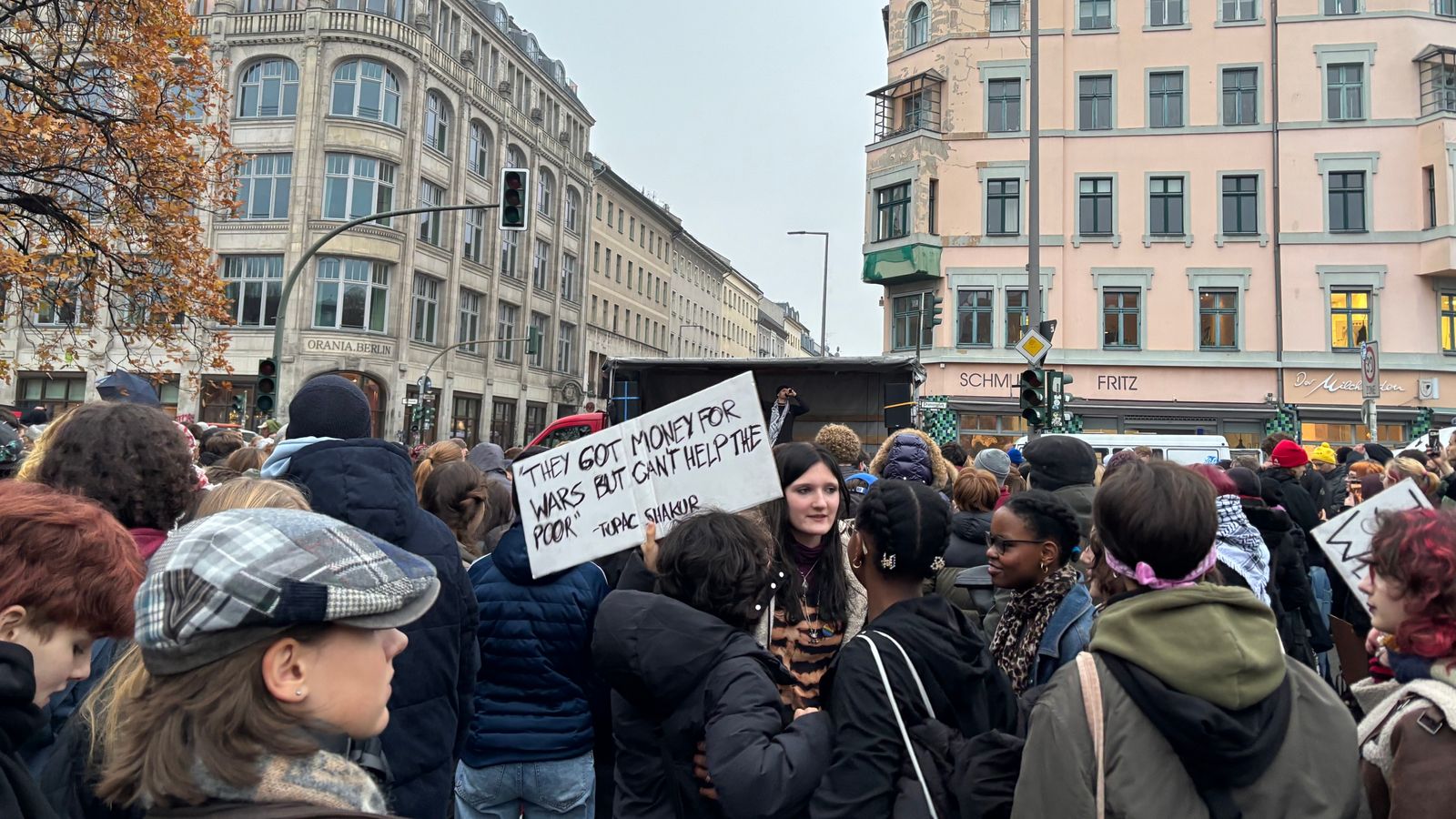
Across the country, students gathered to demonstrate against what they fear will be a return to conscription.
In Berlin, they held signs saying, “You can’t have our lives if we don’t eat your lies” and “peace is power”.
While most demonstrators were in their late teens or twenties, some parents also turned out with their younger children.
One mother held a placard declaring: “You can’t have my son”.
The new plan means from January, all 18-year-olds will be sent a questionnaire about their fitness and willingness to serve.
Men must fill it in, while for women it will be voluntary.
In the future, if the numbers of volunteers are too low, then parliament could trigger conscription at times of war or in emergencies.
It’s an idea which horrifies many in the crowd.
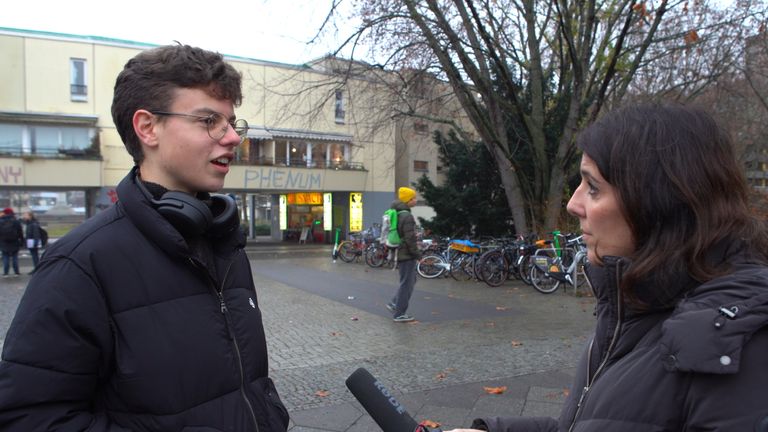
“None of us want to die for a country that doesn’t really care about us,” Levi tells me.
He says the government has ignored their calls for climate protections and better social conditions, so he feels no allegiance to them.
Levi
I ask: “If Germany was attacked, who do you think should defend it if Gen Z don’t want to?”
“Why don’t the people that started the war do it? I don’t see why the older people shouldn’t go to war. I mean, a lot of them already were in the army,” he replies.
17-year-old Sara agrees, declaring: “I would not be willing to die for any country.”
“I don’t think it’s right to send children or anyone against their will into the military, because war is just wrong,” she says.
“I’m never going to join the military and if Germany is attacked, I’ll just go somewhere else where there’s no war.”

Sara
While the government says the system will be voluntary for as long as possible, from 2027 all 18-year-old men will have to have a medical examination so the government can see who is fit to serve.
German defence minister Boris Pistorius says the mandatory medical is needed so that in the event of an attack, Germany would not waste time confirming “who is operationally capable as a homeland protector and who is not”.
The move is a massive cultural shift for Germany, which suspended mandatory military conscription on 1 July 2011.
“From my friends no one wants to volunteer because we don’t want to fight for a problem that’s not really ours. We didn’t start the problems, they [the government] did,” says Silas.
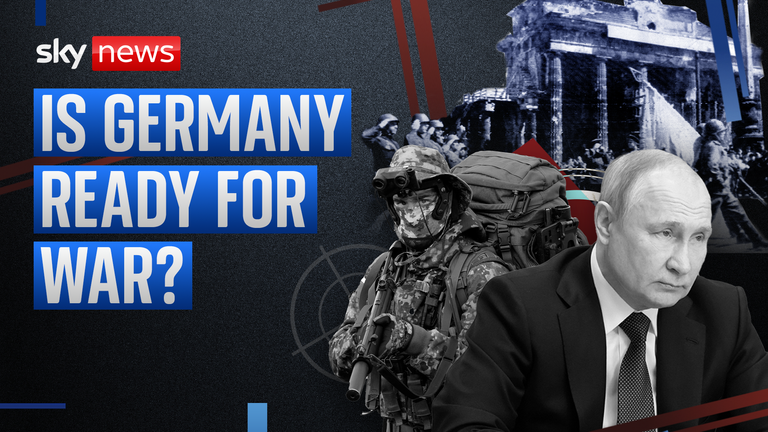
Sky’s Europe Correspondent Siobhan Robbins investigates.
The change is a direct reaction to Russia’s invasion of Ukraine
Despite Moscow’s denials, NATO’s chief has warned Russia could be able to attack a member country in the next four to five years.
I ask 19-year-old Lola if she’s thinks Russia is a threat?
“It could be, maybe. However, I think there are more important issues, especially like social ones, than war,” she says.

Lola
Her friend, 28-year-old Balthasar, goes further, saying: “A country being able to attack isn’t the same as a country planning to attack.
“The track record of Russia has been to attempt at least diplomatic resolution, cooperation, and I think those are the right approaches to take in international politics, opposed to sabre-rattling, which the German government has resorted to.”
The German chancellor, Friedrich Merz, has said he wants to build the strongest army in Europe.
Germany currently has around 184,000 soldiers and wants to boost that by over 80,000 in the next decade.
Read more from Sky News:
Irish police investigating drone sightings during Zelenskyy visit
Giving up Ukrainian territory would be ‘unjust peace’
Volunteers are being offered incentives like a monthly wage of more than €2,000 (£1,750).
Despite this, a survey earlier this year found 81% of Gen Z wouldn’t fight for Germany.
In contrast, many of the older generation supported conscription.
At the Berlin protest, 17-year-old Valentin was the only person we met who reluctantly agreed to fight.
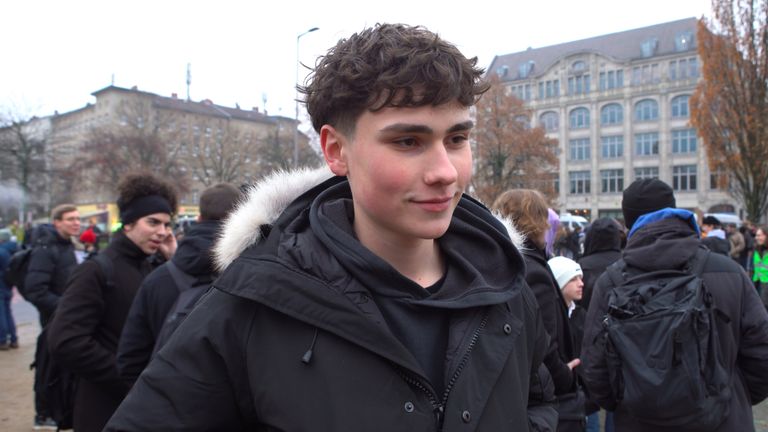
Valentin
“When we are attacked, then yes [I would fight], but when we are attacking other countries, then no,” he says.
Germany isn’t the only country looking for reinforcements, last month France announced a new military service for over-18s.
Currently, 10 EU countries already have compulsory military service.
While others like Belgium, the Netherlands and Germany are opting for voluntary schemes.
The German plan still must be signed off by parliament’s upper house later this month before it’s expected to start in January.
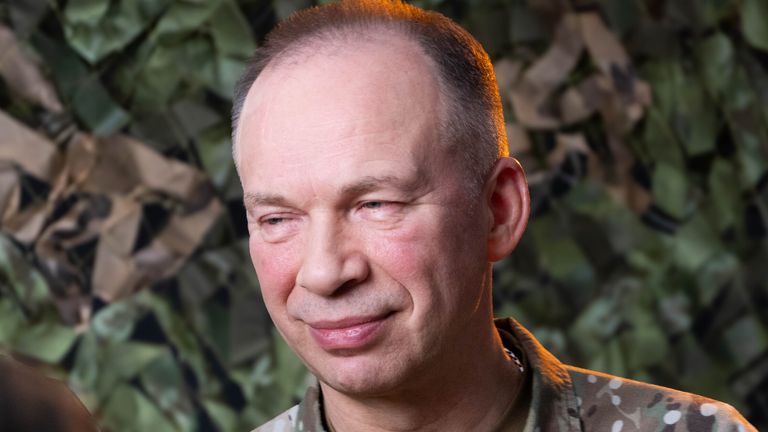
It would be “unacceptable” for Ukraine to “simply give up territory” in any peace deal with Russia, the head of the Ukrainian armed forces has told Sky News.
General Oleksandr Syrskyi said a “just peace” can only be achieved if fighting is halted along current frontlines and then for negotiations to take place.
Signalling a complete lack of trust in claims by the Kremlin that it wants to end its war, he accused Vladimir Putin of using an attempt by Donald Trump to broker peace talks as “cover” while Russian troops try to capture more land by force on the battlefield.
General Oleksandr Syrskyi said Russia is using peace talks as ‘cover’ to grab more Ukrainian territory
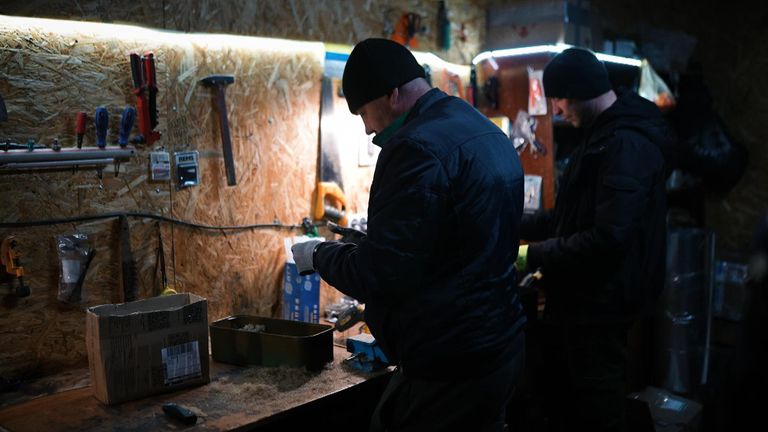
What Ukrainian troops think about giving up Donbas
The rare intervention offers the clearest indication yet of the Ukrainian military’s red lines as Washington tries to negotiate a settlement that – according to an initial draft – would require Kyiv to surrender the whole of the Donbas region in the east of the country to Moscow.
President Volodymyr Zelenskyy, backed by the UK and other European allies, has been trying on the diplomatic front to strengthen Ukraine’s position.
But President Putin has said Russia would either seize the Donbas militarily or Ukrainian troops would have to withdraw.
Europe’s fate at stake
Speaking frankly, General Syrskyi, commander-in-chief of the armed forces of Ukraine, signalled that his country’s soldiers would fight on if diplomacy fails – and he warned that the fate of the whole of Europe is at stake.
In an exclusive interview in the basement of a building in eastern Ukraine – the location of which we are not disclosing for security reasons – he said Ukraine’s main mission “is to defend our land, our country, and our population”.
“Naturally, for us it is unacceptable to simply give up territory. What does it even mean – to hand over our land? This is precisely why we are fighting; so we do not give up our territory.”
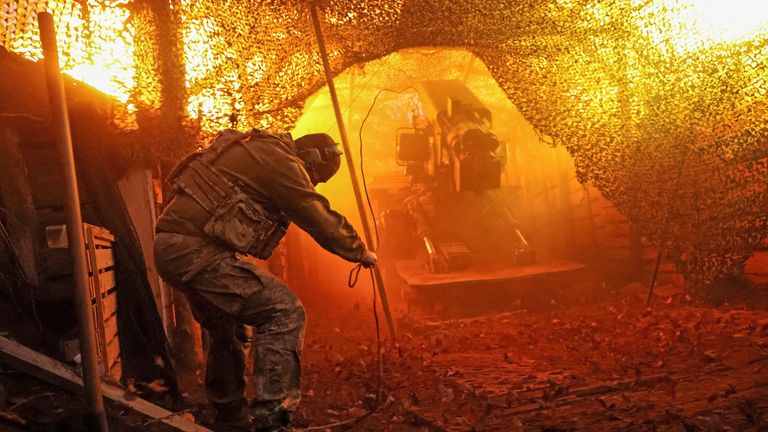
A Ukrainian soldier fires a self-propelled howitzer in Kostiantynivka in Donetsk. Pic: Reuters
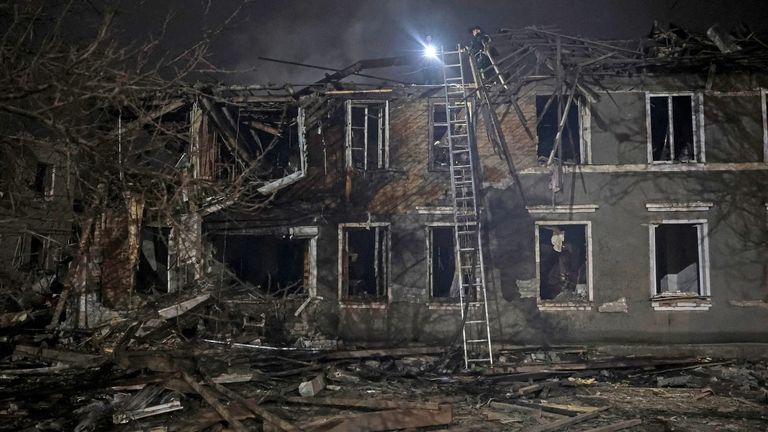
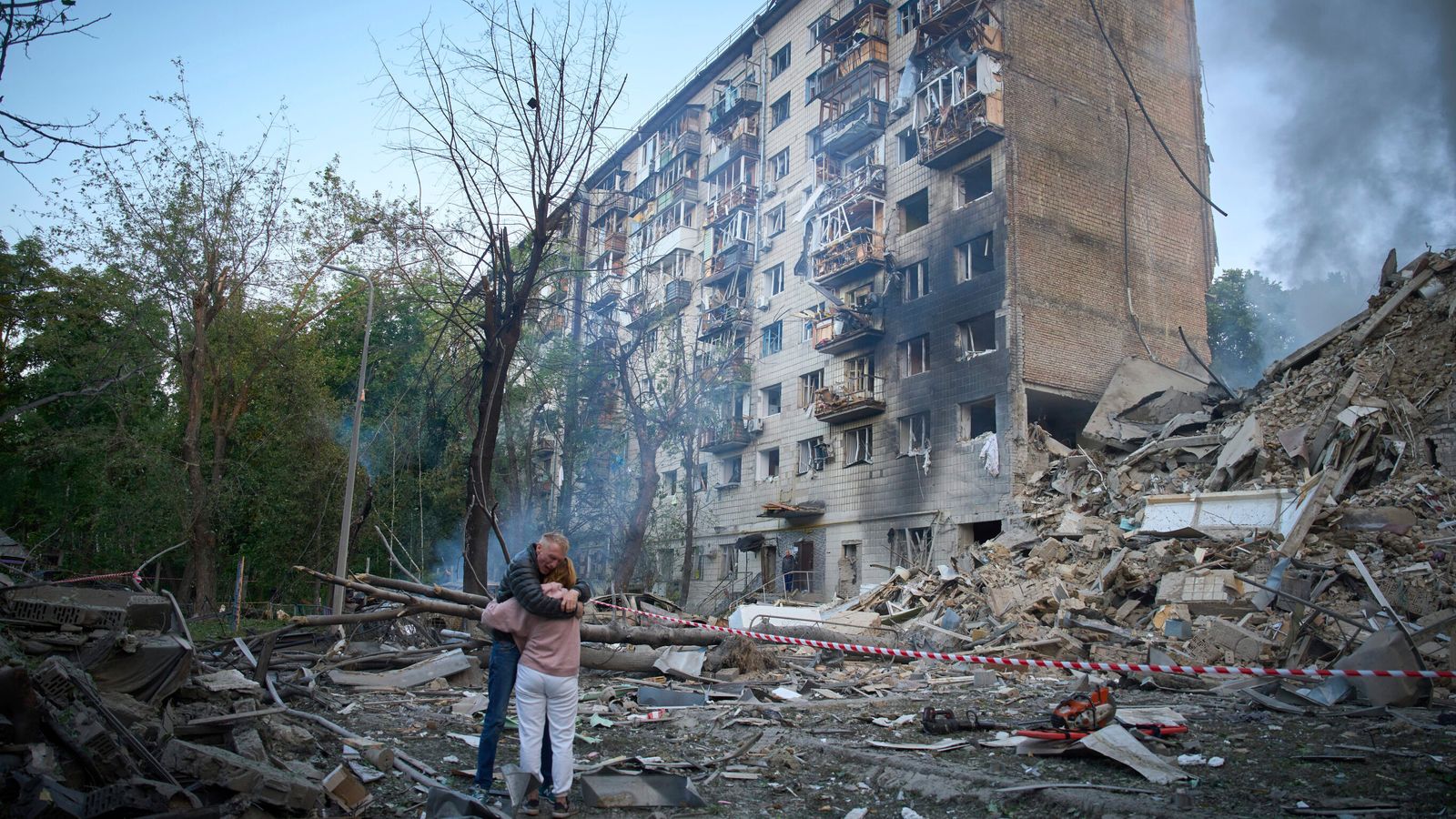
Rescuers work at the site of apartment buildings hit by a Russian airstrike in Sloviansk, Ukraine. Pic: Reuters
Many troops have died fighting for Ukraine since Russia first seized the peninsula of Crimea and attacked the regions of Donetsk and Luhansk, which comprise the Donbas, in 2014.
Hundreds of thousands of Ukrainian civilians were then mobilised to fight alongside professional soldiers following Putin’s full-scale invasion in February 2022.
Russia well short of original goal
Nearly four years on, Russia occupies almost a fifth of Ukraine, including large parts of the Donbas, but well short of an original goal of imposing a pro-Kremlin government in Kyiv.
Asked whether the sacrifice of those people who gave their lives defending their country would be in vain if Ukraine is forced to hand over the land it still controls in the Donbas to Moscow, General Syrskyi, speaking in Ukrainian through a translator, said: “You know, I do not even allow myself to consider such a scenario.
“All wars eventually end, and of course we hope ours will end as well. And when it does, a just peace must be established.
“In my understanding, a just peace is peace without preconditions, without giving up territory. It means stopping along the current line of contact.”

Ukrainians not surprised about lack of progress in peace talks
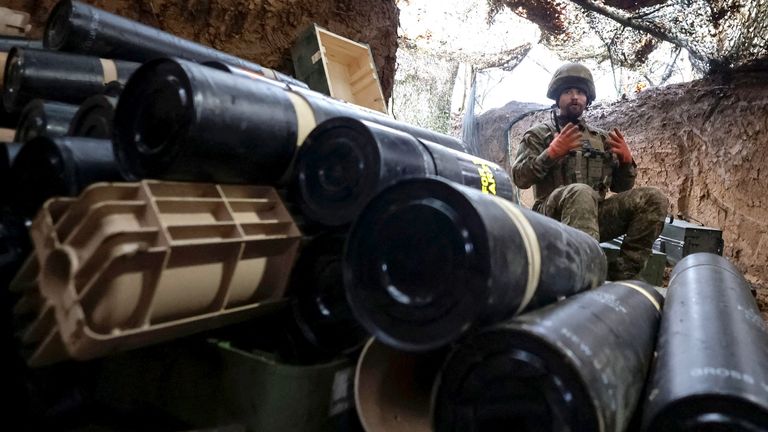
Pic: Reuters
The commander then broke into English to say that this means: “Stop. A ceasefire. And after that negotiations, without any conditions.”
Switching back into Ukrainian, he said: “Any other format would be an unjust peace, and for us it is unacceptable.”
Ukraine’s contingency plans
While Ukraine’s will and ability to fight are key in confronting Russia’s much larger army, so too is the supply of weapons, ammunition and other assistance from Kyiv’s allies, most significantly the US.
But, with the White House under Donald Trump, becoming less predictable, the Ukrainian military appears to be considering contingency plans in case US aid stops.
Asked whether Ukraine would be able to continue fighting if President Trump did halt support, General Syrskyi said: “We are very grateful to our American partners and all our allies who have been supporting us throughout this war with weapons and equipment.
“We hope they will continue providing full support. But we also hope that our European partners and allies, if necessary, will be ready to provide everything required for our just war against the aggressor.
“Because right now we are defending not only ourselves, but all of Europe. And it is crucial for all Europeans that we continue doing so, because if we are not here, others will be forced to fight in Europe.”
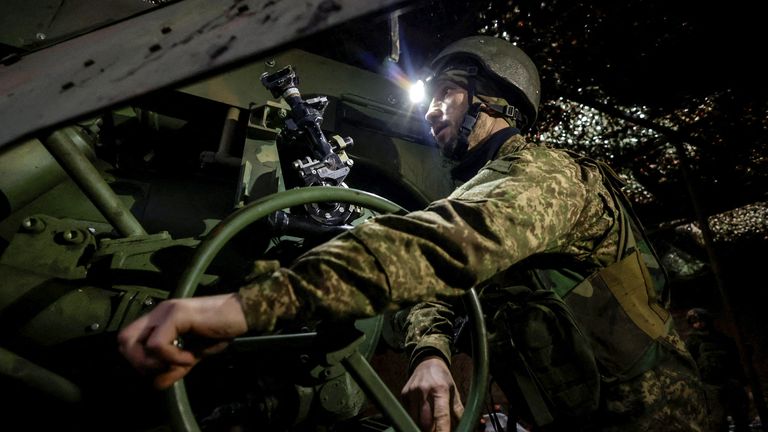
Pic: Reuters
General’s assessment of fighting on ground
A decorated commander, with the call sign “snow leopard”, General Syrskyi has been conducting combat operations against Russia’s invasion for more than a decade.
He was made military chief in February 2024 after President Volodymyr Zelenskyy sacked the previous top commander. General Valerii Zaluzhnyi is now Kyiv’s ambassador to London.
General Syrskyi offered his assessment of the fight on the ground, saying:
• Ukrainian troops still control the northern part of the fortress city of Pokrovsk in the Donbas and will keep battling to retake the rest of it, contrary to Russian claims to have captured what has been a key target for Moscow for the past 16 months.
• Russia is firing between 4,000 to 5,000 one-way attack drones at Ukrainian positions along the frontline every day as well as 1,500 to 2,000 drones that drop bombs. But Ukraine is firing the same volume – and even more – back. “In terms of drones, there is roughly parity. At the moment, we are deploying slightly more FPV [first person view] drones than the Russians.”
• Russia’s armed forces still have double the volume of artillery rounds of Ukraine’s, but the range and lethality of drone warfare mean it is harder to use artillery effectively. Now, 60% of strikes are carried out by drones.
• More than 710,000 Russian soldiers are deployed along a frontline that stretches some 780 miles (1,255km), with the Russian side losing around 1,000 to 1,100 soldiers a day, killed or wounded “and a majority are killed”.
The Russian army is currently “attempting to advance along virtually the entire frontline,” General Syrskyi said.
Where are the harshest battles?
The fiercest battles are around Pokrovsk, as well as the northeastern city of Kupiansk, in Kharkiv region, the Lyman area, also in the Donbas, and near a small city called Huliaipole, in the Zaporizhzhia region of southeastern Ukraine.
“The Ukrainian army is conducting a strategic defensive operation, aiming to contain the enemy’s advance, prevent them from breaking deeper, inflict maximum losses, and carry out counter-offensive actions in those sectors where we see the enemy is vulnerable,” the commander said.
“Our strategy is to exhaust the Russian army as much as possible, prevent its advance, hold our territory, while simultaneously striking the enemy in the near rear, the operational depth, and… into Russia itself, with the aim of undermining its defence capability and industrial capacity.”
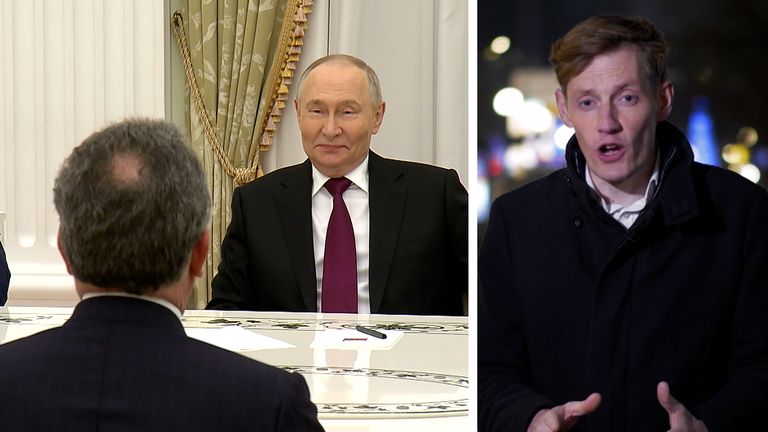
Peace deal: Russia ‘in no mood to compromise’
He is referring to a capability Ukraine has developed to launch long-range drones, laden with explosives, deep into Russia to strike military targets as well as oil refineries.
The operation is aimed at destroying fuel for the tanks, warships and jets that are attacking Ukraine and – crucially – reducing oil revenues that help to fund Russia’s war machine.
Sea drones crash into Russia’s warships
The Ukrainian military is also deploying explosive sea drones that are smashed into Russian warships as well as tankers used to transport sanctioned Russian oil.
Asked if his forces were ready – and had sufficient manpower – to keep fighting if necessary, General Syrskyi said: “We have the resources to continue conducting military operations.”
Yet Ukraine is suffering from a shortage of troops on the frontline.
Soldiers and wider society are also exhausted and facing another winter of war.
No sign of Moscow winding down war effort
President Putin has an advantage when it comes to troop numbers and firepower over time, which makes continued support to Kyiv from its allies more vital than ever.
General Syrskyi cautioned that Moscow showed no sign of winding down its war effort despite the Russian leader telling President Trump he is prepared to negotiate.
Read more on Sky News:
Hugs ahead of India-Russia talks
New Russia sanctions ‘pointless’
“So we do everything so that if the enemy continues the war, and you can see that although we want peace, a fair peace, the enemy continues its offensive, using these peace talks as cover,” he said.
“There are no pauses, no delays in their operations. They keep pushing their troops forward to seize as much of our territory as possible under the cover of negotiations.”
He added: “So we are just forced to wage this war… protecting our people, our cities and towns, and our land.”
The commander said this is what motivates his soldiers.
“If we do not do this, we can see clearly what the Russian army leaves behind, only ruins, only deaths.”
As for whether the UK and other European nations should be preparing their people for the possibility of a wider war with Russia, the general said: “Of course, the armed forces of every country ensure reliable protection of their citizens, their children, and their territory.
“With the existence of aggressive states, above all the Russian Federation and its allies, this issue is extremely urgent.
“Everything must be done to ensure the capability to maintain a level of defence, and armed forces modern enough to repel aggression, both individually and in support of the allies.”
-
 Sports2 years ago
Story injured on diving stop, exits Red Sox game
-
 Sports3 years ago
‘Storybook stuff’: Inside the night Bryce Harper sent the Phillies to the World Series
-
 Sports2 years ago
Game 1 of WS least-watched in recorded history
-
 Sports3 years ago
Button battles heat exhaustion in NASCAR debut
-
 Sports3 years ago
MLB Rank 2023: Ranking baseball’s top 100 players
-
Sports4 years ago
Team Europe easily wins 4th straight Laver Cup
-
 Environment3 years ago
Japan and South Korea have a lot at stake in a free and open South China Sea
-
 Environment1 year ago
Here are the best electric bikes you can buy at every price level in October 2024