
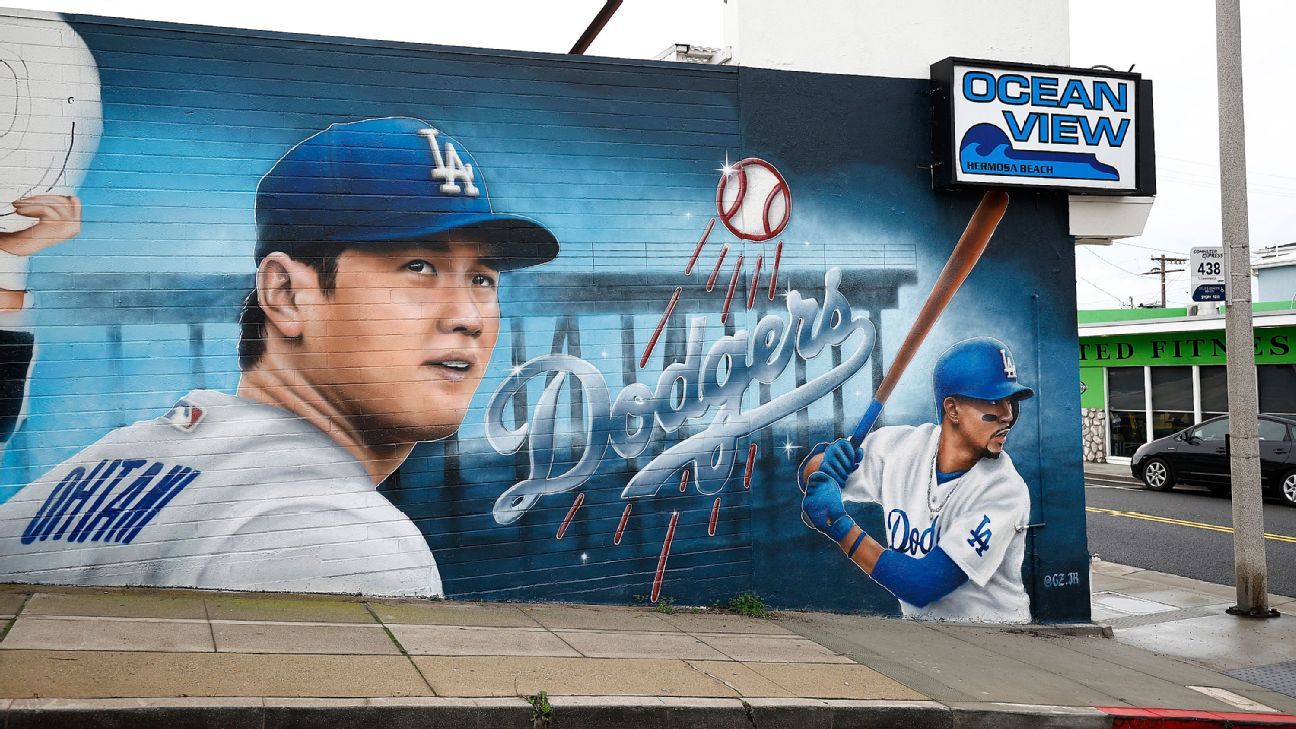
Passan: The Dodgers built a superteam — but that doesn’t mean they’ll win it all


-
Jeff Passan, ESPN
They’ve been plotting this for years. Plans, of course, fall apart all the time, whether they’re for dinner or a meeting or taking over the entire baseball world by signing the best player anyone’s ever seen to the biggest contract anyone’s ever received and then chasing that less than two weeks later with the largest deal a pitcher ever has gotten. For it all to line up so spectacularly for the Los Angeles Dodgers — for this superteam to assemble and take aim on the game — left the people around baseball dazed and woozy from the scale of it all.
First they guaranteed two-way star Shohei Ohtani a 10-year, $700 million contract. They followed Thursday by giving his Japanese cohort Yoshinobu Yamamoto, who has not thrown a pitch in the big leagues, $325 million over 12 years. After a brief moment of austerity — $50 million in free agency on only one-year contracts last winter — the Dodgers lavished more than $1 billion on two players. And now, in 2024 and beyond, they are going to be very, very good.
Their lineup features the reigning MVP, two more future Hall of Famers in Mookie Betts and Freddie Freeman, plus catcher Will Smith, center fielder James Outman and slugger Max Muncy. They entered the winter with Bobby Miller, a rookie this year, as the only lock for their 2024 rotation. Now they’ve got Yamamoto to start Opening Day against the San Diego Padres in Seoul and Tyler Glasnow, whom they acquired in a trade with the Tampa Bay Rays and signed to a five-year, $136.5 million extension, to pitch the second game of the season’s opening series.
They will, undoubtedly, be a force in the National League West, almost certainly its champion next year. Then come 2025, when Ohtani returns from his second Tommy John surgery and presumably joins the rotation, the Dodgers will be that much better. This causes understandable consternation for fans in smaller markets like Pittsburgh and Kansas City, whose entire franchises aren’t worth a whole lot more than the Dodgers guaranteed Ohtani, Yamamoto and Glasnow. The whole sport, frankly, is on tilt. Even the New York Yankees, New York Mets and San Francisco Giants, all of whom pursued Yamamoto with vigor, wound up jilted because they could not offer the combination of money, sunshine and rejoining Ohtani, who captained Yamamoto and the rest of Team Japan to the World Baseball Class title this spring and intends to replicate that many times over with the Dodgers.
Easy as it might be for anyone outside of Los Angeles County to panic, stew, lament, fret and bemoan the current state of affairs in Major League Baseball — to crown the Dodgers, bleat about the lack of a salary cap and swear off the game altogether — such frustrations do not reflect a reality about the modern game and the place of superteams in it.
Here’s the beauty of baseball: Simply put, these teams haven’t won in the wild card era.
For every successful superteam like the late-’90s Yankees — the last to win consecutive World Series — there are multiple cases of others that didn’t win at all (Cleveland in the mid-to-late-’90s), won far less frequently than they ought to have (Atlanta just once in its 14-straight-division-title run from 1991 to 2005) or saw their fortunes run inverse with their superness. The 1997 Seattle Mariners, with three Hall of Famers (Ken Griffey Jr., Randy Johnson, Edgar Martinez) and another all-time great (Alex Rodriguez), won 90 games. Four years later, without Griffey, Johnson and A-Rod, Seattle booked an MLB-record 116 victories.
The sport’s playoff structure, now at 12 teams with a five-game series followed by a pair of seven-game series, makes the game almost superteam-proof. This is not the NBA, where three star players can breed a dynasty. This is not the NFL, where one elite quarterback can buoy a decade of championship aspirations. This is baseball, where the laughable disparity in payrolls hasn’t translated to the same teams vying for titles year in, year out.
Over the past decade, 14 baseball organizations have made the World Series and nine different teams have won — the most champions of any major men’s North American team sport. The NHL had one more team in the Stanley Cup Final (15) but one fewer winner (eight). Both were far better than the NFL (11 teams, seven winners) and NBA (10 teams, five winners). Go out a quarter-century and MLB continues to hold its own despite being the only uncapped league of the four. More baseball teams have won championships in that stretch (16) than the NHL (14), NFL (13) and NBA (11). And only the NHL has a higher percentage of teams that have competed for a title than baseball, which has seen 20 of its 30 franchises in the World Series over the past 25 years.
Just look at another attempted superteam of recent vintage: the 2021 Dodgers. They won a championship the year before, with Betts and Corey Seager in their lineup, a rotation with Clayton Kershaw, Walker Buehler and Julio Urías. And coming off that title, they struck at the trade deadline by adding all-world shortstop Trea Turner and future Hall of Famer Max Scherzer. It led to 106 wins in the regular season — and an October exit after six National League Championship Series games against eventual champion Atlanta. The next year, 111 wins and a 3-1 defeat in the division series to the San Diego Padres. Last season? A 100-win team that got swept in the division series by an 84-win Arizona team with barely half the payroll. The Diamondbacks rolled through the NL and ran into the Texas Rangers and Seager, who won another World Series MVP award.
If that’s not convincing enough, let’s talk money. Over the past 10 years, the Dodgers have outspent the next-highest-spending team in baseball, the Yankees, by a little more than $100 million total — and those two seeming juggernauts, with a combined outlay of nearly $5.1 billion during that decade-plus, won a grand total of one World Series championship between them. The Yankees didn’t make the World Series once.
In the same decade, the organization that spent the most money in free agency advanced past the division series just once. Similarly, the team with the largest disbursements over the winter — free agents plus re-signing their own players — missed the playoffs more often than they made it; only the Dodgers won the World Series, in the 2020 COVID-19 season. The list of disappointments is far longer. Between extensions and new additions last offseason, San Diego guaranteed $894.3 million, a sum not terribly dissimilar from the Dodgers’ this year. And for that, the Padres went 82-80 and sat out October. The New York Mets attempted to assemble a superteam this year. They flopped, moved six players at the trade deadline and finished 77-85 with the largest payroll in the game’s history.
None of this is out of the realm of possibility for the Dodgers. The deals for Ohtani, Yamamoto and Glasnow all carry significant levels of peril. Even if the deferrals in Ohtani’s deal limit the downside, the Dodgers still committed about $450 million in present-day dollars to a player whose value depends heavily on his ability to excel with a twice-repaired pitching elbow. The Dodgers guaranteed Yamamoto, 25, more than the Yankees paid for Gerrit Cole, currently the best pitcher in the big leagues. Glasnow’s career high for innings in a season is 120, and Los Angeles gave him frontline-starter money for half a decade.
What superteams generate in disillusionment they make up for in sundry ways. For fans of good baseball, they provide. For fans of good drama, they abide. As difficult a concept as it might be to reconcile, baseball writ large needs the sort of cultural resonance the Dodgers can supply.
They will fulfill that need for a villain, an enemy. Wins against the Dodgers mean that much more now with Ohtani, Yamamoto and Glasnow in the fold. The joy that comes from beating the Yankees exists because of their utter dominance in the first half of the 20th century: the best team ever in 1927, four straight World Series wins and six in eight years from 1936-43, five consecutive championships from 1949-53. The Yankees built themselves into one of the biggest juggernauts in sports by erecting generations of superteams — in the days when building a team that could win the pennant meant a direct path to the World Series.
The Dodgers, by comparison, have just one title in the past 45 years. But they have become a new kind of superteam, the best-run organization in baseball by a wide margin. They draft exceptionally well. They thrive signing international amateurs. Their player-development system is second to none. They crush analytics. They live on the cutting edge of performance science. And because they’re so good in all of those areas, it affords them the ability to take more chances in free agency than their moneyed contemporaries who aren’t as good.
After all, the Giants and Toronto Blue Jays were asked whether they would match Ohtani’s deal and said yes. The Mets offered Yamamoto the same terms as the Dodgers. Ohtani and Yamamoto chose this team for more than the might of its massive TV deal and all the other revenue it creates.
The Dodgers are a machine, and that they can take a 100-win team and upgrade it with players of this caliber speaks to how well-oiled the machine really is. And perhaps that’s why fans are so up in arms about Ohtani, Yamamoto and Glasnow. Already the Dodgers do everything well. And now they get these guys on top of that?
The resentment is understandable. Fairness is a carrying characteristic in sports, and something about one team handing out two of the biggest deals in sports history in the same month can leave an acrid aftertaste. But that’s where there’s solace in history, in numbers, in logic, in all of the things that prompt you to say maybe this is a superteam — and maybe that’s just fine.

-
Bill Connelly
The 2025 College Football Playoff got underway in Norman, Oklahoma, on Friday night, and we’ve already seen a first. After all four home teams won by demonstrative margins in last year’s first round, Alabama became the first road team to prevail in a playoff game with a stirring comeback against Oklahoma and a 34-24 win.
Here are the main takeaways. We will update this with each completed game.



What just happened?
Oklahoma’s offense only had 20 minutes in it. The Sooners were perfect out of the gate, bursting to a 17-0 lead against an Alabama team that looked completely unprepared for the moment. But the Crimson Tide adjusted and rallied, and OU had only a brief answer. From 17 down, Bama outscored its hosts by a 34-7 margin from there.
We use the word “momentum” far too much in football, but this was an extremely momentum-based game.
1. Over the first 19 minutes, Oklahoma went up 17-0 while outgaining Bama by a stunning 181-12 margin. It could have been worse, too, as the Sooners’ Owen Heinecke came within millimeters of a blocked punt that might have produced a safety or a touchdown.
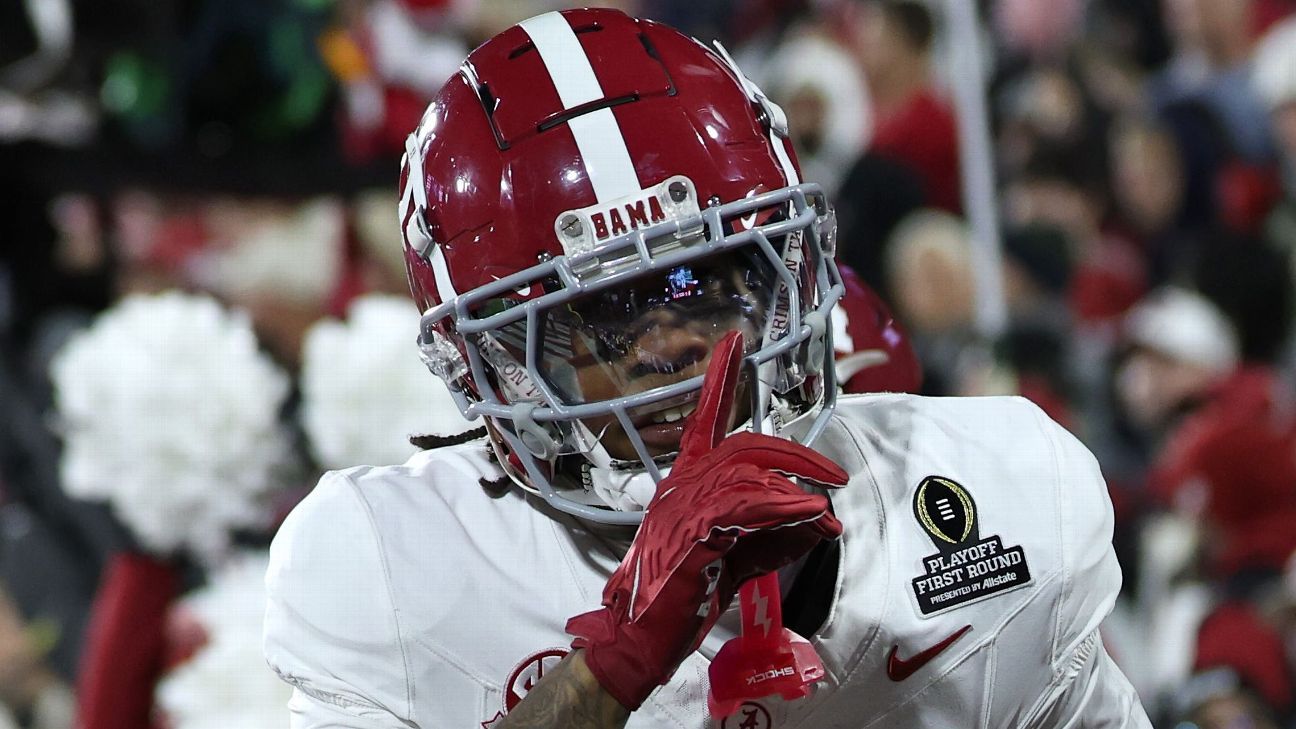
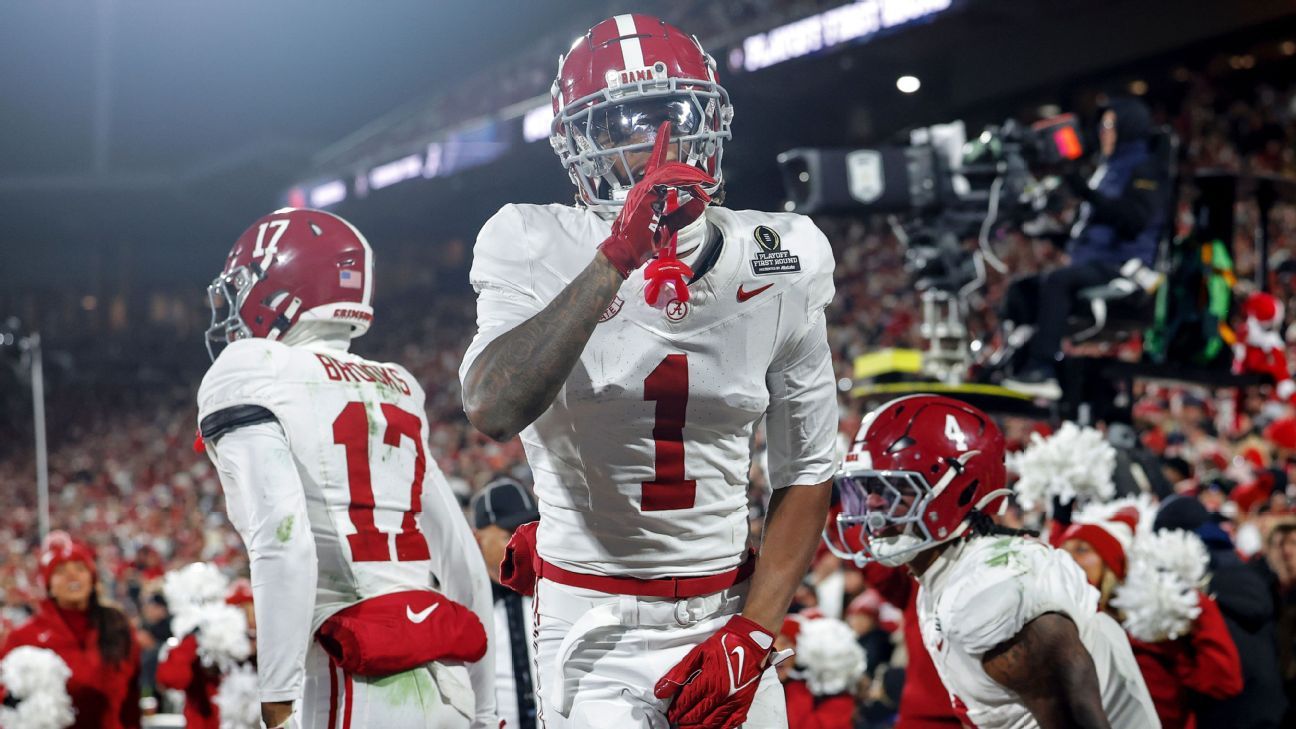
2. Over the next 21 minutes, Bama outscored the Sooners 27-0, outgaining them, 194-59. Freshman Lotzeir Brooks caught two touchdown passes — the first on a fourth-and-2 to finally get Bama on the board (after he caught a huge third-down pass earlier in the drive), and the second TD came on a 30-yard lob that put the Tide up for good. The Tide defense got pressure on John Mateer, and his footwork and composure vanished. An egregious pick-six thrown directly to Zabien Brown tied the game, and Bama scored the first 10 points of the second half as well.
0:58
Zabien Brown stuns OU with game-tying pick-six before halftime
Zabien Brown takes a big-time interception 50 yards to the house to tie the score before halftime.
OU responded briefly, cutting the margin to three points early in the fourth quarter thanks to a 37-yard Deion Burks touchdown. But the Sooners’ offense couldn’t do enough, and kicker Tate Sandell, the Groza Award winner, missed two late field goals to assure a Bama win.
1:25
Tate Sandell’s back-to-back FG misses help Alabama secure 1st-round win
Tate Sandell misses a pair of late field goals as Alabama holds on to beat Oklahoma 34-24 in the CFP first round.
Impact plays
Oklahoma beat Alabama in Tuscaloosa in November — in the game that eventually certified the Sooners’ CFP bid — thanks to a pick-six and special teams dominance. But the tables turned completely in Norman. Brown’s pick six was huge, and special teams completely abandoned the Sooners, both with Sandell’s misses and with a botched punt in the second quarter.
The botched punt was actually the second of a two-part sequence that turned the game against the Sooners. First, Mateer passed up an easy third-and-3 conversion to throw downfield to a wide open Xavier Robinson, but he short-armed the pass and dropped it. On the very next snap, punter Grayson Miller dropped the ball moving into his punting motion. Bama’s Tim Keenan III recovered the ball at the OU 30, and while OU’s defense held the Tide to a field goal, what could have been a 24-3 OU lead turned instead into a 17-10 advantage. That set the table for Brown’s pick-six and everything that followed.
The blown early lead leaves Oklahoma with quite the ignominious feat: In the history of the College Football Playoff, teams are 28-2 with a 17-point lead: OU is 0-2, and everyone else is 28-0. Ouch.
See you next fall, Sooners
We knew that whenever Oklahoma’s season ended, offense would be the primary reason. The Sooners survived playing with almost no margin for error for most of the year. Their No. 49 ranking in offensive SP+ was the worst of any CFP team, but they got enough defense (third in defensive SP+), special teams (21st in special teams SP+) and quality red zone play to overcome it.
The Sooners’ defense still played well on Friday night — Bama gained only 260 total yards (4.8 per play) — but the special teams miscues put more pressure on the offense to come through, and after a brilliant start, it ran out of steam. Mateer began the game 10-for-15 for 132 yards with a touchdown, 26 rushing yards and a rushing TD, but his last 31 pass attempts gained just 149 yards with five sacks and the pick, and his last nine non-sack rushes gained just 15 yards.
Brent Venables therefore heads into the offseason with some decisions to make. OU’s offense technically improved after the big-money additions of coordinator Ben Arbuckle and Mateer, but Mateer was scattershot before his midseason hand injury and poor after it. Do the Sooners run it back with the same roster core, hoping that better health and a theoretically improved run game can give the defense what it needs to take OU to the next level? Does Venables hit the reset button again? Can he ever get all the arrows pointed in the right direction at the same time?
What’s next
Alabama’s reward for the comeback win is a trip out West: The Tide will meet unbeaten and top-seeded Indiana in the Rose Bowl on January 1. Bama’s defense will obviously face a stiffer test from Heisman winner Fernando Mendoza and the Hoosiers attack, but Bama’s defense has been mostly up for the test this season. Their ability to pull an upset will be determined by Ty Simpson and the Alabama passing game.
Simpson began Friday night’s win just 2-for-6 with a sack, and while he improved from there and didn’t throw any interceptions — his final passing line: 18-for-29 for 232 yards, two touchdowns and four sacks (6.0 yards per attempt) — his footwork still betrayed him quite a bit over the course of the evening, and he misfired on quite a few passes. Oklahoma’s pass rush is fearsome, but Indiana’s defense ranks seventh in sack rate itself, and with almost no blitzing whatsoever. The Hoosiers generate pressure and clog passing lanes, and they held Oregon‘s Dante Moore and Ohio State‘s Julian Sayin to 5.1 yards per dropback with 11 sacks and two touchdowns to three picks. Bama will be an underdog for a reason.
That said, kudos to the Tide for getting off the mat. They were lifeless at the start, missing tackles and blocks and looking as unprepared as they did in their season-opening loss to Florida State. But Brooks’ play-making lit the fuse, and Bama charged back.
-
 Sports2 years ago
Story injured on diving stop, exits Red Sox game
-
 Sports3 years ago
‘Storybook stuff’: Inside the night Bryce Harper sent the Phillies to the World Series
-
 Sports2 years ago
Game 1 of WS least-watched in recorded history
-
 Sports3 years ago
Button battles heat exhaustion in NASCAR debut
-
 Sports3 years ago
MLB Rank 2023: Ranking baseball’s top 100 players
-
Sports4 years ago
Team Europe easily wins 4th straight Laver Cup
-
 Environment3 years ago
Japan and South Korea have a lot at stake in a free and open South China Sea
-
 Environment1 year ago
Here are the best electric bikes you can buy at every price level in October 2024