
Connect with us

Published

on

New Yorkers who recently ditched the city for low-tax hot spots in Florida and Texas are finding the savings to be a lot less than they would have if they moved four years ago as the cost to rent or buy a home soars.

Rents and home prices in Miami have surged by around 40% since the pandemic, which sparked the Great Exodus from the Big Apple to the Sunshine State, as well as to Dallas and Austin in the Lone Star State, according to a study by financial information provider SmartAsset.

The result has been that New Yorkers earning $250,000 who moved to Miami last year ended up saving $88,036 or 28% less compared to people in the same income bracket who moved to South Florida in 2019, the study found.

By comparison, those early settlers had saved $122,956, according to the data, first reported by Bloomberg News.

The two Texas cities that have seen explosive population growth in recent years also arent the bargain they once were, according to SmartAsset. A New Yorker earning $250,000 who moved to Austin in 2019 would have saved $154,564. Last year, however, that number declined 25% to $116,195.

New Yorkers in the same tax bracket who relocated to Dallas in 2019 saved $135,887. Last year, however, the savings fell 20% to $108,208.

The data also indicates that the rate at which cost of living is rising in Miami, Austin and Dallas is outstripping that of Manhattan.

From 2019 to 2023, rent in Manhattan has increased 3.3%, while home prices have jumped 29.3%. Meanwhile, the cost of energy and utilities has fallen 13.7% while the cost of gas is up 35.7%.

In Miami, rent has soared during that same period by 37% while home prices are up 43.7%, according to SmartAsset.

In that four-year span, the cost of energy and utilities in Miami rose 17%, while the price of gasoline is up 54.4%.

Austin’s rent prices have gone up 25.5%, while its home prices are up a whopping 55.6%. Its energy and utilities are 12.5% more expensive, while the gas prices have risen by 32.3%.

In Dallas, rent has actually fallen 1.1% but home prices are up 21.1%. Energy and utilities are 16.5% more expensive, while the price of gas has increased by 32.8%.

In 2023, New York State had the third highest income tax rate in the country, according to a study by TurboTax. Florida and Texas are among nine states that do not levy a state income tax.

But the surging demand for real estate have sent home prices soaring — causing a spike in the property tax rate in the Lone Star State, where longtime residents are feeling the pinch.

Florida, meanwhile, is in the midst of a property insurance crisis as residents paid a whopping 42% more for coverage last year compared to 2022.

Last year, Floridians paid on average $6,000 for home insurance — nearly three times the national average of $1,700.

“The fact that people continue to absorb increased costs of food, nightlife, culture and real estate means that this is a new normal,” Michael Martirena, a luxury real estate adviser with Miami-based firm Compass, told The Post.

Cities in the Sun Belt have been the beneficiaries of a population exodus from high-cost New York, Chicago and Los Angeles.

According to census data, more than half a million people have left New York since 2020 — an outflow that was spurred by the coronavirus pandemic as well as a sharp decline in the quality of life throughout the Big Apple, which saw a spike in crime, homelessness and cost of living.

Last year alone, the New York metropolitan area lost 65,000 residents.

The census data also showed that LA shed 71,000 people last year while Chicago, the nations third-most populous metro area, lost 16,600 people.

The biggest beneficiaries of the population shift are towns in Texas, led by Dallas-Fort Worth and the Houston metro area.

The Dallas-Fort Worth area saw its population grow by 152,598 people last year while Houstons population added 139,789 residents, according to the US Census.

Continue Reading

Sports

Jeff Kent elected to HOF; Bonds, Clemens still out

Published

on

By

Jeff Kent elected to HOF; Bonds, Clemens still out

ORLANDO, Fla. — Jeff Kent, who holds the record for home runs by a second baseman, was elected to the National Baseball Hall of Fame on Sunday.

Kent, 57, was named on 14 of 16 ballots by the contemporary baseball era committee, two more than he needed for induction.

Just as noteworthy as Kent’s selection were the names of those who didn’t garner enough support, which included all-time home run leader Barry Bonds, 354-game winner Roger Clemens, two MVPs from the 1980s, Don Mattingly and Dale Murphy, and Gary Sheffield, who slugged 509 career homers.

Bonds, Clemens, Sheffield and Dodgers great Fernando Valenzuela were named on fewer than five ballots. According to a new protocol introduced by the Hall of Fame that went into effect with this ballot, players drawing five or fewer votes won’t be eligible the next time their era is considered. They can be nominated again in a subsequent cycle, but if they fall short of five votes again, they will not be eligible for future consideration.

The candidacies of Bonds and Clemens have long been among the most hotly debated among Hall of Fame aficionados because of their association with PEDs. With Sunday’s results, they moved one step closer to what will ostensibly be permanent exclusion from the sport’s highest honor.

If Bonds, Clemens, Sheffield and Valenzuela are nominated when their era comes around in 2031 and fall short of five votes again, it will be their last shot at enshrinement under the current guidelines.

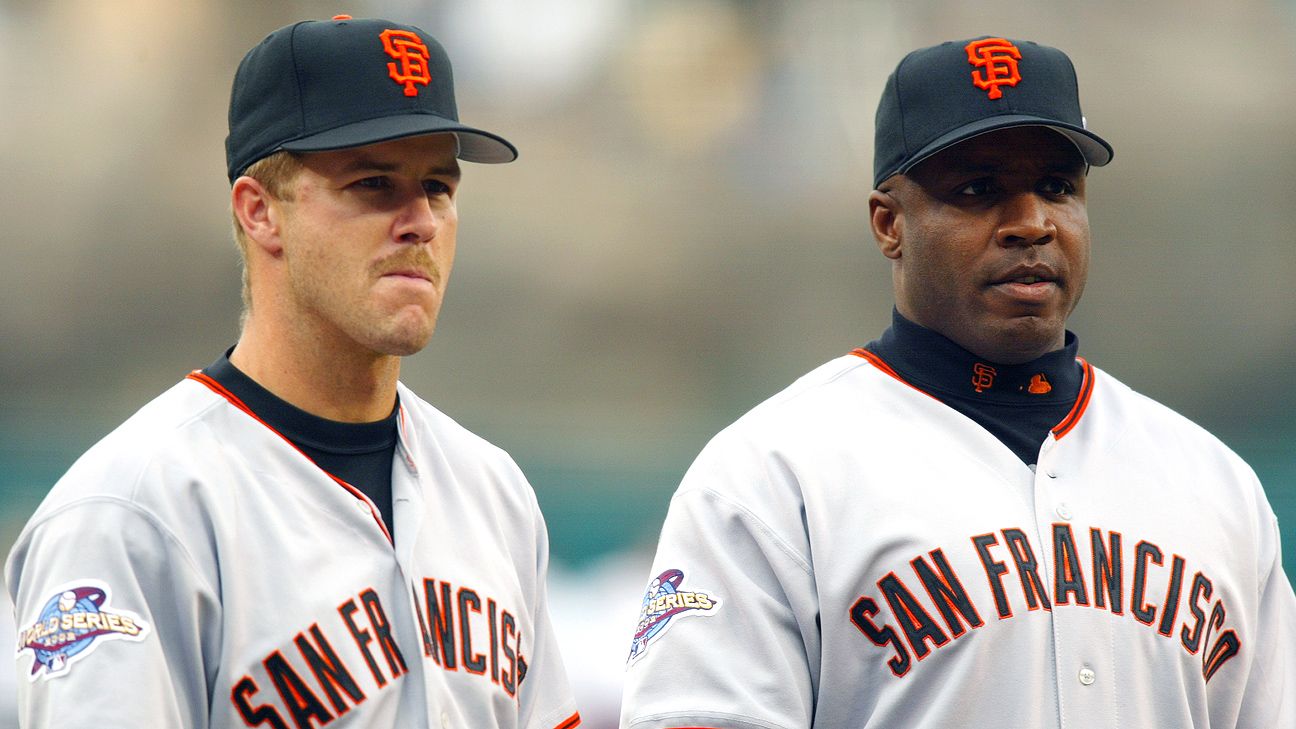
Kent, whose best seasons were with the San Francisco Giants as Bonds’ teammate, continued his longstanding neutral stance on Bonds’ candidacy, declining to offer an opinion on whether or not he believes Bonds should get in.

“Barry was a good teammate of mine,” Kent said. “He was a guy that I motivated and pushed. We knocked heads a little bit. He was a guy that motivated me at times, in frustration, in love, at times both.

“Barry was one of the best players I ever saw play the game, amazing. For me, I’ve always said that. I’ve always avoided the specific answer you’re looking for, because I don’t have one. I don’t. I’m not a voter.”

Kent played 17 seasons in the majors for six different franchises and grew emotional at times as he recollected the different stops in a now-Hall of Fame career that ended in 2008. He remained on the BBWAA ballot for all 10 years of his eligibility after retiring, but topped out at 46.5% in 2023, his last year.

“The time had gone by, and you just leave it alone, and I left it alone,” Kent said. “I loved the game, and everything I gave to the game I left there on the field. This moment today, over the last few days, I was absolutely unprepared. Emotionally unstable.”

A five-time All-Star, Kent was named NL MVP in 2000 as a member of the Giants, who he set a career high with a .334 average while posting 33 homers and 125 RBIs. Kent hit 377 career homers, 351 as a second baseman, a record for the position.

Kent is the 62nd player elected to the Hall who played for the Giants. He also played for Toronto, the New York Mets, Cleveland, Houston and the Dodgers. Now, he’ll play symbolically for baseball’s most exclusive team — those with plaques hanging in Cooperstown, New York.

“I have not walked through the halls of the Hall of Fame,” Kent said. “And that’s going to be overwhelming once I get in there.”

Carlos Delgado was named on nine ballots, the second-highest total among the eight under consideration. Mattingly and Murphy received six votes apiece. All three are eligible to be nominated again when the contemporary era is next considered in 2028.

Next up on the Hall calendar is voting by the BBWAA on this year’s primary Hall of Fame ballot. Those results will be announced on Jan. 20.

Anyone selected through that process will join Kent in being inducted on July 26, 2026, on the grounds of the Clark Sports Center in Cooperstown.

Continue Reading

Environment

Chinese quality: BYD launches ‘Zero Defects’ as it crosses 113 GWh in Q3

Published

on

By

Chinese quality: BYD launches 'Zero Defects' as it crosses 113 GWh in Q3

This week, BYD crossed a major manufacturing milestone as its battery production crossed 113 GWh in the first three quarters of 2025 – but instead of celebrating, the company is doubling down with a new “Zero Defects” initiative to bring battery quality to an even higher level.

CarNewsChina reports that the new “Zero Defects” plan at BYD was launched internally at the start of Q3, with a focus on minimizing manufacturing defects across all stages of the battery’s life, from the manufacturing line to the end user.

The initiative coincides with BYD’s growing role as a battery supplier to other automakers and its expanding battery energy storage system (BESS) business, which are giving BYD both an international footprint and global benchmarks.

In its ongoing bid to prove itself even further in the global battery market, BYD will reportedly emphasize operational efficiency, error reduction, and standardization across manufacturing, process control, and customer service, with the end goal believed to be, “management practices comparable to those of Toyota.”

Advertisement – scroll for more content

BYD on a charge


BYD-EV-growth
Sealion 7 midsize electric SUV; by BYD.

The Chinese automaker seems to be going from strength to strength in 2025, having overtaken EV sales leader Tesla in China back in June and repeating the trick again by overtaking Tesla sales in Europe in August.

Combine those EV sales with the fact that its domestic traction battery production reached 113.42 GWh in just the first three quarters of the year (with 23.65 GWh, or ~20%, being supplied to outside customers – including Tesla), and you might agree that betting against BYD seems to be a bad idea.

Note that BYD has not released official details regarding performance metrics or milestones for its new Zero Defects goal, but the message is clear: BYD plans to keep getting better.

SOURCE: CarNewsChina; images via BYD.


If you’re considering going solar, it’s always a good idea to get quotes from a few installers. To make sure you find a trusted, reliable solar installer near you that offers competitive pricing, check out EnergySage, a free service that makes it easy for you to go solar. It has hundreds of pre-vetted solar installers competing for your business, ensuring you get high-quality solutions and save 20-30% compared to going it alone. Plus, it’s free to use, and you won’t get sales calls until you select an installer and share your phone number with them. 

Your personalized solar quotes are easy to compare online and you’ll get access to unbiased Energy Advisors to help you every step of the way. Get started here.

FTC: We use income earning auto affiliate links. More.

Continue Reading

Technology

CNBC Daily Open: Everyone’s watching the Netflix deal

Published

on

By

CNBC Daily Open: Everyone's watching the Netflix deal

The Netflix logo is pictured at the company’s offices on Vine in Los Angeles, California on Dec. 5, 2025.

Patrick T. Fallon | AFP | Getty Images

“Who’s watching?” Netflix asks whenever someone accesses its site. On Friday, it was probably everyone with an interest in business, markets and television.

The key characters that had people hooked were Netflix and Warner Bros. Discovery, which jointly announced that the streaming giant will acquire the latter’s film studio and streaming service, HBO Max. The equity deal value is pegged at $72 billion.

Netflix investors did not seem too jazzed about the deal, with shares dropping 2.89% on the sheer size of the transaction.

“Look, the math is going to hurt Netflix for a while. There’s no doubt,” Rich Greenfield, co-founder of LightShed Partners, told CNBC. “This is expensive,” he added.

But if one side is paying a lot, that means the other is receiving a bounty. Indeed, investors cheered the potential Warner Bros. Discovery windfall, sending the stock up 6.3% on the news.

It is not a done deal yet, and faces regulatory scrutiny. U.S. President Donald Trump said he would be involved in the decision, Reuters reported Monday, after a senior official from the Trump administration told CNBC’s Eamon Javers on Friday that they viewed the deal with “heavy scepticism.”

Despite this initial show of resistance, stranger things have happened in this administration, and the transaction might eventually go through. Should we get ready for Netflix’s next blockbuster: “The K-Pop Demon Hunters’ Song of Ice and Fire”?

What you need to know today

U.S. stocks had a positive Friday. The S&P 500 had its ninth winning session in 10 and rose 0.3% for the week. Europe’s regional Stoxx 600 closed flat. Separately, third-quarter euro zone economic growth was revised upward to 0.3%.

Netflix to buy Warner Bros. Discovery’s film and streaming businesses. The total equity value of the deal is $72 billion, announced the two companies Friday. But the transaction could run into regulatory hurdles.

Core inflation in the U.S. cools down. September’s core personal consumption expenditures price index was 2.8% on an annual basis, 0.1 percentage point lower than expectations and August’s figure. Other numbers were in line with expectations.

A Ukraine peace deal is ‘really close.’ That’s according to Keith Kellogg, the U.S. special envoy for Ukraine, who reportedly said Saturday that there were two key outstanding issues: the future of Ukraine’s Donbas region and its Zaporizhzhia nuclear power plant.

[PRO] Goldman Sachs unveils its top five global stocks. The picks are from China, Taiwan, India, Germany and the U.K. — and all offer an upside of at least 70%, according to the bank.

And finally…

The Sizewell A and B nuclear power stations, operated by Electricite de France SA (EDF), in Sizewell, UK, on Friday, Jan. 26, 2024. Photographer: Chris Ratcliffe/Bloomberg via Getty Images

Bloomberg | Bloomberg | Getty Images

The history of nuclear energy lies on British soil – does its future?

The U.K. once had more nuclear power stations than the U.S., USSR and France combined. It was a global producer until 1970 but hasn’t completed a new reactor since Sizewell B in 1995.

There is ambition to change that. Authorities want a quarter of the U.K.’s power to come from nuclear by 2050. The country is spreading its bets across tried-and-tested large nuclear projects and smaller, next-generation reactors known as small module reactors.

— Tasmin Lockwood

Continue Reading

Trending






