
Connect with us

Published

on

A new study strikes a blow to the idea that teenage social media use is obliterating in-person time with friends. According to the new research, published in Computers in Human Behavior, teens who spend a lot of time on social media will also log the most in-person socialization time. Futhermore, the researchers “found no support for the assumption that social media use predicts declines in social skills.”

On some level, this isn’t surprising. Social teens are social teens, no matter the medium.

But it’s fashionable today to blame smartphones for depression and anxiety in teens, and a prominent theory of how this works is that social media crowd out unmediated activities, such as hanging out in person. The new study suggests this theory may miss the mark.

Want more on sex, technology, bodily autonomy, law, and online culture? Subscribe to Sex & Tech from Reason and Elizabeth Nolan Brown. Email(Required) EmailThis field is for validation purposes and should be left unchanged. Submit

Δ More Social Media, More Offline Socializing

The research was conducted by an international team of academics that included professors at Brown University, the Norwegian University of Science and Technology, the Amsterdam School of Communication Research, and St. Olavs University Hospital. For the study, they collected biennial data about social media use, social skills, and time spent with friends for hundreds of Norwegian children. This information was measured when the kids were ages 10, 12, 14, 16, and 18.

“More time spent with offline friends was concurrently associated with greater social media use at ages 10, 12, and 14 years,” report the researchers.

In addition, increased use of social media “positively predicted time spent with friends offline” in the future: “participants who liked, commented, and posted more over time displayed an increase in the number of days they spent with friends offline.”

The effects were small but significant, and applied across sexes and age groups.

So contrary to conventional wisdom, teens who start spending more time on social media aren’t largely doing it to the exclusion of in-person socializing.

Nor does spending more time on social media seem to make social skills worse. “Increased use of social media was unrelated to future levels of social skills across ages 1018 years,” states the study.

“Our findings…provide preliminary evidence that concern over declining social skills as a result of social media use may be unwarranted,” the researchers conclude. “Social media use may even support offline interaction with friends, and thus indirectly promote adolescents’ wellbeing and functioning.” No One-Size-Fits-All Script

Increased social media use did predict a decline in social skills among people who already scored high on social anxiety, though the effect was small and only applied to those between ages 12 and 16.

The findings “align with prior research supporting a poor-get-poorer (i.e., rich-get-richer) hypothesis,” the researchers explain.

This is interesting because it points to a wider conundrum when it comes to studies of social media use and teen mental health.

Some previous research has shown higher levels of social media use or screen time are correlated with higher levels of mental health problems. A lot of people like to interpret these studies as evidence that social media causes mental problems in teens. But causation could go the other way: Teens suffering from mental health issues, bullying at school, etc. could start using social media more heavily to cope with offline stress.

Maybe online communities actually help troubled teens deal better with their offline stressors. Or maybe there’s a circular reinforcement effect going on, with offline troubles leading to more time online and that, in turn, leading to more isolation and negative emotions or behaviors. We just don’t know. It’s likely different for different teens, depending on their particular circumstances.

This new study serves as an important reminder of this variance. There’s no one-size-fits-all script for social media use among teenswhich means we should also avoid one-size-fits-all solutions.

For teens who are social and well-adjusted already, social media use may become a fun extension of their in-person social life or spur new friendships that then translate to offline spaces. But for some teens who are already suffering from anxiety or other issues, social media use could prove problematic, exacerbating offline issues.

This is why catchall ruleslike laws banning minors from social media useare both unnecessary and unwise. Such policies could prove helpful to some teens, of no consequence to others, and harmful to still others. That’s why the people best positioned to understand the way a particular teenager relates to social media, and to set more boundaries should problems arise, are that teen’s parents or other adults close to them, not distant lawmakers looking for blanket solutions. More Sex & Tech News

The battle over warrantless federal surveillance is hot again.

So this has to be a bit, right? Comedian Brinan Weeks has filed a class action lawsuit against the manufacturer of the Fleshlight sex toy. Weeks is accusing the company of negligent misrepresentation and unfair and deceptive practices after failing to see improvement in his “sexual performance or stamina” after using it.

A federal court ruled against X in a lawsuit it brought against the Center for Countering Digital Hate. Today’s Image

I recently came across my senior photoand since today’s newsletter is all about teens, I’ll share it with you. Why they had me pose like I’m about to flash somebody in an alley, I don’t know. What I do know is that coat came from the Delia’s catalogue, I still own it, and it’s held up astonishingly well.
(ENB)


Continue Reading

Politics

Foreign Office has been hacked – ministers ‘fairly confident’ individual data not at risk

Published

on

By

Foreign Office has been hacked - ministers 'fairly confident' individual data not at risk

Foreign Office data has been compromised by hackers, a minister has confirmed to Sky News, but he said the government is “fairly confident” that no individual data has been accessed.

Trade minister Sir Chris Bryant told Sky’s Mornings with Jones and Melbourne that the government first became aware of the hack in October, and was now “on top of it”.

Sky News understands that the data stolen was on systems operated on the Home Office’s behalf by the Foreign Office, which detected the breach.

The Sun reported last night that a Chinese groups of hackers known as Storm 1949 targeted Foreign Office servers and had accessed information relating to visa details, with “thousands” of confidential documents and data stolen.

But the minister told Sky News that it is “not entirely clear” who is responsible for the hack, and he could share “remarkably little detail”.

The Conservatives are accusing ministers of failing to protect the UK from Chinese interference.

Sir Chris said: “There certainly has been a hack at the FCDO [Foreign, Commonwealth, and Development Office], and we’ve been aware of that since October.”

More on Foreign And Commonwealth Office

Pointing to high-profile hacks this year of Marks and Spencer, Jaguar Land Rover, and the British Library, the minister added: “All of these are really important things for us to tackle and be aware of and prevent wherever possible.

“Some of the reporting has, I think, been a bit more speculation than accurate.”

He said he could share “remarkably little” in the way of facts about the hack because “quite often the investigation takes quite a long time”.

“We managed to close the hole, as it were, very quickly,” Sir Chris said.

“It was a technical issue in one of our sites, I gather. And we’re fairly confident that there’s a low risk of any individual actually being affected by this.

“I know that some of the reports have said, potentially, various things could happen. I think that that’s a bit more speculation than is helpful. So I don’t want to scaremonger about this. We are on top of it.

“And also it’s not entirely clear where this has come from. I know everybody’s speculating about that as well. That is not entirely clear either.”

Conservative shadow foreign secretary Dame Priti Patel shared a report that said the hack was Chinese and wrote on X: “China undermines our security, institutions and democracy but Labour is failing to protect Britain from China’s foreign interference in our country.

“[Sir Keir] Starmer kowtows to China at every opportunity and cannot be trusted to protect our national interest.”

Continue Reading

Politics

Too late to investigate Farage election expenses, Essex Police say

Published

on

By

Too late to investigate Farage election expenses, Essex Police say

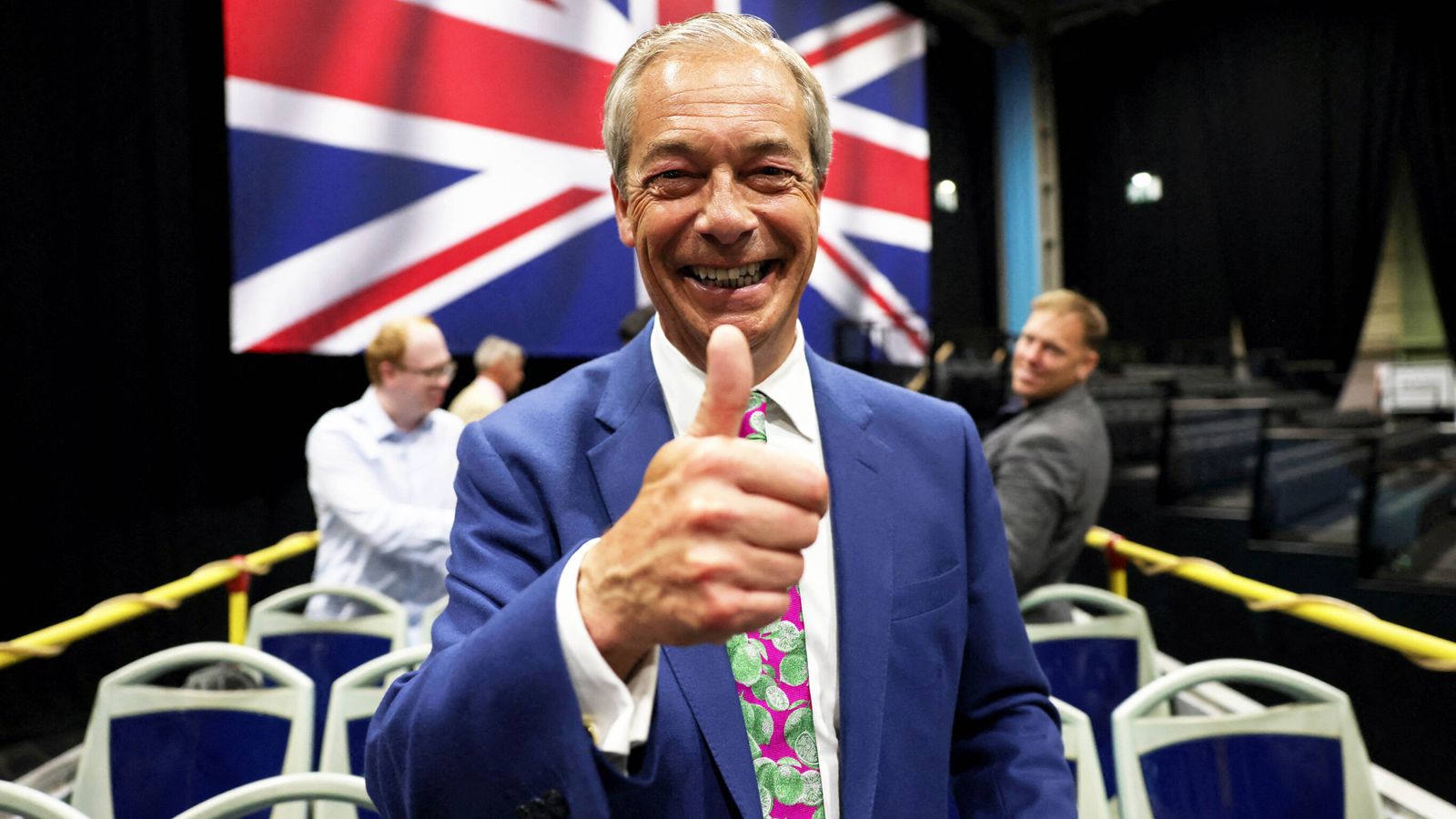
It is too late to investigate whether Nigel Farage broke election law on spending at the general election, Essex Police has said.

The Reform UK leader had been referred to the police following claims by a former member of his campaign team that the campaign to get Mr Farage elected in Clacton last year overspent.

There are tight rules on campaign spending in the UK, including separating what is spent as part of a national campaign and what is spent directly in a constituency.

However, there is a one-year statutory time limit to begin any investigation, which Essex Police said has now elapsed.

The force said: “We have assessed a report relating to an allegation around misreported expenditure by a political candidate in connection with the general election in July 2024.

“Having regard to the Representation of the People Act 1983, which states any prosecution for such an offence must commence within one year, it has been concluded that this report falls outside of the stated statutory time limit, and no investigation can take place.”


Last week: Reform denies Farage broke law

Read more:
Farage’s ex-school mate on claims of racist comments
Reform get record £9m donation from ex-Tory donor

The allegations of overspending on Mr Farage’s campaign were first reported at the start of last week, with Richard Everett – also a former Reform councillor – claiming he had passed information to the Metropolitan Police.

Reform was quick to deny the allegations, and accused Mr Everett of being a “disgruntled former councillor” who was expelled from the party “several months ago”.

The overspending reportedly included failing to declare spending on leaflets, banners, utility bills and the refurbishment of a bar in its Clacton campaign office – although Mr Everett said Mr Farage was “blissfully unaware” as others managed the finances.

Labour Party chair Anna Turley had also written to the Electoral Commission about the claims.

Responding yesterday, the elections watchdog said: “We have responded to Anna Turley MP’s correspondence, which raised questions about Reform UK’s spending at the 2024 general election.

“After carefully considering the information presented in the letter, we did not identify any expenditure relating to Mr Farage’s election campaign in Clacton that should have been declared in Reform UK’s national expenditure.”

Continue Reading

Politics

Fidelity macro lead calls $65K Bitcoin bottom in 2026, end of bull cycle

Published

on

By

Fidelity macro lead calls K Bitcoin bottom in 2026, end of bull cycle

Bitcoin may have ended its historical four-year cycle, signaling an incoming year of downside, despite widespread analyst expectations for an extended cycle driven by regulatory tailwinds.

Bitcoin’s (BTC) $125,000 all-time high on Oct. 6 may have signaled the top of the current four-year Bitcoin halving cycle, both in terms of “price and time,” according to Jurrien Timmer, the director of global macroeconomic research at asset management firm Fidelity.

“While I remain a secular bull on Bitcoin, my concern is that Bitcoin may well have ended another 4-year cycle halving phase,” wrote Timmer in a Thursday X post. “Bitcoin winters have lasted about a year, so my sense is that 2026 could be a “year off” (or “off year”) for Bitcoin. Support is at $65-75k.”

Source: Jurrien Timmer

Related: Bitcoin treasuries stall in Q4, but largest holders keep stacking sats

Crypto market may see more upside on fundamental, regulatory tailwinds

Timmer’s analysis contradicts other crypto analysts, who expect the growing number of regulated crypto investment products to lead to an extended bull market cycle in 2026.

Notably, Tom Shaughnessy, the co-founder of crypto research firm Delphi Digital, expects new all-time highs for Bitcoin in 2026, after investor sentiment recovers from the record $19 billion crypto market crash that occurred at the beginning of October.

“We are working through a one-time disastrous 10/10 liquidation event that broke the market,” wrote Shaughnessy in a Friday X post, adding:

“Once that’s worked through, we hit $BTC ATHs in 2026 as prices rubber band to reflect the progress outside 10/10.”

Shaughnessy said crypto market valuations will be driven by the industry’s “fundamental progress,” including growing Wall Street implementations and regulatory developments.

Related: Bitcoiners push for quantum-resistant BIP-360 upgrade as debate heats up

Policy experts are also predicting a significant year of progress on US cryptocurrency legislation, a development that may bring more institutional investment to the crypto space.

“I do expect 2026 to be another meaningful year for crypto regulation, but it will look different from the last one,” Cathy Yoon, general counsel at crypto research firm Temporal and Solana block-building system Harmonic, told Cointelegraph.

“With stablecoin legislation now passed, the real impact will come from implementation – examinations, disclosures, and how these assets integrate into payments and financial infrastructure,” she said.

Source: Santiment

However, investors’ social sentiment took a significant hit earlier this week as Bitcoin dipped below $85,000. Bearish commentary has since dominated social media platforms, including X, Reddit and Telegram, according to market intelligence platform Santiment.

Meanwhile, the crypto industry’s best-performing traders by returns, who are tracked as “smart money” traders on Nansen’s blockchain intelligence platform, are also betting on a short-term decline for most leading cryptocurrencies.

Smart money traders top perpetual futures positions on Hyperliquid. Source: Nansen

While smart money traders were net short on Bitcoin for $123 million, the same cohort was betting on Ether’s (ETH) price increase, with $475 million worth of cumulative net long positions, Nansen data shows.

Magazine: Sharplink exec shocked by level of BTC and ETH ETF hodling — Joseph Chalom





