
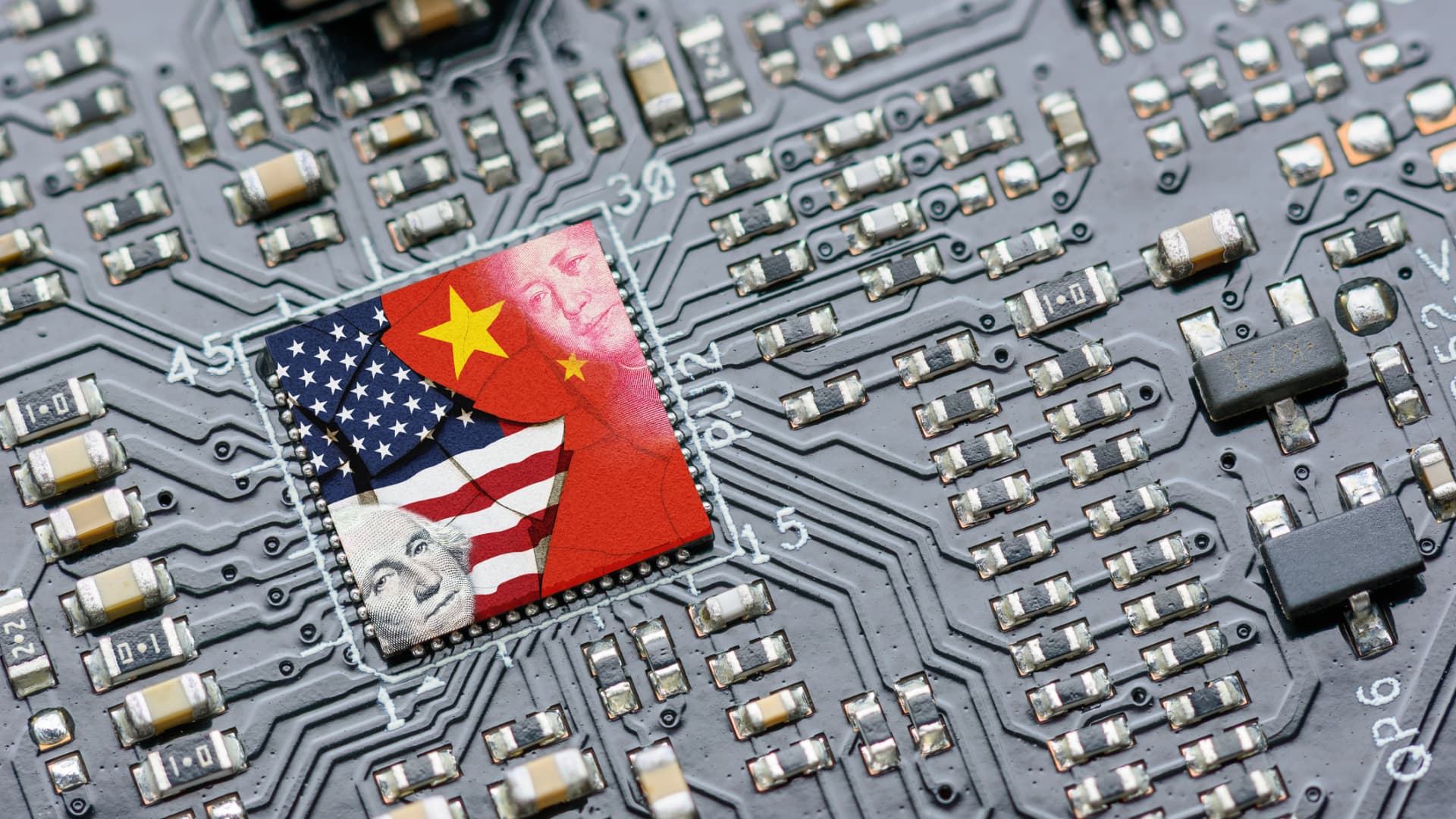
AMD and Intel dip on report China told telecoms to remove foreign chips


Semiconductors are a key focus in the technology trade war taking place between the U.S. and China.
William_potter | Istock | Getty Images
Shares of Advanced Micro Devices and Intel dipped on Friday after The Wall Street Journal reported that China is ordering the country’s largest telecommunications carriers to cease use of foreign chips.
Chinese officials issued the directive earlier this year for the telecom systems to replace non-Chinese core processors by 2027, the Journal reported, citing people familiar with the matter. The report said the mandate would impact AMD and Intel.
Both stocks traded down as much as 4% on Friday afternoon.
Intel declined to comment on the report. AMD didn’t immediately respond to a request for comment.
China accounted for 27% of Intel’s revenue in 2023, making it the company’s biggest market. AMD generated 15% of sales from China, including Hong Kong, last year. Their reliance on China underscores the continued importance of the world’s second-biggest economy despite U.S. regulations aimed at curbing chip exports to the country and China’s efforts to be less dependent on foreign technology.
China set new guidelines in December to remove U.S. chips from government computers and servers, blocking processors from AMD and Intel, the Financial Times reported last month.
And in October 2022, the U.S. instituted rules designed to limit China’s access to advanced American chips, especially those critical to artificial intelligence technology. Late last year, the U.S. announced new restrictions to prevent the sale of more AI chips to China, seeking to close perceived loopholes in the previous order.
AMD failed to get U.S. approval for an AI chip it designed for China and will need to apply for an export license, Bloomberg reported last month.
Intel has reportedly survived a push by AMD to end its sale of hundreds of millions of dollars’ worth of laptop chips to the U.S.-sanctioned Chinese telecom company Huawei.


Chief executive officer of Google Sundar Pichai.
Marek Antoni Iwanczuk | Sopa Images | Lightrocket | Getty Images
Google on Friday made the latest a splash in the AI talent wars, announcing an agreement to bring in Varun Mohan, co-founder and CEO of artificial intelligence coding startup Windsurf.
As part of the deal, Google will also hire other senior Windsurf research and development employees. Google is not investing in Windsurf, but the search giant will take a nonexclusive license to certain Windsurf technology, according to a person familiar with the matter. Windsurf remains free to license its technology to others.
“We’re excited to welcome some top AI coding talent from Windsurf’s team to Google DeepMind to advance our work in agentic coding,” a Google spokesperson wrote in an email. “We’re excited to continue bringing the benefits of Gemini to software developers everywhere.”
The deal between Google and Windsurf comes after the AI coding startup had been in talks with OpenAI for a $3 billion acquisition deal, CNBC reported in April. OpenAI did not immediately respond to a request for comment.
The move ratchets up the talent war in AI particularly among prominent companies. Meta has made lucrative job offers to several employees at OpenAI in recent weeks. Most notably, the Facebook parent added Scale AI founder Alexandr Wang to lead its AI strategy as part of a $14.3 billion investment into his startup.
Douglas Chen, another Windsurf co-founder, will be among those joining Google in the deal, Jeff Wang, the startup’s new interim CEO and its head of business for the past two years, wrote in a post on X.
“Most of Windsurf’s world-class team will continue to build the Windsurf product with the goal of maximizing its impact in the enterprise,” Wang wrote.
Windsurf has become more popular this year as an option for so-called vibe coding, which is the process of using new age AI tools to write code. Developers and non-developers have embraced the concept, leading to more revenue for Windsurf and competitors, such as Cursor, which OpenAI also looked at buying. All the interest has led investors to assign higher valuations to the startups.
This isn’t the first time Google has hired select people out of a startup. It did the same with Character.AI last summer. Amazon and Microsoft have also absorbed AI talent in this fashion, with the Adept and Inflection deals, respectively.
Microsoft is pushing an agent mode in its Visual Studio Code editor for vibe coding. In April, Microsoft CEO Satya Nadella said AI is composing as much of 30% of his company’s code.
The Verge reported the Google-Windsurf deal earlier on Friday.
Technology
Nvidia’s Jensen Huang sells more than $36 million in stock, catches Warren Buffett in net worth


Jensen Huang, CEO of Nvidia, holds a motherboard as he speaks during the Viva Technology conference dedicated to innovation and startups at Porte de Versailles exhibition center in Paris, France, on June 11, 2025.
Gonzalo Fuentes | Reuters
Nvidia CEO Jensen Huang unloaded roughly $36.4 million worth of stock in the leading artificial intelligence chipmaker, according to a U.S. Securities and Exchange Commission filing.
The sale, which totals 225,000 shares, comes as part of Huang’s previously adopted plan in March to unload up to 6 million shares of Nvidia through the end of the year. He sold his first batch of stock from the agreement in June, equaling about $15 million.
Last year, the tech executive sold about $700 million worth of shares as part of a prearranged plan. Nvidia stock climbed about 1% Friday.
Huang’s net worth has skyrocketed as investors bet on Nvidia’s AI dominance and graphics processing units powering large language models.
The 62-year-old’s wealth has grown by more than a quarter, or about $29 billion, since the start of 2025 alone, based on Bloomberg’s Billionaires Index. His net worth last stood at $143 billion in the index, putting him neck-and-neck with Berkshire Hathaway‘s Warren Buffett at $144 billion.
Shortly after the market opened Friday, Fortune‘s analysis of net worth had Huang ahead of Buffett, with the Nvidia CEO at $143.7 billion and the Oracle of Omaha at $142.1 billion.
The company has also achieved its own notable milestones this year, as it prospers off the AI boom.
On Wednesday, the Santa Clara, California-based chipmaker became the first company to top a $4 trillion market capitalization, beating out both Microsoft and Apple. The chipmaker closed above that milestone Thursday as CNBC reported that the technology titan met with President Donald Trump.
Brooke Seawell, venture partner at New Enterprise Associates, sold about $24 million worth of Nvidia shares, according to an SEC filing. Seawell has been on the company’s board since 1997, according to the company.
Huang still holds more than 858 million shares of Nvidia, both directly and indirectly, in different partnerships and trusts.
WATCH: Nvidia hits $4 trillion in market cap milestone despite curbs on chip exports

-
 Sports3 years ago
‘Storybook stuff’: Inside the night Bryce Harper sent the Phillies to the World Series
-
 Sports1 year ago
Story injured on diving stop, exits Red Sox game
-
 Sports2 years ago
Game 1 of WS least-watched in recorded history
-
 Sports2 years ago
MLB Rank 2023: Ranking baseball’s top 100 players
-
Sports4 years ago
Team Europe easily wins 4th straight Laver Cup
-
 Sports2 years ago
Button battles heat exhaustion in NASCAR debut
-
 Environment2 years ago
Japan and South Korea have a lot at stake in a free and open South China Sea
-
 Environment2 years ago
Game-changing Lectric XPedition launched as affordable electric cargo bike