
LinkedIn betting it can take on TikTok and Instagram in influencer marketing

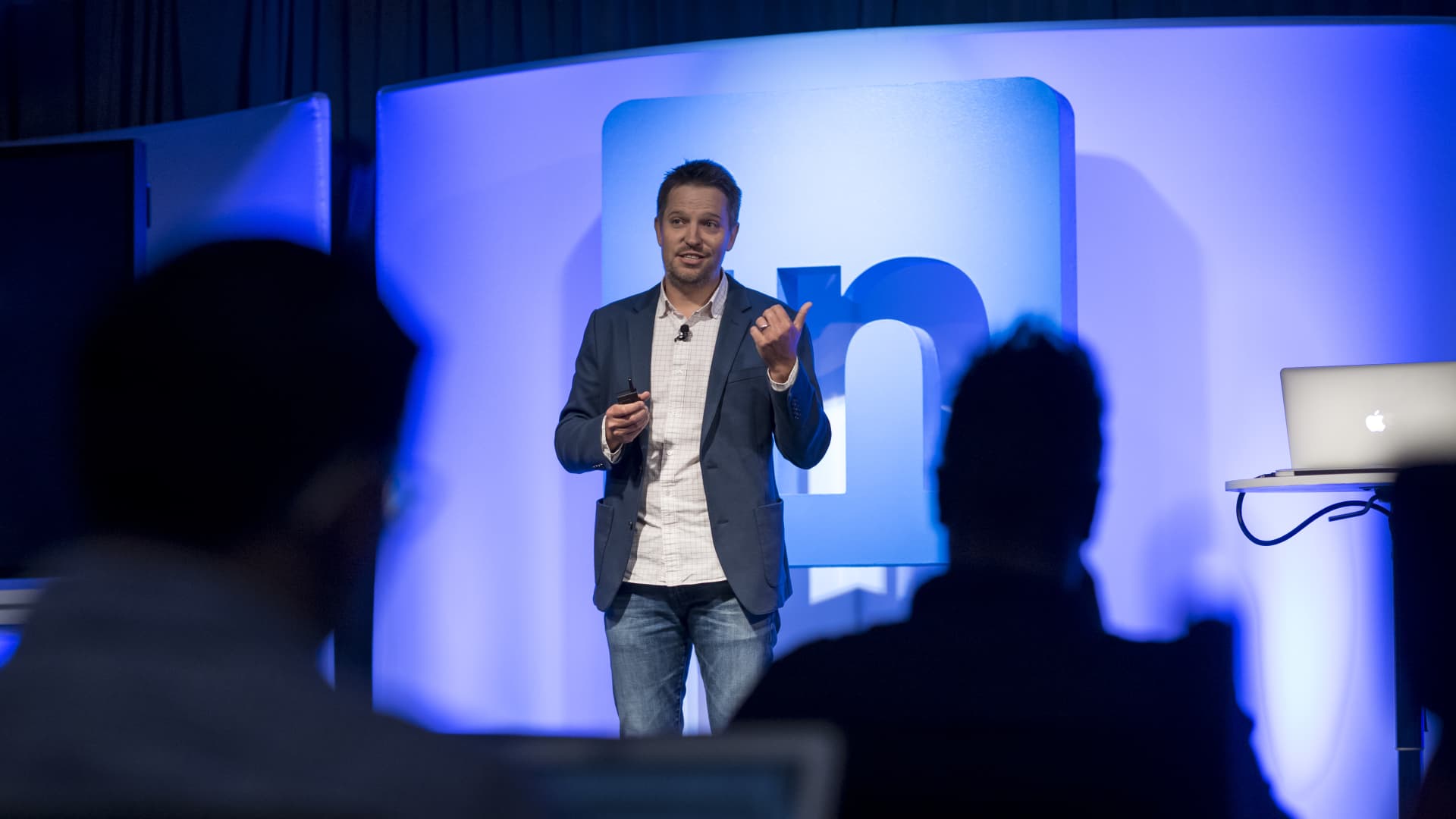
Ryan Roslansky, CEO of Microsoft’s LinkedIn subsidiary, speaks at a LinkedIn event in San Francisco on Sept. 22, 2016.
David Paul Morris | Bloomberg | Getty Images
Influencer marketing has become big business on TikTok and Instagram, where popular creators can make good money by helping brands promote their stuff. Now, LinkedIn wants in the game.
As of last week, LinkedIn is letting advertisers pay to amplify posts from users, including those with sizable followings. Its product, called Thought Leader ads, launched in a limited capacity last year.
The Microsoft-owned business is looking for a jolt, as LinkedIn’s revenue growth has been stuck in single digits since 2022. The company is turning to its membership, which topped 1 billion in November, to help fuel expansion.
Influencer marketing to date has largely been a phenomenon of consumer apps, where shticks and gimmicks can turn internet-savvy creators into celebrities with millions of followers. Almost two-thirds of U.S. social media marketing dollars this year will flow to Instagram parent Meta and TikTok’s Chinese owner ByteDance, with Instagram and TikTok picking up a combined 2 percentage points of additional share by 2026, according to estimates from eMarketer.
LinkedIn, which was launched a year before Facebook, will grab just 4% of the market, equal to $4.5 billion in marketing revenue, eMarketer says, and its share will remain flat over the next two years.
“It takes a long time for ads and ad formats to really take root,” said Max Willens, a senior analyst at eMarketer, referring to LinkedIn’s latest endeavor.
LinkedIn introduced Thought Leader ads last year but with limited use. Brands could only amplify posts from their own employees. Mastercard, for example, promoted posts written by some of its leaders in Singapore, with one receiving over 500 notifications on the first day. LinkedIn has used Thought Leaders ads itself for some posts from operating chief Dan Shapero, but not yet for CEO Ryan Roslansky.
By opening up Thought Leader ads, LinkedIn is letting anyone boost a post as long as the author grants permission. Social media marketer Brendan Gahan is so bullish on the format that he’s focusing much of his efforts on helping companies use Thought Leader ads.
“In an era where brand safety is a big issue, LinkedIn has a leg up, particularly in contrast to Twitter,” said Gahan, who started an agency last year called Creator Authority, referring to the social media platform now known as X.
X lost some leaders working on brand safety last year, just as the Elon Musk-owned platform was seeing a surge in hate speech on the app.
LinkedIn has long been an effective site for advertisers because members list their employment details, making it easy for brands to target ads to relevant audiences. Advertising skews toward business-focused products like software and computer infrastructure, though automakers, universities and banks also use the network to reach potential customers.
“If you’re looking to sell a high-end B2B product, and you know the buying group is a CFO and someone in finance and like someone in HR, we can literally put ads in front of those specific people on LinkedIn, because the first-party data is so strong,” Roslansky said at a conference in late 2022.
Thought Leader ads came about after employees saw marketing clients promoting screenshots of other users’ content. Since turning on the offering last fall, the ads have yielded higher engagement than regular ads that run with images, said Abhishek Shrivastava, a LinkedIn vice president of product management.
“Humanizing your brand is critical for B2B and has been underused in that space,” said Shrivastava, adding that clients are very excited about it.
It might not be cheap. Racking up a thousand ad impressions generally costs more on LinkedIn than on Instagram or TikTok, partly because the company charges more for advertisers to reach its more affluent user base. Shrivastava said that rather than comparing the costs to other sites, brands will look at the sales and business leads they get from running ads.
For months, project management software startup ClickUp has been paying to promote LinkedIn posts from its own executives. Chris Cunningham, head of social marketing at the company, said traditional ads on LinkedIn can sometimes be repetitive and generic, and he’s eager to see how promoted posts will perform when influencers get involved.
On other social networks, ClickUp has found more success promoting posts from creators than with standard ads, Cunningham said. Plus, he said, “it’s super easy.”
Betsy Hindman, a marketer in Tennessee who helps companies make the most of their LinkedIn presence, said a brand ambassador with an audience can have a bigger impact than a typical ad.
“It’s part of a full end-to-end strategy that includes warming people up along the way with whatever type of content they respond to,” she said.
Building up a roster of creators will likely take time. Some influencers are represented by agencies, and LinkedIn’s Campaign Manager advertising system doesn’t have an automatic process for connecting media buyers with agencies.
“That’s a direction we are exploring,” Shrivastava said.
More data will soon be available to advertisers. Starting in a few weeks, LinkedIn members will be able to look up any company’s collection of ads and see its Thought Leader ads, a spokesperson said. That could help advertisers see what works best.
One potential boon for LinkedIn rests with the fate of TikTok. The app faces a possible ban in the U.S. after the House of Representatives passed legislation last month that would force ByteDance to sell it within six months. Momentum has since slowed, though Senate Minority Leader Mitch McConnell, R-Ky., urged lawmakers to take action on the matter earlier this week.
Willens from eMarketer said agencies are keeping an eye on the issue, but said “nobody feels there’s an imminent threat.”
Technology
From 25 years in prison to just four months: Inside the final verdict on a crypto billionaire CEO archrivalry
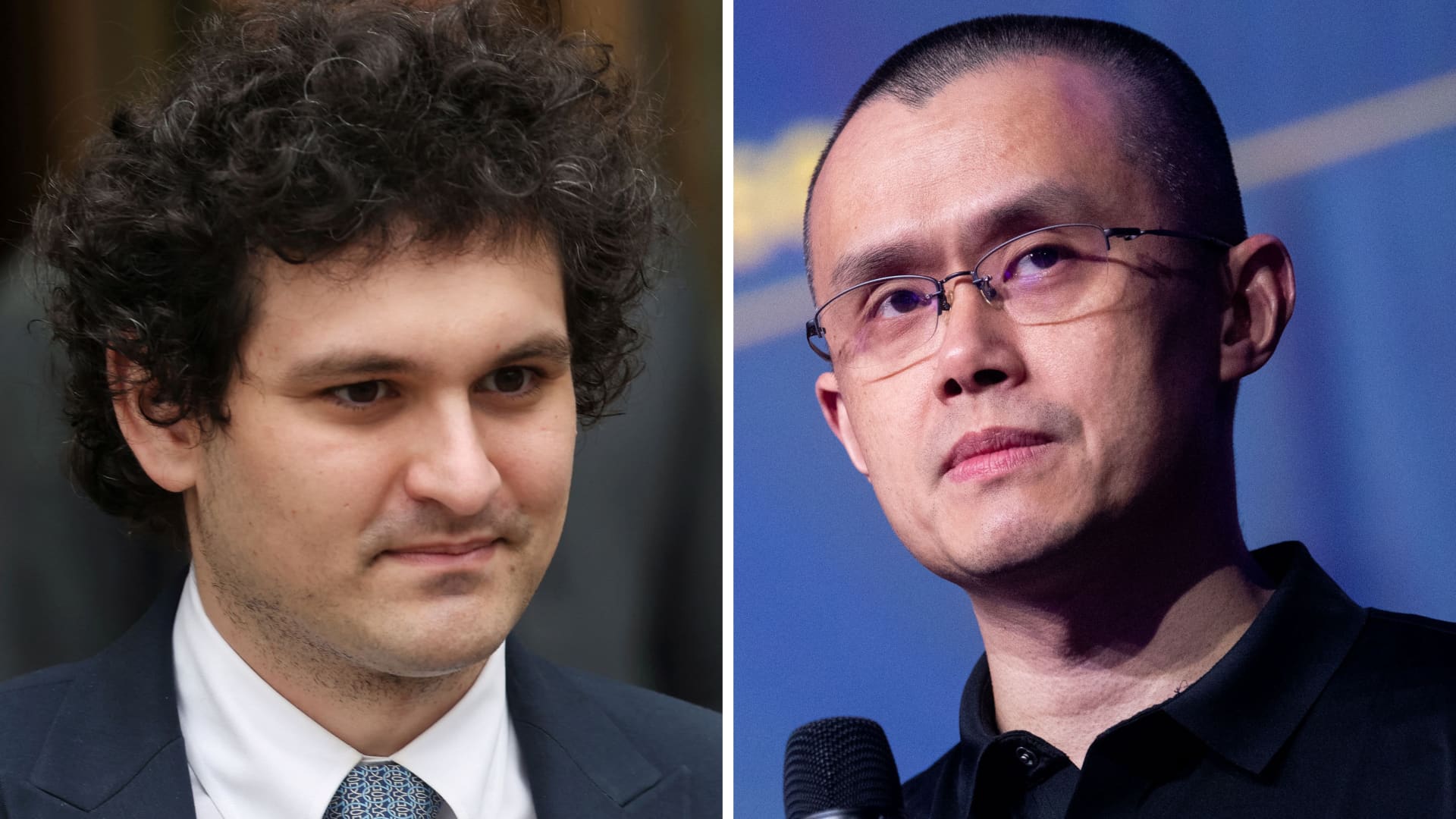
Combination showing Former FTX CEO, Sam Bankman-Fried (L) and Zhao Changpeng (R), founder and chief executive officer of Binance.
Mike Segar | Reuters | Benjamin Girette | Bloomberg | Getty Images
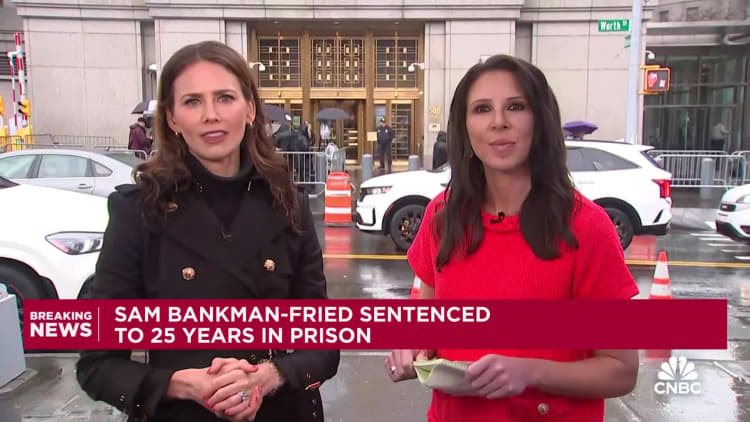
An arch rivalry between one-time crypto titans was brought to a close at a federal courthouse in Seattle on Tuesday when Binance founder Changpeng Zhao was handed a sentence of four months in prison. A month earlier, on the opposite coast in downtown Manhattan, FTX’s Sam Bankman-Fried received a 25-year prison sentence for his crimes.
It seemed an underwhelming and somewhat anti-climactic finish to a protracted battle between Zhao and Bankman-Fried, two men who were legendary adversaries, as well as key stewards of the $2.2 trillion crypto sector.
For years, Binance’s Zhao and FTX’s Bankman-Fried preached the power of decentralized, digital currencies to the masses. Both were bitcoin billionaires who drove Toyotas, ran their own global cryptocurrency exchanges and spent much of their professional career selling the public on a new, tech-powered world order; one where an alternative financial system comprised of borderless virtual coins would liberate the oppressed by eliminating middlemen like banks and the overreach of the government.
Ultimately, both also helped crypto critics and regulators make the case that the skeptics had been right all along — the industry was rife with grifters and fraudsters intent on using new tech to carry out age-old crimes.
Bankman-Fried, 32, was convicted of seven criminal counts in early November, including charges related to stealing billions of dollars from FTX’s customers. Less than three weeks after Bankman-Fried’s conviction, 47-year-old Zhao pleaded guilty to criminal charges and stepped down as Binance’s CEO as part of a $4.3 billion settlement with the Department of Justice.
Yet, much else about the pair is starkly at odds — perhaps most notably, the 296-month difference in their respective prison sentences.
“Comparing CZ and SBF, both figures emerged as prominent in the cryptocurrency sector but under vastly different circumstances,” said Braden Perry, a former senior trial lawyer for the CFTC.
“The nature of their alleged crimes reflects different aspects of the ‘dark’ and illicit corners of crypto: CZ’s case seems to focus on regulatory and compliance failures, while SBF’s case hinges on direct financial misconduct and deception,” Perry said.
Indeed, the disparate consequences for the two former crypto CEOs lay bare that the pair was, in the end, nothing alike in business or in personal dealings.
A tale of two bitcoin billionaires
It was the small things — the type of details that you don’t notice at first and are often difficult to articulate the significance of once you do — that betrayed the more notable differences between the two former CEOs.
Take Manfred, a worn stuffed animal that Bankman-Fried has carried around the world with him since birth, from California, to Hong Kong, to the Bahamas, and then back home to Palo Alto, where the FTX founder lived under house arrest until he was remanded to custody for tampering with witnesses.
The 32-year-old toy, which has lost much of its shape and identifying features, sat on the bed of his sparsely decorated room in his parents’ house on Stanford University’s campus in his final days before incarceration. It was a harmless prop at first glance, more a charming nod to an adolescent spirit than the sort of window into Bankman-Fried’s inner psyche that some of those who knew him would later attempt to turn it into.
Two of Bankman-Fried’s former colleagues and friends took turns at speculating on its meaning. One thought that SBF kept the stuffed animal close because “he doesn’t need to share Manfred with anyone,” according to reporting from “Going Infinite,” the Michael Lewis book that profiled Bankman-Fried. Another guessed, “I think it is very, very important for him to have an emotional attachment.”
Lewis himself writes that “Sam didn’t care about real animals” and that it had, in fact, been “an expected value calculation, rather than emotion, that had led him to go vegan.”
Bankman-Fried did have a history of intimacy issues. Part of it, according to his family, friends, work colleagues, criminal defense attorneys, and even Bankman-Fried himself, had to do with his inability to feel much of anything, for anyone, including romantic love interests.
FTX founder Sam Bankman-Fried leaves the U.S. courthouse in New York City on July 26, 2023.
Amr Alfiky | Reuters
His lawyers described him as often struggling socially, disclosing that in high school, Bankman-Fried “realized he was anhedonic, or unable to experience joy or pleasure.”
“As Sam describes it, he experiences negative emotions in ways that are not very different from many other people — neither much more extreme, nor much less negative. But he does not feel pleasure, or happiness, or joy, even when something very good happens to him,” a court filing in SBF’s criminal court docket reads.
Lawyers for Bankman-Fried added that it was not a disease or condition to be “cured,” but instead, “a fundamental aspect” of his identity. Lewis relayed an exchange with SBF in which Bankman-Fried said that smiling was the biggest thing that he “most weirdly” couldn’t do.
Bankman-Fried never married, has no children, and according to Lewis, moved himself and his company headquarters to the opposite side of the planet, twice, partly to avoid committing to his ex-girlfriend, ex-colleague, and the prosecution’s star witness against him: Alameda CEO Caroline Ellison.
The government’s case against him — which resulted in a unanimous guilty verdict in just a few hours despite it being a complicated month-long trial involving hundreds of exhibits and nearly 20 witnesses — was largely built upon the testimony of the people who knew Bankman-Fried best. The list included his former C-suite, ex-roommates, and ex-best friends going back to high school.
And so, Manfred took on new meaning, and began to embody much of what appeared to onlookers as a very lonely existence, in which the people closest to Bankman-Fried were the ones to seal his fate behind bars.
While Bankman-Friend’s parents were staunch defenders of their son in court, CZ, by contrast, had many who know him best leap to his defense. Zhao’s wife, his current lover, two of his five children, and dozens of Binance employees all penned the judge to plead for mercy in sentencing.
“I am a partner in the work of Changpeng Zhao (abbreviated CZ) and I am also the mother of his three children,” reads a note submitted by Yi He, a co-founder of Binance and Zhao’s current romantic partner. “Although the mainstream media tries to portray CZ as an evil bad actor, millions of community users and ordinary people regard him as a hero of the industry, because CZ has always insisted on justice.”
Changpeng Zhao, former CEO of Binance, arrives at federal court in Seattle, Washington, April 30, 2024.
David Ryder | Bloomberg | Getty Images
Zhao’s wife, Weiqing “Winnie” Yang called him a “self-made man” who “has never owed money to others and has not had any liabilities.” Yang added that Zhao has “taken the greatest care” of her and their shared children. Their daughter, Rachel Zhao, implored the judge “to consider her father’s positive attributes; to not define my father’s character solely through this one incident and consider the entirety of his character,” emphasizing that he was “the best father.”
Differences between the pair also showed up in the way they presented themselves.
Whereas Zhao maintained a military-style buzzcut, Bankman-Fried was known for his iconic and unwieldy mop of curls. CZ bought clothes on Amazon, but his look and demeanor were buttoned-up. SBF, who similarly opted for simple dress (usually a loose T-shirt and cargo shorts), appeared perpetually disheveled, whatever the occasion. At the beginning of his trial, SBF sported a fresh haircut and wore suits, but by its end, his curls were wild again. Zhao wore a fitted navy suit and light blue tie at his sentencing, versus the beige jailhouse jumpsuit donned by Bankman-Fried.
But perhaps the greatest distinction between the two relates to the command they held over those around them.
Zhao had an air of the consummate professional, with a strong appetite for total control of his sprawling enterprise. Bankman-Fried, who takes medication for the neuro-developmental disorder attention-deficit/hyperactivity disorder, sought a similar level of control, but admitted on the stand that mistakes were made, in part, because he was overwhelmed. Bankman-Fried’s psychiatrist unequivocally made clear to the judge that without prescribed medication, Bankman-Fried would experience a return of his symptoms and be “severely negatively impacted in his ability to assist in his own defense.”
Reuters reporting found that even as CZ’s crypto exchange diversified its hiring into traditional finance and regulatory talent pools, “Zhao’s tight control over his company was undiminished.” Binance set up more than 70 entities, and according to Reuters, Zhao personally controlled most of them.
Cryptocurrency exchange Binance founder and CEO Changpeng Zhao speaks at a Binance fifth anniversary event in Paris, France, July 8, 2022.
Staff | Reuters
Prosecutors similarly proved through testimony and evidentiary exhibits their narrative of Bankman-Fried quietly continuing to call the shots at his crypto hedge fund, Alameda Research. They showed that his decision-making power over the $32 billion crypto empire he built was absolute, and that all wrongdoing stemmed from decisions touched, or directly made by, Bankman-Fried himself. But unlike CZ, Bankman-Fried oversaw an organization with chaotic and falsified bookkeeping that ultimately led to the implosion of the companies he founded and the theft of billions of dollars of customer money.
And then there was the way that each looked to craft their public persona.
CZ was big on privacy. The letters submitted by his romantic partners and children were a rare inside look at Zhao’s personal dealings. And rather than take to mainstream media to share his defense, CZ clammed up and cooperated with the feds.
Shirking the advice of all counsel, Bankman-Fried went on a media blitz to talk about the implosion of his crypto empire. Many of those statements ultimately appeared in the government’s successful trial against him in October and November 2023.
“SBF resolutely did not settle, violated his bail conditions, spoke frequently to the press in his own favor and seemed to lack a display of genuine, heartfelt remorse even at his own sentencing,” said Yesha Yadav, law professor and associate dean at Vanderbilt University.
“Part of CZ’s deliberations in settling with Justice in November may have been precisely to make this point – that his conduct stands profoundly in contrast to the brazen behavior of SBF,” Yadav added.
The power of saying you’re sorry
In Seattle, Zhao’s sentencing was a relatively quiet affair, with a vibe that was more muted than the circus surrounding Bankman-Fried’s time in court.
“This proceeding looked and felt like the prosecution of a Wall Street executive,” said Mark Bini, a former state and federal prosecutor.
Zhao also expressed his remorse, accepting responsibility for his crimes and telling the judge he was sorry for his actions. It stood in stark contrast to Bankman-Fried’s final appeal to the judge, which lacked any sort of real admission of guilt.
Judge Lewis Kaplan, who sentenced Bankman-Fried to 25 years in prison, noted during his sentencing hearing that he had never heard “a word of remorse for the commission of terrible crimes” from Bankman-Fried and that in his 30 years on the federal bench, he had “never seen a performance” like SBF’s trial testimony.
If Bankman-Fried was not “outright lying” during cross-examination by prosecutors, he was “evasive,” Kaplan said.
“Instead of accepting responsibility, Bankman-Fried pushed his case to trial where he lied and perjured himself and was convicted by overwhelming evidence,” former federal prosecutor Neama Rahmani told CNBC.
To be sure, the Zhao and Bankman-Fried cases are very different.
While much of Bankman-Fried’s empire was a mirage, Zhao’s operation was laced with questionable business tactics under the hood.
Bankman-Fried and other leaders at FTX took billions of dollars in customer money. In fact, during the criminal trial of Bankman-Fried, both the prosecution and defense agreed that $10 billion in customer money that was sitting in FTX’s crypto exchange went missing, with some of it going toward payments for real estate, recalled loans, venture investments and political donations. They also agreed that Bankman-Fried was the one calling the shots.
The key question for jurors was one of intent: Did Bankman-Fried knowingly commit fraud in directing those payouts with FTX customer cash, or did he simply make some mistakes along the way? Jurors decided within a few hours of deliberation that he had knowingly committed fraud on a mass scale.
The government’s beef with Zhao and Binance was different.
Perry said that the connection with foreign crime, including money laundering and breaching international financial sanctions, was key to Binance’s undoing. There was, however, no pursuit of criminal fraud of its customers’ money — a key distinction from the case of Bankman-Fried.
Instead, three criminal charges were brought against the exchange, including conducting an unlicensed money-transmitting business, violating the International Emergency Economic Powers Act, and conspiracy. Binance agreed to forfeit $2.5 billion to the government, as well as to pay a fine of $1.8 billion, for crimes which included allowing illicit actors to make more than 100,000 transactions that supported activities such as terrorism and illegal narcotics.
Zhao and others were also charged with violating the Bank Secrecy Act by failing to implement an effective anti-money-laundering program and for willfully violating U.S. economic sanctions “in a deliberate and calculated effort to profit from the U.S. market without implementing controls required by U.S. law,” according to the Justice Department. The DOJ is recommending that the court impose a $50 million fine on Zhao.
Zhao turned a blind eye to money laundering, explains Rahmani, but he pleaded guilty and accepted responsibility for his actions. Bankman-Fried, on the other hand, stole money from clients and used them for lavish personal expenses.
“That’s why Bankman-Fried received a significantly longer prison sentence than Zhao,” Rahmani said.
Los Angeles corporate law attorney Tre Lovell said that, unlike Bankman-Fried, who was convicted of fraud, Zhao hasn’t been charged with fraud or other crimes deserving of a longer sentence.
“In addition, his letter to the judge does reflect remorse, discusses his making of poor decisions, and indicates that the Binance platform has instituted strict anti-money laundering controls at his direction,” Lovell said.
“SBF’s case involved allegations of fraud and misuse of customer funds, which are typically viewed as more directly deceitful and financially damaging to a broader array of individuals than compliance failures (like inadequate AML programs),” Perry said. Compliance failures, while serious, might be seen as a failure of oversight rather than active malfeasance, according to Perry.
“Fraudulent actions directly undermine trust and suggest intentional wrongdoing, which can lead to harsher public and judicial responses,” he added.
Money makes all the difference
Unlike SBF, CZ didn’t have his wealth wiped out by bankruptcy of the crypto company he founded. And as he cooperated with the government and pleaded guilty, his assets weren’t seized.
Despite the fact that Zhao is being put behind bars, his controlling stake in Binance means that he will continue being one of the wealthiest people in crypto today. Zhao is widely reported to have an estimated 90% stake in Binance, and his fortune is largely derived from his equity ownership in the company.
Binance is by far the world’s largest cryptocurrency exchange by trading volume, processing $18.1 trillion worth of trading volume in 2023, according to data from crypto market data firm CCData. And even though Binance has seen its market share drop to 41.6% since Zhao stepped down as CEO in November 2023, the company remains the dominant player overall — leagues ahead of South Korean exchange Upbit, Dubai-headquartered Bybit, and U.S. giant Coinbase.
While Binance has been convicted of extremely serious charges, it still remains a lucrative operation, according to Yadav. Binance is profitable and solvent, meaning that it has a hefty war chest to settle fines.
FTX, on the other hand, remains in bankruptcy court in Delaware.
“FTX has been revealed to have been a criminal enterprise that is now headed into liquidation owing to its assessed inability to salvage any brand and use value,” Yadav said.

Notably, because Zhao pleaded guilty to only one count of violation of the U.S. Bank Secrecy Act (BSA), he is regarded as a first-time offender and thus reached a settlement with federal authorities to step down as CEO and not relinquish his interest in the company or have assets frozen.
“Typically, personal assets that are not directly linked to the criminal activity might remain unaffected,” Perry said. “His assets could also be managed on his behalf while he is incarcerated.”
That’s a different situation from Sam Bankman-Fried, who saw his wealth reduced to zero after his crypto empire collapsed into bankruptcy in 2022.
“In relation to CZ’s personal wealth … he would still be able to retain his share in Binance, as well as maintain his crypto holdings which also contribute an unknown, yet material, amount to his overall wealth and net worth,” Joshua de Vos, research lead at CCData, told CNBC via email. “Since there is no misappropriation or bankruptcy proceedings, it is highly unlikely that CZ would see his wealth reduced to zero as was the case with SBF,” de Vos said.
As for what’s next, new FTX CEO John Ray III and his team of restructuring advisors continue their effort to claw back cash, luxury property, and crypto, to try to make customers whole. Bankman-Fried, meanwhile, is appealing the verdict.
Zhao said in a court filing that his future ambition lies in bringing blockchain tech to biotech startups.
Binance isn’t out of the woods yet. The Securities and Exchange Commission was notably absent from the exchange’s $4.3 billion settlement with the U.S. government. Meanwhile, two of its employees remain in jail in Nigeria awaiting trial for alleged crimes committed by the exchange.
— CNBC’s Ryan Browne contributed to this report.
Technology
Apple remains Buffett’s biggest public stock holding, but his thesis about its moat faces questions
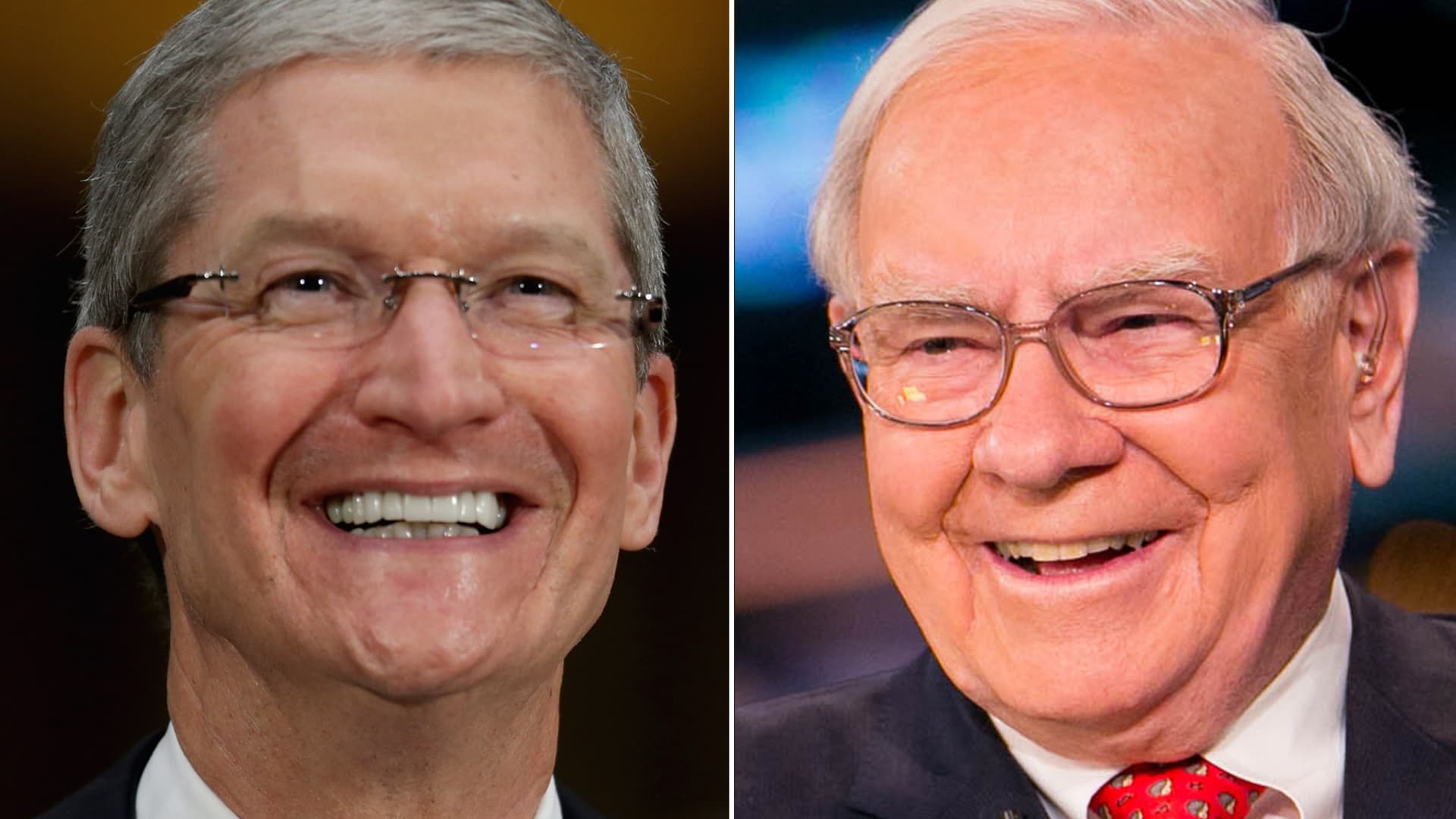
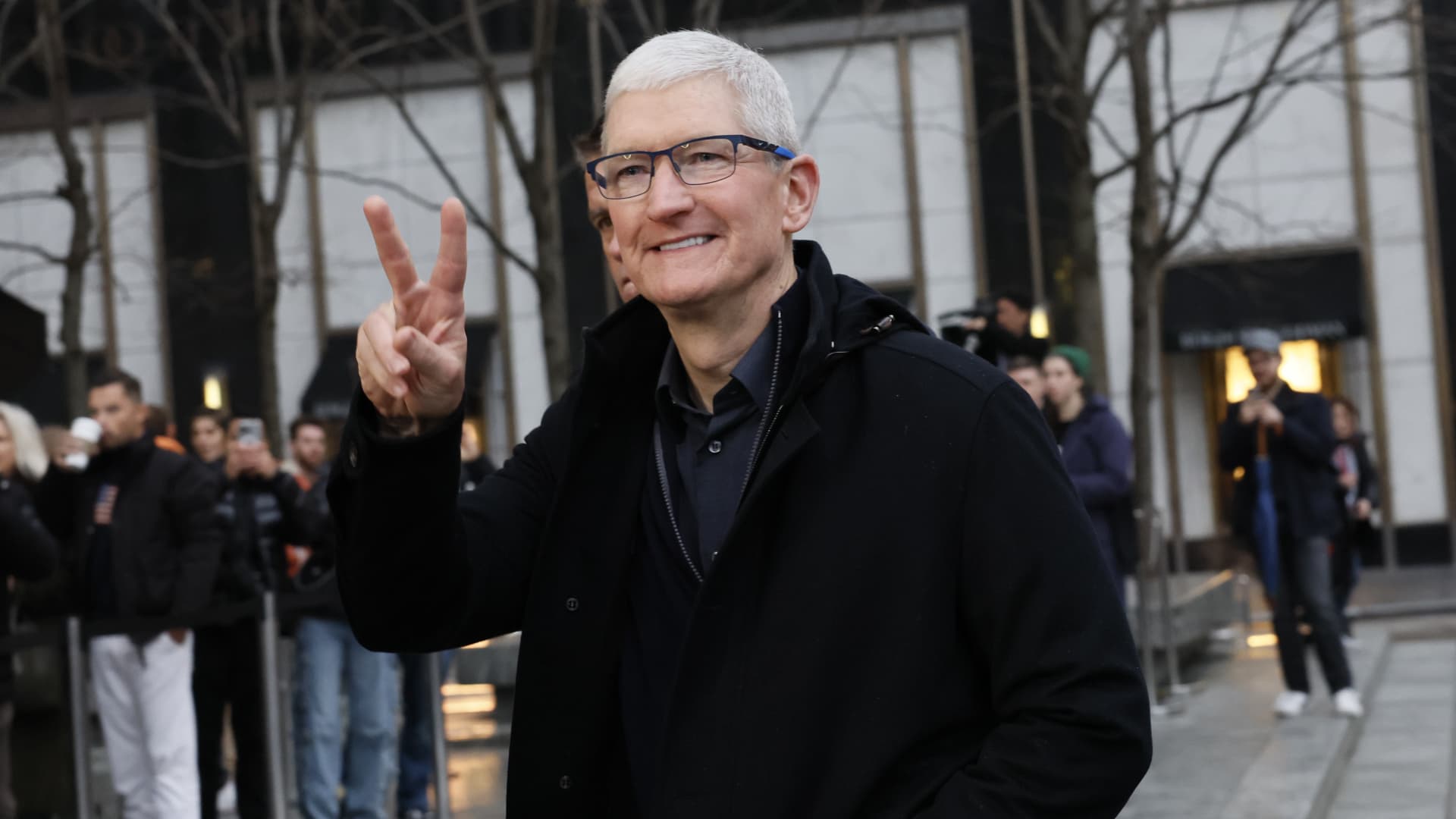
Tim Cook and Warren Buffett
Getty Images (L) | CNBC (R)
Berkshire Hathaway‘s Warren Buffett was still using a flip phone as late as 2020, four years after his investment behemoth started amassing a huge stake in the company that makes iPhones.
“I don’t understand the phone at all, but I do understand consumer behavior,” Buffett said last year at Berkshire’s annual shareholder meeting in Omaha, Nebraska.
He’s emerged in recent years as one of Apple’s top evangelists.
At the end of 2023, Berkshire owned about 6% of Apple, a stake worth $174 billion at the time, or about 40% of Berkshire’s total value. That’s about four times bigger than Berkshire’s second-biggest public stock holding, Bank of America, and makes Berkshire the No. 2 Apple shareholder, behind only Vanguard.
As Berkshire investors and fanboys of the 93-year-old Buffett flood Omaha this weekend for the 2024 annual meeting, Apple is likely to be a hot topic of discussion. The tech giant on Thursday reported a 10% year-over-year decline in iPhone sales, leading to a 4% drop in total revenue. But the stock had its best day since late 2022 on Friday due largely to a $110 billion stock buyback plan and increased margins that result from a growing services business.
The bet on Apple and CEO Tim Cook, has paid off handsomely for Buffett, who said in 2022 that the cost of Berkshire’s Apple stake was only $31 billion. His firm is up almost 620% on its investment since the start of 2016.
Despite being a self-described luddite, Buffett has long had a coherent non-techie thesis for loving Apple. He’s seen how devoted Apple users are to their devices, and has viewed the iPhone as an extraordinary product that could keep its customers spending inside the Apple ecosystem. He calls it a moat, one of his favorite words for describing his preferred businesses.
“Apple has a position with consumers that they’re paying $1,500 or whatever it may be for a phone, and these same people pay $35,000 for a second car,” Buffett said at last year’s meeting. “And if they had to give up their second car or give up their iPhone, they’d give up their second car!”
Data is in his favor. According to a study from Consumer Intelligence Research Partners, Apple has 94% customer loyalty, meaning that nine out of 10 current U.S. iPhone owners choose another iPhone when buying a new device.
Buffett has also hailed Apple’s ability to return billions of dollars to shareholders annually through share buybacks and dividends, a capital allocation strategy for which Buffett may have himself to thank. When asked in a 2016 interview with The Washington Post who he turns to for advice at pivotal moments, Cook offered up a story about his relationship with Buffett.
“When I was going through [the question of] what should we do on returning cash to shareholders, I thought who could really give us great advice here? Who wouldn’t have a bias?” Cook said. “So I called up Warren Buffett. I thought he’s the natural person.”
Apple has shown its appreciation for the Oracle of Omaha in other ways.
In 2019, the company published an original iPhone game called “Warren Buffett’s Paper Wizard” in which a paperboy bikes from Omaha to Apple’s hometown of Cupertino, California.
But with Apple’s business having declined in size in five of the past six quarters and with the company expecting just low-single digit growth in the current quarter, Buffett may face questions this weekend about whether he still sees the same power in the moat, particularly with regulatory pressures building around tech’s megacap companies.
Buffett trimmed his stake in Apple late year, though only by about 1%. Even after Friday’s rally, the stock is down 3.8% in 2024, while the S&P 500 is up 7.5%.
‘Very, very, very locked in’
Berkshire’s initial foray into Apple in 2016 was not Buffett’s idea. Rather, the investment was led by Ted Weschler, one of Buffett’s top deputies, and was seen as a passing of the torch to the next generation of Berskhire investment mangers.
But the following year, Berkshire started purchasing even more Apple, and Buffett began talking it up. He said he liked the stock and the company’s “sticky” product, although he didn’t use it.
In 2018, he said Apple users are “very, very, very locked in, at least psychologically and mentally” to the product and the ecosystem.
“Apple has an extraordinary consumer franchise,” he said.
At last year’s annual meeting, when asked how Berkshire can defend having Apple make up so much of its public portfolio, Buffett said, “It just happens to be a better business than any we own.” He also hailed Cook, calling him one of the “best managers in the world.”
A number Apple likes to use to tout the health of its business, despite the declining revenue, is 2.2 billion. That’s how many devices the company says are currently in use and points to the massive customer base available as Apple rolls out new subscription services.
“Once customers get into the ecosystem, they don’t leave. So it’s not a a speculative tech play,” said Dan Eye, chief investment officer at Fort Pitt Capital Group, which owns Apple shares. “It’s kind of more like an annuity and I think that’s what Warren Buffett really sees as well.”
In addition to the drop in revenue, Apple faces new challenges from regulations and weak overseas markets, as well as from Microsoft and Google’s advancements in artificial intelligence. For regulators, the concern surrounds the very moat that Buffett finds so attractive, and whether its give the company monopolistic control in the smartphone market.
The U.S. government in March alleged that Apple designs its business to keep customers locked in. The Justice Department’s lawsuit claimed that products like Apple Card, the Apple Arcade game subscription, iMessage, and Apple Watch work best or only with an iPhone, creating illegal barriers to competition and making it harder for consumers to switch when it’s time for an upgrade.
However, the litigation is expected to take years, pushing any potential penalties to Apple and its products well into the future. In the meantime, there’s no sign that the iPhone is becoming less important as new devices like virtual reality goggles have found only niche audiences, while consumer AI products have failed to take off.
Buffett hasn’t voiced his view publicly on Apple’s regulatory hurdles, and this will be the first opportunity for investors to ask him about the issue since the DOJ’s lawsuit. But Buffett knows a little something about regulation — two markets where he’s most active are railroads and insurance.
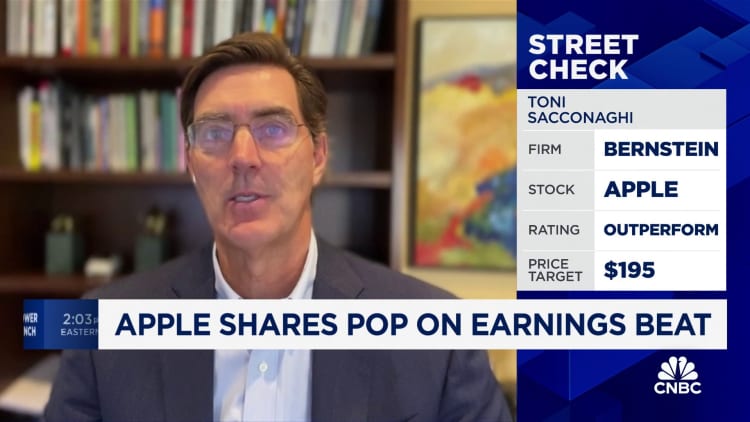
In a note to clients earlier this month, Bernstein analyst Toni Sacconaghi didn’t go deep on regulatory concerns, but mentioned that he doesn’t believe the DOJ suit will “seriously threaten” the strength of Apple’s ecosystem. He also said that following Buffett’s lead on getting in and out of Apple is a solid strategy for making money.
“Despite his reputation as a long term buy and hold investor, Warren Buffett has been remarkably disciplined at adding to his Apple position when it is relatively cheap and trimming when it is relatively expensive,” Sacconaghi wrote. He encouraged investors to “be like Buffett.”
More money back
Odds are that Buffett was thrilled with Apple’s announcement this week regarding its expanded repurchase program. It’s a practice he’s long adored.
“When I buy Apple, I know that Apple is going to repurchase a lot of shares,” he said in 2018.
And he likes to note how buybacks result in getting a bigger stake in the company without buying more shares.
“The math of repurchases grinds away slowly, but can be powerful over time,” Buffett said in 2021.
Apple also increased its dividend by 4%, and signaled that it would continue to lift it annually.
Buffett was effusive about Apple’s capital return strategy at the company’s annual meeting last year, pointing out that it helped Berkshire own a bigger piece of the pie. Unlike insurance company Geico and homebuilder Clayton Homes, which his firm owns in their entirety, Berkshire can continue to increase its stake in Apple, a fact he reminded investors of at the meeting.
“The good thing about Apple is that we can go up,” Buffett said.
WATCH: Warren Buffett’s stake in Japanese trading houses helps them focus on capital efficiency
Technology
Apple’s falling iPhone sales don’t bother Wall Street so long as margins, buybacks are increasing
-
 Sports2 years ago
‘Storybook stuff’: Inside the night Bryce Harper sent the Phillies to the World Series
-
 Sports1 year ago
MLB Rank 2023: Ranking baseball’s top 100 players
-
 Environment12 months ago
Japan and South Korea have a lot at stake in a free and open South China Sea
-
Sports3 years ago
Team Europe easily wins 4th straight Laver Cup
-
 Sports6 months ago
Game 1 of WS least-watched in recorded history
-
 Environment1 year ago
Game-changing Lectric XPedition launched as affordable electric cargo bike
-
 Sports4 weeks ago
Story injured on diving stop, exits Red Sox game
-
 Environment1 year ago
Tesla advances Powerwall pilot project with German electric company