
Big takeaways from the NFL draft: Luxury picks, QB moves and the Chiefs getting richer


-
Brooke Pryor, ESPN Staff Writer
The 2024 NFL draft had everything: a historic run on offensive players, an even more historic run on quarterbacks, moms blocking their sons’ girlfriends from getting in on the draft night celebration, head-scratching picks and a whole slew of trades.
The good news after a record-setting weekend in Detroit: Your team is going 20-0 and winning the Lombardi Trophy.
The bad news: Your team missed out on your favorite X factor prospect, and the future is bleak.
The real news: 257 players had their dreams come true throughout the weekend when they were selected to join an NFL team and help their new organization compete for a Super Bowl.
No pressure.
Here’s a look at some of the major trends of the 2024 NFL draft.

The quarterback quandary
It’s good to be a quarterback. Or at least it’s good to be a first-round quarterback. In a league where quarterback play — especially from young, affordable talent — is becoming increasingly more valuable, the 2024 draft saw six quarterbacks go in the first 12 picks, marking only the second time that six QBs were picked in the first round since 1983. It also represented the fewest selections in which six signal-callers have been drafted.
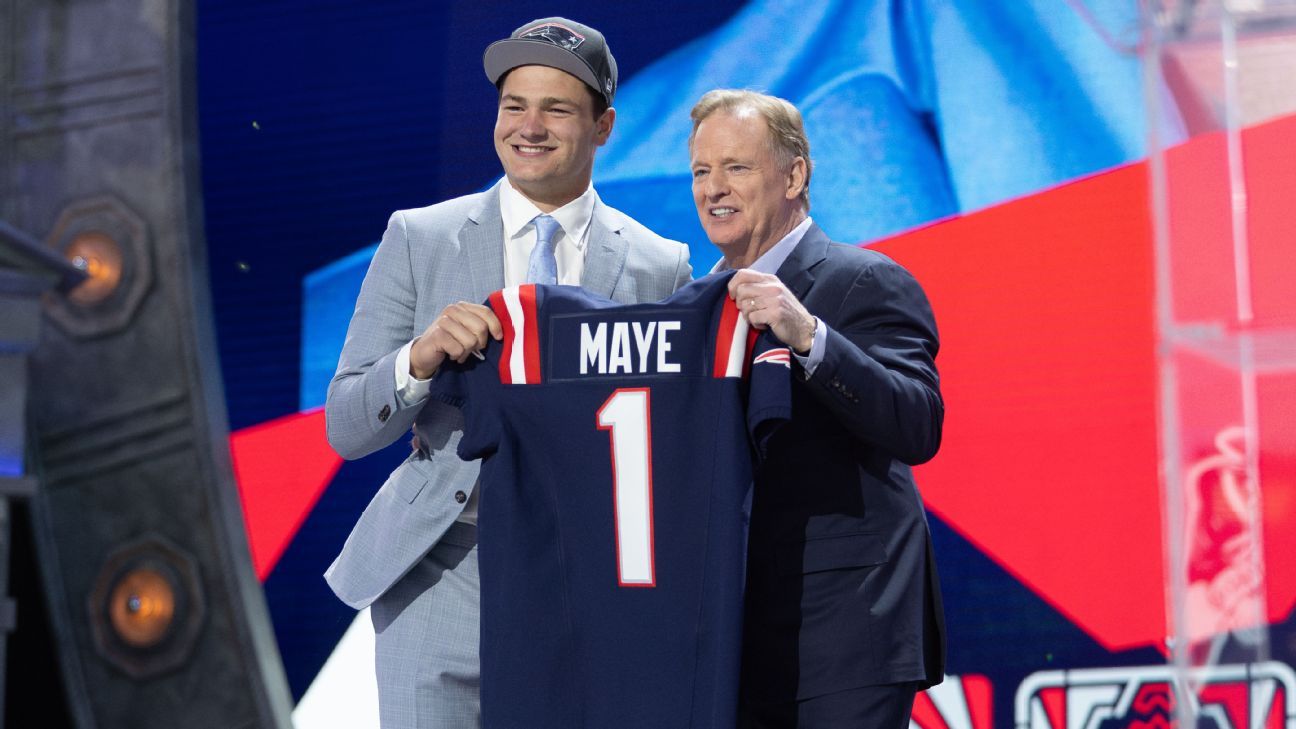
The first three off the board weren’t much of a surprise: Caleb Williams (Bears), Jayden Daniels (Commanders) and Drake Maye (Patriots). Then things went sideways when the Falcons stunningly drafted Washington quarterback Michael Penix Jr. at No. 8, despite signing quarterback Kirk Cousins to a lucrative free agent deal less than two months ago. Two picks later, the Minnesota Vikings made their much-anticipated trade up to select Michigan’s J.J. McCarthy, and the Broncos rounded out the group with Oregon’s Bo Nix at No. 12.
But after the boom of quarterbacks in the top 12 picks, not a single QB went until 150th overall when the New Orleans Saints selected South Carolina’s Spencer Rattler in the fifth round, setting another record of 137 straight picks without a quarterback being drafted. It also marked the third time in the common draft era that a QB wasn’t selected in the second or third round. It was 21 picks later before the second Day 3 quarterback came off the board when the New York Jets drafted Florida State’s Jordan Travis as a potential heir to Aaron Rodgers. Tennessee quarterback Joe Milton III was eventually picked by the Patriots at 193 in the sixth round.
The gap in quarterbacks could signal one of two things: The league’s talent evaluators believed there was a massive drop-off between the top six quarterbacks and the rest of the class or teams are devaluing development prospects. Both make some sense. In a league that has become increasingly impatient with young quarterbacks, there’s more pressure to see an immediate positive impact from its drafted QBs. The faster a quarterback proves himself, the more time the team has to build around him with expensive weapons while its quarterback’s inexpensive rookie contract is still on the books.
Lives of luxury?
No, this category isn’t about the Los Angeles Rams draft house. Although, those are pretty sweet digs, and the Rams actually had to do some work from there in the first round this year for the first time since 2016.
Instead, let’s take a look at the teams that used high draft picks to address positions that were already pretty well stocked.
The Atlanta Falcons started that trend early by drafting quarterback Michael Penix Jr. at No. 8 overall, despite recently signing Kirk Cousins to a four-year deal with $100 million guaranteed. The Falcons, though, stocked up on more pressing positions of need with their subsequent picks, taking four straight front-seven defenders.
Just after the Penix pick, the Chicago Bears opted to give Caleb Williams more help at wide receiver, drafting Rome Odunze despite having Keenan Allen and DJ Moore.
A couple of picks later, with the top-tier quarterbacks off the board, new Raiders general manager Tom Telesco selected Georgia tight end Brock Bowers at No. 13, despite the team drafting TE Michael Mayer at No. 35 overall a year ago. Bowers, though, is a more versatile pass-catcher than Mayer and could work out of the slot or as an outside receiver.
1:43
Can Caleb Williams lead the Bears to the playoffs next season?
Domonique Foxworth and Dan Graziano discuss the likelihood of the Bears making the playoffs with Caleb Williams at quarterback.
“He was really pretty [much] a consensus guy,” Telesco said of the team’s opinion of Bowers on Thursday. “Makes it a little bit easier, fully knowing that we have Michael Mayer, who is an excellent tight end, but there’s no rule in the NFL that you can only play one. We can play two tight ends; we can move people around.”
The 49ers closed Round 1 by drafting Florida wide receiver Ricky Pearsall despite having a stockpile of pass-catchers in WRs Brandon Aiyuk and Deebo Samuel, TE George Kittle, RB Christian McCaffrey and FB Kyle Juszczyk. Some thought the San Francisco pick could signal an impending trade of Aiyuk or Samuel, but when the draft closed, both were still 49ers. And GM John Lynch shot down the trade rumors in his Friday night news conference.
“We didn’t entertain any of that today,” Lynch said. “We’re happy with our wide receiver group. Actually, more than happy. We’re really thrilled with it. And thrilled to have added Ricky to that group and even make it stronger.”
Rich get richer?
The Kansas City Chiefs keep winning. The back-to-back Super Bowl champions not only landed value picks, but they grabbed two of them in trades with teams they beat in the 2023 playoffs. First, general manager Brett Veach traded up in the first round, using Buffalo’s No. 28 pick to snag speedy wide receiver Xavier Worthy, pairing him with another blazing wideout in free agency addition Marquise “Hollywood” Brown.
“Anytime you can add speed and add a guy with that type of versatility, I think you’re going to be interested,” Veach said Thursday night. “Just our ability to play vertical and have speed on the field at all times and having Xavier and Hollywood.
“As the season goes on here, I think we’ll have just an offense that can attack in multiple different ways and always keep defenses guessing.”
Bad news, NFL: Patrick Mahomes already won a Super Bowl without an elite receiving corps. Now, he has a track team on the outside and a physical pass-catcher with great finesse in Travis Kelce on the inside.
The move was particularly head-scratching because the Bills had a clear need at wideout after trading away No. 1 receiver Stefon Diggs. But GM Brandon Beane explained his team traded out of the first round — later trading the Panthers the No. 32 pick for their No. 33 as a part of package — because they wanted to recoup a third-round pick and believed there were quality players available at the top of the second. (Indeed, the Bills selected wideout Keon Coleman at No. 33.)
In the second round, the Chiefs then worked out a deal with the 49ers, whom they beat in overtime in the Super Bowl, to get pick No. 63 and draft 6-foot-5, 325-pound BYU offensive tackle Kingsley Suamataia.
“I love Veach man!” Mahomes tweeted after the Suamataia pick.
Defense delayed
Mamas, don’t let your babies grow up to be defensive players — at least not if you’re hoping for them to be selected in the top 10 picks of the NFL draft. The first defensive player — UCLA edge rusher Laiatu Latu — didn’t come off the board until the 15th pick. And while the Latu selection didn’t exactly open the floodgates right away, eight of the final 18 first-round picks were defensive players.
After a record-setting 23 offensive players went off the board in the first round, 20 defensive players were drafted in Round 2, tied for the fourth most in second round and the most there since 22 went in 2016.
Among the defensive positions most devalued was linebacker. The first one didn’t come off the board until the Packers traded up for Edgerrin Cooper with the 45th overall pick. The next linebacker, Michigan’s Junior Colson, wasn’t drafted until the third round, which proved to be one sweet spot for the position. Five linebackers were selected in the third round. Then six more went in the fifth.
The only defensive position group that had to wait longer to get its first pick was safety. Minnesota’s Tyler Nubin went two picks after Cooper to the New York Giants, followed by two more from the position in that round.
While the majority of teams stocked up on offensive players, two prioritized defense through the first three rounds. Neither the Eagles nor the Lions took an offensive player in the first three rounds.
The offense still finished ahead of the defense by the end of Day 2, with 54 offensive players selected to 46 defensive players.
Trade Eagles, trade
Philadelphia Eagles general manager Howie Roseman outdid himself. Notorious for wheeling and dealing, Roseman orchestrated nine trades in the draft, the most by any team since 1990. The next closest were the 2018 Patriots and the 2023 Texans, with eight trades each.
Not only did Roseman trade up with the Washington Commanders to land cornerback Cooper DeJean in the second round, but on Day 3, the Eagles traded the No. 164 overall pick and a sixth-rounder to the Indianapolis Colts to select legacy linebacker Jeremiah Trotter Jr. with the No. 155 pick overall. Trotter’s dad was selected by the same organization in the third round of the 1998 draft and became a four-time Pro Bowler over a 12-year career. Prior to the trade that landed Trotter, Roseman went wild in the fourth round with three trades. (Jets GM Joe Douglas also got in on the action and made three trades of his own in that round.)
In the first round, though, Roseman didn’t need to pull off any deals to land a star player. Because of the run on offensive players, the board set up perfectly for the Eagles to select Toledo cornerback Quinyon Mitchell at No. 22. Mitchell, widely considered the best cornerback in the class, models his game after veteran Eagles cornerback Darius Slay, giving the team a ready-made heir apparent for the CB1 job whenever Slay, entering his 12th season, moves on.
“Obviously, he’s got a lot to prove as a small-school player,” Roseman told Philadelphia media. “The MAC is not the National Football League. We understand that. We’ve had tremendous success with big schools. To take a player like this from the MAC, he has to be special.”
The Eagles’ first round, uncharacteristic because Roseman stuck with the original pick and chose a player from a small school, caused instant anguish for Cowboys defensive end Micah Parsons, who was watching the draft on a livestream.
“I’m honestly utterly disgusted on how lucky the Eagles are,” Parsons said of the Mitchell pick on a Bleacher Report livestream. “I do not know how he fell that far; with the run of offensive tackles and quarterbacks, that’s the only thing that makes sense. I thought he was a top-15, top-12 talent, and he just fell right into their laps.”
Deep and wide (receiver class)
All the pre-draft buzz of deep wide receiver and offensive line classes was reflected throughout the weekend. There were a combined 50 wideout and O-lineman selections through the first four rounds, setting a common draft era record.
Twenty-five offensive linemen went in the first three rounds, and of those, 17 were listed at offensive tackle — both records for the most drafted in the first three rounds in the common draft era.
The Steelers were among the teams who made the most of the deep offensive line class, drafting three linemen with their first five picks, marking the first time the Steelers have selected three O-linemen within their first five picks in the common draft era.
In that same three-round span, 16 receivers were selected, one shy of tying the record. In fact, the first non-quarterback selected Thursday night was Ohio State’s Marvin Harrison Jr., who went to the Arizona Cardinals. Fittingly, the next player drafted was offensive tackle Joe Alt followed by LSU wide receiver Malik Nabers to the New York Giants.
1:50
Tannenbaum: Giants made a big mistake passing on J.J. McCarthy
Mike Tannenbaum was confused by the Giants drafting WR Malik Nabers over QB J.J. McCarthy considering Daniel Jones’ injury history.
“I do think it’s a deep receiver draft,” Giants general manager Joe Schoen said prior to the draft. “They come in different shapes and sizes and speeds, but I do think it’s a deep wide receiver draft from top to bottom, depending on what you’re looking for.
“[There is] some added value with guys, the new kickoff rules, the guys that can also do returns. I think there’s an added element there too, and there’s some receivers that can wear multiple hats, not just as a receiver but also as a returner. Yeah, I do think it’s a good draft. … However people have them ranked, I think it is a good draft from the receiver position.”
WR Ja’Lynn Polk, picked at No. 37 overall by the New England Patriots was the 10th wide receiver selected, making the 2024 draft the fastest that 10 wideouts came off the board in the common draft era. Prior to this year, the fastest that 10 wide receivers had been drafted was by pick No. 45 in 1994.
Draft of runs
Not only did the draft start with a run on quarterbacks, but that streaky nature continued all weekend. Four wide receivers went off the board consecutively between the final two picks of the first round and the first two of the second. Soon after, four cornerbacks flew off the board in a row, from No. 40 to No. 43. By the end of the round, 10 defensive backs came off the board as compared to just three in the first round.
In the fourth round, running backs started to fly off the board, including three in a row, to the Eagles, Bills and 49ers. By the time the fourth wrapped up, six running backs were selected, the most in a single round since seven went in the sixth round of the 2019 draft. Prior to the fourth round, only four running backs had been selected.
And in the span of 11 picks in the sixth round, three kickers came off the board: Alabama’s Will Reichard (Vikings), Stanford’s Joshua Karty (Rams) and Arkansas’ Cam Little (Jaguars).
Ducks fly together …
… and they get drafted together. Oregon players were a popular pick this year, and when running back Bucky Irving became the seventh Duck off the board by early on Day 3, it set a school record for the most selections in the common draft era.
Three Oregon picks flew off the board in the middle of the fourth round when CB Khyree Jackson went No. 108 overall to the Minnesota Vikings, followed by DL Brandon Dorlus to the Falcons with the next pick and, two selections later, safety Evan Williams to the Green Bay Packers after they made a trade with the Jets.
The Broncos landed two Ducks, trading up 19 spots to open Day 3 to snag wide receiver Troy Franklin, reuniting him with teammate Bo Nix, who was the Broncos’ first-round pick. The Broncos brass was plenty familiar with Franklin, who participated in a private workout with Nix for the Broncos in March. And Franklin thrived with Nix throwing him the ball, setting Oregon single-season records last season in receiving yards (1,383), receiving touchdowns (14) and 100-yard receiving games (eight).
“He makes the receiver’s job easier,” Franklin said of Nix. “That’s my guy right there.”
Ducks center Jackson Powers-Johnson also was drafted, going to the Las Vegas Raiders at No. 44 overall.
Oregon, though, wasn’t the most represented program in this year’s draft, eclipsed by College Football Playoff national champion Michigan (13), runner-up Washington (10) and semifinalists Texas (11) and Alabama (10). The Wolverines’ 13 draft picks also set a program record for most selected in a single draft.
The Big D
No, not Dallas. Detroit put on a show hosting the 2024 NFL draft, breaking the all-time attendance record with 700,000 fans over the three-day event, shattering the previous mark of 600,000 set by fans in Nashville at the 2019 draft. Detroit also broke attendance records on Day 1 and Day 2.
Michigan Gov. Gretchen Whitmer made the announcement to the fans early on Day 3 of the draft.
“We have shown the world what the Motor City is about,” Whitmer told the crowd.
While the fans had fun flooding Detroit’s downtown for the draft, back at the Lions’ facility, the team’s staffers also were having fun by wearing black No. 89 Dan Campbell jerseys on the final day of the NFL draft — a celebratory move after Campbell won a bet to bring back the black jerseys by winning the NFC North in 2023.

-
Max Olson
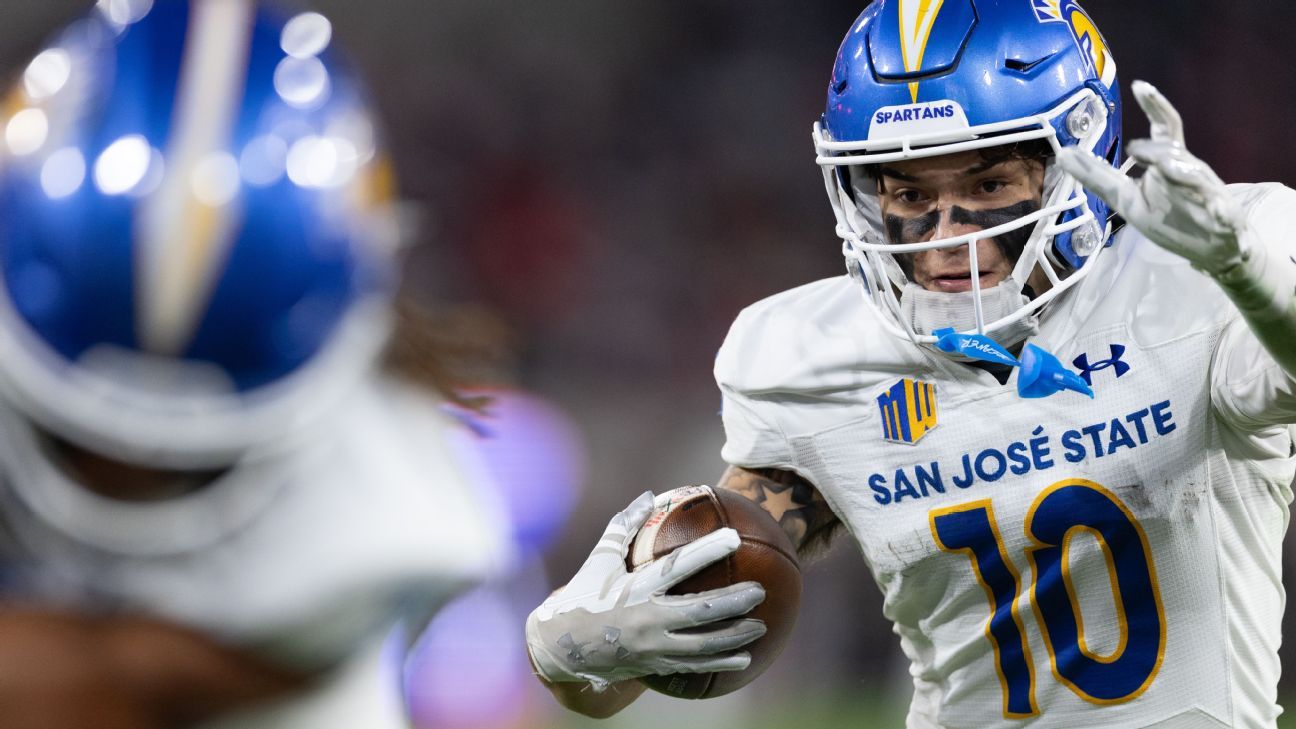
San Jose State wide receiver Danny Scudero, the leading receiver in FBS this season, will enter the NCAA transfer portal when it opens in January, he announced Friday.
The 5-foot-9, 174-pound redshirt sophomore caught 88 passes for 1,291 yards and 10 touchdowns in his first season with the Spartans, becoming a semifinal for the Biletnikoff Award and earning first-team All-Mountain West honors.
Scudero is expected to be one of the more coveted wide receivers available when the transfer portal officially opens on Jan. 2 and has two more seasons of eligibility remaining.
Scudero spent two years at Sacramento State before transferring to San Jose State after the 2024 season. He broke out with 189 receiving yards to open the season against Central Michigan and surpassed 100 yards in five more games, including a career-high 215 and two touchdowns against Hawaii.
Scudero’s 88 receptions ranked fourth-most in FBS, and he leads all receivers this season with 16 catches of 30 or more yards.
The Spartans produced the No. 14 passing offense in FBS this season but went 3-9 in their second year under coach Ken Niumatalolo.
-
 Sports2 years ago
Story injured on diving stop, exits Red Sox game
-
 Sports3 years ago
‘Storybook stuff’: Inside the night Bryce Harper sent the Phillies to the World Series
-
 Sports2 years ago
Game 1 of WS least-watched in recorded history
-
 Sports3 years ago
Button battles heat exhaustion in NASCAR debut
-
 Sports3 years ago
MLB Rank 2023: Ranking baseball’s top 100 players
-
Sports4 years ago
Team Europe easily wins 4th straight Laver Cup
-
 Environment3 years ago
Japan and South Korea have a lot at stake in a free and open South China Sea
-
 Environment1 year ago
Here are the best electric bikes you can buy at every price level in October 2024