
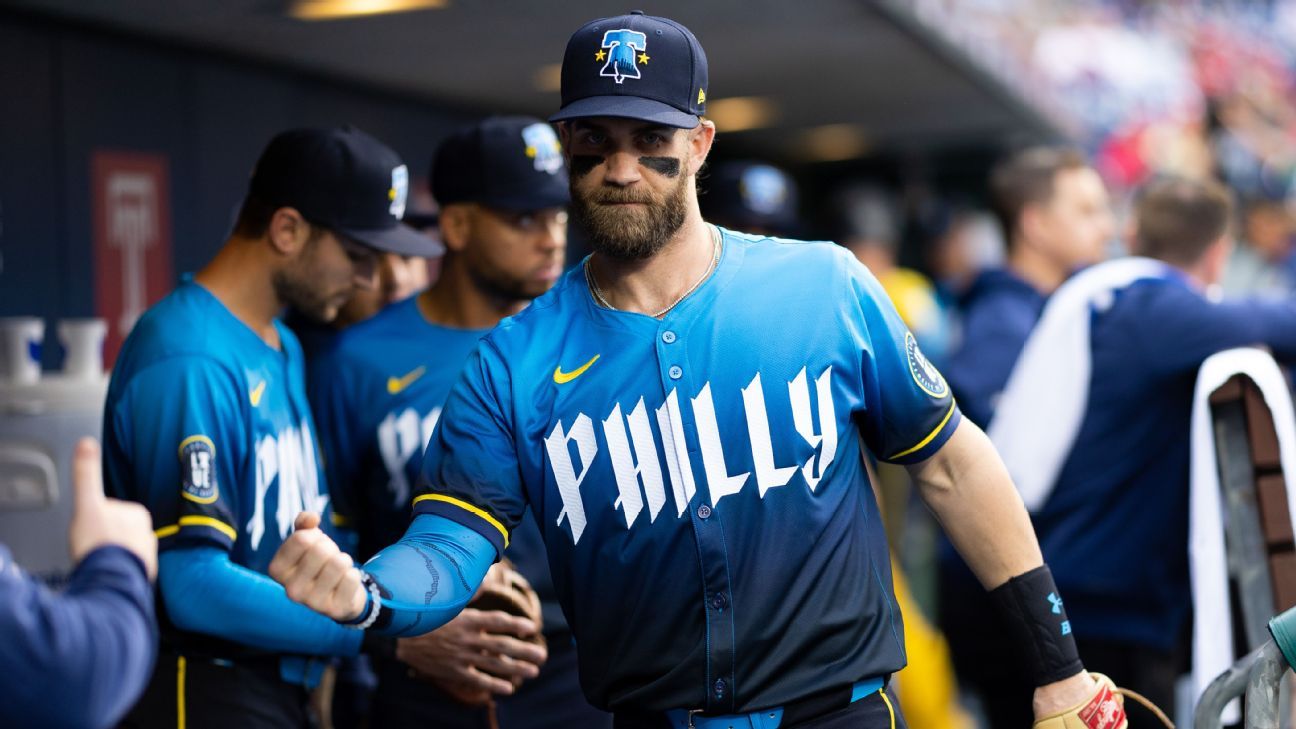
‘Bryce is Philadelphia now’: How a Vegas kid became the face of Philly sports


-
Jesse Rogers, ESPN Staff Writer
BRYCE HARPER’S DAILY routine is no different than many Philadelphia sports fans. On his drive into the city from his home in the suburb of Haddonfield, New Jersey, he listens to local sports talk radio. Often, he walks into Citizens Bank Park wearing gear of a Philadelphia sports team. Then Harper changes into his uniform, rolls up his sleeves and gets to work.
Harper gets a thrill from hearing the passion that fans in his sports-crazed city have for their teams — especially because it’s a passion he shares with them.
“People that call into the radio, they love it. They love us. I love listening to it. I think it’s hilarious. I enjoy listening about all the other sports in town. I love cheering on the Eagles. I love cheering on the Sixers and Flyers,” Harper said.”
“We all know what it’s like to play here and so we all cheer for each other and understand each other. When the city rallies around a team and all the players, it’s just so much fun to see.”
Harper began endearing himself to a fan base known for its rough edges from the moment he signed a 13-year, $330 million contract before the 2019 season. He famously overruled agent Scott Boras’ insistence to include an opt-out, wanting to show loyalty to the place he planned to spend the rest of his career. He also turned down an opportunity to don No. 34 — his number with the Washington Nationals — declaring that Hall of Fame pitcher Roy Halladay “should be the last to wear it.” When he bemoaned the price of beer at Citizens Bank Park, Philadelphia knew it had found one of its own.
“Bryce is really good at saying the right thing and I don’t think it’s B.S.,” longtime Phillies first baseman and current broadcaster John Kruk told ESPN recently. “He means it. From Day 1, when he signed that contract and he didn’t ask for that opt-out, that meant a lot to the fans.”
Fast forward five years and Harper is even more beloved in Philly. Sure, winning an MVP award in 2021 helped that cause. So did leading the Phillies to the World Series the following year and returning to the National League Championship Series in October. But it’s not just the awards and playoff victories that have strengthened his bond with the city.
“I came from Southern California, having no idea what the East Coast was like, let alone Philadelphia,” Chase Utley, another Philly great, said in a phone conversation. “It takes a certain type of personality to succeed and thrive in the Philadelphia sports world. Bryce had it right away.
“He brings you into his game with his talent and grit. That resonates with the fan base.”
The adoration of an East Coast city that prides itself on blue-collar toughness might not be what you’d expect for a superstar who grew up 2,500 miles away, among the glittering lights of Las Vegas. But Harper has always been as much South Philly as Vegas Strip.
“I kind of always thought the city suited him and it was only a matter of time before he got here,” said Trea Turner, who was also Harper’s teammate in D.C. “Bryce is Philadelphia now.”
HARPER WANTS YOU to know at least one thing about Las Vegas: It’s not all about the Strip. There are neighborhoods and locals and working class people all over — just not necessarily where tourists go. It’s more blue-collar than many think.
“You have to be a hard-working town when you’re building all those casinos,” he said.
Harper’s father, Ron, is an iron worker who did local construction for 30 years; his extended family all worked “blue-collar jobs” as well. Harper’s work ethic was honed early in life, in part by laying rebar with his dad.
He took that mindset onto the field with him, quickly outpacing ballplayers his age and playing against players four or five years older on Las Vegas’ best travel teams. At 16, he decided to leave high school, earn his GED and enroll at the College of Southern Nevada. He continued to dominate there, winning college baseball’s Golden Spikes Award, an honor that’s been given to a junior college player just twice in nearly a half-century, in 2010.
All the early morning runs, the workouts in the gym and his dominance on the field paid off that same year when Harper was selected first overall by Washington.
“Bryce was the guy. Everybody had their eyes on Bryce,” said Mike Bryant, who coached Harper, Joey Gallo and his own future major league MVP son Kris, in Las Vegas youth leagues. “Just having Bryce around brought eyes on everyone else. He was the guy. No question about it.”
That sort of attitude and expectations also helped prepare him for the kind of scrutiny a superstar faces in Philadelphia.
“He’s been in the spotlight since he was 14,” former Phillies manager Larry Bowa said. “That has a lot to do with it. He’s had pressure on him his whole life. When you come here, you better be able to deal with it. That doesn’t bother him.”
NEVER WAS HARPER’S work ethic more apparent than his months of rehab after his November 2022 Tommy John surgery. The initial timetable had him rejoining the team around the 2023 All-Star break, but he had a different plan. On May 2 — more than two months ahead of schedule — Harper was back, moving to a new position and eventually helping the Phillies to another playoff berth.
“I was calling him a superhero,” Phillies infielder Bryson Stott said. “His body heals faster than anyone I think I’ve ever seen.”
Though Harper’s move to first base was initially to protect his still-tender arm, the initial success led the Phillies to make the move permanent this offseason. Harper had enough clout that he could have vetoed the plan and stayed at designated hitter or lobbied for a move back to the outfield.
“That’s the first thing our infield coach, Bobby Dickerson, said to me: ‘If you’re all-in, we’re going to do this. If you’re not, we’re not going to,'” Harper recalled. “From that point on, I told him, ‘Whatever you want to do.’
“I love being coached.”
The undertaking meant Harper would need to spend hours this spring learning the nuances of a new position, often putting in extra time before batting practice taking ground balls. His teammates and coaches saw the former MVP attack his new challenge like a rookie trying to make the roster.
“We spent at least 20 minutes a day on our half field. We did all the skill parts of playing the position,” Dickerson said. “Then I did a little verbal test with him every few days, like, ‘Runner on first, double down the right-field line. Where do you go?’ I would hit him with that a good bit.”
“It’s been an amazing transformation to watch, actually. You spend your whole career doing different things in the outfield, then in the major leagues [you] learn to play first base.”
The results so far tell the story. According to ESPN Stats & Information, his range moving to his right has improved since last year and he ranks near the top of the league in outs above average (second) and defensive runs saved (second). Through Wednesday, Harper’s had 251 chances at first base without an error.
“It’s still a transition,” Harper said. “I’m still learning where I need to be on the field. When a guy hits a ball down the line or in the gap, you can’t get caught watching paint dry. I sit there sometimes and watch Bryson make a great play and I’m like, ‘Holy crap, I have to cover first base.'”
Stott, who is also from Las Vegas, sees the connection between that work Harper puts in behind the scenes and his roots. Yes, there are bright lights and big paydays but nothing gets done without effort.
“You see the casino executives,” Stott said. “They’re working, but they’re not in the streets building the casinos. You don’t see those people. You don’t see the work [Bryce] put in either.”
NO MATTER HOW hard you work — or how well you perform — there is a reality for all professional athletes in Philadelphia: You will be booed.
Harper was already hearing it from the fans on his first Opening Day as a Phillie, in 2019 — and he wouldn’t have it any other way.
“On my first day I punched out against Julio Teheran, and I’m walking back to the dugout and they booed me on my first at-bat,” Harper said. “I totally understand and get it.
“When you do stuff wrong they’re going to let you know. As players in this clubhouse, we love that and from an individual standpoint, I love it.”
Harper made it clear that a few boos weren’t going to keep him down — he homered in each of the next three games. Just as important, he answered the tough postgame questions from reporters, starting with that initial 0-for-3 debut.
That culture of accountability has spread through a clubhouse filled with players who have come to join Harper in Philadelphia, a city that is now a destination for big-name free agents. First it was Zack Wheeler signing a $118 million deal before the 2020 season, then sluggers Kyle Schwarber and Nick Castellanos signed on the next season. Finally, Turner reunited with Harper by signing a $300 million contract an offseason ago.
Together, they have formed a core beloved in the city as few Philadelphia teams — in any sport — have been before.
“When they have a s— game, [the fans] want to hear it,” Bowa said. “‘Hey, I stunk tonight.’ Schwarber does it. Turner, too. Bryce has had that kind of impact.”
Some around the Phillies credit the bond Harper created for bringing out a softer side of the fan base. Instead of booing Alec Bohm out of town when he was caught mouthing “I f—ing hate this place” after making an error, the fans rallied around their young third baseman. Turner received a similar reaction when he was greeted with a standing ovation — not a round of boos — when he came to the plate in August, in the midst of a prolonged slump in his first season with the Phillies.
“He’s done a good job of showing the other side of Philly,” Turner said. “The coolest part, over the last five years, is to see where it started and where it is now. The whole organization and the fans and all that stuff is in a lot better position.”
Schwarber agreed. “He embraces the way that they think,” he said. “And he’s really public with it. He wants to win it and win it for the city. That’s what you want out of a leader. That’s what makes it exciting to come and play every day.”
Of course, Harper knows Philadelphia is still Philadelphia, and the boos could always come unless one of these seasons ends with him holding up the World Series trophy. Though they’ve come close, a championship has evaded them, and the euphoria of the team’s unexpected 2022 postseason run was replaced by frustration when the team lost Game 7 of the National League Championship Series at home in October. Signed through 2031, Harper still has nearly a decade to deliver that ultimate prize to his city.
“You do it for so long that it becomes the goal even more, right?” Harper said. “We have such a great group of guys. All we want to do is win. We don’t care about anything else.
“Philly is a very results-oriented town.”
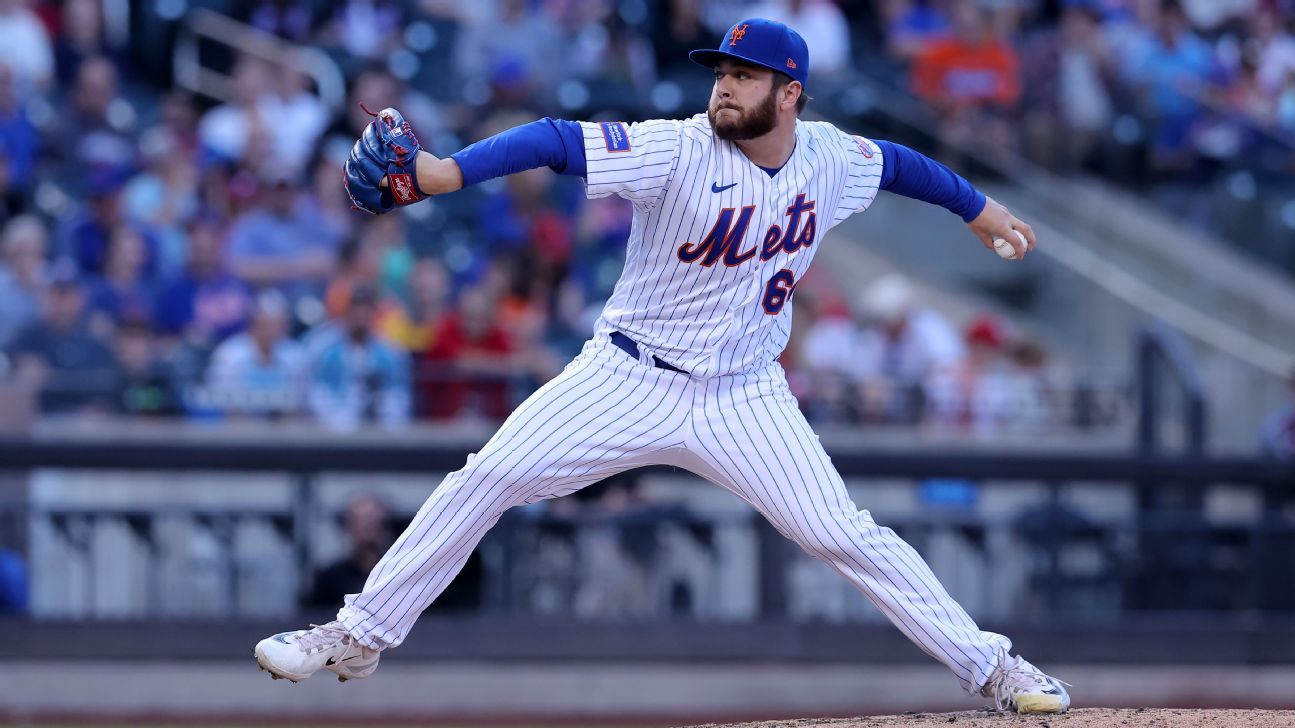
Left-hander Anthony Kay and the Chicago White Sox are in agreement on a two-year, $12 million contract with a club option for a third season, sources told ESPN on Wednesday, bringing the veteran back to Major League Baseball after a successful two-year run in Japan.
Kay, 30, posted a 1.74 ERA over 155 innings for the Yokohama BayStars this year, featuring a new cutter, an improved changeup and a fastball that still sits at 95 mph years after he was one of the game’s best pitching prospects.
The White Sox are aiming to replicate their success with domestic pitchers returning from Asia two years after signing Erick Fedde to a two-year, $15 million deal.
Kay’s deal will pay him $5 million each of the next two seasons and will include a $10 million club option for 2028 with a $2 million buyout, sources said. He can earn another $1.5 million in incentives.
He will slot into a White Sox rotation that includes young right-handers Shane Smith, Davis Martin and Sean Burke. Chicago used 18 starters this year, when it went 60-102 — a 19-game improvement over 2024, when the White Sox set a major league record with 121 losses.
Kay’s return comes after a five-year major league career in which he posted a 5.67 ERA in 85⅔ innings with the Toronto Blue Jays, Chicago Cubs and New York Mets, who took him in the first round of the 2016 draft out of UConn. Kay cruised through the minor leagues and was dealt to the Blue Jays along with Simeon Woods Richardson for Marcus Stroman at the 2019 trade deadline.
Following a return to the Mets in 2023, Kay departed for Yokohama, where he threw 136⅔ innings of 3.42 ERA ball in his first season.
While Nippon Professional Baseball features a depressed offensive environment, Kay still ranked fifth in the league this year in ERA and allowed only eight home runs in 155 innings while striking out 130 and walking 41.
-
 Sports2 years ago
Story injured on diving stop, exits Red Sox game
-
 Sports3 years ago
‘Storybook stuff’: Inside the night Bryce Harper sent the Phillies to the World Series
-
 Sports2 years ago
Game 1 of WS least-watched in recorded history
-
 Sports3 years ago
Button battles heat exhaustion in NASCAR debut
-
 Sports3 years ago
MLB Rank 2023: Ranking baseball’s top 100 players
-
Sports4 years ago
Team Europe easily wins 4th straight Laver Cup
-
 Environment3 years ago
Japan and South Korea have a lot at stake in a free and open South China Sea
-
 Environment1 year ago
Here are the best electric bikes you can buy at every price level in October 2024