

Rangers give exec Young extension, new title



ANNAPOLIS, Md. — When Navy quarterback Blake Horvath returned to his dorm room during Army-Navy week last season, he found pictures of Army quarterback Bryson Daily taped all over his door. Elsewhere, banners had mysteriously appeared in the dining hall, reading, “GO ARMY, BEAT NAVY.”
The likely suspects? West Point cadets spending a semester in Annapolis, Maryland, as exchange students. It’s a program that will celebrate its 50th anniversary this year — one of several enduring traditions between the two academies.
“I can neither confirm nor deny if that was us that evening,” Army senior cadet Jayram Suryanarayan said, “but I can say we were up to some shenanigans — so it could have been.”
The shenanigans were unfolding simultaneously in West Point, where the Navy exchange students’ clothes and uniforms had disappeared and been replaced by costumes — including a smelly fish outfit and a Teenage Mutant Ninja Turtle — to wear the entire week.
“They bought a Marine Corps raincoat, cut it as fabric, and then sewed — and then this is what impressed me because it took time and skill — they sewed together a miniskirt for me to wear and they got a Marine Corps sweatshirt and they cropped it,” Navy senior Michael Middleton said. “They stole all of my uniforms, all of my civilian clothes. It wasn’t just to school — I had to work out in it. It was really quite a scene. It was really fun.”
(Last year’s antics were relatively tame compared to “Operation Black Knight Falling” in 2022, when five Navy midshipmen led three flight crews in formation over the United States Military Academy in West Point, New York, and dropped thousands of BEAT ARMY ping-pong balls and leaflets on campus.)
After spending a semester at their rival school, the tradition culminates when the exchange students stand front and center on the 50-yard line ahead of the Army-Navy football game in what is casually referred to as a “prisoner exchange.” The men and women on the field who annually participate in that program embody everything that follows in the global game — tradition, respect, pageantry, precision — and a deep understanding that one of college football’s longest and strongest rivalries is also about an immeasurable bond that infiltrates beyond the field.
“Army and Navy, West Point and Annapolis, we’re not that different,” said Middleton, who will be a ground officer in the United States Marine Corps after graduation. “We like to have this friendly banter, and we say we’re going to beat Army by a million because that’s what we’re going to do — that’s a fact you can quote that — but really it’s one fight and one team.
“We’re all in the Department of War,” Middleton said. “We all work for each other. If we’re in some far-flung place, having to do a job the nation has called us to do, I don’t care where you graduated because we’re all out there for each other.”
On Saturday at M&T Bank Stadium in Baltimore, this year’s group of exchange students will be released to their classmates and hoisted back into the stands to watch the 126th Army-Navy game together. It’s one of many traditions from America’s Game that don’t involve the players: From the “demonstration of discipline” as thousands of classmates from each academy “March On,” to the grit and fortitude of the relay teams who deliver the game balls after running from their schools along backroads, through states and cities, and into the stadium. It’s the thoughtful, historically accurate and detailed uniforms, which this season will celebrate respectively the 250th anniversaries of the United States Army and Navy. It’s the nearly 800 celebrities and high-ranking dignitaries, including President Donald Trump, who will attend. It’s the live mascots — one mule and two goats — who need careful delivery and their own parking spaces.
The players earn the spotlight in the final and most emotional tradition — singing their alma maters on the field after the game. And woe to the team that lost and has to sing first.
“You just feel like you not only let yourself down, your teammates down,” Army center Brady Small said, “but you feel like you let the Army down.”
While you might be familiar with some or all of these traditions from watching the game on TV, ESPN interviewed more than a dozen people from both academies who make it all come together, taking you behind the scenes for how each tradition unfolds and what it means to be a part of them.
Jump to section:
Alma mater | Uniforms
Ball run | March On
Mascots | Presidential visit
Alma mater
In preseason camp, every Army football player is tested on the school’s alma mater. It’s something they learn from the “Book of Knowledge,” which is required reading during Cadet Basic Training and has been published since 1908. It includes the history and traditions of West Point.
“I can’t tell you the exact page number,” said receiver Noah Short of where the alma mater appears, “but it’s definitely in the first few pages.”
Hail, Alma Mater dear,
To us be ever near.
Help us thy motto bear
Through all the years.
Let Duty be well performed.
Honor be e’er untarned
Country be ever armed.
West Point, by thee.
“I make them write it down,” Army coach Jeff Monken said, “they have to write it out.”
“If you don’t do it right — literally word for word — Coach Monken will not travel you,” Army linebacker Kalib Fortner said.
Both schools sing their alma maters at other games and events, but the tradition of singing it after the Army-Navy football game is unlike any other. The winner sings second.
“It’s awesome,” Monken said, “and there’s just so much emotion and relief that we’re the ones standing there singing second. … It’s equally as gut-wrenching and emotionally just rips you apart to have to stand there and mumble the words of your alma mater if you’ve gotta do it first.”
Horvath, Navy’s quarterback, said the Midshipmen are quizzed on their alma mater about four days into their plebe summer. They’d sing it before they went to bed each night around 10 p.m.
Now colleges from sea to sea
May sing of colors true
But who has better right than we
To hoist a symbol hue
For sailors brave in battle fair
Since fighting days of old
Have proved the sailor’s right to wear
The Navy Blue and Gold
“Singing first, it physically hurts a little bit,” Horvath said. “You know that your fans aren’t singing with as much enthusiasm, you’re not singing with that same sort of loudness and excitement as you would if you were singing second. It’s sort of, as a player, an embarrassment to sing first. On the flip side, singing second, you can feel the joy and excitement like after the Army-Navy game last year. It’s the loudest I’ve ever heard our alma mater sung.”
Uniforms
Army and Navy reveal special uniforms each season, but don’t bother trying to sneak a peek at either before they’re publicly announced — it’s classified, for a whopping two years.
“We don’t really keep files stored here, we just kind of keep things very hush-hush,” said Mike Resnick, associate athletic director in charge of internal operations at West Point. “Nike’s really good on the shipping. It’s West Point; we have some trustworthy people here.”
Just for added security, though, some nondisclosure acts are signed along the way. There are only about 14 or 15 people who know what Army’s uniform will look like — including the history department.
“We don’t let the Pentagon know,” Resnick said. “We keep it pretty close to the vest.”
As parts of the uniform and other sideline gear are shipped, Navy stores everything in a warehouse on the other side of the Severn River. The artist who handpaints their helmets is in Langhorne, Pennsylvania, so when Navy played at Temple this year, a few members of the equipment staff visited him to check on the progress.
A uniform 250 years in the making…https://t.co/168T92kRln#GoNavy | #Navy250 pic.twitter.com/N0LVQkHCKG
— Navy Athletics (@NavyAthletics) November 18, 2025
Every detail in both uniforms has a meaning. For Navy, the six strands of rope on the helmets represent the six original frigates of the U.S. Navy, and the knots were a spin-off of the 126 knots on the sides of the pants to represent and pay homage to the 126th Army-Navy game. On the jersey, there are 250 knots around the neck and sleeves to represent 250 years of the Navy.
“The guys always want hints,” Navy senior associate athletic director Greg Morgenthaler said. “From our first team meeting with Coach Newberry. I talked to the team in November about expectations and stuff, and they’re all like, ‘What are we wearing this year? G, what are we wearing?'”
Around noon on Nov. 17, Navy players, coaches and staff started to file into the auditorium in Ricketts Hall. It wasn’t a mandatory team meeting, but nobody was going to miss the highly anticipated uniform reveal for the Army-Navy game.
“Nobody’s posting anything regarding the unis, everybody good?” Newberry said.
“Yessir!”
Proud to honor an enduring symbol of service and sacrifice for the past 250 years.https://t.co/QlUpMO7VlC#GoArmy pic.twitter.com/5DeHAW0pm9
— Army Football (@ArmyWP_Football) November 15, 2025
Army’s marble print uniforms are designed to mirror the marble headstones at Arlington National Cemetery and the ultimate sacrifice that has been made. The Great Seal on the right shoulder indicates Army’s duty to the United States in peace and war. There is an old guard espontoon etched into each helmet to symbolize Army’s role as the tip of the spear, starting on the back of the helmet and culminating in a tip on the front.
Lieutenant Colonel John Zdeb teaches in the department of History and War Studies at West Point and has been helping with the accuracy of the football team’s uniforms for five years. He’s a graduate of the academy and also had two deployments to Iraq, one to Afghanistan, another to Eastern Europe and another to Kuwait.
“There’s always different elements where they’re asking us, my team in particular, ‘Hey, the way we’ve depicted this, is it historically accurate? Is it representing the historical event in the correct way? And if it is going to veer away from that a little bit, is that a creative liberty that makes sense? That’s worth doing?’ And so we have a lot of feedback.”
Ball run
At 3:30 a.m. Thursday morning, a group of 17 cadet marathoners, four officers and three vans departed from the West Point superintendent’s house on campus to run 240 miles across four different states — all while carrying an Army game ball to be delivered to M&T Bank Stadium in Baltimore at 2 p.m. ET on Friday. On Saturday, each of the teams will jog the ball onto the field at a designated time and present it to their First Captain or Brigade Commander.
At approximately 7 a.m., on Thursday the team will pass from New York into Mahwah, New Jersey, and then continue along Route 202 into Pennsylvania. The marathon team will then run through southeastern Pennsylvania before entering Maryland, near Rising Sun. The final portion of their journey will lead them to downtown Baltimore via Route 1.
“The ball itself is always in a cadet’s hands and is moving nonstop from when we leave up until we reach the stadium,” said senior cadet Michael Clay, who is part of his fourth Army-Navy relay team and estimated he has run about 90 miles total to the past three stadiums.
The Navy relay team has a slightly more advantageous route this week — by more than 200 fewer miles from Annapolis to Baltimore. The Midshipmen will meet in front of Bancroft Hall on Friday before leaving at noon and heading out Gate 8. They will arrive at Fort McHenry in Baltimore at sunset and finish the final few miles to the stadium on Saturday.
“It’s kind of fun because we have the rest of the company there waiting at the stadium for the ball to get there, and then the people that are running that last leg kind of run up to the stadium,” Midshipman Connor Mollberg said. “The whole company’s there. It’s a big celebration that we got the ball there.”
Though not without someone occasionally fumbling along the way.
“It never intentionally hits the ground,” Clay said, “especially in those subfreezing temperatures with gloves on, it can be really hard to tell how firm of a grip you have on the ball. So yes, it has been dropped, but never intentionally — and never more than 13th company.”
The tradition began with Navy’s 13th company, which has about 120 Midshipmen in it, and while nobody is required to participate in the ball run, “people are usually more than willing to run the ball a couple of miles and help out,” said Mollberg, who is on Navy’s parachute team — not track or cross country.
While Army’s relay team is much smaller because it comprises the school’s marathon team, they tend to pass the ball around with anyone who joins them for the last few miles — typically members of the community, first responders and high-ranking West Point officers.
Because Army has a longer trek, their runners will aim for between six and 13 miles per stretch, while Navy will run seven legs of four miles per runner. Along their way, they have both cultivated relationships with small communities they routinely pass through. Elementary and school-aged kids line the streets, cheering for both teams along the way — even at 2 or 3 a.m. when the runners least expect it.
“They let us know who they’re rooting for pretty early on,” Clay said. “Certainly a healthy mix.”
‘March On’
The spectacle of watching roughly 3,000 cadets and another 4,000 Midshipmen march onto the field in unison before the Army-Navy game — entire schools of uniform-clad future military leaders taking their seats in the stadium — is one of the most recognizable traditions of the pregame ceremonies.
The cadets and midshipmen will start to march from Camden Yards about a half-mile away. Navy will be on the first-base side, Army will be in left field, and will come down Ravens Walk before entering the stadium at noon.
“We use it as a demonstration of discipline within the corps, everybody moving in the same uniform, at the same time, in the same place,” said Adam Brady, who has done this as a cadet and now as the Operations Officer at Army. “It’s one of the few times when we have the entire corps of cadets marching.”
At Army, it’s the same 30-inch step. It’s the same arm movements for thousands of students who must keep in line with the person to the right. They guide right (keep the group moving in a straight line), dress right (fine tune everyone’s position so the formation looks perfectly straight), and are centered on the person in front of them. It’s something they practice for a total of four or five hours on one of the campus athletic fields.
Aden Alexander, a plebe at Navy, will be marching onto the field for the first time and said a key to staying in line is listening to the drum beats.
“Typically over the plebe summer we’re taught with a cadence, so our detailers will be saying out loud, ‘left, right, left, right,'” Alexander said. “And we’ll have little ditties or songs that we’ll sing along to get our brains trained to walk in-step, so we’ve gotten pretty good at that.”
Everything is a competition.
“Army always marches on better than Navy,” said Jeff Reynolds, Chief of Protocol, United States Military Academy, West Point. “That’s our first win of the day.”
Mascots
It might be the only game on the planet where two goats and a mule get together before kickoff.
The Army has two mules — Paladin and Ranger IV — but only Paladin will be traveling to Baltimore. Army has an equestrian team, and cadets whose members earn the positions of “mule wranglers.” At Navy, there are eight Midshipmen in the Goat Squad, the group that takes care of Bill(s) the Goat(s) at events and games. Once you’re chosen, the job is yours until graduation. The identity of the daily caretaker, who keeps the goats on a nearby farm, is classified.
Senior Myles Brown leads the Goat Squad and has been a member since his sophomore year. He said the two goats — both named Bill — will arrive at the Stadium around 10 a.m. and be available in the parking lot to visit with fans. The Goat Squad will enter the stadium between noon and 12:30 p.m., and they’ll look for a spot on the field secluded from the football players “so they’re not overstimulated.” After Bill 37 retired, Bill 38 took his place — and Bill 39 is the new addition (for anyone who might be counting).
“They like to be together,” said Brown, who worked on a sheep farm during high school in Georgia. “They’re a lot more calm when they’re around each other.”
The goats will be on leashes, with two handlers per goat, one person to clean up any messes they leave behind (literally), one to carry water and treats, and everyone else is “crowd control.” Though the goats will eat just about anything, Brown said, “they really like animal crackers.”
The mules eat hay and the mule wranglers will bring four bales for Paladin to travel with as well as a hay net filled for him to eat on the field.
“I always think about Bevo,” said LTC Adam Brady, of the Texas Longhorns‘ mascot. Brady is a member of the commandant’s staff responsible for training and operations. “Nobody cares about Bevo until something goes wrong. We’ve got to be aware of that. They’re a huge draw. Kids love them, parents love them. People try to get on them. But they are something that we are concerned about. We have to take care of the animals, but we also do have to recognize that they are wild animals, and they’re significantly larger than the Navy goat.”
“There are some things we have to be aware of,” Brady said. “Logistically, some of that is, hey, can we even get them in the stadium? Just from a safety perspective, how can I get a spooked mule out of a stadium safely? We have to evaluate that, whether it’s here at home with our construction that we’ve been doing, or the different stadiums. The sidelines are a lot tighter than you’d expect.”
This year, one other live mascot might try to steal their spotlight.
Chesty, an English bulldog who is the mascot of the United States Marine Corps, could make a surprise appearance during the coin toss.
“That’s what we’re planning,” said Ann McConnell, the Naval Academy’s director of protocol. “However, that may change. The Secretary of War may come over to our side to walk out with the President. That’s still a little bit in flux.”
Presidential visit
Dear Mr. President:
On behalf of the Department of the Navy and the Department of the Army, we are honored to invite you and Mrs. Trump to attend the 126th Annual Army-Navy football game, on Saturday, December 13, 2025, at M&T Bank Stadium in Baltimore, Maryland.
The home team sends the official invitation to the White House and this year that is Navy. Both schools confirmed President Trump will attend — along with hundreds of other high-ranking officials, dignitaries and celebrities. It’s a massive coordination effort that takes a year of planning and above all else — security.
Jeff Reynolds, Chief of Protocol, United States Military Academy, West Point, said he was expecting close to 800 celebrities and dignitaries in Baltimore, and is in charge of credentialing more than 600 seats on Army’s 50-yard line — extending from the first row up to the first few rows on the upper deck.
Throughout his career, Reynolds has credentialed Elon Musk, Phil Knight, Gary Sinise, Rachel Ray, Charles Barkley, Mark Wahlberg, Peyton and Eli Manning. There’s one person, though, at the top of his list — Army superintendent Lieutenant General Steven W. Gilland, “who for me, outranks everybody else. I work directly for him. I got to make sure he’s taken care of.”
Reynolds, whose first Army-Navy game was in 2008 when President George W. Bush attended, has worked with Presidents Bush, Barack Obama, Bill Clinton, Joe Biden and Trump.
“The challenging part is to try to make sure the fan experience is still great,” Reynolds said. “We want everybody coming to the stadium to have a great time, to enjoy America’s Game.
“But the logistics,” he said. “The White House staff determines the itinerary of the President. The Secret Service’s job is to make sure that itinerary is secure for the President — and everybody — but really they’re focused on the President. My job is to meld all that into the fan experience and the team, so they can still take the field at the right time, do whatever the coaches need them to do.”
Ann McConnell, who has worked in the Naval Academy’s protocol office for 27 years and been its director for nine, said there would be an additional 500 distinguished visitors (DVs) on Navy’s 50-yard line and will include senators, congressmen, cabinet members, and senior military leaders. This year’s coin toss will include: President Trump, the secretary of the Navy, chief of naval operations, master chief of navy, command master chief at naval academy, president from USAA, superintendent, commandant of marine corps, and the sergeant major of marine corps.
(And Chesty.)
While most of the dignitaries start to arrive between 11 a.m. and noon, the President typically comes just before kickoff for security reasons.
“I actually don’t ever sit,” said McConnell, who enlisted in the Navy in 1992 as a yeoman to follow in her father’s footsteps. “I am constantly moving. I am down on the field making sure everyone’s where they need to be for the coin toss and the crossover. I am up in the Midshipmen’s seats when our [distinguished visitors] come up to interact with the Midshipmen, I am down on our seating section making sure everyone has what they need. I am up in the warming room making sure everyone is all set. Sometimes I end up at gates making sure people that can download the tickets are able to get in. So I really from the time we arrive at eight o’clock, I do not sit until I get in my car at seven and head home.”


-
Ryan S. Clark
On Dec. 31 — or thereabouts — we are going to learn which NHL players are going to spend at least two weeks in Italy representing their nations at the Olympic Games, along with knowing who will be on a beach watching those Olympics from afar.
Every nation that’s competing at the Milan-Cortina Games is expected to have its roster finalized by the Dec. 31 deadline. It’s what makes the time between now and then quite crucial, and it could play a role in the difference between potentially challenging for an Olympic medal or thinking about what that would be like.
Canada, Czechia, Finland, Sweden and the United States each have a unique set of decisions to make in the coming weeks. ESPN did its first round of projections in November for those five teams. Now comes one final set of predictions about what those five nations could do with their respective rosters.
Jump to a roster:
United States
Canada
Sweden
Finland
Czechia

United States
Note: Players in bold were the first six selected.
Team USA is facing many uncertainties entering the Dec. 31 roster deadline, which is reflected in my roster projection.
It’s a rather lengthy conversation that starts with how much injuries could impact what Team USA does with its final roster. Adam Fox (upper body) is out for an indefinite period, and Charlie McAvoy (puck to the face) could return later this week. There is also a quartet of players recovering from long-term injuries:
-
Matthew Tkachuk (sports hernia and torn adductor) resumed skating in November with the idea that he could potentially return in December.
-
Jaccob Slavin (lower body) began practicing on Dec. 2 in a noncontact sweater but has not played since Oct. 11.
-
Jack Hughes (finger surgery) is expected to return to the lineup around the second week of January.
-
Connor Hellebuyck (knee surgery) is on a path to return by early to mid-January.
My projection takes those injuries into account, with the idea that those five players should be available for the Olympics. But there are other selection discussions that go beyond these five players.
Enter Jason Robertson.
Will he make the final cut if Team USA has a full complement of players, or is he in the mix only if there’s an injury at forward?
Robertson and his potential addition (or omission) has become a talking point because of what he has done since Nov. 5 (the date of my earlier roster projections). No player has scored more goals in that time than Robertson, and Nathan MacKinnon is the only player who has more points than Robertson within that window.
That has intensified the conversation about why Robertson should make the final roster, though there is an opposing side to the debate:
-
Proponents will point out how he gives Team USA another scorer who can create for others. They’ll also note that Robertson provides the U.S. with a 6-3, 207-pound option for a tournament in which physically imposing players could play a role.
-
Opponents will argue that there could be two-way players who provide more continuity in the defensive zone than Robertson. They’ll also likely present the case that Robertson is not the fastest or most technical of skaters — a detail that became one of the themes of the 4 Nations Face-Off, when it was superstar vs. superstar each shift.
Team USA general manager Bill Guerin told The Athletic in late November that Robertson is doing all he can to make a compelling case. Guerin also acknowledged that there are only so many roster spots. “And when you look at it, there’s so many guys that are close in the way they’re performing, in their statistics, in their body of work,” Guerin said then. “It could come down to fit. What do we need?”
0:52
Jason Robertson scores on the power play for Dallas Stars
Jason Robertson capitalizes on the power play
Targeting defensibly responsible forwards was part of the blueprint Team USA used for the 4 Nations Face-Off. That approach is why there has been so much attention paid to Vincent Trocheck. He sustained an early-season upper-body injury that created questions about his place within the Team USA setup. Since returning on Nov. 10, he’s averaging 0.93 points per game. That’s the sort of production that reinforces his value as a two-way center who can anchor the fourth line and be used in numerous defensive situations.
Trocheck’s play is a contrast to his New York Rangers teammate J.T. Miller. There’s still a chance Miller could make the final roster given he is another two-way presence that can be used on the wing or down the middle. But his selection has been complicated by the fact that he’s averaging 0.62 points this season, despite having a 0.81 points-per-game career average.
That also highlights another reality facing Team USA: There is no shortage of forwards that Guerin and his staff could use to fill out those final spots:
0:33
Tage Thompson tallies goal for Buffalo Sabres on the power play
Tage Thompson scores power-play goal vs. Flames
Having three defensemen who are injured or recovering from injuries means that the U.S. will need to stay nimble right until Dec. 31. They have some options on the blue line, too:
-
Has John Carlson done enough to be in the discussion? His potential addition would give the U.S. another veteran. He has also been sixth in points among defensemen since Nov. 5.
-
There are young player options, such as Lane Hutson, Luke Hughes and Jackson LaCombe, who have been logging heavy minutes over the past month. Veterans like Shayne Gostisbehere or Seth Jones could also be in play.
One area in which it appears Team USA could find continuity is goaltending. As I see it, the U.S. will retain the three goaltenders it used at the 4 Nations Face-Off: Jake Oettinger, Jeremy Swayman and Hellebuyck, in the event he’s healthy. Joey Daccord and Spencer Knight have created compelling cases for why they could pose a selection discussion (particularly if Hellebuyck’s availability is in question).
Swayman, Oettinger and Knight are fifth, sixth and seventh, respectively, in GSAA among goalies in 5-on-5 play (min. 300 minutes), per Natural Stat Trick. Daccord is 13th, and Hellebuyck, who last played Nov. 15, is 19th.
Canada
Note: Players in bold were the first six selected.
Creating the strongest and most strategic lineup possible is the objective for every front office. This particular projection is reflective of what Canada’s front office believes it can achieve, by creating a roster that allows coach Jon Cooper to have as many options as possible at his disposal based on his game-by-game strategy.
Many of Canada’s forwards have shown they can fit within that structure: They can score, create for themselves, create for others around them and defend in ways that allow them to be trusted in any scenario.
Determining how forwards like Connor Bedard, Macklin Celebrini, Anthony Cirelli, Seth Jarvis, Wyatt Johnston, Mark Stone and Tom Wilson fit into those plans appears to be the primary challenge facing Canada’s front office ahead of the roster deadline.
Why? Because it’s essentially choosing between having the additional personnel that fits within a proven plan, versus having players who can fit in to an altered strategy should circumstances change on the ground in Italy.
Cirelli, Jarvis and Stone are two-way players who can both score and create for teammates, but their defensive zone impact is just as crucial. Bedard and Johnston can provide instant offense, and Celebrini is a blend of both; he has shown he can perform highly in every area of the ice.
Wilson is an outlier, in that he might be the most unique forward of this group. He provides Canada with one more tall and heavy presence up front at 6-4 and 225 pounds, and also gives the team another forward who can create problems at the net front.
My projection goes with Bedard, Celebrini, Stone and Wilson to make the final roster because it is a way of getting all those items. Morgan Geekie and Bo Horvat, who could each finish with more than 50 goals this season, may give the Canadian front office some sleepless nights before the deadline.
0:32
Macklin Celebrini’s hat trick wins it for Sharks in OT
Macklin Celebrini scores on the power play for San Jose Sharks
On defense, the emphasis is on players who can possess the puck, create for others and score goals. They must be able to be used in numerous situations while logging heavy minutes.
Experience and size are two of the assets they lost with Alex Pietrangelo, who is out recovering from a long-term hip injury. My projection gives Canada five defensemen who are each taller than 6-2, with the idea that there are other options to consider, like Evan Bouchard, Jakob Chychrun, Mike Matheson and Matthew Schaefer. Canada also has 6-0 Brandon Montour to consider.
Continuity and game strategy could be the hallmark for how Canada assembles its roster. That is also what makes the situation around goaltending difficult, because there’s been a lack of continuity (and long-term strategy).
The three goalies Canada brought to the 4 Nations Face-Off — Jordan Binnington, Adin Hill and Sam Montembeault — have had challenging 2025-26 seasons. A lower-body injury sent Hill to injured reserve in October, and he is possibly weeks away from returning. Montembeault has the worst GSAA of any goalie in the NHL in 5-on-5 play (min. 300 minutes) as of Dec. 8.
The discussion around Binnington has become a rather complicated endeavor. The St. Louis Blues struggled in the first quarter of the season, but entered Dec. 9 just two points out of a playoff spot. Part of what has made the discourse around Binnington complex is that the Blues were one of the strongest teams in the NHL in allowing the fewest scoring chances and high-danger scoring chances per 60 minutes in the first quarter. But Binnington is 53rd in save percentage — of the 57 goalies who qualify in the NHL. He has the fourth-lowest GSAA in all scenarios, and the sixth-lowest GSAA in 5-on-5 play entering Dec. 9, according to Natural Stat Trick.
Of course, one of the counters to those questions is that Binnington has a history of overcoming his inconsistencies to win important games. He had a combined .895 save percentage in December and January last season before backstopping Canada to a 4 Nations Face-Off title. He also led the Blues to a Stanley Cup win in 2019, including a clinching victory on the road in Game 7.
Binnington recently told The Canadian Press that he was “aware of what’s going on, and you want to put yourself in the best position to make that team and make it easy for the people making the decision.” He added, “At the same time, I feel like I’ve been around the league for a decent amount of time, and I know that if I control my inner world and what I need to do to feel at my best, then the rest will take care of itself.”
He made the cut (and the starting nod) in my projection, but the other two spots bring new faces. Logan Thompson entered Dec. 8 ranked first in GSAA among those with more than 10 games, and Scott Wedgewood was third, per Natural Stat Trick. Those two round out the goalie battery for Canada.
Could others like Jake Allen, Mackenzie Blackwood, Tristan Jarry and Darcy Kuemper present a case before New Year’s Eve?
Sweden
Note: Players in bold were the first six selected.
Sweden has quite a few moving parts it must manage. The need for consistency is even more crucial upon knowing that the Dec. 31 roster deadline is quickly approaching.
Elias Pettersson is one of the players at the heart of this conversation. He faced questions at the start of the season about whether he would be a better fit at center or on the wing, considering his offensive struggles along with Sweden’s additional options down the middle. Pettersson came into Dec. 8 averaging 0.79 points per game, while on a team that is in the bottom third of the NHL in goals per game. He also missed the Canucks’ past two games with a lower-body injury.
It has all led to a discussion about who makes the most sense at second-line center between Elias Lindholm, Mika Zibanejad and Pettersson. Lindholm returned from a lower-body injury and scored eight points in his first eight games back, averaging 0.85 points per game for the season. Zibanejad averaged 0.78 points per game through his first 31 games and came into Dec. 8 as the second-highest scoring center in terms of points among Swedes.
I’ve got Zibanejad centering the second line, with Lindholm in the middle of the third and Pettersson on the wing.
Deliberating between those three — with the idea that Joel Eriksson Ek can anchor the fourth line — also comes as Sweden awaits news on William Karlsson. He sustained a lower-body injury in mid-November that led to him being moved to long-term injured reserve on Dec. 6. Karlsson makes the final roster in this projection, with the idea he could be an extra forward who can play down the middle or on the wing.
0:49
Elias Pettersson scores while falling down for Canucks
Elias Pettersson nets an impressive goal while falling onto the ice to give the Canucks a 2-1 lead over the Sharks.
Sweden has seen progress in other areas of the lineup. Gabriel Landeskog went from three points in his first 12 games to having nine points in 13 games in November. Two-way veteran forward Marcus Johansson is averaging 0.69 points per game, one of the strongest offensive campaigns of any Sweden player.
This could result in Sweden’s front office having a difficult decision to make when it comes to finalizing its forward group. Among those left off my roster, Andre Burakovsky, William Eklund and Emil Heineman have each made cases, and Rickard Rakell could also be under consideration despite the fact that he broke his hand in mid-November and is expected to return around mid-January.
The only injury concern facing Sweden’s blue line was Victor Hedman, who returned on Dec. 6 after a nearly monthlong absence. And in fact, my projected roster here has Sweden taking the same D group it used at the 4 Nations Face-Off, plus Hampus Lindholm.
Who’s making a late push? Oliver Ekman-Larsson had the most points of any Swedish defenseman this season entering Dec. 8, and Philip Broberg was fourth in average minutes played among Swedish defensemen. Simon Edvinsson and Adam Larsson could also be in the mix.
Now comes the most interesting question facing Sweden: Is Minnesota Wild rookie Jesper Wallstedt going to Milan-Cortina?
As of Dec. 8, Wallstedt is in the top three in the NHL in GSAA, goals-against average and save percentage among goalies with more than 10 games played. He has worked in tandem with fellow Swede Filip Gustavsson to create one of the best duos in the NHL. I’m sending both Gustavsson and Wallstedt to Italy.
Jacob Markstrom and Linus Ullmark have not fared up to expectation this season. Both entered Dec. 8 carrying save percentages below .880. Ullmark’s performance is particularly puzzling; the Ottawa Senators are among the top five teams in the NHL in fewest scoring chances allowed per 60, fewest high-danger chances allowed per 60 and fewest shots allowed per 60, and the former Vezina Trophy winner’s save percentage is a career-low .877.
Finland
Note: Players in bold were the first six selected.
Finland continues to encounter an extra degree of difficulty when building its roster, because there seems to be some sort of new injury on a near-weekly basis.
It started with Aleksander Barkov tearing his ACL and MCL in training camp. That was followed by Kaapo Kakko, Ukko-Pekka Luukkonen and Rasmus Ristolainen all missing the start of the regular season with injuries.
Kakko returned on Nov. 1, got injured on Nov. 13 and returned again on Nov. 29. Luukkonen has remained mostly healthy, and Philadelphia Flyers coach Rick Tocchet provided a timeline on Dec. 3 for Ristolainen’s potential return, saying, “It’s not a month and it’s not a week.” There’s also the fact that Juuso Valimaki, who was on Finland’s 4 Nations Face-Off roster but didn’t play, sustained a knee injury that required surgery last season and has yet to play this season.
Adding on to that list, Patrik Laine underwent core surgery in late October. He’ll miss three to four months, with his earliest return being Jan. 25. That would give him a five-game window to get ready for the Olympics if he’s named to the final roster. Mikael Granlund (lower body), Eetu Luostarinen (burns from a grilling accident) and Jesperi Kotkaniemi (ankle) were each on IR at various points this season and returned during the first weekend of December. Olli Maatta (upper body) has been out of the lineup since mid-November.
My roster projection takes those injuries into account, with the premise that everyone except Barkov and potentially Laine should be fully healthy when Finland’s front office submits its final roster on Dec. 31. It’s possible Finland could select Laine, but that puts a lot of faith in a five-game window after a major surgery being enough preparation for the Olympics.
Juggling that many injury concerns — with the reality that there could be even more in the coming weeks — has made depth even more imperative. Finland has forwards like Matias Maccelli and Aatu Raty who didn’t make the cut in my projection, but either could make the final cut or be called upon should another injury arise.
Unfortunately, the harsh reality is that 13 of the 28 Finnish forwards who have played a game in the NHL this season had five points or fewer entering Dec. 9. It’s the sort of dynamic that could prompt Finland’s front office to consider Finnish players who aren’t in the NHL, such as Jesse Puljujarvi.
It’s a similar situation with Finland’s defense. Finland has had only seven defensemen who have played a game in the NHL this season.
Czechia
Note: Players in bold were the first six selected.
Like its Finnish counterparts, Czechia’s front office is trying to figure out how it can piece together its best possible roster while navigating injuries. And as noted above with Puljujarvi, Czechia may also rely upon quite a few personnel currently playing in Europe.
Filip Chytil, who has had his career interrupted by injuries, sustained an upper-body injury this season that has kept him on IR since Oct. 20. He resumed skating in mid-November but a timeline has not been given for his return. Jiri Kulich remains out indefinitely with blood clots, while Tomas Nosek continues to recover from a knee injury with the expectation he will miss the Olympics. Czechia’s front office is also monitoring Michal Kempny’s status after he sustained an injury on Nov. 27 while playing in Sweden, with no reported timetable for his return.
Chytil and Kempny are included on my roster because there appears to be enough of a runway for them to prepare for the Olympics. If not, that would leave Czechia seeking another forward to fill its top nine while also losing one of its top six defensemen.
Certain portions of Czechia’s projected roster is in flux. Czechia has seen players like Adam Klapka get more playing time this season, while others like Ondrej Palat are playing every game but struggling. Palat is projected to finish with a career-low 14 points in an 82-game season.
Another player who has struggled this season is David Tomasek. He averaged 1.21 points per game playing in Sweden last season, but his transition to the NHL has been difficult, with five points through his first 19 games. There’s also the possibility that David Kampf could factor into the discussion now that he’s consistently playing games in the NHL again.
All of the above is what has made the performances of those playing in Europe even more important toward creating the strongest Czechia roster. There are forwards like Ondrej Beranek, Filip Chlapik, Ondrej Kase, Michael Spacek and Matej Stransky who are having strong seasons. Jan Kostalek and Libor Zabransky provide another set of options on defense. Kostalek has 27 points in 28 games. Zabransky had 11 goals and 21 points and is second in average ice time through his first 29 games in the Extraliga this season.
Czechia also has some deliberating to do with its goalies beyond Lukas Dostal. The conversation started gaining momentum when rookie Jakub Dobes won his first six starts this season while posting a .930 save percentage. However, he has gone 4-4-2 in 10 games since, with a save percentage below .900 in six of those contests.
Dostal and Dan Vladar are both in the top 22 of GSAA among goalies with 300 minutes or more played this season. Karel Vejmelka is 42nd and Dobes is 44th entering Dec. 9, according to Natural Stat Trick. So I give the slight edge to Vejmelka in this final projection.
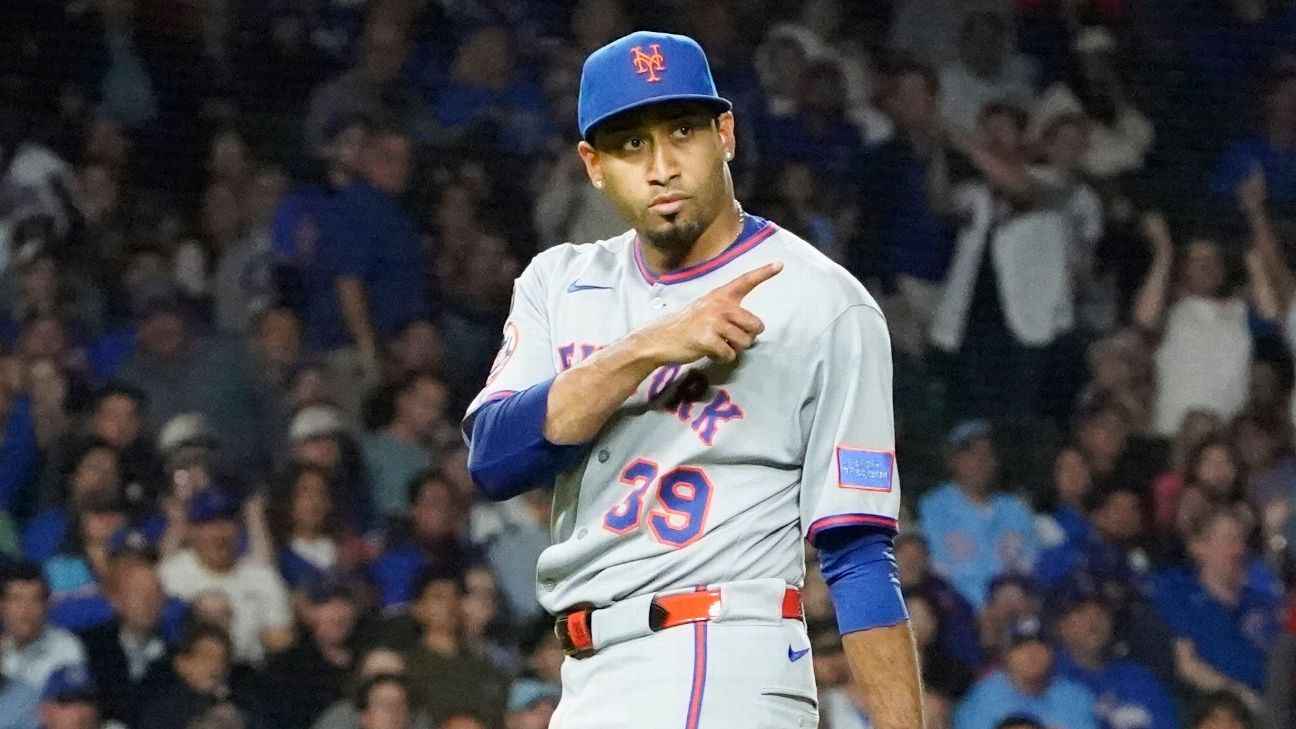
The MLB winter meetings are underway in Orlando, Florida, with the baseball industry gathering for an action-packed week of rumors, signings and trades — including big splashes by top NL powerhouses with the Philadelphia Phillies bringing back Kyle Schwarber and the Los Angeles Dodgers adding top closer Edwin Diaz.
We’ve got it all covered for you, from our predictions going into the meetings to the latest updates and analysis as the moves go down.
Which big free agents will pick a team? Who will be mentioned in blockbuster trade discussion? And what rumors will rule the week? Check out our predictions and refresh often for the latest intel and reaction as the week unfolds.
Key links: Olney, Passan: Latest intel | Every team’s plan | FA tracker | Grades
Winter meetings news and rumors
Dec. 9 buzz


Why Marlins, Orioles could be a trade match
The Marlins are active in trade talks with multiple teams for Edward Cabrera, a 27-year-old right-hander who has been considered the most likely among their controllable starters to be moved, a source familiar with the situation said. At this point, the Orioles are the most advanced in those talks, as first reported by The Athletic. If completed, it’s an ideal fit. The Orioles are in need of a top-of-the-rotation starter and the Marlins are seeking controllable offensive pieces. — Alden Gonzalez

Will Dodgers make another free agency splash for a star outfielder?
Now that the Dodgers have solved their glaring ninth-inning problem, agreeing to a three-year, $69 million contract with Edwin Diaz, they can shift their focus to adding an outfielder. And until he comes off the board, they’ll continue to be linked to top free agent Kyle Tucker.
The Dodgers aren’t expected to get into the $400 million range on a long-term deal, but like with Diaz, they’ll remain on the periphery in case a short-term, high-AAV deal makes sense. That might not be the case for Tucker, who’s 28 and widely considered the best free agent available. Another option is Cody Bellinger, though it remains to be seen whether both sides are truly interested in a reunion. Of note: Both of those players are attached to a qualifying offer, as was Diaz.
Asked Tuesday night if he could see himself making another big free agent signing, Dodgers president of baseball operations Andrew Friedman said: “I would say we definitely can. Whether that makes the most sense within the timing of our roster — there’s so many factors that go into it, and any decision you make has a future cost. … So, yes we can. How likely it is is probably another question.” — Gonzalez

Why extensions could be coming for A’s core hitters
The Athletics still need to build out some depths in their starting pitching as they aim to become sustainable contenders in the leadup to their move to Las Vegas, but there’s little doubt they’ve built a formidable core of position players — and part of the focus this offseason, in addition to adding reliable arms throughout their pitching staff, is keeping that core intact.
The A’s extended Brent Rooker and Lawrence Butler last offseason, and now they’d love to find a way to lock up the likes of Nick Kurtz, Jacob Wilson and Shea Langeliers.
“There’s a big effort there to keep this group together,” A’s manager Mark Kotsay said. “If we look at the group prior to this, that you could identify as a group that you would have wanted to move forward with, a group that came together in ’17 and ’18 and ’19 — the resources weren’t there to afford to keep that group together. I think there’s a vision and a future here going forward with this group that we were able to at least get those opportunities out in front of these players.” — Gonzalez

Will D-backs get enough to move Marte?
All-Star second baseman Ketel Marte continues to be the talk of this year’s winter meetings, but the Arizona Diamondbacks are asking a high return at the moment, sources familiar with the market told ESPN, which falls in line with what general manager Mike Hazen has communicated publicly — that he’s not required to trade Marte, but he will surely consider the right deal.
The Seattle Mariners, Pittsburgh Pirates, Detroit Tigers, Boston Red Sox and Toronto Blue Jays are among those who have been linked to Marte, though others are surely involved. A lot of teams have shown interest, but talks have yet to get serious.
The D-backs would ideally land a higher-end starting pitcher in return — a major need with Zac Gallen and Merrill Kelly probably departing via free agency, and Corbin Burnes spending at least the majority of 2026 recovering from Tommy John surgery — and would require major league-ready talent as part of any package, a source said. Given that his 10-and-5 rights kick in in April, there is at least some urgency to trade him this offseason.
D-backs manager Torey Lovullo said he has been in touch with Marte over the offseason and that the mention of his name so aggressively in rumors “might have caught him by surprise a little bit.”
“But I think he gets it,” Lovullo added. “I told him just what I told you guys — teams are smart. They want really good players. He’s one of the best in the National League. I understand why teams are making phone calls on him. He gets that.” — Gonzalez

White Sox have high bar for dealing Robert
In his first 31 games after the All-Star break, Luis Robert Jr. demonstrated what kind of impact he could have, batting to a .298/.352/.456 slash line, clubbing five homers and stealing five bases. Throughout Robert’s career, the talk has been about his possible impact if he ever remained injury-free and in the lineup, and this was an example of that.
But then Robert got hurt, again, and the Chicago White Sox — with very little future payroll obligation — picked up his $20 million option for 2026, in the hope that he could hit that ceiling for an extended period. The White Sox don’t intend to trade Robert until some interested team is willing to pay for the value of what he could be at his best, rather than for a bargain price. Some teams have checked on Roberts’ availability, but to date, no team has met Chicago’s high bar for a trade return.
Short of that, the White Sox are likely to keep Robert into the ’26 season, and maybe beyond. The team holds another $20 million option for the ’27 season, a year of club control that could make Robert look even more attractive in trade if the 28-year-old is able to stay on the field and generate the kind of high-end production the White Sox enjoyed last summer. — Buster Olney
Fairbanks drawing lots of interest
Pete Fairbanks is a very popular player this offseason. The right-handed reliever has received interest from several clubs, including the Marlins and Blue Jays, sources told ESPN. Fairbanks, 31, recorded a 2.83 ERA in 61 appearances for the Rays last season. He reached free agency after Tampa Bay, in a cost-cutting measure, did not pick up his $11 million option. His injury history could be a concern for teams, but he’s expected to land a two- or three-year deal. — Jorge Castillo


Three teams to watch in trade talks
Free agent splashes dominated the winter meetings spotlight Tuesday morning, but trade winds continue to swirl in Orlando. The Boston Red Sox, Chicago Cubs and San Diego Padres are all coming up often as teams that could make a deal soon. — Jesse Rogers

Could the Blue Jays make another splash?
The reigning AL champions are still looking to spend after a strong start to the offseason and could leave the winter meetings with a new closer. Pete Fairbanks and Robert Suarez are two names to watch in Toronto’s reliever search — Rogers
Don’t expect a Valdez deal soon
The top closer and one of the top hitters in this free agent class agreed to deals Tuesday, but don’t expect to see the best available starting pitcher come off the board next. The market for right-hander Framber Valdez is still developing and he won’t be signing with a team for a while. — Rogers
Diaz’s deal with Dodgers spices up meetings
Moments after news broke of Kyle Schwarber‘s return to the Phillies, the Los Angeles Dodgers made a major move of their own in signing top free agent closer Edwin Diaz. According to ESPN’s Jeff Passan, the deal is for three years and $69 million — which sets an AAV record for relievers.
The Dodgers had a clear need in the ninth going into the offseason, no matter how much they hyped up their depth publicly. But many doubted they’d go long term for the top guy in Diaz. A shorter, higher-AAV deal falls right in line with their preference. — Gonzalez

Will Schwarber’s return to Phillies heat up winter meetings?
Slugger Kyle Schwarber and the Philadelphia Phillies are in agreement on a five-year, $150 million contract, sources told ESPN. Schwarber’s return to Philly takes one of the most coveted free agents of this winter off the board and could be the move that sparks a run of action as the winter meetings roll on.
Dec. 8 buzz
Dodgers eyeing trades — but say Teoscar Hernandez won’t be dealt
The Los Angeles Dodgers aren’t expected to make major free agent moves this winter — at least not to the extent of the past two offseasons — and they’re certainly talking like a team content with where things stand.
Dodgers general manager Brandon Gomes said Monday that “there’s not as many clear paths to make the team meaningfully better.”
Earlier, Dodgers manager Dave Roberts — acknowledging the team’s philosophy last year, that injecting new blood into the roster might be a good way to maintain an edge — said, “There’s really no big splash we feel needs to be made, because this team is still focused, and there’s some talk about a three-peat.”
Still, sources have said, the Dodgers will continue to look for ways to upgrade their outfield and fortify the back end of their bullpen, with the trade market the ideal path. A center fielder would be ideal for the Dodgers because of how it would fortify the entire outfield’s defense, prompting Andy Pages and his plus arm to move to right field while Teoscar Hernandez and his shoddy defense transition to left.
But Gomes praised Pages’ center-field defense, adding that it allows the team the flexibility to pursue any outfielder. Gomes also shot down rumors of Hernandez potentially being traded.
“That doesn’t feel likely,” Gomes said. “Obviously, you can never say never on those types of things, but Teo, I know that’s come up. That’s not something we anticipate at all.” — Gonzalez


Teams checking in on former All-Star Willi Castro
The Atlanta Braves, Pittsburgh Pirates and Colorado Rockies are among the teams interested in signing utility man Willi Castro, sources told ESPN. Castro, 28, was an All-Star in 2024 after a strong first half with the Minnesota Twins, but he regressed through the second half and into the 2025 season.
The switch-hitter slashed .245/.335/.407 with the Twins in 2025 before he was sent to the Chicago Cubs at the trade deadline. He struggled in Chicago, batting just .170 with one home run and a .485 OPS in 34 games and did not have a plate appearance in the postseason.
Advanced metrics indicate Castro also regressed defensively in 2025, dropping from 0 to minus-9 outs above average, but he’s a versatile defender who played second base, third base, shortstop and all three outfield spots. — Castillo
Padres keeping trio in bullpen, need starting pitchers
In his winter meetings availability, San Diego Padres manager Craig Stammen said the team will keep Mason Miller, Adrian Morejon and David Morgan in the bullpen rather than converting them to starters.
“It’s a risky proposition health-wise and performance-wise,” Stammen said.
So, the Padres are very much in the market for starters. — Gonzalez

What will Tigers do with Skubal?
The Detroit Tigers continue to have trade dialogue with other teams about two-time American League Cy Young winner Tarik Skubal. At its heart, Detroit’s choice about whether to swap Skubal now — before he reaches free agency next fall — comes down to this question: Will owner Chris Ilitch and the team’s front office place more on the opportunity to win in 2026, or will they place a greater value on the extraordinary collection of young players they would presumably acquire in a Skubal deal?
What complicates this decision is that the Tigers reside in the highly winnable AL Central. The theoretical path to the World Series is probably easier than it would be to come out of the AL East, with all of its financial monsters, or the AL West, where the Mariners are poised to be a formidable force for years to come. Despite a late-season collapse, the Tigers were still just a run away from playing for the AL championship two months ago.
If the Tigers decide to keep Skubal, they will have to be at peace with the reality that they’ll recoup just a fraction of Skubal’s current value when and if he departs as a free agent — through draft pick compensation. This is the part of the market equation that has compelled the Guardians to flip the likes of CC Sabathia, Cliff Lee or Francisco Lindor in past trades, and why the Brewers dealt Corbin Burnes before the 2024 season. — Olney
Which Marlins starting pitcher will be traded?
Sandy Alcantara is a long shot to be traded at this point, as is teammate Eury Perez, the 22-year-old right-hander whom Miami Marlins would love to sign to an extension. The most likely Marlins starter to get traded, a source familiar with the team’s thinking said, is Edward Cabrera, who is out of options and would be controllable for three years.
Cabrera, 27, posted a 3.53 ERA with 150 strikeouts and 48 walks in 137⅔ innings in 2025. The Marlins would love to use Cabrera — and potentially fellow starter Ryan Weathers, who is coming off an injury plagued season — to address their offensive needs, primarily at first base.
Cabrera, though, is among a deep crop of available starting pitchers this offseason, alongside the likes of Freddy Peralta, Kris Bubic, Mitch Keller, Joe Ryan, Hunter Greene and, most notably, Tarik Skubal. Peralta, Ryan, Greene and Skubal will most likely stay put, but they are nonetheless in trade talks. — Gonzalez
How far will the Phillies go to keep Schwarber?
A lot of the industry is waiting on Kyle Schwarber‘s free agent decision. He has both big and small market teams chasing him but most important will be what he hears from the Philadelphia Phillies, and that can come as soon as Monday or Tuesday. Will they match any offer? Will Schwarber take a little less to stay in Philadelphia? Those questions should be answered soon. — Rogers
King’s suitors starting to take shape
Free agent pitcher Michael King has a half dozen suitors, including the New York Yankees, Boston Red Sox, New York Mets and Chicago Cubs, but his market hasn’t completely materialized yet. — Rogers
Polanco could make a decision soon
Free agent second baseman Jorge Polanco, coming off a strong 2025 season with the Seattle Mariners, is expected to sign with a team during the winter meetings. — Rogers
Winter meetings predictions
Who will be the biggest name to sign (or get traded) in Orlando?
Jorge Castillo: I root for action at the winter meetings, so let’s pick the biggest name on the free agent market: Kyle Tucker. There aren’t many suitors that, whether it’s for fit or financial reasons, are in the mix, but there’s still interest for an ultra-talented player who can alter the championship landscape. And it starts with Toronto.
The Blue Jays whiffed on the brightest stars of the past two free agent classes — Shohei Ohtani and Juan Soto — and Rogers Communications still has money to spend after investing $500 million in Vladimir Guerrero Jr. in April and another $210 million recently in free agent starter Dylan Cease. Tucker visited the Blue Jays’ facility in Florida last week. Pairing the left-handed-hitting outfielder with the right-handed-hitting Guerrero would give Toronto a scary tandem for years.
Bradford Doolittle: The inclusion of Byron Buxton on our trade candidates ranking took me aback, mostly because Buxton has been insistent that he will remain a Twin. It’s surprising that he’s willing to waive his no-trade clause, but Buxton is 31, and the Twins don’t seem all-in on winning. Several leading contenders could use a bump in center field — the Houston Astros and New York Mets jump out as clear fits — and if the Twins are heading down this road, dealing Buxton soon would start those dominoes to fall.
Alden Gonzalez: A game of chicken might be brewing at the moment. On one side it’s Cody Bellinger, represented by the Boras Corporation. On the other it’s Tucker, whose free agency is overseen by Excel Sports Management. They’re arguably the two biggest names available, both of them versatile, multi-dimensional, dynamic outfielders, their markets naturally intertwined. And I think Bellinger goes first.
His price point — ESPN’s Kiley McDaniel predicts a six-year, $165 million contract — is more reasonable, and his list of suitors is seemingly more robust because of it. The New York Yankees want him back. The Los Angeles Dodgers, Toronto Blue Jays and New York Mets are all a fit, to varying degrees. Given Bellinger’s ability to also play first base, other teams will undoubtedly emerge. Jumping on Bellinger before Tucker comes off the board and further inflates his market would be smart. And one team will do so this week.
Jesse Rogers: Ranger Suarez. Scott Boras clients usually take longer to come off the board, but not all of them can wait until the new year. Suarez isn’t staring at a megadeal, so checking him off the free agent list by late next week seems more than plausible.
The chatter surrounding the left-hander’s free agency from potential suitors such as the Astros, Mets, Orioles and others is picking up. He’s in line for at least a solid four-year deal — and if a team offers five or even six, it’ll likely land him.
What is one move fans might not expect you to predict will go down this week?
Castillo: Pete Alonso will probably wait until Kyle Schwarber decides on his destination, but I predict Alonso will sign with the Red Sox. Craig Breslow, Boston’s chief baseball officer, has been clear about his desire to acquire a right-handed slugger for the middle of the order. Not many players are better qualified for that role than the right-handed-hitting Alonso, whose 264 home runs since his debut in 2019 are the third most in baseball behind Aaron Judge and Schwarber.
Alonso is coming off a rebound All-Star season in which he clubbed 38 home runs with 126 RBIs, an NL-leading 41 doubles and an .871 OPS for the Mets. Defensively, Alonso is below average, but he could split time with Triston Casas at first base and designated hitter.
The Mets, on the other hand, are determined to improve their defense and would seemingly be in play for Alonso only if his market collapses for the second straight offseason.
Doolittle: Maybe it’s because I am overly susceptible to rumors that tickle my penchant for anti-Wolfean narratives, but I’ll say Schwarber will sign with his hometown Cincinnati Reds. It’s such a perfect fit, and not just because of Schwarber’s ties to Cincinnati. The Reds have a real chance to contend in the NL Central with the right upgrade on offense. And what an upgrade — Schwarber’s swing is perfect for Great American Ballpark, which has featured more homers from visiting lefty hitters over the past five years than any other venue (including 96 more than Citizens Bank Park). Even at 32, give Schwarber five healthy seasons at that park and he’ll reach 500 career bombs.
Gonzalez: This year’s market seems especially ripe for trades, and I think we’re going to see some big-name starting pitchers dealt during the winter meetings. Who, exactly, is anybody’s guess at this point, but there are a bevy of names to choose from, whether it’s two of the Miami Marlins‘ frontline guys (Sandy Alcantara and Edward Cabrera), three steady veterans (Freddy Peralta, Luis Castillo and Pablo Lopez), two budding aces (Joe Ryan and MacKenzie Gore) or two Cy Young-caliber arms who are unlikely to move but are fascinating nonetheless (Tarik Skubal and Hunter Greene). All eyes will be on the big free agents this week, but the trade market will dominate. And the starting pitchers will be featured in it.
Rogers: How about a bold one: Nick Castellanos gets traded. Perhaps it won’t land as the biggest of surprises, considering how things went down in Philadelphia last year, but a deal would further show that the Phillies are turning things over a bit as they continue to chase a ring.
Castellanos could be the perfect fit for Pittsburgh, which is desperate for hitting. In a recent interview on MLB Network, Castellanos discussed the idea of playing first base. That opens the door to even more possibilities outside of Philadelphia.
What is the one rumor that will dominate the week?
Castillo: Arizona Diamondbacks second baseman Ketel Marte, if moved, would be the best position player to move this offseason — Tucker and Schwarber included. So the fact that he is available will undoubtedly generate rumors all week.
First, Marte produces. His 15.3 WAR over the past three seasons is 13th in the majors. He has made the NL All-Star team each of the past two seasons. He finished third in the NL MVP race in 2024. He owns a .289/.363/.510 slash line since 2019. Second, his economical contract — he has five years and $91 million plus a sixth-year player option at $11.5 million remaining — only adds to the allure and makes him palpable for several clubs. Marte is 32 and drew anonymous criticism from teammates for his behavior last season, but a player of his caliber will draw substantial interest.
Doolittle: Something about Tucker? It doesn’t feel like there have been many concrete reports regarding Tucker’s possible destination, but he’s the top free agent, so the rumor mill is more likely to focus on his wanderings than anyone else until he signs. News about him will pick up in Orlando.
Gonzalez: There is no bigger name on the trade market than Skubal. On one end, he is beloved in Detroit, where he has established himself as the type of cornerstone who should never pitch anywhere else. On the other is the cold reality — that he is a Boras client who would command the types of sums in the open market that the Tigers are either unwilling or unable to pay him. And though the Tigers intend to contend in 2026 and would undoubtedly have a better chance of doing so with Skubal fronting their rotation, it would be foolish not to at least explore a trade and attempt to get major talent back in return. It’s the responsible thing to do — and yet Tigers fans have every right to be enraged about this even being a possibility.
Rogers: Where Kyle Schwarber will play in 2026 and beyond. His next contract should be in the $150 million range, though if a new team steps up and is willing to pay big time for not only his power but his leadership, then all bets are off. But as intriguing as a smaller market might be, the Phillies need him as much as anyone during their current window to win. His return there isn’t a guarantee, but it still makes the most sense.
-
 Sports2 years ago
Story injured on diving stop, exits Red Sox game
-
 Sports3 years ago
‘Storybook stuff’: Inside the night Bryce Harper sent the Phillies to the World Series
-
 Sports2 years ago
Game 1 of WS least-watched in recorded history
-
 Sports3 years ago
Button battles heat exhaustion in NASCAR debut
-
 Sports3 years ago
MLB Rank 2023: Ranking baseball’s top 100 players
-
Sports4 years ago
Team Europe easily wins 4th straight Laver Cup
-
 Environment3 years ago
Japan and South Korea have a lot at stake in a free and open South China Sea
-
 Environment1 year ago
Here are the best electric bikes you can buy at every price level in October 2024