
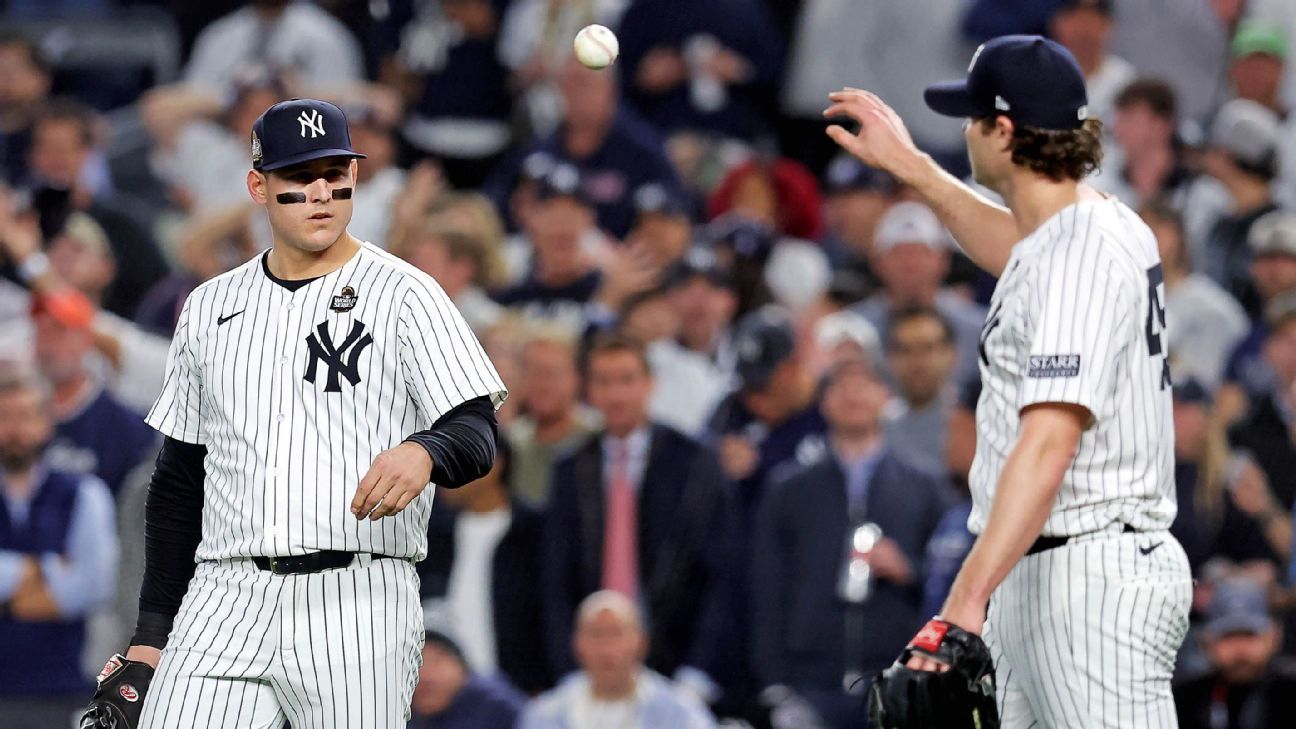
Cole: Yankees’ meltdown in 5th ‘as bad as it gets’


-
Jorge Castillo, ESPN Staff Writer
NEW YORK — All year, right through the American League Championship Series, the New York Yankees overcame a tendency to play sloppy baseball by vanquishing opponents with overwhelming talent. The metrics calculated — and the eyes figured — that they were the worst baserunning team in the majors during the regular season. They regularly committed head-scratching defensive miscues. They were not nearly as fundamentally sound as one would expect from a 94-win AL champion.
But the Yankees flaunted superstars. They had Aaron Judge and Juan Soto fueling an offense that banged home runs. They had Gerrit Cole fronting a top-line starting rotation. They discovered an effective bullpen formula in time for October. Ultimately, they out-talented teams — until they couldn’t.
Their shortcomings finally caught up with them in Game 5 of the World Series on Wednesday night. A total defensive meltdown in the fifth inning, one that will be remembered as one of the worst in postseason history, cost the Yankees their season in a 7-6 loss to the Los Angeles Dodgers at Yankee Stadium, ultimately ending their bid to become the first team to overcome a 3-0 series deficit in the World Series.
“This is like as bad as it gets,” said Cole, the Yankees’ Game 5 starter.
Cole was on the mound for the fifth-inning debacle. The right-hander, pitching on four days’ rest for the fourth time this season, cruised up to the disaster, holding Los Angeles scoreless over four hitless innings. Cole threw just 49 pitches. The Dodgers’ only baserunner reached on a walk. Trouble did not appear imminent. Then everything fell apart.
It started with Enrique Hernández breaking the modest no-hit bid with a leadoff single. Four pitches later, Tommy Edman hit a routine line drive to Judge in center field. An inning earlier, sure-handed Judge had made a highlight catch crashing into the wall to steal extra bases from Freddie Freeman. This time, he flubbed the liner for his first error in 2024 — regular season or postseason.
“That doesn’t happen, we got a different story tonight,” Judge said.
Five pitches after that, Will Smith hit a ground ball to shortstop Anthony Volpe‘s right side. Volpe, a Gold Glove winner last season and a finalist this year, fielded the ball cleanly but short-hopped his throw to third baseman Jazz Chisholm Jr. attempting to nab the lead runner. Chisholm failed to corral the throw, loading the bases with no outs. Yankee Stadium went silent.
Then Cole went to work. He struck out Gavin Lux on four pitches, finishing him off with a 99.4 mph fastball. Up next: Shohei Ohtani. Cole needed four pitches to strike out the superstar, too, getting Ohtani to wave through a curveball at the bottom of the strike zone.
Suddenly, an escape without any damage seemed possible. It seemed like a certainty when Mookie Betts hit a 49.8 mph squibber to first baseman Anthony Rizzo. Because the ball bounced to Rizzo with so much spin, he did not charge it, instead staying back to make sure he gloved it cleanly. That meant he needed Cole to cover first base to beat Betts to the bag. But Cole didn’t dash to first base to cover the bag, and Betts reached base without a throw.
“I took a bad angle to the ball,” Cole said. “I wasn’t sure really off the bat how hard he hit it. I took a direct angle to it, as if to cut it off because I just didn’t know how hard he hit it. By the time the ball got by me, I was not in position to cover first. Neither of us were, based on the spin of the baseball and him having to secure it. Just a bad read off the bat.”
The Dodgers scored their first run on the gaffe, which went down in the box score as an infield single. It will be memorialized as the beginning of the end of the Yankees’ season. Freeman, the third straight past MVP whom Cole was tasked to retire, slashed a two-run single to center field. Teoscar Hernandez followed with a game-tying two-run double to left-center field, completing a stupefying sequence that left the crowd stunned.
“You can’t give teams like that extra outs,” said Judge, who clubbed his first career World Series home run in the first inning to give New York a quick 2-0 lead. “They’re going to capitalize, especially [with] their 1-2-3 top of the order. They don’t miss.”
Cole needed 38 pitches to survive the inning. He kept the score tied and rebounded to pitch into the seventh inning. He exited the game with one out and with a one-run lead — Giancarlo Stanton‘s sacrifice fly in the sixth inning put the Yankees back on top — but the fifth inning changed the game.
“We didn’t take care of the ball well enough in that inning,” Yankees manager Aaron Boone said. “Against a great team like that, they took advantage.”
With little margin for error, Tommy Kahnle entered to pitch the eighth inning. He surrendered a leadoff single through the left side to Hernández and lost his command from there. Edman reached on an infield single. Smith was walked on four pitches. Boone decided that was enough and replaced Kahnle with closer Luke Weaver.
“I let my team down,” said Kahnle, his eyes red from emotion.
The Yankees’ best reliever in October, Weaver yielded a sacrifice fly to Lux that tied the score again and brought up Ohtani with runners on the corners. Weaver got ahead with the first pitch, getting Ohtani to foul off a changeup. But Austin Wells was called for catcher’s interference on the swing, which loaded the bases for Betts. He delivered another sacrifice fly to give the Dodgers their first lead. It was the only lead they needed.
In the end, the Yankees committed nearly every kind of defensive miscue possible. There was Judge’s inexplicable physical mishap, Volpe’s throwing error, Cole’s mental blunder, Wells’ interference and, finally, a balk from Weaver in the ninth inning. The balk didn’t impact the scoreboard, but it typified the Yankees’ flaws on a night when they were exposed for the world to see.
“Capitalizing on mistakes, probably, and opportunities,” Stanton said when asked what he believed was the difference in the series.
It certainly was the difference in the two games that bookended the series. In Game 1, Gleyber Torres‘ inability to corral a throw from the outfield on Ohtani’s double in the eighth inning allowed Ohtani to advance to third base. Ohtani then scored on a sacrifice to tie the score. The run ultimately forced the game into extra innings, where Freeman, with the Dodgers down one, swatted a walk-off grand slam.
The gut-punch loss marked the beginning of the Yankees’ 3-0 hole. They had a chance Wednesday to continue digging themselves out of it. But the fifth inning changed everything. After the game, after Alex Verdugo swung through a curveball from Walker Buehler to end their season, the Yankees didn’t open the clubhouse to the media for 45 minutes, such an unusually long time that Boone began his news conference by apologizing for the delay.
The manager explained players were “pouring their hearts out” with “heartfelt messages.” He emphasized, as the team has all October, this club’s closeness. He said the defeat “is going to sting forever.” In the clubhouse, players said their goodbyes with backslaps and hugs.
“I think falling short in the World Series will stick with me until I die, probably,” Judge said.
In the end, the Yankees’ talent was more than enough to win the AL East and claim the league’s No. 1 seed. It won out against the Kansas City Royals and Cleveland Guardians, clubs with a sliver of the Yankees’ $300 million payroll, in October. But the Dodgers, another high-priced roster brimming with star power and future Hall of Famers, were too good for that to happen again. They were the better, more fundamentally sound baseball team. The fifth inning Wednesday showed that.

-
David Hale
CHARLOTTE, N.C. — Duke defensive end Wesley Williams said he heard the refrain throughout the run-up to Saturday’s ACC championship game: A Blue Devils win would be “a doomsday scenario.”
At 7-5 and unranked, Duke arrived in Charlotte with a chance to win the conference and, in doing so, knock the ACC out of the College Football Playoff entirely, with two teams from the Group of 5 — Tulane and James Madison — potentially making it instead.
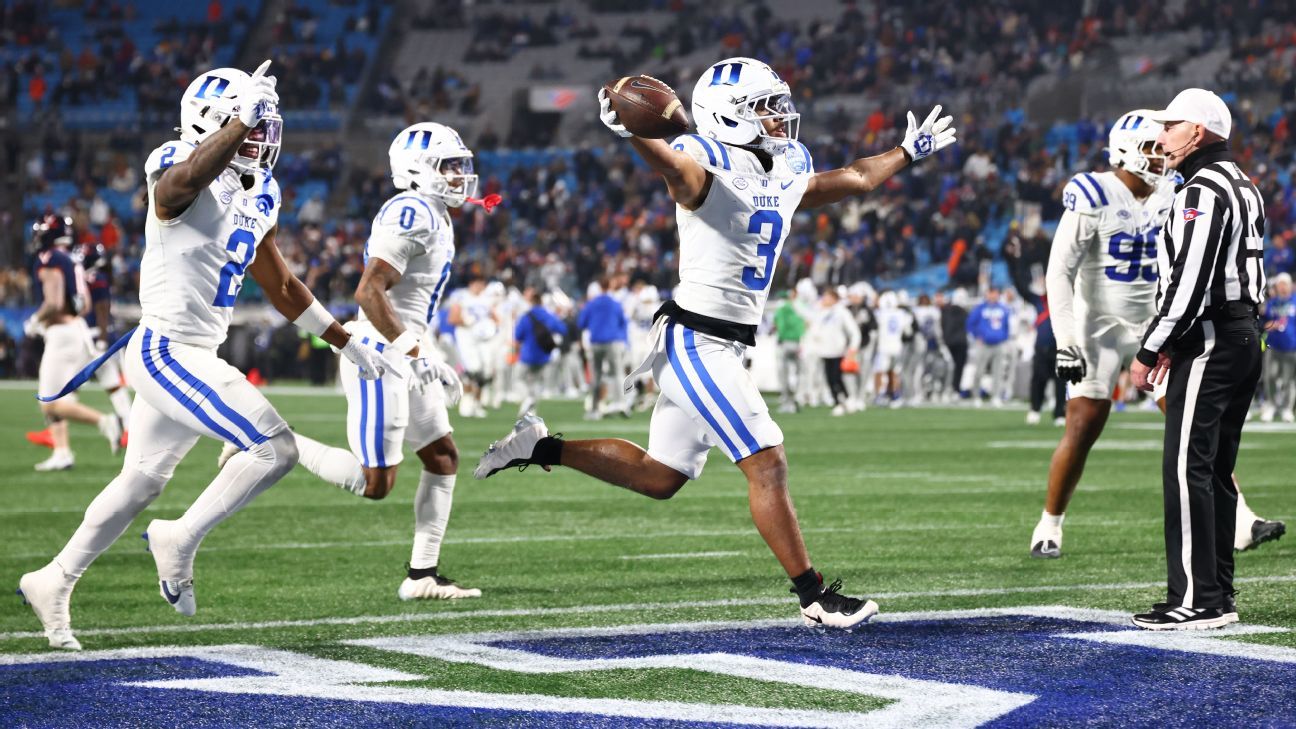
Well, doomsday has arrived, thanks to a series of fourth-down calls by Duke coach Manny Diaz, including one in overtime that resulted in the game-deciding touchdown in a 27-20 Blue Devils victory over No. 17 Virginia.
“Coach Diaz said this week, ‘If you think people hate Duke now, just wait until we win the ACC,'” Williams said.
The ACC’s fifth tiebreaker — combined win percentage of conference opponents — sent Duke to the league’s title game from among five teams tied for second place in the standings, including No. 12 Miami, a team on the fringe of an at-large CFP bid that could have benefited significantly from an extra game to wow the selection committee.
Instead, it was Duke that got the chance to avenge a Nov. 15 loss to Virginia and make its own case for playoff inclusion.
“I’m not going to take anything away from James Madison,” Diaz said. “They had a really great season. … The Sun Belt has been a really good conference in years past, but most of their top teams are having a down year. So when you start comparing strength of schedule — you can’t just look at wins and losses. It’s who you play against. That’s the whole point of playing a Power 4 schedule. There’s a reason all these coaches are all leaving for Power 4 jobs. There’s recognition that’s where the best competition is.
“The ACC champion should go to the College Football Playoff this year and every year. And we’ll be very excited to see how they rule on that tomorrow.”
James Madison coach Bob Chesney has accepted the head coaching position at UCLA, but he is expected to stay with the Dukes through any potential playoff run.
The Dukes finished the season 12-1 but lost their lone game against a Power 4 foe, Louisville, in September. James Madison beat Troy 31-14 on Friday to win the Sun Belt championship.
James Madison athletic director Matt Roan offered a counterpoint, noting that Dukes quarterback Alonza Barnett III was just coming back after a long-term injury and the Dukes still played Louisville close before losing 28-14.
“The next week, we started what is now the second-longest winning streak in the country,” Roan said. “This team is clicking since that time and separated itself as one of the five best conference champions in the country after winning the Sun Belt. JMU led the nation in wins over bowl-eligible teams with seven, matching Indiana and Ohio State. We can score points and stop points with anyone in the country. Our second halves, and fourth quarter in particular, have been untouchable. Who you play matters, but more important is how you play. Our players and our coaches have been elite all season and are deserving of this opportunity.”
James Madison was No. 25 in the most recent CFP rankings. Duke was unranked.
Diaz said after Saturday’s win, however, that the committee now has a more complete body of work to consider.
According to ESPN’s metrics, James Madison has the No. 18 strength of record but the No. 123 strength of schedule. Duke entered Saturday’s game with the No. 59 strength of record and No. 74 strength of schedule. Two of the Blue Devils’ losses were to teams outside the Power 4: playoff hopeful Tulane and 9-3 UConn.
“Having been on the selection committee, I understand it’s complicated,” Duke athletic director Nina King said. “I think we’re deserving when you look at some of these numbers like strength of schedule, number of Power 4 teams we’ve played and won. I think we’re deserving, but I fully appreciate the challenge [for the committee].”
The ACC’s doomsday scenario was in some ways more of a “Mission: Impossible.” After Duke lost to Virginia in Week 11, the Blue Devils were +1800 to win the conference and, according to ESPN’s FPI, had a 3.8% chance of winning the ACC.
Now, the conference will wait for the committee to deliver a verdict on both Duke and Miami on Sunday. The Hurricanes are 10-2 but have consistently been ranked behind several other two-loss teams, including Notre Dame, a team they beat in Week 1.
“Miami should get in,” Diaz said after Saturday’s win. “The head-to-head should matter. And so should we, because we’re the conference champion.”
ACC commissioner Jim Phillips argued the same before Saturday’s kickoff, but he declined to comment after Duke’s win over Virginia that might have left the conference with no playoff bids.
The doomsday scenario for the ACC, however, could just as easily turn into a boon with two teams in, should the committee buy into Duke’s sales pitch. Blue Devils linebacker Luke Mergott, who hauled in the championship-clinching interception in overtime, believes it will.
“We represent the ACC, and the ACC is a respected conference,” Mergott said. “I think we’ll be in, and I’m confident our name will be called.”


-
Adam Rittenberg
INDIANAPOLIS — Indiana assistant coach Ola Adams put his hands on his head in disbelief as confetti fell and the crowd roared at Lucas Oil Stadium.
But the scene unfolding before Adams on Saturday night was very believable. Since the moment coach Curt Cignetti swaggered onto campus two years earlier and outlined a success plan for the losingest program in college football, Indiana has been climbing.
On a magical night 50 miles from their home stadium, the Hoosiers reached the top, outlasting Ohio State 13-10 in a Big Ten championship game that matched the nation’s top two teams, both undefeated. Indiana beat No. 1 to become No. 1.
“We’re going to go in the playoffs as the No. 1 seed,” Cignetti said. “A lot of people probably thought that wasn’t possible.”
The milestones achieved are seemingly endless. The Hoosiers won their first Big Ten championship since 1967 and their first outright title since 1945. They beat Ohio State for the first time since 1988, ending a 32-game losing streak. And quarterback Fernando Mendoza likely clinched the school’s first Heisman Trophy with several heroic throws, rallying his team from a 10-3 deficit.
“It shows everybody: Why not? Why would you not want to come to Indiana?” linebacker Isaiah Jones said. “For any of the doubters out there, this kind of was the final nail in the coffin for any of the Indiana doubters, the Curt Cignetti doubters, the Hoosier doubters.
“This was the last thing that needed to be proved, and we did it.”
Indiana beat a top-ranked team for the first time in 17 tries, holding Ohio State scoreless for the final 40:08 and twice turning away the Buckeyes inside the 10-yard line.
“As a basketball manager, Keith Smart’s shot that won the national championship [in 1987],” Indiana athletic director Scott Dolson, who worked under coach Bob Knight for that title team, told ESPN. “This is right up there with that. This is a big moment.”
Cignetti guided the Hoosiers to a team-record 11 wins in his debut season, but when Indiana faced Ohio State, the eventual national champion, and Notre Dame, the eventual runner-up, its deficiencies were exposed in double-digit losses. Although Indiana faced a tougher regular-season schedule this fall, recorded a signature road win against Oregon and had shown clear improvement in several areas, it still entered Saturday’s game as the underdog.
But the Hoosiers (13-0) were better at the line of scrimmage, recording five sacks against an Ohio State team (12-1) that had allowed six the entire regular season. Facing Heisman Trophy contenders in quarterback Julian Sayin and wide receiver Jeremiah Smith, Indiana’s defense never yielded, making several memorable plays, including linebacker Rolijah Hardy‘s end zone pass deflection to prevent the go-ahead touchdown with 2:51 to play.
“We envisioned it,” defensive lineman Tyrique Tucker said. “We felt like we needed to handle business, especially due to last year. We felt like we had to finish some things and we had some unfinished business.”
Cignetti and his players thought that if they could keep the game close late, they would have an edge. Indiana rallied late to beat Iowa and Penn State and pulled away from Oregon with the score tied early in the fourth quarter. Ohio State, meanwhile, had not faced a second-half deficit this season until Mendoza found Elijah Sarratt for a 17-yard score with 8:02 to play in the third quarter.
“That’s what we dwell on, like, we come out and we take on a challenge,” said cornerback D’Angelo Ponds, who was matched up against Smith in man coverage throughout the game. “They haven’t been challenged all year. … We challenged them.”
Mendoza’s night began with a massive hit by Ohio State’s Caden Curry that left him writhing on the turf and forced him to miss a play. He also threw an interception that led to Ohio State’s only touchdown. But Mendoza steadied himself, even without top wideout Omar Cooper Jr., and found Charlie Becker for completions of 51 and 33 yards, the latter on third-and-6 in the final minutes.
Indiana fans gathered in the north end of the stadium chanted “Heis-Mendoza!” as Mendoza received game MVP honors.
“I don’t want to go in deep depth with the Heisman, but I remember Coach Cignetti brought me in, I think it was after UCLA, and he told me, ‘Hey, the Heisman’s a team game, it’s a team award. It’s not a player award. And if you win, then you can get nominated for it,'” Mendoza said. “Hopefully, I would love the opportunity to get the invite to New York, which would be fantastic.”
The Heisman ceremony awaits Mendoza next week, and Indiana will prepare for its first trip to the Rose Bowl since the 1967 season. But no one associated with the program will forget what happened Saturday night, just a few dozen miles from campus.
“It was just a dream come true,” Ponds said. “It actually didn’t feel real. We believed in ourselves, and we went out there and executed. It all just came together.”
-
 Sports2 years ago
Story injured on diving stop, exits Red Sox game
-
 Sports3 years ago
‘Storybook stuff’: Inside the night Bryce Harper sent the Phillies to the World Series
-
 Sports2 years ago
Game 1 of WS least-watched in recorded history
-
 Sports3 years ago
Button battles heat exhaustion in NASCAR debut
-
 Sports3 years ago
MLB Rank 2023: Ranking baseball’s top 100 players
-
Sports4 years ago
Team Europe easily wins 4th straight Laver Cup
-
 Environment3 years ago
Japan and South Korea have a lot at stake in a free and open South China Sea
-
 Environment1 year ago
Here are the best electric bikes you can buy at every price level in October 2024