
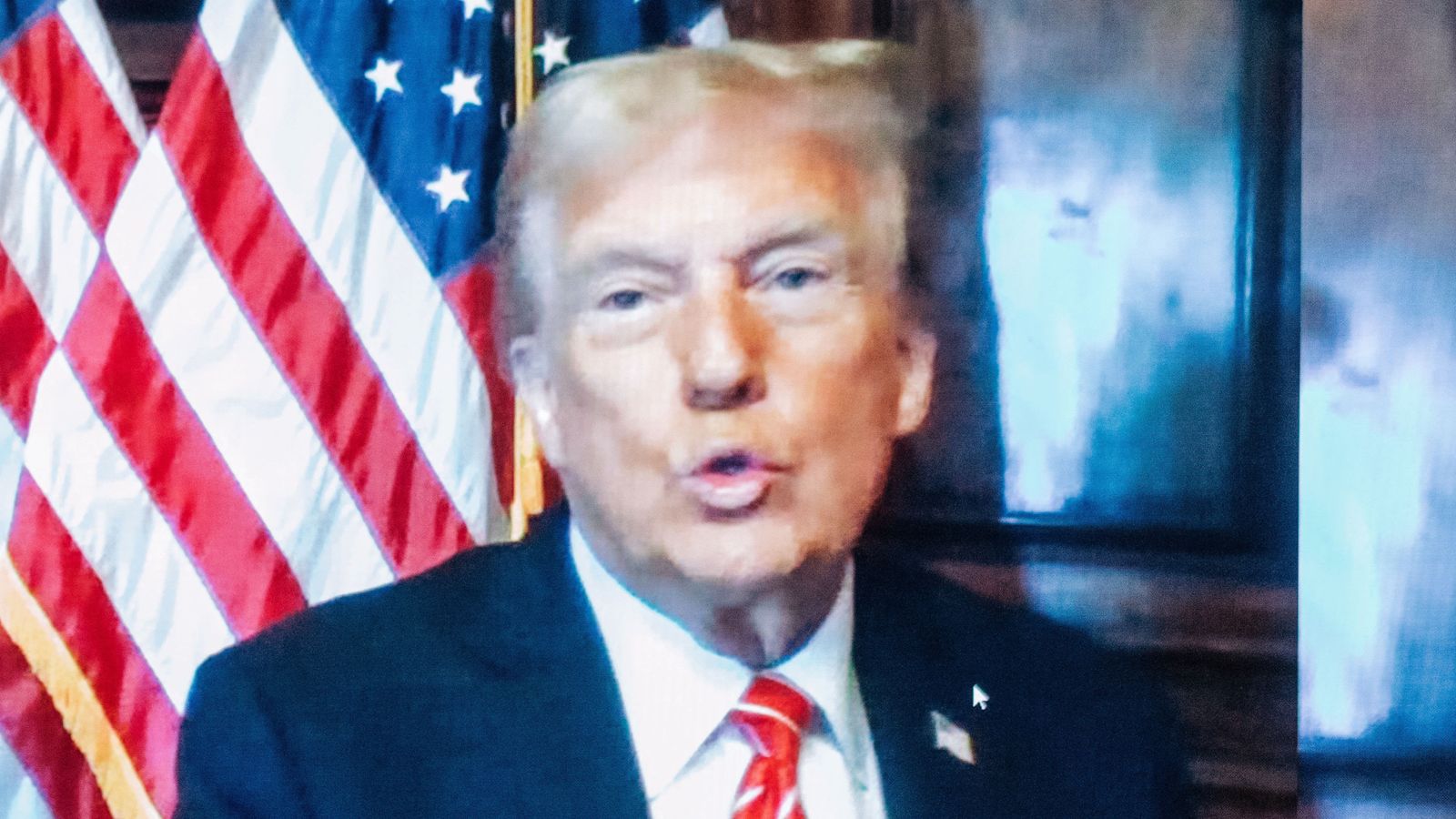
Donald Trump says he’s ‘totally innocent’ and thanks judge moments before no-penalty sentence in hush money case

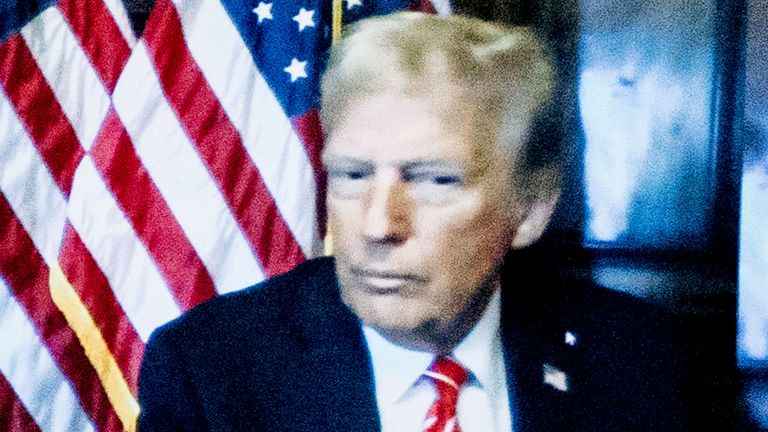
Donald Trump has been handed a no-penalty sentence following his conviction in the Stormy Daniels hush money case.
The incoming US president has received an unconditional discharge – meaning he will not face jail time, probation or a fine.
Manhattan Judge Juan M Merchan could have jailed him for up to four years.
The sentencing in Manhattan comes just 10 days before the 78-year-old is due to be inaugurated as US president for a second time on 20 January.
Trump appeared at the hearing by video link and addressed the court before he was sentenced, telling the judge the case had been a “very terrible experience” for him.
He claimed it was handled inappropriately and by someone connected with his political opponents – referring to Manhattan district attorney Alvin Bragg.
As it happened:
Trump sentenced in Manhattan court
Trump said: “It was done to damage my reputation so I would lose the election.
“This has been a political witch hunt.
“I am totally innocent. I did nothing wrong.”
Concluding his statement, he said: “I was treated very unfairly and I thank you very much.”
The judge then told the court it was up to him to “decide what is a just conclusion with a verdict of guilty”.
He said: “Never before has this court been presented with such a unique and remarkable set of circumstances.
“This has been a truly extraordinary case.”
He added that the “trial was a bit of a paradox” because “once the doors closed it was not unique”.
Pic: Reuters
Prosecutor Joshua Steinglass had earlier argued in court that Trump “engaged in a campaign to undermine the rule of law” during the trial.
“He’s been unrelenting in his attacks against this court, prosecutors and their family,” Mr Steinglass said.
“His dangerous rhetoric and unconstitutional conduct has been a direct attack on the rule of law and he has publicly threatened to retaliate against the prosecutors.”
Mr Steinglass said this behaviour was “designed to have a chilling effect and to intimidate”.
It comes after the US Supreme Court rejected a last-ditch attempt by Trump to delay sentencing in the case on Thursday.
Trump’s lawyers argued that evidence used during the trial violated last summer’s Supreme Court ruling giving Trump broad immunity from prosecution over acts he took as president.
Read more
A guide to Trump’s inauguration
Trump refuses to rule out military force over Panama Canal
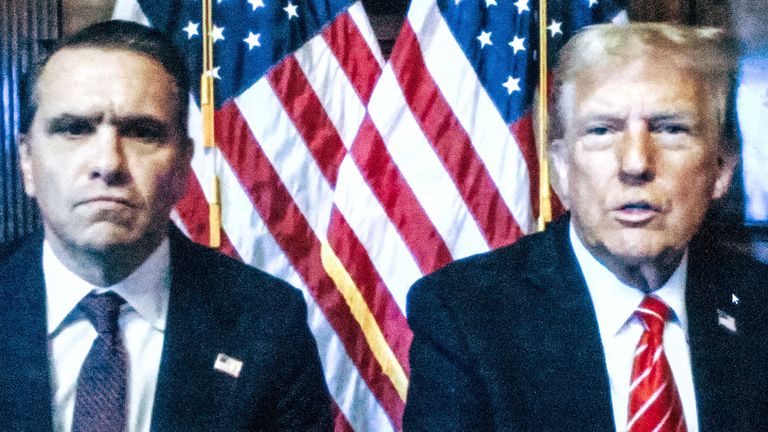
Trump appeared via videolink with his attorney Todd Blanche. Pic: Reuters
Trump’s hush money conviction in May 2024 means he will become the first person convicted of a felony to assume the US presidency.
He was found guilty in New York of 34 counts of falsifying business records relating to payments made to Ms Daniels, an adult film actor, before he won the 2016 US election.
Prosecutors claimed he had paid her $130,000 (£105,300) in hush money to not reveal details of what Ms Daniels said was a sexual relationship in 2006.
Trump has denied any liaison with Ms Daniels or any wrongdoing.
The trial made headlines around the world but the details of the case or Trump’s conviction didn’t deter American voters from picking him as president for a second time.
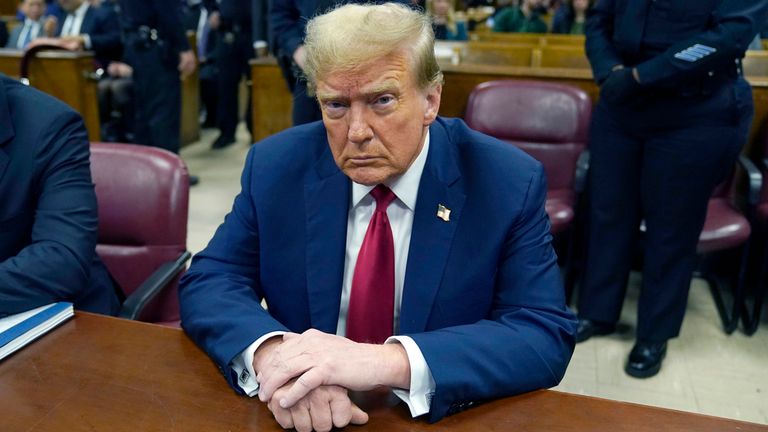
Trump appears in court during his trial. Pic: AP
What is an unconditional discharge?
Under New York state law, an unconditional discharge is a sentence imposed “without imprisonment, fine or probation supervision”.
The sentence is handed down when a judge is “of the opinion that no proper purpose would be served by imposing any condition upon the defendant’s release”, according to the law.
It means Trump’s hush money case has been resolved without any punishment that could interfere with his return to the White House.
Unconditional discharges have been handed down in previous cases where, like Trump, people have been convicted of falsifying business records.
They have also been applied in relation to low-level offences such as speeding, trespassing and marijuana-related convictions.
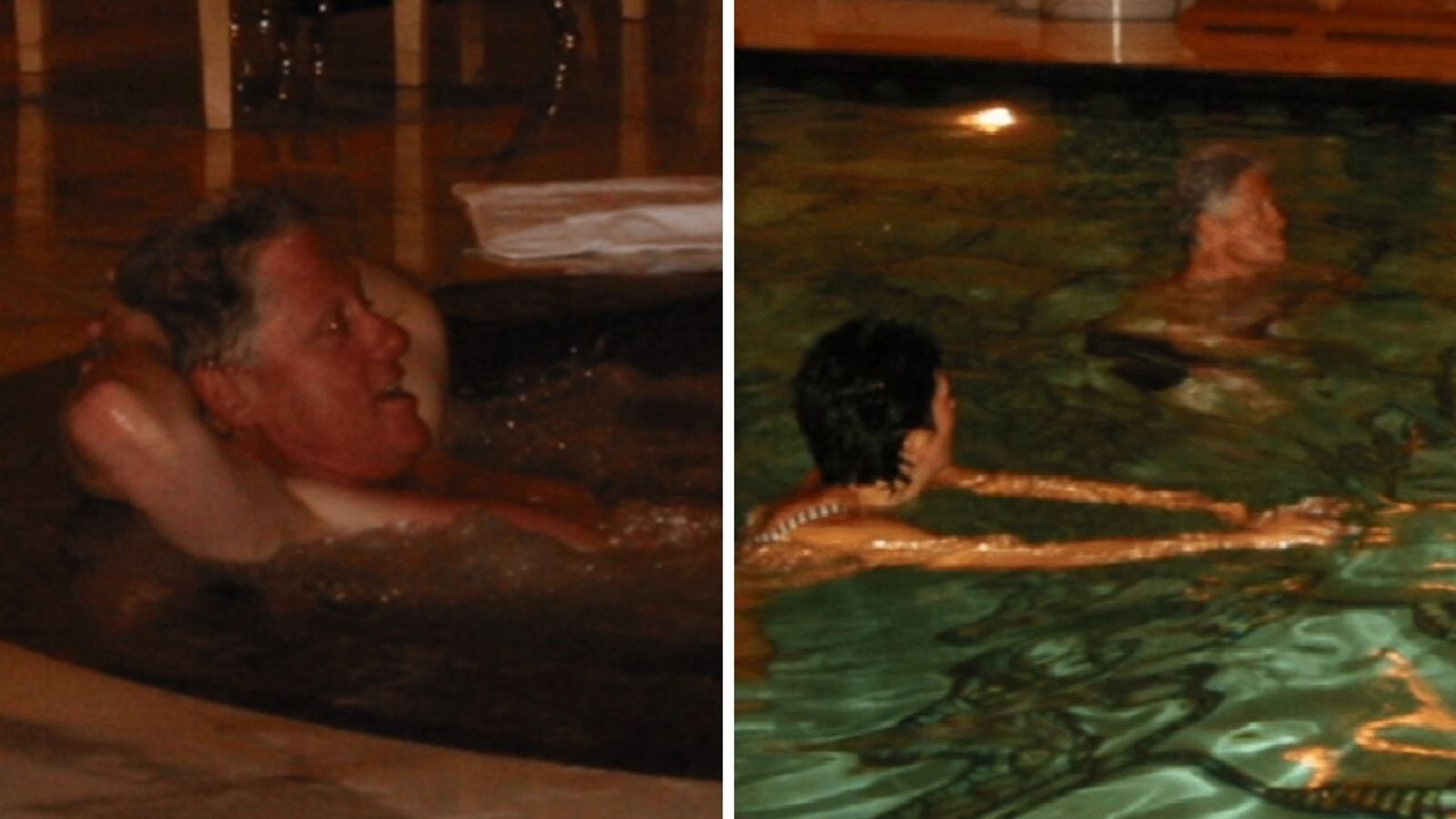
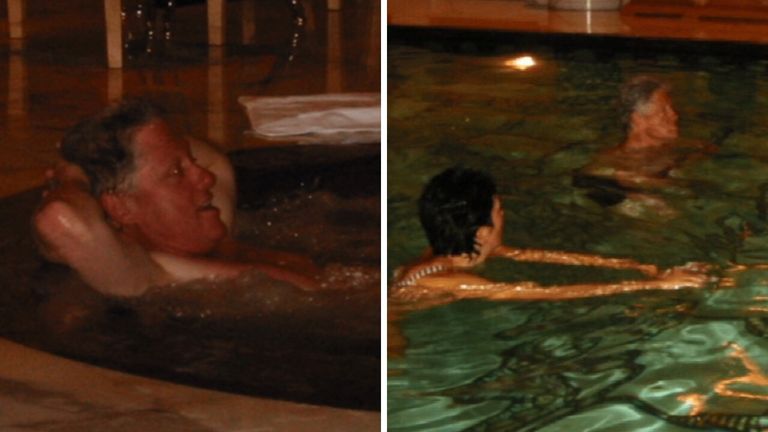
Donald Trump has said he “hated” to see photos of Bill Clinton in the newly released Epstein files.
The former US president was in numerous images that were released by the US Department of Justice among thousands of documents related to the late paedophile financier Jeffrey Epstein.
In his first engagement in front of the media since the release of the latest files, Mr Trump was asked about the images of Mr Clinton.
“I think it’s terrible,” Mr Trump said, adding: “I like Bill Clinton… and I hate to see photos come out of him.
“I’ve always gotten along with Bill Clinton. I’ve been nice to him, he’s been nice to me. I hate to see photos come out of him, but this is what the Democrats, mostly Democrats and a couple of bad Republicans, are asking for.
“So they are giving photos of me to. Everybody was friendly with this guy [Epstein], either friendly or not friendly.
“He was all over Palm Beach and other places… and Bill Clinton was a friend of his, but everybody was.”
Photos released of Bill Clinton included one showing him in a pool with Ghislaine Maxwell. Pics: US Department of Justice
He added: “Bill Clinton’s a big boy. He can handle it, but you probably have pictures being exposed of other people that innocently met Jeffrey Epstein years ago.”
The US president claimed the release of the files “is a way of trying to deflect from the tremendous success that the Republican Party has”.
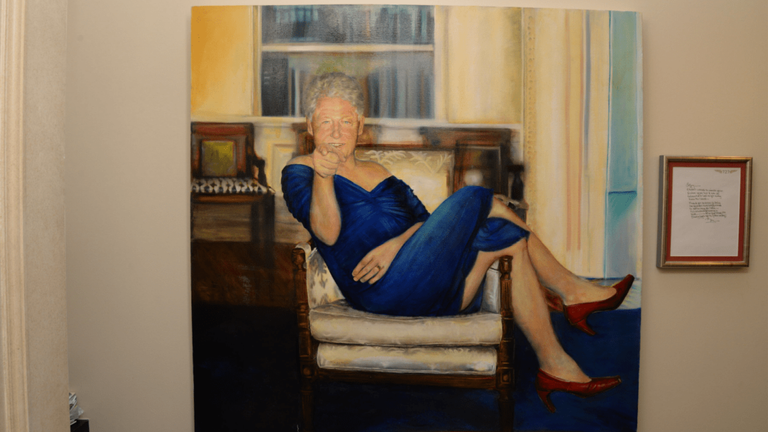
A painting of Bill Clinton in a dress was among the images released. Pic: US DoJ
Clinton calls for release of ‘any remaining materials’
In a statement on Monday, Angel Urena, a spokesman for Mr Clinton, called for Mr Trump to “release any remaining materials referring to mentioning or containing a photograph of Bill Clinton”.
The spokesman said the materials released so far “makes it clear someone or something is being protected” but said Mr Clinton doesn’t need such protection.
“Refusal to do so will confirm the widespread suspicion the Department of Justice’s actions to date are not about transparency, but about insinuation – using selective releases to imply wrongdoing about individuals who have already been repeatedly cleared by the very same Department of Justice, over many years under presidents and attorney generals of both parties,” the spokesperson added.
The context around the photos, that were released hours before a legal deadline in the US following the passing of the Epstein Files Transparency Act, is unknown.
Read more:
Why Andrew photo is deeply awkward for Royal Family
US president announces new ‘Trump Class’ warships
The same release only features one picture with Mr Trump’s name in it.
Mr Clinton has denied any wrongdoing in connection to Epstein and says he regrets meeting him.
Backlash over release of files
It comes as other Democrats and Republicans have grown angry over the length of time it is taking the US Department of Justice to release all files in the Epstein case.
Several victims of Epstein told Sky News that the incomplete release left them feeling shocked, outraged and disappointed.
Republican representative Thomas Massie and Democratic representative Ro Khanna said they are working together on an effort to secure the release of more files, and if necessary would seek contempt of Congress charges against Attorney General Pam Bondi.
Senate Democratic Leader Chuck Schumer also introduced legislation that would instruct Majority Leader John
Thune, a Republican, to undertake “appropriate” legal steps to gain Congress access to all the documents covered by
legislation that was passed by Congress and signed into law by Mr Trump.
It was not clear whether his effort might advance in the Senate when it returns on 5 January.

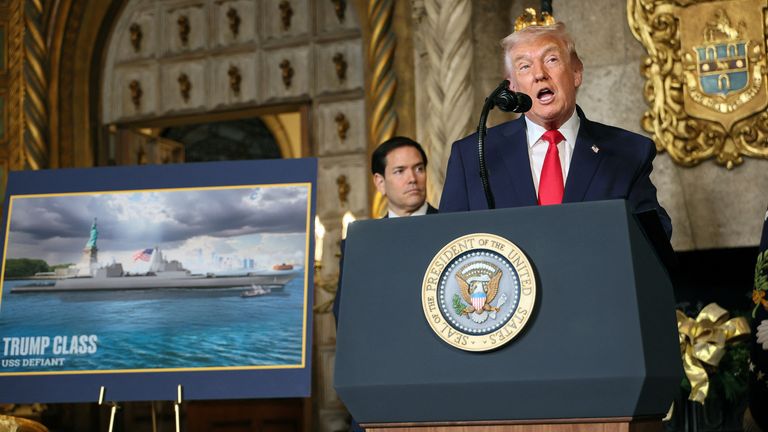
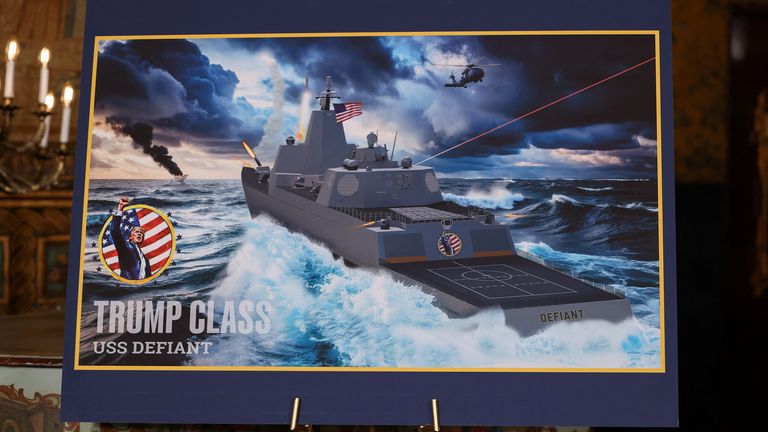
Donald Trump has announced a plan for the US Navy to build two new “Trump Class” battleships.
Aimed at cementing US naval dominance, the president said the vessels will be “the fastest, the biggest and 100 times more powerful than any battleship ever built”.
Constructed in America, made of steel and complete with missiles, guns, lasers and hypersonic weapons, the vessels will be the “centrepiece” of the US Navy’s Golden Fleet initiative, he said.
Starting with two vessels, Mr Trump said the project would eventually expand to include 20 to 25 new ships.
The first will be christened the USS Defiant, with the US leader personally involved in how it looks.
It comes as the US continues to build a large naval military presence near the coast of Venezuela. Since early September, it has struck more than 20 vessels in the Pacific Ocean and Caribbean Sea, which Mr Trump says is to crack down on drug cartels.
The US Navy has also seized two oil tankers and is believed to be in “active pursuit” of a third, according to officials.
Donald Trump speaking about the Navy’s ‘Golden Fleet’. Pic: Reuters
“There’s never been anything like these ships. These have been under design consideration for a long time,” he said.
“Each one of these will be the largest battleship in the history of our country. The largest battleship in the history of the world.
“We haven’t built a battleship since 1994. These cutting-edge vessels will be some of the most lethal surface warfare ships… other than our submarines.”
Mr Trump made the announcement at his Mar-a-Lago estate in Florida. During the briefing, he stood next to mock-up pictures of the new vessels which had “Trump Class” written in the corner – what a senior administration official said the new class of vessel will be known as.

Images of the new ‘Trump Class’ battleship. Pic: Reuters
In addition to the new battleship class, the project aims to increase the number of other types of war vessels, including a smaller, more nimble frigate class.
The term battleship has historically referred to a large, heavily armoured vessel armed with guns designed to bombard other ships or targets ashore.
This type of ship reached peak prominence during the Second World War. The largest of the US battleships was the Iowa-class.
Pic: Reuters
The Trump administration has been complaining about the slow and expensive state of the current defence industry.
Just a month ago, the Navy scrapped its plans to build a new, small warship, citing growing delays and overrunning costs. It has also failed to build its other newly designed ships, like the new Ford-class aircraft carrier and Columbia-class submarines, on time and on budget.
Read more from Sky News:
US in ‘active pursuit’ of third vessel off Venezuelan coast
How Trump has supercharged the new world dis-order
But Mr Trump said the naval expansion would also be paired with renewed pressure on defence contractors to speed up production and rein in costs.
He said he plans to meet with major firms next week to address problems.

Barry Manilow is being treated for lung cancer and has been forced to reschedule live shows, the 82 year-old has revealed.
The Copacabana popstar announced on Instagram that a cancerous spot had been discovered on his left lung.
“As many of you know I recently went through six weeks of bronchitis followed by a relapse of another five weeks,” he wrote.
“Even though I was over the bronchitis and back on stage at the Westgate Las Vegas, my wonderful doctor ordered an MRI just to make sure that everything was OK.
“The MRI discovered a cancerous spot on my left lung that needs to be removed.”
Manilow, 82, added that the cancer had been found early thanks to “pure luck” and a “great doctor”.
And while he would not require chemotherapy or radiation treatment, he wrote, he would have to undergo surgery, forcing him to reschedule his January shows.
He had been due to embark on a string of arena concerts in US cities including Orlando, Tampa, Charleston, Greensboro and Columbus.
He wrote: “I’m going into surgery to have the spot removed. The doctors do not believe it has spread and I’m taking tests to confirm their diagnosis.
“The only follow-up is a month to recover and that means we have to reschedule the January arena concerts.
“I’m very sorry that you have to change your plans.
“Just like you, we were all looking forward to the January shows and hate having to move everything around.”
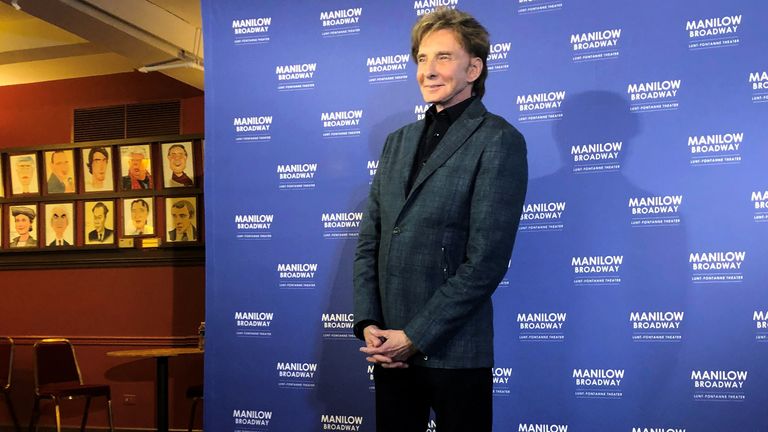
Barry Manilow poses for photographers ahead of a run of shows on Broadway in New York City in 2019. Pic: Reuters
Read more:
King ‘deeply touched’ by reaction to cancer ‘good news’
NHS to offer same-day prostate cancer diagnosis
The Grammy Award-winning singer has released a string of hits over the course of more than 50 years recording music.
They include Could It Be Magic, Looks Like We Made It, Mandy, and Can’t Smile Without You.
His announcement comes after Cliff Richard revealed he had been treated for prostate cancer.
-
 Sports2 years ago
Story injured on diving stop, exits Red Sox game
-
 Sports3 years ago
‘Storybook stuff’: Inside the night Bryce Harper sent the Phillies to the World Series
-
 Sports2 years ago
Game 1 of WS least-watched in recorded history
-
 Sports3 years ago
Button battles heat exhaustion in NASCAR debut
-
 Sports3 years ago
MLB Rank 2023: Ranking baseball’s top 100 players
-
Sports4 years ago
Team Europe easily wins 4th straight Laver Cup
-
 Environment3 years ago
Japan and South Korea have a lot at stake in a free and open South China Sea
-
 Environment1 year ago
Here are the best electric bikes you can buy at every price level in October 2024