
MLB trade grades: Report cards for every major deal


-
Bradford Doolittle
Close
Bradford Doolittle
ESPN Staff Writer
- MLB writer and analyst for ESPN.com
- Former NBA writer and analyst for ESPN.com
- Been with ESPN since 2013
-
David Schoenfield
Close
David Schoenfield
ESPN Senior Writer
- Covers MLB for ESPN.com
- Former deputy editor of Page 2
- Been with ESPN.com since 1995
It’s MLB trade season!
From the early deals that got things started to the last-minute rush of deadline day activity, this is your one-stop shop for grades and analysis breaking down the details for this year’s biggest trades.
ESPN MLB experts Bradford Doolittle and David Schoenfield evaluate and grade the most significant moves below.

Rangers get:
RHP Merrill Kelly

Diamondbacks get:
LHP Kohl Drake
LHP Mitch Bratt
RHP David Hagaman
Rangers grade: B-
When the Rangers won the 2023 World Series, they started the season fast, hit the skids, held on to get into the AL bracket and then caught fire again in October. This year’s team is following a very different trajectory. For much of the season, the Texas offense was so mystifyingly bad that it undermined a strong pitching staff, especially the rotation. Not long ago, it seemed very unlikely Texas would be in position to add a player of Kelly’s caliber, but here we are.
Kelly will bump one of the Rangers’ young starters — Kumar Rocker or Jack Leiter — from the core-five rotation, with Rocker the most likely choice and a candidate to become, for now, a leverage reliever. If Tyler Mahle can make it back from a rotator cuff issue, they’ll both get bumped. But this is a good problem to have for a team trying to keep pace in a clustered AL wild-card chase, and an AL West race that remains up for grabs.
Kelly’s salary in this last year before he hits free agency is just $7 million and the Rangers’ portion of that won’t get them to the first luxury tax threshold and might even leave some space for more additions — preferably for the bullpen. (This assumes of course that staying under the threshold is a goal.) Kelly is a consistent No. 2-type starter who has a better career road ERA than at home after toiling so much in the hitter-ish Chase Field.
It’s a right-now upgrade, but the prospect price is pretty steep here for a player on an expiring deal who adds to an area of existing strength. Hence the solid but not superlative grade, but it’s an odds booster for the Rangers.
Diamondbacks grade: B+
Diamondbacks baseball chief Mike Hazen doesn’t mess around when he decides to subtract. The Snakes are going to look very different coming out of the deadline, and their fans have to wonder what might have been if Arizona had enjoyed better injury luck.
Drake is the standout here, a 6-5 lefty with good stuff, a deep arsenal and above-average command, he has a chance to be at least a mid-rotation starter. Hagaman is raw and, at 22, remains in the low minors as he seeks to improve his control enough to allow his lively pitches to play.
If Drake doesn’t lead this pack, Bratt does. Another lefty, Bratt was a top-10 Rangers prospect at MLB Pipeline who is having a big season in the Double-A Texas League. Bratt, 21, is very young for that level, yet is 6-3 with a 3.18 ERA, 106 strikeouts and just 16 walks. He has given up 13 long balls. — Doolittle

Mets get:
CF Cedric Mullins

Orioles get:
RHP Anthony Nunez
RHP Raimon Gomez
RHP Chandler Marsh
Mets grade: B
Center field was an area of need for a Mets team that is all-in for a 2025 push. Mullins, a former All-Star and top-10 MVP finisher, has the pedigree of a first-division performer at that spot. And, let’s face it, the remaining options in center on the trade market were pretty limited.
Ideally, the Mets would have added a righty option in center, as their recent outfield mix of Juan Soto, Brandon Nimmo and Jeff McNeil consisted of all lefties, like Mullins, and righty-swinging Tyrone Taylor has had a poor season at the plate. But you have to choose from what the market yields, and Mullins is a proven guy. For what it’s worth, Mullins’ numbers against righty pitching this season are brutal. In that regard, he has the same odd platoon splits as McNeil.
The key to this deal might have been the Mets’ evaluation of where Mullins is at as a defender. The defensive rating systems differ tremendously on him in that regard, with assessment ranging from awful to above average. As it is, New York gets a quality player motivated by impending free agency, without giving up anyone it will miss.
Orioles grade: C+
All three hurlers Baltimore picked up from the Mets are righty relievers, with Nunez ranking the highest of the trio. A two-way player in college and a hitter after being drafted in the 29th round by the Padres in 2019, Nunez moved to the mound full time after signing with the Mets as a minor league free agent last season.
The switch has gone well. Nunez has a 1.80 ERA while striking out 13 batters per nine innings over the last two seasons. His success has continued all the way to his current level, Double-A, and he should be a big league relief option for the Orioles sooner than later.
It’s not the sexiest return for someone who contributed as much to the Orioles as Mullins. But he did himself and the O’s no favors with his replacement-level season to date as he approaches free agency. — Doolittle

Rays get:
RHP Griffin Jax

Twins get:
RHP Taj Bradley
Rays grade: C
It’s been a fairly stunning sequence between the Rays and Bradley. After Tampa Bay demoted the long-touted righty earlier this month, Bradley responded with seven no-hit scoreless innings in a Triple-A start on Wednesday. Meanwhile, the Rays dealt Zack Littell to Cincinnati, seemingly opening the door to bring Bradley back into the big league rotation. Not so fast! Bradley’s next start will be for the Twins.
The Rays apparently became convinced that Bradley needed a change of scenery, and at the same time, they add one of the game’s most vicious relievers in Jax. It’s been a strange season for the 30-year-old righty, who sports a 4.50 ERA but a 2.00 FIP. Which is more telling? Given Jax’s 72 strikeouts in 46 innings, we’ll go with the latter. Both hurlers have multiple years of team control remaining.
The grade reflects the simple reality that I’m not sure how to process this. Generally, you don’t trade a talented 24-year-old starter for a talented 30-year-old short reliever. But the Rays generally know what they are doing.
Twins grade: B+
Getting Bradley means the Twins have locked down a deep core of rotation hurlers for the next few seasons, especially since rumors of a Joe Ryan trade didn’t come to fruition. Minnesota’s pitching program has been a good one, though of course so has Tampa Bay’s, but perhaps the Twins can unlock the potential that marked Bradley as a top prospect. With the Twins offloading everyone not nailed down over the past couple of days, the bullpen picture in particular now looks problematic with Jax joining Jhoan Duran and Louis Varland in the club of ex-Twins. — Doolittle

Red Sox get:
RHP Dustin May

Dodgers get:
OF James Tibbs III
OF Zach Ehrhard
Red Sox grade: C-
May was a key pitcher on the 2020 World Series championship team for the Dodgers, but pitched just 101 innings over the next four seasons before returning this year and posting a 4.85 ERA in 18 starts. As the ERA suggests, he hasn’t been too effective, with both a high home run rate and a high walk rate. He doesn’t throw as hard as he did back in 2020, and that shows up in how hard his sinker has been hit this season (.285 average and .633 slugging percentage).
May is heading into free agency, so this doesn’t even fit the idea of “let’s get him this season and maybe he’ll be better next year as he’s further removed from surgery.” He can join the rotation in place of Richard Fitts or even a mediocre Walker Buehler, or maybe he goes to the bullpen, where his fastball might play up a little better.
Dodgers grade: C+
Tibbs was the Giants’ first-round pick last year out of Florida State before going to the Red Sox in the Rafael Devers deal, but he hasn’t hit much at all after a promotion to Double-A (.205/.321/.268 in 29 games). Still, the Dodgers have had success before with guys like this — think of Max Muncy and Chris Taylor — so getting him for a pitcher they didn’t need is worth the roll of the dice even if it never pans out. — Schoenfield

Astros get:
SS Carlos Correa
Twins get:
LHP Matt Mikulski
Astros grade: B
Rumors of this possible trade started floating a couple of days ago, although it still feels like a George Foreman uppercut: Whammo! To facilitate the deal, the Twins will include $33 million to help cover the remaining $103 million or so owed Correa over the rest of 2025 and the next three seasons (he also has some complicated vesting options that run through 2032).
The Astros have been hemorrhaging players via injury, including both shortstop Jeremy Pena and third baseman Isaac Paredes, but have remarkably maintained their lead in the AL West even though half the lineup looks like it should be playing for Triple-A Sugar Land (which it was not so long ago). With Pena apparently set to return on Friday, that means Correa will take over at third base — where he has never played a professional inning.
What kind of player are the Astros getting? Correa turns 31 in September and has battled injuries for years and offensive inconsistency in recent seasons. He had a strong year at the plate in 2024 but was a below-average hitter in 2023 and so far in 2025. He still has plus bat speed and above-average contact rates, but he’s hitting more balls on the ground than ever, plus his walk rate has declined. His defensive metrics at shortstop have likewise declined, although he should make a smooth and quick transition to third base.
Bottom line: Baseball Reference values him at just 0.1 WAR in 2025, FanGraphs a little higher at 1.1. He’s one year removed from being a good player, but it seems fair to suggest he’s unlikely be an elite player again given his age and injury history. Of course, a return to Houston — where Correa still lives in the offseason — could serve as a rejuvenation of sorts, as he never seemed completely comfortable with the Twins. Still, even if the trade helps the Astros in 2025, there is long-term risk here, even with the Twins paying down some of the future salary.
Going back to last offseason with the Kyle Tucker trade and letting Alex Bregman go to now bringing Correa back, it’s hard to figure out the Astros’ philosophy, and no doubt this deal might have come from owner Jim Crane, a big fan of Correa’s. One thing is clear though: The Astros keep on winning.
Twins grade: C
Well, it’s officially a crushingly disappointing season in Minnesota, with the trades of Correa, Jhoan Duran and Harrison Bader. It’s hard to argue against the decision to trade away these guys given the Twins’ 51-57 record, but this feels like a setback season for an organization that has shown promise since winning 101 games in 2019 but never figured out how to get over the top (or spent a little extra money in trying to do so).
In one sense, however, this trade makes perfect sense: Correa is being paid a superstar salary, and he’s no longer a superstar. Given their self-imposed payroll cap, it might improve the Twins’ long-term chances, assuming they can properly reinvest that money in the right players. This trade is mostly about dumping the salary rather than what the Twins got in return. We could label this one incomplete until we see what the Twins do in the offseason. For now, we’ll give it a C, which sums up the Carlos Correa era in Minnesota that will end with just one playoff appearance in four seasons. — Schoenfield

Padres get:
1B/DH Ryan O’Hearn
OF Ramon Laureano
Orioles get:
RHP Boston Bateman
IF Cobb Hightower
IF/OF Victor Figueroa
RHP Tyson Neighbors
INF Brandon Butterworth
RHP Tanner Smith
Padres grade: A-
So I was a little down in my assessment of the Padres’ blockbuster with the Athletics, believing that move to be a precursor to San Diego paring payroll. Clearly, I don’t know AJ Preller at all, though I thought I did. The Padres are … all … the … way … in, with Preller patching up three lineup holes and adding dynamism to his roster on the same day.
Between his stints in Kansas City and Baltimore, O’Hearn was DFA’d several times, and entering his age-29 season, there was little to indicate he’d become a sought-after deadline target. But he found himself as an Oriole, producing all through his time in Baltimore, culminating this year with being selected as the AL’s All-Star DH. Now he has a chance to play a major role for a franchise doing everything it can to win its first-ever championship.
Meanwhile, Laureano has been even better than O’Hearn at the plate and slots into left field for San Diego, one of the weakest spots of any contending team. The Padres entered the day ranked 28th in left by wins above average, 29th at DH and dead last at catcher. They now have Laureano, O’Hearn and Freddy Fermin to upgrade those slots. Look out, Dodgers.
Orioles grade: B+
The Orioles are doing the right thing in shedding their expiring deals and adding prospects in bulk to replenish their system, especially on the pitching side. Meanwhile, in moving Ramon Urias, O’Hearn, Laureano and Cedric Mullins over the past couple of days, Baltimore can go young all around the diamond over the next two months and see what its rebuilding effort of a few years ago truly wrought.
Bateman headlines this return. A 6-8 lefty, MLB Pipeline grades him with an above-average fastball and a plus curve to go with average command. It’s a nice foundation to work from and, at 19, the second-round pick from 2024 is performing well at Low-A. — Doolittle
Astros get:
OF Jesus Sanchez

Marlins get:
SS Chase Jaworsky
RHP Ryan Gusto
OF Esmil Valencia
Astros grade: C-
More than anything, the addition of Sanchez means we aren’t likely to see much more, if any, of Jose Altuve playing left field. We’ll probably also see much less of Cooper Hummel and his career 55 OPS+. Sanchez is a second-division, platoon-level outfielder. He plays average defense on the corners, can play center in a pinch, and has decent secondary skills at the plate against righties. He doesn’t hit southpaws at all and was a bit overexposed during his time in Miami.
When Jeremy Pena returns to action, Mauricio Dubon might end up taking some of Sanchez’s time in left, especially against lefties, but that’s fine. Sanchez plugs a right-now gap for an injury-riddled team that has been flailing on offense.
Marlins grade: B
Ordinarily, I’d hammer on the Marlins for offloading a veteran regular, but as you’ve probably surmised, I’m not that sold on Sanchez as a contention-worthy regular. Jaworsky was one of the top 10 prospects in Houston, though it’s not a highly rated system. Gusto has been invaluable for the Astros in helping them work through rotation injuries. His 4.92 rookie season ERA is a bit misleading given his supporting numbers, and he’ll add to a deepening arsenal of Marlins rotation options.
It’s a sensible move for Miami, but it does merit mentioning: The Marlins might not be in the playoff race, but they have been building up momentum, and their pitching staff has been one of baseball’s hottest for more than two months. Let’s hope their deadline direction doesn’t stunt those positive developments. — Doolittle

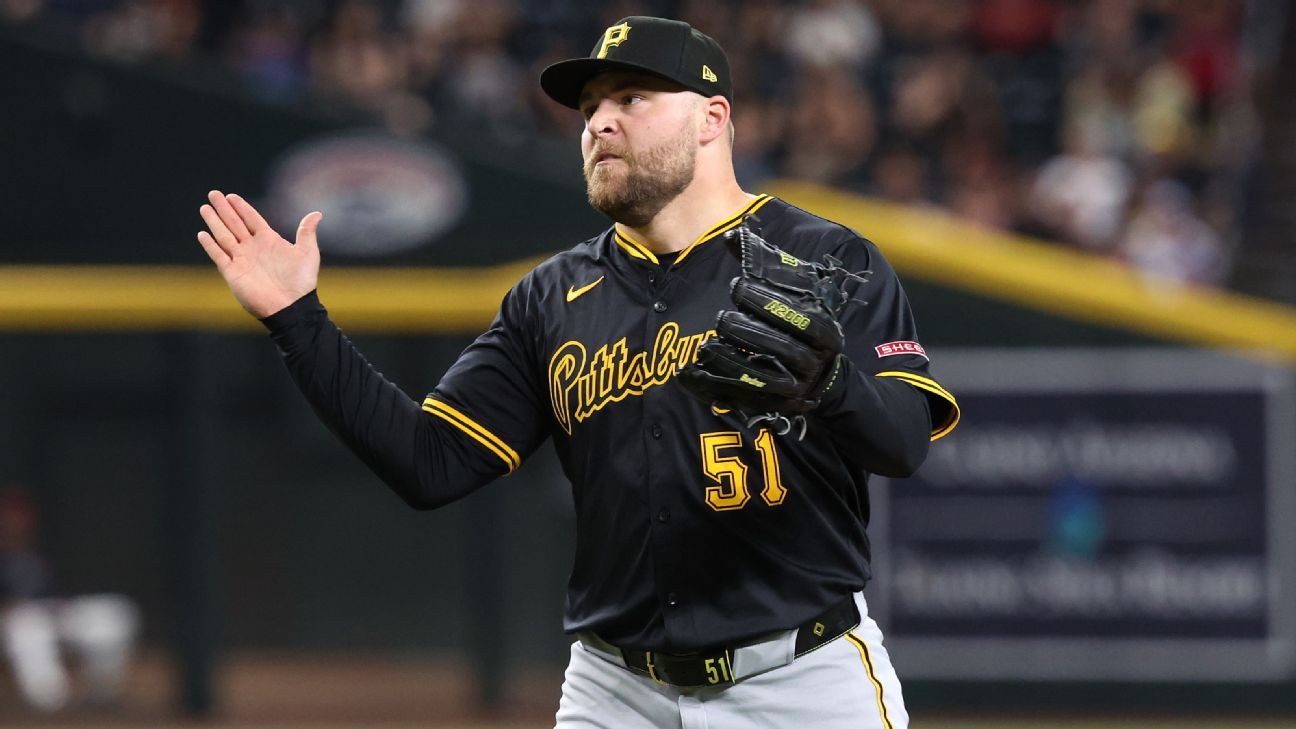
Yankees get:
RHP David Bednar

Pirates get:
C Rafael Flores
C Edgleen Perez
OF Brian Sanchez
Yankees grade: B+
It’s no secret the Yankees desired bullpen help — usually a strength of the team, the pen ranks 21st in the majors with a 4.24 ERA, a figure that has ballooned to 6.29 in July. Closer Devin Williams has had a wildly inconsistent season after coming over from the Brewers, struggling in April, looking good for a couple of months, but now he has allowed runs in four of his past six appearances, including two home runs. Luke Weaver, who came out of nowhere last season to end up as the Yankees’ closer, hasn’t been quite as dominant either, mostly due to a high home run rate (seven in 40⅔ innings).
That suggests it’s possible Bednar even gets a crack at the closer role. After struggling out of the gate to begin the season, he has allowed just one earned run over his past 24 appearances. Bednar’s four-seamer averages 97, but it’s not necessarily a dominant pitch, as he gets most of his swing-and-miss off his curveball and a splitter that he uses effectively against lefties. While Bednar is 17-for-17 in save chances, he does have five losses, so, umm, don’t use him in a tie game?
As a bonus, Bednar also comes with another year of team control. Granted, pitching for Pittsburgh is a lot different than pitching in New York — ask Williams about the pressures of going from a small market to pitching for the Yankees, where the fans will turn on you after that first blown save — but Bednar gives Aaron Boone another late-game, high-leverage arm, no matter what role he settles into.
Pirates grade: C-
One thing the Yankees seem to do well is develop catching prospects and the Pirates got two of them in this deal. That sort of makes sense as Henry Davis, the former No. 1 pick, just hasn’t hit and Endy Rodriguez, once a top-50-ish prospect, has barely played the past two seasons. That has left journeyman Joey Bart (also once a top prospect) as the regular catcher in 2025. Trying to find a long-term solution is a good idea, although the Pirates could use help all over the diamond.
Perez was the Yankees’ No. 10 prospect, but he’s light years from the majors, a 19-year-old hitting .209 with no home runs in low-A ball. He has drawn a lot of walks, but as you might surmise, defense is his calling card. Still, unless something drastic happens with the bat, it’s hard to envision him as anything more than backup. Flores is a more offensive-minded backstop, hitting .287/.346/.496 in Double-A with 15 home runs in 335 at-bats. The analytics department will like his max exit velocity numbers (115 mph), but he’s a fringy defender who might end up as a first baseman, where the bat might not play.
Sanchez is a 20-year-old outfielder in low-A ball with some speed and not much power yet. Given some of the other returns for elite relievers, and factoring in that Bednar comes with another year of team control, it feels like a bit of a light return for the Pirates. — Schoenfield
Yankees get:
RHP Camilo Doval

Giants get:
C/3B Jesus Rodriguez
RHP Trystan Vrieling
IF Parks Harber
LHP Carlos De La Rosa
Yankees grade: B
Duval is a pure fireballer who has excelled in a closing role at times, but his job description has wavered, as does his command. He’s one of those maddening relievers who walks himself into trouble, then tries to strike his way out of it. But the arm is the real deal, and his end-of-the-day acquisition was the final piece of a completely overhauled Yankees bullpen. Now, in some order of preference, Aaron Boone can summon David Bednar, Devin Williams, Luke Weaver, Duval, Tim Hill and Jake Bird. The Yankees didn’t land the starter they needed, but maybe they won’t miss that pitcher now.
Giants grade: C+
The highest rated of these prospects are Rodriguez and Vrieling, but there’s no one above 18th or so in the Yankees organization. Rodriguez is the top ranked, and it seems like everyone wants to get their hands on a Yankees-developed catcher for their success in developing defensive backstops. Rodriguez is more a bat-first guy, though. Vrieling grades out as a potential league-average starter, but only if he can develop at least one standout offering. It feels more like a quantity over quality package, one that could have been meatier given Doval’s two additional seasons of team control. — Doolittle
Yankees get:
RHP Jake Bird

Rockies get:
2B Roc Riggio
LHP Ben Shields
Yankees grade: C
After earlier acquiring David Bednar, the Yankees add another bullpen option with herky-jerky-slinging Bird, who is under team control through 2028. He was one of the hottest relievers in baseball through early June when he had a 1.41 ERA, but he’s been beat up of late, with a 13.20 ERA over his past 17 appearances and a diminishing strikeout rate compared with early in the season. The Rockies worked him heavily those first two months, so the Yankees will hope that maybe less frequent usage will get him back on track. He also had little track record of success heading into the season, so there’s no guarantee he’s anything more than a low-leverage relief option.
Rockies grade: C
The Rockies get a couple long shot prospects in return. Riggio was a fourth-round pick from Oklahoma State in 2023 who is currently tearing up the minors with a .567 slugging percentage, including .542 in 40 games at Double-A. He generates surprising power from the left side despite his 5-9 frame, but there’s a lot of swing-and-miss here and he’s definitely limited to second base. Also: He has the right name for a Rockies player. Shields is old for a prospect at 26 and has battled some injuries in 2025, but he is equipped with a solid-average fastball and plus curveball and could be a late bloomer. No guarantees here, but a fair return for a marginal relief pitcher. — Schoenfield
Padres get:
RHP Mason Miller
LHP JP Sears

Athletics get:
SS Leo De Vries
RHP Braden Nett
RHP Henry Baez
RHP Eduarniel Nunez
Padres grade: B
Miller is no doubt a great talent, and Sears is a consistent source of innings. For now, the Padres’ staff looks positively loaded, but the key words in this sentence are “for now” — because this move was probably as much about payroll as talent. The Padres can prove me wrong by continuing to add, but this doesn’t feel like a typical “A.J. Preller going for it” situation.
Miller has been one of baseball’s most electric closers since being shifted to the back of the Athletics’ bullpen early last year. He might be the best reliever to move at the deadline, surpassing Ryan Helsley and Jhoan Duran, though we can debate that later. But from a pure roster need, this trade accomplishes nothing for the 2025 Padres. Worse, possible deals to come involving Robert Suarez and Dylan Cease could mean Preller’s deadline machinations prove to be a short-term net negative for a team with firm grip on a wild-card slot and the talent to go deep in the playoffs.
San Diego’s bullpen has been the best in baseball all season. Based on my rankings that rate relievers on game-by-game win probability results, the Padres have the top overall relief staff and four of the top nine individual relievers, including Suarez (No. 1), Adrian Morejon (3), Jason Adam (8) and Jeremiah Estrada (9). Miller ranks 30th, but after a slump earlier in the season, he has been hot of late.
Miller and Sears are both pre-arbitration and so don’t cost anything. If the Padres kept everyone intact, the staff would be a beast come October. And it might be anyway, but the savings that would come from moving Suarez and Cease might be enough to get San Diego under the second tax threshold. Even if that doesn’t happen, Cease is in a walk year for sure, and Suarez, who can opt out, likely is as well, as he looks to cash in on his strong season. So even if Preller deals that duo, he is still coming out ahead in terms of net controllable years.
But that doesn’t mean the Padres come out ahead in either short-term or future value. For this season, Miller plus Sears is likely a lesser combination than Suarez plus Cease. That’s rough if that’s how it turns out. And longer term, to make this deal, Preller has again pillaged his minor league system, giving up a truly elite talent in Leo De Vries (preseason No. 15 by ESPN’s Kiley McDaniel and current No. 3 by MLB Pipeline), just to start.
If the Padres don’t unload Cease and Suarez, this grade bumps up to a B on the strength of 2025 championship probability added. It doesn’t become an A, though, because De Vries is that strong of a prospect.
Update: As suggested, the fact that the Padres did not deal either Cease or Suarez — as the rumors and tea leaves suggested they might — changes the way this trade should be considered. Basically, the Padres have gone all-in and have done so with gusto. I still think dealing De Vries to add to a position of strength holds down the grade a bit, but it looks a lot better now than it did this morning. Payroll be damned — AJ Preller is going for it. (And we’ve raised the grade from a D- to a B.)
Athletics grade: A
I love Miller, but come on. I never wanted the Athletics to pigeonhole Miller as a short reliever, but they did, and it feels like he’s fixed there. (Though conversions, such as the Mets with Clay Holmes, have shown it’s never too late). Still, to land De Vries, just 18 and already at High-A, for a reliever is a coup. Exciting power potential, plus plate discipline, a strong arm — he’s the stuff that stars are made of. Shortly after news of this deal dropped, I received a text predicting that someday both the AL MVP (De Vries) and NL MVP (James Wood) will be prospects Preller traded. It could happen. The fans in Vegas are going to love him.
Meanwhile, the A’s add three pitching prospects. Baez and Nunez both rank in the 10 to 20 range in San Diego’s system, according to analysts, but Nett was their No. 3 prospect according to MLB Pipeline, behind De Vries and talented young catcher Ethan Salas, who at last check of my text messages remains a prospect in the San Diego system, but stay tuned.
Nett has a high-end fastball (up to 99 mph, per MLB Pipeline) to headline a five-pitch arsenal. He has struck out more than 10 batters per nine innings in the minors, albeit with ugly walk rates that underscore so-so grades for command. But those walk rates have improved each season, and he’s not far off from his big league debut. It’s an impressive haul for the A’s. — Doolittle
Padres get:
C Freddy Fermin

Royals get:
RHP Ryan Bergert
RHP Stephen Kolek
Padres grade: B
The Padres had the worst catching situation in baseball, at least at the big league level. They rank 30th in WAR at that spot for the season to date and are projected to rank 30th there in the rest-of-season forecast. So upgrading the position was both necessary and hard to do. San Diego did well in nabbing the underrated Fermin, a dynamic defensive backstop with an elite ability to control the running game.
He’s no great shakes on offense but does feature good contact ability to pair with his aggressive approach. It’s enough to make him better than what San Diego was working with. Fermin is in the final season of his pre-arbitration window and should move into a mostly everyday role for Mike Shildt over the rest of the season. Assuming Fermin is still around when Ethan Salas is ready for the majors, Fermin is an ideal No. 2 backstop.
Kolek and, especially, Bergert have pitched well, helping the Padres navigate through rotation injuries. That AJ Preller dealt them on the same day he acquired JP Sears from the A’s is particularly interesting because it leaves Preller once again with a clear five-man core rotation, at least until Michael King is healthy. If this means San Diego is going to hold onto Dylan Cease, it’s all the better.
Royals grade: B+
Fermin was the most popular Freddy/Freddie in Kansas City since Patek and has played a key role over the past two seasons. His ability to produce on both sides of the plate, especially defensively, has allowed the Royals to move Salvador Perez around to first base and DH more often. But the Royals can afford to part with Fermin thanks to the deepest set of catching prospects around, a group that includes 21-year-old Carter Jensen, who has clubbed eight homers and put up a .938 OPS over his first 22 games in Triple-A.
Meanwhile, injuries to Kris Bubic, Cole Ragans and Michael Lorenzen created a short-term need in the rotation. The Royals have had excellent luck in working with acquired veteran starters — especially former Padre Seth Lugo — and will attempt to do the same for Bergert and Kolek. It’s a win-win trade for two teams trying to plug holes for the stretch run. — Doolittle

Phillies get:
OF Harrison Bader
Twins get:
OF Hendry Mendez
RHP Geremy Villoria
Phillies grade: B-
This fits into the “logical but low-impact” department. The Phillies rank 22nd in OPS from center field (Brandon Marsh has been OK, but Johan Rojas hasn’t hit at all) and 26th in OPS from left field (mostly Max Kepler). Bader can slot into either position. He played mostly left field for the Twins with Byron Buxton in center, but he is probably a defensive upgrade over Marsh, so he could push Marsh over to left field. It’s not a perfect alignment since Marsh and Kepler both bat left-handed, but Bader gives the Phillies a much-needed right-handed bat and improves the overall depth.
The issue here is that Bader is having his best offensive season since 2021 — and the Statcast metrics don’t back up those numbers, with an expected batting average of .225 and expected slugging of .385, compared to actual figures of .258 and .439. It wouldn’t be surprising to see his production dip the rest of the season, more in line with what he’s done in recent years. He has always been better in a part-time role, so while he might get the opportunity to play on a regular basis, it’s possible Bader ends up back in a platoon role, with Kepler and Marsh getting the bulk of the at-bats against righties. Still, with a limited number of right-handed bats available, Bader is a nice get for Dave Dombrowski and a clear upgrade over Rojas.
Twins grade: C
Mendez is a 21-year-old left-handed hitter, the Phillies’ No. 8 prospect. He has good contact skills and is hitting .290 at Double-A Reading, but that’s a great hitter’s park — he is hitting just .259 on the road. He is also limited to a corner outfield position and hasn’t delivered much impact, so he looks like a tweener, lacking the defensive chops for center and the power for a corner position.
Villoria is — get this — a 16-year-old right-hander. He has pitched 14 innings in the Dominican Summer League and has fanned 19 batters. He could be anything, the very definition of a lottery ticket — hey, sometimes those players turn into Fernando Tatis Jr. or Junior Caminero. Check back in a few years on him. — Schoenfield

Blue Jays get:
RHP Shane Bieber

Guardians get:
RHP Khal Stephen
Blue Jays grade: B+
Over the past two seasons, Bieber has a strikeout-to-walk ratio of 20-1 in the majors. Unfortunately, that’s been compiled over just two starts, two sparkling outings early in the 2024 season. This season, Bieber has a ratio of 21-1 in the minors. Unfortunately, that’s been compiled over just four outings.
Those small sample observations do a nifty job of illustrating both the risk and the reward of this deal for the Blue Jays, who gave up real prospect talent in Stephen. When he pitches, Bieber is one of the best, an almost impossible combination of command and the ability to work in the zone without damage. But the stress his vicious arsenal puts on his elbow has kept him from putting that ability on display.
Bieber’s last rehab outing was Tuesday, when he threw 57 pitches over four innings, striking out seven and (of course) walking none. He did give up a homer to a young guy named Jake Holton, who will surely cherish the memory. Bieber has been ramping up after experiencing elbow soreness earlier this season, delaying his return. Obviously, for this deal to become official, the Jays will have to be satisfied with Bieber’s medicals.
Bieber has a team option for 2026 ($16 million with a $4 million buyout), which justifies the inclusion of Stephen in the deal. If he pitches — not an insignificant “if” — he would play a major role in aiding Toronto’s effort to get back to the World Series for the first time since the early 1990s. The Jays still need to add to their bullpen, however, among other areas.
Guardians grade: C+
As ever, the Guardians spin things forward, cashing in on the remaining value of Bieber’s contract and shedding the risk attached to his injury history. I still don’t love it, as I’m weary of franchises like this that are well run for the most part but too often seem satisfied to tread water. Cleveland always seems to be on the cusp of breaking through, only to back off. The Guardians aren’t out of this year’s chase, yet this is very much a move for the future.
That’s what holds back this grade, not the return of Stephen, a second-round pick by Toronto last year. His numbers this season in the minors are eye-popping: 9-1, 2.06 ERA over 91⅔ innings and 99 strikeouts against just 18 walks. That’s stretched out across three levels, including his Double-A debut July 20. He has average-to-better grades on four pitches and his command, but no real elite offering. He works in the low-to-mid 90s, so he’s not a burner. And he’s not Shane Bieber. — Doolittle

Mariners get:
3B Eugenio Suarez
Diamondbacks get:
1B Tyler Locklear
RHP Juan Burgos
RHP Hunter Cranton
Mariners grade: A
Just a couple of days after acquiring Josh Naylor from the Diamondbacks, the Mariners go back to their frequent trade partner and get the best power bat available at the deadline — and not just the best available, but one of the best sluggers in the game. Suarez is fifth in the majors with 36 home runs (and there’s a big gap to the next guy with 27), giving the Mariners MLB’s top home run duo now with Suarez and Cal Raleigh.
This hasn’t merely been a hot stretch for Suarez. Going back to last July when he made some adjustments (moving closer to the plate and opening up his stance), Suarez ranks fourth in the majors with 60 home runs and sixth in OPS, hitting .276/.336/.594 in 184 games.
Yes, his strikeout rate remains high at 26.8%, although that’s still lower than the 31% it was at during his first stint with the Mariners in 2022-23. There’s also some concern about his ability to catch up to good fastballs — he’s hitting .224 and slugging .408 against fastballs 95-plus mph — but the Mariners’ lineup now projects as one of the best in the game with the two trade additions (Seattle already ranks third in the majors in road OPS, although just 26th in home OPS).
Give Jerry Dipoto some credit here. He acquired Suarez and Naylor without giving up any of Seattle’s top 10 prospects — a group that includes seven or eight top-100 overall prospects — or rookie second baseman Cole Young, who was a top 100 guy before graduating to the majors earlier this season.
It will be interesting to see where Suarez plays. He’s a below-average third baseman, so he could get a lot of DH time — except when Raleigh plays there — as the Mariners could opt to keep slick-fielding rookie Ben Williamson at third base as much as possible. Something to monitor: If Suarez plays third, an infield of Suarez, J.P. Crawford and Jorge Polanco at second would feature three players with subpar range.
Still, Mariners fans should be happy here. While Dipoto has always been aggressive in making trades, ownership has never been aggressive in letting him bring on salary. That happened this time, and while the Astros hold a comfortable five-game lead in the AL West, Houston is vulnerable given all its injuries. The Mariners last made the playoffs in 2022 — but they fell one game short of the playoffs in 2024, one game short in 2023 and were still alive entering the final day in 2021. The hope now is Suarez and Naylor finally get them over that hump and have the M’s playing October baseball for just the second time since 2001.
Diamondbacks grade: C
Given Suarez’s impact power and the need of several playoff contenders at third base, this return feels a little low — especially given the arguably bigger returns for rental relievers Tyler Rogers and Ryan Helsley. But Mike Hazen saw his list of potential trade partners limited after the Yankees acquired Ryan McMahon, the Reds traded for Ke’Bryan Hayes and the Cubs and Tigers perhaps focused just on adding pitching. By waiting, the Diamondbacks might have received less than what they could have a few days ago.
That might be underselling Locklear though. A right-handed hitter who was drafted out of VCU in the second round in 2022, he fills both a need at first base with Naylor gone and is ready for the majors, hitting .316/.401/.542 at Triple-A Tacoma. He was slow out of the gate, with just three home runs at the end of May, but he’s popped 16 since then, including hitting a robust hitting .422 with nine home runs in July. Maybe he has figured something out.
He should get a run at first the rest of the season and projects as a potential league average-ish first baseman for the future. That’s not necessarily the sexiest of profiles, but the Diamondbacks get a little more certainty and proximity to the majors, which is sometimes the smarter approach rather than gambling on a player further away with more upside. The Diamondbacks also have a replacement ready for Suarez in top prospect Jordan Lawlar, who will finally get his own turn of extended playing time in the majors since he has been blocked by Geraldo Perdomo at shortstop.
Burgos could also be in the bullpen the rest of the season. He has a 0.87 ERA in the minors, allowing just 14 hits in 31 innings, and made four appearances with the Mariners. His fastball sits 96 and touches higher, although it didn’t miss a ton of bats in the minors (31 strikeouts). — Schoenfield
Red Sox get:
LHP Steven Matz

Cardinals get:
1B/3B Blaze Jordan
Red Sox grade: C+
It’s been a decade since Matz broke in as part of the vaunted Mets’ rotation in the mid-2010s, and he has made the full journey from starter to mostly bullpen work. The Cardinals have used Matz as a five-or-six-out reliever for the most part, and that kind of length will help bridge the middle innings for Boston. Unless, of course, the Red Sox want to stretch out Matz as a No. 5 starter or swing pitcher. In recent seasons, Matz’s numbers have been much better working out of the bullpen.
Matz has pretty extreme splits, and in a different era, he might have ended up as one of those onetime starters who morph into lefty specialists, a la Rick Honeycutt. But teams can’t do that anymore, and so Alex Cora will have to figure out how that profile might work when Matz faces righty fly ball hitters at Fenway Park. All in all, Matz is a versatile pitcher with still-identifiable strengths who deepens the Boston staff. He’s not really a needle mover, but it took only an unranked prospect to land him in advance of his looming free agency.
Cardinals grade: C+
This might have been a harsher grade a week ago, but St. Louis continues to be one of baseball’s coldest teams. Meanwhile, the Padres have gone on a pre-deadline spree, which makes the dwindling hopes for fringe wild-card chasers such as St. Louis, San Francisco and Miami that much fainter. Thus, it makes sense to get something for Matz.
Jordan qualifies as something. An unathletic corner infielder, the FanGraphs scouting report compares him to Ryon Healy. He has risen steadily one level at time after being drafted out of high school, and so has reached Triple-A at age 22. His strikeout rates suggest good bat-to-ball ability, but his power and walk numbers portend limited secondary skills for a player whose bat is going to have to carry him.
Still, he’s got a great name and could develop into a useful, lefty-mashing role player in the majors, the kind of performer the Cardinals have often gotten good mileage from in the past. — Doolittle
Astros get:
3B Ramon Urias
Orioles get:
RHP Twine Palmer
Astros grade: B-
The injury to Isaac Paredes left a thin and depleted Astros lineup even shorter, and with Paredes out for a while, Houston was in bad need of a stopgap. Enter Urias, a persistently league-average type performer who raises the rest-of-the-season floor for the Astros, whose offense has been ice-cold. While there were splashier names on the possible target list, Urias is a serviceable regular who didn’t cost much in terms of prospect return.
It’ll be interesting to see where Houston turns from here as it tries to piece things together with its AL West lead narrowing. The Astros need more offense and could use a rotation upgrade as well. But depending on where you look, it’s unclear how much room they have to work with under the first luxury tax threshold.
Orioles grade: B-
The Orioles have been turning the page on 2025’s disappointing roster. The bittersweet part of it for Baltimore fans is the offense has finally started to roll, but even if that keeps up, there’s probably not enough pitching left to sustain a miracle run. In the meantime, the departure of Urias opens up opportunities for both Jordan Westburg and Coby Mayo for the rest of the season, something that could be especially true if the Orioles deal Ryan O’Hearn.
Palmer is a flier. At 6-5, he was a 19th-round pick out of an Oklahoma community college last year. He has steadily added velocity over the past couple of years, and while his command is not great right now, he has missed bats and, at 20, is worth a shot. He is yet to enter anyone’s top 30 just yet, but FanGraph’s James Fegan notes that Palmer has a funky “Josh Collmenter arm slot” — basically the ball seems to appear from behind his head because of an extreme over-the-top delivery — so that’s interesting. — Doolittle

Reds get:
RHP Zack Littell

Rays get:
C Hunter Feduccia
RHP Brian Van Belle
Dodgers get:
LHP Adam Serwinowski
RHP Paul Gervase
C Ben Rortvedt
Reds grade: C-
The Reds made a pair of trades Wednesday for solid big league players who don’t really address the needs Cincinnati seemed to have as the deadline approaches. In the case of Ke’Bryan Hayes, at least we can point to a defensive upgrade and perhaps a boost to the overall run prevention. At first blush, it’s hard to see what exactly Littell upgrades for the Reds, and the fit between player and venue is a little concerning.
The Reds’ rotation has been one of the best in the majors this season, and they’ve reached that status despite the groin injury suffered by ace Hunter Greene in early June. Prospect Chase Burns has made six starts during Greene’s absence and as exciting as his stuff looks, he also looks like someone who needs a bit more seasoning. That might create a rotation need but Greene threw 50 pitches in a rehab outing at Triple-A on Tuesday and should be back in the majors soon.
I have questions.
— Are the Reds going to a six-man rotation? If so, why?
— Are they going to bump someone from the rotation for Littell? The most likely candidate would be Brady Singer, but it’s unclear that Littell is better. If he is, it is a marginal difference, especially since Littel is a pitcher leading the AL in homers allowed who is now moving to a homer haven of a ballpark.
— Are the Reds going to move someone from the rotation to boost the bullpen? Singer might work there, as would Nick Martinez. It might be better to just trade for a reliever.
Another possibility is that Cincinnati was trying to create extra depth for the rotation to use a starter in a deal of a middle-of-the-order bat. If that happens, then maybe the grade for this deal changes. It’s nothing against Littell, a solid No. 3 or No. 4 starter with a 4.92 FIP. Barring related moves to come, it just seems like an odd move for the Reds, who still haven’t addressed their top need: a middle-of-the-order bat.
Rays grade: B-
The Rays are never shy about moving players on expiring deals. After being one of baseball’s hottest teams for several weeks, the Rays have fallen hard over the past month. After dropping a tough extra-innings decision to the Yankees on Wednesday, Tampa Bay finds itself in a quagmire of .500 teams trying to climb back into the AL wild-card picture.
Losing Littell probably hurts a rotation that also just lost Taj Bradley, who was demoted after his struggles dragged on a little too long. Bradley could come back, of course, but he hasn’t had time to iron anything out just yet. It matters because whatever trades the Rays make, they aren’t out of the wild-card chase.
Van Belle profiles as a depth guy who doesn’t have a track record with a lot of swing and miss. He has worked as both a starter and a reliever in the minors since signing as an undrafted free agent in 2020, the year of the truncated draft. He commands his pitches and given the Rays targeted him, there is likely something in his arsenal they feel they can sharpen.
Feduccia has been around a while in the Dodgers’ system, where he’s been stuck behind higher-profile prospects. Now 28, he has just seven big league games on his ledger. The Rays must like his defense since they value that above all else in their catchers, and he is a lefty swinger who can pair in a quasi-platoon with newly acquired Nick Fortes if Tampa Bay things Feduccia is a right-now big leaguer and more appealing than Matt Thaiss.
Both prospects have the tools, and the Rays love to work with players with tools.
Dodgers grade: B+
It’s not a splashy trade for the Dodgers but more an opportunistic one as their depth at catcher enabled them to sweeten Cincinnati’s pot for Littell. Rortvedt is a depth, defense-first backstop who can take Feduccia’s place in Oklahoma City and be ready if someone gets hurt. Gervase is a 6-foot-10 combo righty who posted huge strikeout rates in the minors. His extension on the mound, as you might guess for someone of his size, ranks in the 99th percentile, per Statcast.
The plum of the deal is the lefty Serwinowski, who landed in Kiley McDaniel’s most recent set of team top 10 prospect lists. He is just 21 and has been pitching in High-A for the Reds. His numbers are rough, but his strikeout rates are promising for a starter, so the Dodgers will plug him into their machinery and see what happens.

Cubs get:
RHP Michael Soroka

Nationals get:
OF Christian Franklin
IF Ronny Cruz
Cubs grade: C
The Chicago Cubs are looking for pitching help, with a starting pitcher the priority, but Soroka can help in any role. The Washington Nationals used him exclusively as a starter — he’s 3-8 with a 4.87 ERA in 16 starts — but with solid peripherals, including an 87-to-24 strikeout-to-walk ratio (despite a league-leading 14 hit batters that eat into that), plus a .224 batting average allowed that is right in line with his expected average of .218.
He has done it despite an underwhelming arsenal that relies primarily on a four-seam fastball that batters have slugged .537 against, and a slurve that is essentially a new pitch for Soroka this year. He throws it 35% of the time and batters have hit just .124 against it. He mixes in a changeup against lefties and a two-seamer, but it’s four-seamer/slurve about 80% of the time. It’s back-end starter stuff and results, and he has made it through six innings just four times. Put him in front of the Cubs’ defense, however, and that ERA could decrease, which would make him an upgrade over Ben Brown and maybe Colin Rea.
The Cubs might still look for another starter, in which case Soroka is a nice depth piece for the pen. Working in relief for the White Sox last year, his middling fastball played up and he fanned 60 batters in just 36 innings, so he could be a more viable weapon in relief.
Nationals grade: B
Most of these prospects in these trades won’t pan out, but the Nationals at least got a couple semi-interesting position players for a rental back-end starter. Franklin is in Triple-A, hitting .265/.393/.427. He’s already 25, so there’s not likely any growth here and there was zero room for him on the Cubs, but the former University of Arkansas outfielder has some on-base skills and projects as a fourth outfielder.
Cruz moved to Florida from the Dominican Republic when he was 16 and the Cubs took him in the third round of the 2024 draft. He’s hitting .270/.314/.431 in rookie ball. He’ll spend most of the season at 18 and while he has shown raw power in batting practice from a 6-foot-2 frame, it hasn’t translated to game action yet with two home runs in 174 at-bats. The bat-to-ball skills have been a little better than expected (18% strikeout rate), so he has at least made himself somebody to keep an eye on. — Schoenfield
Mets get:
RHP Ryan Helsley
Cardinals get:
IF Jesus Baez
RHP Nate Dohm
RHP Frank Elissalt
Mets grade: B
Aside from closer Edwin Diaz, the New York Mets‘ bullpen has scuffled since the beginning of June with a 4.81 ERA, so it’s no surprise that David Stearns, president of baseball operations, has been aggressive in adding some much-needed depth, acquiring Tyler Rogers earlier Wednesday from the San Francisco Giants and later two-time All-Star Helsley (after also adding lefty Gregory Soto on Friday). The two right-handers are opposites in stuff, with the side-arming Rogers the softest thrower in the majors with his 83 mph sinker while Helsley lights up the radar gun with a fastball that averages 99.3 mph.
Despite that velocity, that pitch has been hit hard in 2025, as Helsley has allowed a .406 average against it — the reason he hasn’t been quite as dominant as in his All-Star seasons of 2022 and 2024. But his slider has always been his bread-and-butter pitch, and it’s still a wipeout offering as batters have hit .092 against it with a 45% whiff rate. After a rough patch in early June when he blew three consecutive save chances, he has looked better of late, giving up only one run over his past 11 appearances. If he’s your third righty out of the pen, that’s probably a good sign.
Though the high-leverage part of the pen is righty-heavy with Diaz, Rogers, Helsley, Reed Garrett and Ryne Stanek, the Mets do have two lefties in Soto and Brooks Raley. The important thing to note is they will need all of these guys, as manager Carlos Mendoza has had one of the quickest hooks in the majors with his starters (the Mets are fifth in rotation ERA but 25th in innings pitched). That was part of the problem the past couple of months, as Mendoza rode his key guys too hard. With these additions, they’ve gone from a bullpen with a great closer and questionable depth to now one of the best pens in the majors. We’ve seen teams ride their bullpens to October success and Stearns has now put the Mets in position to do that.
Cardinals grade: A-
The St. Louis Cardinals were 8-15 in July entering Wednesday, no doubt changing their thinking from playoff contender to playoff pretender and leading to this trade. Baez is the headline prospect, No. 5 on Kiley McDaniel’s list of the top 10 prospects in a deep Mets system. The 20-year-old has played all over the infield — he’s probably headed to third base in the long run — and is hitting .244/.334/.406 in High-A.
He has plus bat speed and some high-end exit velocity readings, and despite being young for his league, he has kept his strikeout rate in check at just 16%. Though the numbers don’t necessarily jump out, his .740 OPS is well above the South Atlantic League average of .672. He’s hardly a sure thing, but the upside here makes Baez a nice return for a reliever with an expiring contract.
Dohm is the better of the two pitching prospects, a third-round pick last year out of Mississippi State who has a 2.87 ERA as a starter across two levels of A-ball. He has been handled carefully after his junior season in college was cut short because of a forearm strain, but he’s a fastball-heavy pitcher with a good slider. He was up to 99 mph as a reliever for the Bulldogs, so that could be his ultimate destination.
In the end, I think the Cardinals read the trade market correctly: The price for relievers has looked pretty high so far, and while they are only five games out of a wild-card spot, they’re trending in the wrong direction, with no real signs that they’ll snap out of it. — Schoenfield
Phillies get:
RHP Jhoan Duran
Twins get:
C Eduardo Tait
RHP Mick Abel
Phillies grade: A
Is this classic David Dombrowski, or what? The Philadelphia Phillies, despite holding one of baseball’s best records, have a saves leader in Jordan Romano who has only eight with a 6.81 ERA. They’ve mixed and matched in high-leverage spots, not only save situations, with Matt Strahm and Orion Kerkering emerging as the most reliable performers. Take those two, slot them in behind Duran, and how much prettier does that postseason picture look?
Duran might end up as the most valuable reliever dealt at the deadline, trumping the New York Mets‘ deal earlier in the day for Tyler Rogers. Perhaps noticing this, the Mets almost immediately responded by also acquiring Ryan Helsley from the St. Louis Cardinals. Even if the “most valuable traded reliever” title is up for debate, Duran will definitely be in the mix.
He’s arguably a better fit for Philadelphia than Helsley would’ve been, anyway, because Duran makes about half the money in 2025 and the Phillies are paying the maximum penalty in luxury tax (110% on payroll added from here) that the CBA allows. Duran also has three more years of team control (arbitration seasons) after 2025. The Phillies have a new closer and it’s not just for the stretch run of this season.
In dealing Tait and Abel, president of baseball operations Dombrowski dealt two of his top-10 prospects (Nos. 4 and 5) but he didn’t deal Andrew Painter, whose name reportedly kept popping up on the Minnesota Twins‘ wish list. But dealing prospects is what Dombrowski does — along with winning pennants.
For the Phillies, it’s all about August, September and beyond. Their chances to navigate those crucial months just increased considerably.
Twins grade: B
Abel and Tait are excellent prospects that make the Twins’ system deeper and raise its ceiling. Abel, 23, has already played at the big league level and should help the Twins’ rotation from the outset. He’s a classic long (6-foot-5), hard-throwing righty with good extension who, so far, has been hit pretty hard on contact — but he’s just getting started.
Tait has generally been the higher ranked of the two and is one of the 10 best catching prospects. He’s also still a month shy of his 19th birthday, so unless the Twins put him on the really fast track, he’ll be climbing the ranks for a bit. His bat is exciting, with a good base of raw power and a better-than-average hit tool. Most analysts like his arm behind the plate but suggest he needs to learn the finer points of catching to stick at that crucial spot.
It’s a good return, and the value exchange is reasonable for both sides. But given the clamor that had to exist for a player with Duran’s stuff, closing experience and service-time level, it feels as if the Twins could have come out with more of a decided edge on the value standpoint. If they were going to trade Duran, they needed to be truly wowed and I’m not convinced this trade does that. Otherwise, I’d just as soon retain one of the game’s best relievers.
Clearly, the Twins’ evaluators buy into the considerable upside of Tait and the ongoing progress of Abel. If they’re right about that, this “B” can become an “A” easily enough. — Doolittle
Mets get:
RHP Tyler Rogers
Giants get:
OF Drew Gilbert
RHP Jose Butto
RHP Blade Tidwell
Mets grade: C+
Let’s get the important part out of the way first: Of the nine other identical twin combos in MLB history, none of the others was traded on the same day. So, the Rogers twins — who look so much alike as long as they aren’t on the mound — are the first, after Taylor was dealt from Cincinnati to Pittsburgh earlier in the day. That aspect of the grade gets an A+.
The rest of it I’m not so sure about, though Tyler Rogers is without a doubt a significant upgrade for the Mets’ bullpen, giving them a really nice trio at the back of the bullpen with closer Edwin Diaz and Reed Garrett. Deepening the high-leverage contingent was a must-do item for David Stearns at this deadline, so that box has been checked, though more would be nice.
All three in that trio are righties, but they have very different arm slots and pitch mixes, so they should complement each other well. In terms of performance, Rogers has been on point this season with a 1.80 ERA over 50 innings, with 38 whiffs and just four walks. On the other hand, Rogers is in a walk year, and that’s an awful lot of controllable talent to give up for two months and a postseason of a short reliever.
On the other other hand, if Rogers ends up pitching in late-October spots with a high championship-leverage index — and succeeds — Mets fans won’t sweat whatever the three young players headed for San Francisco end up doing. In the meantime, Stearns has freed up room on New York’s 40-man roster that he might need over the next 24 or so hours.
Giants grade: A-
The Giants aren’t out of the race, and while it’s easy to see dealing a key reliever as an act of white flag waving, the actuarial aspect of this deal was simply too good for Buster Posey to pass up. San Francisco’s playoff odds were at 12% in my system through Tuesday night, and while that’s not impossible, Posey is doing the right thing by (presumably) playing both sides of the fence. The Giants’ bullpen has been fantastic this season and is weakened by the loss of Rogers, but there’s still enough there to get back into the playoff chase if San Francisco snaps out of its extended slump.
Gilbert, the Mets’ No. 8 prospect, is the headliner: a good-defending outfielder with a strong enough arm that he can play anywhere in the grass. His offensive profile lacks a statistical standout, and as he will turn 25 in September, the Giants are likely going to push him along as quickly as they can.
Tidwell has good stuff, with a slider as his strong point, but his command has wavered during this development. It’s been better this year, and he made his first four big league appearances earlier this season. He has been a starter, but his fastball-slider combo gives him the flexibility to fill a key bullpen role if that’s the direction the Giants want to go.
Butto has the most big league experience of the three. He had been a combo-type hurler in the majors for the Mets until working exclusively in a medium-leverage role this season. He’ll likely fill Rogers’ role in the San Francisco bullpen for now, but with multiple controllable seasons left on his service-time clock, there’s a lot the Giants can do with him.
Rogers was terrific, but this haul was too good for Posey to refuse. — Doolittle
Yankees get:
OF Austin Slater

White Sox get:
RHP Gage Ziehl
Yankees grade: C+
The Yankees need outfield help. Slater is an outfielder, a veteran, with an easy-to-peg if limited set of strengths. The offense is short right now with Aaron Judge on the injured list, and while Slater is a Lilliputian to Judge’s Gulliver, he plays a decent corner outfield and hits lefty pitchers at an above-average rate, owning a .798 career OPS against southpaws and .859 this season. The recent pickup of Amed Rosario now looks like one that gives fellow recent pickup Ryan McMahon a platoon partner at third base, so Slater should have a steady role on the grass until Judge returns, and perhaps after as a platoon partner for Trent Grisham, with Judge playing some in center.
Eventually, we’ll find out whether losing Ziehl was too steep of a price to pay for adding a role player for two months and the postseason, but the Yankees are putting together a deep and balanced bench — provided their cornerstone players are healthy when October arrives. At the very least, Slater’s addition reduces the chances of the Yankees asking Giancarlo Stanton to figure out where his outfield glove has been stored.
White Sox grade: B
Ziehl hails from upstate New York, not far from the southern shore of Lake Ontario, and if he emerges as a big league pitcher, it looks as if he’ll do so just off the western shore of Lake Michigan now that he’s Chris Getz’s latest prospect acquisition for Chicago.
According to the prospect gurus, Ziehl relies on decent velocity with plus command and a plus sweeper-style slider as the foundation of his arsenal. A standout on the excellent Miami Hurricanes’ staff, Ziehl prospered in high-level competition as a collegian. This year marks his first taste of professional game action, and the results have been just so-so.
But the White Sox had very little use for Slater’s services except for this precise purpose: to add depth to the Chicago farm system via a trade deadline deal. Given Slater’s lack of everyday-player utility, this seems like a solid return. — Doolittle
Reds get:
3B Ke’Bryan Hayes
Pirates get:
SS Sammy Stafura
LHP Taylor Rogers
Reds grade: C-
The Reds have been one of the 57 teams mentioned as having interest in one-time Cincinnati third baseman Eugenio Suarez, who certainly would have been a more direct response to the Reds’ acute need for a middle-of-the-order bat. Hayes, whose sub-.300 slugging percentage stirs fond memories of 1970s-era shortstops, is not that.
He is, however, a Platinum Glove-level defender at the hot corner and, as they say, a run saved is as good as a run scored. Cincinnati has been playing Noelvi Marte at third base recently, and while Marte is having his best season at the plate, his defensive marks have been consistently below average and he has the positional versatility to rove around the field, as do most of the Reds’ other corner players.
Hayes doesn’t move around the field, but you don’t want him to. His value is as a defensive vacuum on the left side of the infield, one who will team with Elly De La Cruz to form one of the more dynamic infield duos around. The four years and $30 million Hayes has left on the extension he signed early in his career should be team-friendly, but he’s got to hit more than he has the past two campaigns amid ongoing back issues. For what it’s worth, Great American Ballpark is the only park other than PNC in which he’s hit more than two career homers. If the bat doesn’t pick up though, the Reds have likely acquired a long-term underwater contract.
Getting the Pirates to take on the remainder of Rogers’ expiring deal (the prorated remainder of his $12 million salary) likely sweetened the prospect return for Pittsburgh, while possibly freeing up the Reds’ payroll for further pursuits of that needed power bat.
Pirates grade: B
It sure seemed like the Pirates had developed their long-term third baseman when Hayes arrived and signed that extension, but the collapse of his bat ended that notion. Some teams might be able to carry a great-defending, poor-hitting corner player, but the Pirates need offense wherever they can get it. Getting out of their commitment to Hayes at least gives them a chance to find a more productive solution at his position.
Stafura, who just missed Cincinnati’s top 10 in Kiley McDaniel’s most recent prospect rankings could well be that guy. Or he might be the Pirates’ shortstop of the future, giving Pittsburgh the option of deploying elite prospect Konnor Griffin in center field.
Stafura is an athletic infielder with plus speed and an above-average defensive profile, good enough to stick at short according to most prospect analysts. His offensive profile is a little murky. He has exceptional plate discipline, but the question is whether he’ll make enough consistent contact in the majors to maintain the high OBPs he’s posted as a professional. Either way, he deepens Pittsburgh’s prospect base. — Doolittle

Brewers get:
C Danny Jansen (from Rays)
Rays get:
C Nick Fortes (from Marlins)
IF Jadher Areinamo (from Brewers)
Marlins get:
OF Matthew Etzel (from Rays)
Brewers grade: B
This might seem like a bizarre trade for the Brewers because they already have a solid catcher in William Contreras, but it looks like they are trying to cover all of their bases as they look toward a potential deep run in October. A question that a playoff-caliber team should consider: What happens if our starting catcher gets injured?
That’s pertinent for the Brewers because Contreras has played through a broken finger on his glove hand that he suffered in early May. That perhaps explains his lower offensive production this year, and he has struggled since the beginning of June, hitting just .229 with one home run in 44 games.
Jansen provides an upgrade over Eric Haase in the Brewers’ backup slot and could take some playing time from Contreras, who has started 87 of the Brewers’ 105 games. Jansen is a low-average hitter who can occasionally homer, hitting .204/.314/.389 with 11 home runs. It’s not a major move on paper, but it’s a smart one from one of the best front offices in the game.
Rays grade: C+
The Rays had big problems during the past couple of seasons with their catcher production, which led them to sign Jansen in the offseason to a one-year deal worth $8 million with a $12 million mutual option. The change from Jansen to Fortes makes sense from the Rays’ perspective: They were unlikely to pick up their half of that 2026 option, so with Fortes under team control through 2028, they at least have a semi-solution for the foreseeable future.
The only issue is that Fortes struggles at the plate, with a career line of .225/.277/.344, and he’s even worse if you look at his numbers since 2023. He is a good defensive catcher, ranking high in Statcast’s framing runs saved despite his limited playing time, so he at least provides a replacement.
Areinamo, who was traded for Jansen, was Milwaukee’s No. 24 prospect, via MLB.com. He’s a 21-year-old who has played all three infield positions at High-A, hitting .297/.355/.463 with 11 home runs. He’s undersized at 5-foot-8 with a strange bat whip as the pitcher delivers the pitch, but he has generated excellent contact rates and has performed in the low minors. He looks like a good sleeper prospect — and we know the Rays have thrived on acquiring those kinds of players (although they’ve made some mistakes as well, like trading Cristopher Sanchez to the Phillies).
Marlins grade: C
The Marlins deal from an organizational strength in trading Fortes. Rookies Agustin Ramirez and Liam Hicks have emerged as a solid backstop duo (with Ramirez getting a lot of DH time), plus they also have Joe Mack, one of their top prospects, in Triple-A.
Etzel was the Rays’ No. 28 prospect, via MLB.com, but the 23-year-old lefty-hitting outfielder has struggled in Double-A, hitting .230/.360/.347 with five home runs in 196 at-bats. He has been out since June 20 because of an injury. He was originally acquired last season from the Baltimore Orioles in the Zach Eflin trade. Etzel has plus speed and takes some walks, but he has played only the corner outfield in Double-A, so he looks like a tweener — not enough power for a corner position, not enough defense for center.
More proof that poor-hitting catchers have limited trade value, even if they’re excellent defensive catchers. — Schoenfield

Tigers get:
RHP Chris Paddack
RHP Randy Dobnak
Twins get:
C Enrique Jimenez
Tigers grade: D
The Detroit Tigers have been stumbling of late, going 2-12 since July 9 (and 21-25 since June 3 if you want to go back a bit further) — and it hasn’t been just a little stumble. They’ve been outscored 93-to-43 in this 14-game stretch, with the starting rotation posting a 5.59 ERA — and that’s including Tarik Skubal‘s numbers (although he did have one mediocre start in there).
The bullpen has been even worse, with a 7.93 ERA in this stretch and 5.03 since the beginning of June. Though it makes sense for the Tigers to acquire some pitching help, Paddack hardly projects as anything more than someone who might chew up a few extra innings beyond what they’ve been getting from their current back-end starters. He’s 3-9 with a 4.95 ERA for the Minnesota Twins, including a 5.40 ERA on the road, where his home run rate has spiked.
Paddack does throw strikes and has pitched at least five innings in 17 of 21 starts this season, but batters are hitting .266 with a .753 OPS off him. He’s a below-average starter, but probably a minor upgrade over Keider Montero, who has allowed 10 runs in 8⅓ innings over his past two starts and was sent down to the minors, or rookie Troy Melton, who made his first career start last week and got hammered by the lowly Pittsburgh Pirates. Meanwhile, Dobnak is just a salary dump for the Twins — he wasn’t even on their 40-man roster and has a 7.12 ERA in Triple-A.
This is just one move for the Tigers. It’s not game changer. Look for them to add some bullpen help over the next few days.
Twins grade: C
Though this mostly seems like the Twins dumping a couple of million in salary between Paddack and Dobnak — don’t ever change, Twins — Jimenez is at least a real prospect, a 19-year-old catcher hitting .250/.339/.440 in the Florida Complex League. He was Detroit’s top international signing in 2023, out of Venezuela, and was ranked No. 14 on MLB.com’s prospect list for the Tigers and No. 17 on Baseball America’s. Jimenez is a switch-hitter, which is always fun to see from a catcher, but it’s also his second year in the FCL and his numbers have shown just minor improvement from 2024. Check back in three years. — Schoenfield
Yankees get:
3B Ryan McMahon
Rockies get:
LHP Griffin Herring
RHP Josh Grosz
Yankees grade: B
For Yankees fans who wanted Eugenio Suarez to fill the hole at third base, this looks like a big letdown considering McMahon is hitting .217/.314/.403 with 16 home runs — compared to Suarez’s 36 — and ranking second in the majors in strikeouts while playing half of his games at Coors Field. Away from Colorado, he has hit just .189 with five home runs. Consider the positives, however:
-
He has signed through 2027, so he is a solution at third base for the next two years as well (he’ll make $16 million each of the next two seasons).
-
He is an excellent defender, ranking in the 91st percentile in Statcast’s outs above average.
-
He ranks in the 86th percentile in walk rate.
-
He ranks in the 98th percentile in average exit velocity and 87th percentile in hard-hit rate.
-
He might get the “leaving Coors Field” boost, where his road numbers adjust to playing his home games in a more normal environment.
That last one is important. The Yankees have experience with this: DJ LeMahieu hit .327 and .364 in his first two seasons with the Yankees after leaving the Rockies. Yes, the strikeouts are the big concern here with McMahon, and while he is not having his best season, at the minimum, he upgrades the defense and gives the Yankees a little more power. I suspect McMahon won’t hit .189 with the Yankees and could prove to be a sneaky good addition.
Rockies grade: C
While McMahon’s name had been on the rumor mill, it’s still a mild surprise the Rockies actually traded him. First, they rarely make trades of any sort, especially significant ones, and they especially rarely trade their homegrown players such as McMahon. So, at least good for them for doing something that probably makes sense.
Did they get much in return? Herring was a sixth-round pick last year from LSU, where he pitched in relief. The Yankees turned him into a starter, and Herring has mowed through two levels of Single-A with a 1.71 ERA and 10.3 K’s per nine. Primarily a fastball/sweeper guy at LSU, his changeup has proven a big weapon as right-handed batters are hitting just .159 against him.
A college pitcher from a high-profile program such as LSU dominating the low minors usually doesn’t tell us much, except in this case, Herring’s lack of experience and successful transition to a bigger workload is a huge positive. Herring didn’t crack Kiley McDaniel’s top 10 Yankees prospects in his July update but did make MLB.com’s list at No. 8.
Grosz has spent the entire 2025 season at high A, posting a 4.14 ERA with 94 strikeouts in 85 innings and holding batters to a .211 average. He has a high-spin fastball that sits in the mid-90s, but the secondary stuff needs improvement, and the command is a tick below average (35 walks).
The biggest issue is these are two pitchers who haven’t performed above Single-A and don’t necessarily have elite stuff. The stat lines look good, but the next step to Double-A will be a big test to see how Herring’s fastball plays against better competition and whether Grosz can improve his command. — Schoenfield
Mets get:
LHP Gregory Soto
Orioles get:
RHP Wellington Aracena, RHP Cameron Foster
Mets grade: C+
Through the end of May, the Mets’ bullpen ranked second in the majors with a 2.78 ERA. Since June 1, however, the Mets rank 27th with a 5.02 ERA, so Soto is a logical addition — and probably won’t be the last reliever the Mets acquire. Part of the problem is Mets’ starters haven’t pitched deep into games and manager Carlos Mendoza ran his top relievers except closer Edwin Diaz into the ground.
The Mets have also been without a reliable lefty with offseason signing A.J. Minter out for the year. They did just activate Brooks Raley, but Soto gives them another lefty option, no doubt thinking ahead to potential playoff matchups against the Phillies (Bryce Harper, Kyle Schwarber), Dodgers (Shohei Ohtani, Freddie Freeman) or Cubs (Kyle Tucker, Michael Busch, Pete Crow-Armstrong). They’re going to need more than one lefty reliever.
Is Soto a good option though? He still has premium stuff with a 97 mph fastball and wipeout slider, and left-handed batters are hitting just .138 against him in 2025 (although two of the eight hits have been home runs). As always, however, throwing strikes is often an issue (4.5 walks per nine), and he has a large platoon split (right-handed batters have a .371 OBP against him). Soto is a good left-on-left on matchup, but his control means he isn’t always the most trustworthy, and the Orioles weren’t using him in a lot of high-leverage situations of late.
Orioles grade: B-
Let the exodus begin. With as many as 11 more potential free agents, the Orioles are going to be busy over the next week. A lot of those trades will look like this one: a couple of second-tier type prospects. Aracena (No. 19 on MLB.com’s Mets list, No. 28 on Baseball America) is a 6-foot-3, 20-year-old right-hander with a 2.38 ERA in low-A, including 84 strikeouts in 64 innings, featuring a fastball in the upper 90s that has topped out at 101. That’s the good news. The “Why did the Mets trade him?” news is that he has walked 35 batters. He has a cutter and a slider, but the profile here suggests he might end up as a reliever. Still, a decent return for a non-elite reliever such as Soto.
Foster is a 26-year-old reliever who crushed Double-A in repeating the level this season (1.01 ERA), although he struggled in his first two outings after a recent promotion to Triple-A (seven runs in 3.2 innings). Given all the trades the Orioles will make, it wouldn’t be surprising to see him pop up in the big league bullpen at some point this season. — Schoenfield
Mariners get:
1B Josh Naylor
Diamondbacks get:
LHP Brandyn Garcia
RHP Ashton Izzi
Mariners grade: B+
This is the first significant trade heading into the final week before the deadline, and it’s interesting in part because it signifies the Diamondbacks are going to be dealing — Naylor could be the first of a group that might include Eugenio Suarez, Merrill Kelly and Zac Gallen, potentially spicing up the deadline with some intriguing names.
While third base was the Mariners’ biggest offensive need, Naylor gives them a well-rounded hitter who has been one of the top contact hitters in the majors this season, hitting .292/.360/.447 with 11 home runs and the 13th-lowest strikeout rate among qualified hitters. Naylor has done most of his damage against right-handed pitchers, hitting .310/.390/.493 with nine of his 11 home runs. That’s an upgrade over incumbent Luke Raley, who has hit .248/.370/.397 against right-handers but is just 1-for-20 against southpaws, with light-hitting Donovan Solano serving as his platoon partner.
Naylor can play every day and fits somewhere in the middle of the lineup, which ranks in the bottom 10 in the majors in strikeout rate, so his contact ability will be a nice addition. It also improves Seattle’s bench as Raley can now fill in at right field (although Dominic Canzone has been hitting well) or DH, with Jorge Polanco perhaps getting some time at second base over Cole Young. Rookie third baseman Ben Williamson is an excellent defender but has just one home run in 256 at-bats. While Polanco has plenty of experience at third in his career, he hasn’t started there since April 4 as a shoulder issue has limited his throwing.
In other words: The Mariners could still seek an upgrade at third base. The Diamondbacks might wait until July 31 to deal Suarez, hoping that one of the several teams that need a third baseman will give in with a nice package of prospects. The Mariners didn’t give up any of their top 10 prospects here, so here’s guessing that Seattle president of baseball operations Jerry Dipoto and Arizona general manager Mike Hazen aren’t done exchanging text messages.
Diamondbacks grade: B
While Garcia and Izzi didn’t rank in Kiley McDaniel’s top 10 Mariners prospects, that’s not necessarily a knock on their potential: Seattle’s top 10 is loaded with top-100 overall prospects. Garcia was ranked No. 13 on MLB.com’s team list and Izzi No. 16.
Drafted in the 11th round out of Texas A&M in 2023, Garcia was a surprising success story as a starter in 2024, but the Mariners moved him to the bullpen this season, and he just made his MLB debut after posting a 3.51 ERA across Double-A and Triple-A with 42 strikeouts in 33⅔ innings. He throws a mid-90s sinker along with a sweeper and cutter, and held lefties to a .235 average and .255 slugging percentage. He can probably go straight to Arizona’s bullpen right now, with the idea that the Diamondbacks try him as a starter in 2026. He’s a nice sleeper prospect in a trade like this, with at least a floor as a reliever and maybe some upside as a back-end starter.
Izzi is a 21-year-old righty with a mid-90s fastball who was a fourth-round pick out of high school in 2022, but he has struggled at high-A Everett with a 5.51 ERA across 12 starts. His fastball/sweeper combo could eventually work as a reliever, although right-handed batters have hit him as hard as lefties. He’s a development prospect.
Nothing too flashy here, but there wasn’t going to be a huge market for Naylor, and he was competing with the likes of Ryan O’Hearn and Marcell Ozuna in the 1B/DH class, so Arizona probably figured it had to strike first with Naylor, giving the team more time to discuss deals for their other pending free agents. — Schoenfield


ANNAPOLIS, Md. — When Navy quarterback Blake Horvath returned to his dorm room during Army-Navy week last season, he found pictures of Army quarterback Bryson Daily taped all over his door. Elsewhere, banners had mysteriously appeared in the dining hall, reading, “GO ARMY, BEAT NAVY.”
The likely suspects? West Point cadets spending a semester in Annapolis, Maryland, as exchange students. It’s a program that will celebrate its 50th anniversary this year — one of several enduring traditions between the two academies.
“I can neither confirm nor deny if that was us that evening,” Army senior cadet Jayram Suryanarayan said, “but I can say we were up to some shenanigans — so it could have been.”
The shenanigans were unfolding simultaneously in West Point, where the Navy exchange students’ clothes and uniforms had disappeared and been replaced by costumes — including a smelly fish outfit and a Teenage Mutant Ninja Turtle — to wear the entire week.
“They bought a Marine Corps raincoat, cut it as fabric, and then sewed — and then this is what impressed me because it took time and skill — they sewed together a miniskirt for me to wear and they got a Marine Corps sweatshirt and they cropped it,” Navy senior Michael Middleton said. “They stole all of my uniforms, all of my civilian clothes. It wasn’t just to school — I had to work out in it. It was really quite a scene. It was really fun.”
(Last year’s antics were relatively tame compared to “Operation Black Knight Falling” in 2022, when five Navy midshipmen led three flight crews in formation over the United States Military Academy in West Point, New York, and dropped thousands of BEAT ARMY ping-pong balls and leaflets on campus.)
After spending a semester at their rival school, the tradition culminates when the exchange students stand front and center on the 50-yard line ahead of the Army-Navy football game in what is casually referred to as a “prisoner exchange.” The men and women on the field who annually participate in that program embody everything that follows in the global game — tradition, respect, pageantry, precision — and a deep understanding that one of college football’s longest and strongest rivalries is also about an immeasurable bond that infiltrates beyond the field.
“Army and Navy, West Point and Annapolis, we’re not that different,” said Middleton, who will be a ground officer in the United States Marine Corps after graduation. “We like to have this friendly banter, and we say we’re going to beat Army by a million because that’s what we’re going to do — that’s a fact you can quote that — but really it’s one fight and one team.
“We’re all in the Department of War,” Middleton said. “We all work for each other. If we’re in some far-flung place, having to do a job the nation has called us to do, I don’t care where you graduated because we’re all out there for each other.”
On Saturday at M&T Bank Stadium in Baltimore, this year’s group of exchange students will be released to their classmates and hoisted back into the stands to watch the 126th Army-Navy game together. It’s one of many traditions from America’s Game that don’t involve the players: From the “demonstration of discipline” as thousands of classmates from each academy “March On,” to the grit and fortitude of the relay teams who deliver the game balls after running from their schools along backroads, through states and cities, and into the stadium. It’s the thoughtful, historically accurate and detailed uniforms, which this season will celebrate respectively the 250th anniversaries of the United States Army and Navy. It’s the nearly 800 celebrities and high-ranking dignitaries, including President Donald Trump, who will attend. It’s the live mascots — one mule and two goats — who need careful delivery and their own parking spaces.
The players earn the spotlight in the final and most emotional tradition — singing their alma maters on the field after the game. And woe to the team that lost and has to sing first.
“You just feel like you not only let yourself down, your teammates down,” Army center Brady Small said, “but you feel like you let the Army down.”
While you might be familiar with some or all of these traditions from watching the game on TV, ESPN interviewed more than a dozen people from both academies who make it all come together, taking you behind the scenes for how each tradition unfolds and what it means to be a part of them.
Jump to section:
Alma mater | Uniforms
Ball run | March On
Mascots | Presidential visit
Alma mater
In preseason camp, every Army football player is tested on the school’s alma mater. It’s something they learn from the “Book of Knowledge,” which is required reading during Cadet Basic Training and has been published since 1908. It includes the history and traditions of West Point.
“I can’t tell you the exact page number,” said receiver Noah Short of where the alma mater appears, “but it’s definitely in the first few pages.”
Hail, Alma Mater dear,
To us be ever near.
Help us thy motto bear
Through all the years.
Let Duty be well performed.
Honor be e’er untarned
Country be ever armed.
West Point, by thee.
“I make them write it down,” Army coach Jeff Monken said, “they have to write it out.”
“If you don’t do it right — literally word for word — Coach Monken will not travel you,” Army linebacker Kalib Fortner said.
Both schools sing their alma maters at other games and events, but the tradition of singing it after the Army-Navy football game is unlike any other. The winner sings second.
“It’s awesome,” Monken said, “and there’s just so much emotion and relief that we’re the ones standing there singing second. … It’s equally as gut-wrenching and emotionally just rips you apart to have to stand there and mumble the words of your alma mater if you’ve gotta do it first.”
Horvath, Navy’s quarterback, said the Midshipmen are quizzed on their alma mater about four days into their plebe summer. They’d sing it before they went to bed each night around 10 p.m.
Now colleges from sea to sea
May sing of colors true
But who has better right than we
To hoist a symbol hue
For sailors brave in battle fair
Since fighting days of old
Have proved the sailor’s right to wear
The Navy Blue and Gold
“Singing first, it physically hurts a little bit,” Horvath said. “You know that your fans aren’t singing with as much enthusiasm, you’re not singing with that same sort of loudness and excitement as you would if you were singing second. It’s sort of, as a player, an embarrassment to sing first. On the flip side, singing second, you can feel the joy and excitement like after the Army-Navy game last year. It’s the loudest I’ve ever heard our alma mater sung.”
Uniforms
Army and Navy reveal special uniforms each season, but don’t bother trying to sneak a peek at either before they’re publicly announced — it’s classified, for a whopping two years.
“We don’t really keep files stored here, we just kind of keep things very hush-hush,” said Mike Resnick, associate athletic director in charge of internal operations at West Point. “Nike’s really good on the shipping. It’s West Point; we have some trustworthy people here.”
Just for added security, though, some nondisclosure acts are signed along the way. There are only about 14 or 15 people who know what Army’s uniform will look like — including the history department.
“We don’t let the Pentagon know,” Resnick said. “We keep it pretty close to the vest.”
As parts of the uniform and other sideline gear are shipped, Navy stores everything in a warehouse on the other side of the Severn River. The artist who handpaints their helmets is in Langhorne, Pennsylvania, so when Navy played at Temple this year, a few members of the equipment staff visited him to check on the progress.
A uniform 250 years in the making…https://t.co/168T92kRln#GoNavy | #Navy250 pic.twitter.com/N0LVQkHCKG
— Navy Athletics (@NavyAthletics) November 18, 2025
Every detail in both uniforms has a meaning. For Navy, the six strands of rope on the helmets represent the six original frigates of the U.S. Navy, and the knots were a spin-off of the 126 knots on the sides of the pants to represent and pay homage to the 126th Army-Navy game. On the jersey, there are 250 knots around the neck and sleeves to represent 250 years of the Navy.
“The guys always want hints,” Navy senior associate athletic director Greg Morgenthaler said. “From our first team meeting with Coach Newberry. I talked to the team in November about expectations and stuff, and they’re all like, ‘What are we wearing this year? G, what are we wearing?'”
Around noon on Nov. 17, Navy players, coaches and staff started to file into the auditorium in Ricketts Hall. It wasn’t a mandatory team meeting, but nobody was going to miss the highly anticipated uniform reveal for the Army-Navy game.
“Nobody’s posting anything regarding the unis, everybody good?” Newberry said.
“Yessir!”
Proud to honor an enduring symbol of service and sacrifice for the past 250 years.https://t.co/QlUpMO7VlC#GoArmy pic.twitter.com/5DeHAW0pm9
— Army Football (@ArmyWP_Football) November 15, 2025
Army’s marble print uniforms are designed to mirror the marble headstones at Arlington National Cemetery and the ultimate sacrifice that has been made. The Great Seal on the right shoulder indicates Army’s duty to the United States in peace and war. There is an old guard espontoon etched into each helmet to symbolize Army’s role as the tip of the spear, starting on the back of the helmet and culminating in a tip on the front.
Lieutenant Colonel John Zdeb teaches in the department of History and War Studies at West Point and has been helping with the accuracy of the football team’s uniforms for five years. He’s a graduate of the academy and also had two deployments to Iraq, one to Afghanistan, another to Eastern Europe and another to Kuwait.
“There’s always different elements where they’re asking us, my team in particular, ‘Hey, the way we’ve depicted this, is it historically accurate? Is it representing the historical event in the correct way? And if it is going to veer away from that a little bit, is that a creative liberty that makes sense? That’s worth doing?’ And so we have a lot of feedback.”
Ball run
At 3:30 a.m. Thursday morning, a group of 17 cadet marathoners, four officers and three vans departed from the West Point superintendent’s house on campus to run 240 miles across four different states — all while carrying an Army game ball to be delivered to M&T Bank Stadium in Baltimore at 2 p.m. ET on Friday. On Saturday, each of the teams will jog the ball onto the field at a designated time and present it to their First Captain or Brigade Commander.
At approximately 7 a.m., on Thursday the team will pass from New York into Mahwah, New Jersey, and then continue along Route 202 into Pennsylvania. The marathon team will then run through southeastern Pennsylvania before entering Maryland, near Rising Sun. The final portion of their journey will lead them to downtown Baltimore via Route 1.
“The ball itself is always in a cadet’s hands and is moving nonstop from when we leave up until we reach the stadium,” said senior cadet Michael Clay, who is part of his fourth Army-Navy relay team and estimated he has run about 90 miles total to the past three stadiums.
The Navy relay team has a slightly more advantageous route this week — by more than 200 fewer miles from Annapolis to Baltimore. The Midshipmen will meet in front of Bancroft Hall on Friday before leaving at noon and heading out Gate 8. They will arrive at Fort McHenry in Baltimore at sunset and finish the final few miles to the stadium on Saturday.
“It’s kind of fun because we have the rest of the company there waiting at the stadium for the ball to get there, and then the people that are running that last leg kind of run up to the stadium,” Midshipman Connor Mollberg said. “The whole company’s there. It’s a big celebration that we got the ball there.”
Though not without someone occasionally fumbling along the way.
“It never intentionally hits the ground,” Clay said, “especially in those subfreezing temperatures with gloves on, it can be really hard to tell how firm of a grip you have on the ball. So yes, it has been dropped, but never intentionally — and never more than 13th company.”
The tradition began with Navy’s 13th company, which has about 120 Midshipmen in it, and while nobody is required to participate in the ball run, “people are usually more than willing to run the ball a couple of miles and help out,” said Mollberg, who is on Navy’s parachute team — not track or cross country.
While Army’s relay team is much smaller because it comprises the school’s marathon team, they tend to pass the ball around with anyone who joins them for the last few miles — typically members of the community, first responders and high-ranking West Point officers.
Because Army has a longer trek, their runners will aim for between six and 13 miles per stretch, while Navy will run seven legs of four miles per runner. Along their way, they have both cultivated relationships with small communities they routinely pass through. Elementary and school-aged kids line the streets, cheering for both teams along the way — even at 2 or 3 a.m. when the runners least expect it.
“They let us know who they’re rooting for pretty early on,” Clay said. “Certainly a healthy mix.”
‘March On’
The spectacle of watching roughly 3,000 cadets and another 4,000 Midshipmen march onto the field in unison before the Army-Navy game — entire schools of uniform-clad future military leaders taking their seats in the stadium — is one of the most recognizable traditions of the pregame ceremonies.
The cadets and midshipmen will start to march from Camden Yards about a half-mile away. Navy will be on the first-base side, Army will be in left field, and will come down Ravens Walk before entering the stadium at noon.
“We use it as a demonstration of discipline within the corps, everybody moving in the same uniform, at the same time, in the same place,” said Adam Brady, who has done this as a cadet and now as the Operations Officer at Army. “It’s one of the few times when we have the entire corps of cadets marching.”
At Army, it’s the same 30-inch step. It’s the same arm movements for thousands of students who must keep in line with the person to the right. They guide right (keep the group moving in a straight line), dress right (fine tune everyone’s position so the formation looks perfectly straight), and are centered on the person in front of them. It’s something they practice for a total of four or five hours on one of the campus athletic fields.
Aden Alexander, a plebe at Navy, will be marching onto the field for the first time and said a key to staying in line is listening to the drum beats.
“Typically over the plebe summer we’re taught with a cadence, so our detailers will be saying out loud, ‘left, right, left, right,'” Alexander said. “And we’ll have little ditties or songs that we’ll sing along to get our brains trained to walk in-step, so we’ve gotten pretty good at that.”
Everything is a competition.
“Army always marches on better than Navy,” said Jeff Reynolds, Chief of Protocol, United States Military Academy, West Point. “That’s our first win of the day.”
Mascots
It might be the only game on the planet where two goats and a mule get together before kickoff.
The Army has two mules — Paladin and Ranger IV — but only Paladin will be traveling to Baltimore. Army has an equestrian team, and cadets whose members earn the positions of “mule wranglers.” At Navy, there are eight Midshipmen in the Goat Squad, the group that takes care of Bill(s) the Goat(s) at events and games. Once you’re chosen, the job is yours until graduation. The identity of the daily caretaker, who keeps the goats on a nearby farm, is classified.
Senior Myles Brown leads the Goat Squad and has been a member since his sophomore year. He said the two goats — both named Bill — will arrive at the Stadium around 10 a.m. and be available in the parking lot to visit with fans. The Goat Squad will enter the stadium between noon and 12:30 p.m., and they’ll look for a spot on the field secluded from the football players “so they’re not overstimulated.” After Bill 37 retired, Bill 38 took his place — and Bill 39 is the new addition (for anyone who might be counting).
“They like to be together,” said Brown, who worked on a sheep farm during high school in Georgia. “They’re a lot more calm when they’re around each other.”
The goats will be on leashes, with two handlers per goat, one person to clean up any messes they leave behind (literally), one to carry water and treats, and everyone else is “crowd control.” Though the goats will eat just about anything, Brown said, “they really like animal crackers.”
The mules eat hay and the mule wranglers will bring four bales for Paladin to travel with as well as a hay net filled for him to eat on the field.
“I always think about Bevo,” said LTC Adam Brady, of the Texas Longhorns‘ mascot. Brady is a member of the commandant’s staff responsible for training and operations. “Nobody cares about Bevo until something goes wrong. We’ve got to be aware of that. They’re a huge draw. Kids love them, parents love them. People try to get on them. But they are something that we are concerned about. We have to take care of the animals, but we also do have to recognize that they are wild animals, and they’re significantly larger than the Navy goat.”
“There are some things we have to be aware of,” Brady said. “Logistically, some of that is, hey, can we even get them in the stadium? Just from a safety perspective, how can I get a spooked mule out of a stadium safely? We have to evaluate that, whether it’s here at home with our construction that we’ve been doing, or the different stadiums. The sidelines are a lot tighter than you’d expect.”
This year, one other live mascot might try to steal their spotlight.
Chesty, an English bulldog who is the mascot of the United States Marine Corps, could make a surprise appearance during the coin toss.
“That’s what we’re planning,” said Ann McConnell, the Naval Academy’s director of protocol. “However, that may change. The Secretary of War may come over to our side to walk out with the President. That’s still a little bit in flux.”
Presidential visit
Dear Mr. President:
On behalf of the Department of the Navy and the Department of the Army, we are honored to invite you and Mrs. Trump to attend the 126th Annual Army-Navy football game, on Saturday, December 13, 2025, at M&T Bank Stadium in Baltimore, Maryland.
The home team sends the official invitation to the White House and this year that is Navy. Both schools confirmed President Trump will attend — along with hundreds of other high-ranking officials, dignitaries and celebrities. It’s a massive coordination effort that takes a year of planning and above all else — security.
Jeff Reynolds, Chief of Protocol, United States Military Academy, West Point, said he was expecting close to 800 celebrities and dignitaries in Baltimore, and is in charge of credentialing more than 600 seats on Army’s 50-yard line — extending from the first row up to the first few rows on the upper deck.
Throughout his career, Reynolds has credentialed Elon Musk, Phil Knight, Gary Sinise, Rachel Ray, Charles Barkley, Mark Wahlberg, Peyton and Eli Manning. There’s one person, though, at the top of his list — Army superintendent Lieutenant General Steven W. Gilland, “who for me, outranks everybody else. I work directly for him. I got to make sure he’s taken care of.”
Reynolds, whose first Army-Navy game was in 2008 when President George W. Bush attended, has worked with Presidents Bush, Barack Obama, Bill Clinton, Joe Biden and Trump.
“The challenging part is to try to make sure the fan experience is still great,” Reynolds said. “We want everybody coming to the stadium to have a great time, to enjoy America’s Game.
“But the logistics,” he said. “The White House staff determines the itinerary of the President. The Secret Service’s job is to make sure that itinerary is secure for the President — and everybody — but really they’re focused on the President. My job is to meld all that into the fan experience and the team, so they can still take the field at the right time, do whatever the coaches need them to do.”
Ann McConnell, who has worked in the Naval Academy’s protocol office for 27 years and been its director for nine, said there would be an additional 500 distinguished visitors (DVs) on Navy’s 50-yard line and will include senators, congressmen, cabinet members, and senior military leaders. This year’s coin toss will include: President Trump, the secretary of the Navy, chief of naval operations, master chief of navy, command master chief at naval academy, president from USAA, superintendent, commandant of marine corps, and the sergeant major of marine corps.
(And Chesty.)
While most of the dignitaries start to arrive between 11 a.m. and noon, the President typically comes just before kickoff for security reasons.
“I actually don’t ever sit,” said McConnell, who enlisted in the Navy in 1992 as a yeoman to follow in her father’s footsteps. “I am constantly moving. I am down on the field making sure everyone’s where they need to be for the coin toss and the crossover. I am up in the Midshipmen’s seats when our [distinguished visitors] come up to interact with the Midshipmen, I am down on our seating section making sure everyone has what they need. I am up in the warming room making sure everyone is all set. Sometimes I end up at gates making sure people that can download the tickets are able to get in. So I really from the time we arrive at eight o’clock, I do not sit until I get in my car at seven and head home.”


-
Ryan S. Clark
On Dec. 31 — or thereabouts — we are going to learn which NHL players are going to spend at least two weeks in Italy representing their nations at the Olympic Games, along with knowing who will be on a beach watching those Olympics from afar.
Every nation that’s competing at the Milan-Cortina Games is expected to have its roster finalized by the Dec. 31 deadline. It’s what makes the time between now and then quite crucial, and it could play a role in the difference between potentially challenging for an Olympic medal or thinking about what that would be like.
Canada, Czechia, Finland, Sweden and the United States each have a unique set of decisions to make in the coming weeks. ESPN did its first round of projections in November for those five teams. Now comes one final set of predictions about what those five nations could do with their respective rosters.
Jump to a roster:
United States
Canada
Sweden
Finland
Czechia

United States
Note: Players in bold were the first six selected.
Team USA is facing many uncertainties entering the Dec. 31 roster deadline, which is reflected in my roster projection.
It’s a rather lengthy conversation that starts with how much injuries could impact what Team USA does with its final roster. Adam Fox (upper body) is out for an indefinite period, and Charlie McAvoy (puck to the face) could return later this week. There is also a quartet of players recovering from long-term injuries:
-
Matthew Tkachuk (sports hernia and torn adductor) resumed skating in November with the idea that he could potentially return in December.
-
Jaccob Slavin (lower body) began practicing on Dec. 2 in a noncontact sweater but has not played since Oct. 11.
-
Jack Hughes (finger surgery) is expected to return to the lineup around the second week of January.
-
Connor Hellebuyck (knee surgery) is on a path to return by early to mid-January.
My projection takes those injuries into account, with the idea that those five players should be available for the Olympics. But there are other selection discussions that go beyond these five players.
Enter Jason Robertson.
Will he make the final cut if Team USA has a full complement of players, or is he in the mix only if there’s an injury at forward?
Robertson and his potential addition (or omission) has become a talking point because of what he has done since Nov. 5 (the date of my earlier roster projections). No player has scored more goals in that time than Robertson, and Nathan MacKinnon is the only player who has more points than Robertson within that window.
That has intensified the conversation about why Robertson should make the final roster, though there is an opposing side to the debate:
-
Proponents will point out how he gives Team USA another scorer who can create for others. They’ll also note that Robertson provides the U.S. with a 6-3, 207-pound option for a tournament in which physically imposing players could play a role.
-
Opponents will argue that there could be two-way players who provide more continuity in the defensive zone than Robertson. They’ll also likely present the case that Robertson is not the fastest or most technical of skaters — a detail that became one of the themes of the 4 Nations Face-Off, when it was superstar vs. superstar each shift.
Team USA general manager Bill Guerin told The Athletic in late November that Robertson is doing all he can to make a compelling case. Guerin also acknowledged that there are only so many roster spots. “And when you look at it, there’s so many guys that are close in the way they’re performing, in their statistics, in their body of work,” Guerin said then. “It could come down to fit. What do we need?”
0:52
Jason Robertson scores on the power play for Dallas Stars
Jason Robertson capitalizes on the power play
Targeting defensibly responsible forwards was part of the blueprint Team USA used for the 4 Nations Face-Off. That approach is why there has been so much attention paid to Vincent Trocheck. He sustained an early-season upper-body injury that created questions about his place within the Team USA setup. Since returning on Nov. 10, he’s averaging 0.93 points per game. That’s the sort of production that reinforces his value as a two-way center who can anchor the fourth line and be used in numerous defensive situations.
Trocheck’s play is a contrast to his New York Rangers teammate J.T. Miller. There’s still a chance Miller could make the final roster given he is another two-way presence that can be used on the wing or down the middle. But his selection has been complicated by the fact that he’s averaging 0.62 points this season, despite having a 0.81 points-per-game career average.
That also highlights another reality facing Team USA: There is no shortage of forwards that Guerin and his staff could use to fill out those final spots:
0:33
Tage Thompson tallies goal for Buffalo Sabres on the power play
Tage Thompson scores power-play goal vs. Flames
Having three defensemen who are injured or recovering from injuries means that the U.S. will need to stay nimble right until Dec. 31. They have some options on the blue line, too:
-
Has John Carlson done enough to be in the discussion? His potential addition would give the U.S. another veteran. He has also been sixth in points among defensemen since Nov. 5.
-
There are young player options, such as Lane Hutson, Luke Hughes and Jackson LaCombe, who have been logging heavy minutes over the past month. Veterans like Shayne Gostisbehere or Seth Jones could also be in play.
One area in which it appears Team USA could find continuity is goaltending. As I see it, the U.S. will retain the three goaltenders it used at the 4 Nations Face-Off: Jake Oettinger, Jeremy Swayman and Hellebuyck, in the event he’s healthy. Joey Daccord and Spencer Knight have created compelling cases for why they could pose a selection discussion (particularly if Hellebuyck’s availability is in question).
Swayman, Oettinger and Knight are fifth, sixth and seventh, respectively, in GSAA among goalies in 5-on-5 play (min. 300 minutes), per Natural Stat Trick. Daccord is 13th, and Hellebuyck, who last played Nov. 15, is 19th.
Canada
Note: Players in bold were the first six selected.
Creating the strongest and most strategic lineup possible is the objective for every front office. This particular projection is reflective of what Canada’s front office believes it can achieve, by creating a roster that allows coach Jon Cooper to have as many options as possible at his disposal based on his game-by-game strategy.
Many of Canada’s forwards have shown they can fit within that structure: They can score, create for themselves, create for others around them and defend in ways that allow them to be trusted in any scenario.
Determining how forwards like Connor Bedard, Macklin Celebrini, Anthony Cirelli, Seth Jarvis, Wyatt Johnston, Mark Stone and Tom Wilson fit into those plans appears to be the primary challenge facing Canada’s front office ahead of the roster deadline.
Why? Because it’s essentially choosing between having the additional personnel that fits within a proven plan, versus having players who can fit in to an altered strategy should circumstances change on the ground in Italy.
Cirelli, Jarvis and Stone are two-way players who can both score and create for teammates, but their defensive zone impact is just as crucial. Bedard and Johnston can provide instant offense, and Celebrini is a blend of both; he has shown he can perform highly in every area of the ice.
Wilson is an outlier, in that he might be the most unique forward of this group. He provides Canada with one more tall and heavy presence up front at 6-4 and 225 pounds, and also gives the team another forward who can create problems at the net front.
My projection goes with Bedard, Celebrini, Stone and Wilson to make the final roster because it is a way of getting all those items. Morgan Geekie and Bo Horvat, who could each finish with more than 50 goals this season, may give the Canadian front office some sleepless nights before the deadline.
0:32
Macklin Celebrini’s hat trick wins it for Sharks in OT
Macklin Celebrini scores on the power play for San Jose Sharks
On defense, the emphasis is on players who can possess the puck, create for others and score goals. They must be able to be used in numerous situations while logging heavy minutes.
Experience and size are two of the assets they lost with Alex Pietrangelo, who is out recovering from a long-term hip injury. My projection gives Canada five defensemen who are each taller than 6-2, with the idea that there are other options to consider, like Evan Bouchard, Jakob Chychrun, Mike Matheson and Matthew Schaefer. Canada also has 6-0 Brandon Montour to consider.
Continuity and game strategy could be the hallmark for how Canada assembles its roster. That is also what makes the situation around goaltending difficult, because there’s been a lack of continuity (and long-term strategy).
The three goalies Canada brought to the 4 Nations Face-Off — Jordan Binnington, Adin Hill and Sam Montembeault — have had challenging 2025-26 seasons. A lower-body injury sent Hill to injured reserve in October, and he is possibly weeks away from returning. Montembeault has the worst GSAA of any goalie in the NHL in 5-on-5 play (min. 300 minutes) as of Dec. 8.
The discussion around Binnington has become a rather complicated endeavor. The St. Louis Blues struggled in the first quarter of the season, but entered Dec. 9 just two points out of a playoff spot. Part of what has made the discourse around Binnington complex is that the Blues were one of the strongest teams in the NHL in allowing the fewest scoring chances and high-danger scoring chances per 60 minutes in the first quarter. But Binnington is 53rd in save percentage — of the 57 goalies who qualify in the NHL. He has the fourth-lowest GSAA in all scenarios, and the sixth-lowest GSAA in 5-on-5 play entering Dec. 9, according to Natural Stat Trick.
Of course, one of the counters to those questions is that Binnington has a history of overcoming his inconsistencies to win important games. He had a combined .895 save percentage in December and January last season before backstopping Canada to a 4 Nations Face-Off title. He also led the Blues to a Stanley Cup win in 2019, including a clinching victory on the road in Game 7.
Binnington recently told The Canadian Press that he was “aware of what’s going on, and you want to put yourself in the best position to make that team and make it easy for the people making the decision.” He added, “At the same time, I feel like I’ve been around the league for a decent amount of time, and I know that if I control my inner world and what I need to do to feel at my best, then the rest will take care of itself.”
He made the cut (and the starting nod) in my projection, but the other two spots bring new faces. Logan Thompson entered Dec. 8 ranked first in GSAA among those with more than 10 games, and Scott Wedgewood was third, per Natural Stat Trick. Those two round out the goalie battery for Canada.
Could others like Jake Allen, Mackenzie Blackwood, Tristan Jarry and Darcy Kuemper present a case before New Year’s Eve?
Sweden
Note: Players in bold were the first six selected.
Sweden has quite a few moving parts it must manage. The need for consistency is even more crucial upon knowing that the Dec. 31 roster deadline is quickly approaching.
Elias Pettersson is one of the players at the heart of this conversation. He faced questions at the start of the season about whether he would be a better fit at center or on the wing, considering his offensive struggles along with Sweden’s additional options down the middle. Pettersson came into Dec. 8 averaging 0.79 points per game, while on a team that is in the bottom third of the NHL in goals per game. He also missed the Canucks’ past two games with a lower-body injury.
It has all led to a discussion about who makes the most sense at second-line center between Elias Lindholm, Mika Zibanejad and Pettersson. Lindholm returned from a lower-body injury and scored eight points in his first eight games back, averaging 0.85 points per game for the season. Zibanejad averaged 0.78 points per game through his first 31 games and came into Dec. 8 as the second-highest scoring center in terms of points among Swedes.
I’ve got Zibanejad centering the second line, with Lindholm in the middle of the third and Pettersson on the wing.
Deliberating between those three — with the idea that Joel Eriksson Ek can anchor the fourth line — also comes as Sweden awaits news on William Karlsson. He sustained a lower-body injury in mid-November that led to him being moved to long-term injured reserve on Dec. 6. Karlsson makes the final roster in this projection, with the idea he could be an extra forward who can play down the middle or on the wing.
0:49
Elias Pettersson scores while falling down for Canucks
Elias Pettersson nets an impressive goal while falling onto the ice to give the Canucks a 2-1 lead over the Sharks.
Sweden has seen progress in other areas of the lineup. Gabriel Landeskog went from three points in his first 12 games to having nine points in 13 games in November. Two-way veteran forward Marcus Johansson is averaging 0.69 points per game, one of the strongest offensive campaigns of any Sweden player.
This could result in Sweden’s front office having a difficult decision to make when it comes to finalizing its forward group. Among those left off my roster, Andre Burakovsky, William Eklund and Emil Heineman have each made cases, and Rickard Rakell could also be under consideration despite the fact that he broke his hand in mid-November and is expected to return around mid-January.
The only injury concern facing Sweden’s blue line was Victor Hedman, who returned on Dec. 6 after a nearly monthlong absence. And in fact, my projected roster here has Sweden taking the same D group it used at the 4 Nations Face-Off, plus Hampus Lindholm.
Who’s making a late push? Oliver Ekman-Larsson had the most points of any Swedish defenseman this season entering Dec. 8, and Philip Broberg was fourth in average minutes played among Swedish defensemen. Simon Edvinsson and Adam Larsson could also be in the mix.
Now comes the most interesting question facing Sweden: Is Minnesota Wild rookie Jesper Wallstedt going to Milan-Cortina?
As of Dec. 8, Wallstedt is in the top three in the NHL in GSAA, goals-against average and save percentage among goalies with more than 10 games played. He has worked in tandem with fellow Swede Filip Gustavsson to create one of the best duos in the NHL. I’m sending both Gustavsson and Wallstedt to Italy.
Jacob Markstrom and Linus Ullmark have not fared up to expectation this season. Both entered Dec. 8 carrying save percentages below .880. Ullmark’s performance is particularly puzzling; the Ottawa Senators are among the top five teams in the NHL in fewest scoring chances allowed per 60, fewest high-danger chances allowed per 60 and fewest shots allowed per 60, and the former Vezina Trophy winner’s save percentage is a career-low .877.
Finland
Note: Players in bold were the first six selected.
Finland continues to encounter an extra degree of difficulty when building its roster, because there seems to be some sort of new injury on a near-weekly basis.
It started with Aleksander Barkov tearing his ACL and MCL in training camp. That was followed by Kaapo Kakko, Ukko-Pekka Luukkonen and Rasmus Ristolainen all missing the start of the regular season with injuries.
Kakko returned on Nov. 1, got injured on Nov. 13 and returned again on Nov. 29. Luukkonen has remained mostly healthy, and Philadelphia Flyers coach Rick Tocchet provided a timeline on Dec. 3 for Ristolainen’s potential return, saying, “It’s not a month and it’s not a week.” There’s also the fact that Juuso Valimaki, who was on Finland’s 4 Nations Face-Off roster but didn’t play, sustained a knee injury that required surgery last season and has yet to play this season.
Adding on to that list, Patrik Laine underwent core surgery in late October. He’ll miss three to four months, with his earliest return being Jan. 25. That would give him a five-game window to get ready for the Olympics if he’s named to the final roster. Mikael Granlund (lower body), Eetu Luostarinen (burns from a grilling accident) and Jesperi Kotkaniemi (ankle) were each on IR at various points this season and returned during the first weekend of December. Olli Maatta (upper body) has been out of the lineup since mid-November.
My roster projection takes those injuries into account, with the premise that everyone except Barkov and potentially Laine should be fully healthy when Finland’s front office submits its final roster on Dec. 31. It’s possible Finland could select Laine, but that puts a lot of faith in a five-game window after a major surgery being enough preparation for the Olympics.
Juggling that many injury concerns — with the reality that there could be even more in the coming weeks — has made depth even more imperative. Finland has forwards like Matias Maccelli and Aatu Raty who didn’t make the cut in my projection, but either could make the final cut or be called upon should another injury arise.
Unfortunately, the harsh reality is that 13 of the 28 Finnish forwards who have played a game in the NHL this season had five points or fewer entering Dec. 9. It’s the sort of dynamic that could prompt Finland’s front office to consider Finnish players who aren’t in the NHL, such as Jesse Puljujarvi.
It’s a similar situation with Finland’s defense. Finland has had only seven defensemen who have played a game in the NHL this season.
Czechia
Note: Players in bold were the first six selected.
Like its Finnish counterparts, Czechia’s front office is trying to figure out how it can piece together its best possible roster while navigating injuries. And as noted above with Puljujarvi, Czechia may also rely upon quite a few personnel currently playing in Europe.
Filip Chytil, who has had his career interrupted by injuries, sustained an upper-body injury this season that has kept him on IR since Oct. 20. He resumed skating in mid-November but a timeline has not been given for his return. Jiri Kulich remains out indefinitely with blood clots, while Tomas Nosek continues to recover from a knee injury with the expectation he will miss the Olympics. Czechia’s front office is also monitoring Michal Kempny’s status after he sustained an injury on Nov. 27 while playing in Sweden, with no reported timetable for his return.
Chytil and Kempny are included on my roster because there appears to be enough of a runway for them to prepare for the Olympics. If not, that would leave Czechia seeking another forward to fill its top nine while also losing one of its top six defensemen.
Certain portions of Czechia’s projected roster is in flux. Czechia has seen players like Adam Klapka get more playing time this season, while others like Ondrej Palat are playing every game but struggling. Palat is projected to finish with a career-low 14 points in an 82-game season.
Another player who has struggled this season is David Tomasek. He averaged 1.21 points per game playing in Sweden last season, but his transition to the NHL has been difficult, with five points through his first 19 games. There’s also the possibility that David Kampf could factor into the discussion now that he’s consistently playing games in the NHL again.
All of the above is what has made the performances of those playing in Europe even more important toward creating the strongest Czechia roster. There are forwards like Ondrej Beranek, Filip Chlapik, Ondrej Kase, Michael Spacek and Matej Stransky who are having strong seasons. Jan Kostalek and Libor Zabransky provide another set of options on defense. Kostalek has 27 points in 28 games. Zabransky had 11 goals and 21 points and is second in average ice time through his first 29 games in the Extraliga this season.
Czechia also has some deliberating to do with its goalies beyond Lukas Dostal. The conversation started gaining momentum when rookie Jakub Dobes won his first six starts this season while posting a .930 save percentage. However, he has gone 4-4-2 in 10 games since, with a save percentage below .900 in six of those contests.
Dostal and Dan Vladar are both in the top 22 of GSAA among goalies with 300 minutes or more played this season. Karel Vejmelka is 42nd and Dobes is 44th entering Dec. 9, according to Natural Stat Trick. So I give the slight edge to Vejmelka in this final projection.
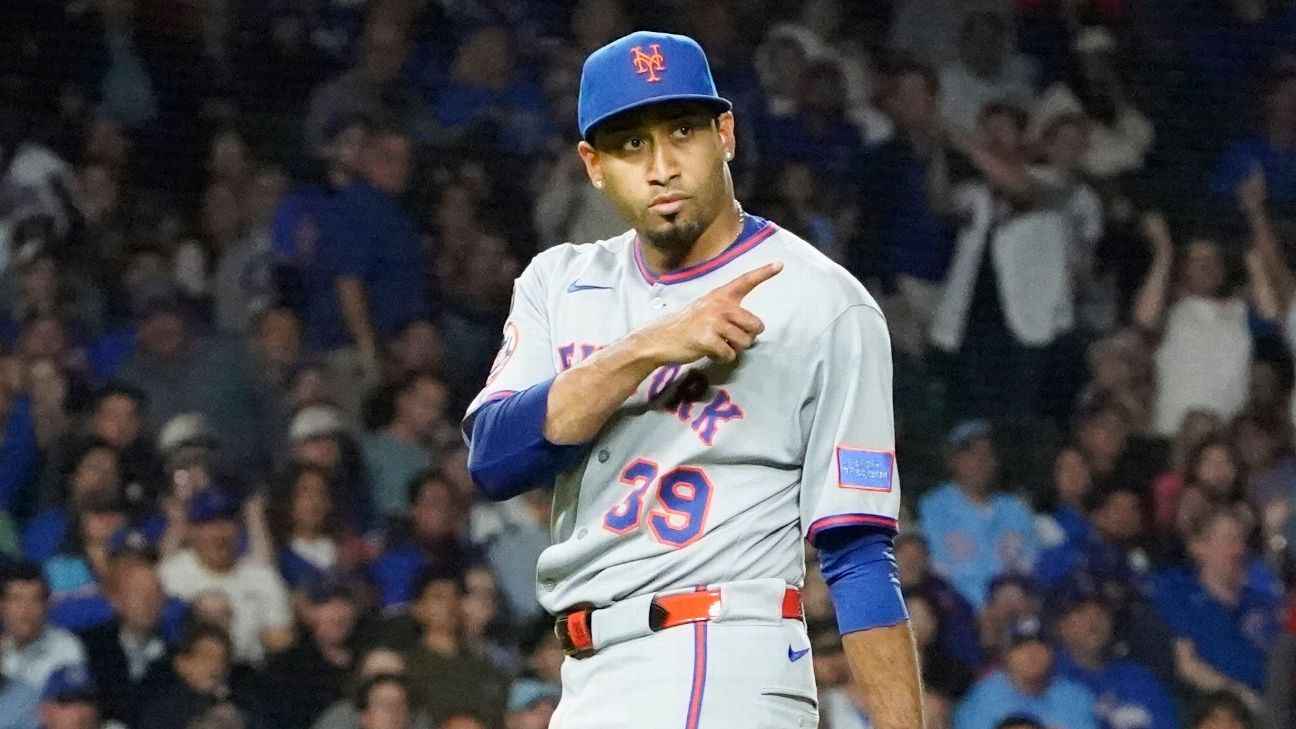
The MLB winter meetings are underway in Orlando, Florida, with the baseball industry gathering for an action-packed week of rumors, signings and trades — including big splashes by top NL powerhouses with the Philadelphia Phillies bringing back Kyle Schwarber and the Los Angeles Dodgers adding top closer Edwin Diaz.
We’ve got it all covered for you, from our predictions going into the meetings to the latest updates and analysis as the moves go down.
Which big free agents will pick a team? Who will be mentioned in blockbuster trade discussion? And what rumors will rule the week? Check out our predictions and refresh often for the latest intel and reaction as the week unfolds.
Key links: Olney, Passan: Latest intel | Every team’s plan | FA tracker | Grades
Winter meetings news and rumors
Dec. 9 buzz
Why Marlins, Orioles could be a trade match
The Marlins are active in trade talks with multiple teams for Edward Cabrera, a 27-year-old right-hander who has been considered the most likely among their controllable starters to be moved, a source familiar with the situation said. At this point, the Orioles are the most advanced in those talks, as first reported by The Athletic. If completed, it’s an ideal fit. The Orioles are in need of a top-of-the-rotation starter and the Marlins are seeking controllable offensive pieces. — Alden Gonzalez
Will Dodgers make another free agency splash for a star outfielder?
Now that the Dodgers have solved their glaring ninth-inning problem, agreeing to a three-year, $69 million contract with Edwin Diaz, they can shift their focus to adding an outfielder. And until he comes off the board, they’ll continue to be linked to top free agent Kyle Tucker.
The Dodgers aren’t expected to get into the $400 million range on a long-term deal, but like with Diaz, they’ll remain on the periphery in case a short-term, high-AAV deal makes sense. That might not be the case for Tucker, who’s 28 and widely considered the best free agent available. Another option is Cody Bellinger, though it remains to be seen whether both sides are truly interested in a reunion. Of note: Both of those players are attached to a qualifying offer, as was Diaz.
Asked Tuesday night if he could see himself making another big free agent signing, Dodgers president of baseball operations Andrew Friedman said: “I would say we definitely can. Whether that makes the most sense within the timing of our roster — there’s so many factors that go into it, and any decision you make has a future cost. … So, yes we can. How likely it is is probably another question.” — Gonzalez
Why extensions could be coming for A’s core hitters
The Athletics still need to build out some depths in their starting pitching as they aim to become sustainable contenders in the leadup to their move to Las Vegas, but there’s little doubt they’ve built a formidable core of position players — and part of the focus this offseason, in addition to adding reliable arms throughout their pitching staff, is keeping that core intact.
The A’s extended Brent Rooker and Lawrence Butler last offseason, and now they’d love to find a way to lock up the likes of Nick Kurtz, Jacob Wilson and Shea Langeliers.
“There’s a big effort there to keep this group together,” A’s manager Mark Kotsay said. “If we look at the group prior to this, that you could identify as a group that you would have wanted to move forward with, a group that came together in ’17 and ’18 and ’19 — the resources weren’t there to afford to keep that group together. I think there’s a vision and a future here going forward with this group that we were able to at least get those opportunities out in front of these players.” — Gonzalez
Will D-backs get enough to move Marte?
All-Star second baseman Ketel Marte continues to be the talk of this year’s winter meetings, but the Arizona Diamondbacks are asking a high return at the moment, sources familiar with the market told ESPN, which falls in line with what general manager Mike Hazen has communicated publicly — that he’s not required to trade Marte, but he will surely consider the right deal.
The Seattle Mariners, Pittsburgh Pirates, Detroit Tigers, Boston Red Sox and Toronto Blue Jays are among those who have been linked to Marte, though others are surely involved. A lot of teams have shown interest, but talks have yet to get serious.
The D-backs would ideally land a higher-end starting pitcher in return — a major need with Zac Gallen and Merrill Kelly probably departing via free agency, and Corbin Burnes spending at least the majority of 2026 recovering from Tommy John surgery — and would require major league-ready talent as part of any package, a source said. Given that his 10-and-5 rights kick in in April, there is at least some urgency to trade him this offseason.
D-backs manager Torey Lovullo said he has been in touch with Marte over the offseason and that the mention of his name so aggressively in rumors “might have caught him by surprise a little bit.”
“But I think he gets it,” Lovullo added. “I told him just what I told you guys — teams are smart. They want really good players. He’s one of the best in the National League. I understand why teams are making phone calls on him. He gets that.” — Gonzalez
White Sox have high bar for dealing Robert
In his first 31 games after the All-Star break, Luis Robert Jr. demonstrated what kind of impact he could have, batting to a .298/.352/.456 slash line, clubbing five homers and stealing five bases. Throughout Robert’s career, the talk has been about his possible impact if he ever remained injury-free and in the lineup, and this was an example of that.
But then Robert got hurt, again, and the Chicago White Sox — with very little future payroll obligation — picked up his $20 million option for 2026, in the hope that he could hit that ceiling for an extended period. The White Sox don’t intend to trade Robert until some interested team is willing to pay for the value of what he could be at his best, rather than for a bargain price. Some teams have checked on Roberts’ availability, but to date, no team has met Chicago’s high bar for a trade return.
Short of that, the White Sox are likely to keep Robert into the ’26 season, and maybe beyond. The team holds another $20 million option for the ’27 season, a year of club control that could make Robert look even more attractive in trade if the 28-year-old is able to stay on the field and generate the kind of high-end production the White Sox enjoyed last summer. — Buster Olney
Fairbanks drawing lots of interest
Pete Fairbanks is a very popular player this offseason. The right-handed reliever has received interest from several clubs, including the Marlins and Blue Jays, sources told ESPN. Fairbanks, 31, recorded a 2.83 ERA in 61 appearances for the Rays last season. He reached free agency after Tampa Bay, in a cost-cutting measure, did not pick up his $11 million option. His injury history could be a concern for teams, but he’s expected to land a two- or three-year deal. — Jorge Castillo
Three teams to watch in trade talks
Free agent splashes dominated the winter meetings spotlight Tuesday morning, but trade winds continue to swirl in Orlando. The Boston Red Sox, Chicago Cubs and San Diego Padres are all coming up often as teams that could make a deal soon. — Jesse Rogers
Could the Blue Jays make another splash?
The reigning AL champions are still looking to spend after a strong start to the offseason and could leave the winter meetings with a new closer. Pete Fairbanks and Robert Suarez are two names to watch in Toronto’s reliever search — Rogers
Don’t expect a Valdez deal soon
The top closer and one of the top hitters in this free agent class agreed to deals Tuesday, but don’t expect to see the best available starting pitcher come off the board next. The market for right-hander Framber Valdez is still developing and he won’t be signing with a team for a while. — Rogers
Diaz’s deal with Dodgers spices up meetings
Moments after news broke of Kyle Schwarber‘s return to the Phillies, the Los Angeles Dodgers made a major move of their own in signing top free agent closer Edwin Diaz. According to ESPN’s Jeff Passan, the deal is for three years and $69 million — which sets an AAV record for relievers.
The Dodgers had a clear need in the ninth going into the offseason, no matter how much they hyped up their depth publicly. But many doubted they’d go long term for the top guy in Diaz. A shorter, higher-AAV deal falls right in line with their preference. — Gonzalez
Will Schwarber’s return to Phillies heat up winter meetings?
Slugger Kyle Schwarber and the Philadelphia Phillies are in agreement on a five-year, $150 million contract, sources told ESPN. Schwarber’s return to Philly takes one of the most coveted free agents of this winter off the board and could be the move that sparks a run of action as the winter meetings roll on.
Dec. 8 buzz
Dodgers eyeing trades — but say Teoscar Hernandez won’t be dealt
The Los Angeles Dodgers aren’t expected to make major free agent moves this winter — at least not to the extent of the past two offseasons — and they’re certainly talking like a team content with where things stand.
Dodgers general manager Brandon Gomes said Monday that “there’s not as many clear paths to make the team meaningfully better.”
Earlier, Dodgers manager Dave Roberts — acknowledging the team’s philosophy last year, that injecting new blood into the roster might be a good way to maintain an edge — said, “There’s really no big splash we feel needs to be made, because this team is still focused, and there’s some talk about a three-peat.”
Still, sources have said, the Dodgers will continue to look for ways to upgrade their outfield and fortify the back end of their bullpen, with the trade market the ideal path. A center fielder would be ideal for the Dodgers because of how it would fortify the entire outfield’s defense, prompting Andy Pages and his plus arm to move to right field while Teoscar Hernandez and his shoddy defense transition to left.
But Gomes praised Pages’ center-field defense, adding that it allows the team the flexibility to pursue any outfielder. Gomes also shot down rumors of Hernandez potentially being traded.
“That doesn’t feel likely,” Gomes said. “Obviously, you can never say never on those types of things, but Teo, I know that’s come up. That’s not something we anticipate at all.” — Gonzalez

Teams checking in on former All-Star Willi Castro
The Atlanta Braves, Pittsburgh Pirates and Colorado Rockies are among the teams interested in signing utility man Willi Castro, sources told ESPN. Castro, 28, was an All-Star in 2024 after a strong first half with the Minnesota Twins, but he regressed through the second half and into the 2025 season.
The switch-hitter slashed .245/.335/.407 with the Twins in 2025 before he was sent to the Chicago Cubs at the trade deadline. He struggled in Chicago, batting just .170 with one home run and a .485 OPS in 34 games and did not have a plate appearance in the postseason.
Advanced metrics indicate Castro also regressed defensively in 2025, dropping from 0 to minus-9 outs above average, but he’s a versatile defender who played second base, third base, shortstop and all three outfield spots. — Castillo
Padres keeping trio in bullpen, need starting pitchers
In his winter meetings availability, San Diego Padres manager Craig Stammen said the team will keep Mason Miller, Adrian Morejon and David Morgan in the bullpen rather than converting them to starters.
“It’s a risky proposition health-wise and performance-wise,” Stammen said.
So, the Padres are very much in the market for starters. — Gonzalez
What will Tigers do with Skubal?
The Detroit Tigers continue to have trade dialogue with other teams about two-time American League Cy Young winner Tarik Skubal. At its heart, Detroit’s choice about whether to swap Skubal now — before he reaches free agency next fall — comes down to this question: Will owner Chris Ilitch and the team’s front office place more on the opportunity to win in 2026, or will they place a greater value on the extraordinary collection of young players they would presumably acquire in a Skubal deal?
What complicates this decision is that the Tigers reside in the highly winnable AL Central. The theoretical path to the World Series is probably easier than it would be to come out of the AL East, with all of its financial monsters, or the AL West, where the Mariners are poised to be a formidable force for years to come. Despite a late-season collapse, the Tigers were still just a run away from playing for the AL championship two months ago.
If the Tigers decide to keep Skubal, they will have to be at peace with the reality that they’ll recoup just a fraction of Skubal’s current value when and if he departs as a free agent — through draft pick compensation. This is the part of the market equation that has compelled the Guardians to flip the likes of CC Sabathia, Cliff Lee or Francisco Lindor in past trades, and why the Brewers dealt Corbin Burnes before the 2024 season. — Olney
Which Marlins starting pitcher will be traded?
Sandy Alcantara is a long shot to be traded at this point, as is teammate Eury Perez, the 22-year-old right-hander whom Miami Marlins would love to sign to an extension. The most likely Marlins starter to get traded, a source familiar with the team’s thinking said, is Edward Cabrera, who is out of options and would be controllable for three years.
Cabrera, 27, posted a 3.53 ERA with 150 strikeouts and 48 walks in 137⅔ innings in 2025. The Marlins would love to use Cabrera — and potentially fellow starter Ryan Weathers, who is coming off an injury plagued season — to address their offensive needs, primarily at first base.
Cabrera, though, is among a deep crop of available starting pitchers this offseason, alongside the likes of Freddy Peralta, Kris Bubic, Mitch Keller, Joe Ryan, Hunter Greene and, most notably, Tarik Skubal. Peralta, Ryan, Greene and Skubal will most likely stay put, but they are nonetheless in trade talks. — Gonzalez
How far will the Phillies go to keep Schwarber?
A lot of the industry is waiting on Kyle Schwarber‘s free agent decision. He has both big and small market teams chasing him but most important will be what he hears from the Philadelphia Phillies, and that can come as soon as Monday or Tuesday. Will they match any offer? Will Schwarber take a little less to stay in Philadelphia? Those questions should be answered soon. — Rogers
King’s suitors starting to take shape
Free agent pitcher Michael King has a half dozen suitors, including the New York Yankees, Boston Red Sox, New York Mets and Chicago Cubs, but his market hasn’t completely materialized yet. — Rogers
Polanco could make a decision soon
Free agent second baseman Jorge Polanco, coming off a strong 2025 season with the Seattle Mariners, is expected to sign with a team during the winter meetings. — Rogers
Winter meetings predictions
Who will be the biggest name to sign (or get traded) in Orlando?
Jorge Castillo: I root for action at the winter meetings, so let’s pick the biggest name on the free agent market: Kyle Tucker. There aren’t many suitors that, whether it’s for fit or financial reasons, are in the mix, but there’s still interest for an ultra-talented player who can alter the championship landscape. And it starts with Toronto.
The Blue Jays whiffed on the brightest stars of the past two free agent classes — Shohei Ohtani and Juan Soto — and Rogers Communications still has money to spend after investing $500 million in Vladimir Guerrero Jr. in April and another $210 million recently in free agent starter Dylan Cease. Tucker visited the Blue Jays’ facility in Florida last week. Pairing the left-handed-hitting outfielder with the right-handed-hitting Guerrero would give Toronto a scary tandem for years.
Bradford Doolittle: The inclusion of Byron Buxton on our trade candidates ranking took me aback, mostly because Buxton has been insistent that he will remain a Twin. It’s surprising that he’s willing to waive his no-trade clause, but Buxton is 31, and the Twins don’t seem all-in on winning. Several leading contenders could use a bump in center field — the Houston Astros and New York Mets jump out as clear fits — and if the Twins are heading down this road, dealing Buxton soon would start those dominoes to fall.
Alden Gonzalez: A game of chicken might be brewing at the moment. On one side it’s Cody Bellinger, represented by the Boras Corporation. On the other it’s Tucker, whose free agency is overseen by Excel Sports Management. They’re arguably the two biggest names available, both of them versatile, multi-dimensional, dynamic outfielders, their markets naturally intertwined. And I think Bellinger goes first.
His price point — ESPN’s Kiley McDaniel predicts a six-year, $165 million contract — is more reasonable, and his list of suitors is seemingly more robust because of it. The New York Yankees want him back. The Los Angeles Dodgers, Toronto Blue Jays and New York Mets are all a fit, to varying degrees. Given Bellinger’s ability to also play first base, other teams will undoubtedly emerge. Jumping on Bellinger before Tucker comes off the board and further inflates his market would be smart. And one team will do so this week.
Jesse Rogers: Ranger Suarez. Scott Boras clients usually take longer to come off the board, but not all of them can wait until the new year. Suarez isn’t staring at a megadeal, so checking him off the free agent list by late next week seems more than plausible.
The chatter surrounding the left-hander’s free agency from potential suitors such as the Astros, Mets, Orioles and others is picking up. He’s in line for at least a solid four-year deal — and if a team offers five or even six, it’ll likely land him.
What is one move fans might not expect you to predict will go down this week?
Castillo: Pete Alonso will probably wait until Kyle Schwarber decides on his destination, but I predict Alonso will sign with the Red Sox. Craig Breslow, Boston’s chief baseball officer, has been clear about his desire to acquire a right-handed slugger for the middle of the order. Not many players are better qualified for that role than the right-handed-hitting Alonso, whose 264 home runs since his debut in 2019 are the third most in baseball behind Aaron Judge and Schwarber.
Alonso is coming off a rebound All-Star season in which he clubbed 38 home runs with 126 RBIs, an NL-leading 41 doubles and an .871 OPS for the Mets. Defensively, Alonso is below average, but he could split time with Triston Casas at first base and designated hitter.
The Mets, on the other hand, are determined to improve their defense and would seemingly be in play for Alonso only if his market collapses for the second straight offseason.
Doolittle: Maybe it’s because I am overly susceptible to rumors that tickle my penchant for anti-Wolfean narratives, but I’ll say Schwarber will sign with his hometown Cincinnati Reds. It’s such a perfect fit, and not just because of Schwarber’s ties to Cincinnati. The Reds have a real chance to contend in the NL Central with the right upgrade on offense. And what an upgrade — Schwarber’s swing is perfect for Great American Ballpark, which has featured more homers from visiting lefty hitters over the past five years than any other venue (including 96 more than Citizens Bank Park). Even at 32, give Schwarber five healthy seasons at that park and he’ll reach 500 career bombs.
Gonzalez: This year’s market seems especially ripe for trades, and I think we’re going to see some big-name starting pitchers dealt during the winter meetings. Who, exactly, is anybody’s guess at this point, but there are a bevy of names to choose from, whether it’s two of the Miami Marlins‘ frontline guys (Sandy Alcantara and Edward Cabrera), three steady veterans (Freddy Peralta, Luis Castillo and Pablo Lopez), two budding aces (Joe Ryan and MacKenzie Gore) or two Cy Young-caliber arms who are unlikely to move but are fascinating nonetheless (Tarik Skubal and Hunter Greene). All eyes will be on the big free agents this week, but the trade market will dominate. And the starting pitchers will be featured in it.
Rogers: How about a bold one: Nick Castellanos gets traded. Perhaps it won’t land as the biggest of surprises, considering how things went down in Philadelphia last year, but a deal would further show that the Phillies are turning things over a bit as they continue to chase a ring.
Castellanos could be the perfect fit for Pittsburgh, which is desperate for hitting. In a recent interview on MLB Network, Castellanos discussed the idea of playing first base. That opens the door to even more possibilities outside of Philadelphia.
What is the one rumor that will dominate the week?
Castillo: Arizona Diamondbacks second baseman Ketel Marte, if moved, would be the best position player to move this offseason — Tucker and Schwarber included. So the fact that he is available will undoubtedly generate rumors all week.
First, Marte produces. His 15.3 WAR over the past three seasons is 13th in the majors. He has made the NL All-Star team each of the past two seasons. He finished third in the NL MVP race in 2024. He owns a .289/.363/.510 slash line since 2019. Second, his economical contract — he has five years and $91 million plus a sixth-year player option at $11.5 million remaining — only adds to the allure and makes him palpable for several clubs. Marte is 32 and drew anonymous criticism from teammates for his behavior last season, but a player of his caliber will draw substantial interest.
Doolittle: Something about Tucker? It doesn’t feel like there have been many concrete reports regarding Tucker’s possible destination, but he’s the top free agent, so the rumor mill is more likely to focus on his wanderings than anyone else until he signs. News about him will pick up in Orlando.
Gonzalez: There is no bigger name on the trade market than Skubal. On one end, he is beloved in Detroit, where he has established himself as the type of cornerstone who should never pitch anywhere else. On the other is the cold reality — that he is a Boras client who would command the types of sums in the open market that the Tigers are either unwilling or unable to pay him. And though the Tigers intend to contend in 2026 and would undoubtedly have a better chance of doing so with Skubal fronting their rotation, it would be foolish not to at least explore a trade and attempt to get major talent back in return. It’s the responsible thing to do — and yet Tigers fans have every right to be enraged about this even being a possibility.
Rogers: Where Kyle Schwarber will play in 2026 and beyond. His next contract should be in the $150 million range, though if a new team steps up and is willing to pay big time for not only his power but his leadership, then all bets are off. But as intriguing as a smaller market might be, the Phillies need him as much as anyone during their current window to win. His return there isn’t a guarantee, but it still makes the most sense.
-
 Sports2 years ago
Story injured on diving stop, exits Red Sox game
-
 Sports3 years ago
‘Storybook stuff’: Inside the night Bryce Harper sent the Phillies to the World Series
-
 Sports2 years ago
Game 1 of WS least-watched in recorded history
-
 Sports3 years ago
Button battles heat exhaustion in NASCAR debut
-
 Sports3 years ago
MLB Rank 2023: Ranking baseball’s top 100 players
-
Sports4 years ago
Team Europe easily wins 4th straight Laver Cup
-
 Environment3 years ago
Japan and South Korea have a lot at stake in a free and open South China Sea
-
 Environment1 year ago
Here are the best electric bikes you can buy at every price level in October 2024