
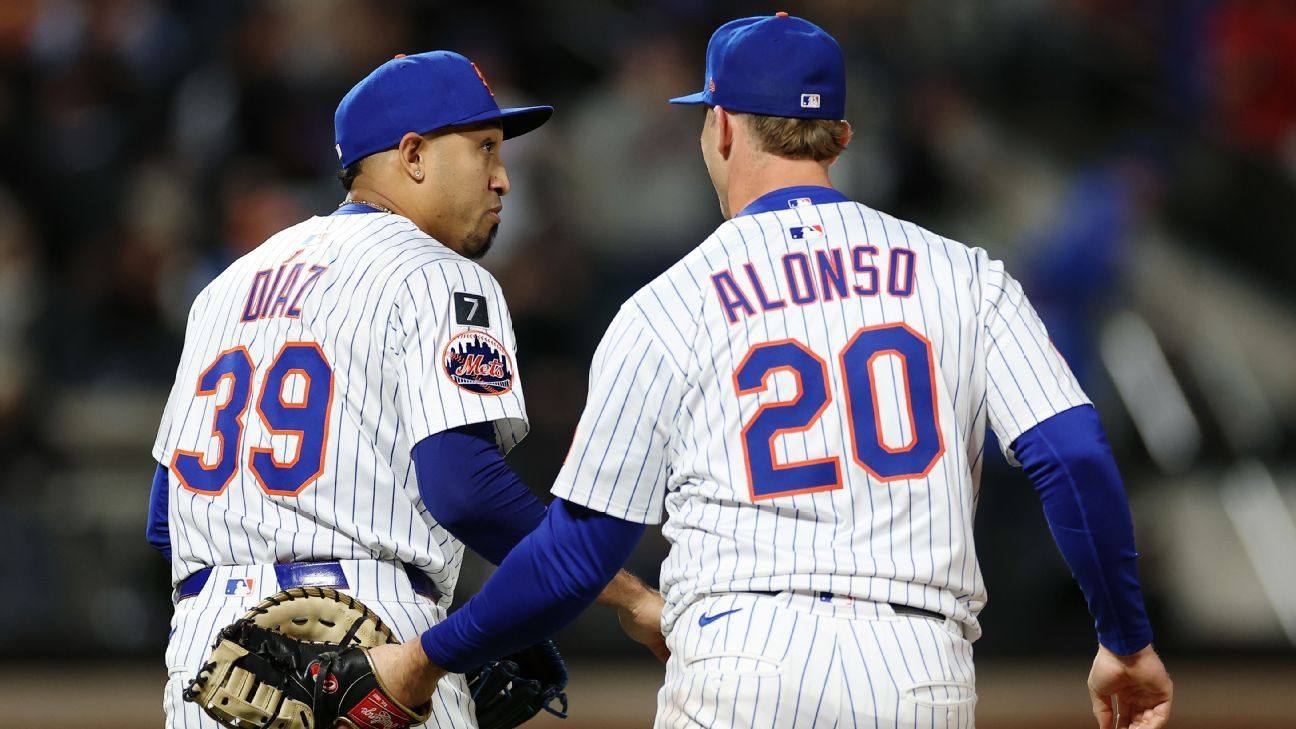
Panic or patience? Debating how concerned Mets should be after departures of Alonso, Diaz

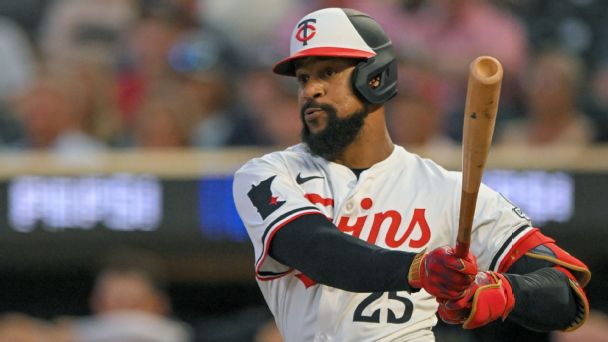
A day after seeing closer Edwin Diaz leave to sign with the Los Angeles Dodgers, the New York Mets watched another longtime star depart via free agency when franchise home run leader Pete Alonso joined the Baltimore Orioles on a five-year deal.
While Mets fans wrap their heads around knowing their roster will look very different going into the 2026 season, we asked our MLB experts to sort out how concerned the Mets should be, what moves New York can make to rebound from its offseason rough stretch and just how stacked the addition of Alonso makes his new team’s lineup.
How concerned are you about the Mets losing two All-Stars to free agency this week?
Jorge Castillo: Not too concerned just yet. There’s a lot of winter left, and the Mets are going to make moves. They have the money and the prospects to add elite talent. It’s clear that Stearns believes the Mets’ core wasn’t good enough after such a disappointing season. Losing Díaz and Alonso — on top of trading Brandon Nimmo — is certainly tough to swallow for Mets fans because those three players were so beloved. The Mets aren’t going to stand pat.
Bradford Doolittle: The Diaz departure concerns me more than the Alonso exit simply because it’s more difficult to secure a difference-making reliever than a run-producing first baseman, and the contract Diaz signed should have been easy for New York to match or beat. When you are an elite revenue team and you don’t retain stars you want to retain, there’s a snag in the hose somewhere along the line.
Kiley McDaniel: My concern level is now elevated because the way the Mets lost these players by chasing value rather than the player and not being aggressive enough, even when they knew everything there was to know about both Alonso and Diaz. This suggests they’re going to have trouble replacing these two slots on the roster.
I don’t think David Stearns wants to trade for two stars by clearing out the strength of the org (upper-minors prospect depth) to get some players with a few years left that are cost controlled. It’s starting to smell like one- and two-year free agent deals might be how they plug these holes, and that might or might not work, but we can be sure Mets fans will hate this winter if that’s the outcome.
Jesse Rogers: Depends how you feel about recently signed Devin Williams as well as the possibilities for the rest of the Mets’ offseason. In other words, panic should not be setting in just yet, as there is plenty of time (and presumably money) to overcome the losses. The Mets believe that Williams can replace Diaz to a certain extent but probably aren’t done reloading on the back end.
Now they have to replace some of what Alonso brought to the table. They could do that in myriad ways, pivoting to Alex Bregman, Kyle Tucker or even Cody Bellinger. Stealing Bellinger away from the Yankees one year after doing the same with Juan Soto could be a good plan for first base. Either way, they can replace the two All-Stars with two (or more) newcomers with similar talents. Williams is a decent start.
Buster Olney: Not yet, because these seem to be part of a larger series of decisions. It has been clear for two years that the Stearns-led Mets have been reluctant to give Alonso big dollars, and now he’s gone. They signed Devin Williams as a hedge against the possibility that Edwin Diaz could walk away — in fact, Williams told reporters that the only role discussed with the Mets was that of closer — and now Diaz is out the door. But whatever happens next, Stearns has to be right. In fact, of all people in baseball — player or executive — there’s more pressure on Stearns than anyone. That’s because he made the choice to move on from three fan favorites in Brandon Nimmo, Diaz and Alonso, and whatever happens the rest of the winter will be on Stearns.
Coming off their epic 2025 regular-season collapse, is it time for David Stearns to get more aggressive in free agency and trades?
Castillo: Yes. Steve Cohen has the money to bully other teams, and Stearns has built a strong farm system that could be used for substantial trades. That should give the Mets the leeway to be more aggressive because they have the resources to overcome mistakes. Signing Juan Soto to that record-setting deal last winter was an example of the Mets’ spending power. Maybe we’ll see another example this winter — whether it’s spending in free agency or in the trade market.
Doolittle: You don’t want to panic. The Mets do have young talent that deserves some runway, and you don’t want to block too many opportunities. But losing Alonso means there is a need for certainty in the middle-of-the-order/run production department. So an aggressive push for Kyle Tucker or Cody Bellinger would be well timed.
McDaniel: Yes. The Mets have two really notable things they can flex with: tons of money and a strong group of young players in the big leagues and upper minors. When you have (understandably) impatient fans and a 2025 collapse to consider, you must win in 2026. Responding by taking half-measures, keeping all the young players and trying not to block them, then also not being aggressive in nine-figure free agency, is operating like the Brewers. You don’t have to do that, and you shouldn’t be doing that with the Mets’ resources.
Rogers: No. Aggressive is the wrong word. Smarter might fit better. He needs a well-rounded team with the right mix in the clubhouse. That doesn’t necessarily mean overspending or doing what looks popular on paper or to the fan base — though Stearns acknowledged how fans feel about players is part of the calculus, just not the most important part. The two players the Mets lost were part of the collapse last season, so a change in the room might not be a bad thing. The last time the Mets were that aggressive, they ended up with Max Scherzer and Justin Verlander. How’d that work out?
Olney: Given the lack of depth in the free agent class, it’s hard to imagine him relying on only that route to improve the team. If he signs Cody Bellinger, that doesn’t fix his problems; if he trades for Mackenzie Gore, he’ll need more. He’ll have to get aggressive on both fronts and make uncomfortable deals — like signing Ranger Suarez, who seems like a great fit for the New York market given his experience in Philadelphia.
What is the next move you would make from here to turn the Mets’ winter around?
Castillo: Two moves come to mind: Signing Bellinger and acquiring an elite starting pitcher. Bellinger’s defensive versatility — he can play all three outfield spots and first base — is perfect for the Mets considering they traded their left fielder, watched their first baseman leave in free agency, could use an upgrade in center, and have a right fielder who was well below average defensively last season. Adding a front-line starter — whether in free agency or via the trade market — has been a pressing need all along.
Doolittle: Sign Tucker. Easy-peasy.
McDaniel: I think Bregman is the best bet among the nine-figure hitters, but the Mets’ infield is pretty full right now while the outfield is begging for impact beyond Juan Soto. You can package together a few of the higher-end prospects in the system and trade for Jarren Duran or bite the bullet and pay Bellinger as a free agent, but I think the next move needs to be in the outfield. Duran, 29, comes with three years of control, so I think Stearns would greatly prefer that option if he can agree to a reasonable prospect haul with Boston.
Rogers: Sign Bregman. Put a winner in the clubhouse who can hit some home runs to make up for the loss of Alonso. Instantly, the vibe in the room will change and perhaps their fortunes on the field will as well. It worked in Boston, and he didn’t even play a full season due to injury.
Olney: I think he needs to load up and make a deal for Tarik Skubal. The Mets are better suited than any other team to get this done, because they have an abundance of resources in prospects. Tell the Tigers: We won’t discuss Nolan McLean, but everyone else is up for discussion in some package. Trade for Skubal, sign Suarez, and all of a sudden the run prevention plan will look very different.
How good is Baltimore’s lineup with Pete Alonso at the center of it?
Castillo: You could easily argue it’s the best lineup in the American League. Gunnar Henderson and Alonso alone give the Orioles one of the top one-two punches in baseball. But they’re deep, too, with a mix of young and veteran talent with Taylor Ward, Jordan Westburg, Adley Rutschman, Dylan Beavers, Colton Cowser, Samuel Basallo, Ryan Mountcastle and Tyler O’Neill on the roster. And that doesn’t include Coby Mayo, Heston Kjerstad and Enrique Bradfield Jr. — highly regarded young position players who the Orioles could move to address the starting rotation.
Doolittle: Better. But let’s not get carried away. A middling-OBP/ high-slugging first baseman is an upgrade for sure given how little production the Orioles got from the position last season. But a player like that has the most utility in a lineup with a strong overall on-base profile. The Orioles have some work to do in that regard. Get the team OBP projection into the top 10 and then the Orioles will be getting somewhere.
McDaniel: I think the Dodgers still have the best lineup in the sport, but the Orioles are now second best in my book. They also have some upward mobility with rookies Dylan Beavers and Samuel Basallo in the lineup and Ryan Mountcastle and Tyler O’Neill in platoon roles, giving them both a high floor and a chance to get to a higher ceiling if everything click for the young hitters.
Rogers: It’s among the best in baseball, but that assumes bounce-back seasons for several players including Gunnar Henderson and Adley Rutschman. A full year of Samuel Basallo combined with Alonso and peak versions of Henderson/Rutschman sounds very dangerous. And that’s just the tip of the iceberg. The Orioles could be both star-laden and deep, but they need some rebound years to make it happen.
Olney: On a macro level, this signing seems weird. The Orioles tanked four seasons and picked so many position players at the top of the draft, and now, when they finally make a big expenditure at a time when their organizational pitching is thin, they spend $155 million on a first baseman/DH? Weird. But Baltimore will be entertaining with this lineup, assuming that its young players bounce back from rough 2025 seasons. If this group hits, it should be a fun lineup to watch. At some point, however, the Orioles do need to figure out how to develop pitching, which must be the lifeblood of a small spender in the AL East.

-
Greg Wyshynski
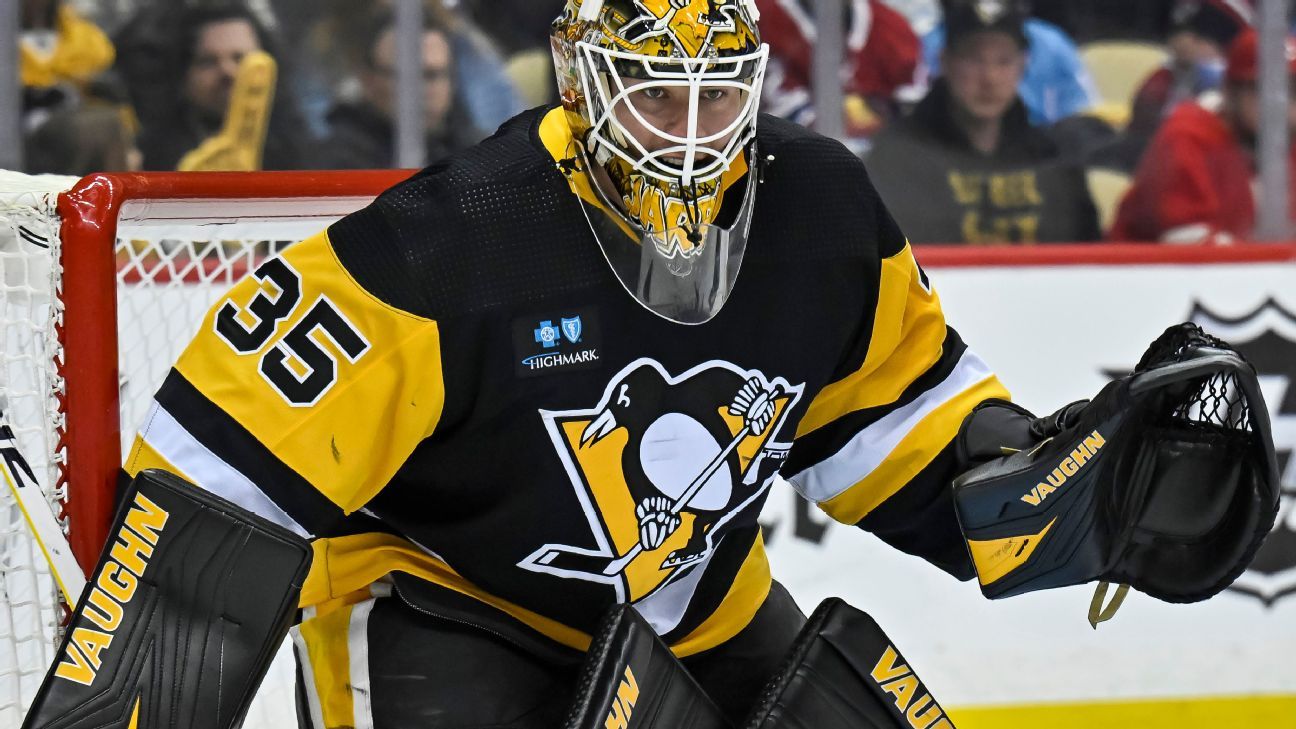
The Edmonton Oilers finally addressed their multiple-season problem in goal by acquiring Pittsburgh Penguins netminder Tristan Jarry on Friday.
The Oilers sent goalie Stuart Skinner, defenseman Brett Kulak and a 2029 second-round pick to Pittsburgh for Jarry and forward Sam Poulin.
Edmonton also made another trade Friday, sending a 2027 third-round pick to the Nashville Predators for defenseman Spencer Stastney.
Jarry, 30, is in his 10th NHL season, all with the Penguins. He had helped Pittsburgh to a surprising start that put it in a playoff seed through Thursday’s games. He was 9-3-1 in 14 games with Pittsburgh this season with a .909 save percentage and a 2.66 goals-against average with one shutout. MoneyPuck had him at 9.8 goals saved above expected.
Edmonton has the second-worst team save percentage in the NHL this season (.873). The Oilers have appeared in back-to-back Stanley Cup Finals, losing both times to the Florida Panthers. Each run has been plagued by goaltending inconsistency, with Skinner and backup Calvin Pickard unable to provide championship-caliber stability. The Oilers would have preferred adding a veteran goalie to a tandem with Skinner, but that would have been a challenge under the salary cap.
Jarry is signed through the 2027-28 season with a $5.375 million cap hit.
Skinner is signed through this season, and his contract carries an average annual value of $2.6 million. Kulak is also signed through 2025-26, and his contract carries an average annual value of $2.75 million. Both are set to be unrestricted free agents next summer.


-
Sean Allen
Close
Sean Allen
Special to ESPN.com
- Sean Allen is a contributing writer for fantasy hockey and betting at ESPN. He was the 2008 and 2009 FSWA Hockey Writer of the Year.
-
Victoria Matiash
Close
Victoria Matiash
Special to ESPN.com
- Victoria Matiash is a contributing writer for fantasy hockey and betting at ESPN. Victoria has been a part of the fantasy team since 2010.
Another week of the 2025-26 NHL season, another week on top of the ESPN NHL Power Rankings for the Colorado Avalanche. However, unlike in weeks past, the Avs were not a unanimous selection at No. 1 in our poll.
Beyond No. 1, the Washington Capitals, Philadelphia Flyers and Toronto Maple Leafs rose in the rankings, while the Minnesota Wild, New Jersey Devils and Ottawa Senators took a tumble from last week.
Plus, along with the new set of rankings, we’ve tapped ESPN fantasy hockey analysts Sean Allen (Eastern Conference) and Victoria Matiash (Western Conference) to advise managers on whether to keep or drop one specific player on each club. And a reminder: It’s not too late to join ESPN Fantasy Hockey, with new leagues starting every Monday.
How we rank: A panel of ESPN hockey commentators, analysts, reporters and editors sends in a 1-32 poll based on the games through Wednesday.
Note: Previous ranking for each team refers to the previous edition, published Dec. 5. Points percentages are through Thursday’s games.


Previous ranking: 1
Points percentage: 82.3%
Valeri Nichushkin, RW (rostered in 30.2% of ESPN leagues): When healthy — as he is again after losing eight games to a lower-body injury — the Avalanche forward serves as a formidable, well-rounded fantasy producer. Savvier managers know how to settle into the cycle of getting the most out of Nichushkin when fit, then tucking him on IR when not. Wash, rinse, repeat. Patience.
Next seven days: vs. NSH (Dec. 13), @ SEA (Dec. 16)

Previous ranking: 2
Points percentage: 73.4%
Matt Duchene, C/LW (rostered in 36.7%): Let’s give him a minute. After losing 24 contests to a concussion, the veteran forward is still getting back up to speed. But it shouldn’t be long before Duchene starts contributing nearer last year’s pace, which netted 30 goals and 82 points. With Tyler Seguin out for the year, the Stars are certainly hoping for as much. Patience.
Next seven days: vs. FLA (Dec. 13), vs. LA (Dec. 15), @ SJ (Dec. 18)

Previous ranking: 6
Points percentage: 64.5%
Dylan Strome, C (rostered in 77.8%): Alex Ovechkin is hitting his midseason stride, and Strome moves with him. Over 80% of Ovechkin’s even-strength minutes come alongside his buddy, giving Strome a steady pipeline to production. Hang tight and the results should follow. Patience.
Next seven days: @ WPG (Dec. 13), @ MIN (Dec. 16), vs. TOR (Dec. 18)

Previous ranking: 7
Points percentage: 62.9%
Frank Vatrano, RW/LW (rostered in 51.6%): This isn’t the 2023-24 Ducks, with whom Vatrano scored an unprecedented 37 goals on 272 shots. Now settled into the bottom six, the winger is only three goals to the good (one assist) and skating fewer than 13 minutes per game. Panic
Next seven days: @ NJ (Dec. 13), @ NYR (Dec. 15), @ CBJ (Dec. 16)

Previous ranking: 3
Points percentage: 66.7%
Andrei Svechnikov, LW (rostered in 58.9%): His shooting percentage is down, but bad luck doesn’t explain why he’s averaging just 16:30 per game. Still, he’s riding with one of the league’s stronger lines (64.8% shot attempt share) and four of his seven goals have come on the power play. Patience, but it’s thinning.
Next seven days: @ PHI (Dec. 13), vs. PHI (Dec. 14), @ NSH (Dec. 17)
0:49
Andrei Svechnikov nets power-play goal
Andrei Svechnikov capitalizes on the power play

Previous ranking: 8
Points percentage: 65%
Noah Hanifin, D (rostered in 49.7): Despite a quiet start to 2025-26 — losing October to injury didn’t help — Hanifin’s fantasy résumé is too respectable to ignore in deeper competition. This is a 40-point player with Vegas who has only six to show for his first 19 games. Fortunately, logging hefty minutes at even-strength and on the power play, the defenseman already appears to be turning a productive corner. Patience.
Next seven days: @ CBJ (Dec. 13), vs. NJ (Dec. 17)

Previous ranking: 4
Points percentage: 61.3%
Brayden Point, C (rostered in 85.5%): Based on his career body of work, Point deserves more time. The Lightning will keep giving him chances to lift his current 1.12 FPPG back toward the 2.45 he has averaged over the past three seasons. Patience.
Next seven days: @ NYI (Dec. 13), vs. FLA (Dec. 15), vs. LA (Dec. 18)

Previous ranking: 5
Points percentage: 62.9%
Marco Rossi, C (rostered in 49.7%): The lingering injury is becoming a bigger bother as plans to have Rossi travel out west on a recent road trip were seemingly scuttled last minute. Reports that he doesn’t look altogether comfortable on the ice are equally disheartening. Outside of fantasy leagues that accommodate for an excess of IR spots, the young center has no role to play right now. Panic.
Next seven days: vs. OTT (Dec. 13), vs. BOS (Dec. 14), vs. WSH (Dec. 16), @ CBJ (Dec. 18)

Previous ranking: 12
Points percentage: 62.1%
Matvei Michkov, RW (rostered in 67.6%): The Flyers’ offense retooled around Trevor Zegras as its focal point. Michkov has only four power-play points and is fourth on his own team in shots on goal. He’ll come around as a fantasy star, but not yet. Panic.
Next seven days: vs. CAR (Dec. 13), @ CAR (Dec. 14), @ MTL (Dec. 16), @ BUF (Dec. 18)

Previous ranking: 10
Points percentage: 60.3%
Kris Letang, D (rostered in 81.1%): Even with Evgeni Malkin resurging and Sidney Crosby still strong, Letang isn’t the fantasy force his name implies. Erik Karlsson dominates the power play, limiting Letang’s minutes. He’s still effective as a quarterback, but the reduced ice time curbs his upside. Panic.
Next seven days: vs. SJ (Dec. 13), vs. UTA (Dec. 14), vs. EDM (Dec. 16), @ OTT (Dec. 18)
1:20
Kris Letang’s OT winner completes comeback for Penguins
Kris Letang slots in the winning goal to lift the Penguins to a 4-3 victory over the Blue Jackets in overtime.

Previous ranking: 13
Points percentage: 60.9%
Anders Lee, LW (rostered in 58.9%): Last season looked like the start of Lee’s decline as a fantasy player, and this year hasn’t changed the trajectory. Even with two injuries on the top power-play unit, the Isles still didn’t turn to him in recent games. That says plenty. Panic.
Next seven days: vs. TB (Dec. 13), @ DET (Dec. 16)

Previous ranking: 11
Points percentage: 60%
Quinton Byfield, C (rostered in 50.6%): The second-line center isn’t shooting on net habitually enough. So, no small wonder he isn’t scoring. Fantasy managers can be asked to invest in a player’s talent and potential for only so long. At some point, the hard numbers need to be there. Panic.
Next seven days: vs. CGY (Dec. 13), @ DAL (Dec. 15), @ FLA (Dec. 17), @ TB (Dec. 18)

Previous ranking: 17
Points percentage: 59.4%
Charlie McAvoy, D (rostered in 85.5%): Not ideal to be in this situation for a second straight season, but McAvoy’s on the mend after taking a puck to the face in November. The Bruins’ power play was elite with him and should pick up where it left off when he’s back. Patience.
Next seven days: @ MIN (Dec. 14), vs. UTA (Dec. 16), vs. EDM (Dec. 18)

Previous ranking: 16
Points percentage: 57.8%
Patrick Kane, RW (rostered in 50.6%): This comes down to expectations. If you’re not waiting for vintage Kane, there’s still solid value here on a strong Red Wings attack and power play. He’s trending up too, leading Detroit in shots on goal in recent weeks. Patience.
Next seven days: @ CHI (Dec. 13), vs. NYI (Dec. 16), vs. UTA (Dec. 17)

Previous ranking: 9
Points percentage: 56.5%
Dougie Hamilton, D (rostered in 74.2%): Luke Hughes was already a threat to take over the top power-play spot, and now Simon Nemec is rising. The advantage has always been Hamilton’s pathway to fantasy upside, so if he’s pushed aside, the ceiling drops fast. Panic.
Next seven days: vs. ANA (Dec. 13), vs. VAN (Dec. 14), @ VGK (Dec. 17)
0:18
Simon Nemec scores OT winner for Devils
Simon Nemec buries the game-winning goal in overtime to lift New Jersey to victory.

Previous ranking: 25
Points percentage: 55%
Anthony Stolarz/Joseph Woll, G (rostered in 52.9%/26.4%): The Leafs are the same team that made these goalies fantasy staples despite a strict timeshare last season. Injuries and missed time have defined the start, but both will eventually be healthy together. Expect a strong second half once they’re back in sync. Patience.
Next seven days: vs. EDM (Dec. 13), vs. CHI (Dec. 16), @ WSH (Dec. 18)

Previous ranking: 26
Points percentage: 53.3%
Sam Bennett, C (rostered in 60.3%): A slow start looked like a Conn Smythe hangover, but Bennett has snapped out of it. He’s been running at a point-per-game pace since mid-November and looks back on track. Patience.
Next seven days: @ DAL (Dec. 13), @ TB (Dec. 15), vs. LA (Dec. 17)

Previous ranking: 20
Points percentage: 53.1%
J.T. Miller, C (rostered in 88.4%): It’s tempting to stay calm after his strong post-trade run last year — 2.44 FPPG in 32 games — but his even-strength play has cratered. Across nine line combos he has logged 20-plus minutes with, the Rangers have been outscored 13-7 at 5-on-5. That’s a big red flag. Panic.
Next seven days: vs. MTL (Dec. 13), vs. ANA (Dec. 15), vs. VAN (Dec. 16), @ STL (Dec. 18)

Previous ranking: 15
Points percentage: 58.3%
Ivan Demidov, RW (rostered in 50.6%): Long-term patience is fine, but this season he doesn’t have the role to justify a roster spot. Zack Bolduc cuts into his power-play time, and injuries have left Montreal’s offense too top-heavy for Demidov to gain traction. Panic.
Next seven days: @ NYR (Dec. 13), vs. EDM (Dec. 14), vs. PHI (Dec. 16), vs. CHI (Dec. 18)

Previous ranking: 27
Points percentage: 54.8%
Darnell Nurse, D (rostered in 90.5%): A much bigger issue when the scoring isn’t there either, the Oilers defender isn’t blocking shots as frequently either. Heading into Thursday’s tilt against Detroit, Nurse has two goals and a single assist to show for 18 games. Far less popular in fantasy play, fellow defender Mattias Ekholm is providing much greater value. Panic.
Next seven days: @ TOR (Dec. 13), @ MTL (Dec. 14), @ PIT (Dec. 16), @ BOS (Dec. 18)
0:33
Darnell Nurse nets goal for Oilers
Darnell Nurse tallies goal vs. Capitals

Previous ranking: 22
Points percentage: 51.6%
Sean Monahan, C (rostered in 17.2%): Monahan opened strong as the No. 1 center with Kirill Marchenko, but that window closed fast once Adam Fantilli vaulted up the lineup. Nothing suggests Fantilli will give that spot back anytime soon, leaving Monahan anchored to the second line with limited upside. Panic.
Next seven days: vs. VGK (Dec. 13), vs. ANA (Dec. 16), vs. MIN (Dec. 18)

Previous ranking: 18
Points percentage: 48.4%
Nick Schmaltz, RW/C (rostered in 85.1%): Here we go. After a dismal stretch that ate up the second half of November, Schmaltz appears back in rhythm with a goal and three assists in five contests. Competing on a top line and power play with Clayton Keller, the streaky center tends to produce with gusto once back in groove. Patience.
Next seven days: vs. SEA (Dec. 12), @ PIT (Dec. 14), @ BOS (Dec. 16), @ DET (Dec. 17)

Previous ranking: 14
Points percentage: 53.3%
Linus Ullmark, G (rostered in 43.4%): Ullmark has been extreme, with seven games above 4.0 fantasy points, four below -6.0. He leads the league in blowups and power-play goals allowed, which may be connected. Still, a penalty-kill fix is doable, so there’s hope if you can hold on. Patience, for a little longer.
Next seven days: @ MIN (Dec. 13), @ WPG (Dec. 15), vs. PIT (Dec. 18)

Previous ranking: 21
Points percentage: 53.3%
Ryan Donato, RW (rostered in 25.7%): Averaging a sniff more than 13 minutes per game in December, the bottom-six skater has two goals (zero assists) in his past 14 contests. October’s exciting run of six goals in six matches feels like a long time ago now. Panic.
Next seven days: @ STL (Dec. 12), vs. DET (Dec. 13), @ TOR (Dec. 16), @ MTL (Dec. 18)

Previous ranking: 19
Points percentage: 53.6%
Joey Daccord, G (rostered in 73.3%): While Wednesday’s victory over the Kings was indeed impressive, one that hardly makes up for the negative fantasy integers accrued in Daccord’s previous four outings. Seattle’s No. 1 — a solid netminder when provided with proper support — should be jettisoned until the Kraken embark on another unexpected successful run, as is their routine. Panic.
Next seven days: @ UTA (Dec. 12), vs. BUF (Dec. 14), vs. COL (Dec. 16), @ CGY (Dec. 18)
0:27
Joey Daccord makes beautiful save
Joey Daccord makes beautiful save

Previous ranking: 23
Points percentage: 51.6%
Yaroslav Askarov, G (rostered in 30.8%): No question, there will continue to be bumps along the way for Askarov and the rest of Ryan Warsovky’s charges. But, led by their young Hart candidate up front, this Sharks squad is a team on the rise. After an ugly October, Askarov is 9-4-0, with a .930 SV% and 2.36 GAA through 13 contests. He boasts enduring value in deeper fantasy competition. Patience.
Next seven days: @ PIT (Dec. 13), vs. CGY (Dec. 16), vs. DAL (Dec. 18)

Previous ranking: 24
Points percentage: 48.3%
Neal Pionk, D (rostered in 63.6%): Outside of the Jets’ top line and defenseman Josh Morrissey, no one is scoring much at all in Winnipeg this season, including the club’s No. 2-ranked fantasy defender. And Pionk isn’t blocking enough shots to otherwise merit rostering. There are likely better blueline options available elsewhere. Panic.
Next seven days: vs. WSH (Dec. 13), vs. OTT (Dec. 15), @ STL (Dec. 17)

Previous ranking: 28
Points percentage: 48.4%
Rasmus Dahlin, D (rostered in 96.6%): He’s well off last season’s pace — and off his elite 2.52 FPPG from the prior three years — but the Sabres’ power play has more success with Josh Norris back. You were always giving Dahlin time anyway, so this is an easy call. Patience.
Next seven days: @ SEA (Dec. 14), vs. PHI (Dec. 18)

Previous ranking: 29
Points percentage: 45.3%
Jordan Kyrou, RW (rostered in 71.7%): Even before falling injured, the points weren’t adding up as usual. As Blues beat reporter Andy Strickland put it, while Kyrou had been playing reasonably well, he just wasn’t scoring. Which is more useful to a real-life hockey squad than one competing in the fantasy sphere. And now the winger is out week-to-week. Panic.
Next seven days: vs. CHI (Dec. 12), vs. NSH (Dec. 15), vs. WPG (Dec. 17), vs. NYR (Dec. 18)

Previous ranking: 32
Points percentage: 43.8%
Jonathan Huberdeau, LW (rostered in 43.3%): Admittedly, fantasy loyalty in this case is becoming more and more difficult to justify. But Huberdeau is still skating on Calgary’s top line and power play. Plus, he has found the back of the net twice in the past week. Just until the new year, maybe. Limited patience.
Next seven days: @ LA (Dec. 13), @ SJ (Dec. 16), vs. SEA (Dec. 18)

Previous ranking: 31
Points percentage: 46.7%
Jonathan Marchessault, RW (rostered in 53.4%): Enough is enough. Despite a mild uptick in offense of late, Marchessault is providing too little, too late into his disastrous tenure with the Predators. Now he isn’t even competing on a line with Filip Forsberg anymore. Fantasy managers can always give the veteran winger a fresh look if or when he’s traded elsewhere. Panic.
Next seven days: @ COL (Dec. 13), @ STL (Dec. 15), vs. CAR (Dec. 17)

Previous ranking: 30
Points percentage: 40.3%
Kiefer Sherwood, LW/RW (rostered in 78.3%): As anticipated, the goal-scoring has dried up. Rocking a highly unsustainable 31.6 S%, Sherwood scored 12 in his first 20 games, followed by zero in his subsequent 10 contests. Outside of fantasy leagues that reward hits at an ultra-premium, the physical forward is replaceable. Panic.
Next seven days: @ NJ (Dec. 14), @ NYR (Dec. 16)
1:34
Which teams are the best fit for Quinn Hughes?
Greg Wyshynski details all the teams that make sense in a potential trade for Canucks defenseman Quinn Hughes.

-
Alden Gonzalez
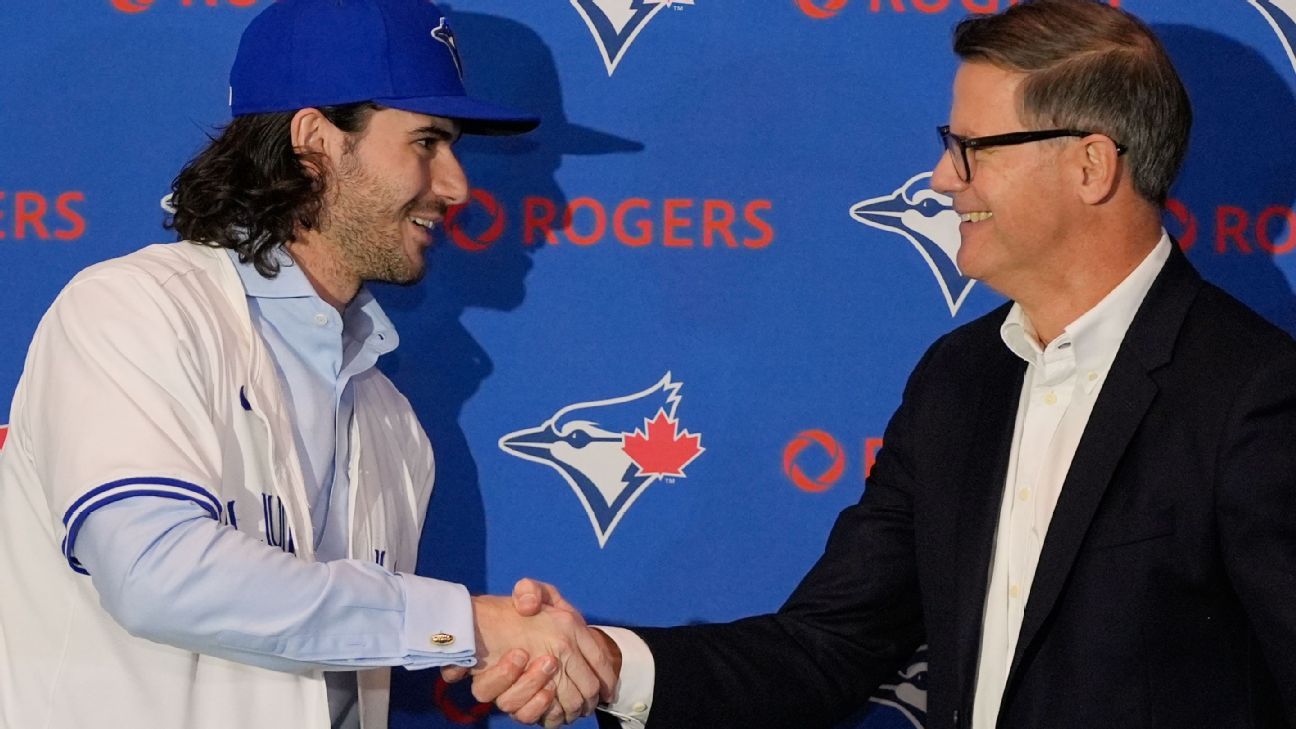
ORLANDO, Fla. — If there’s one team willing and able to give outfielder Kyle Tucker the $400 million he seeks in free agency, it’s the Toronto Blue Jays, according to many of the agents, executives and managers at baseball’s annual winter meetings this week. And if there’s one team with the capability to both trade for and extend Detroit Tigers ace Tarik Skubal, according to insiders, it’s the Los Angeles Dodgers.
Less than six weeks after engaging in one of the most thrilling, tightly contested World Series in recent memory, the Blue Jays and Dodgers reside at the center of an offseason expected to brim with activity over the next week, embedded in the sport’s subconscious once again.
The Blue Jays have already landed arguably the best free agent pitcher, signing Dylan Cease to a seven-year, $210 million contract, and are poised to hand out another nine-figure deal in their pursuit of a bat. The Dodgers signed the most decorated closer in free agency, agreeing to terms on a three-year, $69 million deal with Edwin Diaz, and have the resources to pull off this offseason’s biggest trade, in whichever form it takes. The Blue Jays ultimately might not land Tucker. The Dodgers — in search of an outfielder and also interested in Tucker, though only on a short-term deal — might not get Skubal. But their presence is stark at a time when so many big-market owners seem unwilling to spend.
The Chicago Cubs need an assortment of pitching but are wary of the luxury-tax threshold; the Houston Astros desperately need to replace free agent Framber Valdez in the rotation but will probably have to do so via trade; the San Diego Padres and Texas Rangers are looking to cut costs once again; the San Francisco Giants are expected to act conservatively; and though the Boston Red Sox, New York Yankees and New York Mets could all sign at least one major free agent position player this offseason, they’ve all been operating in more budget-conscious ways than their fans are used to.
A free agent pool defined more so by its depth than by its star power is certainly a factor. But two agents who spoke to ESPN this week said some teams have told them they’re not acting aggressively in free agency because of labor issues they believe will lead to a lockout next December and could alter the economics of the sport significantly. The continued deterioration of local TV deals is just as big of a factor, if not more so, league and team sources have said. And yet the Blue Jays and Dodgers appear to exist outside of those concerns, which probably shouldn’t come as a surprise.
The Blue Jays are backed by Rogers Communications, one of Canada’s largest media conglomerates. The Dodgers, further bolstered by the vast revenue streams generated by Shohei Ohtani, have what many consider the most lucrative and most stable local-media contract in the industry.
They might be on another collision course.
IF YOU WANT to get a sense for how things have changed financially for the Dodgers since signing Ohtani 24 months ago, look no further than the relievers. At the start of 2025, the Dodgers signed Tanner Scott to a four-year, $72 million deal, the type of massive commitment for a volatile position group that Andrew Friedman, now in his 12th year as president of baseball operations, had spent his entire career avoiding. Scott flamed out tremendously in his first year in L.A., and yet Friedman went to the well again on Tuesday, addressing the Dodgers’ ninth-inning need by rewarding Díaz with the highest average annual value ever for a reliever.
It’s ultimately not complicated: Dodgers owner Mark Walter is willing to spend whatever it takes, and his lieutenants are happy to oblige.
“We are in a really strong position right now, financially, and our ownership group has been incredibly supportive of pouring that back into our team and that partnership with our fans,” Friedman said.
“As we look at things, if we were on a really tight budget, we probably wouldn’t allocate in the same way. But having more resources, it allows us to be a little bit more aggressive on that point. In a world where there are major constraints, that wouldn’t be an area where I personally would allocate versus other areas. But we’re in a really fortunate position right now, and we have a really talented team going into 2026. We’re going to do everything we can to put ourselves in the best position to win a World Series.”
Díaz followed Ohtani, Yoshinobu Yamamoto, Tyler Glasnow, Teoscar Hernandez, Blake Snell, Roki Sasaki and Scott — all considered among the best players available at their respective positions over the past three offseasons, all acquired by the Dodgers. The team’s competitive-balance-tax payroll finished at roughly $415 million in 2025, a whopping $70 million more than the second-place Mets. The Díaz deal all but ensures they’ll once again blow past Major League Baseball’s highest threshold in 2026.
The Dodgers are interested in bringing Enrique Hernandez back, sources said, and would prefer to trade from their surplus of outfield prospects to augment their lineup, with bat-to-ball specialists like Cleveland Guardians left fielder Steven Kwan and St. Louis Cardinals utility man Brendan Donovan seen as ideal fits. In other words, they can very easily just go the straightforward route. Or, as they aggressively pursue a three-peat, they can pounce on Tucker with another short-term, high-AAV deal, or use their vast starting-pitching depth — including, perhaps, Glasnow, whose name has been thrown around — to get Skubal. They might even do both.
In the words of one rival executive: “You can never rule anything out with them.”
TUCKER MAKES HIS offseason home in Tampa, Florida, 25 miles from the Blue Jays’ spring training headquarters in Dunedin. Visiting the complex of one of his most aggressive suitors is a no-brainer as Tucker navigates his first free agency. And yet reports of him being spotted there last week raised eyebrows — not just from Blue Jays fans still recovering from a deflating World Series loss, but from industry insiders who recognize the type of game changer that place can be.
A facility alone won’t singlehandedly sway a top-tier free agent, of course, but if there’s one capable of doing so, the Blue Jays’ sprawling, state-of-the art spring training home is it.
As one agent said, “It’s sick.”
But it’s also not new. The Blue Jays have boasted arguably the most advanced complex in baseball ever since an $80 million renovation was completed five years ago. The city of Toronto, meanwhile, has always been held in high regard. Their fans have always been passionate. But over these past eight months, during which Vladimir Guerrero Jr. signed a $500 million extension and led a World Series run that captivated an entire country, players’ perceptions of them have shifted dramatically.
“You’re on Zoom calls with high-profile players that are speaking very, very highly of the organization, the facilities, the players that are on the team and how they conduct themselves,” Blue Jays manager John Schneider said. “That’s been a shift. I feel like in years past, with some high-profile players, it’s kind of been us selling us to them, whereas now I think the players know what they’re getting into as soon as they start talking to us.”
For so long, the Blue Jays were the team left at the altar. Inspired runs at Juan Soto, Ohtani and Sasaki led only to heartbreak. Now the expectation is that players are finally going to take their money. It started with Guerrero’s extension in April, then Cease and fellow starter Cody Ponce in free agency earlier this month. But the Blue Jays are also expected to add a bona fide late-inning reliever, and several agents and rival execs view them as the favorites for either Tucker or Bichette — or potentially both.
Their march to the World Series made them a legitimate landing spot for players who long to win and cast new light on a stretch previously marked by three playoff appearances and zero victories. It has also highlighted their most appealing traits.
Schneider’s popularity with players is one of them. Canada’s fervor for the Blue Jays, which became the country’s lone major league franchise when the Montreal Expos left, is another. Their facilities — a sprawling campus in Dunedin and a state-of-the-art weight room in Toronto, all designed to make them a destination spot — are yet another.
Most notable of all, though, is their money.
It might finally be making a difference.
-
 Sports2 years ago
Story injured on diving stop, exits Red Sox game
-
 Sports3 years ago
‘Storybook stuff’: Inside the night Bryce Harper sent the Phillies to the World Series
-
 Sports2 years ago
Game 1 of WS least-watched in recorded history
-
 Sports3 years ago
Button battles heat exhaustion in NASCAR debut
-
 Sports3 years ago
MLB Rank 2023: Ranking baseball’s top 100 players
-
Sports4 years ago
Team Europe easily wins 4th straight Laver Cup
-
 Environment3 years ago
Japan and South Korea have a lot at stake in a free and open South China Sea
-
 Environment1 year ago
Here are the best electric bikes you can buy at every price level in October 2024