

The only game that coaches love more than coaching an actual game is the game of “Hey, who have you coached with?”
Hey Coach, nice to meet you.
Good to meet you, too, Coach.
Coach, didn’t you coach with the same coach I coached with when we were assistant coaches for that one head coach?
Yes, I did, Coach. He’s a helluva guy. And a helluva coach. And the head coach we coached under …
Now, that’s a helluva guy and helluva coach.
They fist-bump (or hold up their drinks) and say in unison: To Coach!
As the newest edition of the College Football Playoff begins, that conversation will be taking place on sidelines and in hotel bars from Oxford to Oregon. And nearly every toast/dedication will be in honor of a man whose still-growing legacy stands out in a forest of coaching trees like a crimson-colored sequoia.
“I know there are a lot of coaching trees out there that were started by a lot of legends,” Kirby Smart said on the eve of winning the SEC championship game in Atlanta. After a decade at the helm of the Georgia Bulldogs, he has planted quite the nursery of saplings himself. “But I’m not sure anyone can match what Nick Saban has done when it comes to preparing coaches, getting them ready to run their own programs.”
Smart smartly points out that to him, a “coaching tree” isn’t about where someone started their career or how many years they spent with a coach, but rather the influence that root coach has, even if the assistant served on his staff for only one season.
“To me, it’s about the mentor aspect of it,” Smart said of Saban during the same weekend when he said he called Saban for advice and also did a live interview with Saban on “College GameDay.” “Can I call that coach whenever I need to, even if I am now coaching against him in the same conference, with questions or needing advice? That’s real influence. And I think that’s the relationship we would tell you that we all have with him.”
Added Indiana Hoosiers head coach Curt Cignetti: “He’s not coached a game in nearly two years, and I think his influence has only grown since then. I can’t speak for 150 years of college football history, who all worked for Bear Bryant or Knute Rockne or those guys. But there’s certainly zero argument about Nick Saban’s impact in the here and now.”
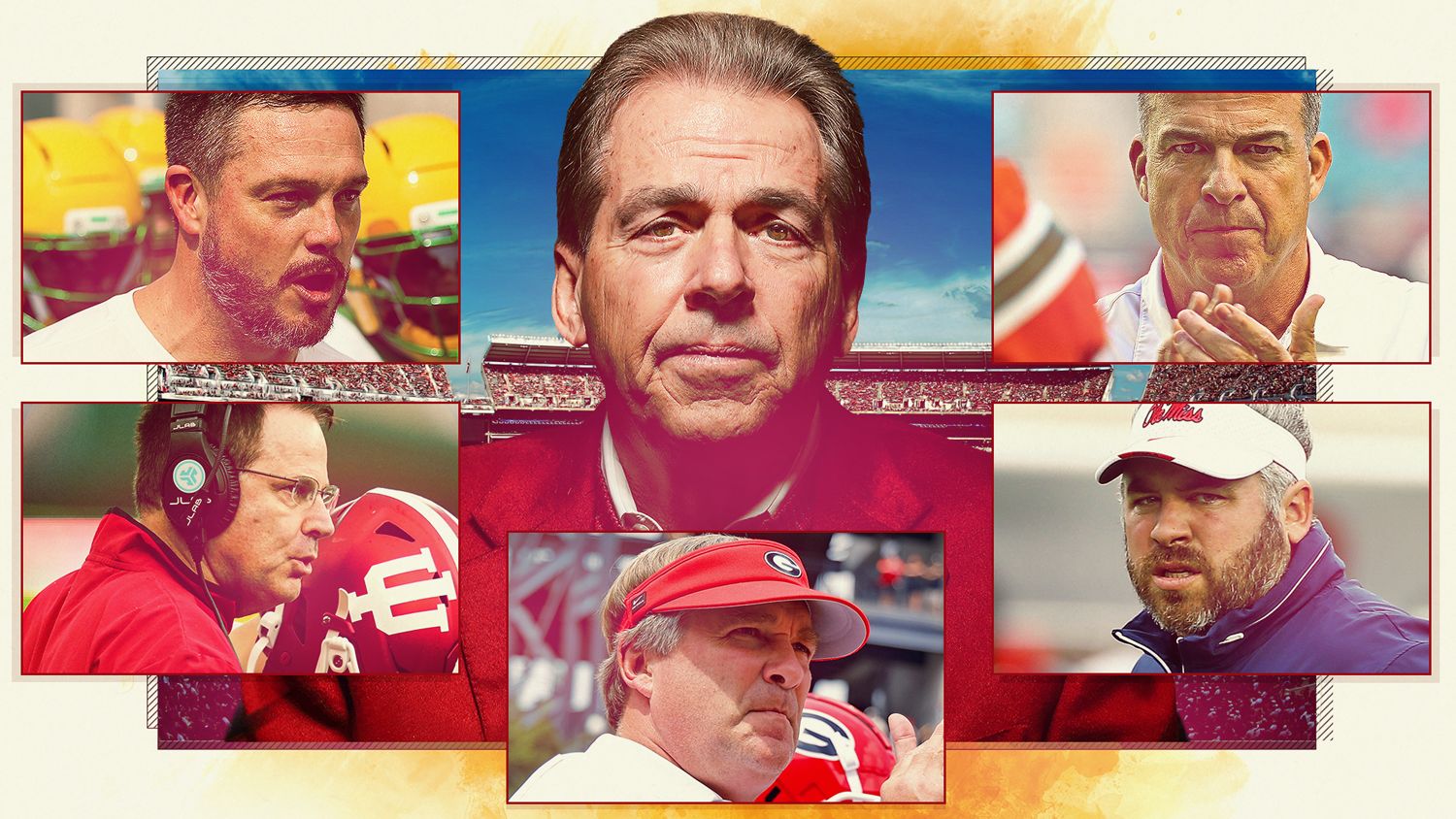
Here, in the second edition of a 12-team CFP format, and now, as that bracket begins with the first of four opening-round games Friday night when Alabama faces Oklahoma, five of those dozen teams are led by former Saban assistants. That includes four of the top six teams, with all five ranked in the top nine.
It does not include two teams that barely missed the playoff, ranked 13th and 25th, or the coach who was running the sixth-ranked team but left to lead another school … oh, by the way, a team that Saban once coached to a national title and a move that said coach made only after talking to Saban about the decision. Nor does it include the many others who run programs around the country, deployed throughout every level of college football.
The CFP list:
• Indiana, led by Cignetti, who was on Saban’s initial Alabama staff in 2007, working for five seasons as a wide receivers coach and as the recruiting coordinator who stockpiled Heisman winners, NFL first-round draft picks and a pair of national titles.
• Georgia, led by Smart, who worked for Saban at LSU, Alabama and even the Miami Dolphins, 11 seasons in all, during which he collected four nattys.
• Oregon, led by Dan Lanning, who served as a graduate assistant under Saban at Bama during the 2015 national title run before taking a full-time assistant job at Memphis and then joining Smart at Georgia.
• Ole Miss, led by Pete Golding, who worked as a defensive coach under the famously defense-obsessed Saban for five years, including the 2020 national championship season, before leaving to join the staff at Ole Miss. He was hired there by another former Saban assistant, Lane Kiffin. Now Golding will make his head coaching debut in the CFP, pushed into that role after Kiffin’s less-than-smooth departure for LSU.
• And finally, Miami, coached by Mario Cristobal, who was hired by Saban at Alabama in 2013 after losing his head coaching job at Florida International. Cristobal oversaw the offensive line, carried the title of assistant head coach, but like Cignetti, had his greatest impact in the role of recruiting coordinator. When Cristobal left Tuscaloosa at the end of the 2016 season, he did so with four SEC titles and a 2015 national championship ring.
The near-CFP list:
• 13th-ranked Texas, the first team out of the playoff, led by Steve Sarkisian, who like Kiffin and Cristobal, is a graduate of the Nick Saban head coach rehabilitation and career rejuvenation program. Amid personal struggles with addiction and professional struggles as USC’s head coach, Sark was brought to Bama by Saban as an offensive assistant in 2016 and again from 2019 to 2020. Together, they won a pair of SEC titles and the 2020 natty before Sarkisian left for Austin.
• 25th-ranked Georgia Tech, which stayed in the ACC title fight all season and nearly upset Georgia over Rivalry Week, led by Brent Key. Key was Saban’s offensive line coach for three seasons, including for the 2017 natty.
Some of the rest (always subject to change as this unprecedented coaching carousel-turned-Gravitron keeps spinning):
• Major Applewhite, South Alabama
• Scott Cochran, West Alabama
• Charles Huff, Southern Miss
• Lane Kiffin, LSU
• Bill O’Brien, Boston College
• Butch Jones, Arkansas State
• Charles Kelly, Jacksonville State
• Mike Locksley, Maryland
• Alex Mortensen, UAB
• Lance Taylor, Western Michigan
“I think if you talk to any of us who worked on one of Nick’s staffs, we all have a list of coaches who have influenced us and have served as mentors,” O’Brien said in July, when he was about to begin his second season at Boston College and his fourth overall as a college head coach. O’Brien’s career also includes seven years as the Houston Texans’ head coach, five years as an offensive coach in the high holy days of Tom Brady and Bill Belichick’s New England Patriots, and two years as Saban’s offensive coordinator in 2021 and ’22.
“The question becomes what did you take away from someone? How did they change you? I had been an NFL head coach and the head coach at Penn State at a really challenging time. But he showed me organization on a level that I had never experienced, from practice to how you run a meeting to how you deal with the outside obligations. I think anyone who spent time with him will tell you that.”
They do indeed. Every single Saban apprentice we spoke to this season about this topic certainly did. But no one talked about schemes or any plan of football attack. Instead, every discussion about their lessons with the seven-time national champion centered on process and details. Not how to tackle ball carriers but rather tackling whatever problems players might carry into their office.
“I worked for him for one year, that was it, but it gave me this cheat sheet on every possible situation you can think of,” said Lanning, who is quick to say he doesn’t run his day-to-day operation as meticulously as Saban, but is “addicted” to studying and emulating Saban’s devotion to consistency. “No matter what the question is for him, his answer is like a teacher’s lesson. ‘Dan, when I was faced with this, these were the three things that I did …’ He always has that answer. That’s a leader.”
As for Saban himself, the master of details is well aware of his impact, even if he tries to sidestep a conversation about it.
“I’m not a tree expert, but I do know you can’t grow one tree unless you have something from another tree. A pine cone or whatever. Wherever the seeds come from has to come from somewhere else,” he said earlier this fall, when his disciples and their teams made up six spots in the AP top 10, not to mention Alabama, which is not led by a former Saban staffer, but is housed in a building where he still has an office. “For me, that was Don James. I played for Coach James at Kent State. It’s George Perles. I learned under him at Michigan State. They learned from guys like Bump Elliott and Chuck Noll. And they learned from guys like Paul Brown. You know who those guys are, right?”
Sure. James, national championship coach and College Football Hall of Famer. Perles, Rose Bowl winner, two-time Big Ten champion, godfather of Pittsburgh’s Steel Curtain defense. Noll, four-time Super Bowl-winning coach of those Steelers. Elliott, Big Ten champ, Michigan coach and legendary Iowa athletic director. Paul Brown, high school teammate of a member of the famed Notre Dame Four Horsemen and, oh yeah, pretty much the inventor of modern football. A man whose attention to detail made Saban look downright slack. Brown once traded away a future Pro Football Hall of Famer for burping during a team meeting.
Saban connecting his coaching mentees to the greatest coaching mentors of a century ago is not an accident. It is a GOAT-level version of the “Hey, who have you coached with?” game, played by the same man who just so happens to be squarely in the middle of that endless coaching tree, braiding together the branches of today with those of yesteryear.
“As much as football and the business of football evolves, the fundamentals of coaching still come down to what they have always come down to,” the sequoia said. “It is our job to take what we learned, figure out how that translates into today’s job and then make damn sure the next generation who is learning it from us is ready to teach it to the ones who work for them.”
The Washington Nationals have hired Ani Kilambi as their new general manager, the team announced Thursday.
Kilambi will switch organizations in the National League East after previously being an assistant general manager for the Philadelphia Phillies, working with that club since 2021.
Before that, he was with the Tampa Bay Rays for more than five years.
“Our goal is to be the highest performing organization in baseball,” Kilambi said in a statement. “To do so, we aim to exemplify our core values of joy, humility, integrity and competitiveness, while displaying sharp eyes for talent and best-in-class player development. I’m excited to call Washington, D.C. my home and cannot wait to get started.”
Kilambi takes over a job that was held for more than a decade and a half by Mike Rizzo, who became the general manager in Washington in 2009 and added the title of president of baseball operations in 2013. Rizzo was fired in July during the Nationals’ sixth consecutive losing season. Manager Dave Martinez also was fired then.
Rizzo and Martinez were in charge in 2019 when the Nationals won the World Series, but the team hasn’t had a winning year since. Washington went 66-96 in 2025, putting it 14th out of 15 clubs in the National League.
Mike DeBartolo took over as interim general manager after Rizzo was let go and oversaw the selection of 17-year-old high school shortstop Eli Willits with the No. 1 pick in Major League Baseball’s amateur draft in July.
Paul Toboni, 35, was hired in late September to run the Nationals. Toboni, who had been an assistant general manager with the Boston Red Sox, brought in manager Blake Butera, who at 33 became the youngest skipper in the majors since the 1970s.
“Ani has earned a reputation around the industry as one of the brightest front office minds in the game,” Toboni said in a statement. “He’s not only a sharp and strategic leader who is a great communicator, but he is also thoughtful and humble and aligns with our values. Ani is an excellent complement to the leadership group we have in place, both in terms of his past experiences and who he is as a person.”
Information from The Associated Press was used in this report.
-
 Sports2 years ago
Story injured on diving stop, exits Red Sox game
-
 Sports3 years ago
‘Storybook stuff’: Inside the night Bryce Harper sent the Phillies to the World Series
-
 Sports2 years ago
Game 1 of WS least-watched in recorded history
-
 Sports3 years ago
Button battles heat exhaustion in NASCAR debut
-
 Sports3 years ago
MLB Rank 2023: Ranking baseball’s top 100 players
-
Sports4 years ago
Team Europe easily wins 4th straight Laver Cup
-
 Environment3 years ago
Japan and South Korea have a lot at stake in a free and open South China Sea
-
 Environment1 year ago
Here are the best electric bikes you can buy at every price level in October 2024