
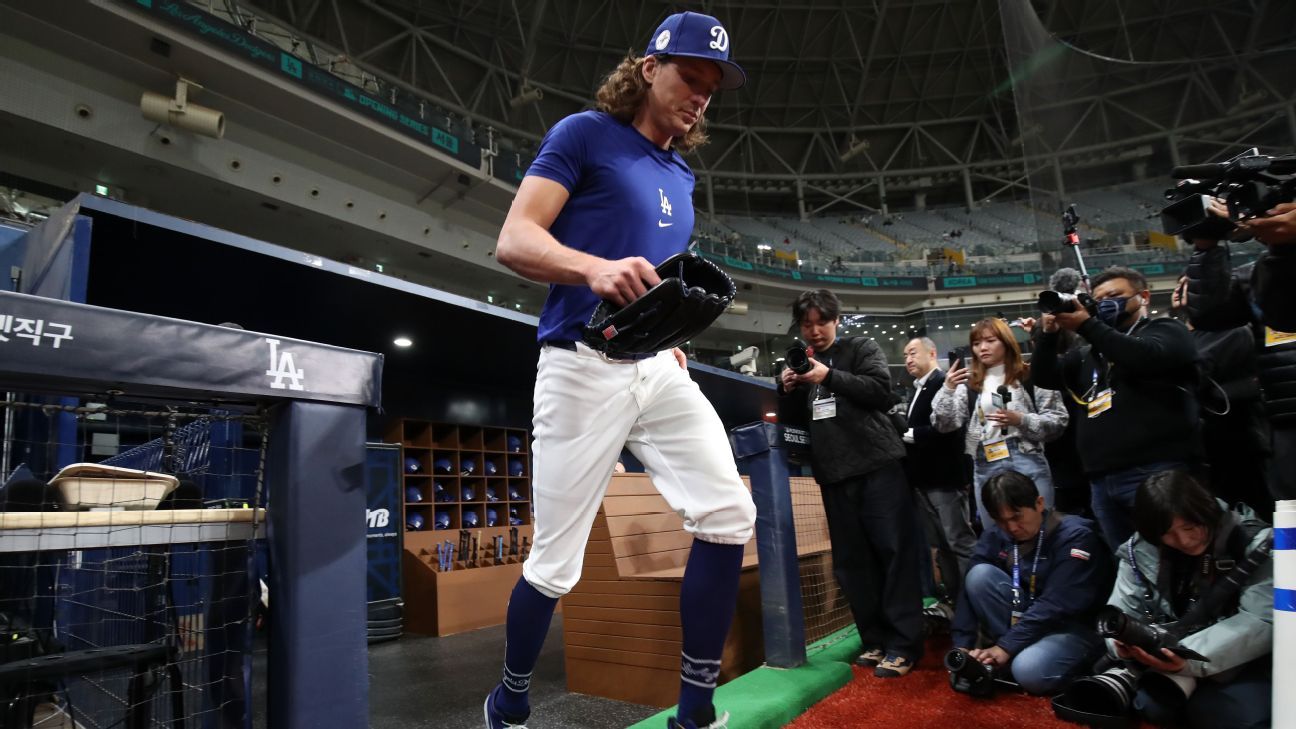
A very big deal: How Tyler Glasnow marries strength and agility


-
Tim Kurkjian, ESPN Senior Writer
DODGERS PITCHER Tyler Glasnow, who stands 6-foot-8, 225 pounds, can do a standing backflip.
“It’s no big deal, really,” he said. (Yes, it is. There aren’t many people that big and tall who can do a backflip.)
“Oh, I’m sure there are a lot of people bigger than me that can,” he said. (No, there aren’t.)
Glasnow, 30, is a new member of the Los Angeles Dodgers‘ rotation, acquired from the Tampa Bay Rays in a trade in December and immediately signed to a five-year, $136 million extension. His stuff is as overpowering and violent as anyone’s in the game, in part because of his remarkable athleticism: a breathtaking combination of size, speed, strength, agility, mobility and balance, all of which has drawn comparisons to Michael Jordan, Michael Phelps — and a giraffe.
“He is the most physically gifted athlete I have ever seen in my life,” said Rays closer Pete Fairbanks, an ex-teammate. “He is more flexible than anyone I’ve ever seen. His movements are cleaner than anyone I’ve ever seen. He is unbelievable. I don’t think there is athletic activity that he can’t do.”
Besides a backflip, Glasnow can walk on his hands. He won a silver medal in the Junior Olympics in the high jump. He was an excellent basketball player (“I’m tall,” he said). He loved roller hockey and was a wizard on a skateboard. He ran track, did the shot put and played football for one year in high school. He lifted a huge amount of weight, and says, “if I’m on the side of a squat rack, I can go parallel to the ground, but I don’t know if that is unusual.”
It is.
“We call that a flagpole,” said Dodgers pitcher J.P. Feyereisen. “He was doing that in the weight room today. I’m not sure how many guys could do that. He’s 6-8, and he can do it.”
Yet with this amazing array of skills and athleticism, Glasnow hasn’t been able to stay healthy. He has never completed a game in his major league career; he has never pitched enough innings in a season (162) to qualify for the ERA title. He had Tommy John surgery in 2021, an injury he said had affected him for even longer.
But he has averaged 11.5 strikeouts per nine innings and only 7.3 hits. His stuff is hellacious. His curveball is one of the best in the game; it’s unhittable when paired with his 98 mph fastball. Beginning Wednesday, when Glasnow takes the mound in Seoul, South Korea, for the Dodgers’ Opening Day game against the San Diego Padres, the Dodgers are hoping to harness that athletic ability and spectacular stuff.
“I feel amazing now,” he said. “I figured out the elbow thing. I’ve had that since 2019. Now that that’s ironed out. I feel the healthiest I’ve ever felt. Now after meeting all the coaches and the training staff [with the Dodgers], I’m really excited about the future. Everything is so buttoned-up here, I will be able to put my body in the best position to succeed.”
“When it comes to ability, no one is better than Tyler,” former teammate Brad Miller said. “I think his relationship with the Dodgers is a match made in heaven. That $130 million extension is going to be like pennies on the dollar for what he will do for the Dodgers.”
THE ART OF pitching has changed dramatically in the past 10 years, as athletic trainers and performance experts have found new ways to improve body function with all-new exercises — and yet it all feels familiar to Glasnow.
“I look at videos doing gymnastics when I was 5, and the fundamentals and warmups I was doing then are what baseball players are being taught today,” Glasnow said. “It’s crazy. Walking on your hands, the high jump, backbends. I already have a baseline for all this.”
“Whatever he did as a kid from ages 5 to 12, I need to write it down and have my son do it, because that’s how you build an athlete,” Fairbanks said. “He’s the perfect blend of genetics.”
Glasnow’s mom, Donna, is 5-9, a retired gymnast who now coaches gymnastics at Cal State Northridge; his dad, Greg, 6-2, is a swimmer and a water polo player.
“She chose to be a gymnast, but if she had chosen another sport, she probably would have been great at it,” Glasnow said of his mom. “She’s almost 70 years old. But she’s in insanely good shape. I remember growing up, she was always doing handstands and cartwheels around the house, all this crazy stuff. She put us [Glasnow and his brother, Ted] in gymnastics when we were little. She was always trying to get us to do as many athletic things as possible. I look at the gymnastics things we did as kids. It was insane. It was like, ‘Whoa, we were 5!'”
Ted was a decathlete at Notre Dame.
“He is 6-1, 6-2, he is ginormously strong,” Glasnow said. “He is the most shredded human in our family. When he was competing, it was insane how big he was. I got the height. He got the strength. I could lift a lot of weight, I was obsessed by it, but he was stronger.”
Said Yarbrough: “I asked Tyler once what he would have done if he hadn’t been a baseball player. He said nonchalantly, ‘Well, my brother does the decathlon. I guess I’d do that.'”
As a kid, Glasnow loved being on the trampoline, doing flips, which taught him the sensation of being in space while still maintaining control of his body. That led to his first backflip.
“I was 19 years old, I was at the ocean in Mexico,” he said. “I had never thought about doing a backflip in gymnastics. But I was there, on the sand, and I thought, ‘I think I can do this.’ So I did it in the sand. I just thought to myself, ‘Well, I guess I can do a backflip.'”
Dodgers pitcher Ryan Yarbrough has seen it.
“He just said to me, ‘Do you want to see it?'” Yarbrough said. “And he just did it on a dime.”
“I call him the Giraffe,” said Texas Rangers first baseman Nathaniel Lowe, a former teammate in Tampa. “Giraffes have long limbs, long levers, but can really move. People think giraffes are bumbling animals, but they can run. When I was with the Rays, Tyler used to beg to pinch run if we were in a long game. He’d say, ‘Please let me run. I promise I can score from first on a double. My sprint speed would measure really high on Statcast!'”
“Everyone talks about how [5-10 Dodgers pitcher Yoshinobu] Yamamoto can contort his body and bend his back all the way,” said Andrew Friedman, the Dodgers president of baseball operations. “But Tyler can do that even better.”
Glasnow knows his body well, what it can do.
“The biggest difference with the athleticism is [considering] my height, how I’m able to get down the mound differently than most,” Glasnow said. “And because I do a lot of the mobility stuff, I think I can stay stable in places where some people would find it harder to balance. I think I have good single-leg stability. I am pretty explosive. I can push off hard, and … I can get the ball out a lot harder than most people. It’s all about stability, where you are in space, finding yourself, kind of like eyes-closed balance. When pitching, I get so extended in my back, like the high jump. My mom would always have us doing handstand walks, single-arm stability stuff. Doing all that at such young age, it has helped my body and my brain on the mound.”
GLASNOW’S HEIGHT CAME from his mother’s side; she has a brother who is 6-9. In Glasnow’s case, it happened suddenly. He was 5-8 as a high school freshman in Santa Clarita, California.
“Then my junior year, over a winter break, in like five weeks, I grew like four inches,” he said. “When I got back to school at winter break, people were like, ‘What the hell happened to you?’ Crazy. I remember leaving and coming back and people were like ‘What!?'”
Glasnow graduated high school at 6-6, meaning he grew almost a foot in only four years. Normally, when someone grows that quickly, it is difficult for the body to catch up, to remain coordinated. Not Glasnow. The increased size only added to his pitching acumen.
“I’ve always been really athletic,” he said. “I was always comfortable picking up any new sport. As far as baseball specifics go, having athletic parents, growing up in the place that I grew up, it’s such a great baseball culture there. Santa Clarita was all about baseball. I played all year round, And I had some really good coaches. Baseball was always my best sport.”
His idol was Randy Johnson, who was 6-10, “and he had trouble throwing strikes, too,” said Glasnow, who struggled with his own command. “But I never really nerded out on baseball too much when I was a kid. I was such a rambunctious human, I couldn’t just sit and watch a baseball game.”
Even then, though, his stuff was elite. He was drafted in 2011 by the Pittsburgh Pirates and spent several years after his 2016 debut yo-yoing between the majors and Triple-A and the bullpen and the rotation. After being traded to the Rays midseason in 2018, he became a full-time starter until he had Tommy John surgery in August 2021.
“The first time I saw him throw in person [in 2018], he was in an empty stadium, in the bullpen just getting some work in, no one in the box, and he was casually throwing 97-98 mph, the ball was just exploding, and the look on his face was, ‘I can’t help it,'” said Adam Kolarek, an ex-teammate in Tampa. “It looked like Michael Jordan shrugging his shoulders [after making another 3-pointer] as if to say, ‘I don’t know how I do it.’ It’s not cocky. Tyler just can’t help it.”
“I faced him last spring in a simulated game,” said former Rays teammate Brandon Lowe. “I swung at a curveball that bounced before the plate. I thought it was a fastball. That has never happened to me before. It is almost impossible to mistake a fastball for a curveball.”
“He is a beast,” Miller said. “He is so long, but he is not lanky. [Jacob] deGrom has these amazing levers in his body. Tyler has the same ones, and he’s 40 pounds bigger. The dude just hands the ball to the catcher.”
So, is there anything Glasnow can’t do?
“I suck at golf,” he said. “Awful. Terrible. I chunk it. I have the all-or-nothing mentality. I hit it really far, but it slices farther than it goes straight. I’ll lose like 15 balls in a round. I suck.”
Finally, we found the one thing Tyler Glasnow can’t do.

-
Mark Schlabach
Indiana quarterback Fernando Mendoza, who led the No. 1 Hoosiers to a perfect 13-0 record and their first Big Ten title since 1967, captured the 91st Heisman Trophy on Saturday night.
Mendoza beat out quarterbacks Diego Pavia (Vanderbilt) and Julian Sayin (Ohio State) and running back Jeremiyah Love (Notre Dame) to take home the trophy during a ceremony in New York.
Mendoza, who played two seasons at California before joining the Hoosiers this season, completed 71.5% of his pass attempts for 2,980 yards with 39 total touchdowns.
He was only the second Heisman Trophy finalist from Indiana. Running back Anthony Thompson was runner-up to Houston quarterback Andre Ware in one of the closest votes in 1989.
With Mendoza, Pavia and Love expected to move on to the NFL after this season, who are the top returning Heisman Trophy candidates for 2026?
In compiling the list of potential candidates, I projected that quarterbacks John Mateer (Oklahoma), Ty Simpson (Alabama) and Dante Moore (Oregon); receivers Carnell Tate (Ohio State), Zachariah Branch (Georgia) and Makai Lemon (USC); and running back Emmett Johnson (Nebraska) will turn pro (along with the aforementioned finalists from this year).
Here is a look at some of the top potential contenders (in no particular order):


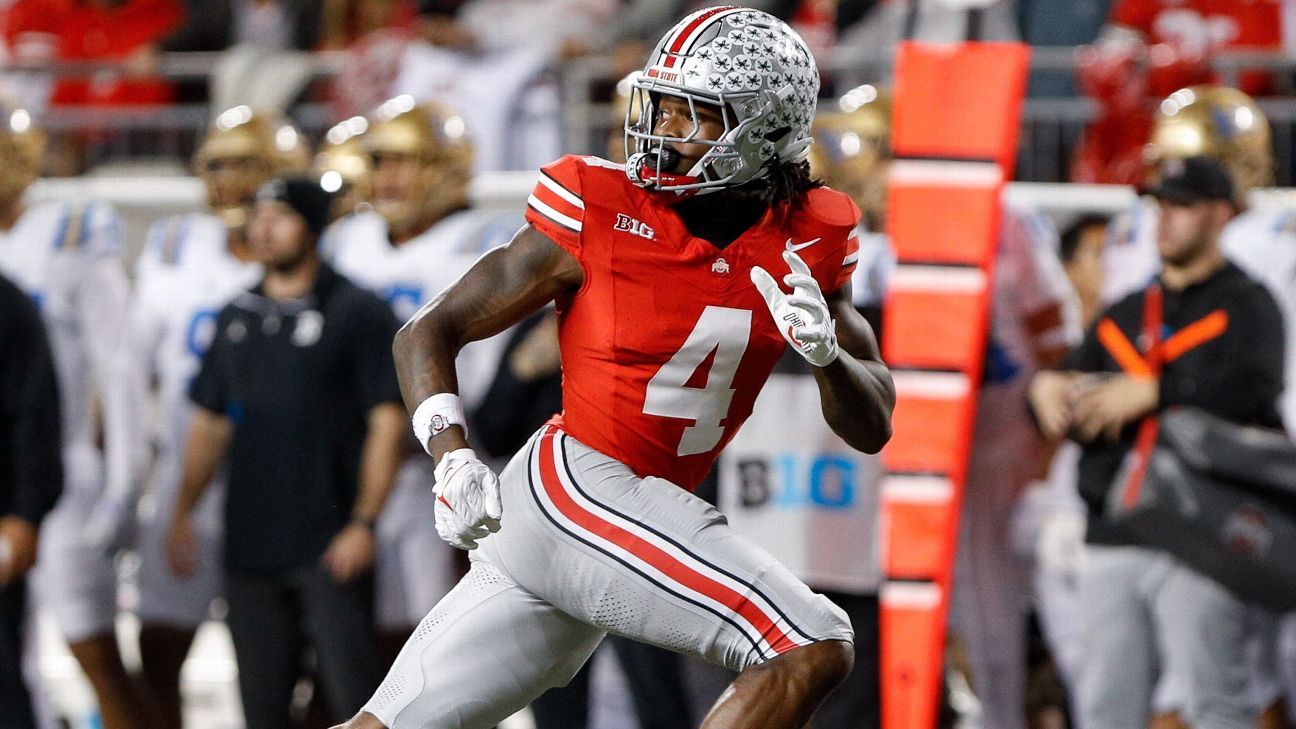
2025 stats: 80 catches, 1,086 receiving yards, 12 total touchdowns
Smith’s highlight reel of acrobatic, one-handed catches continues to grow, and he arguably has been the best player in college football this season. He was the fastest Buckeyes player to reach career marks of 2,000 receiving yards (24 games), 100 catches (20) and 25 touchdown receptions (25).
2025 stats: 78.4% completion pct, 3,323 passing yards, 31 touchdowns, 6 interceptions
Sayin might have captured the Heisman Trophy this season if Ohio State’s offense hadn’t flopped in its 13-10 loss to Indiana in the Big Ten championship game. In his first season as a starter, Sayin is on pace to break the NCAA single-season pass completion record of 77.4%, set by Oregon’s Bo Nix in 2023.

2025 stats: 70.7% completion pct, 2,691 passing yards, 442 rushing yards, 31 total touchdowns
In his first full season as Georgia’s starting quarterback, Stockton helped guide the Bulldogs to a 12-1 record and SEC title. His legs and right arm were a big reason the Bulldogs averaged 31.9 points, despite enduring myriad injuries on the offensive line. Stockton was at his best when the game was on the line — he completed 86% of his passes with 11 touchdowns and one interception in the fourth quarter against ranked opponents.

2025 stats: 84 receptions, 970 receiving yards, 7 receiving touchdowns
Toney’s teammates call him “Baby Jesus,” and the true freshman delivered in a big way in his first season with the No. 10 Hurricanes. He ranks sixth in the FBS with 84 catches and had 1,328 all-purpose yards. Toney even threw for two scores. Not bad for an 18-year-old who would be a senior in high school if he hadn’t reclassified to the class of 2025.

2025 stats: 61.4% completion pct, 2,942 passing yards, 32 total touchdowns
Even after all the hand-wringing about Manning being overrated at the start of the season, the former five-star recruit ended up putting together a good campaign, throwing for 2,942 yards with 24 touchdowns. The No. 13 Longhorns need to find some offensive linemen (he was sacked 23 times) and receivers to help him in 2026.

2025 stats: 65.5% completion pct, 3,016 passing yards, 24 total touchdowns
Ole Miss officials have submitted a waiver to the NCAA on Chambliss’ behalf for another season of eligibility. He played his first three seasons at Division II Ferris State before transferring to Ole Miss this year. He was named SEC Newcomer of the Year after taking over the starting job in the third game of the season.

2025 stats: 1,560 rushing yards, 16 touchdowns
A transfer from Louisiana-Monroe, Hardy led the FBS with 130 rushing yards per game and was No. 2 with 1,560 total rushing yards. He had eight 100-yard games for the Tigers, including a whopping 300-yard effort with three touchdowns in a 49-27 victory against Mississippi State on Nov. 15.

2025 stats: 61.8% completion pct, 2,932 passing yards, 466 rushing yards, 31 total touchdowns
Reed announced this week that he plans to stay at Texas A&M next season, which is great news for the No. 7 Aggies. He was a threat with the ball in his hands, throwing for 2,932 yards with 25 touchdowns and running for 466 yards with six scores. His decision-making needs to continue to improve, so he can cut down on his 10 interceptions.

2025 stats: 63.6% completion pct, 3,117 passing yards, 20 total touchdowns
There’s a reason new Bears coach Tosh Lupoi took a late-night flight to Hawai’i to make sure Sagapolutele was staying at Cal. He was only the second true freshman in FBS history to pass for 200 yards or more in each of his first 11 starts. In the Bears’ late-season upsets of then-No. 21 SMU and No. 15 Louisville, Sagapolutele passed for a combined 653 yards with six touchdowns and no picks.
2025 stats: 1,279 rushing yards, 20 touchdowns
After transferring from Missouri, Lacy helped the No. 6 Rebels win 11 games in the regular season for the first time. He ranks No. 2 in the FBS with 20 rushing touchdowns and piled up 1,279 yards on the ground. Will he follow former coach Lane Kiffin to LSU or remain with the Rebels in 2026?

2025 stats: 66.2% completion pct, 3,431 passing yards, 29 total touchdowns
If Maiava returns to the No. 16 Trojans for another season, he’ll probably flourish in Lincoln Riley’s offense. This year, he threw for 3,431 yards with 23 touchdowns and 8 interceptions. He ranks No. 1 with a 91.2 total QBR. According to Pro Football Focus, he was second in the FBS with 26 big-time throws. (A big-time throw is defined as a high-difficulty, high-value pass.)
2025 stats: 1,035 rushing yards, 6 total touchdowns
Jackson became the fifth true freshman in OSU history to produce a 1,000-yard season, joining Robert Smith (1990), Maurice Clarett (2002), JK Dobbins (2017) and TreVeyon Henderson (2021). That’s good company. And, of course, he’d be the second Bo Jackson to collect a stiff-armed trophy.

2025 stats: 70.2% completion pct, 4,129 passing yards, 36 total touchdowns
Mestemaker is one of the best stories in college football. He didn’t start a single game in high school, then joined North Texas as a walk-on. This season, he led the FBS with 4,129 passing yards, helping him capture the Burlsworth Trophy as the top walk-on in the country. Will he join former Mean Green coach Eric Morris at Oklahoma State in 2026?

CJ Carr, QB, Notre Dame
2025 starts: 66.6% completion pct, 2,741 passing yards, 24 touchdowns
Fighting Irish coach Marcus Freeman entrusted Carr to lead his offense after a heated battle in preseason camp. The decision paid off, as Carr put together one of the best performances by a first-time starter in Notre Dame history. He threw for at least one touchdown in each of his first 12 starts, becoming the first Irish player to do that since Everett Golson in 2012-14. Carr’s 24 passing touchdowns are tied for the most in the first 12 starts by a Notre Dame player since 1966.

2025 stats: 70% completion pct, 2,850 passing yards, 595 rushing yards, 27 total touchdowns
Williams is one of the best dual-threat quarterbacks in the FBS, and his ability to run and throw was on display in the Huskies’ 38-19 victory against Rutgers on Oct. 10. He became the first player in school history to pass for at least 400 yards (400) and run for at least 100 (136) in the same game. Williams was second on the team with 595 rushing yards.
Others to watch: Sam Leavitt, QB, TBA; Cam Coleman, WR, Auburn; Brendan Sorsby, QB, Cincinnati; Josh Hoover, QB, TCU; Darian Mensah, QB, Duke; Nate Frazier, RB, Georgia; LJ Martin, RB, BYU; Bear Bachmeier, QB, BYU; LaNorris Sellers, QB, South Carolina; Bryce Underwood, QB, Michigan

-
Adam Rittenberg
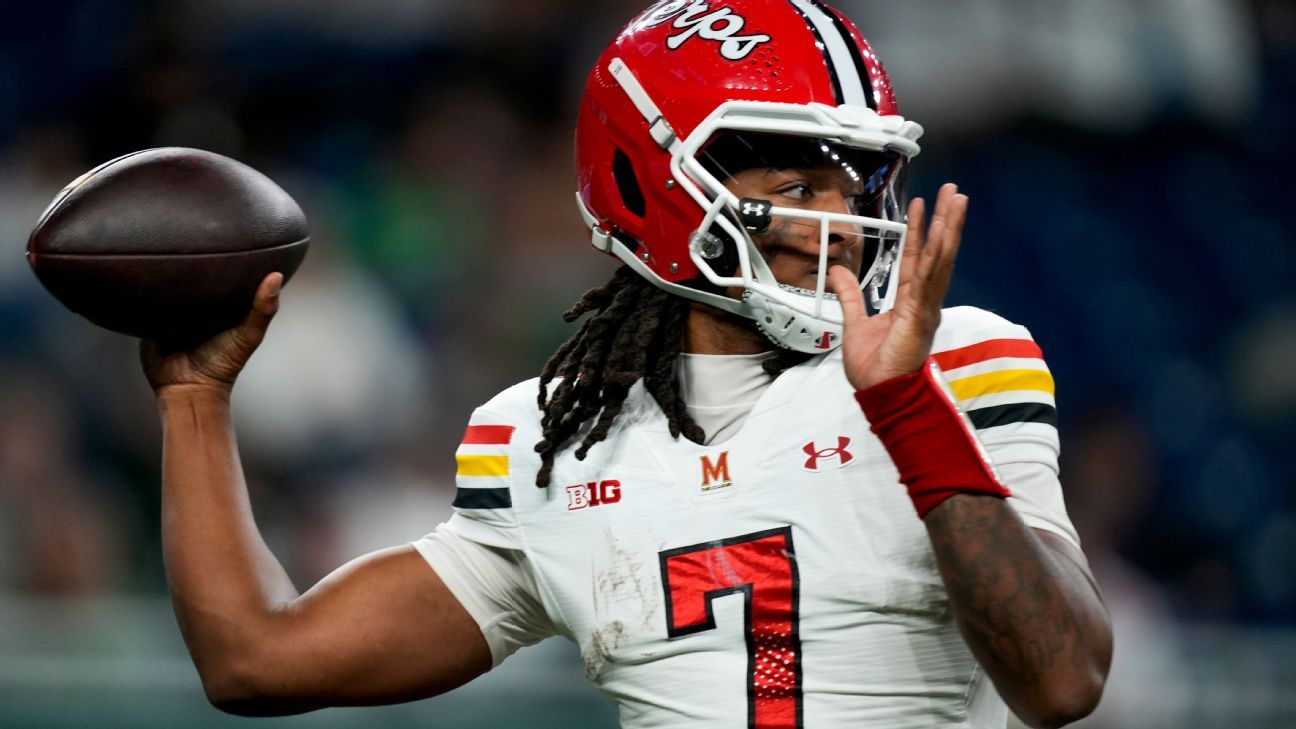
Maryland quarterback Malik Washington, who set the team’s freshman passing record this fall, will return to the Terrapins for the 2026 season.
Washington set Maryland freshman records for passing yards (2,963) and completions (273) this season, while connecting on 17 touchdown passes. He reached 200 passing yards in all but one game and finished as just the second Big Ten freshman since 1996 to record at least 2,500 passing yards and at least 300 rushing yards.
“Representing this team, this area, means so much to me and my family,” Washington said in a statement Saturday. “This is home and we’re going to continue keeping the best athletes from this area here with the Terps. I believe in everyone in our facility and I know we’re building something that our fans will be excited about for years to come.”
Washington, the nation’s No. 134 recruit in the 2025 class, grew up in Severn, Maryland, about 30 miles from Maryland’s campus. Despite a 4-8 record that included only one Big Ten win, Maryland announced that coach Mike Locksley, who recruited Washington, would return in 2026. Locksley will enter his eighth season as Maryland’s coach.
“Malik is a Terp through and through and I’m thrilled he’s coming back to lead this football team,” Locksley said in a statement. “He means so much to this area and this area means so much to him. What we saw from Malik this past season is only the tip of the iceberg. He has such a bright future and he’s already started putting the work in towards the 2026 season.”

-
 Sports2 years ago
Story injured on diving stop, exits Red Sox game
-
 Sports3 years ago
‘Storybook stuff’: Inside the night Bryce Harper sent the Phillies to the World Series
-
 Sports2 years ago
Game 1 of WS least-watched in recorded history
-
 Sports3 years ago
Button battles heat exhaustion in NASCAR debut
-
 Sports3 years ago
MLB Rank 2023: Ranking baseball’s top 100 players
-
Sports4 years ago
Team Europe easily wins 4th straight Laver Cup
-
 Environment3 years ago
Japan and South Korea have a lot at stake in a free and open South China Sea
-
 Environment1 year ago
Here are the best electric bikes you can buy at every price level in October 2024