
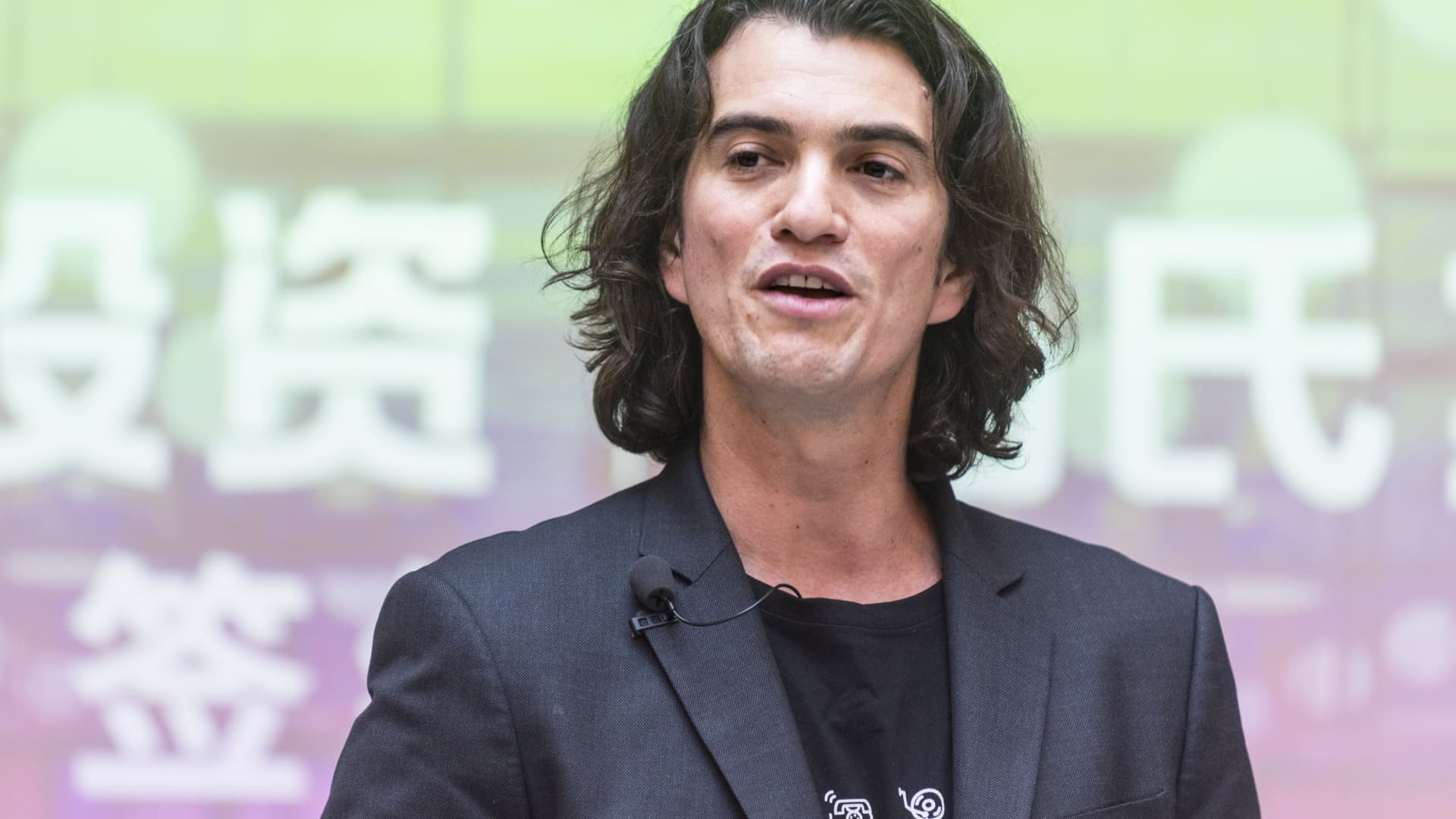
Adam Neumann’s bid to buy back WeWork faces uphill battle due to financing challenges

Israeli-American businessman Adam Neumann speaks during The Israeli American Council (IAC) 8th Annual National Summit on January 19, 2023 in Austin, Texas.
Shahar Azran | Getty Images
Adam Neumann has sent a preliminary offer to buy WeWork out of bankruptcy for more than $500 million, five years after he was ousted by the office-sharing company he founded. But it’s not clear that he has the financing and requisite support from creditors to consummate a deal.
In trying to reclaim WeWork, Neumann has to contend with a checkered past at the company, uncertainty over funding and the difficulty in valuing a business that’s midway through a restructuring process. CNBC spoke with multiple people familiar with the company and Neumann’s offer. They requested anonymity to speak freely about private matters.
Investment firm Rithm Capital, which acquired Daniel Och’s Sculptor Capital Management in November, is one of parties interested in financing the bid, sources told CNBC. Rithm’s involvement remains preliminary and the diligence process is at an extremely early stage, one of the people said.
More broadly, people close to the matter say they’re skeptical of whether Neumann has committed financing lined up to support an offer. That’s because Neumann has previously named other financing sources in prior communications with WeWork’s advisors that hasn’t come to fruition, the sources say.
For example, Dan Loeb’s Third Point was previously cited in a letter by Neumann’s counsel to WeWork’s bankruptcy advisors as a firm that was providing financing. But the hedge fund quickly denied involvement and said discussions had only been preliminary. Third Point is not involved in any offer, people familiar with the matter told CNBC.
Baupost Group was also floated as a potential financing source months earlier but didn’t join Neumann’s latest bid, the people said. Conversations between Neumann and Baupost were preliminary and informal, one source said. The Financial Times first reported that Baupost was not involved.
WeWork declined to comment for this story. In a previous statement, the company said it received “expressions of interest from third parties on a regular basis,” and that it worked to “always act in the best long-term interests of the company.”
Neumann didn’t immediately respond to a request for comment.
Blurred lines
Neumann is represented by law firm Quinn Emanuel’s Alex Spiro, who also advises Tesla CEO Elon Musk and billionaire rapper Jay-Z. But Neumann, who once called JPMorgan Chase CEO Jamie Dimon his “personal banker,” doesn’t appear to have tapped bankers or financial advisors in his effort to buy WeWork, two people with direct knowledge of the matter said.
Adding to the confusion is Neumann’s involvement with his latest venture, Flow, which is one of the parties bidding on WeWork. Following his ouster from WeWork, Neumann founded Flow, a startup that says it’s reinventing home ownership and building a sense of community among its tenants.
Andreessen Horowitz invested a reported $350 million in Flow in 2022. Marc Andreessen, the venture firm’s co-founder, sits on Flow’s board. Andreessen Horowitz didn’t respond to a request for comment.
Neumann’s counsel is also representing Flow in WeWork’s bankruptcy proceedings. Flow and Neumann share a spokesperson, who confirmed the WeWork bid.
Questions about timing and plans
Israeli-American businessman Adam Neumann speaks during The Israeli American Council (IAC) 8th Annual National Summit on January 19, 2023 in Austin, Texas.
Shahar Azran | Getty Images
The timing of Neumann’s offer also raises questions about its viability. The bid came two weeks ago, sources said, and landed at a time when the company had yet to show a viable path to exit bankruptcy.
Sources said WeWork advisors are not currently running a bidding process for the company and are instead focused on moving through the bankruptcy proceedings in New Jersey.
Then there’s the reputational damage Neumann suffered in his waning days at the company. Prior to WeWork’s failed IPO in mid-2019, Neumann went on a fundraising and spending binge that public market investors determined was unsustainable. Even with WeWork’s business is freefall, Neumann profited handsomely.
SoftBank, WeWork’s largest investor at the time, ultimately spearheaded the ouster of Neumann, an ordeal that ended in court. SoftBank is one of WeWork’s creditors in bankruptcy court.
Neumann held significant equity in WeWork prior to its bankruptcy filing, but like other shareholders, his equity stake was wiped out. Any successful bid from Neumann would require that he first pay off secured creditors, who are first in line for repayment. Those creditors have shown no indication that they are weighing Neumann’s bid, one person said.
WATCH: WeWork founder Adam Neumann is trying to buy back the company

Technology
‘China’s Nvidia’ Moore Threads surges over 400% on trading debut after $1.1 billion listing


An illustration photo shows Moore Threads logo in a smartphone in Suqian, Jiangsu Province, China on October 30, 2025.
Cfoto | Future Publishing | Getty Images
Shares of Moore Threads, a Beijing-based graphics processing unit (GPU) manufacturer often referred to as “China’s Nvidia,” soared by more than 400% on its debut in Shanghai following its $1.1 billion listing.
The stock is currently trading at 584.98 yuan, over five times its IPO price of 114.28 yuan.
Moore Threads’ IPO was led by CITIC Securities, which served as the lead underwriter for the offering. The joint book runners on the deal were BOC International Securities, China Merchants Securities, and GF Securities.
The company, which is not yet profitable, said in its listing that the IPO proceeds are needed to accelerate several core research and development initiatives, including new-generation self-developed AI training and inference GPU chips. A portion of the funds will also be used to supplement working capital.
Moore Thread’s successful IPO comes despite it being placed under U.S. sanctions in 2023, which limited its access to advanced chip manufacturing processes and foundries.
The firm is representative of a growing cast of Chinese companies developing AI processors amid Beijing’s efforts to reduce reliance on American chip designer Nvidia.
Other companies in the space include tech giants like Huawei, as well as more specialized players like Cambricon — a firm whose shares on the Shanghai exchange have surged more than 100% year to date.
Washington has maintained varying export restrictions on Nvidia for years, preventing it from selling its most advanced AI chips to China. More recently, Beijing has also stepped in to block imports of Nvidia’s chips as it tries to encourage domestic alternatives like Moore Threads.
Newer players like Enflame Technology and Biren Technology have also entered the space, aiming to capture a share of the billions in GPU demand no longer served by Nvidia. Chinese regulators have also been clearing more semiconductor IPOs in their drive for greater AI independence.


Anthony Noto, CEO of SoFi, speaking with CNBC at the annual Allen & Co. Media and Technology Conference in Sun Valley, Idaho on July 10th, 2025.
David A. Grogan | CNBC
SoFi shares fell almost 6% in extended trading Thursday after the fintech company announced a $1.5 billion stock offering.
The company, which provides online loans and other banking services, said in a press release that it will use the proceeds for “general corporate purposes, including but not limited to enhancing capital position, increasing optionality and enabling further efficiency of capital management, and funding incremental growth and business opportunities.”
The announced offering comes after SoFi’s market cap almost doubled so far in 2025. The stock price is up more than sixfold since the end of 2022.
A company’s share price often drops on a planned share sale as the offering dilutes the value of existing holders’ stakes.
In its third-quarter earnings release in late October, SoFi reported revenue growth of 38% from a year earlier to $961.6 million, while net income more than doubled to $139.4 million. The company reported cash and equivalents of $3.25 billion.
-
 Sports2 years ago
Story injured on diving stop, exits Red Sox game
-
 Sports3 years ago
‘Storybook stuff’: Inside the night Bryce Harper sent the Phillies to the World Series
-
 Sports2 years ago
Game 1 of WS least-watched in recorded history
-
 Sports3 years ago
Button battles heat exhaustion in NASCAR debut
-
 Sports3 years ago
MLB Rank 2023: Ranking baseball’s top 100 players
-
Sports4 years ago
Team Europe easily wins 4th straight Laver Cup
-
 Environment3 years ago
Japan and South Korea have a lot at stake in a free and open South China Sea
-
 Environment1 year ago
Here are the best electric bikes you can buy at every price level in October 2024