
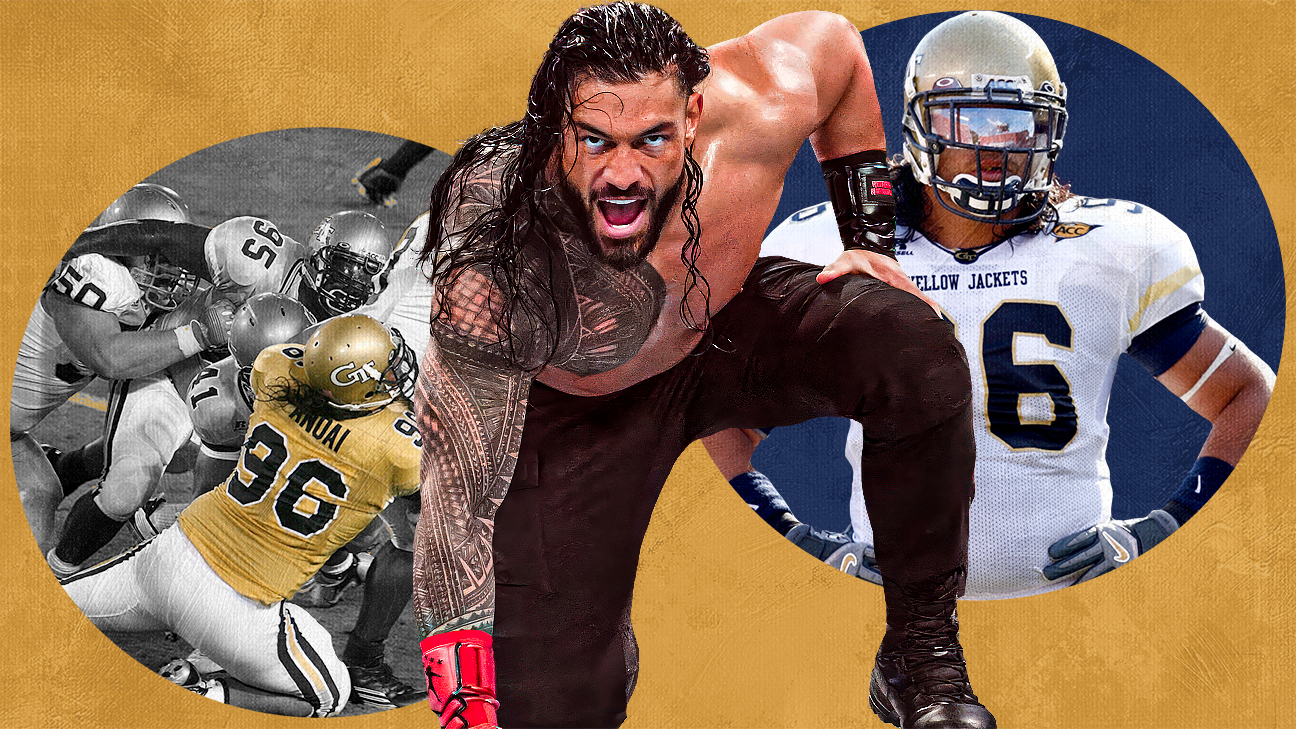
‘I didn’t know what hit me’: Opponents recall Roman Reigns’ playing days at Georgia Tech


-
Harry Lyles Jr., ESPN Staff Writer
ON SEPT. 3, 2005, quarterback Brandon Cox was making his first start for the Auburn Tigers, who were coming off an undefeated season in which they finished No. 2 in the AP poll.
“It’s still a game I have nightmares about,” he said.
With running back Kenny Irons out, Auburn was short-handed in the ground game, meaning Cox would take on a greater role. And the Tigers’ opponent that day, Georgia Tech, had a defense built to make an inexperienced quarterback’s life difficult.
It was led by senior defensive tackle Joe Anoa’i, who would go on to have a first-team All-ACC season for the Yellow Jackets.
“We wound up throwing the ball a lot more than we planned to,” Cox said. “And I was hit a lot, most of the time by Joe.”
One play in particular summed up Cox’s misery. Midway through the fourth quarter, Anoa’i beat Auburn center Joe Cope with a spin move and hit Cox’s elbow as he threw. The pass was intercepted, and as Cox turned to run toward the defender, Anoa’i was standing right there and flattened him.
“I didn’t know what hit me,” Cox said.
Today, Cox has two young sons. While they have become big Auburn fans and know their dad once was the Tigers’ quarterback, he hasn’t shown them the hit that Anoa’i delivered, but said he expects to one day.
“I’ll be like, ‘Yeah, your dad was about beheaded by Roman Reigns back in 2005.'”
JOE ANOA’I HAS found new ways to inflict punishment on his opponents, such as the Superman punch and his signature spear. Under the name Roman Reigns, he is the WWE Universal champion and will headline the main event at WrestleMania 40 this weekend.
The roots of Reigns’ success as a professional wrestler were apparent to those who coached and played with and against him at Georgia Tech, Cox in particular.
“After starting for three years, looking back, that was probably one of the hardest-hitting games I was a part of,” he said. “There were a lot of times that I was peeling myself off the ground.”
Wrestling is in Leati Joseph Anoa’i’s blood. His father, Sika, and his uncle Afa were the Wild Samoans, one of the top tag teams of the 1980s. He is cousins with WWE Hall of Famer Rikishi. Reigns and Dwayne “The Rock” Johnson share a Samoan heritage and consider themselves cousins, even if not by blood.
Given his lineage, it’s not shocking Anoa’i, as Roman Reigns, has become, in wrestling storylines, the Tribal Chief, Head of the Table and leader of The Bloodline, and has held the championship belt for more than three years.
But before wrestling captured his full attention, Anoa’i got bit by the football bug — and he remembers the specific moment it happened.
When he was 7, growing up in Pensacola, Florida, he went to his best friend Henry’s house to play. He knocked on the door, Henry’s mom let him in, and told him her son would be downstairs in a minute.
Anoa’i looked over to the island in the kitchen, and a football helmet sitting on the counter caught his eye. It was green with silver wings on it.
“It looked like a Philadelphia Eagles helmet,” he said. “We were the Myrtle Grove Eagles.
“It was like a movie where it had a halo shining behind it,” Anoa’i recalled, as if seeing it again for the first time. “I was like, ‘Oh, what’s that?’
“And Henry saw me staring, he goes, ‘Hey, I’m playing football this year. Let’s go outside.’ He put it on and just ran right into the house. He’s like, ‘See? I’m all right!’ And that’s how I knew. It wasn’t even about football. It’s just, ‘I gotta get one of these helmets. I’m not even sure what this football thing is all about. But this helmet is the coolest thing ever.'”
AFTER A SUCCESSFUL high school football career, Anoa’i was looking for a place to play college ball. He had interest from some Conference USA schools and potentially some other bigger programs, but the search essentially ended when he visited Georgia Tech.
“Once I went to Tech, I just knew that that’s what it was, man,” he said. “The city of Atlanta just offered so much. It was the city I was looking for, the experience I was looking for.
“There was something about Tech and the legacy of it, being a part of something. A lot of these other schools, one of their sales pitches were, ‘You’re gonna create history here because the program’s not that old.’ But there was just something about being at Tech and you know, being a part of something that’s been around for a century long. … There’s just something about joining that fraternity that just made it an easy close on me.”
When Anoa’i speaks of Atlanta, the second “T” goes silent, just like the locals say it, and he has a variety of local spots he can still rattle off the top of his head.
He and his boys had their go-to bar, Moondogs, in Buckhead. Other favorites were OK Cafe, Willy’s, Rocky Mountain Pizza and Silver Skillet.
And Fellini’s Pizza. “My wife ran track at Tech,” he said, “and that was our first date on Valentine’s Day.
“Even places as mainstream as Waffle House. You go in Waffle House in Atlanta, and at 2:30, 3 a.m.? There’s always a story.”
Of course, Anoa’i and his friends created their own stories during college. With his connections, Anoa’i would take teammates to wrestling events when the WWE came to Atlanta.
Joe Gaston, who met Anoa’i when both were on their recruiting visits to Georgia Tech and later became his roommate, said, “We were backstage hanging out with The Rock and a couple other of those big-name guys. I think they knew Joe just based on his family.
“Those guys, it’s funny because they have their personalities they have to maintain as part of their gig, and then you see them backstage and they’re just regular guys that are doing what they love to do.”
During at least one of those outings, Anoa’i and his teammates got to meet The Undertaker. Former Georgia Tech running back Tashard Choice, who grew up a big wrestling fan, passed.
“This dude Undertaker caused me so many nightmares,” Choice said. “And the first thing Joe said to me, ‘He’s cool as hell, bro. One of the coolest dudes you’ll ever meet.’ I’m sitting there going, ‘Damn, Joe! You know The Undertaker!?’ Because I grew up, that dude scared the hell out of me. To hear Joe talk about dudes that I watched my whole life, and talk to him about who they really are as people, I’m like dawg, that’s cold.”
BUT AT THAT point in his life, Anoa’i’s main focus was football, and it was something he excelled at.
Defensive coordinator Jon Tenuta’s units at Georgia Tech in the early and mid-2000s were known for their toughness, and Anoa’i was exactly the kind of player Tenuta would lean on.
“Jon Tenuta’s that guy,” former Georgia Tech quarterback Reggie Ball said. “And he loved Joe. Joe was one of his guys, and he didn’t hide that, either.”
“He was very fundamentally sound, but he was also very athletic,” Tenuta said of Anoa’i. “He had great feet and he could really shoot his hands.”
Beyond his impact during games, Anoa’i took practice as seriously as anyone.
“Every day at practice you noticed him because he was flipping blocks or he was knocking somebody over,” Tenuta said. “He’s always running to the ball. He was a high-motor guy, that’s just how he was. … He just liked playing football.”
Choice describes Anoa’i’s game in two words: “Physical. Violent.”
“That is who he is,” Choice said. “Joe loved contact because he had to. He played all the way to the fourth quarter. He was a dude you could count on.”
Chan Gailey, Tech’s head coach at the time, recalled, “He was strong as an ox, and he was quicker than you thought he was.”
Anoa’i was an Iron Jacket, an honor given to the strongest players on the team. He was also awarded the team’s Lifter of the Year in 2006, alongside fellow team captain and future Pro Football Hall of Fame wide receiver Calvin Johnson.
“The criteria we had for those awards was you had to be a leader, but you also had to make the people around you better,” then-Georgia Tech strength coach Eric Ciano said. “And Joe obviously always did that.”
Philip Wheeler, who played linebacker for the Yellow Jackets and spent nine years in the NFL, said, “I would be in awe watching him, like, ‘Oh yeah, we’re gonna be good. … I’m good, I’m playing behind Joe.'”
Giff Smith, Georgia Tech’s defensive line coach at the time, remembers the moment he knew Anoa’i would be a great player. Brad Honeycutt, an offensive lineman for the Yellow Jackets, got the better of Anoa’i one day in practice early in his career.
“[Honeycutt] kind of punked Joe in a one-on-one,” Smith said. “I kind of laid into [Anoa’i]. That was when I knew he was gonna be special, because of the look in his eyes. If he could have legally kicked the s— out of me at that point, he would have. And that was the response I was looking forward to. And then he took off after that.
“He had a little fire,” Smith added, “[that would] make you reevaluate your decision for a split second when you’re challenging him.”
Anoa’i’s drive and fire helped him become a three-year starter and first-team All-ACC player and team captain by his senior season in 2006, when Tech went 9-5 overall and 7-1 in conference play.
“Every time we won games, Joe was a part of it,” Choice said. “He was always inspiring, he was somebody when the going got tough, he was always encouraging others.”
“When he talked, everybody listened because he wasn’t a super vocal leader,” fullback Mike Cox said. “But he definitely had a presence. Wherever he went, you knew where he was. It was kind of ominous, or just intimidation. He just oozed confidence.”
And if it came down to telling a teammate what he needed to hear, he’d do that, too.
“That’s what I loved about him,” Choice said. “He was always cool no matter what the situation was, but you knew if he was pissed at someone. He’d tell you, but he didn’t tell you in any way to demean you. He said it straight up, matter of fact.”
After Georgia Tech suffered a close, frustrating loss to Georgia at the end of the 2006 regular season, the Yellow Jackets played Wake Forest in the ACC championship game.
They couldn’t get anything going offensively — they would lose 9-6 — and Anoa’i let Ball know he felt he needed to do more.
“He was pissed,” Ball said. “He wasn’t shy about letting it be known, like, ‘Hey bro, you got to make plays. You need to make it happen. You need to make it work.’ And at the time, you want to do everything that coaches tell you to do. You don’t want to go off script.”
That’s not how Anoa’i saw it.
“We got a Calvin Johnson on our team,” Anoa’i said. “You know what I mean? Screw what they’re calling, I’m just throwing it up. There’s just no excuse. We got T. Choice in the backfield. So let’s just get the job done.
“I guess I said, ‘Let’s just make this work,’ because that’s what we’ve been doing. All this work. And I’m not trying to leave here empty-handed. And unfortunately, it happened.”
Ball took the criticism in stride because of Anoa’i’s credibility as a player and fellow co-captain.
“I know it’s not coming from a spiteful place or a place of demoralizing or trying to tear anybody down,” he said. “It’s coming from a place of somebody who wants to win and somebody who wants the best for their team.”
0:57
Reigns: Cody Rhodes took my ‘storybook ending’ with The Rock
Roman Reigns joins “The Pat McAfee Show” and explains how wrestling The Rock was the WrestleMania “endgame” until Cody Rhodes.
THE 2005 AUBURN Tigers couldn’t forget Joe Anoa’i even if they tried.
“Brandon Cox? Auburn? Oh, hell yeah,” Ball said. “[Joe] was whooping their ass.”
Cope, the Auburn center, recalled the scouting report on Anoa’i being more thorough than usual.
“He was the guy on their defensive line that year that we had circled and said, ‘To win this game, we’re gonna need to really do a good job blocking him,'” Cope said. “Our offensive line coach was telling us that his father was a former wrestler, and that he came from a wrestling background. It was more of, he’s not going to do things by the book that we’re used to. He doesn’t play like a traditional defensive tackle. He’s a playmaker, he’s got that athletic ability to do some wild stuff on the field.”
That became clear to Cope from the first play of the game, which let him know what the Tigers were in for.
“He was a shade to my right side, and we ran a zone to that side. We snapped the ball and all of a sudden [Anoa’i] was by me,” Cope said. “And I was like, ‘Whoa, what just happened here?’ Just super quick, and made a tackle in the backfield. It haunts me to this day.”
The source of Cox’s nightmares came a bit later.
“Nowadays they would have crucified me for what I did to Brandon Cox,” Anoa’i said. “And I apologize, I was caught up in the moment. It’s like one of those things where you’re just in it. You’re in a fight and you’re like, ‘I don’t know how I got into this thing.'”
With about eight minutes left in the fourth quarter and Georgia Tech leading 20-14, Anoa’i again beat Cope, this time with a spin move, pressuring Cox into throwing the ball. Anoa’i hit Cox as he let go of the pass, which was intercepted by KaMichael Hall.
As Cox turned to pursue Hall, Anoa’i delivered a blow that’s always near the top of any highlight reel made of his football career.
Giff Smith summed it up as well as anyone.
“I remember thinking that I was glad I didn’t play quarterback,” he said. “He knocked the ever-living s— out of that guy. Good gracious.”
Gaston added, “It was one of those hits that you hear it in the crowd, that ‘Ahhh!'”
“I was just blindsided by Joe,” Cox said. “I’m on the ground and all of a sudden he jumps on top of me and he has his forearm up underneath my chin. And just laying on top of me.
“I still remember that vividly, thinking in my head, ‘So this is what college football is like?’ A kind of welcome-to-the-game type of hit.”
Georgia Tech won the game 23-14, forcing six Auburn turnovers, including four Cox interceptions. Anoa’i finished with just one solo tackle, but Cox said that doesn’t reflect his impact.
“There were a lot of hits on me that didn’t go down as sacks or tackles in the final book,” he said.
In fact, Cox said he was hit so many times after the whistle that Auburn submitted game film to the ACC, whose officials worked the game, and got a handwritten apology from the league, which acknowledged there were multiple late hits that should have been called penalties.
Anoa’i has an explanation for it all.
“Let me just preface this,” he began. “By the time he’s on the ground, it was dirty what I was doing. It was a little dirty, but the hit was actually legal.
“He goes to throw the ball, I hit his arm, it deflects, we intercept it. Brandon turns to run. He’s now a defender, correct? He’s moving toward the angle, you can watch the film, he does it. And I’m in a perfect position.
“I kind of gather myself, and I just shoot my hands into him like he’s an offensive lineman. For anybody who doesn’t play football, they’ll look at this and be like, ‘That’s ridiculous.’ But if you play defensive line, that’s exactly how you shoot your hands and that’s what I did to him, but he’s just not an offensive lineman.
“But then that momentum took me down with him, and I landed kind of with my forearm on his throat. And I struggled getting off of him. So that was kind of where people would think, ‘Oh, that’s a little dirty,’ but I was trying to get off him. But he was sweaty and slippery, so I kept slipping. So that little bit at the end was probably a bit excessive.
“The play was a great play, in my opinion. It was a turnover, so that speaks for itself.”
GEORGIA TECH OPENED the 2006 season on an even bigger stage. “College GameDay” was in midtown Atlanta, where the Yellow Jackets were hosting No. 2 Notre Dame and Heisman hopeful Brady Quinn at Bobby Dodd Stadium.
“I think that was [Anoa’i’s] coming-out party for everybody around the country,” Ball said. “And I think scouts around the country really started to take note of who [No.] 96 was.”
“I moved Joe up and down the line that game just to screw with their offensive line because he could handle it,” Tenuta said. “He was a very smart football player, and he understood what he had to do to make us successful.”
As with Cox, there is one play from that game that people ask Quinn about. It’s one that — when you learn Joe Anoa’i became Roman Reigns — makes all the sense in the world.
“On that play, like most good quarterbacks, [Quinn] just shifted over a bit,” Anoa’i recalled. “I went to bat the ball and one of his guys just checked my hip. And as my momentum took me, it just kind of did like a wrestling crossbody where you land on him, so it kind of was a perfect wrestling move.”
Despite a flying Anoa’i landing on top of him, Quinn said, “I don’t remember the hit or anything like that at all. I kind of pop right back up.
“The funny thing about the clip is people will show me that all the time who are avid wrestling fans. And I’m like, I wish I could tell you it hurt. But maybe that was the beginning of fake wrestling because it really didn’t hurt, it really didn’t feel real.”
That comment brought a big smile to Anoa’i’s face. “It’s funny that he had his little, smart dig,” he said. “Because it’s simple, we can put Brady Quinn in the wrestling ring, and I’ll boom his ass real quick.”
Anoa’i added, “The fact that we’re 18 to 22 [years old], we’re all like Superman at that point. I’m not surprised that he didn’t feel anything.”
All joking aside, Anoa’i acknowledges that two of the most replayed highlights of his career undoubtedly would be penalties today.
“I support the rules and where the game is now. But that’s just the way we played it back then,” he said. “I was not a dirty player by any means. I wasn’t one of those crazy, emotional intense players, but I was intense. When it’s taken out of context, it doesn’t sound right.
“But when you’re in the middle of what we’re doing out there, you’re kind of ready for war. You take it to that mental level of, ‘Man, I’ll do whatever we got to do to win,’ — obviously without doing stupid stuff. But we were taught whistle to whistle. … And that’s what was expected.
“[Smith] and Tenuta were the best coaches I ever played for, and we reflected that. When you’re in film study with Tenuta, he’s going to call you out,” Anoa’i said. “It’s his ring. He’s cutting the best promos of all time. He would sit there and put you on the spot, just embarrassing people. I didn’t want to be embarrassed.”
Anoa’i said his coaches’ approach gave him extra motivation to study the playbook and tape even more.
“They took it very seriously, what we were doing, and I think we all did, and that’s why we were a top-10 defense, is because we all played from whistle to …” Anoa’i paused. “Slightly after the whistle, just in case I didn’t hear that whistle.”
PRETTY MUCH EVERYBODY who played with or against him thought Anoa’i was going to be an NFL player.
AJ Smith, who played offensive line for the Yellow Jackets, said, “Joe was such a great football player. It was always, ‘Joe’s gonna play in the league. Joe’s gonna be an NFL guy.’ I don’t think it ever crossed our minds that he was gonna be where he is in WWE today.
“But at the same point in time, nobody’s surprised because Joe’s committed to his craft, and the work ethic that he put in to be an elite player in college football, he’s put in that same work ethic to be top of his craft in WWE.”
Anoa’i did get a chance in the NFL, but it was fleeting. While getting his physical at Minnesota Vikings rookie minicamp, he learned that he had chronic myeloid leukemia.
Gaston, who remained close with Anoa’i after their playing days, said, “He dove in headfirst and said, ‘I can’t change the fact, let’s just do everything we can do to try to beat this, and understand it first, and then just attack it.'”
The Vikings released him, and when he got into remission, he signed with the Jacksonville Jaguars with a couple of weeks left of camp in 2007, although he wasn’t in game shape due to his recovery.
After being cut on the final day of camp with Jacksonville, he signed with the Hamilton Tiger-Cats of the Canadian Football League in 2008. He rolled an ankle in practice, and once he was cleared to play, he was cut again.
The challenges of chasing his football dream began to weigh on Anoa’i, who was struggling financially with a 1-year-old now in his life and rent to pay.
“It was more stressful than anything,” he said. “So I just knew it was time to let it go.”
After football, Anoa’i said he was working in a warehouse for his sister, assembling office furniture, building cubicles, loading trucks — “just doing blue-collar work, labor.”
“While I was doing that, I lost my football weight,” he said. “I was kind of starting to peel some of that excessive weight off. I could start to see the guy that went into Tech, the high school version of me.”
Meanwhile, his cousins, current WWE wrestlers Jimmy and Jey Uso, were starting their journeys in independent wrestling while also working at the warehouse.
“It started kind of plugging me back into wrestling because I loved it when I was a kid,” he said. “I loved it until football just took over.”
Eventually, his cousins left the warehouse job.
“I was by myself,” he said. “That was the most depressing part. There was no more camaraderie there. We weren’t having a good time at work. It was just me quietly building office furniture. Terrible.”
One day, while Anoa’i was building office chairs, his dad walked in. Laughing, his father asked, “Oh, you’re just gonna be a chair builder your whole life?”
Trying to be slick, Anoa’i responded, “Well, you never taught me how to wrestle.”
He thought his father was going to leave it there and go to lunch. Instead, he asked, “Well, do you want to learn?”
The former Wild Samoan and future Roman Reigns had a couple of training sessions. After his father made a couple of calls, Reigns said he was “thrown into the deep end” in the WWE developmental program in Tampa, Florida, where he had a tryout.
“And now I’m here,” he said.
Reigns said if football had worked out, he doesn’t think he ever would have gotten into wrestling.
“I wanted to have an impact on young men,” he said. “I wanted to be the way Emmitt Smith and Michael Jordan and Joe Montana and the stars of when I was a child, the way they made me feel. I wanted to make other young athletes feel that way.
“But no matter what, it was either you’re going to be a wrestler, or you’re going to be a football player.
“A superstar of some sort.”


-
Bradford Doolittle
ORLANDO, Fla. — There were a number of ironies surrounding the results of the contemporary baseball era committee’s Hall of Fame ballot, announced Sunday night at MLB’s winter meetings.
Perhaps the most poignant is this: If not for Barry Bonds, Jeff Kent — the only one of the eight players under consideration selected Sunday — might not be bound for Cooperstown. While Kent is the all-time home run hitter among second basemen, he was on the same ballot as Bonds — who hit more homers than anyone, at any position.
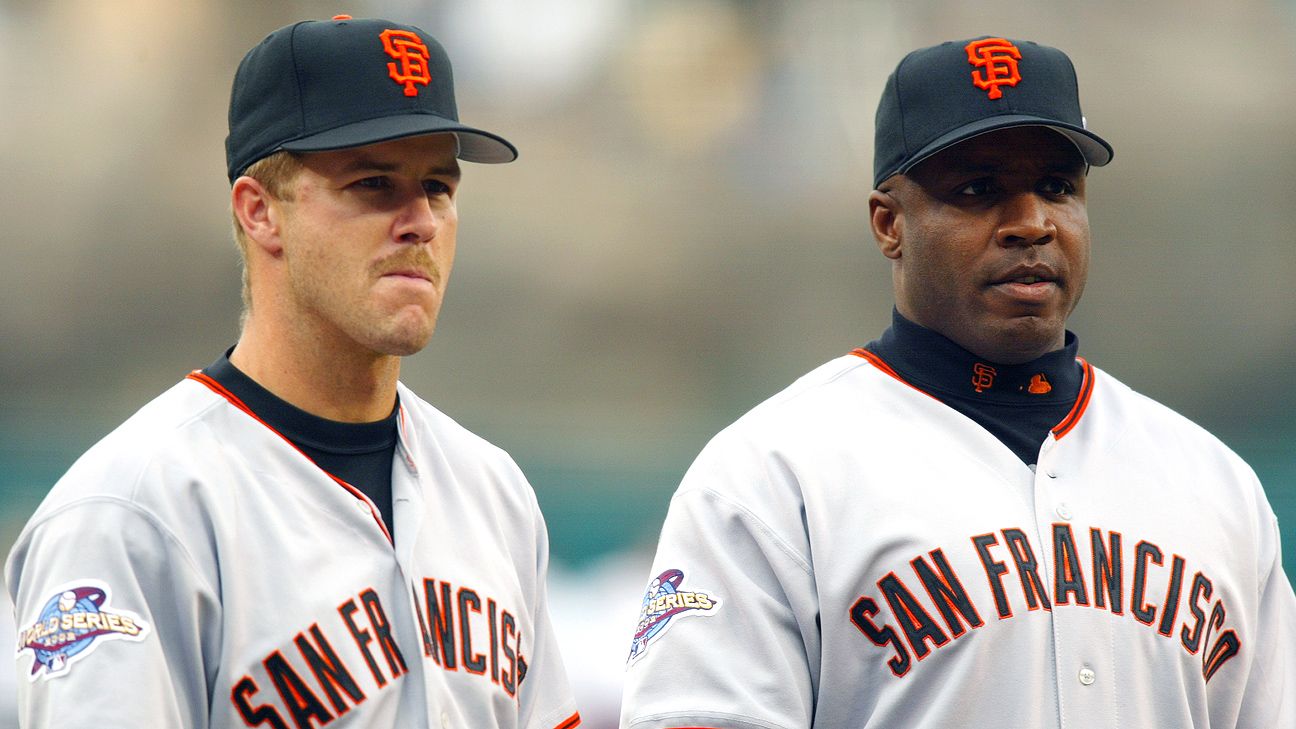
During a post-announcement news conference, Kent recalled the way he and Bonds used to push, prod and sometimes annoy each other during their six seasons as teammates on the San Francisco Giants. Those were Kent’s best seasons, a fairly late-career peak that ran from 1997 to 2002, during which Kent posted 31.6 of his 55.4 career bWAR.
The crescendo was 2000, when Kent enjoyed his career season at age 32, hitting .334 with a 1.021 OPS, hammering 33 homers with 125 RBIs and compiling a career-best 7.2 bWAR. Hitting fourth behind Bonds and his .440 OBP, Kent hit .382 with runners on base and .449 with a runner on first base.
During Kent’s six years in San Francisco, he was one of five players in baseball to go to the plate with at least one runner on base at least 2,000 times, and the other four all played at least 48 more games than he did. Turns out, hitting behind Bonds is a pretty good career move.
To be clear, Kent was an outstanding player and the numbers he compiled were his, and his alone. When you see how the news of election impacts players, it’s a special thing. I am happy Jeff Kent is now a Hall of Famer.
But I am less happy with the Hall of Fame itself. While Kent’s overwhelming support — he was named on 14 of the 16 ballots, two more than the minimum needed for induction — caught me more than a little off guard, what didn’t surprise me was the overall voting results. In what amounted to fine print, there was this mention in the Hall’s official news release: “Barry Bonds, Roger Clemens, Gary Sheffield and Fernando Valenzuela each received less than five votes.”
By the new guidelines the Hall enacted for its ever-evolving era committee process — guidelines that went into effect with this ballot — Bonds, Clemens, Sheffield and Valenzuela aren’t eligible in 2028, the next time the contemporary era is considered. They can be nominated in 2031, and if they are, that’s probably it. If they don’t get onto at least five ballots then, they are done. And there is no reason to believe they will get more support the next time.
I thought that the makeup of this committee was stacked against the PED-associated players, but that’s a subjective assessment. And who knows what goes on in those deliberations. With so many players from the 1970s and 1980s in the group, it seemed to bode well for Don Mattingly and Dale Murphy. But they were both listed on just six ballots. Carlos Delgado had the second most support, at nine.
Why? Beats me. I’ve given up trying to interpret the veterans committee/era committee processes that have existed over the years. But the latest guidelines seem perfectly designed to ensure that for the next six years, there’s no reason to wail about Bonds and Clemens being excluded. Then in 2031, that’s it.
Meanwhile, the classic era will be up for consideration again in 2027, when Pete Rose can and likely will be nominated. Perhaps Shoeless Joe Jackson as well. What happens then is anybody’s guess, but by the second week of December 2031, we could be looking at a Hall of Fame roster that includes the long ineligible (but no more) Rose and maybe Jackson but permanently excludes the never-ineligible Bonds and Clemens — perhaps the best hitter and pitcher, respectively, who ever played.
If and when it happens, another kind of symbolic banishment will take place: The Hall will have consigned itself, with these revised guidelines, to always being less than it should be. And the considerable shadows of Bonds and Clemens will continue to loom, larger and larger over time, just as they happened with Rose and Jackson.
Ironic, isn’t it?
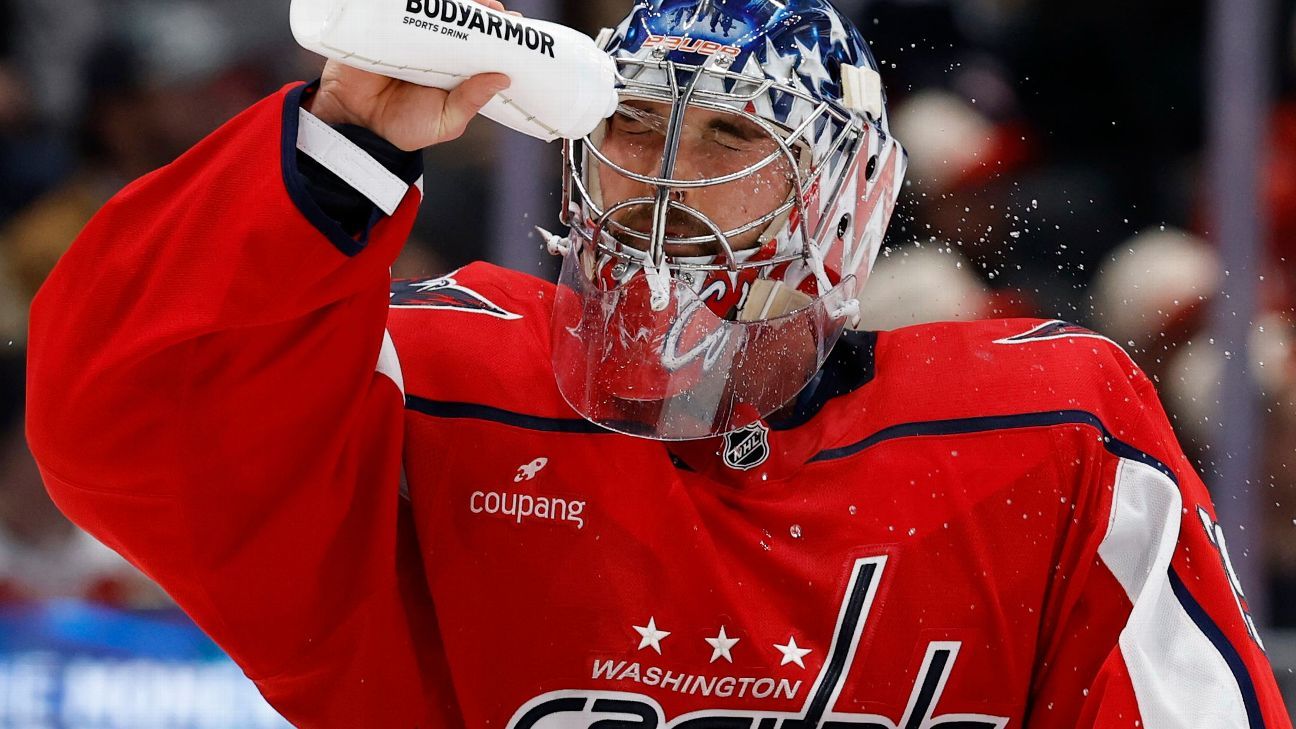

WASHINGTON — The Washington Capitals placed goaltender Charlie Lindgren and forward Ryan Leonard on injured reserve Sunday night before their game against the Columbus Blue Jackets.
Washington recalled forward Bogdan Trineyev and goaltender Clay Stevenson from Hershey of the American Hockey League.
Lindgren (upper body) was a late scratch Friday night before a 4-3 shootout loss at Anaheim. Leonard (upper body) didn’t return after his face was bloodied on an unpenalized first-period check from Jacob Trouba.
“He’s going to miss an extended period of time,” Capitals coach Spencer Carbery said about Leonard, the rookie who has seven goals and 11 assists after having two each Wednesday night in a 7-1 win at San Jose.
Lindgren is 5-3 with a 3.11 goals-against average in his 10th NHL season and fifth with Washington.
“We’ll see once he gets back on the ice,” Carbery said. “But [we] put him on the IR, so he’s going to miss, what is it, seven days at the bare minimum. And then we’ll see just how he progresses.”
-
Bradford Doolittle
ORLANDO, Fla. — Jeff Kent, who holds the record for home runs by a second baseman, was elected to the National Baseball Hall of Fame on Sunday.
Kent, 57, was named on 14 of 16 ballots by the contemporary baseball era committee, two more than he needed for induction.
Just as noteworthy as Kent’s selection were the names of those who didn’t garner enough support, which included all-time home run leader Barry Bonds, 354-game winner Roger Clemens, two MVPs from the 1980s, Don Mattingly and Dale Murphy, and Gary Sheffield, who slugged 509 career homers.
Bonds, Clemens, Sheffield and Dodgers great Fernando Valenzuela were named on fewer than five ballots. According to a new protocol introduced by the Hall of Fame that went into effect with this ballot, players drawing five or fewer votes won’t be eligible the next time their era is considered. They can be nominated again in a subsequent cycle, but if they fall short of five votes again, they will not be eligible for future consideration.
The candidacies of Bonds and Clemens have long been among the most hotly debated among Hall of Fame aficionados because of their association with PEDs. With Sunday’s results, they moved one step closer to what will ostensibly be permanent exclusion from the sport’s highest honor.
If Bonds, Clemens, Sheffield and Valenzuela are nominated when their era comes around in 2031 and fall short of five votes again, it will be their last shot at enshrinement under the current guidelines.
Kent, whose best seasons were with the San Francisco Giants as Bonds’ teammate, continued his longstanding neutral stance on Bonds’ candidacy, declining to offer an opinion on whether or not he believes Bonds should get in.
“Barry was a good teammate of mine,” Kent said. “He was a guy that I motivated and pushed. We knocked heads a little bit. He was a guy that motivated me at times, in frustration, in love, at times both.
“Barry was one of the best players I ever saw play the game, amazing. For me, I’ve always said that. I’ve always avoided the specific answer you’re looking for, because I don’t have one. I don’t. I’m not a voter.”
Kent played 17 seasons in the majors for six different franchises and grew emotional at times as he recollected the different stops in a now-Hall of Fame career that ended in 2008. He remained on the BBWAA ballot for all 10 years of his eligibility after retiring, but topped out at 46.5% in 2023, his last year.
“The time had gone by, and you just leave it alone, and I left it alone,” Kent said. “I loved the game, and everything I gave to the game I left there on the field. This moment today, over the last few days, I was absolutely unprepared. Emotionally unstable.”
A five-time All-Star, Kent was named NL MVP in 2000 as a member of the Giants, who he set a career high with a .334 average while posting 33 homers and 125 RBIs. Kent hit 377 career homers, 351 as a second baseman, a record for the position.
Kent is the 62nd player elected to the Hall who played for the Giants. He also played for Toronto, the New York Mets, Cleveland, Houston and the Dodgers. Now, he’ll play symbolically for baseball’s most exclusive team — those with plaques hanging in Cooperstown, New York.
“I have not walked through the halls of the Hall of Fame,” Kent said. “And that’s going to be overwhelming once I get in there.”
Carlos Delgado was named on nine ballots, the second-highest total among the eight under consideration. Mattingly and Murphy received six votes apiece. All three are eligible to be nominated again when the contemporary era is next considered in 2028.
Next up on the Hall calendar is voting by the BBWAA on this year’s primary Hall of Fame ballot. Those results will be announced on Jan. 20.
Anyone selected through that process will join Kent in being inducted on July 26, 2026, on the grounds of the Clark Sports Center in Cooperstown.
-
 Sports2 years ago
Story injured on diving stop, exits Red Sox game
-
 Sports3 years ago
‘Storybook stuff’: Inside the night Bryce Harper sent the Phillies to the World Series
-
 Sports2 years ago
Game 1 of WS least-watched in recorded history
-
 Sports3 years ago
Button battles heat exhaustion in NASCAR debut
-
 Sports3 years ago
MLB Rank 2023: Ranking baseball’s top 100 players
-
Sports4 years ago
Team Europe easily wins 4th straight Laver Cup
-
 Environment3 years ago
Japan and South Korea have a lot at stake in a free and open South China Sea
-
 Environment1 year ago
Here are the best electric bikes you can buy at every price level in October 2024