
‘I’m never going to stop’: Inside Freddie Freeman and the Dodgers’ march to a title that solidified their dominant era


-
Jeff Passan, ESPN
NEW YORK — Two days before the Los Angeles Dodgers‘ postseason began, Freddie Freeman felt a twinge in his rib cage when he took a swing during a simulated game. He vowed to ignore it. It’s not as if he wasn’t already in pain. Over the previous week, Freeman had nursed a sprained right ankle sustained trying to avoid a tag while running to first base. He needed no more impediments. The Dodgers had a World Series to win.
A day later, Oct. 4, after Freeman finished a news conference in which he declared himself ready to play despite the ankle injury, he retreated to the batting cage at Dodger Stadium. He wanted to take some swings in preparation for a live batting-practice session. His side tingled with each of his first dozen swings. On the 13th swing, Freeman felt a jolt through his body and crumpled to the ground.
Unable to even pick himself off the floor, Freeman was helped into the X-ray room next to Los Angeles’ dugout. The results were inconclusive, and around 9:30 p.m., he received a call. The Dodgers wanted him to drive to Santa Monica for more imaging. He hopped in the car, then in an MRI tube. Around 11:30 p.m., the results arrived: Freeman had broken the costal cartilage in his sixth rib, an injury that typically sidelines players for months.
Devastation set in. Walking hurt. Breathing stung. Swinging a bat felt like an impossibility.
Freeman’s father, Fred, worried about his youngest son, whom he raised after Freeman’s mother, Rosemary, died of melanoma when Freddie was 10. He saw the anguish in every minuscule movement. Considering the injuries to his rib and ankle and the lasting soreness from a middle finger he fractured in August, surely Freeman was too beaten up to keep playing. Surely there would be more postseasons, more opportunities.
“I actually told him to stop,” Fred said. “I said, ‘Freddie, this is not worth it. I know you love baseball. I love baseball. But it’s not worth what you’re going through.’ And he looked at me like I was crazy, and he said, ‘Dad, I’m never going to stop.'”
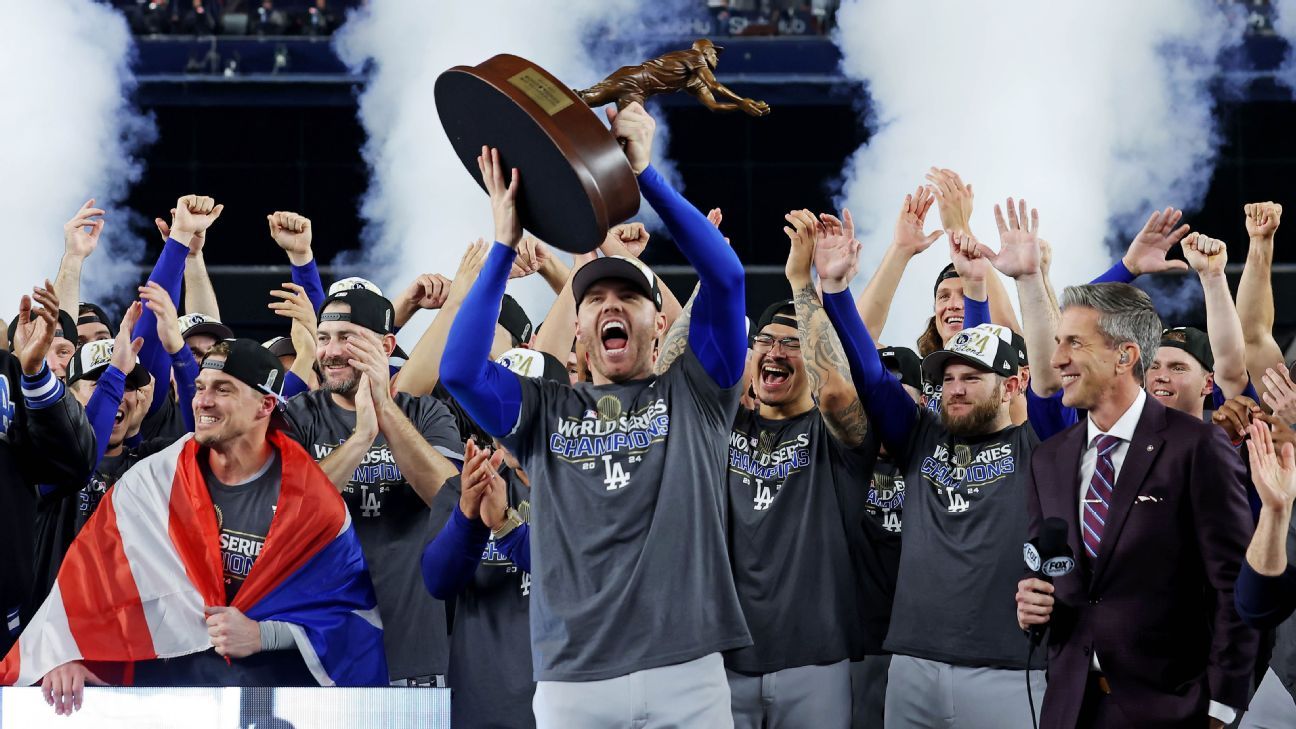
NOT ONLY DID Freeman never stop, he put on one of the Dodgers’ greatest Fall Classic performances in history and readied the franchise for its first victory parade in 36 years.
The championship was won in a Game 5 that saw the Dodgers stake the New York Yankees a five-run lead, claw back for a 7-6 victory thanks to one of the most horrific half-innings in the Yankees’ storied history, and seal the championship with bravura performances from their bullpen and manager.
Los Angeles never got to fete the Dodgers for their World Series victory in 2020. Beyond the lack of a celebration, the title had been demeaned and denigrated by those who regarded it as a lesser championship, the product of a 60-game season played in front of no fans and a postseason run inside a pseudo-bubble. To the Dodgers, that always registered as unfair, and they used the slight as fuel.
“Twenty-nine other teams wanted to win the last game, too, regardless of the circumstances,” said right-hander Walker Buehler, who pitched the ninth inning of Game 5 to close the series for the Dodgers. “Like, everyone that talks about it, fine. … But 29 other professional, billion-dollar organizations would’ve liked to have won the last one. And we did.”
Los Angeles’ fortunes in recent postseasons have belied its evolution into the best organization in baseball. This season, the Dodgers won a major-leagues-best 98 games and their 11th National League West division title in 12 years. Their only championship in that time came in 2020. The Dodgers felt as if they had a World Series stolen from them in 2017 by a Houston Astros team later found to have used a sign-stealing scheme. A juggernaut Boston Red Sox team bulldozed them in five games a year later. The past two years, Los Angeles flamed out in first-round division series.
The Dodgers wanted this championship for so many reasons beyond the obvious. Regardless of a baseball team’s talent or payroll — both areas in which this team finds itself at the game’s apex — October is a baseball funhouse mirror. A team fat on ability can look waifish in a hurry. The short series, the odd schedule, the capacity for a lesser team to beat a better one simply because it gets hot at the right time — all of it conspires to render April through September inert. Teams built for the six-month marathon that is the regular season aren’t necessarily well-constructed for the postseason’s one-month sprint. A team’s ability to code-switch is its greatest quality.
This year, Los Angeles craved validation for its regular-season dominance. Something to silence those who malign its 2020 championship and chalk up its success not to sound decision-making processes and elite player development but an endless flow of cash. The Dodgers cannot deny the power of the dollar after guaranteeing $700 million in free agency to star designated hitter Shohei Ohtani and another $325 million to Japanese right-hander Yoshinobu Yamamoto. Ohtani hit 54 home runs and stole 59 bases during the regular season. Yamamoto threw six brilliant innings in his first World Series game. Money plays.
“World Series champions come in all different sizes and shapes and forms,” Dodgers president of baseball operations Andrew Friedman said. “And there are different strengths that help you win a World Series.”
Their lineup was an obvious one. Even a hobbled Freeman is still an eight-time All-Star — and a former MVP, just like the two men ahead of him in the lineup, Ohtani and Mookie Betts. The Dodgers led major league baseball in home runs and slugging percentage while finishing second in runs scored and on-base percentage . For all the depth the Dodgers’ lineup featured, though, the pitching staff was threadbare on account of a mess of injuries. With just three starting pitchers and a half-dozen trusted relievers — not to mention the necessity of throwing bullpen games, further taxing arms — Los Angeles required a deft touch with its pitching.
Championships take luck and timing and depth and open-mindedness and savvy. World Series are won as much on the margins as they are in the core. And every championship team features something beyond that, a separator, a je ne sais quoi. Like, say, a starter suffering through his worst season emerging to close out a World Series game. Or someone who refuses to let his broken body impede a quest so meaningful to those who rely on him.
IN 2005, WHEN Freddie Freeman was 15 years old, he was hit by a pitch that broke his wrist. Freeman was scheduled to play for Team USA’s 16-and-under national team, and he couldn’t let the opportunity pass. So he simply didn’t tell anyone about his wrist injury and gritted through the agony.
Almost two decades later, Freeman started Game 1 of the division series against San Diego without publicly divulging his broken rib cartilage. Even the slightest competitive advantage can separate win from loss, and Freeman understood the sort of challenge the Padres posed. They had constructed their roster for postseason baseball: heavy on power hitters and front-line bullpen arms, light on offensive swing-and-miss. San Diego ousted the Dodgers from the postseason in 2022 and was prepared to do the same in 2024.
The Dodgers cherished Freeman’s presence, even if he was playing at far less than 100 percent. Their manager, Dave Roberts, told Freeman that simply standing in the batter’s box imputed a particular sort of value: the fear of the unknown. If Freeman were healthy enough to play, opponents would figure, surely he could contribute, too. What San Diego didn’t know was that every time Freeman strode to fire his compact, powerful left-handed swing, his right ankle felt as if it was about to buckle. And when he whiffed on a pitch, his side screamed silently.
“It only hurts when I miss,” Freeman told his father. “So I’m just going to have to stop missing.”
In the first game of the series, with his midsection bound by kinesiology tape to stabilize it, Freeman laced a pair of singles. The limp in his running drew attention away from the rib. When he winced after swing-and-misses — Freeman did so four times in Game 1 of the NLDS — the ankle served as an ideal cover for the actual nerve center of the pain: his rib. After winning the first game, Los Angeles dropped the next two to the Padres, and his symptoms worsened.
“Every day,” Dodgers hitting coach Aaron Bates said, “I would ask: ‘How’s your ankle? How’s your rib? How’s your finger? How’s your brain?'”
The 2024 season already had strained Freeman’s psyche. In late July, his 3-year-old son, Maximus, was diagnosed with Guillain-Barré syndrome, a neurological disorder that necessitated the use of a ventilator and left him unable to walk for a period. Freeman left the Dodgers during the final week of July to take care of Max. Although Freeman returned in early August, when Max was discharged from the hospital and started his recovery, the detritus of the episode remained.
Freeman and his wife, Chelsea, carved days into pieces. Wake up. Get to the afternoon. Then the evening. Then the morning. And repeat.
“It was more just breaking things up, all those small things just to get yourself through,” Chelsea said.
“Never think big picture,” Fred said.
“And then you look back,” Chelsea said, “and you’re like, ‘Oh, my gosh, we can’t believe we went through all that.'”
The perspective helped when the pain in Freeman’s rib would not relent. After Game 3, Freeman listened to Fred. No matter how much treatment he received, how much doctors and trainers did to mask the pain, he needed a break. But to require it in an elimination game — he was despondent. Freeman had signed with the Dodgers on a six-year, $162 million free agent contract in 2022 after a protracted free agency. He joined them following a World Series-winning season with the Atlanta Braves, where he spent the first 12 years of his career. Losing in the division series for the third straight year was not an option. Losing to the Padres again was unthinkable.
When his teammates learned Freeman would sit out Game 4, they rallied around him in the team’s group chat. Kiké Hernández, Miguel Rojas, Max Muncy, Betts — they were in awe of Freeman and what he had done already and offered their appreciation. He had rescued them so many times. They would resuscitate the Dodgers’ season in his absence. The offense scored eight runs, and eight Dodgers relievers combined to shut San Diego out. Two days later, with Freeman back in the lineup, Yamamoto threw five scoreless innings, the bullpen added four more and the Dodgers surged into the NL Championship Series against the New York Mets.
Once there, Freeman struggled, mustering only three singles in 18 at-bats and sitting out Game 4 again. The rest of the Dodgers thrived. Ohtani and Betts each whacked a pair of home runs. Muncy, a remnant of the 2020 team, set a postseason record by reaching base in 12 consecutive at-bats. Tommy Edman hit .407, drove in 11 runs and won NLCS MVP as the Dodgers bounced the Mets in six games. They were off to another World Series, another opportunity to substantiate their belief in themselves, where they would face their American League analog in prestige and might: the New York Yankees.
“Freddie doesn’t complain about really anything,” Chelsea said. “He was getting over four hours of treatment a day, even on days that they weren’t playing, just to be able to hope to play in the postseason. So going into the World Series, we had no expectations. We just were hoping he’d be able to play.”
HAD THE DODGERS deposed the Mets in five games, the World Series would have started Oct. 22, two days after the conclusion of the NLCS. Instead, the Dodgers had four days off, and in that time something happened. On Oct. 21, the day after Los Angeles celebrated its NL pennant, Freeman rested. On Oct. 22, he went through his usual treatment routine and felt noticeably better. By Oct. 23, the respite and therapy felt as if they were making a demonstrable difference in his recovery. On Oct. 24, the day before Game 1 of the most anticipated World Series in years, Freeman and the Dodgers’ staff had identified a cue to unlock the power that had gone missing in the first two rounds of the playoffs.
Freeman would tell himself to stride more toward first base. In actuality, he was not doing so; it would leave him vulnerable to outside pitches, which he had made a Hall of Fame career shooting to the opposite field. The idea of doing so, though, prevented Freeman from hunching over as he swung. A more vertical stance, in theory, would allow Freeman to drive the fastballs that had eaten him up in the NLCS, when he went 2-for-13 against them.
“Dad,” Freeman told Fred, “my swing is back. It’s as good as it’s been all year.”
Fred had heard this plenty of times before. Sometimes his son was right; sometimes he wasn’t. Fred wanted to be optimistic. He needed to see it to believe it.
In the first inning of Game 1, against Yankees ace Gerrit Cole, Freeman sliced a curveball down the left-field line and motored toward second base. New York left fielder Alex Verdugo misplayed the ball, an early sign of the state of the Yankees’ defense, and Freeman kept running. He chugged into third base, slid, popped up, stared into the Dodgers’ dugout, lifted his arms and shook side to side — the original version of what has become known as the Freddie Dance, a celebration adopted by all the Dodgers for big hits.
At the end of the inning, Freeman was left stranded on third base, his ankle throbbing. While the tenderness in his rib area had abated somewhat and his finger felt good enough to throw the ball normally, the 270 feet of running from home to third reminded Freeman that Humpty Dumpty hadn’t been put back together entirely. He tried to joke about it — Freeman occasionally asked Dodgers assistant general manager Alex Slater: “Can we trade ankles?” — but his hobbling was a serious reminder that the between-series break was over.
What unfolded that night constituted one of the best opening games in World Series history. Cole and Dodgers starter Jack Flaherty traded scoreless frames until the Dodgers scored a run in the fifth. The Yankees answered with two in the sixth. Los Angeles tied the score in the eighth. And on to extra innings it went, with New York scratching across a run in the top of the 10th. In the bottom of the inning, Gavin Lux walked with one out. Edman — like Flaherty a trade-deadline acquisition — singled. Yankees manager Aaron Boone called on left-hander Nestor Cortes, who hadn’t pitched in more than five weeks due to an arm injury, to face Ohtani. He induced a flyout.
Boone then intentionally walked Betts to load the bases and face Freeman. Cortes challenged him with a 93 mph fastball on the inside corner, the sort for which his cue was made. He swung, took two steps and lifted his bat with his right hand, Los Angeles’ version of Lady Liberty. The ball flew seven rows into the right-field bleachers. Dodger Stadium shook. Roberts was so giddy reveling in the moment that he bumped into the right arm of Gavin Stone, the young right-hander who two weeks earlier had undergone major shoulder surgery.
In the 119 previous years of World Series games, 695 in all, never had a player hit a walk-off grand slam. Freeman doing so in Game 1, then shambling around the bases invoking memories of Kirk Gibson 36 years earlier — the last time Los Angeles won a full-season World Series — added a poetic touch to the night, one of the most memorable in Dodgers postseason history.
“Game 1, when he hit the grand slam, felt like we won the World Series,” Chelsea said. “Like we were going to win.”
While Chelsea knows baseball well enough to understand it’s never that easy, in the next few games, Freddie continued to make it look so. He blasted another home run off a fastball in a Game 2 win. His two-run, first-inning shot on a high inside 93 mph Clarke Schmidt cutter in Game 3 gave the Dodgers a lead they held for their second consecutive 4-2 victory. For the series’ first three games, Freeman was single-handedly carrying the Dodgers’ offense, just the way it had collectively carried him through the NLCS. Muncy was hitless. Betts cooled down. And Ohtani partially dislocated his shoulder sliding into second base during Game 2 and was never a factor in the series.
The presence of Ohtani, who had absconded from the Los Angeles Angels in pursuit of a championship, as well as that of Yankees slugger Aaron Judge, had turned this World Series into a supersized event — but Freeman was the one owning it. He hit another two-run shot in the first inning of Game 4, marking an MLB-record sixth consecutive World Series game with a home run, his streak dating back to 2021 with Atlanta. The Dodgers’ attempt at a sweep fizzled with a third-inning grand slam by Yankees shortstop Anthony Volpe and eventually turned into an 11-4 blowout, not exactly a surprise considering Roberts stayed away from using his best relievers in hopes of keeping them fresh for a potential Game 5.
Game 4 marked the Dodgers’ fourth all-bullpen effort of the postseason, a staggering number for a team with as much talent as Los Angeles. Consider the names on L.A.’s injured list come October. Longtime ace and future Hall of Famer Clayton Kershaw made only seven starts before a toe injury ended his season. Tyler Glasnow, acquired to help anchor the rotation over the winter, never returned from a mid-August elbow injury. Stone, the Dodgers’ best starter this season, was out. So was Dustin May after an esophageal tear. Emmet Sheehan, River Ryan and Tony Gonsolin all were on the shelf following Tommy John surgery, and the Dodgers had signed Ohtani, MLB’s first two-way player in nearly a century, knowing he wouldn’t pitch in 2024 because of elbow reconstruction.
Losing a rotation-and-a-half worth of starting pitchers would have torpedoed any other team. Los Angeles had figured out how to weather the deficiency, with Roberts and pitching coach Mark Prior puppeteering their 13-man pitching staff without excessive fatigue or overexposure to Yankees hitters. It was a delicate balance, one they feared could collapse if Game 5 went the wrong way.
AROUND 3 P.M. on Wednesday, Walker Buehler boarded the Dodgers’ team bus to Yankee Stadium, looked at general manager Brandon Gomes and said: “I’m good tonight if you need me.” Two nights earlier, Buehler had spun magic in Game 3, shutting down New York in five scoreless innings. He was scheduled to throw a between-starts bullpen session; if he needed to forgo it to instead throw in a World Series game, he was ready.
Buehler is 30 and coming off the worst regular season of his career, winning just one of his 16 starts and posting a 5.38 ERA. He missed all of 2023 after undergoing his second Tommy John surgery and returned a much lesser version of the cocksure right-hander whose postseason badassery earned him a reputation as one of baseball’s finest big-game pitchers. His fastball lacked life and his breaking balls sharpness, and with free agency beckoning, Buehler had looked positively ordinary.
This was October, though, and the month has always brought out something different in him. He dotted his fastball in all four quadrants of the strike zone in Game 3, flummoxing Yankees hitters. It revved past them with the sort of carry he displayed over four shutout innings against the Mets in the NLCS. Back, too, was Buehler’s self-assuredness. Just in case Gomes and the rest of the Dodgers’ staff didn’t understand what he meant, Buehler reiterated at the stadium: “If things get a little squirrelly, then I’ll be ready.”
The game was all Yankees to start. Judge hit his first home run of the series in the first inning. Jazz Chisholm Jr. followed with another. An RBI single from Verdugo in the second inning chased Flaherty after he had recorded just four outs. For the second consecutive night, Roberts would need to lean on his bullpen. He went into break-glass-in-case-of-emergency mode. Left-hander Anthony Banda escaped a bases-loaded jam in the second. Ryan Brasier allowed a third-inning leadoff home run to Giancarlo Stanton. Michael Kopech pitched the fourth and wriggled out of a first-and-second-with-one-out situation.
In the meantime, Cole was cruising. He held the Dodgers hitless through four innings. Hernández broke that streak with a leadoff single in the fifth. Edman lined a ball to center that clanked off Judge’s glove, his first error on a fly ball since 2017. After Volpe fielded a ground ball and tried to nab the lead runner at third, Hernández almost Eurostepped into his throwing lane, a brilliant bit of baserunning that illustrated the difference between Los Angeles’ and New York’s fundamentals. Volpe bounced the throw for a second error in the inning, loading the bases.
Cole bore down, striking out Lux and Ohtani, and Betts squibbed a ball at 49.8 mph toward Yankees first baseman Anthony Rizzo. Even with the English spinning the ball away from the first-base bag, Rizzo likely could have tagged first to end the inning. He expected to flip the ball to Cole, who anticipated Rizzo would take the out himself. Once Rizzo realized Cole had not covered the bag, he shuffled toward first. Betts beat him there, and the mental blunder gave the Dodgers their first run of the day.
Freeman served a single on an inner-third, two-strike, 99.5 mph fastball — the hardest pitch Cole threw all season — to center for two more runs. And on another 1-2 pitch that caught too much of the plate, Teoscar Hernandez drove the ball 404 feet to center field. Because it hopped against the wall instead of over it, Freeman hauled all the way from first to home. Just like that, a 5-0 advantage had evaporated into a 5-5 tie.
Yankee Stadium, minutes earlier a madhouse, flatlined. Buehler had adjourned to the weight room, loosening his arm with a yellow plyometric ball. He saw Slater, who works out during the game to calm his nerves.
“Is it squirrelly yet?” Buehler asked.
It was squirrelly, all right. Friedman had come downstairs to consult with the rest of the front office about the logistics of finding a lie-flat airplane seat to fly Yamamoto back to Los Angeles ahead of the team for a potential Game 6. Now, instead of expending energy on that, they focused on how the Dodgers would possibly secure the final 15 outs of the game if they could steal a lead.
Inside the dugout, Roberts and Prior were doing the same. They were counting on left-hander Alex Vesia for more than one inning. With his pitch count run to 23 after weathering a bases-loaded situation by getting Gleyber Torres to fly out to right field, Vesia was done after the fifth. Buehler had returned to the dugout, and Prior asked whether he had thrown all day. No, Buehler said. He offered his services to Roberts, who told him to head to the bullpen, which he did at 10:08 p.m. When Buehler arrived, he saw Brent Honeywell, whose 7⅔ innings in the NLCS had helped keep the Dodgers’ bullpen fresh, and Joe Kelly, the veteran not on the roster because of an injury.
“What the f— are you doing here?” Honeywell said.
“I just came out here to hang with you and Joe,” Buehler said.
Brusdar Graterol, the Dodgers’ sixth pitcher of the night, walked the first two hitters in the sixth and allowed the Yankees to take a 6-5 lead on a Stanton sacrifice fly. After a third walk left runners on first and second, Roberts summoned Blake Treinen, the Dodgers’ best reliever, to face Volpe, who grounded out to second on a full count.
“I owed it to them to exhaust every possible resource to give them the best chance to win the game,” Roberts said. “At that point, I’m just counting outs.”
The math was not in his favor. Left in the bullpen were the Game 4 starter, rookie Ben Casparius, and Honeywell, who had gotten tagged for four runs the previous night, along with veteran Daniel Hudson, who had surrendered Volpe’s grand slam. Treinen took care of the seventh in order, and the Dodgers greeted Yankees reliever Tommy Kahnle rudely, loading the bases with two singles and a four-pitch walk. Boone signaled for closer Luke Weaver, who had pitched in Games 3 and 4, and he worked the count full before Lux lofted a sacrifice fly to center field. Ohtani reloaded the bases on another error via catcher’s interference before the second sac fly of the inning, from Betts, gave Los Angeles a 7-6 advantage.
Roberts was ready. About 20 minutes earlier, Buehler had thrown five balls to the bullpen catcher to ensure his arm would be ready. It felt fresh. Hudson began warming up as well, and Buehler later rejoined him. Roberts wanted to stick with Treinen as long as he could, and the decision looked fateful after Judge doubled and Chisholm walked. Roberts, not Prior, walked to the mound. A pitching change seemed imminent. He considered putting Hudson into the game to face Stanton, whose seven home runs this October set a Yankees postseason record.
Roberts did not realize that Hudson’s forearm was screaming as he warmed up. Hudson had fashioned a 15-year major league career despite two Tommy John surgeries within one calendar year from 2012 to 2013, typically a career ender for pitchers. Forearm tightness is a telltale sign of elbow troubles, and Hudson foresaw catastrophe if Roberts called on him to pitch.
“If Doc brought me in,” Hudson said, “I was going to blow out again.”
When Roberts arrived at the mound, he put his hands on Treinen’s chest.
“I just wanted to feel his heartbeat and just kind of look him in the eye and say, ‘What do you got?'” Roberts said. “And he said, ‘I want him.’ And so I said, ‘All right, you got this hitter.’ Because my intention was for him to get one hitter.”
On a middle-middle first-pitch sinker, Stanton sent a lazy fly ball to short right field. Roberts planned to hook Treinen there. Treinen avoided eye contact with Roberts. Out of the corner of his eye, Roberts saw Freeman.
“I give Freddie credit,” Roberts said. “Freddie was waving me off. He kind of subtly kind of said, ‘Hey, let him stay in.’ So then I trusted the players, and Blake made a pitch.”
He struck out Rizzo on a backfoot slider, his 42nd pitch of the night, and bounded off the mound and into the dugout, lead secure. Roberts knew his next move. He was going to use his projected Game 7 starter as his Game 5 closer and win the damn World Series.
When the bullpen door swung open in the ninth inning and Buehler jogged to the mound, his wife, McKenzie, sitting in the stands, started to sob. Their baby daughter, Finley, was asleep on McKenzie’s shoulder, and the tension of the moment was eating at her, and the tears didn’t stop — not after Volpe grounded out to third, not after Austin Wells swung over a full-count curveball and not after Verdugo flailed at a 77.5 mph curveball in the dirt that won the Dodgers a World Series that 29 other professional, billion-dollar organizations would’ve liked to have won.
Buehler exulted. His teammates swarmed him. Every time the Dodgers win a series, Buehler fetches his phone, opens Instagram and captions a triumphant photo with the same two words, all caps: WHO ELSE. He means the Dodgers, yes, but there’s more to it, this manifestation of the best version of himself in October, something with which Freeman and his fellow champions are familiar.
“That’s how I feel about myself,” Buehler said. “Who else is going to do it? Who else is going to be out there? Who else is supposed to do this? We’ve got 30 guys that believe that same way. And I was just the one in the spot to do it.”
ADRENALINE STILL FLOWING, booze serving as a mighty analgesic, Freddie Freeman walked around the Dodgers’ clubhouse around 2 a.m. with only a slight limp and little sign of pain in his side. He sheathed his middle finger because the Dodgers had given theirs to all of those who called 2020 a Mickey Mouse title and suggested they couldn’t win a real one.
“He couldn’t even walk two days ago,” Chelsea said. “Getting out of bed, literally yesterday, he looked like he was 100 years old.”
On Wednesday night, into Thursday morning, onto the plane ride back to Los Angeles, Freeman felt like a kid. Like Ohtani, Freeman came to Los Angeles for this. To win. To feel greatness. If the price of that is the return of pain that eventually will subside, he gladly paid it.
“I gave myself to the game, to the field,” Freeman said. “I did everything I could to get onto that field. And that’s why this is really, really sweet. I’m proud of the fact that I gave everything I could to this team and I left it all out there. That’s all I try to do every single night. When I go home and put my head on that pillow, I ask if I gave everything I had that night. And usually it’s a yes. One hundred percent of the time it’s a yes. But this one was a little bit sweeter because I went through a lot. My teammates appreciated it. The organization appreciated it. And to end it with a championship makes all the trying times before games, what I put myself through to get on the field, worth it.”
He did it for Buehler, who walked around shirtless inside the clubhouse and on the field, trying and failing to avoid champagne-and-beer showers, including one from Ohtani that doused the cigar in Buehler’s mouth. “Shohei,” he said. “This is a Cuban!” Buehler beamed at what he had done — what they had done — to fortify the external validation the Dodgers had held internally for four years.
“I still very much see this as the second one. I don’t see them very differently,” Buehler said. “But do it on the road, in New York, against the Yankees. It’s emphatic.”
He did it for Kiké Hernández, who, with the flag of Puerto Rico wrapped around his shoulders, said: “What are they going to say now? That this one doesn’t count?” And for Ohtani, who knows how hard baseball is more than anyone and still had the temerity to say: “Let’s do this nine more times.” And for everyone else in the organization, including Kershaw, who at 36 has been with the Dodgers organization for half his life.
Just after the presentation of the commissioner’s trophy on the field, Kershaw looked at his 9-year-old daughter, Cali, and tried to explain that they were finally going to get their parade, the one COVID-19 stole from them.
“All the people get to celebrate,” Kershaw said. “Isn’t that awesome?”
“Are you crying?” Cali said.
“No, I’m not crying,” Kershaw said. “Happy tears. Happy tears. OK. I’m done crying. I’m done crying.”
He stopped and looked around. Kershaw wants to pitch again, for the Dodgers, because however others view the organization, it represents home.
“I stopped caring about what other people that weren’t a part of it thought a long time ago,” Kershaw said. “It felt real to me. So I’m going to always have that one. But we get to have a parade. We’re going to get to do a parade in L.A. on Friday. Basically a culmination of those two championships. It’s going to be incredible. I’ve always wanted to have a parade. I’ve always wanted to do that. I feel like I missed out on it in 2020. So I think it’s going to be pretty awesome.”
Freeman did it for himself, too. For him, this is just the beginning. Some of the injured starters will return next season, and the Dodgers will enter the season as favorites to become the first back-to-back World Series winners since the Yankees won three straight championships from 1998 to 2000. Brian Cashman was the general manager of those teams, and he walked through the bowels of Yankee Stadium to the Dodgers’ clubhouse to congratulate Friedman. While he was waiting, Freeman walked by.
“Congrats, man,” Cashman said. “Hell of a series.”
It was. Maybe not the dream series of seven games or even the last one in which the Dodgers and Yankees met for a title. That one, in 1981, lasted six games, with the first five all decided by three or fewer runs, and was also won by the Dodgers. It included a Game 3 started by Fernando Valenzuela, the Dodgers legend who died last week. His presence will be felt on Friday — what would have been his 64th birthday — along the 45-minute parade route, a celebration of all things Dodgers.
The merriment Wednesday stretched deep into the night. On the clubhouse speakers, Kendrick Lamar’s “Not Like Us” played, an appropriate soundtrack. The Padres weren’t. The Mets weren’t. The Yankees weren’t.
Nobody is like these Dodgers, champions of the baseball world.

-
Adam Rittenberg
The 12-team College Football Playoff is no longer new, but there are some different elements to consider when beginning the intrepid task of predicting every postseason game the day the pairings are announced.
For starters, there are more justifiably aggrieved teams at being left out of the 12-team CFP. Among them: Vanderbilt (10-2), BYU (11-2), Texas (9-3) and, of course, Notre Dame (10-2), which had the most bitter Sunday following the selections.
The annual coaching carousel always impacts the postseason, but this year has seen moves that have impacted the CFP unlike ever before. Ole Miss will play without former coach Lane Kiffin, while new coach Pete Golding will make his debut at the helm in the biggest game in team history. Jon Sumrall, meanwhile, will lead Tulane into its first CFP before focusing fully on his new job at Florida. James Madison is a surprise inclusion to the CFP, and coach Bob Chesney will lead the Dukes before departing for UCLA.
Several CFP teams also have coordinators moving on to head-coaching roles, including Oregon‘s Will Stein (Kentucky) and Tosh Lupoi (Cal), and Ohio State‘s Brian Hartline (South Florida). There are also the standard uncertainties around bowl games, including NFL draft declarations and transfer announcements, which haven’t kicked into high gear yet since the portal doesn’t open until January. All this makes predicting the bowl/CFP outcomes right after the pairings are revealed kind of insane, but also fun!
Don’t mortgage your house on these, but if they hit, I will accept any and all gifts and congratulations. Without further ado, from Bowl Predictions HQ in downtown Indianapolis, here are the breakdowns and picks for every college football postseason game.
Ready, set, bowl!
All times ET.
Jump to a section:
CFP games | Title game | Bowl schedule

Friday, Dec. 19
CFP first-round game


Alabama Crimson Tide at Oklahoma Sooners
Gaylord Family – Oklahoma Memorial Stadium (Norman, Oklahoma)
8 p.m., ABC, ESPN
The CFP begins with a rematch of a game played barely a month earlier at Bryant-Denny Stadium. I was there and came away impressed by Oklahoma’s defensive talent and layered scheme, which prevailed in a 23-21 victory. Alabama was clearly worn down toward the end of the season, not looking impressive in its victory at Auburn, and being held scoreless for more than 47 minutes against Georgia in the SEC championship. But teams that squeak into the CFP can gain some momentum from being granted a second life, and despite the head-to-head outcome in Tuscaloosa, Alabama still outgained Oklahoma 406-212 and had 11 more first downs. Quarterback Ty Simpson has a chance to reset and reclaim his accuracy, and running back Jam Miller will likely return for the CFP. Coach Kalen DeBoer and the Tide are no strangers to this stage, and they’ll find a way to win a close one in Norman.
Prediction: Alabama 20, Oklahoma 17
Saturday, Dec. 20
CFP first-round game


Miami Hurricanes at Texas A&M Aggies
Kyle Field (College Station, Texas)
Noon, ABC, ESPN
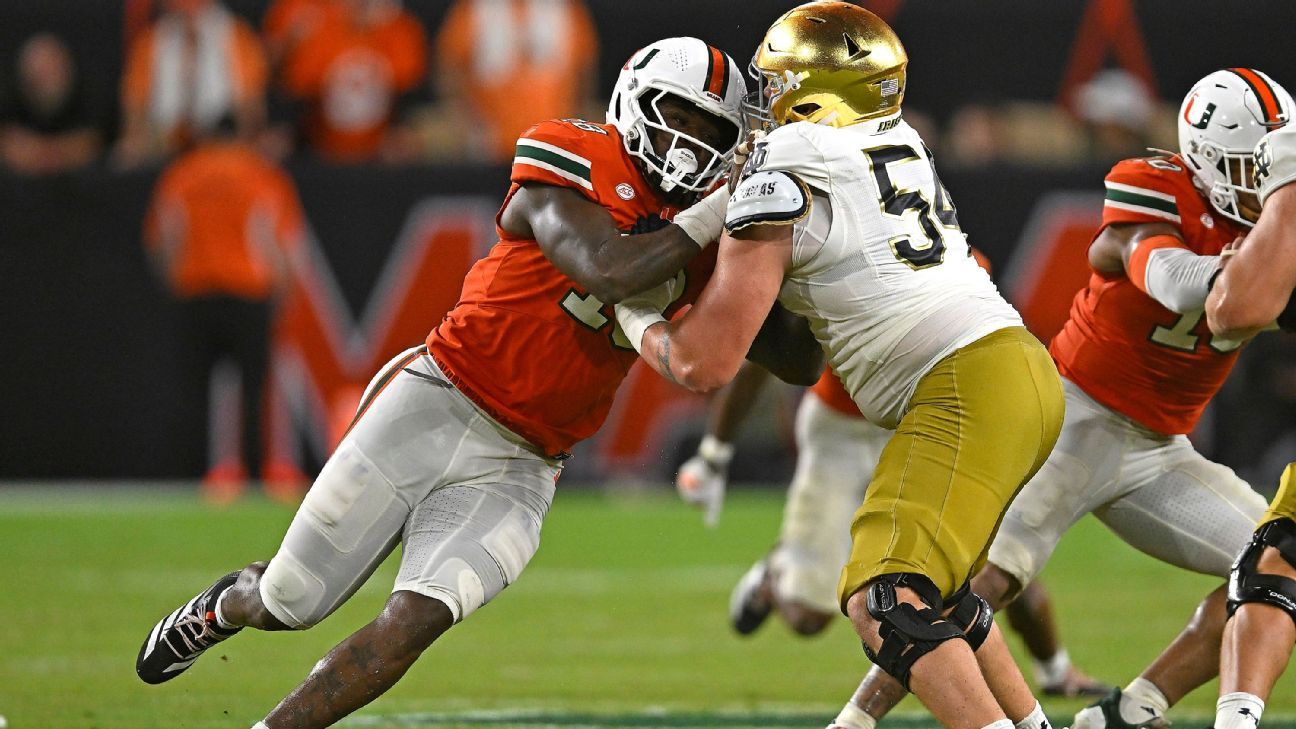
The Hurricanes can exhale after making it into the field over Notre Dame, which they beat in the season opener. Miami is one of the nation’s most talented teams. Now the Hurricanes must draw from making their first CFP appearance against another CFP newcomer in Texas A&M, which is coming off its first loss of the season. Kyle Field is always electric and should help Texas A&M in its first CFP game, but Miami should benefit from the earlier start time, rather than having to deal with the 12th Man at night. Both teams have tremendous talent at wide receiver and playmaking quarterbacks in Marcel Reed (Texas A&M) and Carson Beck (Miami). But Miami’s improved defense under coordinator Corey Hetherman should provide the Canes an edge in this game, especially after Reed has thrown six interceptions in his past five games. The Hurricanes force a late takeaway and get out of Aggieland with a win.
Prediction: Miami 31, Texas A&M 28
CFP first-round game


Tulane Green Wave at Ole Miss Rebels
Vaught Hemingway Stadium (Oxford, Mississippi)
3:30 p.m., TNT
A first-round rematch of a game Ole Miss won by 35 points back on Sept. 20 is less than ideal, but the changed circumstances around both programs add some intrigue. How will Ole Miss perform without Kiffin at the controls? Golding is a popular replacement, but he has never led this team and will be facing a future SEC competitor in Sumrall. Tulane defended North Texas extremely well in the American Conference championship game, forcing five turnovers and holding the Mean Green to seven points until the final minute of the third quarter. Golding’s defense gave Tulane problems in the first matchup, as quarterback Jake Retzlaff completed only 5 of 17 passes for 56 yards before being benched. Tulane struggled to defend Ole Miss quarterback Trinidad Chambliss, who had 307 passing yards, 2 touchdowns and 112 rushing yards in the first meeting. Sumrall’s team will play a bit better this time, but Ole Miss overcomes a slow start to pull away behind Chambliss and running back Kewan Lacy.
Prediction: Ole Miss 34, Tulane 16
CFP first-round game


James Madison Dukes at Oregon Ducks
Autzen Stadium (Eugene, Oregon)
7:30 p.m., TNT
A year ago, the Ducks went 13-0 and received a very tough CFP draw, which resulted in a fast and humbling exit in the Rose Bowl. Oregon will be playing earlier in this year’s playoff, and coach Dan Lanning’s team is heavily favored to advance against James Madison, the Sun Belt champion. Although the Dukes are well-coached and won their final 11 games, they did so in a weaker-than-normal Sun Belt and lost at Louisville by 14 points, while also surviving a home scare against Washington State. Oregon needs no motivation after losing big to Ohio State in last season’s CFP. The Ducks should finally be healthy again at wide receiver, and quarterback Dante Moore played very well down the stretch. How Stein and Lupoi function in their dual roles is worth watching, but Oregon shouldn’t have too much trouble with JMU at thunderous Autzen Stadium.
Prediction: Oregon 38, James Madison 13
Wednesday, Dec. 31
CFP Quarterfinal at the Goodyear Cotton Bowl Classic

Miami Hurricanes vs. Ohio State Buckeyes
AT&T Stadium (Arlington, Texas)
7:30 p.m., ESPN
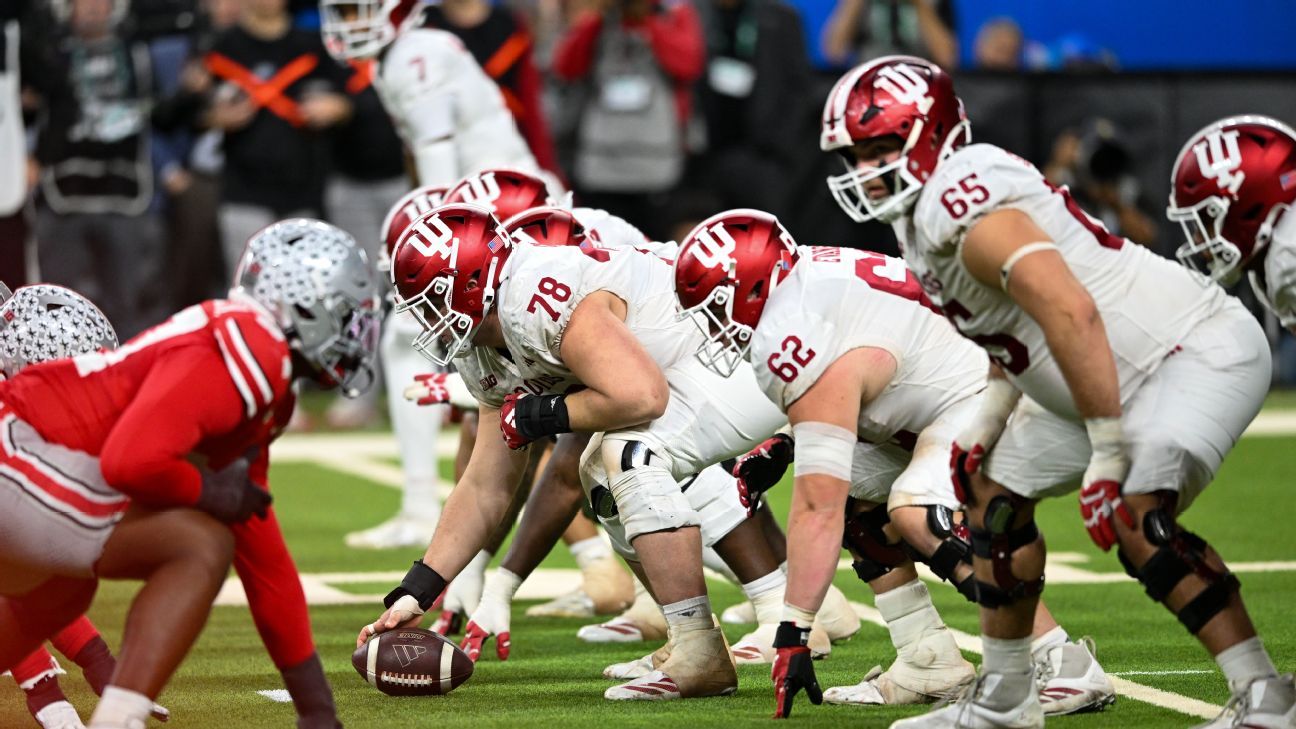
The quarters kick off with a good one, as Ohio State returns to the building where it won a CFP semifinal matchup in last season’s national title run. Despite the disappointment of the Big Ten championship game, coach Ryan Day and his team can draw upon their playoff success from last season and begin the quest to repeat. A key matchup will be Ohio State’s offensive line (which allowed five sacks to Indiana after surrendering six during the entire regular season) facing a talented Miami defensive front led by Akheem Mesidor and Rueben Bain Jr. The Buckeyes will need to run the ball effectively, especially in short-yardage situations. But they can also lean on their defense to fluster Beck and the Hurricanes a bit. Expect big games from Arvell Reese, Caden Curry and others as Ohio State moves on.
Prediction: Ohio State 27, Miami 20
Thursday, Jan. 1
CFP Quarterfinal at the Capital One Orange Bowl

Oregon Ducks vs. Texas Tech Red Raiders
Hard Rock Stadium (Miami Gardens, Florida)
Noon, ESPN
The best teams money can buy? Let’s freaking go. No two programs seem to get more flak for what they invest in their rosters than Oregon (hello, Phil Knight) and Texas Tech (howdy, Cody Campbell). But the Red Raiders and Ducks have earned their way to this stage and should deliver an incredible matchup in South Florida. Oregon has the quarterback edge with Dante Moore, who should have more wide receivers at his disposal as he faces a top-five defense in Texas Tech. The matchup of Oregon’s offensive line and Texas Tech’s defensive front should be epic. Even though Oregon has CFP experience, Texas Tech should be able to ride Shiel Wood’s defense and just enough offense to get the W.
Prediction: Texas Tech 23, Oregon 20
CFP Quarterfinal at the Rose Bowl Game presented by Prudential

Alabama Crimson Tide vs. Indiana Hoosiers
Rose Bowl (Pasadena, California)
4 p.m., ESPN
Indiana had barely capped off the most magical night in recent program history before coach Curt Cignetti turned his attention toward preparing (and humbling) his team before the CFP. The Hoosiers are AP No. 1 for the first time and riding high from their first outright Big Ten title since 1945. But going undefeated didn’t matter for Oregon in last season’s Rose Bowl, and Indiana must lock in for an opponent that is used to the biggest of stages. Yes, it’s Alabama, but the Hoosiers have the better quarterback in Fernando Mendoza, a much better running game with multiple options and a defense that can match up with the Tide, especially after the Ohio State win. Alabama will need some type of offensive balance to win this one, and I don’t see it happening against coordinator Bryant Haines’ ferocious defense. Indiana gets two touchdown passes from Mendoza and advances.
Prediction: Indiana 24, Alabama 16
CFP Quarterfinal at the Allstate Sugar Bowl

Ole Miss Rebels vs. Georgia Bulldogs
Caesars Superdome (New Orleans)
8 p.m., ESPN
The quarterfinals end with an SEC rematch in the Big Easy, as coach Kirby Smart tries to avoid a repeat of last season’s Sugar Bowl, when Georgia had just 10 points and 62 rushing yards in a loss to Notre Dame. Anyone think Kiffin will make the trip over from Baton Rouge to watch his former team? Quarterback Gunner Stockton was making his first career start in place of the injured Beck and should be much more comfortable this time around. Stockton had his best game of the season Oct. 18 against Ole Miss, completing 26 of 31 passes for 289 yards with four touchdowns and no interceptions in a 43-35 win. Georgia also is playing some of its best football collectively during the stretch run, especially a defense that struggled at times against Chambliss in the first meeting. I love this Ole Miss team, but I don’t see Georgia exiting the playoff so soon again.
Prediction: Georgia 31, Ole Miss 21
Thursday, Jan. 8
CFP Semifinal at the Vrbo Fiesta Bowl
Georgia Bulldogs vs. Ohio State Buckeyes
State Farm Stadium (Glendale, Arizona)
7:30 p.m., ESPN
The best matchup of the entire CFP could come in the desert, featuring teams that have combined for three of the past four national championships. Ohio State and Georgia delivered a classic in the 2022 national semifinal, a game the Buckeyes largely controlled before falling 42-41 in Atlanta. Georgia has an experience edge at quarterback with Stockton over redshirt freshman Julian Sayin, but Ohio State’s wide receivers and overall defensive staff power could swing the game its way. I’m not expecting many points but Ohio State finds a few more, as kicker Jayden Fielding redeems himself after the Big Ten title game miss.
Prediction: Ohio State 19, Georgia 16
Friday, Jan. 9
CFP Semifinal at the Chick-fil-A Peach Bowl
Texas Tech Red Raiders vs. Indiana Hoosiers
Mercedes-Benz Stadium (Atlanta)
7:30 p.m., ESPN
Two of the nation’s best defenses will go at it in Atlanta with a spot in the national championship game on the line. The game also pits Mendoza, the FBS leader in touchdown passes, against arguably the nation’s top defender in Texas Tech linebacker Jacob Rodriguez. Each scoring chance will be critical, as both defenses rank in the top five nationally in red zone touchdowns allowed. I could certainly see this going either way, but Indiana has a fairly substantial advantage at quarterback with Mendoza, and an underrated run game to provide balance. The Hoosiers move on to the natty.
Prediction: Indiana 20, Texas Tech 17
Monday, Jan. 19
CFP National Championship
Ohio State Buckeyes vs. Indiana Hoosiers
Hard Rock Stadium (Miami Gardens, Florida)
7:45 p.m., ESPN
Shield your eyes, Paul Finebaum and Peter Burns, it’s an all-Big Ten national title game, featuring a rematch of the conference championship in Indianapolis. Mendoza will be playing in his hometown with a chance to cap a dream season on so many fronts for himself, his family and his Hoosiers team. But Ohio State will spoil the party in a game that will be a slightly higher-scoring version of what we saw at Lucas Oil Stadium. Jeremiah Smith, who grew up near Hard Rock Stadium, shows why he’s the best player in the sport with two second-half touchdown catches, as Ohio State repeats as national champion for the first time.
Prediction: Ohio State 24, Indiana 20
Complete bowl season schedule
Saturday, Dec. 13

 Cricket Celebration Bowl
South Carolina State Bulldogs vs. Prairie View A&M Panthers
Mercedes-Benz Stadium (Atlanta)
Noon, ABC
The Bulldogs return to the Celebration Bowl for the second straight season and for the third time in five years, while Prairie View A&M makes its debut in the game under talented first-year coach Tremaine Jackson. South Carolina State quarterback William Atkins IV, who had 16 touchdowns and only four interceptions this season, faces a Prairie View A&M defense that allowed fewer than 10 points in five of its final seven games. The Panthers are coming in hot and win a close one behind the defense and dynamic wide receiver Jyzaiah Rockwell, who catches two touchdown passes.
Prediction: Prairie View A&M 27, South Carolina State 21

 Bucked Up LA Bowl
Boise State Broncos vs. Washington Huskies
SoFi Stadium (Inglewood, California)
9 p.m., ESPN
The Broncos didn’t return to the College Football Playoff, but they still found a way to win the Mountain West for the third consecutive season. Two years ago, I picked Boise State in this game but UCLA took down the Broncos even though coach Chip Kelly had one foot out the door. Washington is a young, talented and somewhat confounding team, but I like the Huskies to use the bowl as a springboard toward 2026. Quarterback Demond Williams Jr. connects for two second-half touchdown passes as Washington pulls away late.
Prediction: Washington 37, Boise State 27
Tuesday, Dec. 16

 IS4S Salute to Veterans Bowl
Troy Trojans vs. Jacksonville State Gamecocks
Cramton Bowl (Montgomery, Alabama)
9 p.m., ESPN
The runners-up from the Conference USA (Jacksonville State) and Sun Belt (Troy) championship games meet in their home state for what should be a well-attended and fun environment in Montgomery. Troy held a second-half lead at Clemson and a really nice start to Sun Belt play, but its offense struggled to score late, including in the conference championship. Jacksonville State has been a bit more consistent and will ride running back Cam Cook, the MVP of C-USA with 1,659 rushing yards and 16 touchdowns, to a victory.
Prediction: Jacksonville State 24, Troy 20
Wednesday, Dec. 17

 StaffDNA Cure Bowl
Old Dominion Monarchs vs. South Florida Bulls
Camping World Stadium (Orlando, Florida)
5 p.m., ESPN
Both teams had very strong seasons, taking down Power 4 opponents in Florida (South Florida) and Virginia Tech (Old Dominion). Both are also in some degree of flux. USF coach Alex Golesh left for Auburn and won’t be coaching the bowl game. Old Dominion standout quarterback Colton Joseph, a dynamic dual threat, is set to enter the transfer portal and won’t play in the bowl. South Florida has the talent edge here after spending a good chunk of the season in the AP Top 25. Both defenses are playing very well, as Old Dominion allowed a total of 26 points in its final four games. I’m going with South Florida in a somewhat lower-scoring game.
Prediction: South Florida 24, Old Dominion 17

 68 Ventures Bowl
Louisiana Ragin’ Cajuns vs. Delaware Blue Hens
Hancock Whitney Stadium (Mobile, Alabama)
8:30 p.m., ESPN
The game location certainly favors Louisiana, which makes its eighth consecutive bowl appearance and 13th since 2011, but is just 1-3 under coach Michael Desormeaux. Delaware, meanwhile, is going bowling in its first season as an FBS member. The Blue Hens have notable wins against UConn and Louisiana Tech but were pretty uneven this season, losing to Sam Houston on Nov. 15. The Ragin’ Cajuns won their final four games to get bowl-eligible, all by single digits, and will find a way in another tight one behind a balanced rushing attack.
Prediction: Louisiana 28, Delaware 24
Thursday, Dec. 18

 Xbox Bowl
Arkansas State Red Wolves vs. Missouri State Bears
Ford Center at The Star (Frisco, Texas)
9 p.m., ESPN2
Coach Butch Jones leads Arkansas State into its third consecutive bowl game, and is 5-1 in his past six bowls. Missouri State, meanwhile, reached the postseason in its first year as an FBS member under promising coach Ryan Beard. Expect some points in this one, as the two defenses rank 105th (Arkansas State) and 109th (Missouri State) in SP+. Both teams have played a lot of one-score games, but Missouri State’s passing game will be the difference. Senior quarterback Jacob Clark has been very solid, and the Bears have five players with more than 420 receiving yards.
Prediction: Missouri State 34, Arkansas State 30
Friday, Dec. 19

 Myrtle Beach Bowl
Kennesaw State Owls vs. Western Michigan Broncos
Brooks Stadium (Conway, South Carolina)
Noon, ESPN
One of the top early bowl matchups features the Conference USA champ (Kennesaw State) and the MAC champ (Western Michigan), as well as two promising coaches to know in Jerry Mack and Lance Taylor. The best unit on the field is Western Michigan’s defense, as first-year coordinator Chris O’Leary has overseen a group that ranks 14th nationally in points allowed and 15th in yards allowed. Kennesaw State has been really good in close games and has a playmaker in quarterback Amari Odom, but WMU’s defense will carry the day.
Prediction: Western Michigan 28, Kennesaw State 20

 Union Home Mortgage Gasparilla Bowl
Memphis Tigers vs. NC State Wolfpack
Raymond James Stadium (Tampa, Florida)
3:30 p.m., ESPN
The way these teams ended their regular seasons couldn’t have been more different. Memphis dropped its final three games and four of its final six after entering the AP Top 25 following a 6-0 start. Then, the Tigers lost coach Ryan Silverfield and others to Arkansas. NC State had a tough midseason stretch but won three of its final four games, including an upset of Georgia Tech. The Wolfpack haven’t won a bowl game since 2017 (Sun) and shouldn’t lack motivation in this one. Expect a big performance from quarterback CJ Bailey and the NC State offense.
Prediction: NC State 38, Memphis 27
Monday, Dec. 22

 Famous Idaho Potato Bowl
Washington State Cougars vs. Utah State Aggies
Albertsons Stadium (Boise, Idaho)
2 p.m., ESPN
The Cougars are the better team, as they put a scare into two CFP participants, Ole Miss and James Madison, and a CFP hopeful in Virginia, losing the three road games by a total of eight points. But Washington State last week was rocked by the departure of coach Jimmy Rogers to Iowa State after only one year on the Palouse. The Cougars were in a similar situation last year after coach Jake Dickert’s departure and lost the Holiday Bowl. Utah State had a nice road win against Fresno State, and played better defensively down the stretch. But I don’t expect the Cougars to splinter. They finish strong.
Prediction: Washington State 26, Utah State 20
Tuesday, Dec. 23

 Bush’s Boca Raton Bowl
Toledo Rockets vs. Louisville Cardinals
Flagler Credit Union Stadium (Boca Raton, Florida)
2 p.m., ESPN
Louisville’s last trip to South Florida brought its best moment of the season, a 24-21 win against then-No. 2 Miami that put the Cardinals in the mix for the ACC title and a CFP spot. Those hopes quickly faded after a three-game ACC losing streak, but Louisville crushed rival Kentucky 41-0 in the regular-season finale, and can still finish with its third consecutive season of nine or more wins under coach Jeff Brohm. Toledo, meanwhile, lost longtime coach Jason Candle to UConn and defensive coordinator Vince Kehres to Syracuse. The Rockets’ path to success is through their defense, which ranks fourth nationally in points allowed (12.2 ppg). But Louisville should be engaged enough to finish things with a win.
Prediction: Louisville 27, Toledo 16
 New Orleans Bowl
Western Kentucky Hilltoppers vs. Southern Miss Golden Eagles
Caesars Superdome (New Orleans)
5:30 p.m., ESPN
The good news for Southern Miss is it returns to the postseason for the first time since 2022 after improving from 1-11 last year to seven wins this fall. The bad news: Coach Charles Huff is headed for Memphis after his lone season in Hattiesburg, creating some uncertainty entering this game. Western Kentucky has steady leadership with Tyson Helton, who is 4-2 in bowls and has won eight or more games in each of the past five seasons. The Hilltoppers have been a bit erratic on offense but can lean on their defense in this one.
Prediction: Western Kentucky 31, Southern Miss 21

 Scooter’s Coffee Frisco Bowl
Ford Center at The Star (Frisco, Texas)
9 p.m., ESPN
Despite falling short in the Mountain West championship game, UNLV can cap a strong first season under coach Dan Mullen with its 11th win, matching last year’s Rebels and the 1984 squad for the most in team history. Ohio also had a solid season at 8-4, but the team was rocked by coach Brian Smith being placed on leave Dec. 1 with no details provided. The quarterback matchup of UNLV’s Anthony Colandrea and Ohio’s Parker Navarro should be fun, but given the uncertainty around Ohio, the Rebels get the win.
Prediction: UNLV 33, Ohio 24
Wednesday, Dec. 24

 Sheraton Hawai’i Bowl
California Golden Bears vs. Hawai’i Rainbow Warriors
Clarence T.C. Ching Athletics Complex (Honolulu)
8 p.m., ESPN
What a fun matchup on the island, as former Hawai’i coach Nick Rolovich, leading Cal on an interim basis, faces his former team, led by record-setting Hawai’i quarterback Timmy Chang, who has done an outstanding job this season. It’s also a homecoming for Cal standout freshman quarterback Jaron-Keawe Sagapolutele, an Ewa Beach native who faces a Hawai’i defense that allowed a total of 13 points in its final two regular-season wins (both at home). Will the Rainbow Warriors open the season with a win against Stanford and close with a win over Cal? They will, thanks to a last-minute field goal from the “Tokyo Toe,” Kansei Matsuzawa.
Prediction: Hawai’i 30, Cal 28
Friday, Dec. 26

 GameAbove Sports Bowl
Central Michigan Chippewas vs. Northwestern Wildcats
Ford Field (Detroit)
1 p.m., ESPN
Some Big Ten teams wouldn’t get up for a post-Christmas bowl visit to Detroit and a MAC opponent, but not Northwestern. The Wildcats were elated to get bowl-eligible with a dramatic win over Minnesota at Wrigley Field, and have performed well in the postseason, winning five consecutive bowls, including the 2023 Las Vegas Bowl under coach David Braun. Central Michigan returns to the postseason for the first time since 2021 and should have the crowd edge at Ford Field. But the Chippewas really struggled against Power 4 opponents Pitt (45-17) and Michigan (63-3), and Northwestern went through a much tougher schedule.
Prediction: Northwestern 28, Central Michigan 14

 Rate Bowl
New Mexico Lobos vs. Minnesota Golden Gophers
Chase Field (Phoenix)
4:30 p.m., ESPN
When it comes to outsized coaching personalities, few bowl matchups will deliver better than Jason Eck (New Mexico) and P.J. Fleck (Minnesota). Eck, a former Wisconsin lineman who is familiar with Minnesota from his playing days, won Mountain West Coach of the Year honors in his debut season with New Mexico, which tied for first in the league and went 6-0 at home for the first time since 1934. The Lobos haven’t played in a bowl outside their home state since 2004, but will be well-represented in Phoenix. My lean is New Mexico, but Fleck is excellent in bowls, going 6-0 at Minnesota with a Rate Bowl victory in 2021. Tough call here, but I’m riding with the Lobos, who win their 10th game for the first time since 1982.
Prediction: New Mexico 24, Minnesota 20

 SERVPRO First Responder Bowl
Florida International Panthers vs. UTSA Roadrunners
Gerald J. Ford Stadium (Dallas)
8 p.m., ESPN
The vibes certainly seem better on the Florida International side. FIU won its final four games, including a triumph over Jacksonville State, to secure bowl eligibility under first-year coach Willie Simmons, who won the Celebration Bowl in 2023 at Florida A&M. UTSA coach Jeff Traylor, meanwhile, hasn’t looked happy this season, as the Roadrunners haven’t harnessed the momentum from some nice home wins over Tulane and East Carolina. UTSA has the talent edge with quarterback Owen McCown and others, but will it be truly motivated? I say yes.
Prediction: UTSA 37, Florida International 24
Saturday, Dec. 27

 Go Bowling Military Bowl
Pittsburgh Panthers vs. East Carolina Pirates
Navy-Marine Corps Memorial Stadium (Annapolis, Maryland)
11 a.m., ESPN
Pitt has been quite good away from home this season, sweeping its ACC road schedule at 4-0 and enduring its only stumble against West Virginia in the Backyard Brawl. The Panthers seemingly have a bright future with quarterback Mason Heintschel, running back Ja’Kyrian Turner and others set to return in 2026. East Carolina had a nice season under coach Blake Harrell, sustaining its only losses against bowl teams (NC State, BYU, Tulane, UTSA). Quarterback Katin Houser blossomed for ECU with 3,300 passing yards, and will challenge Pitt’s defense. But the Panthers have a bit too much firepower in this one.
Prediction: Pitt 34, East Carolina 28

 Bad Boy Mowers Pinstripe Bowl
Clemson Tigers vs. Penn State Nittany Lions
Yankee Stadium (Bronx, New York)
Noon, ABC
Neither team entered the 2025 season expecting to finish it out in a baseball stadium in the Bronx, although at least Dabo Swinney is a Yankees fan. Penn State made a midseason coaching change, while Swinney has hinted at significant adjustments for the way his program operates. Both teams finished strong, though, as Clemson swept its final four games, and Penn State claimed its final three under interim coach Terry Smith, who will remain on staff with new coach Matt Campbell. Opt-outs likely will factor into this matchup, given the NFL hopefuls on both teams. The location favors Penn State, which will play hard for Smith and win a low-scoring contest.
Prediction: Penn State 20, Clemson 16

 Wasabi Fenway Bowl
UConn Huskies vs. Army Black Knights
Fenway Park (Boston)
2:15 p.m., ESPN
For the first time in the brief life of the Fenway Bowl, two teams based in the Northeast will meet at the iconic baseball venue. UConn aims for its second straight win in the game, and its first 10-win season, and will be led by interim coach Gordon Sammis, the team’s offensive coordinator, following Jim Mora’s departure to Colorado State. Army had an often-frustrating season, filled with close games, but the Black Knights finally started winning some down the stretch and will make things challenging on UConn standout Joe Fagano (3,441 pass yards, 28 touchdowns, 1 interception). But Fagano will do enough as UConn makes history.
Prediction: UConn 31, Army 23

 Pop-Tarts Bowl
BYU Cougars vs. Georgia Tech Yellow Jackets
Camping World Stadium (Orlando, Florida)
3:30 p.m., ABC
America’s favorite newer bowl game features a really fun matchup for line-of-scrimmage enthusiasts. Will motivation be a concern? BYU felt it had a playoff-worthy profile, while Georgia Tech seemingly had a CFP path before losing three of its final four regular-season games. Coaches Kalani Sitake (BYU) and Brent Key (Georgia Tech) are true believers in physical play and out-toughing your opponent. Both teams feature talented running quarterbacks in Haynes King, who is playing his final college game, and Bear Bachmeier, a true freshman with 11 rushing touchdowns. BYU has a pretty significant advantage on defense, though. Star linebacker Jack Kelly and his teammates get it done.
Prediction: BYU 29, Georgia Tech 21

 Snoop Dogg Arizona Bowl
Miami (OH) RedHawks vs. Fresno State Bulldogs
Arizona Stadium (Tucson, Arizona)
4:30 p.m., CW Network
As a child of the ’90s who considers “The Chronic” one of the best-produced albums ever, I’m not picking against a team called the Bulldogs in the Snoop Dogg Bowl. Not happening! Fresno State thrives in the postseason, winning five of its past six bowl games, and first-year coach Matt Entz won two FCS national championships at North Dakota State. To be fair, Miami won this bowl game last year, and coach Chuck Martin’s teams are always at the line of scrimmage. But Fresno State is pretty stingy on defense and has some stars, such as cornerback Simeon Harris and lineman Finn Claypool. Fresno State takes this one.
Prediction: Fresno State 24, Miami (Ohio) 17

 Isleta New Mexico Bowl
North Texas Mean Green vs. San Diego State Aztecs
University Stadium (Albuquerque, New Mexico)
5:45 p.m., ESPN
This game could come down to which team responds better to recent disappointments. North Texas lost out on a CFP berth after falling to Tulane in the AAC title game. Coach Eric Morris is moving on to Oklahoma State, and North Texas’ roster situation will be worth monitoring. Standout quarterback Drew Mestemaker made his first career start in North Texas’ last bowl game, passing for 393 yards with 2 touchdowns and 2 interceptions in a loss to Texas State. San Diego State returns to the same stadium where it lost its regular-season finale to New Mexico, costing itself a shot at the Mountain West title game. The matchup features a top-five scoring defense in San Diego State (12.6 ppg) against the nation’s top scoring offense in North Texas (44.8 ppg). I’ll go with defense in a tight one.
Prediction: San Diego State 31, North Texas 28

 TaxSlayer Gator Bowl
Virginia Cavaliers vs. Missouri Tigers
EverBank Stadium (Jacksonville, Florida)
7:30 p.m. ABC
Virginia hasn’t really been in this position before, having to rebound from the disappointment of losing out on its first CFP opportunity. Coach Tony Elliott must rally his team as a good opportunity awaits to finish things out with a team-record 11th victory. Missouri’s four losses came against top-10 opponents at the time, and the Tigers have one of the nation’s best running backs in Ahmad Hardy, who has 1,560 rushing yards and 16 touchdowns in his first season as a Tiger. Coach Eliah Drinkwitz has won his past two bowl games with Missouri and should get a third, as the Tigers win a lower-scoring game.
Prediction: Missouri 26, Virginia 19

 Kinder’s Texas Bowl
LSU Tigers vs. Houston Cougars
NRG Stadium (Houston)
9:15 p.m., ESPN
An LSU season that began with national championship aspirations ends with a quasi-road game against Houston in the Texas Bowl, which the Tigers were in — and lost — the last time they had a midseason coaching change in 2021. Houston took a big step in coach Willie Fritz’s second season, improving its win total from four to nine. The game’s key matchup could be LSU’s defense, which has been very good and will remain under the direction of coordinator Blake Baker, facing Conner Weigman, the former Texas A&M quarterback who had 2,475 passing yards and 21 touchdowns for the Cougars this fall. Ultimately, location and motivation swing the arrow toward Houston, which gets its 10th win and evens the all-time series with LSU at 2-2.
Prediction: Houston 23, LSU 17
Monday, Dec. 29

 JLab Birmingham Bowl
App State Mountaineers vs. Georgia Southern Eagles
Protective Stadium (Birmingham, Alabama)
2 p.m., ESPN
Kudos to Appalachian State, which said yes when many others did not, and gave Georgia Southern an opponent to close out the season. These Sun Belt teams have already played, which isn’t ideal, but their first meeting delivered some late drama before Georgia Southern prevailed 25-23. Georgia Southern’s last four wins all came by seven points or fewer, while Appalachian State lost four games by eight points or fewer. Neither team is particularly strong on defense, but Georgia Southern boasts star power on offense with wide receiver Camden Brown, who has 1,049 receiving yards and 14 touchdowns, and adds to those totals in a win.
Prediction: Georgia Southern 37, Appalachian State 31
Tuesday, Dec. 30

 Radiance Technologies Independence Bowl
Coastal Carolina Chanticleers vs. Louisiana Tech Bulldogs
Independence Stadium (Shreveport, Louisiana)
2 p.m., ESPN
Coach Sonny Cumbie’s Bulldogs quietly rebounded nicely this fall, ensuring their first winning season since 2019. They also will be playing just 70 miles from campus and will have a significant crowd advantage, especially against a Coastal Carolina program going through a coaching change after Tim Beck’s firing. Louisiana Tech’s offense has had a few no-shows this season, but scored a total of 76 points in its past two games and has a deep and balanced rushing contingent with four ball carriers eclipsing 450 yards.
Prediction: Louisiana Tech 35, Coastal Carolina 24

 Liberty Mutual Music City Bowl
Tennessee Volunteers vs. Illinois Fighting Illini
Nissan Stadium (Nashville, Tennessee)
5:30 p.m., ESPN
There will be plenty of orange in Nissan Stadium, although much of it won’t be cheering for Illinois, which caps a season that began with CFP hopes, was sidetracked sharply with a 53-point loss at Indiana but still ended with wins in three of the final four regular-season contests. Illini quarterback Luke Altmyer started his career in the SEC at Ole Miss and can finish it against an SEC opponent in Tennessee, which pursued him as a transfer target this spring after Nico Iamaleava‘s exit to UCLA. The Vols never really recovered from their early loss to Georgia and have much to sort out on defense, which ranks 91st nationally in points allowed. Expect a lot of scoring in this one, but Tennessee prevails behind quarterback Joey Aguilar.
Prediction: Tennessee 37, Illinois 30

 Valero Alamo Bowl
USC Trojans vs. TCU Horned Frogs
Alamodome (San Antonio)
9 p.m., ESPN
Placing too much emphasis on non-CFP bowls can be tricky, but this one feels important for Lincoln Riley and USC. The Trojans clearly improved this season, despite once again falling short of the CFP. They bring in the nation’s No. 1 recruiting class and should retain several key foundational players from this year’s roster. A road-like win against TCU would mean USC’s first 10-win season since 2022, and a likely top-15 finish. TCU can somewhat quietly finish with consecutive nine-win seasons. Opt-outs will be a storyline for USC with star wideout Makai Lemon and others not playing, but the Trojans should have enough to outlast the Horned Frogs.
Prediction: USC 37, TCU 30
Wednesday, Dec. 31

 ReliaQuest Bowl
Iowa Hawkeyes vs. Vanderbilt Commodores
Raymond James Stadium (Tampa, Florida)
Noon, ESPN
Vanderbilt lobbied aggressively for CFP inclusion, even though the team never entered serious consideration. Diego Pavia and the Commodores still can deliver a strong closing argument against an Iowa team led by the nation’s No. 8 scoring defense. Few players have transformed an entire program — the way it’s viewed, the way it sees itself — as much as Pavia at Vandy the past two seasons. Iowa will provide a nice test as the Hawkeyes pushed teams such as Indiana and Oregon, even in defeat. But Pavia and the Vanderbilt offense will be too much in this one, as the Commodores secure a once-unthinkable 11th win and a possible top-10 finish.
Prediction: Vanderbilt 34, Iowa 23

 Tony the Tiger Sun Bowl
Arizona State Sun Devils vs. Duke Blue Devils
Sun Bowl Stadium (El Paso, Texas)
2 p.m., CBS
The 2025 ACC champions and 2024 Big 12 champions meet in one of college football’s most iconic stadiums, for a Devils vs. Devils clash. Although Duke became the surprise ACC winner, it also seemingly underachieved this season, especially because quarterback Darian Mensah delivered on the hype with 3,646 passing yards, 30 touchdowns and only five interceptions. ASU will counter with quarterback Jeff Sims, who began his career at Georgia Tech before a challenging journey that culminated with a solid finish. The Sun Devils will need a strong defensive effort to slow down Mensah.
Prediction: Duke 35, Arizona State 31

 Cheez-It Citrus Bowl
Michigan Wolverines vs. Texas Longhorns
Camping World Stadium (Orlando, Florida)
3 p.m., ABC
The only question here is Texas’ motivation level, after missing out on the CFP for the first time since 2022, despite beating two playoff participants in No. 7 Texas A&M and No. 8 Oklahoma, as well as No. 14 Vanderbilt. The Longhorns have a much better profile than Michigan, which lost by double digits to the best three teams it faced and didn’t take advantage of a favorable schedule in quarterback Bryce Underwood‘s freshman season. Michigan capped 2024 with a surprise bowl win against an SEC opponent, but I really don’t see it happening again. Arch Manning accounts for three touchdowns, and Texas shuts down Underwood and U-M.
Prediction: Texas 28, Michigan 20

 SRS Distribution Las Vegas Bowl
Nebraska Cornhuskers vs. Utah Utes
Allegiant Stadium (Las Vegas)
3:30 p.m., ESPN
As Kyle Whittingham’s career winds down, a bowl win would be a fitting send-off for the future Hall of Fame coach. Whittingham dominated the postseason earlier in his career (11-1 in first 12 bowl games) but has struggled lately (five straight losses, including the 2023 Las Vegas Bowl). The Utes still should handle a Nebraska team that seems very much in flux, with its roster and coaching staff. Star running back Emmett Johnson is off to the NFL, and coach Matt Rhule has made several staff changes. Nebraska’s defense likely will have several problems with Devon Dampier. Utes roll.
Prediction: Utah 38, Nebraska 20
Friday, Jan. 2

 Lockheed Martin Armed Forces Bowl
Rice Owls vs. Texas State Bobcats
Amon G. Carter Stadium (Fort Worth, Texas)
1 p.m., ESPN
The team opt-outs opened an opportunity for Rice, which will complete its first season under coach Scott Abell and seek the team’s first bowl victory since 2014. Rice has wins over UConn and Louisiana but really struggled defensively late in the season, which Texas State should be able to expose. Quarterback Brad Jackson and wide receiver Beau Sparks connect for two touchdowns as the Bobcats pull away.
Prediction: Texas State 41, Rice 24

 AutoZone Liberty Bowl
Navy Midshipmen vs. Cincinnati Bearcats
Simmons Bank Liberty Stadium (Memphis, Tennessee)
4:30 p.m., ESPN
One of the last bowl games could be among the most fun, especially with the quarterback matchup of Navy’s Blake Horvath and Cincinnati’s Brendan Sorsby. Horvath has back-to-back 1,000-yard rushing seasons, while Sorsby finished the regular season with 2,800 passing yards and 27 touchdowns. Cincinnati’s poor finish is a concern, though, as the Bearcats didn’t eclipse 24 points in any of their four losses. Navy doesn’t take these games lightly, having won six of its past seven bowl games, including last year’s Armed Forces Bowl. Mids get it done.
Prediction: Navy 27, Cincinnati 24

 Duke’s Mayo Bowl
Wake Forest Demon Deacons vs. Mississippi State Bulldogs
Bank of America Stadium (Charlotte, North Carolina)
8 p.m., ESPN
From Egg Bowl disappointment to Mayo Bowl mania, Mississippi State is in the postseason as a fill-in team. How will the Bulldogs capitalize on their surprise opportunity? Despite a 5-7 record, Mississippi State competed much better this season under coach Jeff Lebby, and has the offensive talent to give Wake Forest some problems. Wake isn’t afraid to grind out wins with its defense and run game, led by Demond Claiborne. Coach Jake Dickert has done a great job in his first season, and he’ll cap it with a mayo dump.
Prediction: Wake Forest 31, Mississippi State 27

 Trust & Will Holiday Bowl
Arizona Wildcats vs. SMU Mustangs
Snapdragon Stadium (San Diego)
8 p.m., Fox
A lot can happen to both rosters between now and Jan. 2, but this appears to be one of the more evenly matched pairings in bowl season. Arizona quarterback Noah Fifita has seen it all during his career, and can secure the team’s second 10-win season in three years — and just the fifth in team history — with a victory in San Diego. SMU will counter with Kevin Jennings, who seeks postseason redemption after his rough performance in last year’s CFP. Both teams can defend well, too, and boast standouts, such as safeties Dalton Johnson (Arizona) and Ahmaad Moses (SMU). A tough call here, but I’ll go with Arizona in a close one.
Prediction: Arizona 30, SMU 24

-
Dan Wetzel
The purpose of the College Football Playoff selection committee is to sort through the unsortable — deciding between two teams of similar accomplishment.
This sport is a spectacular mess, of course, famously and belovedly so. The FBS level has 136 teams playing 12 regular-season games competing for one championship. The schedules are disparate, even within the current oversize “conferences.”
No one would design such a thing. Big schools. Small schools. State schools. Religious institutions. Even three military academies. From L.A. (Los Angeles) to L.A. (Lower Alabama). It’s glorious.
If a proper computer formula exists to figure out who should or shouldn’t be in a playoff, none has earned the trust of the sport. College football, after all, ain’t much for college.
So, it has a selection committee — 13 people who make the final, difficult, no-truly-correct-answer call. Their thanks comes from a barrage of hate courtesy of whomever they didn’t choose.
That there is controversy, hard feelings and anger doesn’t mean the system isn’t working.
It’s a sign that it is.
A sport that used to leave unbeaten teams out of the title game is now arguing about 10-2 and 9-3 clubs. A postseason that was once a collection of mostly meaningless exhibition bowl games designed as tourism campaigns is now anchored by a 12-team, 11-game free-for-all.
At least half a dozen teams must believe they can actually win the national title. Maybe more. Four playoff games will be staged on campuses, not at antiseptic NFL stadiums. The title will be settled on the field. This is the good stuff.
It’s why everyone needs to exhale for a moment.
Don’t let the pursuit of (unachievable) perfection get in the way of progress. This is always going to be an imperfect operation.
Would it be better if the ACC’s tiebreaker system didn’t malfunction and both Miami (as ACC champ) and Notre Dame (as an at-large selection) were in the field? Of course. But the presence of James Madison and some Fighting Irish disappointment shouldn’t cause anyone to take a wrecking ball to this entire enterprise.
College athletics is famous for knee-jerk decisions that it comes to regret. It too often makes policy via emotional swings and selfish reasoning without vision for the future.
Leagues get blown up (or expanded) for basic cable subscriptions (which are already dwindling). Legal cases are waged on the idea NIL will decrease competitive balance (Indiana is currently ranked No. 1). Congress is lobbied with hysterics that the sport needs “saving” (all while interest, revenue and television ratings rise).
The latest overreaction is to kill off this 2-year-old playoff for a bigger model that will supposedly be controversy-free (impossible) — one with 24 teams, at least, or with four automatic bids to certain conferences or who knows what else.
The committee is the punching bag. Subjectivity is the wedge issue. Conspiracies are everywhere. Emotions are running hot.
Look, there is one sure way for major programs to get into this thing: win your conference. If not, then you get into the knife fight that is the at-large selection process. Anything can happen. Criteria can shift. Decisions can seem unfair or arbitrary.
If, like Notre Dame, you find more overall value in independence, then this is your trade-off. It isn’t going to work as you wish every time.
Are there improvements and tweaks that can be made? Of course.
The committee should no longer release weekly rankings during the back half of the season. A single verdict should come out at the end. The current setup is good for content (including here at ESPN, which broadcasts the weekly rankings), but it undermines the credibility of the process. The week-to-week contradictions are maddening and, even worse, can box in the committee’s final decision.
Bloated leagues could return to divisions in an effort to create scheduling structure or find other ways to fix tiebreakers (ahem, ACC).
Two rounds of home games would increase the importance of seeding and bring more campuses and local communities into the fold. That would serve fans and families rather than bowl directors.
Conference championship weekend could even be eliminated altogether; if Alabama can get beaten soundly and not drop, then was it even a real game? (And yes, BYU, we see you.) That would move the playoff up a week and allow for the semifinals on New Year’s Day and a title game in early January rather than during the heart of the NFL postseason.
Of course, ending conference title games would require leaving money on the table, not to mention unwinding complicated media and hosting contracts, so it’s a heavy lift.
The minor tweaks are fine, though, as long as the regular season continues to matter. That has to be the North Star. This committee maintained that by valuing Miami’s Week 1 victory over Notre Dame. Yes, it should have made that determination weeks earlier, but it’s never too late to do the right thing.
A playoff that gets so big where results don’t matter very much or, as the Big Ten proposal would have, where Michigan and Iowa are still alive via play-in rounds forever alters how the sport is played.
Better to have one or two bitter 10-2 teams out there at the end.
Better to have cries and screams and a little bit of infuriation.
Better to have those 13 people in a meeting room making a decision.
Because in this wonderfully chaotic and disorganized sport, the selection committee, to channel some Winston Churchill, might indeed be the worst system ever, except for all the others.
Terry Ryan is living out a hockey player’s dream. It’s just not the exact one he grew up dreaming.
One of the stars of the hit show “Shoresy,” the hockey-centered comedy that has acted as equal parts love letter to the sport and cultural tastemaker, Ryan will join his castmates (all of whom are also hockey players achieving various levels of success) on Dec. 10 at UBS Arena on Long Island as part of the Shoresy Fall Classic, a multistop tour across Canada and the United States where the cast plays games typically against the alumni of that NHL team.
“Aaron Asham is one of my best friends in the world. I played junior and pro with him,” Ryan said of the retired 15-year NHL veteran who played four seasons with the New York Islanders. “So I’m looking forward to that.”
The pace of play is higher than most people think heading in, the 48-year-old noted, adding “we’re not out there trying to hurt each other or anything, but it’s a step up from a regular shinny game.”
“It’s a very unique experience. I don’t know if I’ve ever come across anything like it whereby the fans are cheering for both teams,” he said. “Even though we lose — we’ve been losing most of the games — we’re not getting blown out, and I think people walk away with an appreciation that, you know, we’re all actors in the show, but we’re all hockey players. We’re a pretty good team. We hang in there.”
The event, which also includes a Q&A with the cast, was sparked by the massive popularity of the show, which will release its fifth season in Canada on Christmas Day and on Hulu in early 2026 (its parent show, “Letterkenny,” wrapped up with 12 seasons and 81 episodes).
As for Ryan, he was the No. 8 pick in the 1995 draft of the Montreal Canadiens, and achieved his dream of playing in the NHL — but played only eight games with the Habs. He then spent six seasons with different AHL teams after an ankle injury brought his NHL dreams to a halt.
The Newfoundland native continued to play in various leagues while pursuing another career — film and television. But not as an actor.
“I got an arts degree in folklore and English, and within that there’s a film studies certificate. I worked on a crew, I mean like location [scouting], production assistant, AD. I was like ‘jump how high’ for six years,” he said. “Then I spilled over, I did some stunts, and then because I have no tooth, I got to play some parts like, you know, British soldiers, crackheads, pimps, drug dealers, stuff like that. … My entrance into this world was a lot different than the other guys [on the Shoresy cast].”
Eventually, Ryan did cross paths with one Hollywood star, who took him under his wing.
“There’s a show on Netflix called ‘Frontier.’ I was on crew, I was waiting to get in the union. I met Jason Momoa. He came along with [producers] and gave me a chance,” Ryan said. “I had no tooth, Momoa said, ‘Keep the tooth out. I can get you some stunt gigs.’
“Five seconds into the show, I’m the very first face you see. It’s a British soldier begging for his life, and I’ve got no tooth obviously … they got me that role. That’s how I got in.”
Ryan and Momoa also shared a love for hockey. Ryan taught Momoa and members of the crew how to skate (in Momoa’s case, the finer points).
“I don’t know how many times we went out on the ice, maybe 100 times,” Ryan recalled.
Ryan also taught Momoa the intricacies of a hockey fight.
“When we first [fought], I just shook him and beat him in a fight,” Ryan said. “I said, ‘It’s all about balance, man. You can be as big as you want.’
“Anyway, he laughed … trust me, if he hit me with one, it wouldn’t matter. [Momoa] wanted to get in a hockey fight [in the second season of ‘Frontier’], so, like, I’m [wearing] the British red coat, and he pulls the thing over, and he simulates a hockey fight.”
Momoa helped Ryan get several stunt gigs and even hired Ryan as his assistant for a period of time. Eventually, “Letterkenny” called with the role of Ted Hitchcock, a lovable hockey player from Newfoundland with a penchant for “martoonies,” which led to “Shoresy.”
And now, the show and cast enjoy a level of success that allows them to play in hockey games against NHL players across North America, with thousands of people cheering them from the stands. In a very circuitous way, a version of Ryan’s hockey dreams did come true.
Jump ahead:
Games of the week
What I loved this weekend
Hart Trophy candidates
Social post of the week
Stick taps

Biggest games of the week

I’m getting into “watch every Colorado Avalanche game” territory. I saw them live for the first time this season at Madison Square Garden on Saturday, and it was incredibly fun. Nathan MacKinnon had a pair of goals, including a nasty backhand overtime winner under the crossbar that he made look absolutely effortless.
1:08
Nathan MacKinnon skates through Rangers defense to score dazzling OT winner
Nathan MacKinnon makes a sweet move and scores on the backhand to give the Avalanche an overtime win.
We’ve been focusing a lot on the lack of regulation losses for Denver’s team — only two so far this season. But we can now start keeping an eye on points in general, because the Avs are are currently on pace for 58 wins and 134 points this season.
That would be second-most points by any team in a season in NHL history, behind the 2022-23 Bruins (135).
If things keep rolling, the Avalanche have a chance to make history. They have build a solid foundation for it. They have the players. Could they do it?
Weeks in mid-December can sort of fly under the radar in the course of the regular season, but these are the ones where teams chasing history work in the shadows and build. The Avs visit the Nashville Predators on Tuesday, host the Florida Panthers on Thursday and then have the Preds at home Saturday. It could be a three-win week for the NHL’s premier team.
Other key games this week


Monday, 9 p.m. | ESPN+


Tuesday, 7 p.m. | ESPN+


Tuesday, 7 p.m. | ESPN+

Thursday, 7 p.m. | ESPN+


Thursday, 7 p.m. | ESPN


Thursday, 7 p.m. | ESPN+


Thursday, 8 p.m. | ESPN+


Saturday, 7 p.m. | ESPN+
Saturday, 8 p.m. | ESPN+

Sunday, 6 p.m. | ESPN+
What I loved this weekend
The Athletic’s Murat Ates wrote a story about the mental health journey of Winnipeg Jets forward Gabriel Vilardi. The story, which includes raw and honest reflection from Vilardi, is equal parts fascinating and emotional. This quote from Vilardi was particularly humbling and something that certainly many athletes probably go through during a game:
“For me, negative self-talk is not just panic attacks; it’s something that I deal with a lot. And it drags on. It starts with one play. Then it’s like, ‘Oh s—, I’ve got to make up for that play.’ Then it drags on to three shifts because you’re still thinking in your head that you’ve got to make up for it. Next thing you know, it’s a period and it’s like, ‘F—, I’ve only got two periods left.’ I was in my head the whole first period.”
Sports psychologist Dr. Alicia Naser — who works with NHL players such as Seattle Kraken forward Shane Wright and Calgary Flames center John Beecher along with other professional athletes — has helped to normalize the discussions, particular through her social media content, which includes bite-sized wisdom and actionable items related to mental health and performance that can benefit anyone watching or reading.
Hart Trophy contenders if the season ended today
Nathan MacKinnon times three. That’s it.
But really, MacKinnon obviously remains on the list. He’s currently on pace for 70 goals and 140 points this season; if he reaches those totals, he’d be the fifth player in NHL history to do it, joining Wayne Gretzky (who did it four times), Mario Lemieux (twice), Bernie Nicholls (1988-89) and Phil Esposito (1970-71). MacKinnon would also have the first 70-goal season since Teemu Selanne and Alexander Mogilny did it in 1992-93 (both with 76 goals).
As for the second contender, that goes to Connor McDavid. He pulled into second place in the points race, now six back of MacKinnon with 42; he also leads the league in assists (28).
Indeed, this might be the week it becomes a two-player race. For that reason, I’m giving one more nod in this section to both Connor Bedard and Macklin Celebrini, because one (or both) might be unseated as early as next week. I kind of hope I’m wrong though.
Social media post of the week
It definitely isn’t the 6-7 cam at MSG, or Sam Bennett taking part in the trend.
My choice this week is new hockey fan Big Z on TikTok. It feels as if every few years someone goes viral (at least in the hockey bubble) for finding out how exciting hockey is. It’s fun to live vicariously through someone who is experiencing the same joy we all once did as hockey fans.
Big Z’s joy over seeing Alex Ovechkin and Dustin Byfuglien deliver checks, or lamenting a Red Wings shootout loss (but still saying that he needs to buy a jersey), is fantastic.
Stick taps
The Washington Capitals have partnered with WWE to release a limited edition collab for John Cena’s final WWE match before he retires, taking place Saturday. The shirt features Cena wearing a Caps hat holding a towel in his iconic pose that reads “Let’s Go Caps.”
The time is now for an #ALLCAPS x @JohnCena collaboration in celebration of his final match!
Fans who purchase through the special link will receive the exclusive t-shirt and tickets to #CapsCanes this Thursday, Dec. 11.
🎟️ https://t.co/IzoZjSdSrq pic.twitter.com/iAkVHjBx12
— Washington Capitals (@Capitals) December 5, 2025
I’m all for more partnerships like this. City-specific merchandise is on the rise and often becomes a collector’s item. WWE also has championship belts specific to teams across multiple sports, including the NHL.
-
 Sports2 years ago
Story injured on diving stop, exits Red Sox game
-
 Sports3 years ago
‘Storybook stuff’: Inside the night Bryce Harper sent the Phillies to the World Series
-
 Sports2 years ago
Game 1 of WS least-watched in recorded history
-
 Sports3 years ago
Button battles heat exhaustion in NASCAR debut
-
 Sports3 years ago
MLB Rank 2023: Ranking baseball’s top 100 players
-
Sports4 years ago
Team Europe easily wins 4th straight Laver Cup
-
 Environment3 years ago
Japan and South Korea have a lot at stake in a free and open South China Sea
-
 Environment1 year ago
Here are the best electric bikes you can buy at every price level in October 2024