

Airspeeder unveils Mk4 eVTOL ahead of first crewed flying car racing series

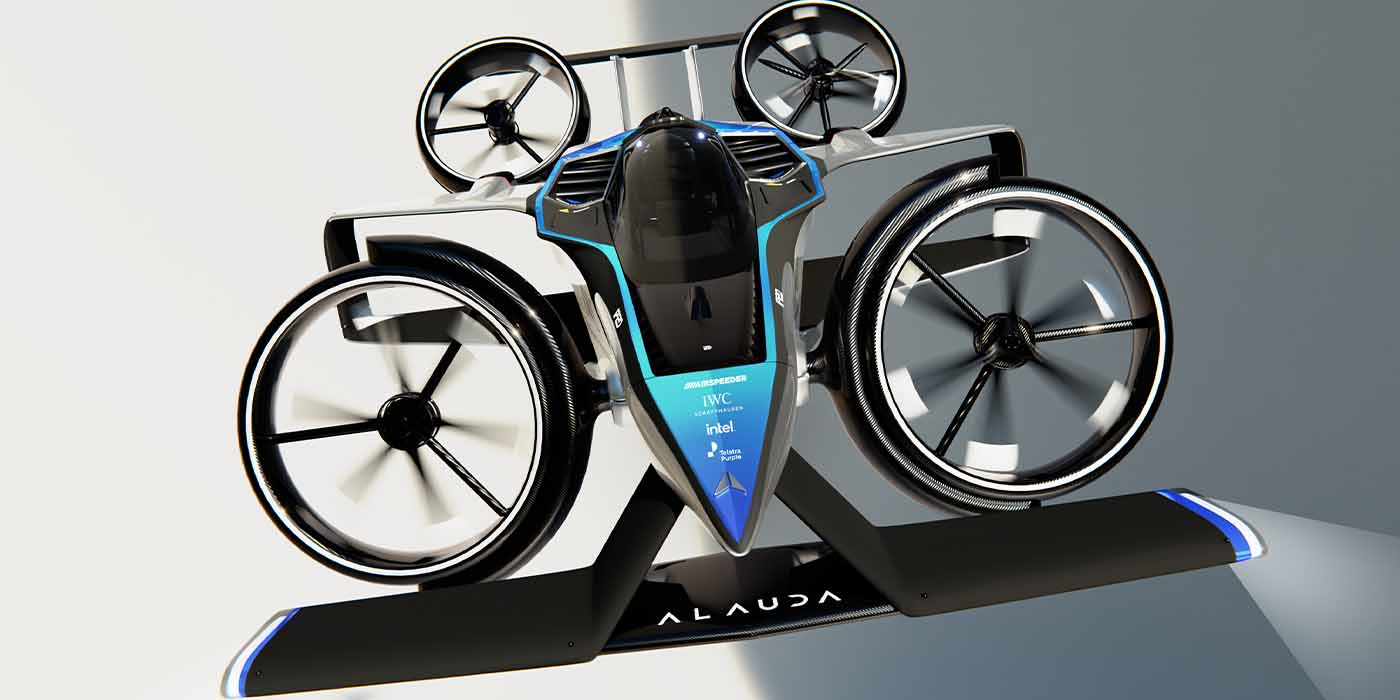
Alauda Aeronautics – the electric aviation company behind the design of the eVTOLs being developed for the nascent Airspeeder racing series – has unveiled its latest “flying car.” As the next iteration of Airspeeder, the Mk4 is the first to be designed specifically for crewed racing flights as the league moves closer to enabling its racers to compete from the tracks in the skies.
Airspeeder is an electric vertical takeoff and landing (eVTOL) racing league headquartered in London, first announced in November 2021. The league exists as an entity of Alauda Aeronautics – an electric aviation company based in Adelaide, Australia, where the league’s technical HQ is located along with its testing grounds. Alauda designs, engineers, and builds the league’s eVTOL racing aircraft called “Airspeeders.”
Since its initial launch, Alauda and Airspeeder have been assembling teams of racers to compete in development races on the way to a full global competition called the EXA Series. In March of 2022, the series announced former Formula E driver Bruno Senna as an early eVTOL racing pilot and an ambassador to the league.
Meanwhile, Alauda Aeronautics has spent hours upon hours testing its Airspeeder eVTOLs remotely piloted using virtual cockpits on the ground. This past fall, we got our first glimpse of the excitement an eVTOL racing league could bring to motorsport enthusiasts when Airspeeder showcased its first-ever EXA racing event.
At the time, pilots Zephatiali Walsh and Fabio Tishcler were given full license to race their Mk3 Airspeeder eVTOLs blade-to-blade around a one-kilometer-long digital sky-track circuit in Australia.
However, those pilots, once again, competed remotely from the ground. The goal of Airspeeder and the EXA Series has always been to deliver crewed eVTOL racing. Following today’s rendering reveal of the Mk4 Airspeeder, eVTOLs piloted from the sky are now one step closer to reality.
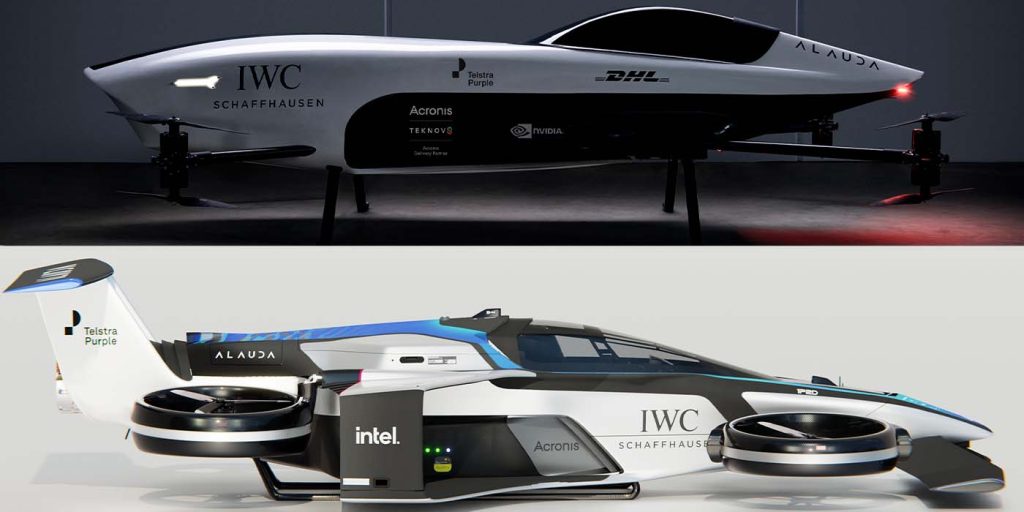
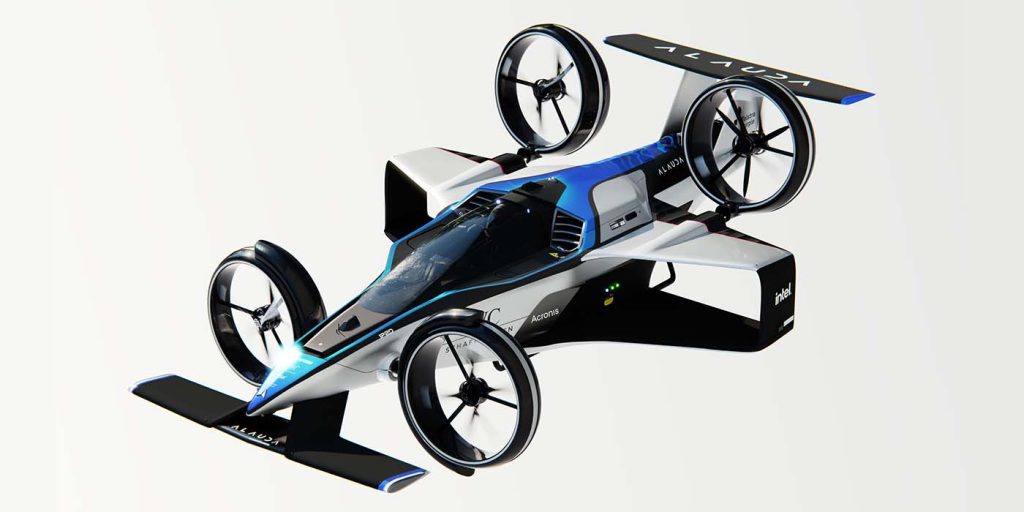
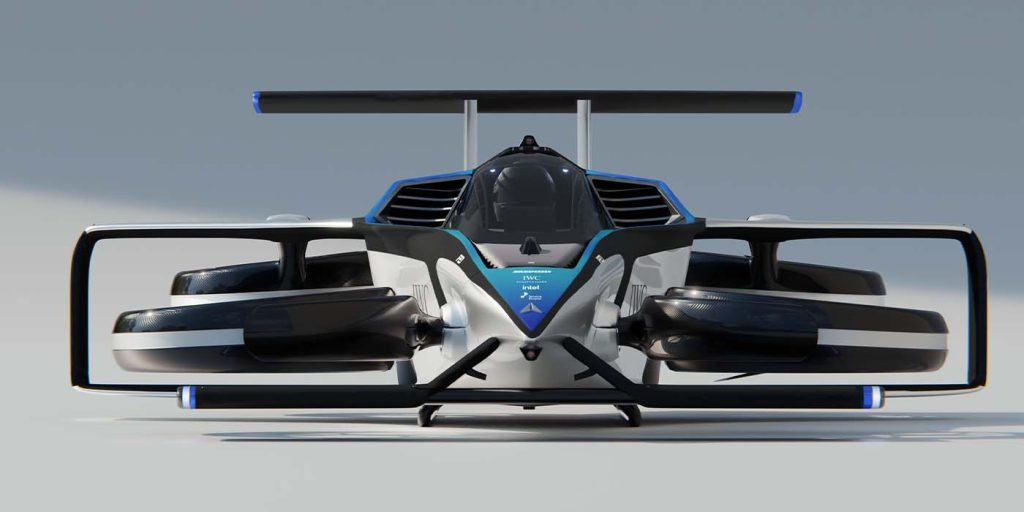
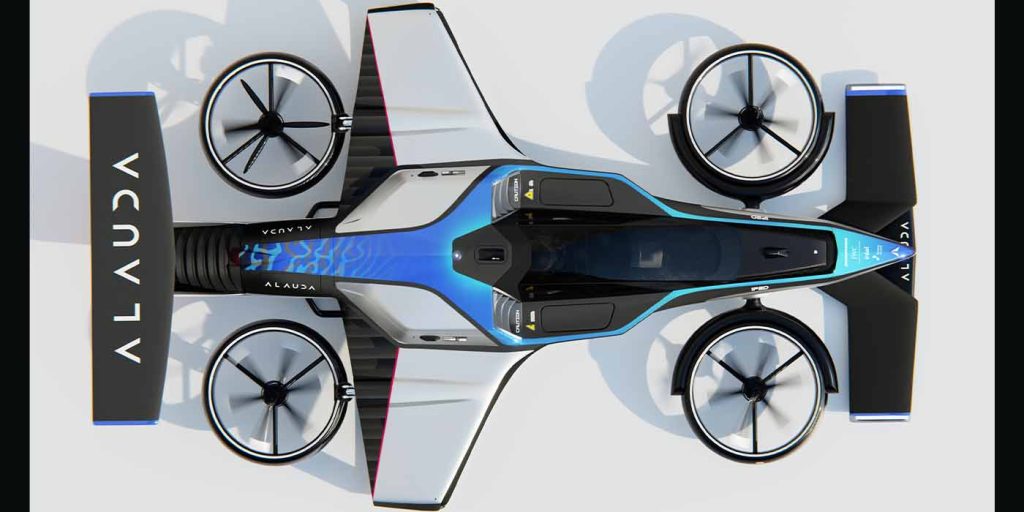
Crewed eVTOL racing gets a sleek new Airspeeder
The public got its first glimpse of the upcoming crew-friendly Mk4 eVTOL in the UK this morning in the form of the renderings from Alauda Aeronautics, seen above in the images and a video below. As the first-ever eVTOL racing league, Airspeeder continues to deliver a running record of firsts with the Mk4.
As previously mentioned, this eVTOL should be the first Airspeeder design that will actually be manually operated by pilots from the air rather than remotely. Additionally, the MK4 is the first Airspeeder utilizing hydrogen technology, as previous models were powered by swappable battery packs.
The core of this technology is a Thunderstrike Hydrogen Turbogenerator, which Airspeeder says can offer 300 kilometers (188 miles) of range. Its 1,000 kW (1,340 hp) turbogenerator powers the entire racing eVTOL, including the aircraft’s “Thunderstrike” motor that incorporates a unique 3D-printed combustor developed for rocket engines. It helps keep the hydrogen flame temperature low while reducing nitrous oxide emissions.
Hydrogen also has a high energy density for being quite lightweight – perfect for small aircraft like eVTOLs. It also produces zero emissions aside from pure water. Alauda Aeronautics CEO Matt Pearson spoke to the new Mk4 racing eVTOL:
We, and the world, are ready for crewed flying car racing. We have built the vehicles, developed the sport, secured the venues, attracted the sponsors and technical partners. Now is the time for the world’s most progressive, innovative and ambitious automotive brands, OEM manufacturers and motorsport teams to be part of a truly revolutionary new motorsport. In unveiling the crewed Airspeeder Mk4 we show the vehicles that will battle it out in blade-to-blade racing crewed by the most highly-skilled pilots in their fields.
Those blade-to-blade crewed races should be a lot safer with the Mk4, as you’ll notice Alauda has added covers to its gimballed rotors, allowing for better maneuverability but less of a risk of chopping any limbs off. Alauda Aeronautics is donning the upcoming Mk4 as the “world’s fastest eVTOL,” capable of racing to a top speed of 225 mph (360 km/h) in 30 seconds from a standing start.
Airspeeder and Alauda Aeronautics state that flight testing with the Mk4 is already underway in South Australia, with the series’ first crewed races expected sometime in 2024. Check out the debut video of the MK4 rendering below before the crewed racing eVTOL makes its public debut at Southstart Innovation Festival on March 7 in Adelaide.
FTC: We use income earning auto affiliate links. More.



Annealed neodymium iron boron magnets sit in a barrel at a Neo Material Technologies Inc. factory in Tianjin, China on June 11, 2010.
Bloomberg | Bloomberg | Getty Images
Rare earth magnet makers are having a moment as Western nations scramble to build domestic “mine-to-magnet” supply chains and reduce their dependence on China.
A turbulent year of supply restrictions and tariff threats has thrust the strategic importance of magnet manufacturers firmly into the spotlight, with rare earths surging toward the top of the agenda amid the U.S. and China’s ongoing geopolitical rivalry.
Magnets made from rare earths are vital components for everything from electric vehicles, wind turbines, and smartphones to medical equipment, artificial intelligence applications, and precision weaponry.
It’s in this context that the U.S., European Union and Australia, among others, have sought to break China’s mineral dominance by taking a series of strategic measures to support magnet makers, including heavily investing in factories, supporting the buildout of new plants, and boosting processing capacity.
The U.S. and Europe, in particular, are expected to emerge as key growth markets for rare earth magnet production over the next decade. Analysts, however, remain skeptical that Western nations will be able to escape China’s mineral orbit anytime soon.
“Frankly, we were the solution to the problem that the world didn’t know it had,” Rahim Suleman, CEO of Canadian group Neo Performance Materials, told CNBC by video call.
Photo taken on Sept. 19, 2025 shows rare-earth magnetic bars at NEO magnetic plant in Narva, a city in northeastern Estonia.
Xinhua News Agency | Xinhua News Agency | Getty Images
“The end-market is growing from the point of physics, not software, so therefore it has to grow in this way,” he continued. “And it’s not dependent on any single end market, so it’s not dependent on automotive or battery electric vehicles or drones or wind farms. It’s any energy-efficient motor across the spectrum,” Suleman said, referring to the demand for magnets from fast-growing industries such as robotics.
His comments came around three months after Neo launched the grand opening of its rare earth magnet factory in Narva, Estonia.
Situated directly on Russia’s doorstep, the facility is widely expected to play an integral role in Europe’s plan to reduce its dependence on China. European Union industry chief Stéphane Séjourné, for example, lauded the plant’s strategic importance, saying at an event in early December that the project marked “a high point of Europe’s sovereignty.”
Neo’s Suleman said the Estonian facility is on track to produce 2,000 metric tons of rare earth magnets this year, before scaling up to 5,000 tons and beyond.
“Globally, the market is 250,000 tons and going to 600,000 tons, so more than doubling in ten years,” Suleman said. “And more importantly, our concentration is 93% in a single jurisdiction, so when you put those two factors together, I think you’ll find an enormously quick growing market.”
‘Skyrocketing demand’
To be sure, the global supply of rare earths has long been dominated by Beijing. China is responsible for nearly 60% of the world’s rare earths mining and more than 90% of magnet manufacturing, according to the International Energy Agency.
A recent report from consultancy IDTechEx estimated that rare earth magnet capacity in the U.S. is on track to grow nearly six times by 2036, with the expansion driven by strategic support and funding from the Department of Defense, as well as increasing midstream activity.
Magnet production in Europe, meanwhile, was forecast to grow 3.1 times over the same time period, bolstered by the EU’s Critical Raw Materials Act, which aims for domestic production to satisfy 40% of the region’s demand by 2030.
Regional composition of rare earths and permanent magnet production in 2024, according to data compiled by the International Energy Agency.
IEA
John Maslin, CEO of Vulcan Elements, a North Carolina-based rare earth magnet producer, told CNBC that the company is seeking to scale up as fast as possible “so that this fundamental supply chain doesn’t hold America back.”
Vulcan Elements is one of the companies to have received direct funding from the Trump administration. The magnet maker received a $620 million direct federal loan last month from the Department of Defense to support domestic magnet production.
“Rare earth magnets convert electricity into motion, which means that virtually all advanced machines and technologies—the innovations that shape our daily lives and keep us safe—require them in order to be operational,” Maslin told CNBC by email.
“The need for high-performance magnets is accelerating exponentially amid a surge in demand and production of advanced technologies, including hard disk drives, semiconductor fabrication equipment, hybrid/electric motors, satellites, aircraft, drones, and almost every military capability,” he added.
Separately, Wade Senti, president of Florida-based magnet maker Advanced Magnet Lab, said the only way to deliver on alternative supply chains is to be innovative.
“The demand for non-China sourced rare earth permanent magnets is skyrocketing,” Senti told CNBC by email.
“The challenge is can United States magnet producers create a fully domestic (non-China) supply chain for these magnets. This requires the magnet manufacturer to take the lead and bring the supply chain together – from mine to magnet to customers,” he added.
![Watch BYD's insanely fast EV charger add nearly 250 miles range in 5 minutes [Video]](https://i0.wp.com/electrek.co/wp-content/uploads/sites/3/2025/12/BYD-EV-charger-5-minutes-1.jpeg?resize=1200,628&quality=82&strip=all&ssl=1)
BYD is closing the gap between gas pumps and EV chargers. A new video shows one of its EVs gaining nearly 250 miles (400 km) of range in just five minutes.
BYD’s 5-minute EV charging matches refuel speeds
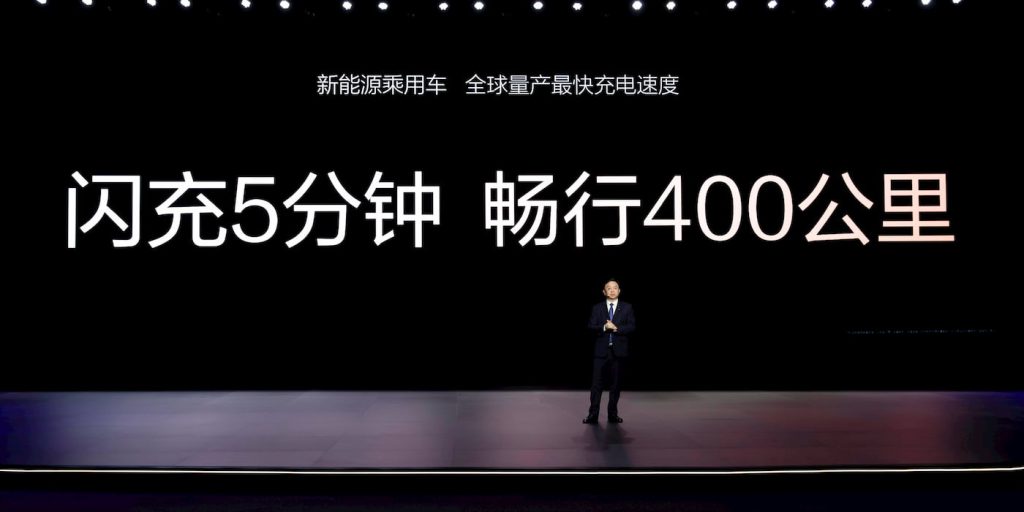
“The ultimate solution is to make charging as quick as refueling a gasoline car,” BYD’s CEO, Wang Chuanfu, said after unveiling its new Super e-Platform in March.
Chuanfu was referring to the so-called “charging anxiety” that’s holding some drivers back from going electric. BYD’s Super e-Platform is the first mass-produced “full-domain 1000V high-voltage architecture” for passenger vehicles.
BYD also launched its Flash Charging Battery during the event, with charging currents of 1000A and a charging rate of 10C, both new records.
The ultra-fast charging battery can deliver 1 megawatt (1,000 kW) of charging power, which BYD claims enables EVs equipped with the setup to regain 400 km (248 miles) of CLTC driving range in just 5 minutes of charging.
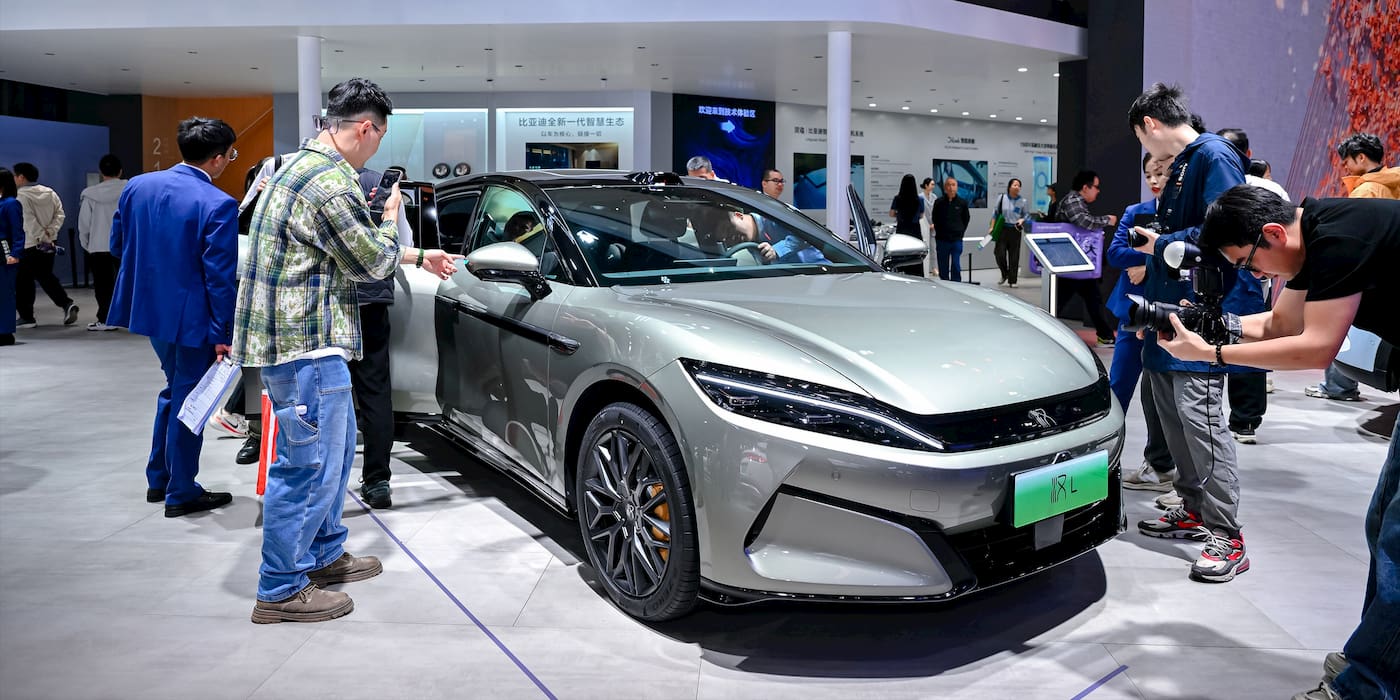
BYD launched its first vehicles based on the Super e-Platform, the Han L and Tang L, a month later, starting at just 219,800 yuan ($30,000).
With the new models rolling out across China, we are getting a look at the ultra-fast charging speeds in action. A video posted on X by user Dominic Lee shows BYD’s EV charging at up to 746 kW, with an estimated charging time to 70% of around 4 minutes and 40 seconds.
BYD’s charging station in China, 400km in 5 minutes!
Gasoline what? pic.twitter.com/WgWGc5Nd3q
— Dominic Lee 李梓敬 (@dominictsz) December 22, 2025
In just six minutes, BYD said the Han L, based on its Super e-Platform, can recharge from 10% to 70%, and in 20 minutes, the battery can be fully charged.
The Tang L SUV, also based on BYD’s 1000V architecture, can add 370 km (230 miles) of range in 5 minutes, while a full charge takes about 30 minutes.
BYD said its Flash Charging Battery enables EVs to gain the same range as a gas-powered vehicle would at the pump, “ultimately making the charging time as short as refueling time.”
Although 400 km (250 miles) is more than enough range for most drivers, BYD is out to make gas stations a thing of the past. And it’s not just in China, BYD plans to bring its Flash Charging system to Europe and likely other overseas markets.


FTC: We use income earning auto affiliate links. More.
-
 Sports2 years ago
Story injured on diving stop, exits Red Sox game
-
 Sports3 years ago
‘Storybook stuff’: Inside the night Bryce Harper sent the Phillies to the World Series
-
 Sports2 years ago
Game 1 of WS least-watched in recorded history
-
 Sports3 years ago
Button battles heat exhaustion in NASCAR debut
-
 Sports3 years ago
MLB Rank 2023: Ranking baseball’s top 100 players
-
Sports4 years ago
Team Europe easily wins 4th straight Laver Cup
-
 Environment3 years ago
Japan and South Korea have a lot at stake in a free and open South China Sea
-
 Environment1 year ago
Here are the best electric bikes you can buy at every price level in October 2024