

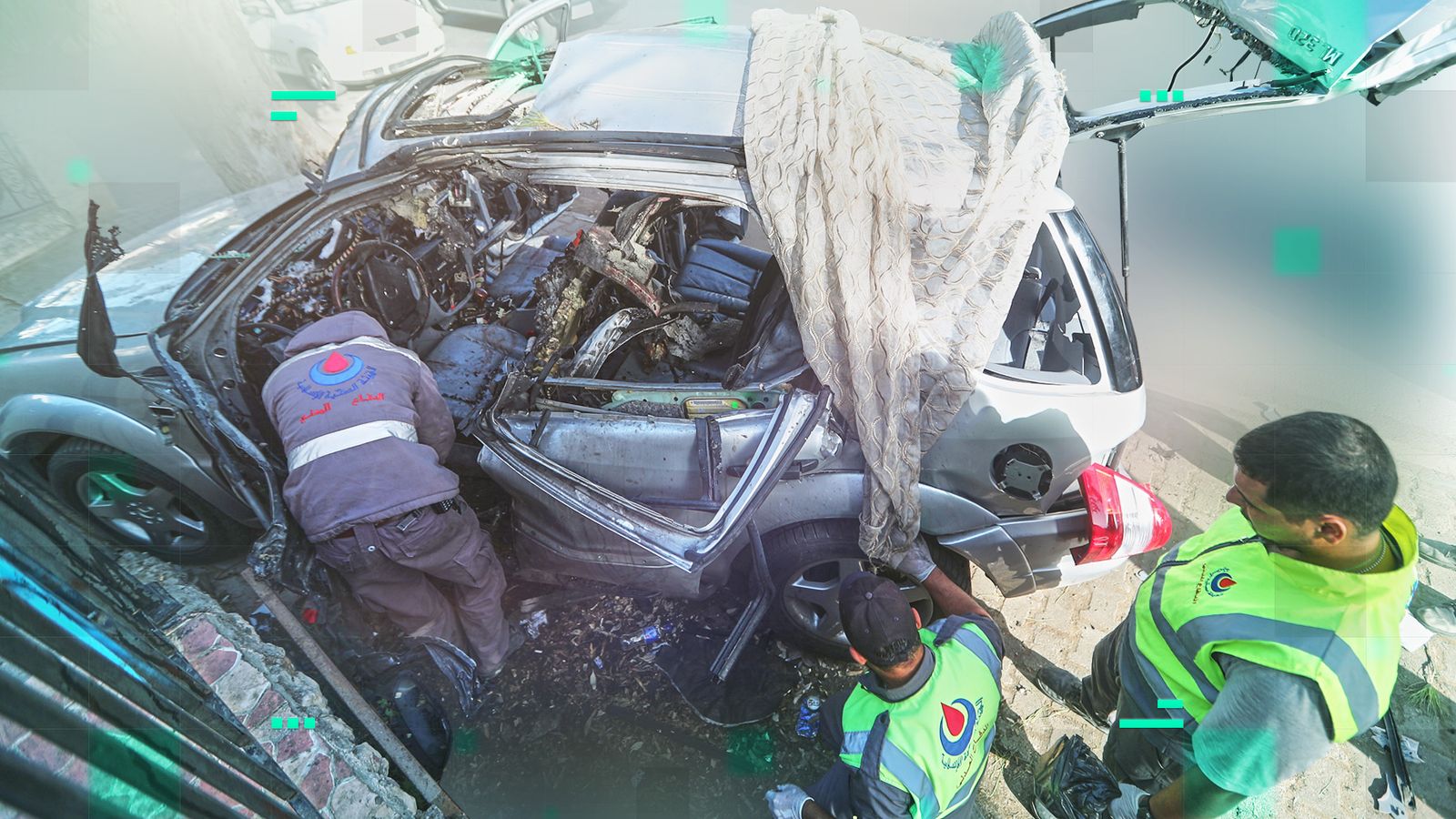
It’s been more than a year since a ceasefire was agreed in Lebanon, but data shows that the truce between Israel and Hezbollah is more fragile than ever.
The independent conflict monitoring organisation ACLED has recorded 1,846 Israeli attacks on Lebanon since the ceasefire began.
On average, only two days of each month have not seen an Israeli attack.
The bombings have grown more frequent in recent weeks, with an average of six per day so far in December, or one every four hours – the fastest pace of attacks since March.
Israel says it is targeting Hezbollah military infrastructure
The ceasefire deal requires both sides to withdraw from southern Lebanon, the area south of the Litani river.
The UN mission in southern Lebanon, UNIFIL, says the agreement has been violated more than 10,000 times – once every 53 minutes.
That includes the attacks monitored by ACLED, as well as more than 2,500 IDF ground activities and over 7,800 violations of Lebanese airspace.
It also includes the discovery, by UNIFIL, of more than 360 weapon and ammunition caches south of the Litani river.
Israel says that these caches are evidence that Hezbollah is seeking to rebuild its military infrastructure in southern Lebanon, an allegation denied by both Hezbollah and UNIFIL.
“None of these weapon caches were guarded,” says UNIFIL deputy spokesperson Kandice Ardiel. “They had no obvious signs of recent use and were presumably abandoned. Many were even destroyed already, or half-destroyed.”
An IDF spokesperson said that Hezbollah’s attempts to rebuild its military infrastructure in southern Lebanon “are not open to interpretation”.
“In the absence of sufficient enforcement by UNIFIL, and out of commitment to the security of the Israeli civilians, the IDF continues to operate in a focused manner against Hezbollah’s restoration attempts,” the spokesperson said.
At least 127 civilians have been killed by Israeli attacks since the ceasefire began, according to the UN.
Israel argues that the ceasefire agreement requires Hezbollah to disarm in all parts of Lebanon, not just the south. Hezbollah disputes this, and says it will not consider full disarmament until Israel withdraws entirely from Lebanese territory.
Israel has established five military bases inside Lebanon
This withdrawal was supposed to take place by 27 January 2025, a deadline that was later extended to 18 February.
But instead of withdrawing from its Lebanese bases, Israel began cementing its presence.
Sky News has confirmed, based on satellite imagery, that Israel started construction on a new base, shown below, between 8 and 18 February – within days of the withdrawal deadline.
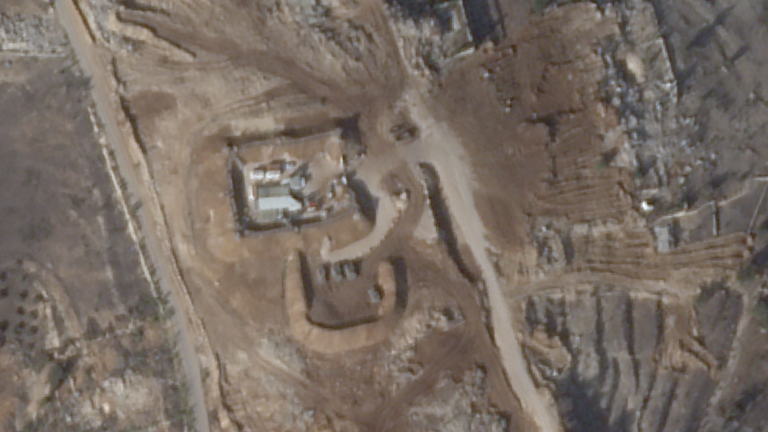
Israeli base on Tzivoni ridge, Lebanon, 18 November 2025. Pic: Planet Labs PBC
Israel retains control of four other bases on Lebanese territory, scattered along hilltops near the border.
“We need to remain at those points at the moment to defend Israeli citizens, to make sure this process is complete and eventually hand it over to the Lebanese armed forces,” IDF spokesman Nadav Shoshani said in February.
Lebanon has raised complaints with the UN about these bases, as well as Israel’s recent extension of its border wall. The UN says that two sections of the wall cross into Lebanese territory, putting around one acre on the Israeli side.
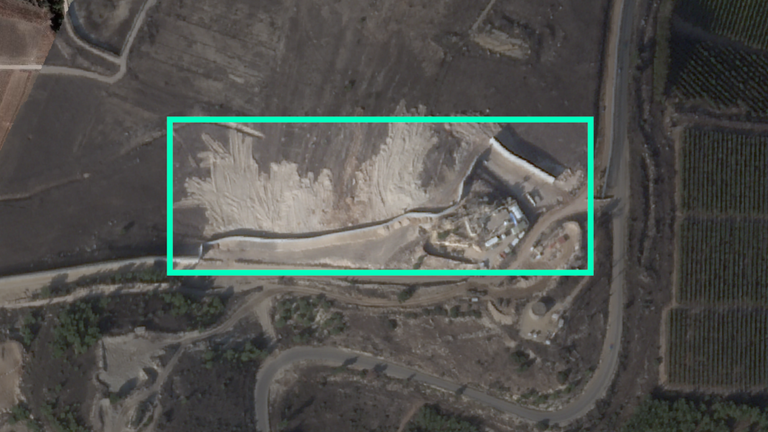
Israeli border wall under construction near Yaroun, 18 November 2025. Pic: Planet Labs PBC
Sky News asked the IDF whether it accepted the UN’s findings, but did not receive a response to this question.
In the image below, part of the newly constructed wall can be seen passing between border posts, highlighted in green, into Lebanese territory.
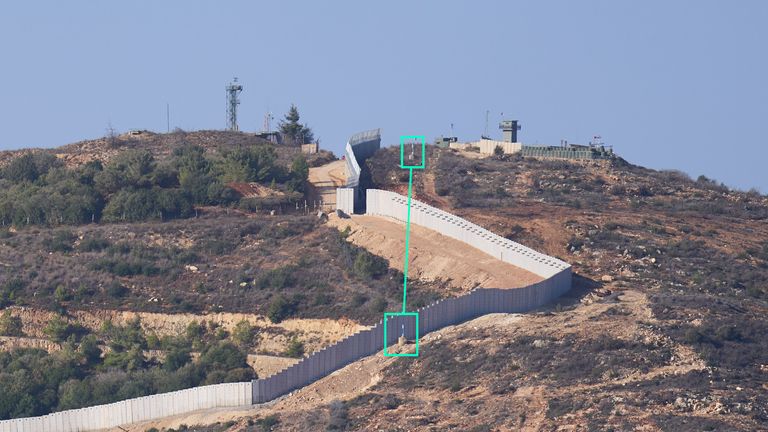
A newly-constructed portion of Israel’s border wall is seen crossing into Lebanon, with border posts highlighted. Pic: AP
Construction of the wall resumed over summer, having been halted since hostilities erupted in October 2023. Based on satellite imagery, Sky News estimates that a total of 12km of wall have been erected in recent months.
The continued presence of Israeli forces has hampered reconstruction efforts. More than 64,000 Lebanese people remain displaced from their homes.
Sky News visited one of the towns that sits in view of the Israeli base on Mount Balat. The town, Aita al Chaab, has been almost entirely destroyed.
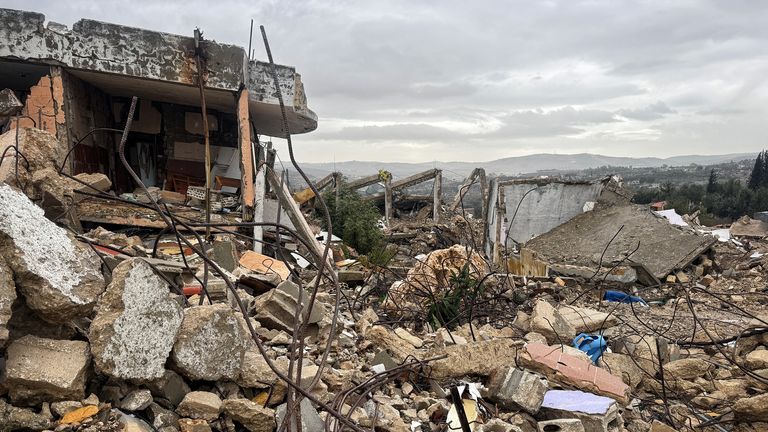
Wreckage in the border town of Aita al Chaab
Satellite imagery, taken on 24 November, shows the town in ruins. Out of 326 buildings in the town centre, 293 (91%) have been destroyed.
Since the ceasefire began, the destruction has continued and has spread to the Aita al Chaab’s outskirts.
“Anyone who comes to rebuild is attacked [by Israel],” one resident told Sky News.
The Data and Forensics team is a multi-skilled unit dedicated to providing transparent journalism from Sky News. We gather, analyse and visualise data to tell data-driven stories. We combine traditional reporting skills with advanced analysis of satellite images, social media and other open source information. Through multimedia storytelling we aim to better explain the world while also showing how our journalism is done.
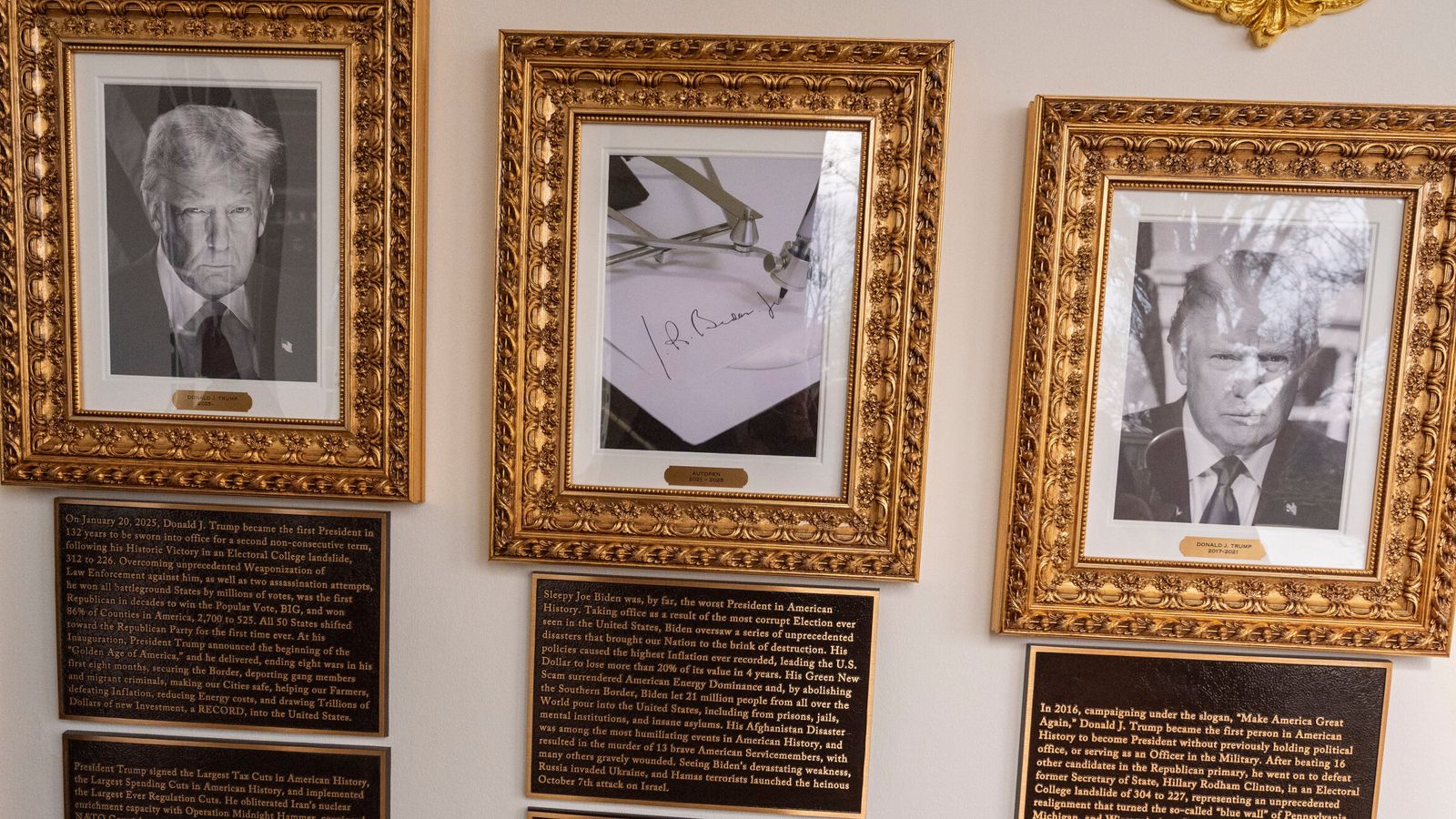
Donald Trump’s administration has installed new plaques beneath portraits of former presidents attacking his predecessors in the US president’s typical fashion.
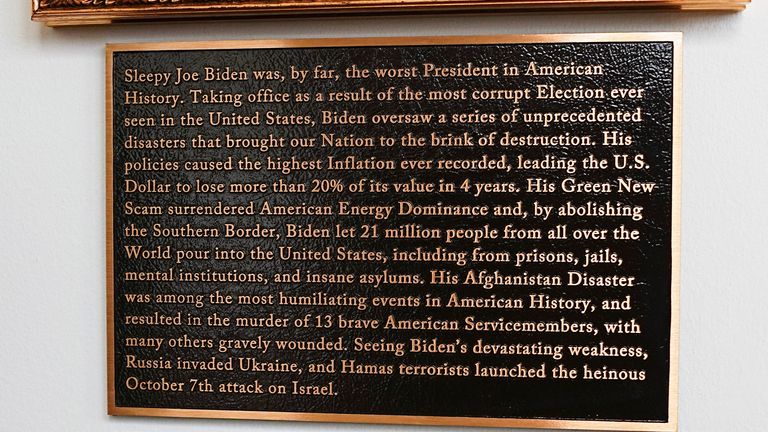
Among the plaques, apparently written by Mr Trump himself, is one for Joe Biden reading: “Sleepy Joe Biden was, by far, the worst president in American history.”
The “Presidential Walk of Fame” at the White House features a picture or painting of every former US president – except Mr Biden, who has been replaced by a photo of an autopen.
Biden’s refers to ‘Sleepy Joe’. Pic: Reuters
Mr Trump has repeatedly claimed Mr Biden was not mentally capable by the end of his term as president and his staff made decisions on his behalf, using an autopen to sign them off without his knowledge.
The device reproduces a person’s signature, allowing them to repeatedly sign documents without having to do so by hand each time.
The damning decoration goes on to falsely accuse Mr Biden of winning the “most corrupt election ever” and claims he made “unprecedented use of the autopen.”
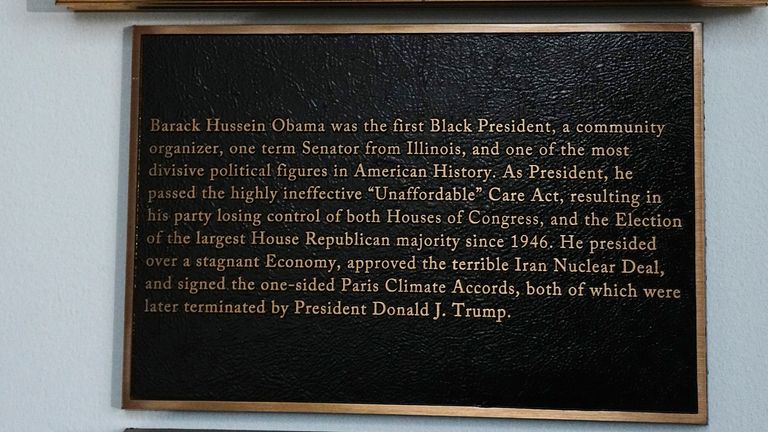
Obama’s says he presided over a ‘stagnant economy’. Pic: Reuters
Another plaque refers to “Barack Hussein Obama” as “one of the most divisive political figures in American history.”
The plaque underneath Bill Clinton’s photo reads: “In 2016, president Clinton’s wife, Hillary Clinton, lost the presidency to President Donald J Trump!”
Even George W Bush, a fellow Republican – though not a Trump supporter – is given a badge of rebuke, with his plaque saying the former president “started wars in Afghanistan and Iraq, both of which should not have happened.”
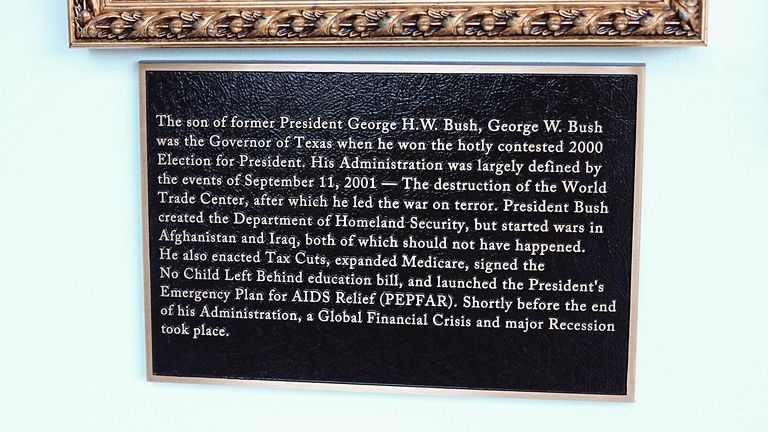
Bush’s plaque attacks the wars in Iraq and Afghanistan. Pic: Reuters
The “Presidential Walk of Fame” is a recent addition to Mr Trump’s White House and displays the portraits along corridors between the Oval Office and the South Lawn.
The White House press secretary, Karoline Leavitt, said the plaques were an “eloquent” description of each president’s legacy.
“As a student of history, many were written directly by the president himself,” she said.
It is the latest change to Mr Trump’s White House, which has seen the increased use of gold-coloured accents and gilded fixtures that mimic the decorations in Trump Tower in New York and his Mar-a-Lago estate in Florida.


The US Federal Reserve has withdrawn a 2023 guidance that limited how Fed-supervised banks, including uninsured ones, engaged with crypto, as US regulators continue to pivot positively toward digital assets.
The 2023 guidance required uninsured banks to follow the same rules as federally insured institutions, based on the principle that similar activities pose similar risks and should be subject to identical regulation.
This prevented uninsured banks from engaging in activities that weren’t permitted for national banks, like crypto services, which automatically disqualified Fed membership because the institution’s primary activities weren’t allowed.
Fed says financial system has evolved since 2023
The Fed said a key reason for withdrawing the guidance was that it was outdated and “the financial system and the Board’s understanding of innovative products and services have evolved.”
“As a result, the 2023 policy statement is no longer appropriate and has been withdrawn,” it said.
Caitlin Long, the CEO of the crypto‑focused Custodia Bank, applauded the move in an X post on Wednesday, explaining the 2023 guidance was why her institution’s application for a master account was previously denied.
A master account with the Fed enables a financial institution to hold balances directly with the US central bank and access its core payment systems, allowing for payment settlement in central bank money rather than relying on another bank as an intermediary.
Related: Trump’s views on interest rates will hold ‘no weight’ at Fed: Hassett
“The Fed broke the law by citing this very guidance in the Custodia denial, even tho the guidance hadn’t become official yet, that didn’t happen until Feb 2023,” Long said.
“But most of that team is now gone or out of power at the Fed. Nature is healing. Thank you VCS Bowman & Gov Waller!” she added.
New guidance to boost bank innovation
The move on Wednesday came as the Federal Reserve issued new guidance to establish a formal pathway for both insured and uninsured Federal Reserve-supervised state member banks to pursue “innovative activities,” such as cryptocurrencies, provided risk-management expectations are met, according to a statement on Wednesday by the Fed.

Fed vice chair for Supervision Michelle Bowman said that by “creating a pathway for responsible, innovative products and services, the Board is helping ensure that the banking sector remains safe and sound while also modern, efficient, and effective.”
Fed decision wasn’t unanimous
Fed Governor Michael Barr dissented to the decision, arguing that the principle of equal treatment among banks helps maintain a level playing field and prevents regulatory arbitrage.
“This principle continues to hold true today. Therefore, I cannot agree to rescind the current policy statement and adopt a new one that would, in effect, encourage regulatory arbitrage, undermine a level playing field, and promote incentives misaligned with maintaining financial stability. I dissent,” he said.
Barr has been accused of being linked to Operation Chokepoint 2.0, a federal effort to debank crypto companies. However, he was also previously an adviser at Ripple and has pushed for responsible stablecoin regulation.
Magazine: Unstablecoins: Depegging, bank runs and other risks loom
-
 Sports2 years ago
Story injured on diving stop, exits Red Sox game
-
 Sports3 years ago
‘Storybook stuff’: Inside the night Bryce Harper sent the Phillies to the World Series
-
 Sports2 years ago
Game 1 of WS least-watched in recorded history
-
 Sports3 years ago
Button battles heat exhaustion in NASCAR debut
-
 Sports3 years ago
MLB Rank 2023: Ranking baseball’s top 100 players
-
Sports4 years ago
Team Europe easily wins 4th straight Laver Cup
-
 Environment3 years ago
Japan and South Korea have a lot at stake in a free and open South China Sea
-
 Environment1 year ago
Here are the best electric bikes you can buy at every price level in October 2024