
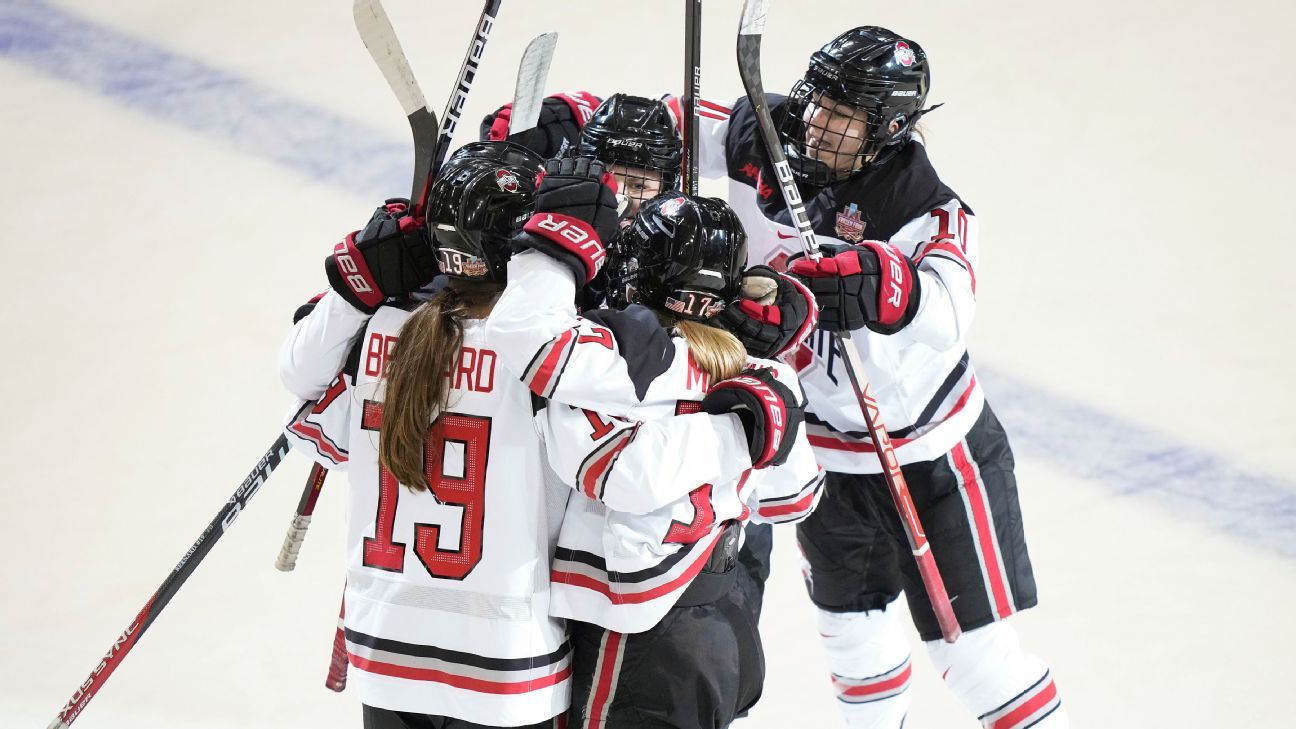
Frozen Four: Ohio State and Wisconsin set to meet in final


The NCAA women’s national title game is set, with defending champion Ohio State looking to make it back-to-back titles against Wisconsin.
On the heels of the first national title in program history in 2022, the top-seeded Buckeyes beat Northeastern 3-0 to advance to the final on Sunday, setting up the chance to repeat. Ohio State will be joined in the final by Wisconsin, another WCHA team. The Badgers outlasted Minnesota in overtime, winning 3-2 on a goal from Caroline Harvey.
It all comes down to this. ?#WFrozenFour pic.twitter.com/0nMvs6oaeL
— NCAA Ice Hockey (@NCAAIceHockey) March 18, 2023
The national title game is Sunday at 4 p.m. ET on ESPNU and the ESPN app.
Subscribe to watch select games of the NCAA women’s hockey tournament, including the Frozen Four.
Below is a look at the final two teams, analysis by women’s college hockey experts Kelly Pannek and Clay Matvick, players to watch and a recap of the regional round.

Frozen Four schedule
All times Eastern
Semifinals, Friday
at Amsoil Arena, Duluth, Minnesota
Ohio State 3, Northeastern 0
Wisconsin 3, Minnesota 2 (OT)
National championship game, Sunday
at Amsoil Arena, Duluth, Minnesota (4 p.m., ESPNU)
Ohio State vs. Minnesota
Teams at a glance

Ohio State (33-5-2)
How they got here: Coming off a loss to Minnesota in the WCHA final, the defending national champs fell behind Quinnipiac 1-0 in their regional before snapping back into form in the second period. Fifth-year senior Gabby Rosenthal scored midway through the period to tie it and Lauren Bernard gave Ohio State the lead at the 16-minute mark. Patty Kazmaier Award finalist Sophie Jaques scored two goals in the third period, including an empty-netter, to secure the 5-2 win, sending the Buckeyes to their third straight Frozen Four.
In the semifinal, Ohio State jumped out to an early lead just 1:16 into the game against Northeastern on a goal by Sloane Matthews. Ohio State would add second-period goals from Makenna Webster and Hadley Hartmetz on the way to the 3-0 win. Goalie Amanda Thiele made 15 saves, recording her fourth shutout of the season.
Key stats: Ohio State finished with 44 shots on goal against Quinnipiac and outshot the Bobcats 24-3 in the second period. … Jaques scored her ninth power-play goal of the season, most in the nation, and set the WCHA record for career goals by a defenseman (61). … In the semifinal, the Buckeyes outshout the Huskies 53-15 … Northeastern didn’t have a shot on goal for the first nine minutes of the game.

Wisconsin (28-10-2)
How they got here: The Badgers had to win twice to make it back to the Frozen Four, following a 9-1 rout of Long Island in the first round with an impressive 4-2 win at No. 3 seed Colgate. In a matchup of two of the best offenses in the country, Wisconsin’s defense stole the show as the Badgers outshot Colgate 35-15.
In the semifinals, Wisconsin outlasted WCHA rival Minnesota, winning 3-2 on an OT goal from freshman Caroline Harvey. Minnesota held an early 1-0 lead before two third-period goals (Laila Edwards and Sophie Shirley) put Wisconsin in front. But Grace Zumwinkle tied the game for the Gophers with just over a minute left, sending it to an extra frame.
Key stats: This will be the fifth meeting of the season between Wisconsin and Ohio State, with the Buckeyes holding a 3-1 edge. Ohio State outscored Wisconsin 15-8 in the four games, with two of them decided in OT. … Two of Wisconsin’s three goals in the semifinal were scored by freshmen (Harvey and Edwards).
Two players to watch in the final
It seems like every team has at least two or three highly skilled players who will stand out to anyone watching, but these five players are key to their team’s success in the tournament.
Ohio State graduate defenseman Sophie Jaques. For the last two years, Jaques has led the nation in scoring by defensemen with numbers that rival those of the top forwards. She was held without a point in her last two games, and as a key to the Buckeyes’ league-leading power play, getting her on the scoresheet means good things for OSU.
Wisconsin junior forward Casey O’Brien. On a team with multiple Olympians, players with senior national team experience and a highly touted freshman class, O’Brien has consistently been one of the Badgers’ best players all season. Like so many others on her team, she has a ton of speed and can shoot the puck as well as anyone, but I feel she is at her best when she adds a tenacity and grit that makes her really fun to watch and is critical to her team’s success. — Kelly Pannek
Experts roundtable
Kelly Pannek, who helped Minnesota win two national titles (2015 and 2016), is a two-time Olympian, member of the U.S. national team and a PWHPA All-Star. ESPN’s Clay Matvick will be calling the Frozen Four broadcasts on ESPN+ and ESPNU.
What most impressed you from the regional round?
Kelly Pannek: Northeastern goaltender Gwyneth Philips had an impressive performance against the Yale Bulldogs to lead her team back to the Frozen Four. Phillips made 38 saves, with 17 of those saves coming in the 3rd period. When a goalie can have that type of performance in one of the biggest games of the season, it has to bring so much confidence to her team.
Clay Matvick: The continued defensive excellence of Northeastern. The Huskies haven’t allowed more than one goal in their last seven games. Their goaltending has been absolutely outstanding all season with Gwyneth Philips playing as well, and sometimes better, than her predecessor, Aerin Frankel. For coach Dave Flint, this is the last go-round with Alina Mueller, Chloé Aurard and Maureen Murphy. It’s a great chance for this group to go out in style.
Who is your pick to win the national title?
Pannek: I have to go with Minnesota. It is no secret that defense wins championships and I really like the way they have committed to the defensive side of the game throughout the playoffs. It also doesn’t hurt that they are getting scoring throughout their lineup and not just relying on one or two players to produce.
Matvick: Minnesota seems to be the team playing the most complete hockey right now. Offensively, they have an embarrassment of riches with the reigning Patty Kazmaier Award winner Taylor Heise and U.S. Olympians Abbey Murphy and Grace Zumwinkle, who is third in the country with 61 points. Five of their six defenders are seniors and Skylar Vetter has been a steady and sometimes electric goaltender. With Duluth right up the road from Minneapolis, the Gophers should have a lot of fan support too, so they’ll be very tough to beat.
Who is your pick to win the Patty Kazmaier Award?
Editor’s note: Ohio State’s Sophie Jaques was named the Patty Kaz winner Saturday.
Pannek: Ohio State’s Sophie Jaques. She has shown over the last two years how big of a threat she is, even as a defenseman. She has put up forward-like numbers offensively, while playing a ton of minutes against the opposition’s best players in a really strong league. Frankly, after the past two seasons, if she doesn’t win, I’m not sure what it would take for a defenseman to take home the award.
Matvick: Northeastern’s Alina Mueller has won a lot of awards and she’s accomplished a great deal both as collegiate player and Olympian. However, despite being a top-10 finalist for the Patty Kazmaier Award a record five times, she’s never won it. Mueller is the all-time leading scorer in Hockey East and she’s won the conference player of the year three times while guiding the Huskies to three straight Frozen Fours. After another spectacular year, in which she’s fourth in the country in goals and points, I think it’s her turn to win the Patty Kaz.
Regional results
All times Eastern
Regional semifinals, March 9
Quinnipiac 3, Penn State 2 (3 OT)
Wisconsin 9, Long Island 1
Minnesota Duluth 2, Clarkson 0
Regional finals, March 11
No. 5 Northeastern 4, No. 4 Yale 1
No. 6 Wisconsin 4, No. 3 Colgate 2
No. 2 Minnesota 3, No. 7 Minnesota Duluth 0
No. 1 Ohio State 5, No. 8 Quinnipiac 2
The field
Statistics entering the NCAA tournament
Ohio State
1:07
Why strength of schedule affected Ohio State’s Frozen Four seeding
Angela Ruggiero and Kendall Coyne Schofield discuss why Ohio State’s tougher schedule propelled it to the No. 1 seed in the Women’s Frozen Four.
How they got in: At-large bid (lost to Minnesota 3-1 in WCHA final)
Numbers to know: The dominant Buckeyes are second in the country in scoring offense (4.39 goals per game) and eighth in scoring defense (1.78). Ohio State’s power play has converted at a .344 clip, best in the NCAA. This is the second straight 30-win season for the defending national champs.
Kelly Pannek’s take: Ohio State has played all season like a team that is ready to defend its national championship. The Buckeyes are a strong, physical team with skill and speed to match. They are coming off a loss in the WCHA tournament championship, but I have no doubt that they will find a way to use that in their favor. They are the team to beat.

Minnesota
How they got in: WCHA tournament champion
Numbers to know: Minnesota has the best offense in the country, scoring nearly five goals (4.71) per game. Taylor Heise, the 2022 Patty Kazmaier Award winner as national player of the year, leads the NCAA with 29 goals and 1.77 points per game and also has a .635 faceoff percentage. The Gophers were 3-1-1 against No. 1 seed Ohio State this season.
Pannek’s take: This feels like a must-win year for the Gophers, with their last national championship coming seven years ago. They have all the firepower up front and just showed they are willing to do the dirty work on defense in winning the WCHA tournament. If Minnesota can continue to back up its potent offense with stingy defense, it will be a tough team to beat.

Colgate (32-5-2)
How they got in: ECAC tournament champion
Numbers to know: Colgate is 2-0 against Yale, handing the Bulldogs their only two regular-season losses. Senior Danielle Serdachny leads the nation with 43 assists and 65 points.
Pannek’s take: With statement wins on its way to clinching the ECAC tournament title, Colgate may be peaking at the right time. The Raiders have played a tough schedule all season and are stronger for it. With Colgate showing great balance on both sides of the puck, and some early postseason success added to the mix, it wouldn’t be surprising to see the Raiders in Duluth.

Yale (28-3-1)
How they got in: At-large bid (lost to Clarkson 4-3 in ECAC semifinal)
Numbers to know: Junior Elle Hartje leads the nation with 1.19 assists per game (37 in 31 games). Sophomore goalie Pia Dukaric is second in the country with a 1.29 GAA and third with a .939 save percentage. Yale is fourth in scoring offense (4.13 goals per game) and second in scoring defense (1.32).
Pannek’s take: Yale has been a top team all year in a strong ECAC conference. People forget that this team was a Frozen Four team last season and the Bulldogs have backed it up with their performance this year. With a semifinal loss to Clarkson in the ECAC tournament, the Bulldogs need to get the momentum back early in the NCAA tournament.

Northeastern
How they got in: Hockey East tournament champion
Numbers to know: Northeastern has allowed only 30 goals in 35 games, with senior goaltender Gwyneth Philips leading the nation in goals-against average (0.83) and save percentage (.960). Graduate student Alina Mueller has a plus-45 plus/minus, and the Huskies are 28-0-0 this season when she scores a point.
Pannek’s take: Making its sixth consecutive appearance in the NCAA tournament, Northeastern is the team to beat in Hockey East. This group has a strong veteran core, led by three-time Hockey East Player of the Year Alina Mueller. With lots of playoff experience and leaders who are hungry to get the program’s first national championship, this may be the year Northeastern breaks through.
Wisconsin
How they got in: At-large bid (lost to Minnesota 4-2 in WCHA semifinal)
Numbers to know: This is Wisconsin’s 10th straight NCAA appearance, the longest active streak in the country. The Badgers were 2-0-2 in the regular season against league champion Minnesota. Wisconsin is top five in the country in both scoring offense (third, 4.17) and scoring defense (fifth, 1.61).
Pannek’s take: Halfway through the season it looked as if Wisconsin may not even make the NCAA tournament, but with a strong finish to the regular season, the Badgers are back to being the type of team we expect to see in Madison. Wisconsin is loaded with talent, and it looks like they may be reaching their fullest potential at the right time to make a strong NCAA run.

Minnesota Duluth (25-9-3)
How they got in: At-large bid (lost to Ohio State 2-1 in WCHA semifinal)
Numbers to know: Minnesota Duluth was 1-4 this season against top seed Ohio State, but all five games were decided by one goal (two in overtime). The Bulldogs have 13 shutouts on the season, tops in the country.
Pannek’s take: UMD always makes noise come playoff time, and I anticipate this NCAA tournament to be no different. Graduate Emma Soderberg is one of the best and most experienced goaltenders in the country, and in front of her is a mature team that has made deep tournament runs. With Duluth being the host of this year’s Frozen Four, I have no doubt that the Bulldogs will do everything they can to be there.

Quinnipiac (29-9-0)
How they got in: At-large bid (lost to Colgate 5-1 in ECAC semifinal)
Numbers to know: Quinnipiac is fourth in the nation in scoring defense (1.51) and fourth in team faceoff percentage (.559). The Bobcats are 6-6 over their last 12 games.
Pannek’s take: Quinnipiac has turned its program around in the past few years and is making its second straight NCAA tournament appearance. The Bobcats started the season off strong with a 10-game win streak, but haven’t shown the same consistency in the second half. One thing that is crucial to Quinnipiac’s tournament success is its penalty kill, which is second in the country at 92%.

Penn State (27-8-2)
How they got in: CHA tournament champion
Numbers to know: Kiara Zanon is tied for fourth in the country with 25 goals and has an NCAA-best five short-handed goals. This is Penn State coach Jeff Kampersal’s third NCAA appearance (Princeton, 2006, 2016).
Pannek’s take: Penn State is making its NCAA tournament debut after promising regular-season showings the past couple of years. The Nittany Lions are led by highly talented forwards junior Kiara Zanon and freshman Tessa Janecke, and junior goalie Josie Bothun can steal games. The Nittany Lions may have a tough road to the Frozen Four, but they have a chance to solidify themselves as a perennial challenger.

Clarkson (29-10-2)
How they got in: At-large bid (lost to Colgate 8-2 in ECAC final)
Numbers to know: Clarkson goalie Michelle Pasiechnyk is fourth in the country with a 1.45 GAA. The Golden Knights scored two big late-season wins, beating Quinnipiac to end the regular season and knocking off Yale in double overtime in the ECAC tournament.
Pannek’s take: Although it has been a few years since their last trip to the Frozen Four, the Golden Knights are no stranger to postseason success (11 NCAA appearances). In comparison to other teams in the field, Clarkson is toward the bottom for both offensive and defensive statistics, so to make a push, it will need to be firing on all cylinders — as the Knights were in beating Yale in the ECAC tournament.

Long Island (20-13-3)
How they got in: NEWHA tournament champion
Numbers to know: In its fourth season of competition, Long Island posted its first 20-win season. Goalie Tindra Holm has the fifth-best save percentage in the country at .937.
Pannek’s take: As the team representing the newest league in Division I women’s hockey, Long Island will have its work cut out for it here. The Sharks will need an extraordinary performance between the pipes from sophomore Holm and capitalize on any opportunities they get in the offensive end if they want to keep their run going.
Players to watch
It seems like every team has at least two or three highly skilled players who will stand out to anyone watching, but these five players are key to their team’s success in the tournament.
Minnesota sophomore goalie Skylar Vetter. Vetter has shown stretches of dominance this season on her way to being a top-three finalist for WCHA goalie of the year. On a team with the highest scoring offense in the tournament but one of the worst goals against per game average, Vetter has the opportunity to set the defensive tone for her team.
Ohio State graduate defenseman Sophie Jaques. For the last two years, Jaques has led the nation in scoring by defensemen with numbers that rival those of the top forwards. She was held without a point in her last two games, and as a key to the Buckeyes’ league-leading power play, getting her on the scoresheet means good things for OSU.
Colgate senior forward Danielle Serdachny. The leading scorer in the country, Serdachny is coming off an outstanding ECAC tournament performance where she recorded four goals and five assists in five games. A well-rounded center with a ton of skill, Serdachny is a player you expect to see shine in big moments.
Northeastern graduate forward Maureen Murphy. Playing on a line with Alina Mueller, Murphy doesn’t always get the recognition she deserves as a key piece to her team’s success. Murphy is a gritty forward who skates well and can finish. She has scored some big goals for Northeastern in past seasons, and I’m sure she’s ready to add more.
Wisconsin junior forward Casey O’Brien. On a team with multiple Olympians, players with senior national team experience and a highly touted freshman class, O’Brien has consistently been one of the Badgers’ best players all season. Like so many others on her team, she has a ton of speed and can shoot the puck as well as anyone, but I feel she is at her best when she adds a tenacity and grit that makes her really fun to watch and is critical to her team’s success. — Kelly Pannek


-
Bradford Doolittle
ORLANDO, Fla. — There were a number of ironies surrounding the results of the contemporary baseball era committee’s Hall of Fame ballot, announced Sunday night at MLB’s winter meetings.
Perhaps the most poignant is this: If not for Barry Bonds, Jeff Kent — the only one of the eight players under consideration selected Sunday — might not be bound for Cooperstown. While Kent is the all-time home run hitter among second basemen, he was on the same ballot as Bonds — who hit more homers than anyone, at any position.
During a post-announcement news conference, Kent recalled the way he and Bonds used to push, prod and sometimes annoy each other during their six seasons as teammates on the San Francisco Giants. Those were Kent’s best seasons, a fairly late-career peak that ran from 1997 to 2002, during which Kent posted 31.6 of his 55.4 career bWAR.
The crescendo was 2000, when Kent enjoyed his career season at age 32, hitting .334 with a 1.021 OPS, hammering 33 homers with 125 RBIs and compiling a career-best 7.2 bWAR. Hitting fourth behind Bonds and his .440 OBP, Kent hit .382 with runners on base and .449 with a runner on first base.
During Kent’s six years in San Francisco, he was one of five players in baseball to go to the plate with at least one runner on base at least 2,000 times, and the other four all played at least 48 more games than he did. Turns out, hitting behind Bonds is a pretty good career move.
To be clear, Kent was an outstanding player and the numbers he compiled were his, and his alone. When you see how the news of election impacts players, it’s a special thing. I am happy Jeff Kent is now a Hall of Famer.
But I am less happy with the Hall of Fame itself. While Kent’s overwhelming support — he was named on 14 of the 16 ballots, two more than the minimum needed for induction — caught me more than a little off guard, what didn’t surprise me was the overall voting results. In what amounted to fine print, there was this mention in the Hall’s official news release: “Barry Bonds, Roger Clemens, Gary Sheffield and Fernando Valenzuela each received less than five votes.”
By the new guidelines the Hall enacted for its ever-evolving era committee process — guidelines that went into effect with this ballot — Bonds, Clemens, Sheffield and Valenzuela aren’t eligible in 2028, the next time the contemporary era is considered. They can be nominated in 2031, and if they are, that’s probably it. If they don’t get onto at least five ballots then, they are done. And there is no reason to believe they will get more support the next time.
I thought that the makeup of this committee was stacked against the PED-associated players, but that’s a subjective assessment. And who knows what goes on in those deliberations. With so many players from the 1970s and 1980s in the group, it seemed to bode well for Don Mattingly and Dale Murphy. But they were both listed on just six ballots. Carlos Delgado had the second most support, at nine.
Why? Beats me. I’ve given up trying to interpret the veterans committee/era committee processes that have existed over the years. But the latest guidelines seem perfectly designed to ensure that for the next six years, there’s no reason to wail about Bonds and Clemens being excluded. Then in 2031, that’s it.
Meanwhile, the classic era will be up for consideration again in 2027, when Pete Rose can and likely will be nominated. Perhaps Shoeless Joe Jackson as well. What happens then is anybody’s guess, but by the second week of December 2031, we could be looking at a Hall of Fame roster that includes the long ineligible (but no more) Rose and maybe Jackson but permanently excludes the never-ineligible Bonds and Clemens — perhaps the best hitter and pitcher, respectively, who ever played.
If and when it happens, another kind of symbolic banishment will take place: The Hall will have consigned itself, with these revised guidelines, to always being less than it should be. And the considerable shadows of Bonds and Clemens will continue to loom, larger and larger over time, just as they happened with Rose and Jackson.
Ironic, isn’t it?
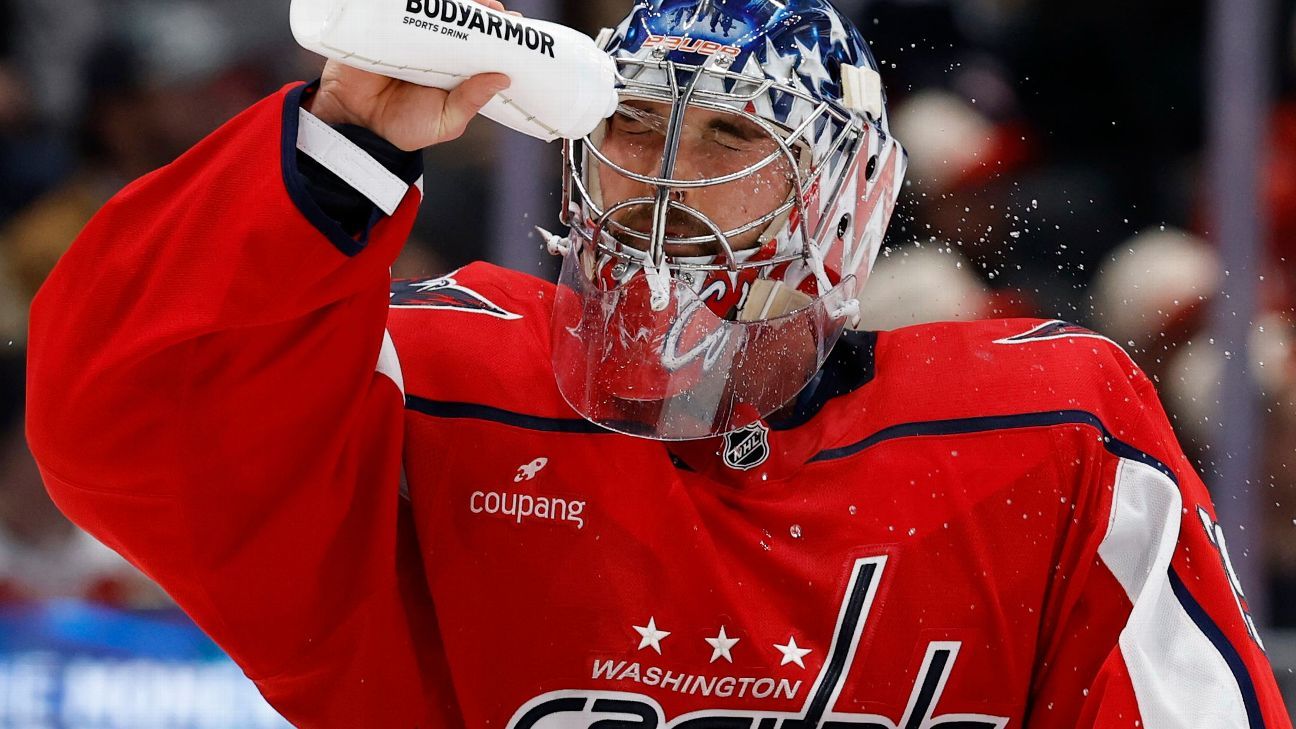

WASHINGTON — The Washington Capitals placed goaltender Charlie Lindgren and forward Ryan Leonard on injured reserve Sunday night before their game against the Columbus Blue Jackets.
Washington recalled forward Bogdan Trineyev and goaltender Clay Stevenson from Hershey of the American Hockey League.
Lindgren (upper body) was a late scratch Friday night before a 4-3 shootout loss at Anaheim. Leonard (upper body) didn’t return after his face was bloodied on an unpenalized first-period check from Jacob Trouba.
“He’s going to miss an extended period of time,” Capitals coach Spencer Carbery said about Leonard, the rookie who has seven goals and 11 assists after having two each Wednesday night in a 7-1 win at San Jose.
Lindgren is 5-3 with a 3.11 goals-against average in his 10th NHL season and fifth with Washington.
“We’ll see once he gets back on the ice,” Carbery said. “But [we] put him on the IR, so he’s going to miss, what is it, seven days at the bare minimum. And then we’ll see just how he progresses.”
-
Bradford Doolittle
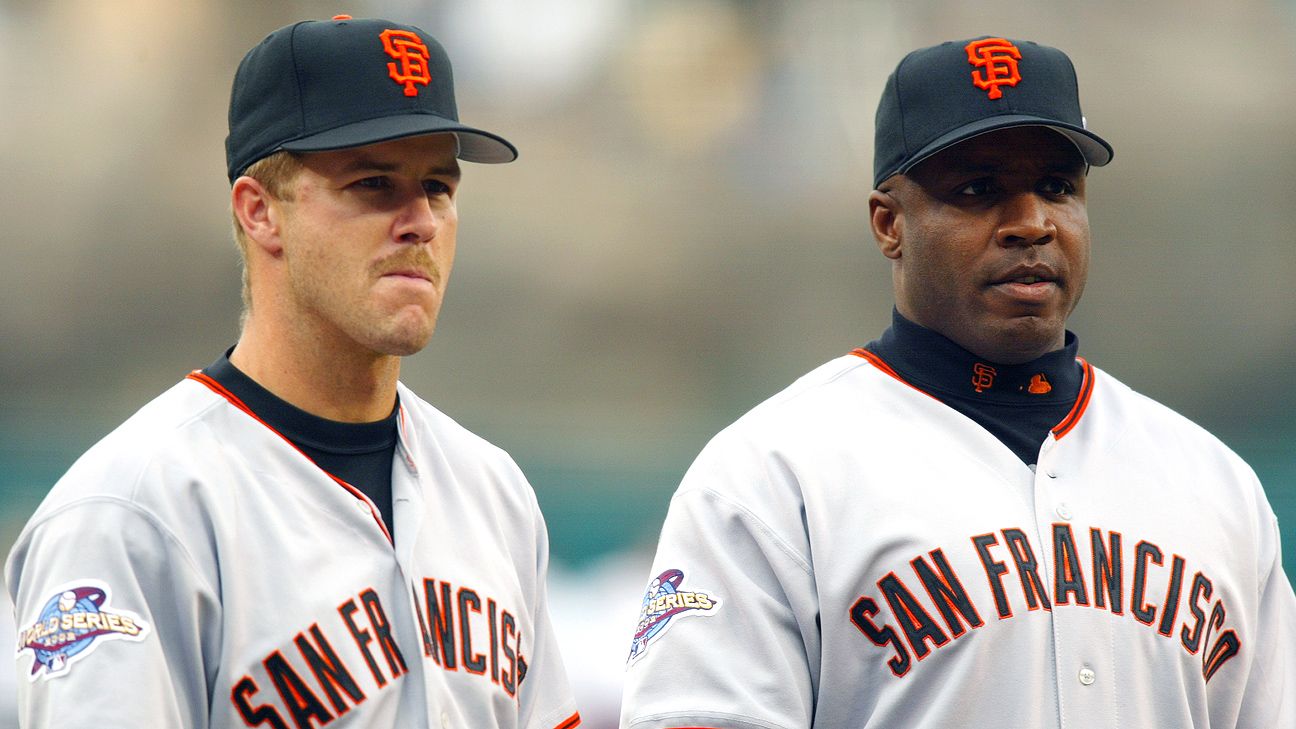
ORLANDO, Fla. — Jeff Kent, who holds the record for home runs by a second baseman, was elected to the National Baseball Hall of Fame on Sunday.
Kent, 57, was named on 14 of 16 ballots by the contemporary baseball era committee, two more than he needed for induction.
Just as noteworthy as Kent’s selection were the names of those who didn’t garner enough support, which included all-time home run leader Barry Bonds, 354-game winner Roger Clemens, two MVPs from the 1980s, Don Mattingly and Dale Murphy, and Gary Sheffield, who slugged 509 career homers.
Bonds, Clemens, Sheffield and Dodgers great Fernando Valenzuela were named on fewer than five ballots. According to a new protocol introduced by the Hall of Fame that went into effect with this ballot, players drawing five or fewer votes won’t be eligible the next time their era is considered. They can be nominated again in a subsequent cycle, but if they fall short of five votes again, they will not be eligible for future consideration.
The candidacies of Bonds and Clemens have long been among the most hotly debated among Hall of Fame aficionados because of their association with PEDs. With Sunday’s results, they moved one step closer to what will ostensibly be permanent exclusion from the sport’s highest honor.
If Bonds, Clemens, Sheffield and Valenzuela are nominated when their era comes around in 2031 and fall short of five votes again, it will be their last shot at enshrinement under the current guidelines.
Kent, whose best seasons were with the San Francisco Giants as Bonds’ teammate, continued his longstanding neutral stance on Bonds’ candidacy, declining to offer an opinion on whether or not he believes Bonds should get in.
“Barry was a good teammate of mine,” Kent said. “He was a guy that I motivated and pushed. We knocked heads a little bit. He was a guy that motivated me at times, in frustration, in love, at times both.
“Barry was one of the best players I ever saw play the game, amazing. For me, I’ve always said that. I’ve always avoided the specific answer you’re looking for, because I don’t have one. I don’t. I’m not a voter.”
Kent played 17 seasons in the majors for six different franchises and grew emotional at times as he recollected the different stops in a now-Hall of Fame career that ended in 2008. He remained on the BBWAA ballot for all 10 years of his eligibility after retiring, but topped out at 46.5% in 2023, his last year.
“The time had gone by, and you just leave it alone, and I left it alone,” Kent said. “I loved the game, and everything I gave to the game I left there on the field. This moment today, over the last few days, I was absolutely unprepared. Emotionally unstable.”
A five-time All-Star, Kent was named NL MVP in 2000 as a member of the Giants, who he set a career high with a .334 average while posting 33 homers and 125 RBIs. Kent hit 377 career homers, 351 as a second baseman, a record for the position.
Kent is the 62nd player elected to the Hall who played for the Giants. He also played for Toronto, the New York Mets, Cleveland, Houston and the Dodgers. Now, he’ll play symbolically for baseball’s most exclusive team — those with plaques hanging in Cooperstown, New York.
“I have not walked through the halls of the Hall of Fame,” Kent said. “And that’s going to be overwhelming once I get in there.”
Carlos Delgado was named on nine ballots, the second-highest total among the eight under consideration. Mattingly and Murphy received six votes apiece. All three are eligible to be nominated again when the contemporary era is next considered in 2028.
Next up on the Hall calendar is voting by the BBWAA on this year’s primary Hall of Fame ballot. Those results will be announced on Jan. 20.
Anyone selected through that process will join Kent in being inducted on July 26, 2026, on the grounds of the Clark Sports Center in Cooperstown.
-
 Sports2 years ago
Story injured on diving stop, exits Red Sox game
-
 Sports3 years ago
‘Storybook stuff’: Inside the night Bryce Harper sent the Phillies to the World Series
-
 Sports2 years ago
Game 1 of WS least-watched in recorded history
-
 Sports3 years ago
Button battles heat exhaustion in NASCAR debut
-
 Sports3 years ago
MLB Rank 2023: Ranking baseball’s top 100 players
-
Sports4 years ago
Team Europe easily wins 4th straight Laver Cup
-
 Environment3 years ago
Japan and South Korea have a lot at stake in a free and open South China Sea
-
 Environment1 year ago
Here are the best electric bikes you can buy at every price level in October 2024