
Your guide to MLB’s offseason chaos: The wild moves that happened — and the even wilder ones that didn’t


The opening week of the 2023 MLB season is just four days away following a baseball offseason that was, in a word, chaotic.
Not long after the Houston Astros were done celebrating their 2022 World Series title, the hot stove season heated up and provided a little bit of everything — from Cy Young winners changing teams and a star switching sides of a rivalry to decade-long record contracts and unexpected big spenders. And the drama surrounding the players who ultimately stayed put somehow managed to top even the biggest additions.
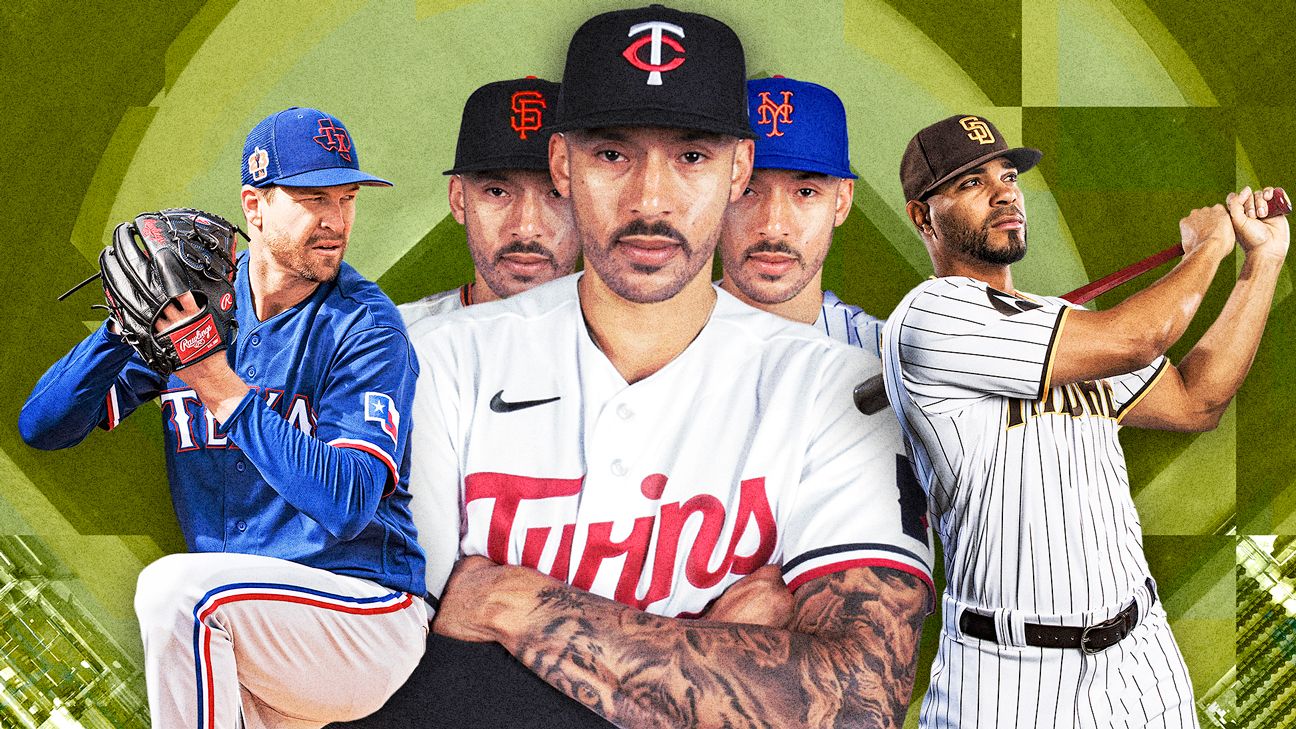
Whether you are just realizing that Jacob deGrom left New York for the Texas Rangers, Justin Verlander replaced him on the New York Mets and Carlos Correa is on the … well, you are going to need to sit down for that one — or you know all the moves that went down and still aren’t quite sure what to make of them, there’s plenty to learn before the games begin. ESPN MLB experts Bradford Doolittle, Jesse Rogers and David Schoenfield break down the moves that rocked the offseason. What did they mean for the teams that made them — and for the rest of MLB?
Who needs a GM to sign a former MVP?
Date of the deal: Nov. 28: Astros sign Jose Abreu for three years, $58.5 million
What if means for the Astros: The Astros’ core has been evolving ever so quietly over the past two or three years, and with mainstay Yuli Gurriel headed for free agency, the choice for the then-GM-less Astros was to either pursue a 38-year-old player coming off his second poor offensive season in three years, or a 36-year-old player two years removed from an MVP award and coming off another strong season. Houston’s GM-less front office chose door No. 2, inking Jose Abreu to a three-year, $58.5 million deal. And so the Astros still have a high-contact, run-producing veteran first baseman — albeit for a lot more money than it would have cost to keep Gurriel, who ended up with a minor-league pact with the Marlins.
How it rocked baseball: Gently. Anytime the reigning champions add a former MVP, the baseball world is going to notice — but there are much bigger moves ahead.
Abreu landed the upper end of the range of contract he could have hoped for, and now he has a chance to roll with the defending champs in pursuit of his first World Series ring. The move invited scrutiny only because it was natural to wonder if the Astros would have given three years to Abreu, or anyone else who might have served as a Gurriel replacement, had championship-winning GM James Click still been in the fold. No other first base/DH atop this winter’s free agent market got a three-year contract and the total value of the deal was 46% more than any other free agent in that role received.
Dominoes: Probably not many, as it’s unlikely teams were lining up to give Abreu that kind of contract. But there were at least a few interested suitors because despite his age, Abreu is a 1B/DH run producer good enough to hit in the middle of the order. His record of consistency and durability were big marks in his favor. The Guardians reportedly also offered Abreu three years and so might have preferred Abreu to Josh Bell, whom they eventually landed on a two-year deal. Elsewhere, if the price point were different, maybe the Dodgers would have given Abreu a long look rather than signing J.D. Martinez. The White Sox, Abreu’s old team, seemed intent to move forward with younger players already on their roster. Overall, the signing created more of a ripple than a wave, but it’s hard to ignore anytime the defending champs add an impact bat to their lineup.
The Rangers gave Jacob deGrom how much?
Date of deal: Dec. 2: Rangers sign Jacob deGrom for five years, $185 million

What it means for the Rangers: If deGrom can stay healthy, this move could push the Rangers into wild-card contention and make us forget that this was viewed as something of an overpay at the time. (The five-year, $185 million contract was such a shock that even New York Mets owner Steve Cohen wouldn’t match it to keep the longtime ace in Queens.)
DeGrom has looked great this spring after being slowed by tightness on his left side. As long as he stays healthy, he’ll be the lead in a revamped rotation that features newcomers Nathan Eovaldi and Andrew Heaney along with holdovers Martin Perez and Jon Gray. It’s simple: deGrom gives the Rangers American League West legitimacy — as long as he’s on the mound every five days.
How it rocked baseball: This was the move that really ignited this winter’s hot stove. The deal was announced just days before the winter meetings and served as a reminder there was money ready to be spent by teams across the league after last year’s lockout.
Adding deGrom’s contract to the combined $500 million Texas doled out for Corey Seager and Marcus Semien last season showed the Rangers are suddenly playing in the deep end of the free agency pool. It also signaled to fans the team was basically all-in after hiring Bruce Bochy as manager.
But the length of the deal also had many in the game shaking their heads. Is the oft-injured deGrom really going to be healthy for one season — let alone five? “Risky move” was a term used by rival general managers in the aftermath of the signing — of course, deGrom will be facing their teams this season, so they might be eating their own words.
Dominoes: When Texas followed the deGrom signing by adding Eovaldi and Heaney to its rotation, the AL playoff hopefuls gained a new contender. Texas’ starting pitching spree also made the competition even stiffer for teams trying to upgrade their own rotations during the offseason.
But the biggest domino this move set off fell when the Mets countered with an ace signing of their own a few days later …
Did you really think the Mets wouldn’t respond with a huge splash?
Date of deal: Dec. 5: Mets sign Justin Verlander for two years, $86.7 million

What it means for the Mets: Remember, the Mets entered the offseason needing to replace or re-sign several key free agents. They took care of one the day after the World Series, quickly re-signing Edwin Diaz to a $102 million deal. That still meant three-fifths of their starting rotation were free agents — deGrom, Chris Bassitt and Taijuan Walker. With deGrom headed to Texas, the Mets moved quickly to replace an injury-prone ace with one who had just won the AL Cy Young Award.
In his return from Tommy John surgery with the Astros in 2022, Verlander had one of his best seasons, going 18-4 with a 1.75 ERA and holding batters to a .186 average. The only acknowledgment to age and health was a dip in his workload: He made just 28 starts and pitched 175 innings, after averaging 34 and 218 with Houston in 2018 and 2019. The Astros’ rotation depth meant Verlander started just five times all season on four days of rest, so that may be something the Mets consider doing as well. Yes, he’s now 40 years old, but at the same age, Randy Johnson finished second in the Cy Young voting, Nolan Ryan led the National League in ERA and strikeouts, Roger Clemens won 17 games and Tom Seaver won 16. The great ones are often still great at 40.
How it rocked baseball: Everyone knew Steve Cohen was going to spend money this offseason — with so many free agents, the Mets had no choice. But making a 40-year-old pitcher the highest-paid player in the game is always going to draw a few raised eyebrows — and four-letter exclamations. In the interest of team harmony, Verlander’s two-year contract (it also includes a conditional player option for 2025) will pay him $43.333 million per season — matching teammate Max Scherzer for the highest annual average salary in the sport. While Cohen’s pockets are deeper than the Mariana Trench, the deGrom-Verlander maneuvering also showed the Mets weren’t going to approach the offseason with complete reckless abandon: When the deGrom price tag got higher than they were comfortable with, they shifted gears to Verlander.
If there was a surprise here, it was that the Astros and Dodgers — the two initial favorites to land Verlander — never seemed to be in the picture. The Astros didn’t have a general manager at the time and seemed intent on not dramatically increasing their payroll and relying on their pitching depth for 2023, while the Dodgers, who like short-term contracts, appeared intent on lowering payroll for 2023 — and perhaps stashing away money for a run at Shohei Ohtani for 2024.
Dominoes: The Mets weren’t going to stop at Verlander. A couple of days later they signed Jose Quintana and then a few days after that they signed Kodai Senga, the hard-throwing righty out of Japan. That filled New York’s rotation needs, so Bassitt signed with the Blue Jays and Walker with the Phillies — and with deGrom and Verlander both off the board, Carlos Rodon was left as the clear top starter still available.
A $300 million megadeal starts the shortstop carousel
Date of deal: Dec. 5: Phillies sign Trea Turner for 11 years, $300 million

What it means for the Phillies: Trea Turner is another dynamic hitter in a lineup full of them, and he should help Philadelphia get by without Bryce Harper for at least the early part of the 2023 season. As he showcased in the World Baseball Classic, Turner brings a combination of speed and power that few other players possess — a perfect fit for the only NL offense to rank in the top five in both home runs and stolen bases last season. With the rule changes, expect Turner to swipe even more bags, providing a lethal combination of talents at the top of the lineup (while also playing a key position on the field). There are some injury questions in Philadelphia’s lineup, but this is still one of the most dangerous offenses in all of baseball.
How it rocked baseball: Turner’s 11-year, $300 million deal was the first of several decade-long contracts given out over the winter. Because we did not yet know just how freely money was going to be spent on the other top available hitters, those two numbers — $300 million and 11 years — drew a collective “wow” from the industry, which was gathered at the winter meetings in San Diego. It became the second-largest deal for a shortstop in MLB history, and even with what came after, only one free agent received more total dollars than Turner this winter.
Dominoes: Turner set the market for shortstops. He’s the best of the four stars at the position who were available, and he got the most money. After Turner signed, teams looking for an impact player at the position knew they would have to pay big to land one of those remaining: Xander Bogaerts, Carlos Correa and Dansby Swanson. In the end, thanks to Turner setting the tone, the four players received a combined $965 million.
Arson Judge to San Francisco; Aaron Judge returns to the Bronx
Date of the Deal: Dec. 7: Yankees re-sign Aaron Judge for nine years, $360 million

What it means for the Giants and Yankees: For the Giants, this was a once-in-a-decade opportunity. Landing Aaron Judge would have been the team’s biggest free agent signing since Barry Bonds in 1992, almost 30 years to the day from when Judge … didn’t sign with them. With Judge off the table, the Giants moved on to Carlos Correa — and then moved on from Carlos Correa, pivoting back to the softer lights of adding quality veteran depth. The Yankees, on the other hand, retained a great player who had already achieved iconic status for a franchise with which that’s not easy to do. It was more than a baseball coup — it was a message to everyone that maybe, just maybe, the Yankees brand is still transcendent.
How it rocked baseball: Well, the thing that will resonate from the Judge-to-the-Giants saga was that we all got another reminder to never tweet. All along it seemed like Judge was overwhelmingly likely to either remain with the Yankees or end up with the Giants, for whom he rooted as a Bay Area kid. During the hours in which it seemed like Judge might be changing coasts, there were knee-jerk reactions published and many more that were prepared but never posted. Perhaps someone will come out with a book of those unnecessary commentaries someday.
Dominoes: Correa … and Not Correa. For a moment, the Giants’ offseason seemed so glitzy, and then it didn’t. It was as strange an offseason a franchise has had in a long time. And it might still turn out to be a decent one if their less-splashy acquisitions (the ones that actually happened) pan out. Meanwhile, the Yankees, with Judge in hand, turned their focus to pitching and landed Carlos Rodon … from the Giants. Things haven’t been this strange between these franchises since they shared the Polo Grounds.
The Padres get in on the shortstop fun (because of course they do)
Date of deal: Dec. 7: Padres sign Xander Bogaerts for 11 years, $288 million

What it means for the Padres: The Padres didn’t need a shortstop — Ha-Seong Kim had a solid 2022 season, especially with the glove, and they have Fernando Tatis Jr. coming back from injury and suspension next month. But with Bogaerts they get a four-time All-Star coming off one of his best all-around seasons, a hitter with a .304 average over the past four seasons and a reputation as a strong leader.
The Padres are all-in with an exclamation point, and now they have a fearsome offensive foursome in Juan Soto, Manny Machado, Tatis and Bogaerts. Bogaerts will play shortstop, Kim will slide over to second, Jake Cronenworth to first and Tatis will move to the outfield. With the Dodgers expected to take a major step back from their 111-win season, many now view the Padres as favorites to win the NL West — something they haven’t done since 2006.
How it rocked baseball: The Padres?!?! How the heck are the Padres doing this?!?! Indeed, Bogaerts’ 11-year, $280 million deal — on top of the mega-contracts the team already had with Tatis and Machado — was perhaps the most shocking of the offseason. At the beginning of the offseason, estimates for Bogaerts ranged from $168 million (ESPN) to $189 million (MLB Trade Rumors) to $217 million (FanGraphs). As good as he is, Bogaerts hit just 15 home runs in 2022, he’s entering his age-30 season and his defensive metrics have usually been below average (although not in 2022).
The deal staggered front offices and other owners. Indeed, while owners expected Steve Cohen and the Mets to spend lavishly, that comes with the territory of playing in New York. The small-market Padres, after running the sixth-highest payroll in 2022, will likely rank third this season behind only the Mets and Yankees. To top it off, the Padres later signed Machado to an 11-year, $350 million extension rather than let him walk away from his opt-out after the season. There are some in the game wondering how the Padres can afford it — and there are fans wondering why their team’s owner can’t do the same thing.
Dominoes: Well, here’s the deal: Owner Peter Seidler and GM A.J. Preller were going to spend the money on somebody. They reportedly offered Turner $342 million. They made a pitch at the winter meetings — held in San Diego — hoping to lure Judge to the West Coast.
When they ultimately made Bogaerts their signature offseason signing, no team felt the pressure more than the shortstop’s former team — the Boston Red Sox. Fans in Boston were angry. Another star had left, and the fact that the Padres were willing to spend like this while Boston’s ownership was not added to the ire. Soon after, the Red Sox handed out an 11-year, $331 million extension to ensure Rafael Devers would spend his entire career with the franchise.
An All-Star catcher changes sides of a heated rivalry
Date of deal: Dec. 7: Cardinals sign Willson Contreras for five years, $87.5 million

What it means for the Cardinals: St. Louis replaced a legend with an All-Star, not a bad follow-up after franchise icon Yadier Molina retired. It’s a defensive downgrade — no one was better than Molina at calling a game and dealing with pitchers — but the Cardinals will get more offense from the position. Willson Contreras will likely slot in after Paul Goldschmidt and Nolan Arenado in one of the game’s best 3-4-5 lineup combinations.
How it rocked baseball: Few thought that the organization synonymous with developing pitchers over the decades would hand the keys to its staff to an offensive-minded catcher like Contreras. But the real shockwaves came because a star who had spent the entirety of his career on the North Side of Chicago landed with the Cubs’ biggest rival — where he will be tasked with succeeding a St. Louis icon. As you can imagine, Cubs fans were stunned by Contreras’ landing spot and Cardinals fans will have to get used to rooting for a player who was a big part of their rivals’ recent success.
The five-year, $87.5 million deal also opened some eyes because it didn’t seem that Contreras had a lengthy list of suitors. The Cardinals opted to sign Contreras over making a trade for one of the available catchers and were confident enough to make him the highest-paid free agent in franchise history.
Dominoes: The catching market thinned out quickly once Contreras signed with the Cardinals, including the Cubs turning to defensive-minded Tucker Barnhart to fill their own hole at the position. But the biggest fallout of the Cardinals signing Contreras was that it crossed off one possible trade destination for another All-Star backstop.
The Braves make their annual deal for an A’s star
Date of deal: Dec. 12: Braves acquire Sean Murphy in trade with A’s

What it means for the Braves: The Braves’ deal to acquire catcher Sean Murphy from Oakland came about nine months after they brought in Matt Olson from the A’s in a deal that returned catcher Shea Langeliers — who became a big reason why Oakland was willing to part with Murphy. Not long after Atlanta traded for Murphy, they signed him to one of those Braves-esque extensions, this one going for six years, $73 million. It’s a team-friendly deal (as long as the team isn’t called the “Oakland Athletics“).
How it rocked baseball: This trade probably produced more than one spit-take from rival executives. Because Murphy’s service time was climbing into the latter phase of his controllable years, and Oakland had Langeliers in hand, it seemed like a foregone conclusion that the A’s would trade him — he’s a good player, and that’s what happens to good players on the A’s. There were plenty of contending teams that could have used Murphy. The Braves weren’t necessarily one of them, but they saw the chance and they took it.
Dominoes: The Guardians ended up with Mike Zunino. The Astros stood pat with Martin Maldonado, deciding against signing a replacement for Christian Bethancourt. The Braves, after landing Murphy, dealt William Contreras to the Brewers for a prospect. There is much that is different than it would have been had Oakland traded Murphy to what seemed like a more likely destination.
Carlos Correa to the Giants … or so it seemed
Date of (non-)deal: Dec. 13: Carlos Correa, Giants agree to deal for 13 years, $350 million
What it meant for the Giants: The Giants had been searching for a new face of the franchise even before Buster Posey retired in 2021, and according to president of baseball operations Farhan Zaidi, they were going to be “aggressive” and “really active” in free agency this offseason. The obvious target to fill their need for a power-hitting outfielder: Aaron Judge, who grew up rooting for the Giants. When he instead decided to return to the Yankees, and with Turner and Bogaerts off the board, the Giants and Correa were … well, maybe not exactly a perfect fit, but the Giants had money to burn and Correa wanted the biggest contract he could get. The two sides agreed to a 13-year, $350 million contract, blowing past the Giants’ previous record contract for a free agent, Johnny Cueto‘s $130 million deal.
And then Correa failed his physical.
How it rocked baseball: A week after agreeing to terms with Correa, the Giants were finally set to introduce Correa for his official signing press conference — only to back out at the last minute over concerns about an old ankle injury that required surgery when Correa was in the minor leagues in 2014. Agent Scott Boras was not happy.
“You’re talking about a player who has played eight major league seasons,” Boras said. “There are things in his medical record that happened decades ago. These are all speculative dynamics. Every team has a right to go through things and evaluate things. The key thing is, we gave [the Giants] medical reports at the time. They still wanted to sign the player and negotiated with the player.”
Nobody could remember something like this happening before, certainly not so late in the process. Zaidi termed it a “difference of opinion” on Correa’s medicals. One of the top free agents headed back into free agency.
Dominoes: With most of the top free agents already signed and delivered, the Giants were left scrambling for the second-tier players. They ended up parceling out their money to outfielders Mitch Haniger and Michael Conforto and pitchers Ross Stripling and Sean Manaea, but they lost Rodon to the Yankees and finished the offseason with no Judge and no Correa.
For Correa, though, the pivot seemed quick, as in the hours after the deal with the Giants fell apart, it appeared he had found a new landing place courtesy of Steve Cohen and the Mets. Little did we know at the time, but this saga was only just getting started.
The Yankees land an ace — if he can stay healthy
Date of the deal: Dec. 15: Yankees sign Carlos Rodon for six years, $162 million

What it means for the Yankees: With Rodon joining a pitching corps of Gerrit Cole, Luis Severino, Nestor Cortes, Frankie Montas and others, New York had put together the best on-paper rotation in MLB’s hot stove season. Rodon, 30, is coming off two straight dominant seasons in two different leagues, both of which landed him in the top six of postseason Cy Young balloting. This came on the heels of years of injury-related frustration for the lefty who was the third pick of the 2014 draft. Sure, it was a $162 million commitment but, hey, Rodon is really good and it’s the Yankees.
How it rocked baseball: ESPN’s Kiley McDaniel forecasted a $130 million outlay for Rodon, so the value of his deal was more than we thought he would get (only deGrom, who got $185 million from Texas, received more as a pitcher). But the market for him was robust — after deGrom signed, teams hoping to make the splashiest of splashes with rotation upgrades were down to Rodon. After this, it was a whole lot of Plan Bs. For the Yankees, it meant ever more injury risk for an expensive rotation full of that quality. And indeed, they’ll be without Montas for a long time because of a shoulder injury. Rodon — yeah, he’s hurt as well, but it doesn’t appear to be serious, though it will delay his Yankees debut.
Dominoes: It’s hard to say. Rodon’s deal was the last massive free agent deal of the offseason to go to a pitcher. Minnesota was an oft-mentioned possibility for Rodon and so perhaps the Twins, at the time, were the club most frustrated at Rodon landing with the Yankees. As it turned out, though, if the Twins had indeed met this market price for Rodon’s services, their pivot back to Correa — from whom they spent big after his earlier deals fell through — might not have been possible.
A homegrown Braves star becomes the new face of the Cubs
Date of deal: Dec. 17: Cubs sign Dansby Swanson for seven years, $177 million
What it means for the Cubs: Chicago should have a solid double-play combo for at least the next half-decade after the signing of Swanson moved Nico Hoerner back to second base, where he was a Gold Glove finalist in 2020. Both players are strong in the field and provide offensive value in different ways: Hoerner makes contact, Swanson hits for power.
They are now the centerpieces of the franchise, with Swanson’s decision to come to Chicago giving credence to the team’s latest rebuilding efforts. He has made it known he wants to win, but the Cubs might not be ready for prime time just yet — it’s hard to imagine this is the year that Chicago makes the leap into the group of elite teams. With Swanson on the roster, though, a winning season became a much more attainable goal.
The move also shows that the big-market Cubs are coming out of their rebuild and willing to spend again. That they landed a star who has been part of championship-level teams in Atlanta this quickly signals that Chicago will continue to be a destination for top free agents.
How it rocked baseball: For two consecutive offseasons, star shortstops have been at the top of free agent rankings.
Last year, it was Seager, Semien, Correa, Trevor Story and Javier Baez. This year, Turner, Bogaerts and Swanson joined the mix, along with Correa, who hit free agency again.
The Cubs’ signing of Swanson signaled that the two-winter carousel ride was finally coming to an end, with Chicago one of the big spenders that had now solidified the position for years to come. All in all, more than nearly $1.75 billion was handed out to this group — not bad for a position that not that long ago was thought of as a place for light-hitting, glove-first players.
Dominoes: Not only had the game of shortstop dominoes now come to an end, but the entire top of the free agent class had found homes after Swanson joined the Cubs. This move capped an unprecedented two weeks of spending, starting with deGrom’s contract just before the winter meetings and culminating with Swanson’s deal.
The winners of free agency had won, the losers were left looking for smaller deals and all of the biggest contracts were in place before the calendar turned to 2023 — or so we thought at the time.
Hey, the Dodgers and Red Sox finally did something
Date of the deal: Dec. 17: Dodgers sign J.D. Martinez for one year, $10 million | Dec. 18: Red Sox sign Justin Turner for two years, $22 million


What it means for the Red Sox and Dodgers: Justin Turner with the Red Sox and J.D. Martinez with the Dodgers? Man, free agency can get weird. Over the past two seasons, Martinez has been a better hitter (123 OPS+ to 118 OPS+) over more plate appearances (1,230 to 1,144). They both got in the neighborhood of $10 million in annual value, but Turner, nearly three years older, got two years from Boston while Martinez’s L.A. pact is for one year. The Dodgers will use Martinez at DH, meaning that Max Muncy will be at the hot corner — a weak spot for the Dodgers, at least on defense — and L.A. will hope for the best. Turner will also be DHing, only for the Red Sox — a team that needed a DH but not a third baseman, because they have Devers.
How it rocked baseball: Really, how does this happen? This might have rocked the two markets more than all of baseball — but these two players were beloved on their former teams. They did great things and won rings. It felt more like a “Freaky Friday” situation: If they were traded for each other before Opening Day, would anybody remember that they were free agents to begin with?
Dominoes: Well, the Dodgers, who had Justin Turner at third base and lots of options for DH, now have a shaky glove at third base and a more or less everyday DH in Martinez. The Red Sox, who had an everyday DH in Martinez and a star third baseman in Devers, now have an everyday-ish DH in Turner and a star third baseman in Devers. Why?
To say that fans of these two teams were frustrated with the offseason plans of their front offices would be an understatement, and these moves didn’t exactly change those sentiments. In the case of the Dodgers, the biggest fallout to an offseason without a big splash is that the top of the National League is now much more open than in recent years with L.A. likely to take a step back and other NL heavyweights positioned to pounce.
Correa to the Giants … Correa to the Mets … OK, now this is getting awkward
Date of (non-)deal: Dec. 24: Mets, Carlos Correa ‘working through’ medical issue
What it meant for the Mets: While most of the top-spending teams already had a shortstop, the Mets had another idea: They would sign Correa and play him at third base alongside Francisco Lindor. It didn’t matter that they already had Eduardo Escobar and top prospect Brett Baty. Hours after Correa’s deal with the Giants fell apart and with owner Cohen negotiating the deal while vacationing in Hawaii, the Mets and Correa agreed to a 12-year, $315 million deal that would push the Mets’ payroll to nearly $500 million including tax penalties — but give them a lineup featuring an All-Star infield of Pete Alonso, Jeff McNeil, Francisco Lindor and Correa.
“We needed one more thing, and this is it,” Cohen told the New York Post.
It all seemed like such a perfect fit.
How it rocked baseball: Five. Hundred. Million.
Dominoes: In the collective bargaining agreement signed before the 2022 season, a third level of luxury tax had been implemented — the so-called “Cohen Tax,” as other owners were already wary of how Cohen might spend. The players had bet that Cohen wouldn’t let a little tax interfere with his desire to win a World Series. The players were right. After the Correa deal, the Mets were about $90 million above the third level.
But then the official announcement of the signing dragged on … and on … and three weeks later, there was no deal. The Mets had the same concerns with Correa’s medical reports as the Giants. And suddenly, this match made in Flushing went down the drain.
Correa to the Giants … Correa to the Mets … Correa to the Twins — and the saga is finally resolved
Date of deal: Jan. 10: Twins sign Carlos Correa for six years, $200 million

What it means for the Twins: The Twins had been a surprising landing spot for Correa after his first trip into free agency after 2021, in a deal that included an opt-out, which Correa exercised. The Twins wanted Correa back, but they knew they couldn’t offer a deal that matched the Giants or Mets. Their options at shortstop at this point included moving Jorge Polanco from second base or the recently acquired Kyle Farmer — so let’s just say having Correa fall back into their laps was a very good thing in Minnesota. While they’re probably not a World Series contender, the Twins will hope to emerge from a three-team race in the AL Central.
How it rocked baseball: It certainly capped the wildest, most adventurous free agent trek in history. The final deal guarantees Correa $200 million over six years and includes four years of options that could make it a 10-year, $270 million deal, a nice pick-up for the Twins at a discount compared to Correa’s original $350 million deal with the Giants — if he stays healthy, of course.
Dominoes: For the rest of this offseason? Not many. By this point, Correa’s options were limited, and the Twins were the only real fit. The Dodgers weren’t spending, the Yankees had multiple shortstop prospects (including Anthony Volpe, who will start in the majors), the Orioles have Gunnar Henderson already in the majors, the Mariners were content with J.P. Crawford and the Braves were banking on Vaughn Grissom.
But the fallout of the Carlos Correa saga goes far beyond what moves followed, or even just MLB free agency. Will anyone ever be as certain that a mega-contract in any sport will be completed until the ink on the contract is actually dry again? Correa’s name now goes down as a reminder of every twist and turn that made this MLB offseason unforgettable.

-
Mark Schlabach
Indiana quarterback Fernando Mendoza, who led the No. 1 Hoosiers to a perfect 13-0 record and their first Big Ten title since 1967, captured the 91st Heisman Trophy on Saturday night.
Mendoza beat out quarterbacks Diego Pavia (Vanderbilt) and Julian Sayin (Ohio State) and running back Jeremiyah Love (Notre Dame) to take home the trophy during a ceremony in New York.
Mendoza, who played two seasons at California before joining the Hoosiers this season, completed 71.5% of his pass attempts for 2,980 yards with 39 total touchdowns.
He was only the second Heisman Trophy finalist from Indiana. Running back Anthony Thompson was runner-up to Houston quarterback Andre Ware in one of the closest votes in 1989.
With Mendoza, Pavia and Love expected to move on to the NFL after this season, who are the top returning Heisman Trophy candidates for 2026?
In compiling the list of potential candidates, I projected that quarterbacks John Mateer (Oklahoma), Ty Simpson (Alabama) and Dante Moore (Oregon); receivers Carnell Tate (Ohio State), Zachariah Branch (Georgia) and Makai Lemon (USC); and running back Emmett Johnson (Nebraska) will turn pro (along with the aforementioned finalists from this year).
Here is a look at some of the top potential contenders (in no particular order):


2025 stats: 80 catches, 1,086 receiving yards, 12 total touchdowns
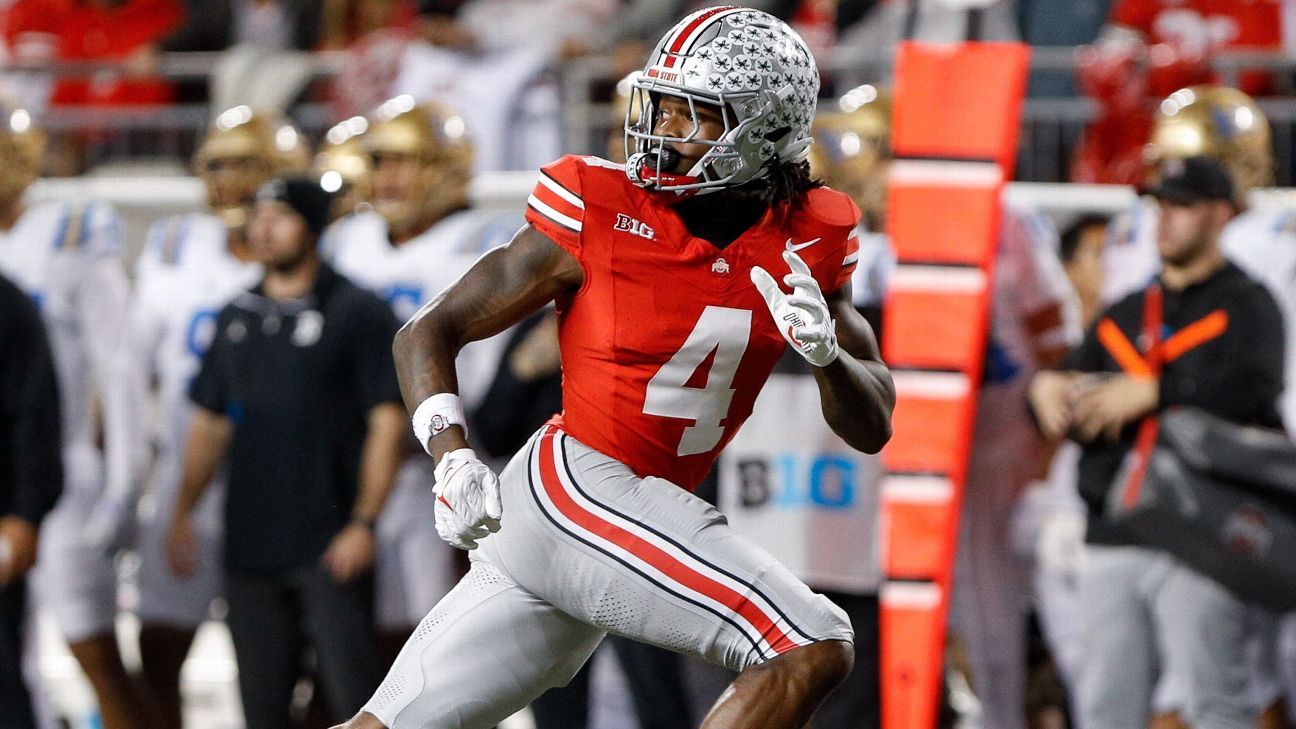
Smith’s highlight reel of acrobatic, one-handed catches continues to grow, and he arguably has been the best player in college football this season. He was the fastest Buckeyes player to reach career marks of 2,000 receiving yards (24 games), 100 catches (20) and 25 touchdown receptions (25).
2025 stats: 78.4% completion pct, 3,323 passing yards, 31 touchdowns, 6 interceptions
Sayin might have captured the Heisman Trophy this season if Ohio State’s offense hadn’t flopped in its 13-10 loss to Indiana in the Big Ten championship game. In his first season as a starter, Sayin is on pace to break the NCAA single-season pass completion record of 77.4%, set by Oregon’s Bo Nix in 2023.

2025 stats: 70.7% completion pct, 2,691 passing yards, 442 rushing yards, 31 total touchdowns
In his first full season as Georgia’s starting quarterback, Stockton helped guide the Bulldogs to a 12-1 record and SEC title. His legs and right arm were a big reason the Bulldogs averaged 31.9 points, despite enduring myriad injuries on the offensive line. Stockton was at his best when the game was on the line — he completed 86% of his passes with 11 touchdowns and one interception in the fourth quarter against ranked opponents.

2025 stats: 84 receptions, 970 receiving yards, 7 receiving touchdowns
Toney’s teammates call him “Baby Jesus,” and the true freshman delivered in a big way in his first season with the No. 10 Hurricanes. He ranks sixth in the FBS with 84 catches and had 1,328 all-purpose yards. Toney even threw for two scores. Not bad for an 18-year-old who would be a senior in high school if he hadn’t reclassified to the class of 2025.

2025 stats: 61.4% completion pct, 2,942 passing yards, 32 total touchdowns
Even after all the hand-wringing about Manning being overrated at the start of the season, the former five-star recruit ended up putting together a good campaign, throwing for 2,942 yards with 24 touchdowns. The No. 13 Longhorns need to find some offensive linemen (he was sacked 23 times) and receivers to help him in 2026.

2025 stats: 65.5% completion pct, 3,016 passing yards, 24 total touchdowns
Ole Miss officials have submitted a waiver to the NCAA on Chambliss’ behalf for another season of eligibility. He played his first three seasons at Division II Ferris State before transferring to Ole Miss this year. He was named SEC Newcomer of the Year after taking over the starting job in the third game of the season.

2025 stats: 1,560 rushing yards, 16 touchdowns
A transfer from Louisiana-Monroe, Hardy led the FBS with 130 rushing yards per game and was No. 2 with 1,560 total rushing yards. He had eight 100-yard games for the Tigers, including a whopping 300-yard effort with three touchdowns in a 49-27 victory against Mississippi State on Nov. 15.

2025 stats: 61.8% completion pct, 2,932 passing yards, 466 rushing yards, 31 total touchdowns
Reed announced this week that he plans to stay at Texas A&M next season, which is great news for the No. 7 Aggies. He was a threat with the ball in his hands, throwing for 2,932 yards with 25 touchdowns and running for 466 yards with six scores. His decision-making needs to continue to improve, so he can cut down on his 10 interceptions.

2025 stats: 63.6% completion pct, 3,117 passing yards, 20 total touchdowns
There’s a reason new Bears coach Tosh Lupoi took a late-night flight to Hawai’i to make sure Sagapolutele was staying at Cal. He was only the second true freshman in FBS history to pass for 200 yards or more in each of his first 11 starts. In the Bears’ late-season upsets of then-No. 21 SMU and No. 15 Louisville, Sagapolutele passed for a combined 653 yards with six touchdowns and no picks.
2025 stats: 1,279 rushing yards, 20 touchdowns
After transferring from Missouri, Lacy helped the No. 6 Rebels win 11 games in the regular season for the first time. He ranks No. 2 in the FBS with 20 rushing touchdowns and piled up 1,279 yards on the ground. Will he follow former coach Lane Kiffin to LSU or remain with the Rebels in 2026?

2025 stats: 66.2% completion pct, 3,431 passing yards, 29 total touchdowns
If Maiava returns to the No. 16 Trojans for another season, he’ll probably flourish in Lincoln Riley’s offense. This year, he threw for 3,431 yards with 23 touchdowns and 8 interceptions. He ranks No. 1 with a 91.2 total QBR. According to Pro Football Focus, he was second in the FBS with 26 big-time throws. (A big-time throw is defined as a high-difficulty, high-value pass.)
2025 stats: 1,035 rushing yards, 6 total touchdowns
Jackson became the fifth true freshman in OSU history to produce a 1,000-yard season, joining Robert Smith (1990), Maurice Clarett (2002), JK Dobbins (2017) and TreVeyon Henderson (2021). That’s good company. And, of course, he’d be the second Bo Jackson to collect a stiff-armed trophy.

2025 stats: 70.2% completion pct, 4,129 passing yards, 36 total touchdowns
Mestemaker is one of the best stories in college football. He didn’t start a single game in high school, then joined North Texas as a walk-on. This season, he led the FBS with 4,129 passing yards, helping him capture the Burlsworth Trophy as the top walk-on in the country. Will he join former Mean Green coach Eric Morris at Oklahoma State in 2026?

CJ Carr, QB, Notre Dame
2025 starts: 66.6% completion pct, 2,741 passing yards, 24 touchdowns
Fighting Irish coach Marcus Freeman entrusted Carr to lead his offense after a heated battle in preseason camp. The decision paid off, as Carr put together one of the best performances by a first-time starter in Notre Dame history. He threw for at least one touchdown in each of his first 12 starts, becoming the first Irish player to do that since Everett Golson in 2012-14. Carr’s 24 passing touchdowns are tied for the most in the first 12 starts by a Notre Dame player since 1966.

2025 stats: 70% completion pct, 2,850 passing yards, 595 rushing yards, 27 total touchdowns
Williams is one of the best dual-threat quarterbacks in the FBS, and his ability to run and throw was on display in the Huskies’ 38-19 victory against Rutgers on Oct. 10. He became the first player in school history to pass for at least 400 yards (400) and run for at least 100 (136) in the same game. Williams was second on the team with 595 rushing yards.
Others to watch: Sam Leavitt, QB, TBA; Cam Coleman, WR, Auburn; Brendan Sorsby, QB, Cincinnati; Josh Hoover, QB, TCU; Darian Mensah, QB, Duke; Nate Frazier, RB, Georgia; LJ Martin, RB, BYU; Bear Bachmeier, QB, BYU; LaNorris Sellers, QB, South Carolina; Bryce Underwood, QB, Michigan

-
Adam Rittenberg
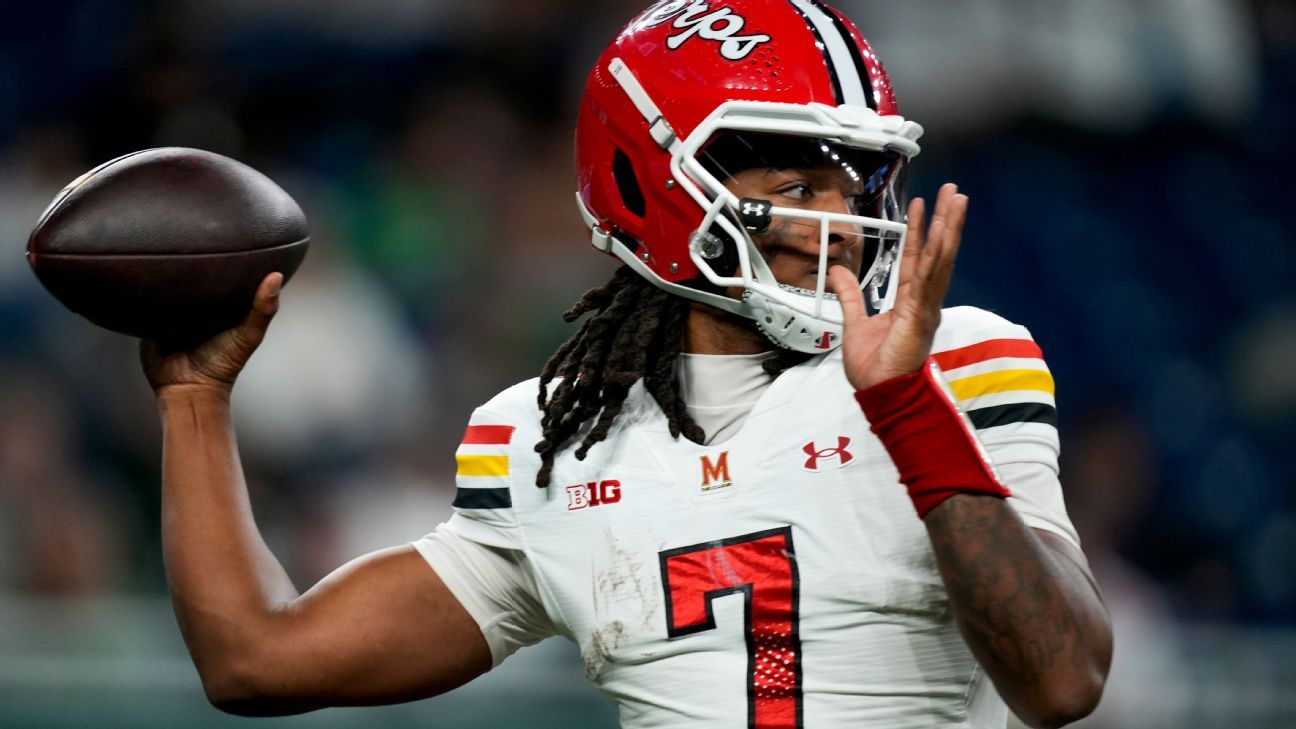
Maryland quarterback Malik Washington, who set the team’s freshman passing record this fall, will return to the Terrapins for the 2026 season.
Washington set Maryland freshman records for passing yards (2,963) and completions (273) this season, while connecting on 17 touchdown passes. He reached 200 passing yards in all but one game and finished as just the second Big Ten freshman since 1996 to record at least 2,500 passing yards and at least 300 rushing yards.
“Representing this team, this area, means so much to me and my family,” Washington said in a statement Saturday. “This is home and we’re going to continue keeping the best athletes from this area here with the Terps. I believe in everyone in our facility and I know we’re building something that our fans will be excited about for years to come.”
Washington, the nation’s No. 134 recruit in the 2025 class, grew up in Severn, Maryland, about 30 miles from Maryland’s campus. Despite a 4-8 record that included only one Big Ten win, Maryland announced that coach Mike Locksley, who recruited Washington, would return in 2026. Locksley will enter his eighth season as Maryland’s coach.
“Malik is a Terp through and through and I’m thrilled he’s coming back to lead this football team,” Locksley said in a statement. “He means so much to this area and this area means so much to him. What we saw from Malik this past season is only the tip of the iceberg. He has such a bright future and he’s already started putting the work in towards the 2026 season.”

-
 Sports2 years ago
Story injured on diving stop, exits Red Sox game
-
 Sports3 years ago
‘Storybook stuff’: Inside the night Bryce Harper sent the Phillies to the World Series
-
 Sports2 years ago
Game 1 of WS least-watched in recorded history
-
 Sports3 years ago
Button battles heat exhaustion in NASCAR debut
-
 Sports3 years ago
MLB Rank 2023: Ranking baseball’s top 100 players
-
Sports4 years ago
Team Europe easily wins 4th straight Laver Cup
-
 Environment3 years ago
Japan and South Korea have a lot at stake in a free and open South China Sea
-
 Environment1 year ago
Here are the best electric bikes you can buy at every price level in October 2024