
Household payouts considered to offset green energy costs in bid to hit net-zero target

The government is considering paying families to help them offset the rising cost of gas bills and to incentivise a switch to green heating.
The potential scheme, first reported in The Times newspaper and confirmed by Sky News, means that the amount paid would remain the same even if a homeowner reduced their gas bills by more effectively insulating their homes, or installing a heat pump, allowing them to keep the difference.
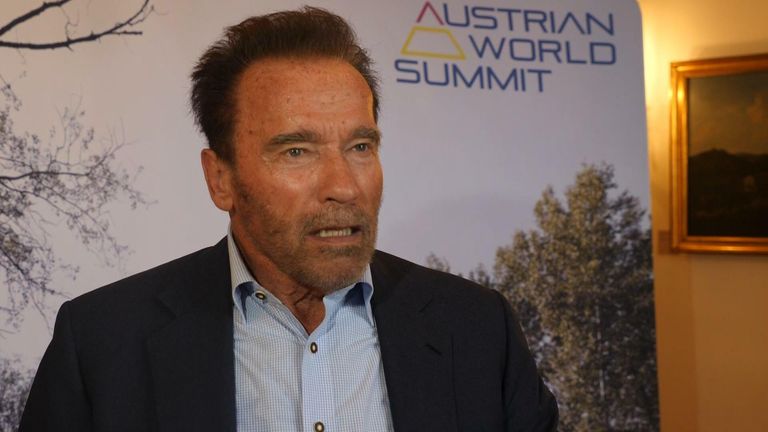
‘Politics screws everything up’ – Arnie on climate change
The idea is modelled on a Canadian policy in which the first adult in the household receives an annual payment of approximately £129, with other individuals in the home receiving smaller amounts.
It would be paid for by a new carbon tax.
Alongside the annual payment policy, the government is also considering a scheme to help people scrap their gas boilers as well as putting extra money into the proposed clean heat grant, which would help people pay for low carbon heat systems like heat pumps.
The prime minister’s spokesperson said: “Any measures that we introduce will need to be fair for consumers and represent good value for money. But no decisions have been taken on the targeted measures, we will take.
“But I would also point back to what the prime minister said at the liaison committee earlier this week, he said that this government is determined to keep bills low, and that is a priority.
“The only way to do that is to build the markets in a very systematic way to make sure that we have the technology and make sure that it’s affordable.”
The way we heat our homes accounts for 15% of the UK’s carbon emissions.
There are around 19 million houses in the country that need to be better insulated and switched to greener heating methods if the government is to hit its pledge on net-zero carbon emissions by 2050.
But the government has yet to publish detailed policy on how this will be achieved, and how much of the cost homeowners will be expected to bear.
It is a huge, complicated problem to solve, something that the prime minister acknowledged himself at a recent liaison committee hearing.
Subscribe to ClimateCast on Spotify, Apple Podcasts, or Spreaker.
Boris Johnson told MPs: “This is something that is very difficult to pull off because what we need to do is to ensure that we are able to heat people’s homes and provide them with power in an affordable way whilst also reducing CO2.
“What we can’t have is a situation in which ordinary homeowners… are suddenly faced with an unexpected and unreasonable cost.
“We have got to make sure that when we embark on this programme that we have a solution that is affordable and that works for people.”
The Climate Change Committee, which is an independent government advisory body, has already warned the UK lacks the policy to make good on its pledges.
It noted that this is a particular issue ahead of the COP26 climate summit in Glasgow in November, where the UK government will urge other countries to make more ambitious plans to tackle global warming.
Chancellor Rachel Reeves has suffered another budget blow with a rebellion by rural Labour MPs over inheritance tax on farmers.
Speaking during the final day of the Commons debate on the budget, Labour backbenchers demanded a U-turn on the controversial proposals.
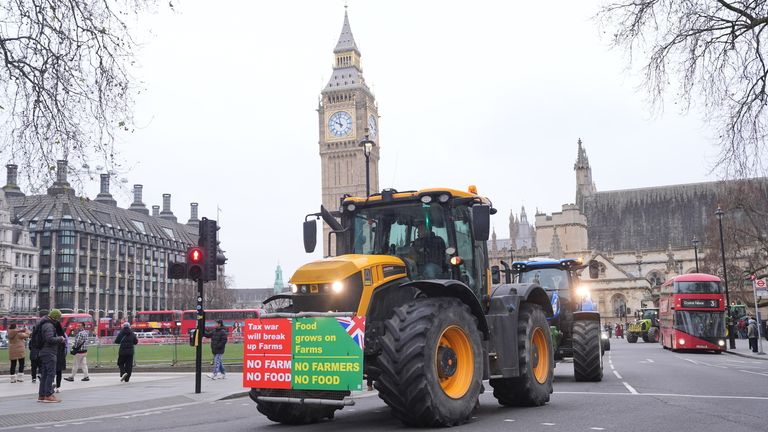
Plans to introduce a 20% tax on farm estates worth more than £1m from April have drawn protesters to London in their tens of thousands, with many fearing huge tax bills that would force small farms to sell up for good.
Farmers have staged numerous protests against the tax in Westminster. Pic: PA
MPs voted on the so-called “family farms tax” just after 8pm on Tuesday, with dozens of Labour MPs appearing to have abstained, and one backbencher – borders MP Markus Campbell-Savours – voting against, alongside Conservative members.
In the vote, the fifth out of seven at the end of the budget debate, Labour’s vote slumped from 371 in the first vote on tax changes, down by 44 votes to 327.
‘Time to stand up for farmers’
The mini-mutiny followed a plea to Labour MPs from the National Farmers Union to abstain.
“To Labour MPs: We ask you to abstain on Budget Resolution 50,” the NFU urged.
“With your help, we can show the government there is still time to get it right on the family farm tax. A policy with such cruel human costs demands change. Now is the time to stand up for the farmers you represent.”
After the vote, NFU president Tom Bradshaw said: “The MPs who have shown their support are the rural representatives of the Labour Party. They represent the working people of the countryside and have spoken up on behalf of their constituents.
“It is vital that the chancellor and prime minister listen to the clear message they have delivered this evening. The next step in the fight against the family farm tax is removing the impact of this unjust and unfair policy on the most vulnerable members of our community.”
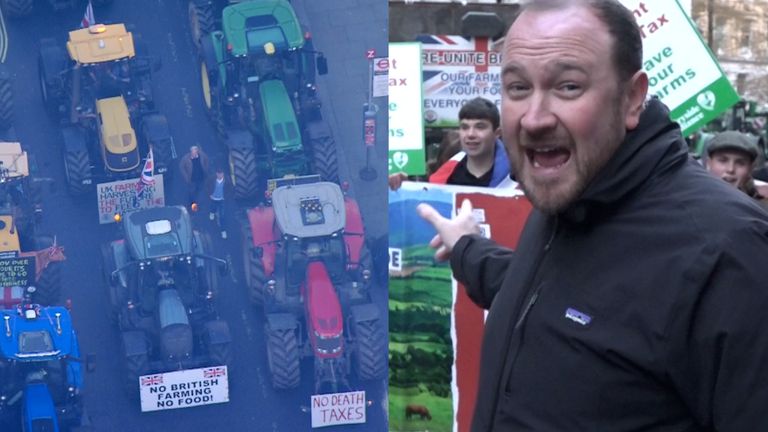
Farmers defy police ban in budget day protest in Westminster.
The government comfortably won the vote by 327-182, a majority of 145. But the mini-mutiny served notice to the chancellor and Sir Keir Starmer that newly elected Labour MPs from the shires are prepared to rebel.
Speaking in the debate earlier, Mr Campbell-Savours said: “There remain deep concerns about the proposed changes to agricultural property relief (APR).
“Changes which leave many, not least elderly farmers, yet to make arrangements to transfer assets, devastated at the impact on their family farms.”
Samantha Niblett, Labour MP for South Derbyshire abstained after telling MPs: “I do plead with the government to look again at APR inheritance tax.
“Most farmers are not wealthy land barons, they live hand to mouth on tiny, sometimes non-existent profit margins. Many were explicitly advised not to hand over their farm to children, (but) now face enormous, unexpected tax bills.
“We must acknowledge a difficult truth: we have lost the trust of our farmers, and they deserve our utmost respect, our honesty and our unwavering support.”

UK ‘criminally’ unprepared to feed itself in crisis, says farmers’ union.
Labour MPs from rural constituencies who did not vote included Tonia Antoniazzi (Gower), Julia Buckley (Shrewsbury), Torquil Crichton (Western Isles), Jonathan Davies (Mid Derbyshire), Maya Ellis (Ribble Valley), and Anna Gelderd (South East Cornwall), Ben Goldsborough (South Norfolk), Alison Hume (Scarborough and Whitby), Terry Jermy (South West Norfolk), Jayne Kirkham (Truro and Falmouth), Noah Law (St Austell and Newquay), Perran Moon, (Camborne and Redruth), Samantha Niblett (South Derbyshire), Jenny Riddell-Carpenter (Suffolk Coastal), Henry Tufnell (Mid and South Pembrokeshire), John Whitby (Derbyshire Dales) and Steve Witherden (Montgomeryshire and Glyndwr).
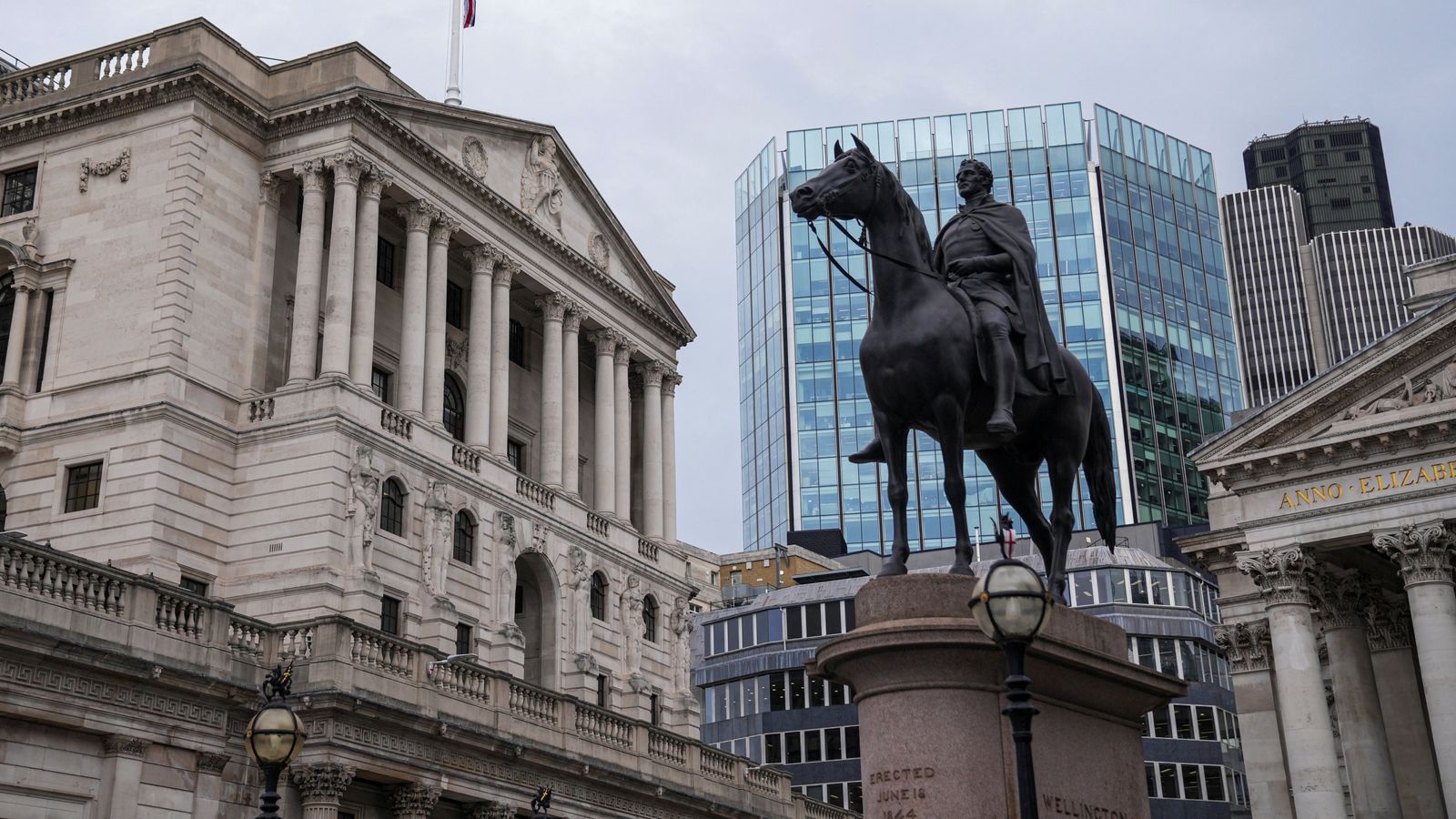
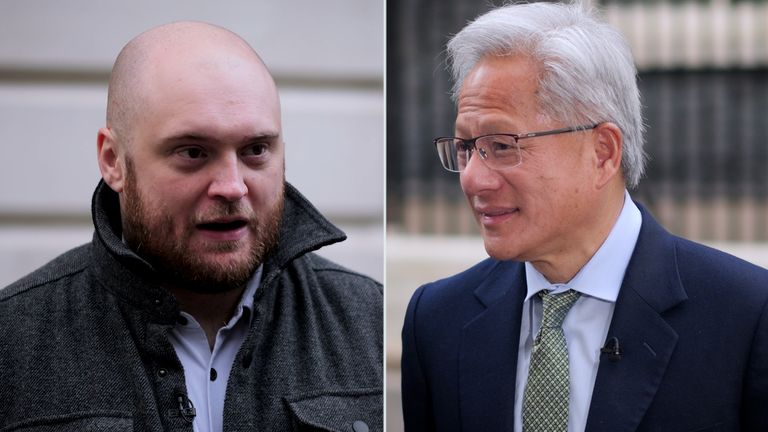
The Bank of England has warned of heightened risks to the UK’s financial system but cut the amount of money that banks need to hold in reserve in case of shock.
The twice-yearly financial stability report highlights a series of pressures, from higher government borrowing costs to risks around lending to major tech firms and record stock market valuations – particularly in areas exposed to artificial intelligence (AI).
“Risks to financial stability have increased during 2025,” the Bank‘s financial policy committee (FPC) said.
“Global risks remain elevated and material uncertainty in the global macroeconomic outlook persists. Key sources of risk include geopolitical tensions, fragmentation of trade and financial markets, and pressures on sovereign debt markets.
Money latest: My supermarket delivery row
“Elevated geopolitical tensions increase the likelihood of cyberattacks and other operational disruptions.
“In the FPC’s judgement, many risky asset valuations remain materially stretched, particularly for technology companies focused on AI.
“Equity valuations in the US are close to the most stretched they have been since the dot-com bubble, and in the UK since the global financial crisis (GFC). This heightens the risk of a sharp correction.”
Its concern extended to the growing trend of tech firms using debt finance to fund investment.
Could the AI bubble burst?
The Bank, which joined the International Monetary Fund in warning over an AI-led bubble in October, delivered its verdict at a time when UK regulators are under pressure from the government to place a greater focus on supporting economic growth.
It is understood, for example, the UK’s ringfencing regime – that sees retail banking separated from more risky investment banking operations within major lenders – is the subject of a review between the Bank and government.
Efforts by the chancellor to grow the economy will be potentially helped by the Bank’s decision today to lower capital requirements – the reserves banks must hold to help them withstand shocks in the financial system such as the global crisis of 2008/9.
The sector’s main capital requirement was cut by the Bank from 14% to 13%.
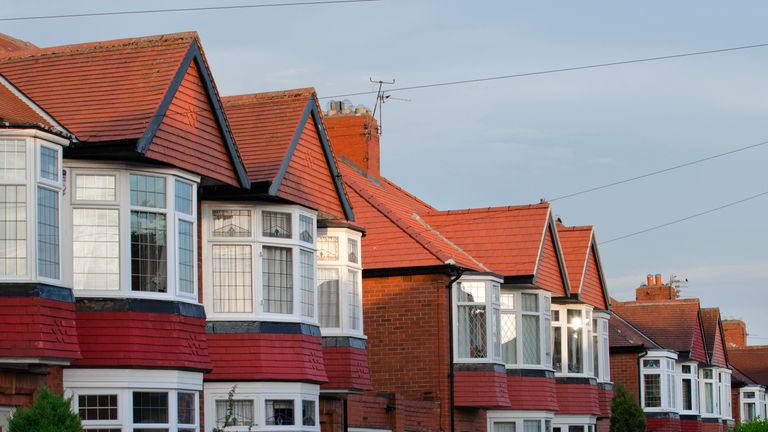
The Bank said that almost four million households face higher mortgage costs as fixed-term deals end. Pic: iStock
Such a move was urged, not only by the government, but by businesses to bolster UK lending and competitiveness.
The relaxation of the buffer does not take effect until 2027.
It was announced alongside confirmation that the country’s biggest lenders – Barclays, HSBC, Lloyds, NatWest, Santander UK, Standard Chartered and Nationwide building society – had passed the Bank’s latest stress tests.
The shocks each was exposed to included a 5% contraction in UK economic output, a 28% drop in house prices and Bank rate at 8%.
Despite the growing risks identified by the FPC, the Bank said that each was strong enough to support households and businesses even in the event of such scenarios, given the healthy state of their reserves.
It is widely expected that the gradual reduction in Bank rate will continue next year, assuming the outlook for inflation remains on a downwards trajectory, helping wider borrowing costs – a source of record bank profitability – decline.
The Bank said that three million households were expected to see their mortgage payments decrease in the next three years but that 3.9 million were forecast to refinance onto higher rates.
As such, it projected a £64 (8%) rise in costs for a typical owner-occupier mortgage customer rolling off a fixed rate deal in the next two years.
Banking stocks, which have enjoyed strong gains this year, were up when the FTSE 100 opened for business despite wider market caution globally which is aligned with the risks spoken of in the financial stability report.
Matt Britzman, senior equity analyst at Hargreaves Lansdown, said: “UK banks are offering a dose of optimism this morning in what’s turning out to be a good couple of weeks for the major lenders.
“The UK’s seven biggest banks sailed through the latest stress test, reaffirming their resilience and earning a regulatory nod to ease capital buffers.
“Most banks already hold capital well above the minimum by choice, so any shift in strategy may take time – but in theory, it frees up extra capital for lending or capital returns.
“However they use the new freedom, this is another clear signal that the UK banking sector is in robust health. This was largely expected, but the confirmation should still be taken well, especially after dodging tax hikes in last week’s budget.”

Did the chancellor mislead the public, and her own cabinet, before the budget?
It’s a good question, and we’ll come to it in a second, but let’s begin with an even bigger one: is the prime minister continuing to mislead the public over the budget?
The details are a bit complex but ultimately this all comes back to a rather simple question: why did the government raise taxes in last week’s budget? To judge from the prime minister’s responses at a news conference just this morning, you might have judged that the answer is: “because we had to”.
“There was an OBR productivity review,” he explained to one journalist. “The result of that was there was £16bn less than we might otherwise have had. That’s a difficult starting point for any budget.”
Politics latest: OBR boss resigns over budget leak
Beth Rigby asks Keir Starmer if he misled the public
Time and time again throughout the news conference, he repeated the same point: the Office for Budget Responsibility had revised its forecasts for the UK economy and the upshot of that was that the government had a £16bn hole in its accounts. Keep that figure in your head for a bit, because it’s not without significance.
But for the time being, let’s take a step back and recall that budgets are mostly about the difference between two numbers: revenues and expenditure; tax and spending. This government has set itself a fiscal rule – that it needs, within a few years, to ensure that, after netting out investment, the tax bar needs to be higher than the spending bar.
At the time of the last budget, taxes were indeed higher than current spending, once the economic cycle is taken account of or, to put it in economists’ language, there was a surplus in the cyclically adjusted current budget. The chancellor had met her fiscal rule, by £9.9bn.
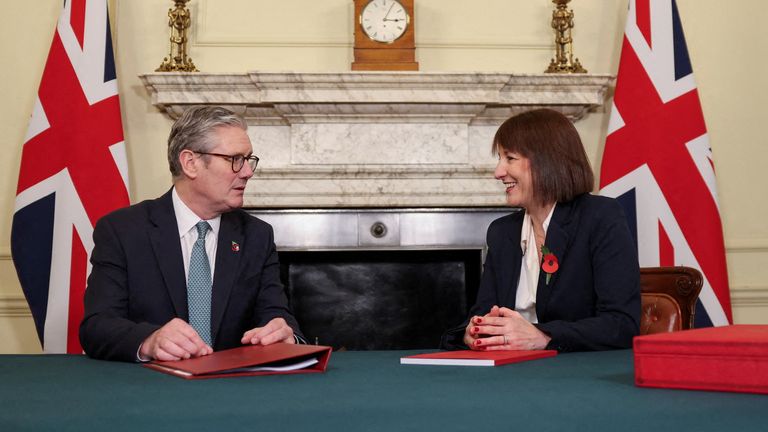
Pic: Reuters
This, it’s worth saying, is not a very large margin by which to meet your fiscal rule. A typical budget can see revisions and changes that would swamp that in one fell swoop. And part of the explanation for why there has been so much speculation about tax rises over the summer is that the chancellor left herself so little “headroom” against the rule. And since everyone could see debt interest costs were going up, it seemed quite plausible that the government would have to raise taxes.
Then, over the summer, the OBR, whose job it is to make the official government forecasts, and to mark its fiscal homework, told the government it was also doing something else: reviewing the state of Britain’s productivity. This set alarm bells ringing in Downing Street – and understandably. The weaker productivity growth is, the less income we’re all earning, and the less income we’re earning, the less tax revenues there are going into the exchequer.
The early signs were that the productivity review would knock tens of billions of pounds off the chancellor’s “headroom” – that it could, in one fell swoop, wipe off that £9.9bn and send it into the red.
Read more:
Main budget announcements – at a glance
Enter your salary to see how the budget affects you
That is why stories began to brew through the summer that the chancellor was considering raising taxes. The Treasury was preparing itself for some grisly news. But here’s the interesting thing: when the bad news (that productivity review) did eventually arrive, it was far less grisly than expected.
True: the one-off productivity “hit” to the public finances was £16bn. But – and this is crucial – that was offset by a lot of other, much better news (at least from the exchequer’s perspective). Higher wage inflation meant higher expected tax revenues, not to mention a host of other impacts. All told, when everything was totted up, the hit to the public finances wasn’t £16bn but somewhere between £5bn and £6bn.
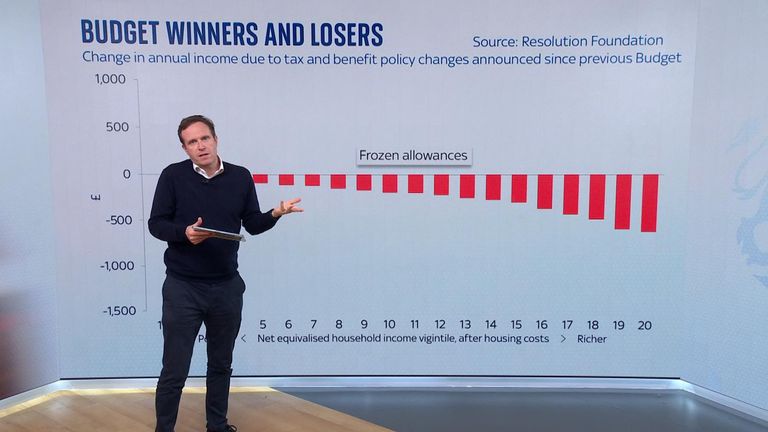
Budget winners and losers
Why is that number significant? Because it’s short of the chancellor’s existing £9.9bn headroom. Or, to put it another way, the OBR’s forecasting exercise was not enough to force her to raise taxes.
The decision to raise taxes, in other words, came down to something else. It came down to the fact that the government U-turned on a number of its welfare reforms over the summer. It came down to the fact that they wanted to axe the two-child benefits cap. And, on top of this, it came down to the fact that they wanted to raise their “headroom” against the fiscal rules from £9.9bn to over £20bn.
These are all perfectly logical reasons to raise tax – though some will disagree on their wisdom. But here’s the key thing: they are the chancellor and prime minister’s decisions. They are not knee-jerk responses to someone else’s bad news.
Yet when the prime minister explained his budget decisions, he focused mostly on that OBR report. In fact, worse, he selectively quoted the £16bn number from the productivity review without acknowledging that it was only one part of the story. That seems pretty misleading to me.
-
 Sports2 years ago
Story injured on diving stop, exits Red Sox game
-
 Sports3 years ago
‘Storybook stuff’: Inside the night Bryce Harper sent the Phillies to the World Series
-
 Sports2 years ago
Game 1 of WS least-watched in recorded history
-
 Sports3 years ago
Button battles heat exhaustion in NASCAR debut
-
 Sports3 years ago
MLB Rank 2023: Ranking baseball’s top 100 players
-
Sports4 years ago
Team Europe easily wins 4th straight Laver Cup
-
 Environment3 years ago
Japan and South Korea have a lot at stake in a free and open South China Sea
-
 Environment1 year ago
Here are the best electric bikes you can buy at every price level in October 2024