
Romo retires as Giant after pitching one final time


SAN FRANCISCO — Sergio Romo retired as a San Francisco Giant just the way he wanted to, pitching one final time for the team he helped to win three World Series championships, and then calling it a career Monday night.
In a moment more special than he could have imagined, the entertaining right-hander faced three Oakland batters in the seventh inning at Oracle Park in the exhibition finale for both clubs.
“Very fitting to find some closure in what literally is for me, was a storybook career,” he told reporters, pausing to catch his breath after the Athletics’ 12-6 win.
The Giants reached out a few weeks back to see whether Romo might consider tossing an inning — he looked at his arm and asked if it could give it one last hurrah. He had already taken up golf.
“I understand how special this opportunity was,” he said.
So, Bay Area baseball fans were treated to a last listen of Romo’s longtime signature “El Mechon” walk-up tune, too, and he basked in the cheers.
But ahead of unleashing his nasty slider, Romo got a dose of what he’ll be missing in the new, modern baseball world — he was immediately called for two clock violations by the plate umpire, resulting in a pair of automatic balls.
The first was for taking too long to finish his warmup tosses. The second was for taking too long to throw his first pitch.
Going against one of his former teams, and starting with a 2-0 count, Romo quickly walked his first batter. He threw a wild pitch and surrendered two singles that scored a run before former teammate Hunter Pence walked out to make a pitching change.
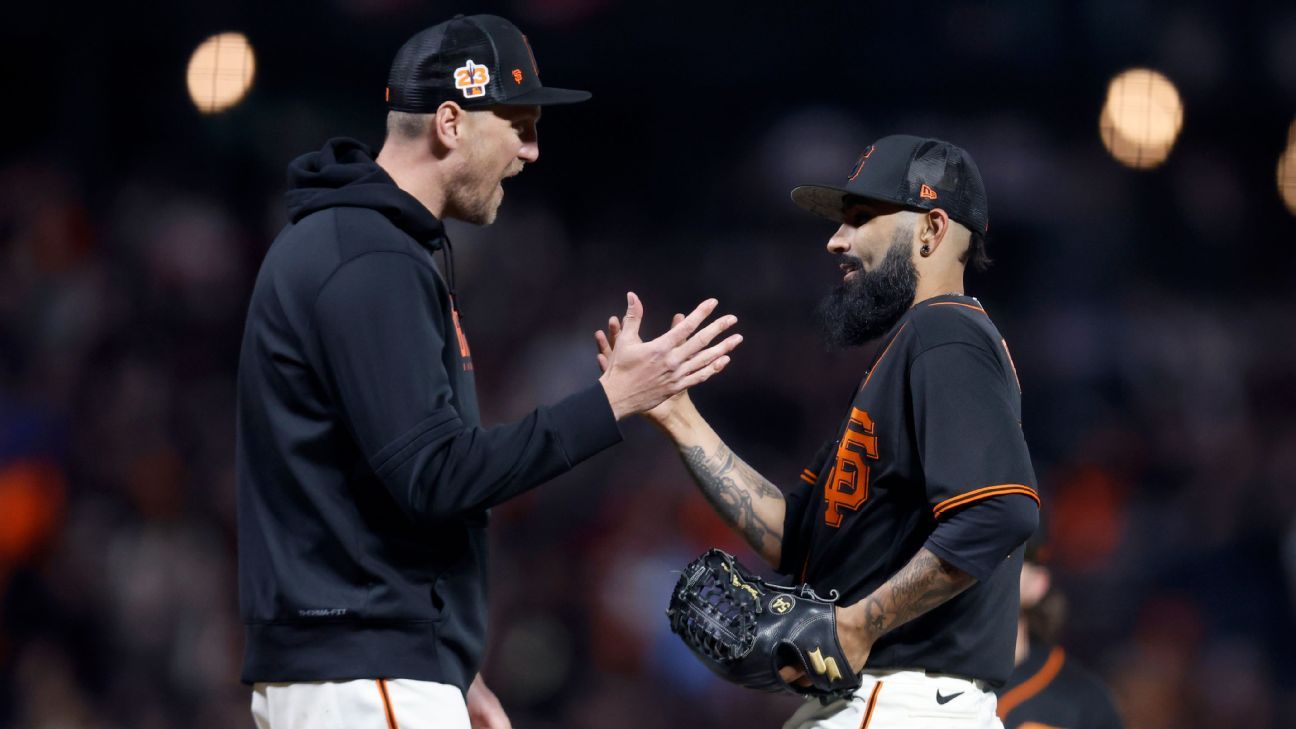
Romo, 40, soaked it all in as he made his way to the dugout, tipped his cap and hugged Giants manager Gabe Kapler and others in a sensational sendoff.
Romo got a curtain call and fought tears as he went back into the dugout.
Saluted with a rousing ovation when he strolled to the bullpen to begin his warmup tosses, Romo received more cheers when he came into the spring training game. The A’s players watched and clapped from their dugout rail, and the Giants grinned, witnessing the emotional goodbye to baseball.
Ever popular with the home fans, Romo wore a special hat. All during spring training, every time a kid asked for an autograph, he’d have them sign his cap.
“If this was the last hat I was going to wear in the big leagues … I figured it would be nice to not go in there alone,” he said.
Romo played 15 seasons for eight organizations, including the Athletics, spending his initial nine years with the Giants. The reliever on Monday shared a goodbye note to San Francisco on The Players’ Tribune.
“Dear San Francisco, Tonight I get to do something one last time – something that’s been one of the biggest honors of my whole life: I get to put on a Giants jersey. And before I go do that, I just wanted to write this letter, and share some thoughts with you all. Thanks for reading,” he said.
On Sunday in Oakland, Romo greeted fans and fist-bumped youngsters as he made his farewell rounds. On his Instagram account, the ever-creative Romo posted a photo of himself holding a sign similar to those of students on the first day of school but signifying his last day in the majors.
Romo grew up in Brawley, California, about 125 miles east of San Diego and some 30 miles north of Mexicali, Baja California, Mexico. He was a 2013 All-Star for the Giants and posted a career record of 42-36 with a 3.21 ERA and 137 saves over 821 appearances spanning 722⅔ innings. Last year, he pitched a combined 23 games for Seattle and Toronto.
He also played for the Dodgers, Tampa Bay, Miami and Minnesota. A 28th-round draft pick by San Francisco in 2005 out of Colorado Mesa University in Grand Junction, Colorado, Romo was a key member of manager Bruce Bochy’s stellar bullpen soon after making his big league debut in 2008.
Romo helped the Giants win every-other-year titles in 2010, ’12 and ’14 — the 2010 team capturing the franchise’s first championship since 1954 and first since moving West from New York in 1958.
Romo excelled in those games, posting a 0.00 ERA and three saves in six World Series appearances.
And long after those October highlights, Romo wound up on the very same mound for the last time, finishing up on a March night.
“What an experience,” he said.

-
Eli Lederman
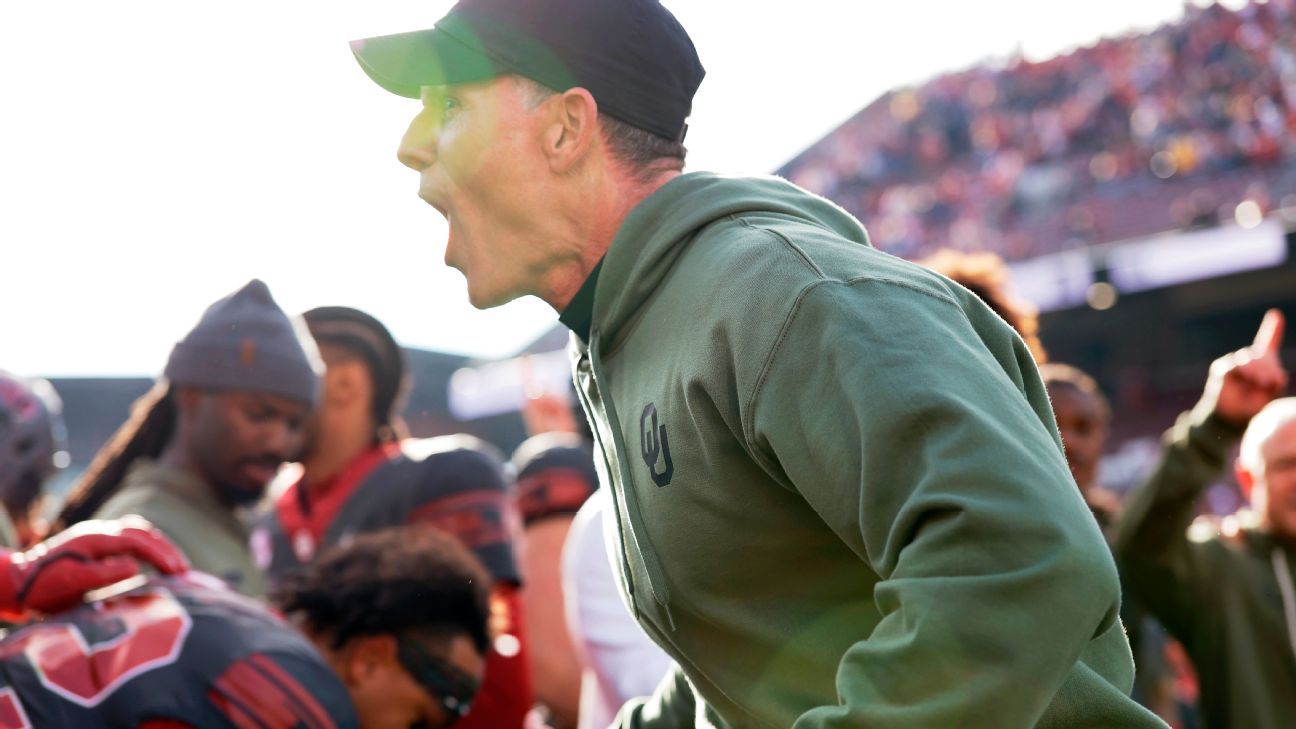
NORMAN, Okla. — Oklahoma coach Brent Venables carried a somber tone.
Disappointed. Embarrassed. An unsmiling Venables had plenty of words to describe a disastrous 2024 football season in the minutes after last December’s Armed Forces Bowl. It had ended, mercifully, in a 21-20 defeat to Navy that afternoon. The Sooners had dropped six of the final eight games in their eagerly anticipated debut SEC campaign. For the second time since 1998 — and the second time under Venables — the Sooners would finish with a losing record.
Three seats to Venables’ left, veteran Sooners linebacker Kobie McKinzie felt a different energy radiating from his head coach. Minutes later, in an otherwise empty locker room inside TCU’s Amon G. Carter Stadium, Venables spoke like a man who knew what was coming.
“He looked me in my eyes and told me, ‘We’re going to be all right,'” McKinzie recalled after a recent practice. “I saw the passion. I could feel it in his presence. He couldn’t take enough deep breaths to calm himself down because he was so eager to get this figured out. He was ready to go to work.”
Venables left the Armed Forces Bowl on the hot seat. A month later, he announced plans to take over as the Sooners’ defensive playcaller this fall, assuming full control of the defense for the first time as a head coach and placing a calculated bet on a make-or-break season in Norman. As No. 8 Oklahoma rolls into its first College Football Playoff appearance since 2019 on Friday, the decision stands as one of the most consequential offseason moves in the sport in 2025.
Disguising blitzes, overwhelming opposing quarterbacks, blowing up backfields; Oklahoma’s oft-red-faced defensive mastermind got back to doing what he does best this fall, in turn dispelling doubts over his coaching future and launching a vintage Venables defense reminiscent of the units he sculpted as a three-time national champion coordinator at Oklahoma and Clemson.
Along the way, perhaps no one has enjoyed the move more than Venables himself.
“Everything’s just different for you when you’re calling it,” Venables told ESPN. “You feel this responsibility of doing it on your side of the ball …You live and die in the course of the week. Literally you’re born and then you die at the end of it. I think in a good, healthy way.”
Venables’ latest elite defense is powered by a core of experienced defenders, many of them in their third and fourth years playing in the system. It shows. Oklahoma entered the postseason ranked in the top 10 nationally in points per game (13.9), total defense (273.9 YPG) and run defense (81.4 YPG). Its 41 sacks are tied with Texas A&M for the national lead. No program across the country has logged more tackles for loss (115) in 2025.
That defensive unit stifled Auburn, LSU, Missouri and Tennessee en route to a CFP berth. But no win in Oklahoma’s path looms larger than its Nov. 15 win at Alabama, a 23-21 victory fueled by a defensive master class from Venables. On Friday, the Sooners host the No. 9 Crimson Tide (8 p.m. ET, ABC) in a playoff rematch, looking to defeat Alabama for the second time in 34 days.
Venables’ confidence at Oklahoma never wavered. Nor did his determination. Operating with a matured defensive core and what Venables calls “the best staff I’ve been a part of,” one of college football’s most creative defensive minds is back in the saddle, firmly at the center of a ferocious defensive juggernaut and a seismic turnaround in Norman.
“It’s pure passion and pure heart coming from him,” McKinzie said. “That’s what the program has been built on. That’s what the defense has been built on. It will never be replicated.”
OF COURSE, VENABLES was never not involved in the defense at Oklahoma over the past few years. But after nearly three decades spent living and breathing it every day, it took him four years to find the right balance as he adjusted to the duties of life as a head coach with the Sooners.
Venables handed playcalling to former Duke coach Ted Roof in 2022, then split the duties with Roof in 2023. When Venables fired Roof following the 2023 season, the Sooners brought in Zac Alley, a 30-year-old protégé who had worked for Venables at Clemson, to call plays in 2024.
None of those arrangements lasted more than a season. More crucially, although Oklahoma showed flashes of brilliance, it didn’t look like a Venables unit. The Sooners never finished better than 29th in scoring defense from 2022 through 2024. After Alley left for West Virginia last December, Venables didn’t necessarily need a nudge, but two of his former bosses still shared their thoughts.
“I expressed to him that calling plays was the best thing he could do,” former OU coach Bob Stoops told ESPN. Weeks after the Armed Forces Bowl, Clemson coach Dabo Swinney and Venables spent a few days together at the American Football Coaches Association Convention in Charlotte, North Carolina. “He knew what was at stake this year,” Swinney said. “He just took it head on.”
After cutting his teeth under Bill Snyder at Kansas State, Venables joined Stoops at Oklahoma in 1999 and won a national title the next year. A decade later, he landed with Swinney at Clemson. While capturing a pair of national championships, Venables burnished his reputation as a loud-barking mad scientist and emerged as one of the nation’s sharpest tactical minds.
When he decided to take over playcalling duties earlier this year, Venables’ explanation was simple: “Why am I going to call the defense?” he said in March. “Because I’m good at it.”
Peyton Bowen, an All-SEC safety, felt Venables’ heightened impact immediately this spring.
Venables, notoriously, likes to tinker pre-snap. Under previous setups, Bowen recalled, there could be occasional confusion around signal calling to the field when Venables and another coordinator were operating together. Sometimes playcalls got crossed entirely. With Venables in full control, multiple Sooners said those processes have run more smoothly in 2025.
“Everything just goes through him,” Bowen said. “You just got to remember your stuff.”
McKinzie swears the 55-year-old coach has a photographic memory. “It’s crazy, dude, he doesn’t have to see the play or have anybody draw anything,” McKinzie said. “He can literally tell you the exact formation and exactly what they did. That’s how you know you’re around one of the great ones.”
In previous seasons, Venables roamed across multiple meetings while coordinators — Roof or Alley — led the primary defensive sessions. Known for his meticulous film study and attention to detail dating to his earliest days as an assistant at Oklahoma, Venables is now at the forefront of Oklahoma’s defensive meetings, offering his players an essential asset.
“You just get to pick his mind throughout the whole week,” McKinzie said. “I try to sit as close to him as possible.”
Playcalling duties have altered nearly every part of Venables’ game week schedule. In his words, it has taken the job into a more “intimate space,” both relationally and logistically. Breaking down film. Building packages. Game-planning. Meeting with his staff. Meeting with players.
“The anticipation of game day is different, too,” Venables said. “It all just becomes more a part of your DNA each week and then across the season as opposed to a CEO-type coaching of role.”
For that, Venables credits the staff around him, from assistant coaches to a revamped front office. One of Venables’ favorite parts of the week, he says, is the morning meetings with his defensive staff, which includes offseason hires Wes Godwin — who replaced Venables as Clemson’s defensive coordinator in 2022 — and former Utah State defensive coordinator Nate Dreiling. The arrival of first-year general manager Jim Nagy has freed Venables up more, too.
“I knew I needed to trust the people that I’ve hired,” Venables said. “It’s all, ‘Coach Venables is getting back and calling plays,’ Man, the collaboration is very real. It’s not like I’m giving that lip service.”
Given his perpetual well of intensity, it would be misleading to suggest Venables is reenergized this fall. But settled into the rhythms of his playcalling duties, ingrained in the minutiae and fully hands-on with his defense, Venables appears as comfortable as he ever has been as a head coach.
“You’d like to be a head coach where you can be the good guy and a connector,” Venables said. “I certainly like to have fun. But fun for me is when we’re whupping people.”
VENABLES ADDRESSED HIS team in the visiting locker room of Alabama’s Bryant-Denny Stadium last month after Oklahoma snapped the host’s 17-game home winning streak. His face was red. His voice was hoarse. In his hands: an “Original Can of Whoop Ass.” It retails for $14.99 online.
In the 23-21 win over then-No. 4 Alabama on Nov. 15, Oklahoma had looked as close to Venables’ vaunted Clemson defenses as it had at any point across his four seasons in charge.
The Sooners puzzled Crimson Tide quarterback Ty Simpson with exotic pressures and sacked the Heisman hopeful six times. They turned three Alabama turnovers into 17 points, headlined by an 87-yard pick-six from Eli Bowen. Oklahoma created constant pressure in the pocket and smothered every available lane, angle or opening in the run game.
“Every one of you guys putting that freaking jersey on,” Venables told his players. “You guys have made the decision to work. To improve. To get better. To kick the door in. To believe. To respond. That’s what you guys have chosen to do. I didn’t make one freaking tackle tonight.”
The performance was everything Venables had promised in his introductory news conference on Dec. 6, 2021. On Friday, the Sooners will attempt to stifle the Crimson Tide again, led by Venables and perhaps the most suffocating defense across the 12-team CFP field, a unit that has all the very best elements that have defined Venables’ elite units of the past.
Like his swarming Clemson defenses of the 2010s, Oklahoma is built on the defensive line.
Anchored by sack leader R Mason Thomas and interior stars David Stone, Gracen Halton, Damonic Williams and Jayden Jackson, the Sooners sit atop the nation in both sacks and runs stops of zero or negative yards, just like Venables’ national title-winning defense in 2018.
That group, led by All-Americans Austin Bryant, Clelin Ferrell and Christian Wilkins, logged six sacks in the national semifinal against Notre Dame. This fall, Oklahoma hammered Auburn quarterback Jackson Arnold for nine sacks in September. A month later, the Sooners taxed South Carolina’s LaNorris Sellers six times before creating 13 pressures against Alabama.
Within a unit nicknamed the “Dog Pound,” the Sooners roll deep, too. Per ESPN Research, Oklahoma had 10 defensive linemen register 100-plus snaps during the regular season, more than all but three other defenses across the SEC.
“They just do a great job of causing chaos,” Alabama coach Kalen DeBoer said of the Sooners’ defense this week. “They love the tackles for loss and the sacks. There’s obviously a triggerman. Coach Venables [is] one of the best that there is at doing it.”
Venables’ penchant for disguised blitzes and unique pressures has popped often this fall, too. “They do a great job of creating confusion,” Alabama offensive coordinator Ryan Grubb said.
Halton, a member of Venables’ first Oklahoma signing class in 2022, points out Venables’ knack for halftime adjustments. In 2018, Clemson finished with the nation’s ninth-ranked second-half scoring defense. This fall, the Sooners are giving up 7.4 points and 125.8 yards per game after halftime, per ESPN Research, ranked fifth and 11th nationally in the respective categories.
Last month, Missouri ran for 70 yards on 26 carries led by All-American rusher Ahmad Hardy. After halftime, the Tigers’ running lanes disappeared. On nine second-half rushing attempts, Missouri gained zero yards with minus-13 yards before contact, per ESPN Research.
“BV comes in at halftime completely dialed in on the offense,” Halton said. “He knew what they were doing. They had a great offense and some really good running backs. He locked it down.”
There’s perhaps no time when Venables’ acumen is more valuable than in the seconds before the ball is snapped. Along with his complex pre-snap alignments, Venables is an astute reader of opposing offenses, often waiting deep into the play clock to call a pre-snap audible.
“He’s always just trying to win that chess match,” Peyton Bowen said.
Bowen’s mind goes back to the fourth quarter at Alabama. With the Crimson Tide facing third-and-5 and 12:22 remaining, Oklahoma’s sideline was a barrage of movement. “Alabama was switching back and forth between formations,” Bowen said.
“We’re checking and checking and checking and checking. The defense communicated perfectly.”
After loading the defensive line pre-snap, Venables sent sophomore cornerback Devon Jordan in on a delayed blitz. After overpowering a blocker, Jordan swarmed Simpson for a critical sack.
“In the end, BV made the right call.” Bowen said.
FOR THE PAST two weeks, Venables has knocked down suggestions of a potential advantage in seeing an opponent for a second time. “They have certain matchups they like, and we have certain matchups that we like,” he said on Dec. 7. “But at the end of the day you can throw that all out.”
All told, Venables is 4-0 in same-season rematches from 2000 through 2020, all as a coordinator. That record shouldn’t have much bearing on Friday night’s game. But if any of those games could be instructive, it might be the most recent one: a December 2020 win over Notre Dame.
The Fighting Irish, provisional members of the ACC that fall, dropped 510 yards on Venables’ Clemson defense and outlasted the Tigers in a 47-40, double-overtime thriller that November.
When the programs met again in the ACC title game a month later, Venables had an answer for everything. Clemson cruised to a 34-10 victory. A Notre Dame rushing attack that averaged 211.1 yards per game that fall finished with just 44 yards on the ground. “There were new looks for sure, in the secondary as well as up front,” Irish quarterback Ian Book said afterward.
It was a Venables special.
Despite being outgained 406-212, the Sooners left Tuscaloosa with their biggest victory of the Venables era last month. From that performance, they’ll have a formula for Friday’s game. OU allowed just four first downs over the final 15:09 and limited Simpson to one of his least productive second-half showings of the season, sealing the win that ultimately vaulted Oklahoma into the CFP by limiting mistakes and winning on the margins.
Afterward, Venables demurred at the suggestion that Oklahoma had won ugly.
“Who’s it not pretty for? What does that mean?” he said. “I happen to like it.”
-
 Sports2 years ago
Story injured on diving stop, exits Red Sox game
-
 Sports3 years ago
‘Storybook stuff’: Inside the night Bryce Harper sent the Phillies to the World Series
-
 Sports2 years ago
Game 1 of WS least-watched in recorded history
-
 Sports3 years ago
Button battles heat exhaustion in NASCAR debut
-
 Sports3 years ago
MLB Rank 2023: Ranking baseball’s top 100 players
-
Sports4 years ago
Team Europe easily wins 4th straight Laver Cup
-
 Environment3 years ago
Japan and South Korea have a lot at stake in a free and open South China Sea
-
 Environment1 year ago
Here are the best electric bikes you can buy at every price level in October 2024