
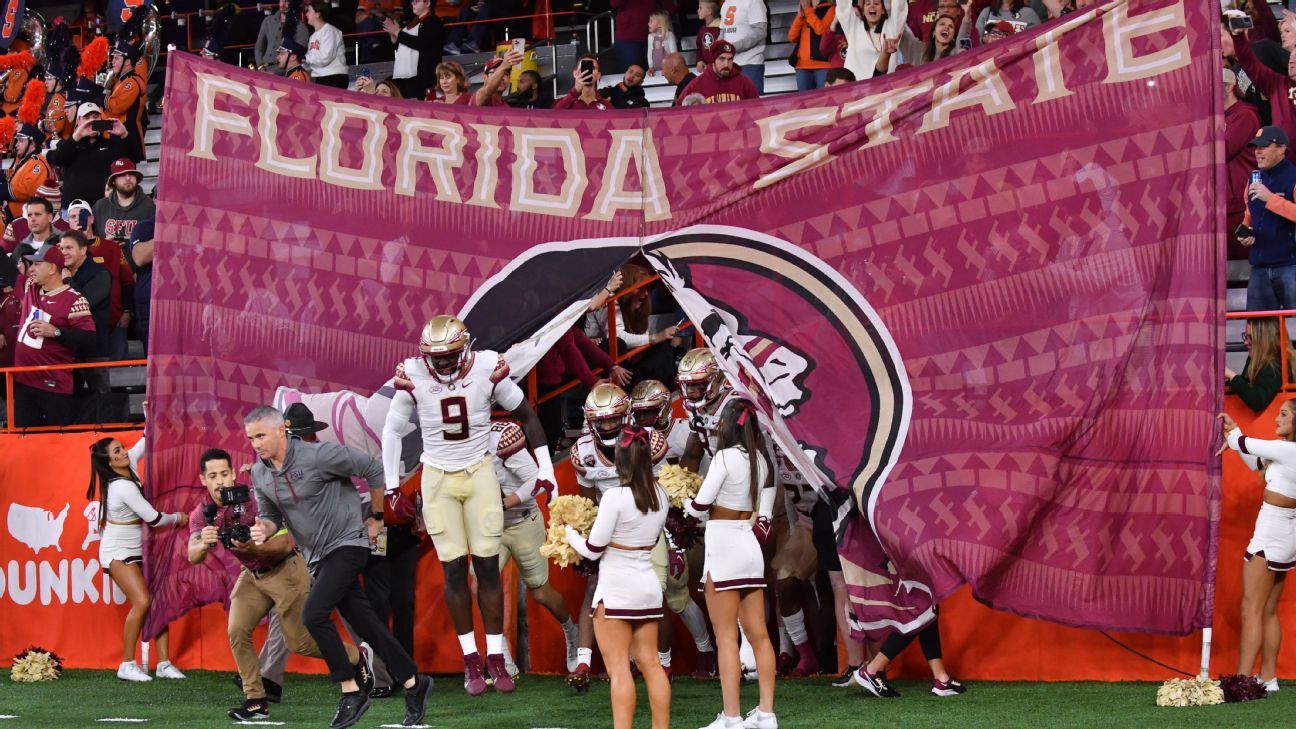
State of ACC and realignment: What’s next for Florida State and the conference?


-
Andrea Adelson, ESPN Senior Writer
ACC PRESIDENTS HAD a meeting scheduled last Wednesday that had the potential to affect the future of the league. As the hours ticked closer to the call, nobody had a clear idea of what would happen, only that expansion was on the table.
One administrator thought the discussion about adding Cal and Stanford had gone on long enough, and the presidents had to vote. But the administrator admitted to having no idea whether a vote would actually happen.
What was certain was there were votes in favor of expansion (Notre Dame, Wake Forest, Louisville, Miami, Georgia Tech) and votes opposed (Clemson, Florida State, North Carolina) and swing votes in between. Another administrator thought enough of the 15 voting presidents would swing to yes and get the required 12 to approve expansion.
Once the call started, it became clear that would not be the case. No official vote was taken. In straw polling, the fourth school opposed was NC State, according to multiple sources.
An Aug. 15 deadline to depart the ACC for the 2024 season has come and gone. Expansion discussions are now “on life support.” After two weeks filled with near-constant drama, including Florida State president Richard McCullough saying the Seminoles would “very seriously consider” leaving the ACC, the league prepares to start a new football season. Interviews with several ACC administrators and sources with a deep understanding of the conference’s issues revealed the inner workings of what happened (or did not happen) this month, and what comes next.
1:04
Finebaum: FSU is better off leaving the ACC
Paul Finebaum discusses why Florida State and other members of the ACC should look elsewhere.
McCULLOUGH DID NOT make his comments about Florida State’s future and what he hopes can be a “radical change” to the ACC revenue distribution model to his board of trustees on Aug. 2 in a vacuum. At the time, the Pac-12 was on the verge of falling apart. Colorado had already announced its intentions to join the Big 12 starting in 2024, and speculation centered around Arizona, Arizona State and Utah following suit. Speculation also swirled that Oregon and Washington could join the Big Ten. McCullough’s reminder to the league about his program’s unhappiness came as college athletics stood on the precipice of another round of radical conference realignment.
Behind the scenes, however, the ACC was already having conversations about trying to add Cal, Stanford, Oregon and Washington — discussions that had been taking place for well over a year. In fact, Duke president Vincent Price (serving as ACC board chair) reached out to Washington president Ana Mari Cauce last year to gauge interest in a partnership. Cauce declined, according to a source with knowledge of the discussions.
McCullough knew this as he sat in front of his board of trustees. Once Colorado announced its future move to the Big 12 on July 27, those Pac-12 discussions picked up again but did not yield a deal. “I cannot fathom how Colorado moving back to a league they had already been in somehow started all of this,” one ACC administrator said, calling it a “panic move” among presidents.
Two days after McCullough spoke publicly, the Big Ten added Oregon and Washington, but at a discounted share of media rights revenue — starting at around $30 million per school, per ESPN sources, compared to the roughly $60 million or more existing members would receive. At the time, nobody knew whether the Big Ten would continue adding schools, so this provided an opening for McCullough’s comments to be taken more seriously.
But a source with knowledge of the discussions said the Big Ten did not have serious conversations about adding Florida State, and its top priority remains Notre Dame.
With Oregon and Washington headed to the Big Ten, and Arizona, Arizona State and Utah officially joining the Big 12, the Pac-12 had only four schools remaining. The ACC conversations about Cal and Stanford grew more serious. From an outside perspective, there seemed to be few benefits, especially for a league that needed two things desperately: more revenue and a boost to its football reputation. Neither school provided that. Add in travel to the West Coast for only two teams, and it made little sense.
Except to the presidents.
“Cal and Stanford were probably from the presidents’ perspective a better target than anybody else in the Pac-12 just because of the academic reputation,” one administrator said. “The fact that Oregon and Washington left, OK that’s fine, but these are two pretty good brands, so how do we integrate them into the league?”
Among athletic directors, the initial conversations around Cal and Stanford did not yield much. But further discussion changed minds. Multiple administrators in favor of the move described it this way: longer-term security in the event schools such as Florida State leave the conference. The Seminoles are not the only ones who have looked at their future and evaluated the grant of rights, which gives the ACC control over home broadcasts and media revenue through 2036. Six other schools had discussions with Florida State about the grant of rights and charting a path forward: Clemson, Miami, Virginia, Virginia Tech, North Carolina and NC State.
If the ACC added Cal and Stanford, the new schools would also have to sign the grant of rights until 2036. The current ACC contract is the longest running among all the power conferences, and adding more schools would help with stability. One administrator put it this way, “If I was the commissioner, I would be doing the exact same thing he is doing, looking to add schools.”
While more athletic directors moved in favor of adding teams, they were still not completely aligned with the presidents. Some asked why there was urgency. For more than a year they had discussed having more than two teams from the West Coast in order to get any deal done, but demurred. Now they were OK with only two? One administrator pointed out that plenty of dominoes could fall, potentially starting when the Big Ten television contract comes up after the 2029-30 season, and the Big 12 deal is up the following year. Why the rush?
SMU entered the conversation as a way to help financially — bringing in the state of Texas has appeal not only from a television household perspective but from a geographical standpoint. Unlike with the Pac-12 schools, though, there is no rush on SMU, because as multiple administrators have said, it can be added at any time. SMU has been lobbying for a Power 5 invite and hosted Pac-12 commissioner George Kliavkoff on its campus in February.
So the discussion last week started to take shape around Cal and Stanford. As more ADs moved in that direction, the university presidents seemed to be coalescing around a “yes” vote. Notre Dame was, indeed, leading the charge. Although the Irish do not play football in the ACC, all their other sports — minus hockey in the Big Ten — do, and therefore get a full vote when it comes to expansion. The ACC requires 12 out of 15 yes votes to expand, and the decision to add Cal and Stanford would be made by the presidents.
Not only did the Irish like the idea of bringing in two elite academic schools with stellar Olympic sports programs, one source noted there was also a football perspective to all this. There is a fear among college administrators that if Stanford gets left out of a Power 5 conference, it would drop football to a non-FBS level. That, of course, would affect the longstanding Notre Dame-Stanford football series, which has been played every year since 1988 (excluding the COVID year of 2020).
Why was NC State not in favor of expansion? The dynamics in the state of North Carolina provide a fascinating window into the North Carolina-NC State relationship. North Carolina is one of the most attractive schools in the country to both the SEC and Big Ten, should those conferences decide to expand further.
NC State holds power within the University of North Carolina System and the state legislature. Siding with North Carolina essentially signals the Wolfpack believe their future is tied with UNC.
So in the end, there was not enough support among the ACC presidents. Adding just to add, with zero financial benefit, did not make sense to the four schools not in favor, according to multiple sources. Still, ACC commissioner Jim Phillips said as recently as July 27 — the day Colorado left for the Big 12 — the league would continue to actively consider adding teams, with an emphasis on finding value in any expansion option.
Adding teams in the realignment landscape provides benefits that could help the league’s survival. As one administrator in favor of the move said, “I have to always be thinking, ‘How do I get f—ed?’ You don’t want to end up like Oregon State and Washington State.”
Another source put it this way: “We’re at a point because of all these other moves on the chessboard that the consequences and risks of doing nothing start to seem worse than the consequences and risks of doing something.”
THOUGH THE TOPIC is not completely closed, discussions have not moved forward since last week, and there are no presidents calls currently scheduled. The clock is ticking for both Cal and Stanford, who currently reside in a four-team Pac-12 for 2024. One source said the window for the ACC to expand remains open.
As for Florida State, the Aug. 15 deadline to leave the league by next year might have passed, but the Seminoles are still serious about having their revenue concerns addressed. McCullough told his board of trustees two weeks ago “our goal would be to continue to stay in the ACC,” but something has to change with revenue.
Any school wishing to leave the conference must contend with a $120 million exit fee plus the grant of rights, which has never been challenged in court. Florida State, like other schools in the league, has sent lawyers to study the contract language to better understand the document.
It should be noted the Aug. 15 deadline was only to withdraw for 2024. Teams can still decide to leave at any time, but multiple sources have said doing so could produce a protracted legal battle that could take years to resolve.
Those inside the league are paying attention. With no vote on expansion, and the continuing specter of Florida State possibly leaving, there is at least some hope in Tallahassee that discussions about changing the television revenue distribution might begin again, according to sources with knowledge of the situation.
There is significant resistance among other ACC members, for obvious reasons. Few schools are willing to take less television money based on ratings and marketability. Florida State has touted its viewership metrics — an average of 3.09 million viewers for regular-season games in 2014-21 to top the league — much to the chagrin of other schools.
Wake Forest, for example, has taken the time over the past month to push back. In the latest edition of the Wake Forest athletic director John Currie’s newsletter, he notes that since August 2019, Wake Forest has been the fastest-growing brand in the Power 5, with a 115% growth in its fan base during that span.
Schools have privately questioned the brand and marketability data Florida State has touted, including its assertion that if conference revenues were removed, the Seminoles would rank No. 3 in the SEC and Big Ten in revenue generated.
Florida State is not going to stop pushing for more money. As Phillips has continuously reiterated, generating more revenue is at the top of his daily to-do list. The ACC is third behind the Big Ten and SEC, but Phillips pointed out the ACC topped all conferences with 16 national championships over the past two seasons despite being behind financially.
“Revenue generation continues to be a priority,” Phillips said last month at ACC media days. “But let me be clear also, this league is third right now in revenue as we go forward into wherever the next TV deals are for other conferences. We’ve had multiple TV consultants. Third is certainly a good position, but we want to gain and gain traction financially in order to close the gap with obviously the SEC and the Big Ten, who have leapfrogged everyone.”
It is an issue that will only continue to grow when the SEC and Big Ten start new television contracts that are estimated to earn their teams $30 million more annually than those in the ACC.
If there are enough presidents worried about the Seminoles leaving, perhaps those revenue distribution conversations will change, making Florida State happy. For now.
“We love the ACC. My No. 1 goal is to stay in the ACC. That’s my No. 1 goal,” McCullough told ESPN. “But at some point it becomes difficult for me to do what I’m supposed to do for athletics at Florida State.”
David Hale contributed to this report.


-
Michael Rothstein
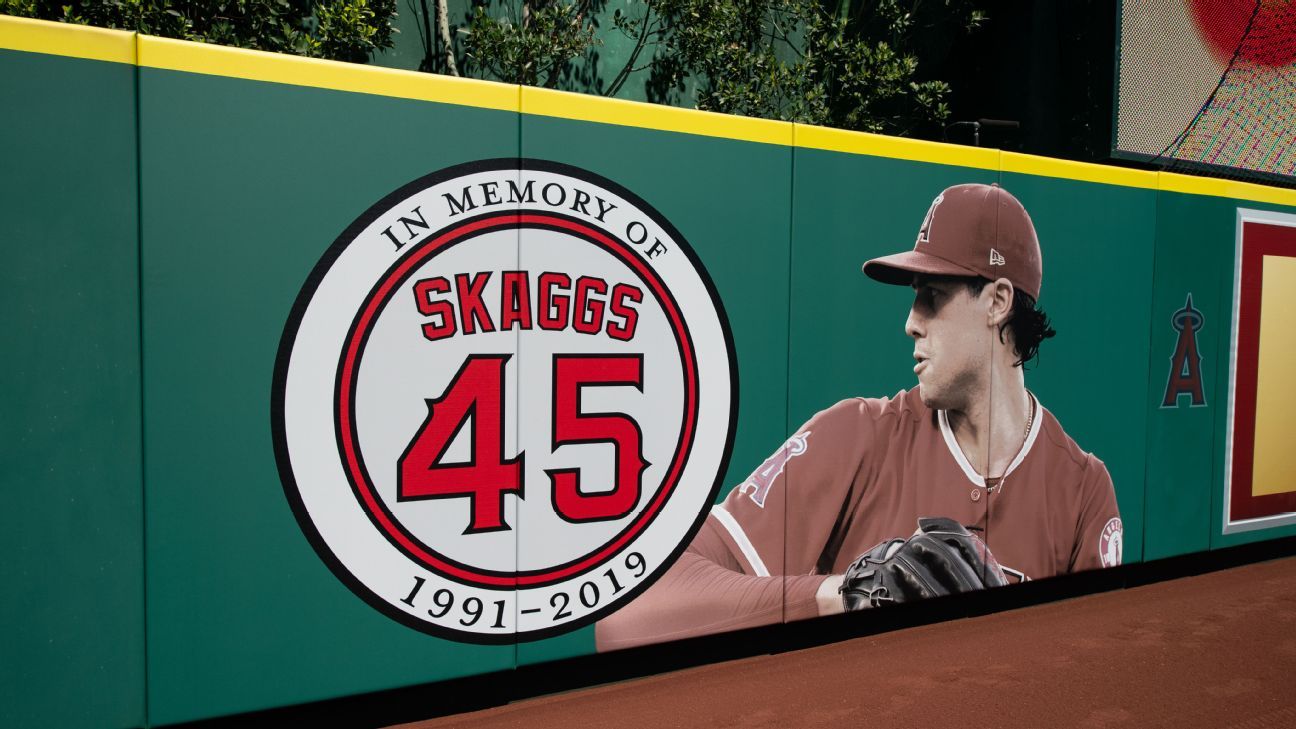
SANTA ANA, Calif. — The Los Angeles Angels agreed Friday to a last-minute settlement with the family of deceased pitcher Tyler Skaggs after jurors, deliberating for more than two days, sent queries that suggested the verdict might go in the family’s favor.
The amount and terms of the settlement — ending a yearslong battle over culpability in Skaggs’ death — were not immediately disclosed. The Skaggs family had been seeking $118 million in potential lost earnings plus added damages.
“The Skaggs family has reached a confidential settlement with Angels Baseball that brings to a close a difficult six-year process, allowing our families to focus on healing,” the family said in a statement. “We are deeply grateful to the members of this jury, and to our legal team. Their engagement and focus gave us faith, and now we have finality. This trial exposed the truth and we hope Major League Baseball will now do its part in holding the Angels accountable. While nothing can bring Tyler back, we will continue to honor his memory.”
Skaggs’ family sued the Angels after Tyler Skaggs died in 2019 after an Angels employee, Eric Kay, gave him a fentanyl-laced pill that killed him. Kay is serving a 22-year federal prison sentence for his role in Skaggs’ death. If Kay hadn’t provided that pill, jurors were instructed, Skaggs would not have died that night.
Lawyers for the Skaggs family and the Angels were in discussions Friday morning both outside the courtroom and privately in front of Judge H. Shaina Colover as the jury began its third day of deliberations. Settlement talks picked up in earnest Thursday, according to a source.
On Wednesday, the jury asked questions about the testimony of the five wage experts and about whether the jury would also be allowed to award punitive damages. Throughout the trial, the jury heard baseball wage experts testify that Skaggs’ lost career wages ranged from $21 million to nearly $125 million.
Jurors sat through 31 days of courtroom drama, which included testimony and depositions from 44 witnesses and arguments from attorneys. They viewed 312 exhibits.
The jury instructions required answers of up to 26 questions that varied from easy-to-answer stipulations of fact to more complicated assessments of negligence or culpability. Nine of 12 jurors had to agree on each question — but not necessarily the same nine jurors.
In the end, the jury did not get to render a verdict or assign “percentages of responsibility” among Skaggs, Kay and the Angels.
Angels lead attorney Todd Theodora argued it was “undisputed in this case that Eric was doing this on his own” and that the Angels were unaware Kay was distributing pills.
Plaintiffs attorney Daniel Dutko argued that the Angels knew of Kay’s drug problem, pointing to a Drug Enforcement Agency interview with Kay after Skaggs’ death that stated Kay had told his superior in 2017 that he and Skaggs were doing drugs.
The Skaggs family argued the Angels did nothing to prevent or monitor Kay’s drug abuse and did not discipline or terminate him. By doing so, the family said, the team put Skaggs in harm’s way.
“We’ve spent two months in trial,” Dutko said during his closing argument. “At any point have the Angels taken any responsibility?”
The Angels claimed they were not aware of Skaggs’ drug addiction and that he concealed it from the team. Theodora said the club signed Skaggs “under false pretenses” because he did not disclose his prior addiction to Percocet and that not even his wife knew about his previous addiction.
Angels attorneys said Kay was not operating in the scope of his employment when he provided pills to Skaggs and other players and that team officials were unaware of Kay’s illicit drug activity. The Angels argued it was Skaggs’ reckless decisions that led to his death.

-
 Sports2 years ago
Story injured on diving stop, exits Red Sox game
-
 Sports3 years ago
‘Storybook stuff’: Inside the night Bryce Harper sent the Phillies to the World Series
-
 Sports2 years ago
Game 1 of WS least-watched in recorded history
-
 Sports3 years ago
Button battles heat exhaustion in NASCAR debut
-
 Sports3 years ago
MLB Rank 2023: Ranking baseball’s top 100 players
-
Sports4 years ago
Team Europe easily wins 4th straight Laver Cup
-
 Environment3 years ago
Japan and South Korea have a lot at stake in a free and open South China Sea
-
 Environment1 year ago
Here are the best electric bikes you can buy at every price level in October 2024