
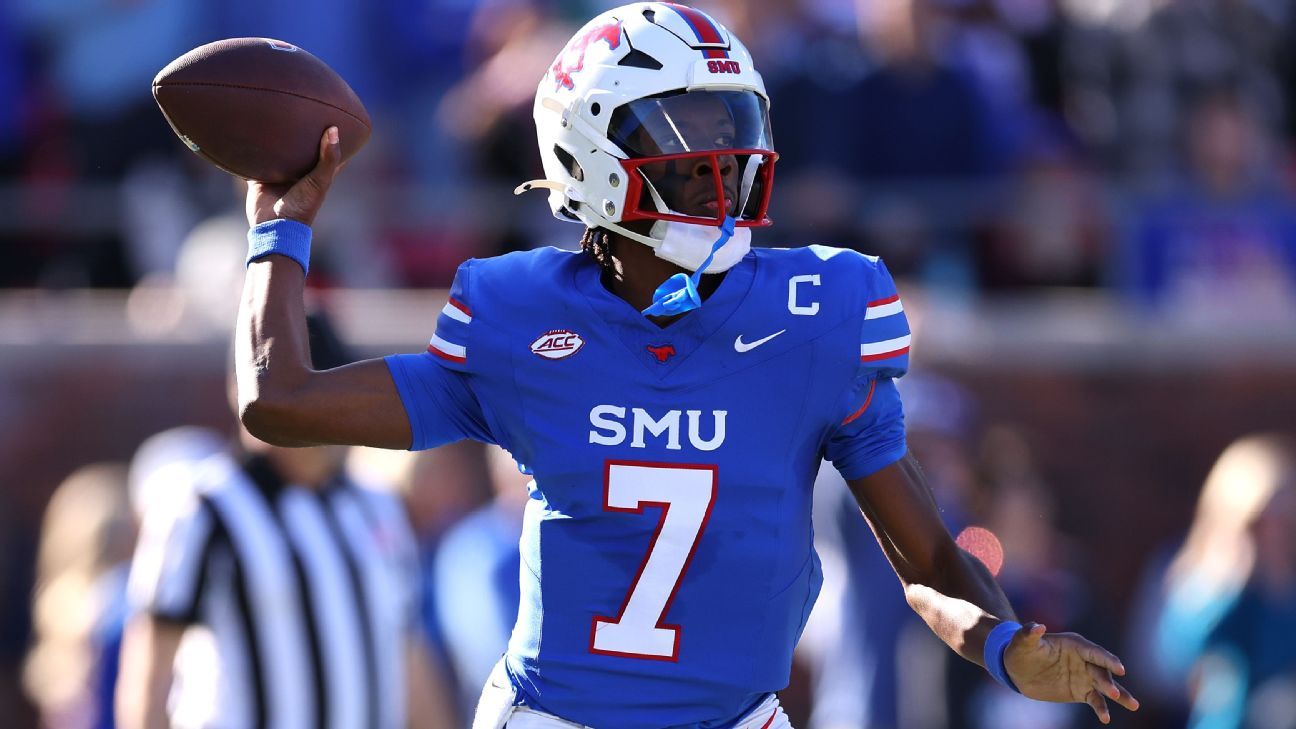
How SMU’s first season in the ACC became a massive success


-
Dave Wilson, ESPN Staff Writer
SMU COACH RHETT Lashlee might have a sleepless first week on the job to thank for this historic Mustangs season.
Lashlee was hired on Nov. 30, 2021, just about two weeks before signing day. He was trying to re-recruit the kids who were committed to the previous coach, Sonny Dykes, who departed for TCU. He was trying to re-recruit his own roster. And he was looking to potentially add finishing touches on the class after arriving from Miami, where he’d been for two years as offensive coordinator.
So on that first Friday night, he went to watch South Oak Cliff play Lovejoy at The Star, the Dallas Cowboys’ practice facility in Frisco that also doubles as a high school venue. He was there to see a few underclassmen from both teams that SMU was already recruiting. But there was someone else who caught his eye: South Oak Cliff quarterback Kevin Jennings. Jennings impressed Lashlee with his composure, his demeanor and his arm. At 6 feet, 175, he wasn’t the biggest guy, but he played big.
Against Lovejoy, Jennings was 18 of 25 for 250 yards and a touchdown, running four times for 29 yards and two other scores. SOC beat Lovejoy 42-21. The week before, in a massive upset, Jennings had led South Oak Cliff to a win over Aledo, a Texas powerhouse that has won 11 state titles in the past 15 years (and has not lost a playoff game since).
But Jennings had only one college scholarship offer, from Bobby Petrino at Missouri State, and was committed there. Jennings heard all the excuses: South Oak Cliff was loaded with talent, and he was a game manager, a point guard. He was too small. He should play a different position. But Jennings was determined to play quarterback, which he’d played since he was 7.
“I was with Casey Woods, our offensive coordinator,” Lashlee said. “I didn’t know what was up from down. I’d been the head coach for maybe a week. I finally had a minute to just go mindlessly watch a game and do what’s normal. And we’re standing there and about midway through the second quarter, I looked at Casey and go, ‘What am I missing about this quarterback?’ So that was the moment.”
Lashlee called and offered the next week. Jennings took a visit that weekend and committed. Afterward, he led South Oak Cliff to the first state championship for a Dallas Independent School District program since 1958.
“He was just as calm and level-headed the whole game. He would come to the sidelines, take his helmet off, and you could just tell he commanded the respect of his guys,” Lashlee said. “He spoke, they listened. He’d make a big play, act like he’s supposed to do it. A bad play would happen, he’d move on to the next. You could just sense he’s a leader and a winner.”
Since taking over for Preston Stone after an 18-15 loss in the Mustangs’ third game — SMU’s only loss — the Mustangs have gone 9-0 since, scoring 30 or more points in eight of those games en route to going undefeated in Year 1 in the ACC, unprecedented for a team moving up from the Group of 5 level.
All SMU wanted was a chance to play for something. All Jennings wanted was a chance to play for someone. Now, Jennings, who started last year’s AAC championship game while Stone was injured and led SMU to its first conference title in 40 years, has a chance to lead them to an ACC title with a win over Clemson on Saturday (8 ET, ABC).
No team has ever started 2-0 in a power conference after moving up from a lower level. The Mustangs were picked seventh in the league’s preseason poll, then went 9-0 in the league during an 11-1 season and now sit at No. 8, the highest-ranked team in the ACC.
A win on Saturday would give SMU, which has won 11 games in consecutive seasons for the first time in school history, its first 12-win season since 1935. It’s all quite a ride for Jennings, who went to high school 12 miles from the Hilltop.
“It means a lot just to come out every week to play in front of my family, to be able to stay here and not be too far from home,” Jennings said. “It means a lot. I have the community on my back.”
LASHLEE WASN’T JUST agonizing over players while he was living in the Doubletree hotel in Dallas trying to lay the groundwork for his first head-coaching job.
He’d work until midnight, then, mind racing, he’d wake up at 3 or 4 a.m. and start trying to figure out who he wanted on his staff. One of those nights, he grabbed his phone and started looking at defensive statistics. And one name high up in the rankings jumped out at him: Liberty.
Lashlee had worked with Scott Symons, the Flames’ defensive coordinator, at Arkansas State for about nine months when Symons was a graduate assistant early in his career. The more he thought about it, the more excited he got. Symons is from Hurst, in the Dallas-Fort Worth area. And he was doing all this while working for Hugh Freeze.
“He’s the DC for an offensive-minded coach who likes to play with some tempo and play fast,” Lashlee said. “And they’re still playing championship defense, which people act like you can’t do, but I know you can.”
Lashlee spoke with Freeze, who gave a glowing review, then flew out to meet Symons, who met him about an hour away from campus.
“In about five minutes, he pops out a big dip [of tobacco]. And I thought, I’m going to Texas. I need a DC who’s tough. This might be the guy,” Lashlee said, laughing.
In Year 1, SMU gave up 33.9 points per game, 119th in the country. But Lashlee liked what he saw schematically. He knew they needed to upgrade the talent, then let players develop in the system.
He was right. Last year, the SMU defense improved to 11th in points per game (17.8) in the AAC. Despite moving up to the ACC this year, still held opponents to 19.8 points per game, 19th best nationally and first in the conference.
Notably, the Mustangs allowed just 2.8 yards per carry, third-best in the country. They’re 16th nationally in completion percentage allowed (56.1) and 18th in quarterback pressures, despite blitzing just 23.3% of plays (83rd).
SMU added 18 Power 4 transfers this offseason, including eight on the defensive line. The Mustangs landed transfers from Michigan, Ohio State, Oregon, Georgia, Texas, Texas A&M, Utah, two from Oklahoma and three each from Miami and Arkansas.
“Scott and what they’ve done defensively is a big part of it,” Lashlee said. “We hadn’t had a top 40 defense in 40 years until last year. And now we’re going to go back to back years. Changing the defense while also keeping a good offense has been big.”
SYMONS ISN’T THE only personal connection Lashlee mined when trying to shape his program. After serving as Manny Diaz’s offensive coordinator at Miami, he knew the talent Miami had on its roster, and what it was going to take to compete in the ACC. He had seen it up close.
Lashlee didn’t bring any players with him in his first year — he thought that’d be a bad look. But after Mario Cristobal took over for Diaz, some players started looking for new starts. And they’ve been huge for SMU.
Former Hurricanes Elijah Roberts, Jahfari Harvey and Jared Harrison-Hunte have combined for 15.5 sacks on the defensive line and Keyshawn Smith has 30 catches and five TDs at receiver.
“Guys like Elijah, who didn’t have a lot of game tape, we knew him because we had been there with him and he had been on scout team and we couldn’t block him,” Lashlee said. “There wasn’t even enough film for our defensive staff to validate it, but they just trusted us. So a couple guys came in the first year and they had a great experience. They see our guys are happy, they love it here, they like Dallas. And so they would just start saying, when guys were going the portal, ‘Man, this is a good situation.'”
But none might have been a bigger find than Brashard Smith. The Mustangs’ only preseason all-conference pick (as a kick returner), Lashlee almost discouraged him from coming to Dallas from Miami, where he had mostly played receiver, a position the Mustangs felt good about.
“We didn’t want to bring him here to not play,” Lashlee said. “We also don’t want to bring him in here and do wrong by the guys that are returning. So we kind of told him no, honestly. We just said we really don’t have a spot.”
But Kyle Cooper, SMU’s running backs coach who had been with Lashlee at Miami, kept hearing from Smith. He wanted to come, and other coaches, like QBs coach D’Eriq King, who had played quarterback at Miami when Smith was a receiver, kept reminding Lashlee how good he was. He didn’t disagree, but wasn’t sure what to do with him.
“It just so happened we’re watching the [Kansas City] Chiefs play and Isaiah Pacheco was playing great. I remember texting Coop during the game and being like, ‘Hey, how much does Brashard weigh?’ He hit me back and it was like 10 pounds less than Pacheco.”
He might just be a player at running back, Lashlee thought, and Cooper agreed. They called Smith and said if you want to come play play a new position and be a kick returner, they were in. Smith was too.
“After spring, our defense was like, ‘Hey, that guy’s different,’ Lashlee said.
Then former five-star running back recruit and Alabama transfer Camar Wheaton injured his knee on the second day of fall camp, and is out for the season. Then last year’s leading rusher, Miami transfer Jaylan Knighton, was lost for the season with a knee injury in September.
All Smith has done since then is rush for 1,157 yards and 14 TDs while averaging 6 yards per carry. His 1,667 all-purpose yards (seventh-most in the FBS), are fourth-most in school history in a single season behind Eric Dickerson (1,677 in 1982), Jerry LeVias (1,772 in 1968), and Arthur Whittington (1,843 in 1976).
“For him to come in, never played running back before, it’s crazy,” Jennings said. “But you see how dynamic he is, he played receiver his whole life. He can do everything.”
LASHLEE ADMITS NOW he hoped to downplay expectations before the season.
“I was doing my best Lou Holtz trying to get everybody to calm down,” Lashlee said about the old Notre Dame coach’s penchant for praising other teams while worrying about his own. “No one’s ever had a winning conference record making the jump from Group of Five to Power Five. I did feel like we had a team that would compete, but nobody knows what that looks like.”
But a little luck, a fun offense and a lot of dynamic pieces around an unflappable quarterback have made for a storybook season for SMU.
Michael Jennings, Kevin’s dad, always hoped this moment would come. He knew talent. His younger brother, Corey Coleman, was a star receiver at Baylor and a first-round pick of the Kansas City Chiefs. When Kevin was still being overlooked, he begged Coleman, who played for the New York Giants at the time, to put a word in with Eli Manning for a Manning Passing Academy invite for his son. Coleman came through, and he took Kevin to Louisiana for the camp.
Michael said he watched as Peyton Manning put Kevin on the spot, telling him if he stood and threw the ball into the bucket, he’d give him $5.
“Kevin backs up and threw it in the bucket,” Michael said. “Of all the kids out there, he made it. He’s so hard on himself that there’s no pressure because he already puts pressure on himself. He’s never been nervous.
“And Peyton still owes him $5.”
Jennings has risen to big moments before. Now 10-1 as the starter (with only a bowl loss to Boston College last year) he’ll be back on a big stage Saturday, looking to make more history for SMU. He credits his time spent behind Tanner Mordecai and Stone, a highly recruited Dallas native who threw for 3,197 yards with 28 touchdowns to six interceptions last year, with helping him be ready for this moment.
“I think I waited behind some great quarterbacks,” Jennings said. “Tanner Mordecai, he’s a dog. He was one of the best quarterbacks I’ve ever seen. And Preston, he’s a great quarterback. Just learning from those guys, being able to pick up things those guys do and translating it to my game helped me out a lot.”
Lashlee, who played for Gus Malzahn in high school and coached under him at Auburn when they played in big games, has been there too. But this time, he’s doing it somewhere that hasn’t been there before.
“I’ve been blessed to coach in two national championship games and do a lot of really cool things,” Lashlee, who is 29-10 at SMU, said. “And to me what would be really special is getting a school like SMU back on the stage where Eric Dickerson and others had us, [like] playing in a College Football Playoff or winning an ACC championship. Let’s do something we haven’t done in a long time.”

-
Jorge Castillo
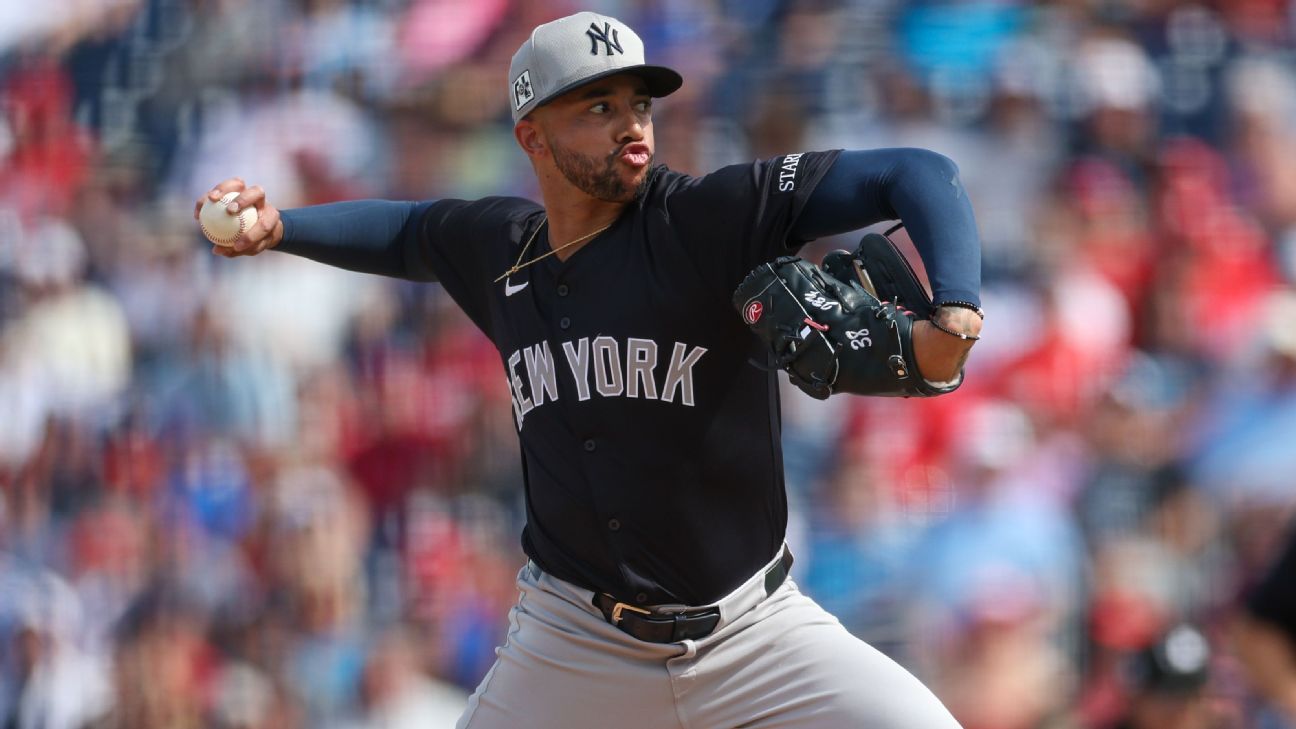
The New York Mets and reliever Devin Williams agreed to a three-year, $51 million deal, league sources told ESPN’s Jeff Passan on Monday night, giving the club a replacement for Edwin Diaz should the All-Star closer sign elsewhere.
The contract has no opt-outs or options but includes a $6 million signing bonus spread over the three seasons.
Williams will bolster the back end of a bullpen that the Mets are determined to substantially improve this winter. The question is whether he will be used as a setup man or a closer.
Williams’ role depends on whether the Mets re-sign Diaz, who opted out of his contract last month and is considered the top free agent reliever this offseason. The addition of Williams does not erase the possibility of a reunion with Diaz, and the Mets remain interested in bringing him back, sources told Passan.
Williams, 31, hit free agency after his lone season with the New York Yankees. Acquired last December from the Milwaukee Brewers for pitcher Nestor Cortes and National League Rookie of the Year finalist Caleb Durbin, Williams struggled to a career-worst 4.79 ERA over 67 appearances for New York. But underlying metrics — including a 2.68 FIP, a .195 expected batting average against, and elite strikeout, whiff and chase rates — suggest the bloated ERA is misleading.
He saved 18 games in 22 chances for the Yankees, but despite entering the season as the designated closer, he shared the role for most of the season after his rough start to 2025. Williams recorded four scoreless outings during the Yankees’ postseason run, but David Bednar earned both of New York’s playoff saves.
Before joining the Yankees, Williams was a premier back-of-the-bullpen pitcher during his six seasons with Milwaukee, first as a setup reliever for star closer Josh Hader and then as Hader’s replacement in the role.
After winning the NL Rookie of the Year in 2020 — when he posted a 0.33 ERA over 22 outings — Williams was named to two NL All-Star teams. During the three seasons before being dealt to the Yankees, Williams went 15-7 with 65 saves and a minuscule 1.66 ERA.
Williams has had an unorthodox style as a closer. Despite a fastball velocity below the big league average, he flourished thanks to one of the game’s best changeups, an offering so distinct that it acquired a nickname — “The Airbender.”
Now, Williams will be reunited with Mets president of baseball operations David Stearns, who was in that role for the Brewers for Williams’ first four seasons in Milwaukee.
Williams’ agreement with the Mets was first reported by The Athletic.
ESPN MLB Writer Bradford Doolittle contributed to this report.

The Orioles signed closer Ryan Helsley to a two-year contract Monday, continuing the remaking of their beleaguered pitching staff with one of the most sought-after relievers on the free agent market.
Sources told ESPN’s Jeff Passan that the deal is for $28 million and includes an opt-out after the first season.
While multiple teams sought to sign Helsley as a starter, the 31-year-old right-hander chose to remain in the role that made him a two-time All-Star and will hand him the ninth inning for the Orioles while retaining the ability to reach the open market after 2026.
Helsley, whose deal is pending a physical, is the second bullpen addition of the winter for Baltimore, which reacquired right-hander Andrew Kittredge from the Cubs after dealing him to Chicago at the trade deadline. With a moribund pitching staff, the Orioles went 75-87 and finished in last place in the American League East after consecutive postseason berths.
Orioles president of baseball operations Mike Elias trawled the free agent market for a late-inning option and landed on Helsley, who over his seven-year career has a 2.96 ERA in 319⅔ innings with 377 strikeouts, 133 walks and 105 saves.
Among the lowest points were the final two months of Helsley’s 2025 season, when, following a deadline deal from St. Louis to the New York Mets, he posted a 7.20 ERA and allowed 36 baserunners in 20 innings. Coming off an All-Star showing for St. Louis in 2024, which included a National League-leading 49 saves and a 2.04 ERA, Helsley saved 21 games with a solid 3.00 ERA for the Cardinals before the deadline, when he was sent to the Mets for three prospects.
Acquired to deepen a New York bullpen anchored by closer and fellow free agent Edwin Diaz, Helsley struggled badly during his time with the Mets. He blew saves in three straight appearances in mid-August and spent most of the past month working in low-leverage situations as New York collapsed down the stretch and missed the postseason.
Baltimore saw more noise than signal in Helsley’s downturn and is banking on Helsley’s stuff — which pitch-quality metrics rate as some of the best in the game — returning him to dominance. Helsley deploys one of baseball’s hardest fastballs, which averaged 99.3 mph in 2025, according to Statcast, ranking in the 99th percentile of all pitchers.
With incumbent closer Felix Bautista expected to miss the 2026 seasons following rotator cuff and labrum surgeries in August, the Orioles entered the winter with only right-hander Yennier Cano and left-hander Keegan Akin as veteran bullpen options. Beyond Helsley and Kittredge, Baltimore could add another reliever, sources said. The Orioles’ need for pitching help isn’t limited to their bullpen, either. Following the trade of Grayson Rodriguez to the Los Angeles Angels for left fielder Taylor Ward, Baltimore continues to pursue starting-pitching options to join left-hander Trevor Rogers and right-hander Kyle Bradish at the top of their rotation, sources said.
A fifth-round pick out of Northeastern State in Oklahoma, Helsley was a full-time starter throughout the minor leagues until he joined the Cardinals’ big league roster. From 2022 to ’24, he was arguably the most valuable reliever in the NL, alongside right-hander Devin Williams, a free agent with whom the Orioles spoke as well.
ESPN’s Bradford Doolittle contributed to this report.
-
 Sports2 years ago
Story injured on diving stop, exits Red Sox game
-
 Sports3 years ago
‘Storybook stuff’: Inside the night Bryce Harper sent the Phillies to the World Series
-
 Sports2 years ago
Game 1 of WS least-watched in recorded history
-
 Sports3 years ago
Button battles heat exhaustion in NASCAR debut
-
 Sports3 years ago
MLB Rank 2023: Ranking baseball’s top 100 players
-
Sports4 years ago
Team Europe easily wins 4th straight Laver Cup
-
 Environment3 years ago
Japan and South Korea have a lot at stake in a free and open South China Sea
-
 Environment1 year ago
Here are the best electric bikes you can buy at every price level in October 2024