
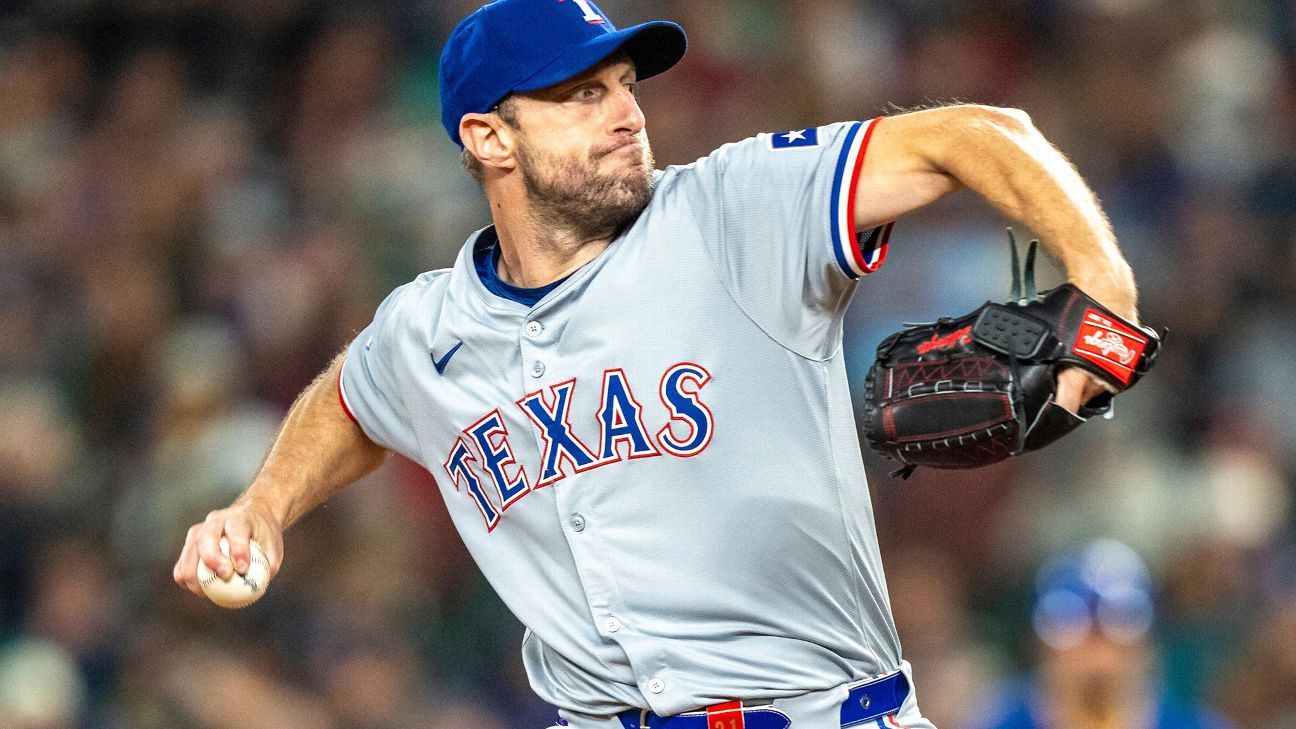
Scherzer has eyes on winning title with 3rd team


TORONTO — Max Scherzer joined the Toronto Blue Jays convinced he can win a World Series with a third team following titles with Washington and Texas.
“Winning cures everything,” the 40-year-old right-hander said Friday, three days after his $15.5 million, one-year contract was announced. “All you need to do to wake up in the morning is to have that drive to win, and the rest kind of takes care of itself.”
A three-time Cy Young Award winner, Scherzer was 2-4 with a 3.95 ERA last year for the Rangers. He started the season on the injured list while recovering from lower back surgery and was on the IL from Aug. 2 to Sept. 13 because of shoulder fatigue. He didn’t pitch after Sept. 14 because of a left hamstring strain.
Scherzer feels healthy.
“Normal ramp-up kind of in the lifting, normal ramp-up in the throwing, right where I need to be in terms of my bullpen progression,” he said during a Zoom news conference. “So I’m looking to come in here into spring training at full tilt.”
He joined a rotation projected to include José Berríos, Kevin Gausman, Chris Bassitt and Bowden Francis.
“The backbone of any team is always the starting rotation,” Scherzer said. “It doesn’t matter how much offense you got, if you don’t have a starting staff, you’re always going to be in trouble if you don’t have starters going out there and eating innings.”
Scherzer learned about the current Blue Jays when he spoke with Bassitt, a New York Mets teammate in 2022, and assistant hitting coach Hunter Mense, a University of Missouri teammate from 2004 to 2006.
“Just understanding how the team is, how the organization is, how they treat the families and how the guys on the team are, where the state of the organization is, how they want to improve,” Scherzer said. “I had a good chat with those guys how the Blue Jays handle everything and felt like this was going to be a fit.”
A Florida resident, Scherzer had geography in mind when considering teams.
“First and foremost is kind of staying here on the East Coast, especially with my family here in Florida. The kids are in school,” he said. “That makes it very easy to be able to get back and forth, be able to see them and have them be able to travel in, as well.”
Scherzer is 216-112 with a 3.16 ERA over 17 seasons with 3,407 strikeouts in 2,878 innings. His average fastball velocity dropped from 94.7 mph in 2020 to 92.5 mph last year.
“I still feel I can pitch at a very high level here. I frankly got all the pitches to be able to navigate a lineup,” he said. “It’s not about throwing 98. If you can throw 94, 95, you can get a lot of people out.”
He limits his use of analytics.
“There’s too much data, actually,” he said. “What we’re talking about with pitching now, I actually completely disagree with. And so, for me I understand what I do well, what I need to look at, what I actually need to be thinking about in terms of all my pitches, in terms of everything I’m doing … there’s some data that’s good, but a lot of data is bad.”
Though Scherzer spent parts of parts of nine seasons in the NL East, this will be his first time in the AL East.
“You got five teams that can all beat each other up. So, that’s the good news,” he said. “When you’re in a highly competitive division, that only makes you better. … It makes you battle-tested.”
The 25-year-old, a four-time All-Star, has a $28.5 million, one-year contract and can become a free agent after the World Series.
“You all know our desire to have him here for a long time, and we’ll continue to work towards that,” Blue Jays general manager Ross Atkins told reporters during the news conference.

-
Jorge Castillo
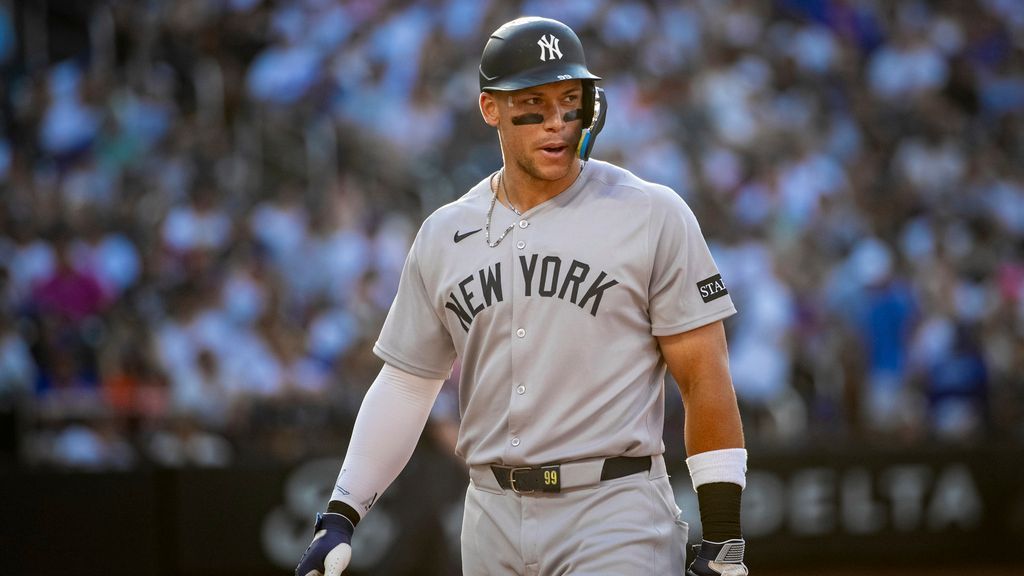
NEW YORK — A blunder that typifies the current state of the New York Yankees, who find themselves in the midst of their second six-game losing streak in three weeks, happened in front of 41,401 fans at Citi Field on Saturday, and almost nobody noticed.
The Yankees were jogging off the field after securing the third out of the fourth inning of their 12-6 loss to the Mets when shortstop Anthony Volpe, as is standard for teams across baseball at the end of innings, threw the ball to right fielder Aaron Judge as he crossed into the infield from right field.
Only Judge wasn’t looking, and the ball nailed him in the head, knocking his sunglasses off and leaving a small cut near his right eye. The wound required a bandage to stop the bleeding, but Judge stayed in the game.
“Confusion,” Yankees manager Aaron Boone said. “I didn’t know what happened initially. [It just] felt like something happened. Of course I was a little concerned.”
Avoiding an injury to the best player in baseball was on the Yankees’ very short list of positives in another sloppy, draining defeat to their crosstown rivals. With the loss, the Yankees, who held a three-game lead over the Toronto Blue Jays in the American League East standings entering June 30, find themselves tied with the Tampa Bay Rays for second place three games behind the Blue Jays heading into Sunday’s Subway Series finale.
The nosedive has been fueled by messy defense and a depleted pitching staff that has encountered a wall.
“It’s been a terrible week,” said Boone, who before the game announced starter Clarke Schmidt will likely undergo season-ending Tommy John surgery.
For the second straight day, the Mets capitalized on mistakes and cracked timely home runs. After slugging three homers in Friday’s series opener, the Mets hit three more Saturday — a grand slam in the first inning from Brandon Nimmo to take a 4-0 lead and two home runs from Pete Alonso to widen the gap.
Nimmo’s blast — his second grand slam in four days — came after Yankees left fielder Jasson Dominguez misplayed a ball hit by the Mets’ leadoff hitter in the first inning. On Friday, he misread Nimmo’s line drive and watched it sail over his head for a double. On Saturday, he was slow to react to Starling Marte’s flyball in the left-center field gap and braked without catching or stopping it, allowing Marte to advance to second for a double. Yankees starter Carlos Rodon then walked two batters to load the bases for Nimmo, who yanked a mistake, a 1-2 slider over the wall.
“That slider probably needs to be down,” said Rodon, who allowed seven runs (six earned) over five innings. “A lot of misses today and they punished them.”
Jazz Chisholm Jr.’s throwing woes at third base — a position the Yankees have asked him to play to accommodate DJ LeMahieu at second base — continued in the second inning when he fielded Tyrone Taylor’s groundball and sailed a toss over first baseman Cody Bellinger’s head. Taylor was given second base and scored moments later on Marte’s RBI single.
The Yankees were charged with their second error in the Mets’ four-run seventh inning when center fielder Trent Grisham charged Francisco Lindor’s single up the middle and had it bounce off the heel of his glove.
The mistake allowed a run to score from second base without a throw, extending the Mets lead back to three runs after the Yankees had chipped their deficit, and allowed a heads-up Lindor to advance to second base. Lindor later scored on Alonso’s second home run, a three-run blast off left-hander Jayvien Sandridge in the pitcher’s major league debut.
“Just got to play better,” Judge said. “That’s what it comes down to. It’s fundamentals. Making a routine play, routine. It’s just the little things. That’s what it kind of comes down to. But every good team goes through a couple bumps in the road.”
This six-game losing skid has looked very different from the Yankees’ first. That rough patch, consisting of losses to the Boston Red Sox and Los Angeles Angels, was propelled by offensive troubles. The Yankees scored six runs in the six games and gave up just 16. This time, run prevention is the issue; the Yankees have scored 34 runs and surrendered 54 in four games against the Blue Jays in Toronto and two in Queens.
“The offense is starting to swing the bat, put some runs on the board,” Boone said. “The pitching, which has kind of carried us a lot this season, has really, really struggled this week. We haven’t caught the ball as well as I think we should.
“So, look, when you live it and you’re going through it, it sucks, it hurts. But you got to be able to handle it. You got to be able to deal with it. You got to be able to weather it and come out of this and grow.”
-
Jorge Castillo
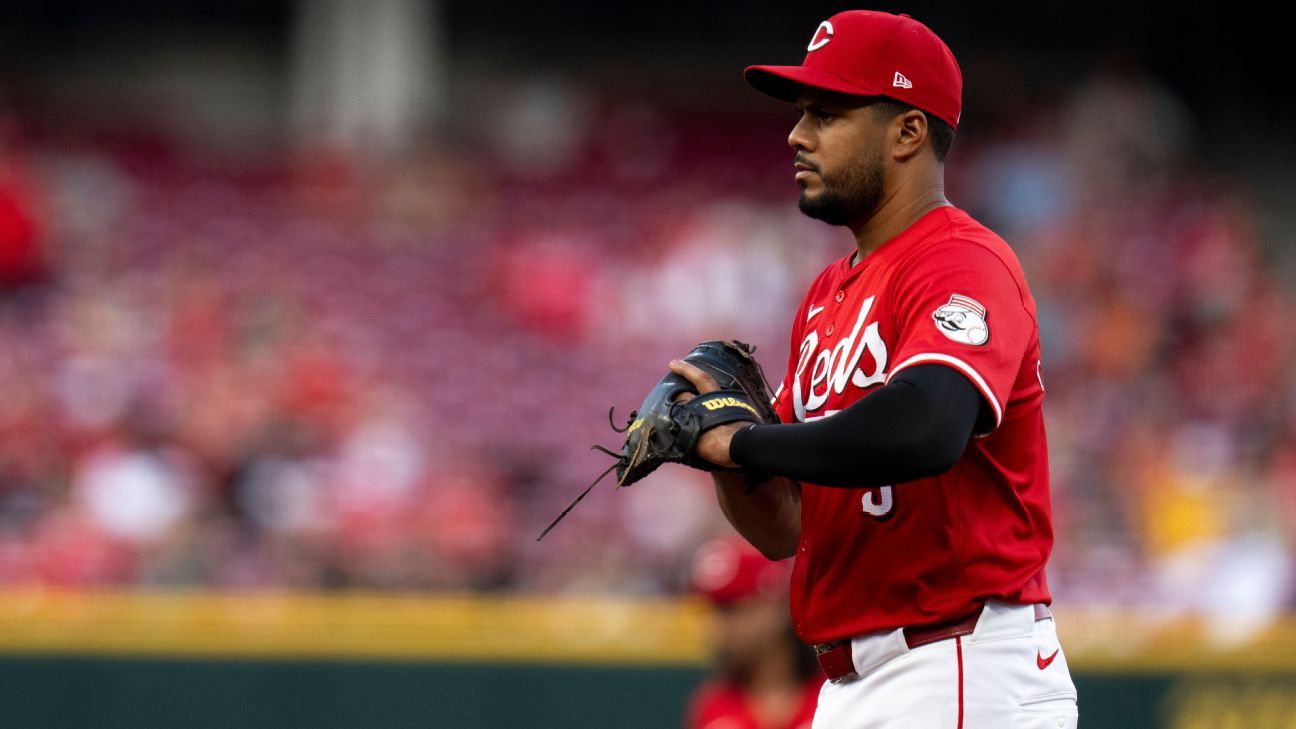
NEW YORK — The New York Yankees, digging for options to bolster their infield, have signed third baseman Jeimer Candelario to a minor league contract and assigned him to Triple-A Scranton/Wilkes-Barre, the affiliate announced Saturday.
Candelario, 31, was released by the Cincinnati Reds on June 23, halfway through a three-year, $45 million contract he signed before the start of last season. The decision was made after Candelario posted a .707 OPS in 2024 and batted .113 with a .410 OPS in 22 games for the Reds before going on the injured list in April with a back injury.
The performance was poor enough for Cincinnati to cut him in a move that Reds president of baseball operations Nick Krall described as a sunk cost.
For the Yankees, signing Candelario is a low-cost flier on a player who recorded an .807 OPS just two seasons ago as they seek to find a third baseman to move Jazz Chisholm Jr. to second base, his natural position.
Candelario is the second veteran infielder the Yankees have signed to a minor league contract in the past three days; they agreed to terms with Nicky Lopez on Thursday.
-
 Sports3 years ago
‘Storybook stuff’: Inside the night Bryce Harper sent the Phillies to the World Series
-
 Sports1 year ago
Story injured on diving stop, exits Red Sox game
-
 Sports2 years ago
Game 1 of WS least-watched in recorded history
-
 Sports2 years ago
MLB Rank 2023: Ranking baseball’s top 100 players
-
Sports4 years ago
Team Europe easily wins 4th straight Laver Cup
-
 Environment2 years ago
Japan and South Korea have a lot at stake in a free and open South China Sea
-
 Sports2 years ago
Button battles heat exhaustion in NASCAR debut
-
 Environment2 years ago
Game-changing Lectric XPedition launched as affordable electric cargo bike